This postcard campaign was initiated by our friend and colleague Dr. Judith Miller of the First United Church Water Care Allies. Please also send a card, email or phone message to your own MP!
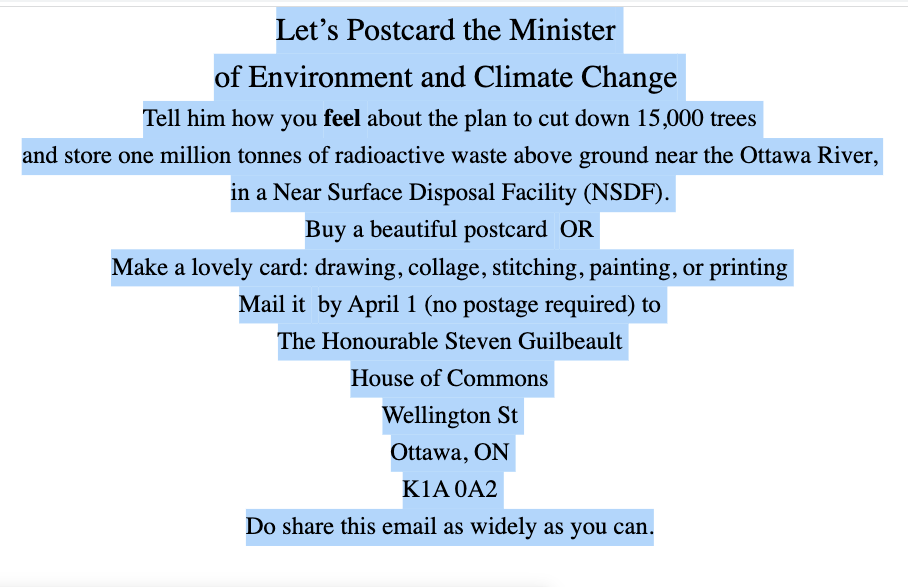
This postcard campaign was initiated by our friend and colleague Dr. Judith Miller of the First United Church Water Care Allies. Please also send a card, email or phone message to your own MP!
On May 31st the final licensing hearing for giant Chalk River radioactive waste mound will begin. The Commission will hear interentions (10 minute presentations) from First Nations, NGOs, municipal representatives, citizens’ groups and others.
This will be the final opportunity for the public to comment on this flawed proposal that will endanger the Ottawa River when this mound leaks and disintegrates, which the proponent’s own studies show is inevitable. There are many good reasons to stop this dump. For a simple summary of six of the most compelling see this post.
You do not need to have any scientific or technical expertise to intervene. Your intervention/submission/letter can be short or more substantial. Some of the most effective interventions in past hearings have involved singing and/or strong visual images. You can present a slide show that could include a short video. Passionate pleas for common sense are good too! Let’s press the CNSC to uphold its mandate to protect the environment and current and future generations of Canadians.
Contact us if you would like more guidance than is contained in this post.
Please send a copy of your intervention to your Member of Parliament.
April 11 is the deadline to request to intervene
Your request must include:
To Send: two options ~ send by email or use on-line form (link just below):
1. Send via email to CNSC:interventions@cnsc-ccsn.gc.ca
To identify your request, write in the subject line and as a heading:
May 31 Public Commission Hearing – Canadian Nuclear Laboratories Near Surface Disposal Facility
OR
2. Use on-line CNSC Request Form
Date: May 31 Licensee: Canadian Nuclear Laboratories (CNL)
Subject: Public Commission Hearing – Near Surface Disposal Facility
http://www.nuclearsafety.gc.ca/eng/the-commission/intervention/
What to expect: The Commission Registry will acknowledge receipt of your request to intervene and will later confirm if your intervention has been accepted by the Commission.
Your intervention will be given a Commission member document (CMD) reference number and will be added to the public record. Submissions will be publicly available on the CNSC website.
Reference material to possibly inspire your intervention:
Six Reasons to Stop the Ottawa River Radioactive Waste Dump
Critical Flaws, Errors and Omissions in CNSC staff’s case to approve the Chalk River Mound
Défauts, erreurs et omissions critiques dans le dossier d’approbation du monticule de Chalk River
Media Release: February 16, 2022 ~ MPs and groups oppose hearings to license Canada’s first permanent radioactive waste dump. The media release in English and in French.
The statement referred to in the media release was sent to Ms. Rumina Velshi, CNSC President, and to the federal ministers of Environment, Natural Resources, Indigenous Services and Crown Indigenous Relations.

This letter was sent to CNSC president Rumina Velshi on March 14, 2022. (Click on the blue hyperlink below the box, to read in your browser without downloading.)
This is an excerpt from the NSDF proponent’s draft Environmental Impact Statement (March 2017)


March 2022 , updated January 2025
A 2016 Access to Information request revealed the following information about the salaries of senior executives under the GoCo scheme for operating Canada’s Chalk River Laboratories (and other federal nuclear sites). Scroll down to the end of this post for the updated information from the 2024 ATIP request.
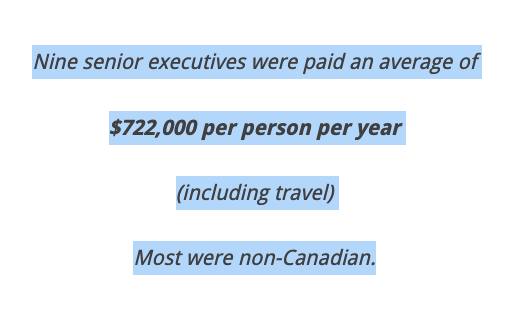
Nine senior executives were paid an average of $722,000 per person per year (including travel)
Most were non-Canadian.
Twenty-eight senior contractors were paid an average of $377,275 per year per person.
27 of the 28 senior contractors were non-Canadian.
The documents obtained trough the ATIP program are as follows:
File 1: Executive and senior contractor files (9 executive salaries + travel) = $722, 000 / yr per person. Senior contractor costs (28 persons) at $377, 275 / yr per person. (For comparison purposes, consider that the salary of the Prime Minister of Canada is $347,400 per year)
File 2. Confirmation that 27 out of 28 senior contractors were non-Canadian. It is not known if any Canadian tax is paid by the non Canadians.
Files 3. CNEA fees ~ CNEA fees are all redacted despite being taxpayer funded and Science Advisory Board, SAB, costs. Typically the CNEA fees would likely be 15-20% of overall contract value per year but there is no way to confirm what these CNEA fees are. Also on p4 of 7 is the Science Advisory Board cost for one year. ($183,254) where 4 out of 5 members were non-Canadian (advising Canadians on science policy).
~~~~~~~~~~~~~~
The following updated information was obtained in an ATIP request in 2024:
“In 2023, via contract money funneled through AECL, Canadian taxpayers paid average salaries of $510,301 to each of 44 CNL executives and non-executive contract staff, mostly non-Canadians — well above the Prime Minister’s $406,200 salary. ” Ole Hendrickson, Rabble.ca
GoCo contract costs – Total labour and total non-labour costs
| Number | Total cost ($)4,5,6 | Average cost ($) | ||||
| 2023 | 2016 | 2023 | 2016 | 2023 | 2016 | |
| CNL executives1 | 14 | 9 | 7,969,646 | 6,498,000 | 569,260 | 722,000 |
| CNL non-executive contract staff2 | 30 | 28 | 14,483,594 | 10,563,700 | 482,786 | 377,275 |
| CNL total or average | 44 | 37 | 22,453,240 | 17,061,700 | 510,301 | 461,127 |
| AECL executives3 | 11 | 5,710,125 | 519,102 | |||
| CNL + AECL total or average | 55 | 28,163,365 | 512,061 | |||
1Total Canadian National Energy Alliance executive management labour and non-labour costs included in expenses (not necessarily paid) of all CNL managers working on management type functions relating to the GoCo. Labour costs include salaries, bonuses, performance-related fees and other compensation. Non-labour costs include all other costs (e.g., relocation costs).
2Total labour and total non-labour costs included in expenses (not necessarily paid) of GoCo contract staff working on management type functions related to the GoCo: (30 staff including 20 non-Canadians in 2023; 28 staff including 27 non-Canadians in 2016). Labour costs include salaries, bonuses, performance-related fees and other compensation paid by CNL for contractors. Non-labour costs include all other costs paid by CNL for contractors (e.g., relocation costs).
3Total labour and total non-labour costs included in expenses for AECL’s 11 executive staff for the most recent fiscal year, 2023-24.
4Total travel costs (non-labour) for CNL executives in 2016 were $200,732.
5Total labour costs for non-executive contract staff in 2016 were $6,207,952; total non-labour costs for non-executive contract staff in 2016 were $4,355,748.
6Total cost of CNL executives increased by 22.6% between 2016 and 2023; total cost of CNL non-executive contract staff increased by 37.1% between 2016 and 2023.
le 22 février, 2022
Des groupes de citoyens de l’Ontario et du Québec ont présenté à la CCSN, l’organisme de réglementation nucléaire du Canada, une critique virulente du dossier d’autorisation d’un gigantesque monticule de déchets radioactifs le long de la rivière des Outaouais. Cette critique a été transmise à la présidente de la CCSN, Rumina Velshi, avant l’audience publique sur la demande de permis qui débute mardi le 22 février.
Si elle est approuvée, la décharge géante s’élèvera à 18 mètres de haut et contiendra un million de tonnes de déchets radioactifs et dangereux mélangés. Une partie du contenu resterait dangereusement radioactif pendant des milliers d’années; cependant, la décharge devrait se détériorer en quelques centaines d’années selon les études produites par le promoteur, les Laboratoires nucléaires canadiens, propriété d’un consortium de multinationales. Les normes de sécurité internationales interdisent l’élimination des déchets radioactifs à longue durée de vie dans les décharges.
La critique citoyenne des principaux documents d’autorisation a relevé onze failles critiques, allant du manque d’informations détaillées sur le contenu de la décharge de déchets radioactifs, comme l’exige le Règlement sur la sûreté et la réglementation nucléaires, jusqu’à de graves lacunes dans le processus de sélection du site de l’installation.
“On ne pourrait pas trouver de pire site pour ce dépotoir”, a déclaré Johanna Echlin, de l’Association des propriétaires de chalets de Old Fort William (Québec), l’un des groupes qui ont cosigné la critique des citoyens. “Le site, sur le flanc d’une colline, est entouré sur trois côtés par des zones humides qui se déversent dans la rivière des Outaouais, à un kilomètre de là. La nappe phréatique se trouve à quelques centimètres sous la surface à cet endroit et le substratum rocheux est très fracturé.”
L’emplacement de l’installation proposée préoccupe également les collectivités en aval qui tirent leur eau potable de la rivière des Outaouais, notamment Ottawa, Gatineau et Montréal. Ces trois villes font partie des 140 municipalités qui ont adopté des résolutions pour exprimer leur inquiétude au sujet de la décharge proposée. L’Assemblée des Premières Nations a également adopté une résolution s’opposant à ce dépotoir.
Ole Hendrickson, scientifique et chercheur pour le groupe Concerned Citizens of Renfrew County and Area, a déclaré que les documents d’autorisation contenaient un certain nombre d’erreurs graves, notamment une surestimation d’un facteur 1000 de la radioactivité des gisements d’uranium voisins. “Cette surestimation grossière est utilisée par le promoteur et l’organisme de réglementation pour faire valoir que le monticule géant serait moins radioactif que les roches environnantes après quelques centaines d’années”, a déclaré Hendrickson. “En fait, les conteneurs de déchets à haute radioactivité dans la décharge dépasseraient les niveaux dans les roches environnantes pendant des milliers d’années.”
Le Ralliement contre la pollution radioactive, basé au Québec, a contribué à un certain nombre de conclusions dans la critique. Le groupe est très préoccupé par la présence du cobalt-60 qui fournira à lui seul 98% de la radioactivité initiale du dépotoir, même si sa radioactivité diminuera rapidement par la suite. Les sources de cobalt-60 usagées nécessitent un blindage en plomb parce qu’elles émettent des rayonnements gamma intenses mettant en danger les travailleurs. La physicienne Ginette Charbonneau, porte-parole du Ralliement, affirme que seules les sources de cobalt-60 de faible activité pourraient être acceptées dans un monticule en surface et que les critères d’acceptation de ces déchets dans le dépotoir doivent être resserrés. “Il est aussi hors de question que des substances radioactives à longue durée de vie comme le plutonium soient éliminés dans une décharge”, a déclaré Mme Charbonneau. “Il s’agit tout simplement d’une proposition insensée, qui n’est absolument pas conforme aux normes internationales”, a-t-elle ajouté.
Les groupes de citoyens affirment que les arguments en faveur de l’approbation de la décharge radioactive géante, appelée installation de gestion des déchets près de la surface (IGDPS) par le promoteur, présentent de si graves lacunes que les commissaires de la CCSN ne pourraient pas prendre une décision d’autorisation judicieuse sur la base du contenu des documents. Ils ont demandé que cette critique des citoyens soit distribuée aux commissaires lors de l’audience du 22 février et que tous les défauts, erreurs et omissions soient entièrement traités avant que la Commission ne soit invitée à prendre une décision sur le permis de la décharge.
Les audiences relatives à l’autorisation de la décharge géante de déchets radioactifs se dérouleront en deux parties. La première aura lieu le 22 février. La deuxième commencera le 31 mai, mais elle devrait durer plusieurs jours car elle inclura des présentations de communautés autochtones, de représentants municipaux, d’ONG et de membres du public. Les demandes d’intervention dans les audiences doivent être soumises par écrit à la CCSN d’ici le 11 avril 2022. Voir l’avis d’audience publique pour plus de détails.
– 30 –

Graphique ci-dessus tiré de Radio Canada Découverte, mars 2018, montrant le débordement du monticule dans le cadre du processus de dégradation et d’érosion, décrit par le promoteur dans son rapport d’évaluation des performances.
OTTAWA, February 22, 2022 – Citizens’ groups from Ontario and Quebec provided Canadian Nuclear Safety Commission (CNSC) President Rumina Velshi with a searing critique of CNSC’s case to approve a giant radioactive waste mound alongside the Ottawa River in advance of a February 22nd hearing.
If approved, the giant landfill would stand 60 feet high and hold one million tonnes of mixed radioactive and hazardous wastes. Some of the contents would remain dangerously radioactive for thousands of years, but the mound itself is only expected to last a few hundred years according to studies produced by the proponent, Canadian Nuclear Laboratories, owned by a consortium of multinational corporations. International safety standards prohibit disposing of long-lived radioactive wastes in landfills.
The citizens’ critique of key licensing documents found eleven critical flaws ranging from a failure to provide detailed information about what would go into the dump, as required under the Nuclear Safety and Control Regulations, to a failure to note serious deficiencies in the siting process for the facility.
“You couldn’t find a worse site for this dump if you tried,” said Johanna Echlin of the Old Fort William (Quebec) Cottagers’ Association, one of the groups that co-authored the citizens’ critique. “The site is on the side of a hill, and is surrounded on three sides by wetlands that drain into the Ottawa River, a kilometre away. The water table is just inches under the surface at that location and the bedrock is highly fractured.”
The site of the proposed facility is also of concern to downstream communities who take their drinking water from the Ottawa River, including Ottawa, Gatineau and Montreal. The three cities are among the more than 140 municipalities that have passed resolutions of concern about the proposed dump. The Assembly of First Nations has also passed a resolution opposing the facility.
Ole Hendrickson, a scientist and researcher for the group Concerned Citizens of Renfrew County and Area said there are a number of serious errors in the licensing documents including a 1000-fold overestimate of radioactivity in nearby uranium ore bodies. “That gross overestimate is used by the proponent and the regulator to make the case that the giant mound would be less radioactive than surrounding rocks after a few hundred years,” Hendrickson said. “In fact, high-radioactivity waste containers in the dump would exceed levels in surrounding rocks for thousands of years.”
The Quebec-based Ralliement contre la pollution radioactive contributed a number of findings to the critique. The group is very concerned about the presence of cobalt-60, which alone will provide 98% of the initial radioactivity in the dump, even though its radioactivity will decline rapidly thereafter. Used cobalt-60 sources require lead shielding because they emit intense gamma radiation that endangers workers.
Physicist Ginette Charbonneau, a spokeswoman for the Ralliement, says that only low-level cobalt-60 sources could be accepted in an above-ground mound and that the criteria for accepting such waste in the dump must be tightened.
“It is also out of the question that long-lived radioactive substances like plutonium be disposed of in a landfill,” Charbonneau said. “This is simply a senseless proposal, which is not in line with international standards at all,” she added.
The citizens’ groups say the case to approve the giant radioactive landfill, called the NSDF by the proponent, is so seriously flawed that CNSC Commissioners cannot make a sound licensing decision based on the contents of the documents. They have asked that the citizens’ critique be distributed to Commissioners at the hearing on Feb 22 and that all of the flaws, errors and omissions be fully addressed before the Commission is asked to make a decision on the license for the dump.
The licensing hearings for the giant radioactive waste dump will take place in two parts. Part 1 will take place February 22. Part 2 will start on May 31, but is expected to take several days as it will include presentations from Indigenous communities, municipal representatives, NGOs and members of the public. Requests to intervene in the hearings must be submitted in writing to the CNSC by April 11, 2022. See Notice of Public Hearing for details.
– 30 –


