Author: hendricksonjones
Open Letter ~ Cleanup of Chalk River radioactive wastes
April 29, 2022
Dear Mayors, Reeves and Councillors of Renfrew County and the City of Pembroke,
Elected officials in the Ottawa Valley have been lobbied to support the “NSDF,” the giant Chalk River nuclear waste landfill for one million tonnes of radioactive and hazardous waste. The final licensing hearing for the facility begins on May 30, 2022.
Chalk River Laboratories has been the second largest employer in Renfrew County for many years. It is understandable that elected officials wish to support Chalk River Laboratories and keep the funding and jobs going. However, supporting the NSDF could be a serious mistake for Renfrew County. Consider the following:
- The radioactive waste at Chalk River, described in a 2011 Ottawa Citizen article “Chalk River’s Toxic Legacy,” needs to be cleaned up. It represents the lion’s share of a federal nuclear waste liability that is by far the largest environmental liability on the books of the Government of Canada. If done properly, to international standards and according to plans developed by AECL in 2014, the cleanup would cost roughly $16 billion and take several decades.
- In an effort to speed things up and cut costs, a multinational consortium was contracted in 2015 under a public-private partnership and given ownership of Canadian Nuclear Laboratories (CNL). The consortium, “Canadian National Energy Alliance,” is comprised of SNC Lavalin and two Texas-based multinationals, Fluor and Jacobs. Their contract says they will quickly and cheaply reduce the federal nuclear liabilities.
- CNL has proposed the NSDF as the way to clean up the Chalk River Laboratories site and reduce the federal nuclear liabilities. The estimated cost for the NSDF is $750 million. CNL is proposing to put materials in the NSDF that should never be put in a landfill such as plutonium.
- CNL is importing commercial and federal nuclear wastes to Chalk River for disposal in the NSDF. These shipments are happening despite a specific request from the City of Ottawa for cessation of radioactive waste imports into the Ottawa Valley.
- Critics of the NSDF proposal, including retired senior scientists and managers from AECL, say the facility is poorly sited and fails to meet international safety standards. CNL’s own studies show that the NSDF would leak and disintegrate long before radioactive components like plutonium decayed to a harmless state. The Assembly of First Nations and more than 140 municipalities, including Pontiac County, Ottawa, Gatineau and Montreal have passed resolutions of concern about the proposed project.
- If the NSDF is approved, we will get one substandard leaking facility for $750 million, instead of $16 billion spent over many decades. If approved, the leaking radioactive mound will pollute the Ottawa River, adversely affect property values, and pose health risks to current and future generations in the Ottawa Valley.
This does not seem to be fair treatment for Ottawa Valley residents who have lived with radioactive pollution from Chalk River Laboratories for close to eight decades. Surely we deserve world class facilities that we can be proud of and that will keep radioactive wastes out of our air and drinking water. In-ground concrete vaults and rock caverns on sites further from the Ottawa River would provide better waste containment and better protection for the river.
It should concern our elected representatives that costs to Canadian taxpayers have quadrupled since the public private partnership began in 2015. The consortium is being paid more than $1 billion annually up from the $327 million AECL received in 2015. A 2016 access to information request revealed that nine senior CNL executives were paid an average of $722,000 per person per year and twenty-eight senior contractors were paid an average of $377,275 per year per person. Almost all of these senior executives and senior contractors were non-Canadian.There has been no decrease in the federal nuclear waste liabilities since the consortium took over control of Chalk River Laboratories.
Donations from CNL to charitable causes in the Ottawa valley have been reported in the media recently. No doubt these are valuable donations to the recipients but they are tiny drops in the bucket of the more than $1 billion the consortium is receiving annually from Canadian taxpayers, much of it going to foreign shareholders, foreign senior executives and foreign contractors. We question whether it is appropriate for our tax dollars to be used by foreign corporations to garner support for the NSDF.
Saying “no” to the NSDF would not mean an end to nuclear industry jobs in the Ottawa Valley. The wastes are not going anywhere and need to be cleaned up. The nuclear waste liability is a multibillion dollar industry. Why not further develop our Canadian expertise and become world leaders in nuclear decommissioning and radioactive waste management? A commitment to world class cleanup would bring more funding over a longer period, more jobs, protection of health and the Ottawa River, greater peace of mind and the respect of our international partners.
Yours sincerely,
Lynn Jones, Concerned Citizens of Renfrew County and Area
Johanna Echlin, Old Fort William Cottagers’ Association

Concerns about commercial wastes destined for disposal in the Chalk River Mound
Posted 29 April 2022, revised 9 May 2022, December 2025
If the license to build it is approved, large quantities of industrial waste including Cobalt-60, Tritium, Niobium-94 and Carbon-14 from commercial sources will be disposed of in the Chalk River Mound.
Significant quantities of cobalt-60 and tritium are imported as radioactive wastes from other countries. These two substances would give off nearly all the initial radioactivity in the NSDF. The “Licensed Inventory” for the NSDF (Table 13 in the Waste Acceptance Criteria) includes 90.6 Terabecquerels of cobalt-60 and 0.891 Terabecqurels of tritium.
Chalk River Laboratories, a publicly owned research facility, is Canada’s only commercial radioactive waste STORAGE facility.
There are many companies shipping wastes to Chalk River. A partial list for the period 2014 to 2018 obtained through an Access to Information request to Atomic Energy of Canada Limited (AECL) (view the ATIP response package below) includes ABB Inc., ALARA Consultants, Bunge Canada, BWXT Nuclear Energy Canada, DFF Recyclex, Energy Solutions Canada, Kinetrics, MDS Nordion, Noremtech Inc., Nuclear Services Canada, Overwatch, Permafix NW, Shield Source, Spencer Manufacturing, SRB Technologies, Stuart Hunt, Uni-Vert, and Voith.
Large quantities of cobalt-60 and cesium-137 ‘disused sources’ are in storage at Chalk River, mainly imported by Ottawa-based companies Nordion and Best Theratronics. The transcript of the 2019 licensing hearing for Best Theratronics says “In 2014, we had a resident inventory of disused sources at Nordion. All of that has now been disposed of at CNL… So I can report that all those legacy sources, which is over 500 sources, cobalt and cesium, have been successfully removed from our license.”
Amounts of cesium-137 in storage are likely to be roughly 100,000 times the “licensed inventory” limit for the NSDF. CNL may have initially planned to put its stored cesium-137 waste in the NSDF as well, but backed off because it is designated as intermediate level waste (ILW) by the International Atomic Energy Agency (higher activity cobalt-60 waste is also considered to be ILW).
SRB Technologies (based in Pembroke) imports large quantities of waste ‘light sources’ filled with tritium (the radioactive form of hydrogen) from the U.S. It regularly receives truckloads of expired tritium exit signs, dismantles them, and puts the tritium-filled ‘glow in the dark’ glass tubes in packages, and ships them to Chalk River for storage. Nuclear regulations in the U.S. do not allow expired tritium exit signs to be dumped in municipal landfills. Canada has a special exemption in its nuclear regulations to allow this, but as far as we can tell, SRB only sends small quantities of its tritium wastes to the Ottawa Valley Waste Recovery Center. All of SRB’s radioactive waste imports are sent to Chalk River.
When commercial wastes are sent to Chalk River the ownership changes. We, the Canadian citizens and taxpayers, become the proud owner of radioactive waste shipped from around Canada and around the world. Technically speaking, the federal crown corporation AECL becomes the owner of this waste, and is responsible for its long-term management.
This has been going on for many years. Canadian Nuclear Laboratories, which has been contracted by AECL to deal as quickly and cheaply as possible with AECL’s 70+ years of accumulated waste, appears to be planning to put into the NSDF as much as possible of the (former) commercial waste now in storage at Chalk River .
~~~~~
Information from Canada’s most recent report to the Joint Convention confirms that wastes are being imported from other countries
Table D.5 in Canada’s Seventh National Report to the Joint Convention lists facilities in Canada that manage non-spent fuel radioactive waste, including intermediate level waste (ILW) and low level waste (LLW). These include Best Theratronics Manufacturing Facility, Kanata, Ontario that engages in “Storage of disused sealed sources and depleted uranium shielding (LLW and ILW)” and Nordion Manufacturing Facility in Kanata that also engages in “Storage of disused sealed sources (ILW).”
Table D.8 in the Report has an inventory of low and intermediate level radioactive waste in storage in Canada as of December 31, 2019. It shows that Best Theratronics had 71 Terabecquerels of “Disused cobalt-60 sealed sources, disused cesium-137 sealed sources, depleted uranium shielding components;” and Nordion had 4,126 Terabecquerels of “Disused cobalt-60 sealed sources; disused cesium-137 sealed sources.” A Terabecquerel is the radioactivity of the quantity of a radioactive substance that undergoes one trillion radioactive disintegrations every second.
Section J of the Report says that “the CNSC has received more than 2,820 applications to export Category 1 and 2 radioactive sealed sources to 100 countries and has controlled the export of more than 20.4 million TBq [Terabecquerels],” adding that “Canada remains a global leader in the production and export of Category 1 cobalt-60 radioactive sealed sources, supplying approximately 95 percent of the global demand.”
Section J of the Report, Disused sealed sources, quotes the Joint Convention as saying that “A Contracting Party shall allow for re-entry into its territory of disused sealed sources if, in the framework of its national law, it has accepted that they be returned to a manufacturer qualified to receive and possess the disused sealed sources.” Section J adds that “For long-term management, radioactive sealed sources may be returned to the manufacturer in Canada,” and that disused sources may be sent to a licensed waste management facility “such as the facility operated by CNL in Chalk River, Ontario.”
~~~~~~~~
Here are specific points about Cobalt-60 excerpted from the Concerned Citizens’ intervention for the May 30 licensing hearings:
B. Cobalt-60 commercial wastes
… It nonetheless appears that CNL may plan to put large numbers of disused, highly radioactive cobalt-60 sources in the mound. Disposal of disused sources is described in sections 5.7 and A.5.7 of the NSDF Waste Acceptance Criteria, the key document providing limits on quantities and radioactivity concentrations of radioactive substances destined for the mound.IAEA guidance does not allow near-surface disposal of high-activity cobalt-60 disused sources. The IAEA says that higher-activity disused Cobalt-60 sources represent intermediate-level waste. Higher-activity disused sources cannot be placed in near surface disposal until they decay below a certain concentration of radioactivity.
Lead shielding must be used to protect workers handling such waste. Roughly 200 tonnes of lead would be disposed of in the mound, leading to contamination of groundwater.
~~~~
The following presentation was given to the City of Ottawa Environment Committee on March 30, 2021
https://docs.google.com/presentation/d/1PBgA1D48fBgKw3N7yGoUta_3J1Jt5FETz83vhtMc4k0/edit?usp=sharing

SRB Technologies, a factory in Pembroke, manufactures and exports tritium exit signs. The tritium in one sign, if oxidized and taken into the body, would be lethal. SRB takes back used, but still highly radioactive, tritium exit signs from around the world and ships them to Chalk River for disposal.
Kanata-based Nordion and Best Theratronics manufacture 95% of the world’s radioactive devices for food sterilization, cancer treatment and other uses. These devices are still highly radioactive when no longer useful. The companies take back the devices(photo in the top right) from around the world and ship them to Chalk River for disposal.
A call for World-class Cleanup at Chalk River Laboratories
April 2022
Canada’s $16 billion nuclear waste legacy is in danger of being abandoned in substandard facilities and allowed to leak into our rivers and drinking water. Instead, let’s use our expertise to turn Canada into a world leader in the cleanup and safe storage of radioactive waste.
WORLD-CLASS NUCLEAR WASTE CLEANUP would protect health, drinking water, property values and peace of mind.
What do experts say is needed?
The International Atomic Energy Agency says that radioactive waste facilities must be carefully sited and waste placed below ground to keep radioactive materials out of air and water and protect current and future generations. The IAEA says that siting is a fundamentally important activity in the disposal of radioactive waste. Location of a disposal facility in a “stable geological formation” provides protection from processes such as erosion and glaciation. It says that nuclear reactor entombment should only be used in the case of a “severe accident”, such as a meltdown.
Retired AECL scientists say that IAEA guidance must be followed, that Canada has an obligation to follow the guidelines as a signatory to the Joint Convention on the Safety of Radioactive Waste Management.
First Nations, in a Joint Declaration, endorsed by resolution at the Assembly of First Nations, say that nuclear waste should be managed according to five principles: 1) no abandonment, 2) monitored and retrievable storage 3) better containment, more packaging, 2) away from drinking water and major water bodies and 5) no unnecessary transport (exports and imports)
The Canadian Coalition for Nuclear Responsibility says radioactive waste should be carefully managed in monitored and retrievable condition so that repairs to packaging can be made as needed, to keep the contents out of the biosphere, our air, soil and drinking water. The CCNR suggests that a “rolling stewardship” strategy whereby each generation teaches each subsequent generation how to look after the wastes and keep them out of the biosphere.
Some countries such as Finland have made good progress building facilities to keep radioactive waste out of the biosphere. Finland puts low- and intermediate-level radioactive wastes produced by its four nuclear reactors in bedrock geological facilities 100 meters deep. It has over 25 years of experience with these facilities. They will also house the radioactive remains of the reactors when they are shut down and dismantled.
WORLD-CLASS NUCLEAR WASTE CLEANUP would bring money into the Ottawa Valley economy and support good careers for generations of valley residents.
WORLD-CLASS NUCLEAR WASTE CLEANUP would involve:


WORLD-CLASS NUCLEAR WASTE STORAGE FACILITIES would protect the Ottawa River and future generations.

Inadequate siting process for the NSDF
April 14, 2022 (Updated May 13, 2022, and November 1, 2023)
The site for the proposed Chalk River NSDF is on the side of a steep forested hill, the base of which is surrounded by wetlands that drain into the Ottawa River less than one kilometer away. This proposed location is of deep concern for many critics of the proposal, including Algonquin First Nations, 150+ Quebec and Ontario municipalities, and many citizens’ groups and NGOs.
The choice of such an unsuitable site for the NSDF can be traced back to an inadequate siting process that failed to meet international safety standards and recommendations produced by the International Atomic Energy Agency, of which Canada is a member state.
IAEA Safety Guide SSG-29, Appendix 1, Siting of Near Surface Disposal Facilities, says siting is a “fundamentally important activity in the disposal of radioactive waste.” (Ref: https://www-pub.iaea.org/MTCD/publications/PDF/Pub1637_web.pdf, p. 83)
SSG-29 says the first two stages in the siting process are a “conceptual and planning stage,” during which “projected waste volumes and activities should be quantified,” and an “area survey stage,” involving “regional mapping or investigation.”
The NSDF facility type and site were selected without quantifying volumes and activities of federal wastes awaiting disposal, and without a regional investigation, thus skipping the first two stages identified in the IAEA Safety Guide.
Proximity to contaminated structures being demolished at the Chalk River Laboratories — not safety or environmental protection — appears to have been the priority is choosing the site of the NSDF. No serious consideration was given to sites other than those on AECL’s 3700-ha Chalk River property,
Proximity to contaminated structures being demolished at the Chalk River Laboratories — not safety or environmental protection — appears to have been the priority is choosing the site of the NSDF.
Alternative sites should be sought to avoid rapid discharge of radioactive and hazardous substances to a major water body and to avoid placing wastes in an area with a high water table (Ref: CMD 22-H7, Section 3.2, Design Options Evaluation).
Flat, sandy portions of the 30,770-ha Department of National Defence Garrison Petawawa property, adjacent to the Chalk River Laboratories, would accommodate a larger, less expensive, and safer in-ground concrete vault facility. Vegetation was removed from extensive portions of this property to create a parachute training zone for the Canadian Airborne Regiment, which was disbanded in 1995.
A regional investigation of crown land for geological formations suitable for a shallow rock cavern facility should also be conducted.
IAEA Safety Requirement SSR-5, Disposal of Radioactive Waste, indicates that an in-ground concrete vault or a shallow rock cavern could contain a wider range of waste types than an above ground, landfill-type facility such as the NSDF. (Ref: https://www-pub.iaea.org/MTCD/Publications/PDF/Pub1449_web.pdf)
The southern portion of the site chosen for the NSDF is underlain by a feature categorized in 1994 as a ““high-probability” fracture zone,” ten meters wide and over a kilometer long – a potential groundwater flow pathway with “permeability values several orders of magnitude greater than bulk rock mass.” (Ref: https://www.iaac-aeic.gc.ca/050/evaluations/document/139596, p.5-109).This feature should have eliminated the proposed site from further consideration.
Original site selection criteria announced by the proponent would have excluded any site with more than a 10% slope. This criterion was changed to 25% to allow CNL’s desired site (Ref: Near Surface Disposal Facility Site Selection Report 232-10300-TN-001 Revision 2. Oct. 2016). In fact, the proposed NSDF site was rejected as a site for VERY LOW LEVEL RADIOACTIVE WASTE due to its slope and exposed bedrock, back in the days before privatization of the the Chalk River Laboratories.
Site selection criteria were also supposed to exclude known or proposed critical habitats for species listed under the Federal Species at Risk Act (SARA) or by the Committee on the Status of Endangered Wildlife in Canada (COSEWIC).” However, construction of the NSDF would destroy 30 hectares of mature and semi-mature forest (including endangered Black Ash trees) that provides high-quality maternity roosting habitat for three endangered bat species (Little Brown Myotis, Northern Myotis and Tri-colored Bat) and nesting habitat for five at-risk bird species (Canada Warbler, Golden-winged Warbler, Wood Thrush, Eastern Wood Pewee, Whip-poor-will). It would also have adverse impacts on the at-risk Eastern (Algonquin) Wolf, a keystone species because of its predation on moose and deer, and on at-risk aquatic species such as the Blanding’s Turtle.
The proposed NSDF site is on a hillside, over fractured rock, with a high water table, surrounded on three sides by wetlands that drain into Perch Lake 50 metres from the base of the hill. Perch Creek flows from Perch Lake into the Ottawa River, one kilometre away. The entire Chalk River Laboratories property — with its proximity to the Ottawa River, high groundwater table, uneven terrain, and fractured bedrock — is a very poor location for permanent radioactive waste disposal.

IAEA guidance suggests Chalk River wastes are not suitable for disposal in an aboveground mound or in-ground trenches
April 2022
The radioactive wastes at Chalk River Laboratories (CRL), Canada’s main nuclear research facility, are well described in Annex III, Origin and Types of Radioactive Waste, in the International Atomic Energy Agency (IAEA) General Safety Guide GSG-1, Classification of Radioactive Waste:
Annex III, Origin and Types of Radioactive Waste, IAEA General Safety Guide GSG-1, Classification of Radioactive Waste:Waste from research reactors III–16.
The waste generated by research reactors and from some disused radioactive sources is particularly significant because, owing to its level of activity concentration and to the half-lives of the radionuclides, it does not meet the waste acceptance criteria of near surface disposal facilities.Waste from research facilities III–17.
Research facilities (e.g. hot cell chains, glovebox chains) or pilot plants for checking fuel fabrication processes (particularly the fabrication of mixed uranium plutonium oxides, known as MOX), for fuel reprocessing (particularly advanced schemes), and for post-irradiation examinations, as well as their
analytical laboratories, generate types of waste that, often, are different from the typical waste generated by industrial plants. Owing to the presence of non-negligible amounts of long lived alpha emitters, waste from research facilities generally belongs to the ILW class and even, in some circumstances, to the HLW class.
The radioactive waste at CRL would not be appropriate for near surface disposal, even true “near surface disposal” which is defined by the IAEA as trenches and vaults below the ground surface. Much of the waste is likely to belong to the ILW class, requiring disposal tens of meters or more below the ground surface, as noted by Dr. JR Walker, former director of safety engineering and licensing at AECL. See also: National Observer: Waste headed for Ontario site is a radioactive ‘mishmash’: nuclear industry veterans
The NSDF proponent is misusing the name “Near Surface Disposal Facility” for an aboveground landfill. It defies belief that CNSC staff would support the construction of an aboveground facility for wastes from a Government of Canada research facility, nearly all of which (by volume) will remain hazardous and radioactive for more than 100,000 years.
See also: What would go into the Chalk River Mound (NSDF)?
Properly characterizing the radioactive wastes at Chalk River Laboratories would be the work of decades
Pushing ahead with a disposal facility, before properly characterizing the wastes is an act of very poor judgement according to an expert in waste inventory control and radioactive waste characterization.
The following submission to the CNSC for the NSDF licensing hearing was prepared by Greg Csullog, an expert on radioactive waste characterization who worked for 21 years at Atomic Energy of Canada Limited and seven years at the the International Atomic Energy Agency. He has given us permission to share his intervention here. His qualifications and experience are summarized at the start of his intervention which can be viewed below.
This information is critical to the issue of whether or not CNSC should grant approval to CNL to construct the NSDF. The bottom line is that the legacy radioactive wastes accumulated at Chalk River Labs over a period of nearly eight decades are a poorly characterized mishmash of “low” and “intermediate” level waste, and they are not suitable for disposal in the proposed NSDF.
The legacy radioactive wastes accumulated at Chalk River Laboratories over a period of nearly eight decades are a poorly characterized mishmash of “low” and “intermediate” level waste, and they are not suitable for disposal in the proposed NSDF.
Here are some key “takeaways”:
- in Mr. Csullog’s opinion, the NSDF proponent has displayed a deep lack of knowledge of “low level waste” and “intermediate level waste” and how they must be handled
- For the vast majority of time that radioactive wastes were generated, collected and stored at CRL, LLW and ILW were not characterized, labeled, and tracked and most were not managed separately. Simply put – a lot of LLW and ILW were stored together in unmarked packages.
- mixing a small amount of ILW with LLW would mean the mix of LLW and ILW wastes would have to be re-classified as all ILW, just as contaminating 1000 ml of water with 1 ml of toxic water would turn drinkable water into non-drinkable water.
- Prior to the 1990’s wastes were not classified as would be commonly accepted today. They were placed into storage based on where they were generated, the radiation field they emanated, and the size, shape and weight of packages. They were NOT classified as LLW and ILW
- CNSC would seem to have underestimated the huge effort if would take to adequately characterize stored waste, much of it a mish-mash of unsegregated, unmarked, uncharacterized, mixture of LLW and ILW.
- CNSC should advise the NSDF project that it would be better off considering a non-surface option for this mish-mash.
- bad past practices would make it extremely difficult for anyone to determine how much LLW and ILW was stored (at CRL) and that puts any estimate like done for the JC [Joint Convention] in the suspect category.
Here is Greg Csullog’s full intervention. Click on the link below the window if you prefer to read in your browser without downloading.

Greg Csullog also submitted details comments on the Draft Environmental Impact Statement for the NSDF. They are posted on the Impact Assessment registry at these links.
Greg Csullog (May 1, 2017)
Greg Csullog (May 29, 2017)
Six raisons d’ARRÊTER le dépotoir radioactif de Chalk River (IGDPS)
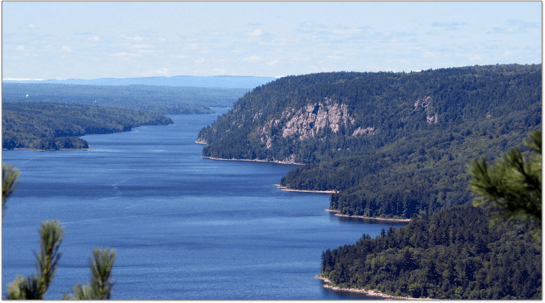
La rivière des Outaouais est une rivière du patrimoine canadien qui coule au pied de la Colline du Parlement. Sa valeur comme site naturel et comme trésor historique est inestimable. La rivière est sacrée pour le peuple algonquin, dont elle définit le territoire traditionnel.
La rivière des Outaouais est menacée par un dépotoir géant, d’une hauteur de sept étages, conçu pour abriter un million de tonnes de déchets radioactifs. Un consortium multinational (SNC-Lavalin, Fluor et Jacobs) prévoit construire ce monticule sur les terrains des Laboratoires nucléaires canadiens (LNC) près de Chalk River, en Ontario, à 150 km au nord-ouest d’Ottawa.
Les scientifiques indépendants et le public n’ont pas eu d’occasion de s’exprimer officiellement sur le projet depuis août 2017, alors que des centaines de commentaires critiques ont été soumis à la Commission canadienne de sûreté nucléaire (CCSN). La CCSN est l’« autorité responsable» en vertu de l’ancienne Loi canadienne sur l’évaluation environnementale et prévoit tenir une audience sur l’émission d’un permis cette année. Un Comité d’experts recommandait en 2017 que la CCSN ne soit pas chargée de l’évaluation environnementale des projets nucléaires. Le Comité avait aussi noté que la CCSN était largement perçue comme un « régulateur captif » des entreprises plutôt qu’un organisme indépendant.
L’Assemblée des Premières nations et plus de 140 municipalités du Québec et de l’Ontario ont adopté des résolutions s’opposant au dépotoir nucléaire de Chalk River.
Voici six raisons d’ARRÊTER ce projet:
1. Le site proposé est tout simplement inapte à recevoir un dépotoir, de quelque type qu’il soit. Le site est à moins d’un kilomètre de la rivière des Outaouais, qui forme la frontière entre l’Ontario et le Québec. La rivière fournit l’eau potable à des millions de Canadiens. Après avoir passé les LNC, elle coule entre Ottawa et Gatineau, au pied de la colline du Parlement, puis jusqu’à Montréal. Le site est exposé aux risques de tornades et de tremblements de terre; la rivière des Outaouais constitue d’ailleurs une ligne de faille géologique majeure. Le site est partiellement entouré de milieux humides et le substrat rocheux est poreux et fracturé.
2. Le monticule prévu contiendrait des centaines de matériaux radioactifs, des douzaines de produits chimiques dangereux et des tonnes de métaux lourds. Parmi les matériaux radioactifs destinés au monticule, on trouve du tritium, du carbone 14, du strontium 90, quatre types de plutonium (un des matériaux radioactifs les plus dangereux lorsqu’inhalé ou ingéré), et jusqu’à 6 tonnes d’uranium. Vingt-cinq des 30 radionucléides cités dans l’inventaire de radionucléides pour le monticule ont une longue durée de vie. Ces renseignements donnent à penser que le dépotoir demeurerait dangereusement radioactif pour quelque 100 000 ans.
La très grande quantité de cobalt 60 dans le dépotoir émettrait tellement de radiation gamma que les travailleurs devraient utiliser un blindage en plomb pour éviter une exposition dangereuse. L’Agence internationale de l’énergie atomique (AIEA) considère le cobalt 60 à haute activité comme un « déchet de moyenne activité », qui doit être stocké en profondeur.
Le dépotoir recevrait aussi des dioxines, des BPC, de l’amiante, du mercure, jusqu’à 13 tonnes d’arsenic et des centaines de tonnes de plomb. Il contiendrait aussi des milliers de tonnes de cuivre, de fer et 33 tonnes d’aluminium, des métaux qui pourront amener des voleurs à creuser dans le monticule après la fermeture du site.
3. Le monticule laisserait s’écouler des matériaux radioactifs et dangereux dans la rivière des Outaouais durant son opération et après sa fermeture. L’énoncé des incidences environnementales décrit plusieurs des façons dont le monticule pourrait laisser fuir son contenu. On prévoit que le monticule se désintégrera avec le temps, un processus qualifié d’« évolution normale ».
4. Il n’existe pas de niveau sécuritaire d’exposition aux radiations qui s’écouleraient du monticule de Chalk River dans la rivière des Outaouais. Chacun des matériaux radioactifs qui s’échapperait du site augmenterait les risques de malformations congénitales, d’altérations génétiques, de cancer et d’autres maladies chroniques. L’AIEA considère que les déchets radioactifs doivent être soigneusement stockés à l’écart de la biosphère et non dans un monticule en surface.
5. Les normes de sécurité internationales ne permettent pas d’utiliser les décharges pour l’élimination des déchets radioactifs de “faible activité”. L’AIEA considère que seuls des déchets de très faible activité peuvent être placés dans une installation en surface, comme un dépotoir. Le Canada se déroberait à ses obligations internationales comme État membre de l’AIEA et signataire d’un traité international sur les déchets nucléaires s’il autorisait ce dépotoir à obtenir sa licence.
6. Le monticule géant de Chalk River ne réduirait pas la responsabilité légale du Canada face aux déchets nucléaires, qui s’élève déjà à 8 milliards de dollars. Il pourrait au contraire l’alourdir. La remise en état de cette colline de déchets radioactifs serait très difficile. Les coûts d’assainissement pourraient dépasser ceux de la gestion des déchets s’ils n’avaient pas été mis dans le monticule.
Deadline Monday April 11 to apply to be an “intervenor” in the CNSC hearing for the giant Ottawa River nuclear waste dump
Note: If you are seeing this page for the first time and the April 11 deadline has passed, feel free to write to the CNSC to tell them what you think, and copy your Member of Parliament.
On April 1 the Algonquins of Barriere Lake joined the Kebaowek Algonquins and numerous elected officials and civil society groups in calling for a halt to the licensing hearings for the giant Chalk River/Ottawa River nuclear waste dump .
Unfortunately, the requests are falling on deaf ears as Canada has a woefully inadequate nuclear governance system that leaves the Canadian Nuclear Safety Commission free to steamroll ahead with licensing in defiance of common sense and the wishes of many Canadians and Indigenous communities.
Please consider adding your voice to the many who are calling for a halt to the licensing of the giant, million tonne radioactive landfill, called NSDF by the proponent. You can “intervene” in the CNSC hearings that start on May 31 either by sending written comments or by making an oral presentation to the panel of the commision. Whether you choose to intervene with a written submission or an oral presentation, you need to apply by April 11. It’s a simple process. See below for details.
How to intervene in the licensing hearings for the Chalk River/Ottawa River radioactive waste dump
The hearing is scheduled to start on May 31. It could possibly be an in-person hearing (in Pembroke) but intervening by zoom will be an option in any case.
Intervenors get 10 minutes to address the panel of CNSC commissioners.
You need to apply to intervene. The deadline to apply to intervene is April 11.
Here’s how to apply:
1. Send an email to interventions@cnsc-ccsn.gc.ca
2. Use the subject line: May 31 Public Commission Hearing – Canadian Nuclear Laboratories Near Surface Disposal Facility
3. Include your name, address and phone number.
4.Specify how you would like to intervene, either in writing or in person at the hearing. If by writing, include your written comments in or attached to your email. If you specify that you wish to intervene orally, during the hearings, you should provide a brief summary of what you would like to say in your email; (NB Update ~ CNSC is asking for more detail from oral intervenors. They are asking for a paragraph on each point that you with to cover in your oral intervention.) you will have an opportunity closer to the hearing to provide a slide deck if you wish to use one.
5. Please cc your Member of Parliament on your request to intervene.
There is a ton of substantive material on why the case to approve the giant dump makes no sense whatsoever. If you would like to help highlight some of this information in an oral intervention, please get in touch.
More info:
Six Reasons to Stop the Ottawa River Radioactive Waste Dump
Critical Flaws, Errors and Omissions in CNSC staff’s case to approve the Chalk River Mound
Défauts, erreurs et omissions critiques dans le dossier d’approbation du monticule de Chalk River
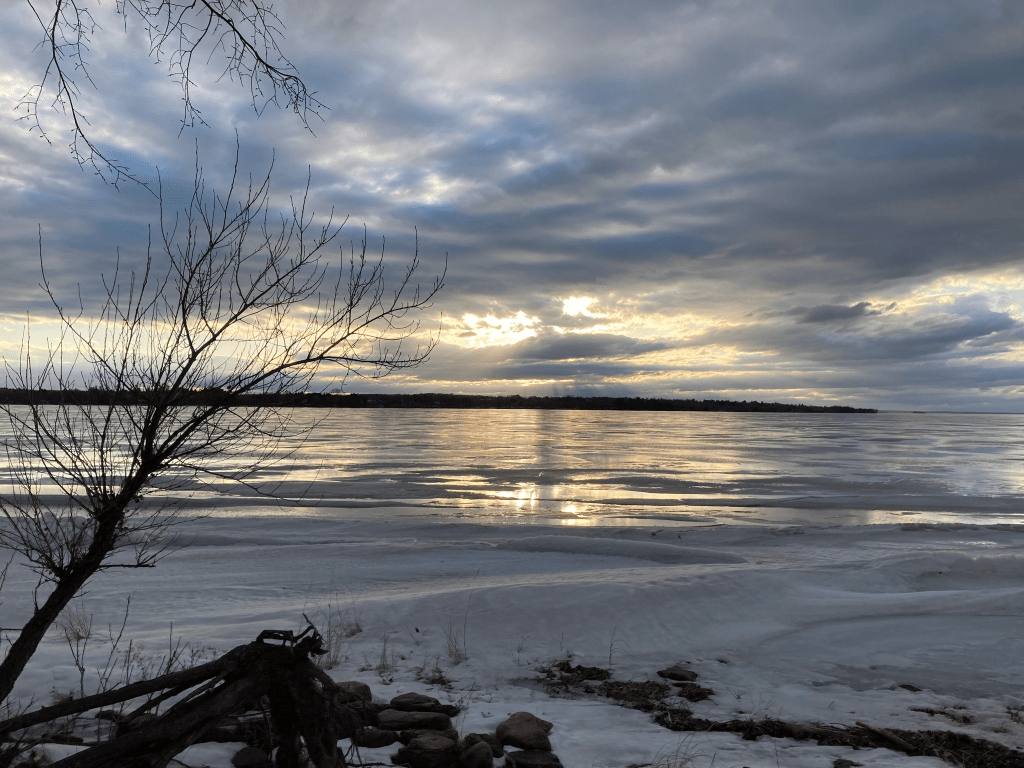
Photo below of the Ottawa River (Kitchissippi) taken on April 1, from Morrison Island Quebec looking north-west toward Chalk River.
Algonquins of Barriere Lake request adjournment of hearings for the Chalk River mound (NSDF)
The request was sent to the Canadian Nuclear Safety Commission on April 1, 2022.
The Algonquins of Barriere Lake joined the Kebaowek Algonquins and numerous civil society groups and elected officials in calling for adjournment of the hearings.

