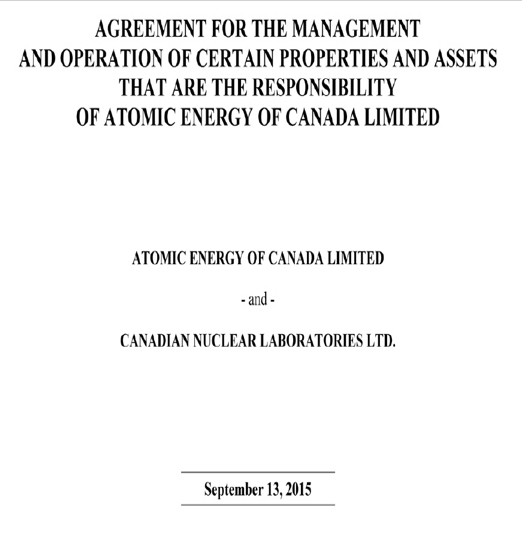
AECL is paying the CNEA consortium close to a billion dollars annually

November 5, 2020

According to the AECL Annual report for 2019-20
http://www.aecl.ca/wp-content/uploads/2020/10/FINAL-AECL-19-20-Annual-Report-.pdf
Contractual amounts paid or payable were:

2020 – $973,838 thousand or 974 million

2019 – $897,657 thousand or 898 million (see pages 59-60)

Previous AECL reports provide the following for contractual amounts:

2018 – $903,527 thousand or 904 million (https://www.aecl.ca/wp-content/uploads/2018/12/AECL-Annual-Report-2017-18-FINAL-EN.pdf page 54)

2017 – $864,930 thousand or 865 million (https://www.aecl.ca/wp-content/uploads/2018/12/AECL-Annual-Report-2017-18-FINAL-EN.pdf page 54)

2016 – $432,444 thousand or 432 million(https://www.aecl.ca/wp-content/uploads/2019/02/AECL-2016-2017-ANNUAL-REPORT.pdf page 49)

The total amount paid to the CNEA consortium to date (November 3, 2020) $4,072,396 thousand – just over $4 billion over five years.

Consortium’s study appears to show the Chalk River mound would disintegrate

November 2020

The proponent of the Chalk River Mound, Canadian Nuclear Laboratories, was required to produce an Environmental Impact Statement (EIS) as part of the very flawed and protracted Environmental Assessment process that is still underway.

The draft EIS was published in March 2017. It is 990 pages long. The full document is posted on the Impact Assessment Agency registry for the project. Here is the link to the full document: https://iaac-aeic.gc.ca/050/documents/p80122/118380E.pdf

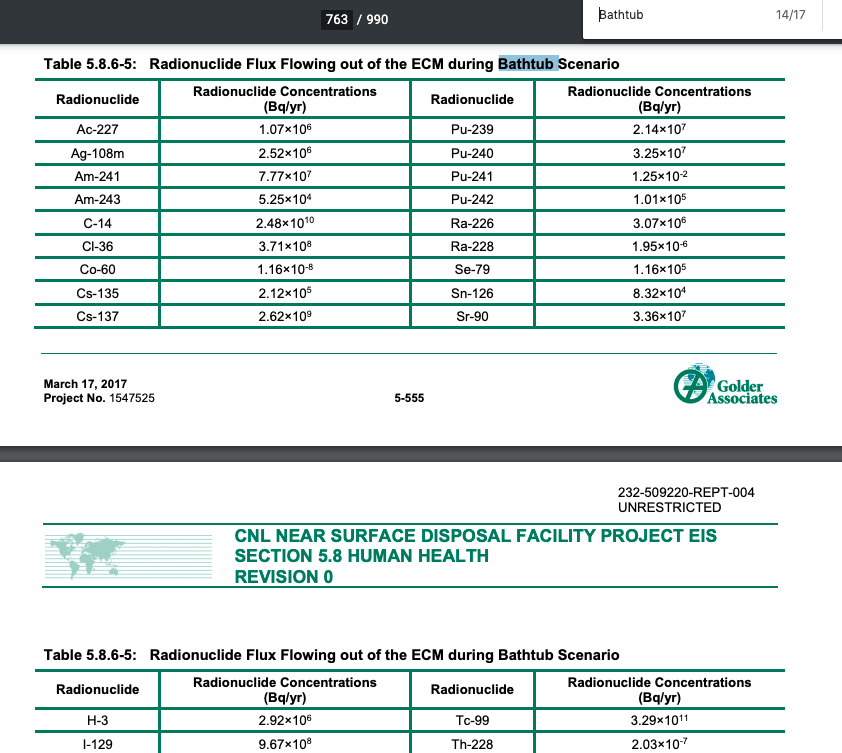
The draft EIS includes 25 occurrences of the phrase “liner and cover failure as a result of normal evolution”. The document also includes 11 occurrences of the term “bathtub effect” during which there is a flow of radioactive materials out of the mound. Table 5.8.6-5 lists quantities of radioactive materials, including four isotopes of plutonium, that would flow out of the mound under the “bathtub scenario”.

Here’s a screenshot from page 723 of the pdf document, that describes the liner and cover failure as a result of “normal evolution” followed by two scenarios for disintegration of the mound and migration of contaminants into Perch Creek and the Ottawa River.

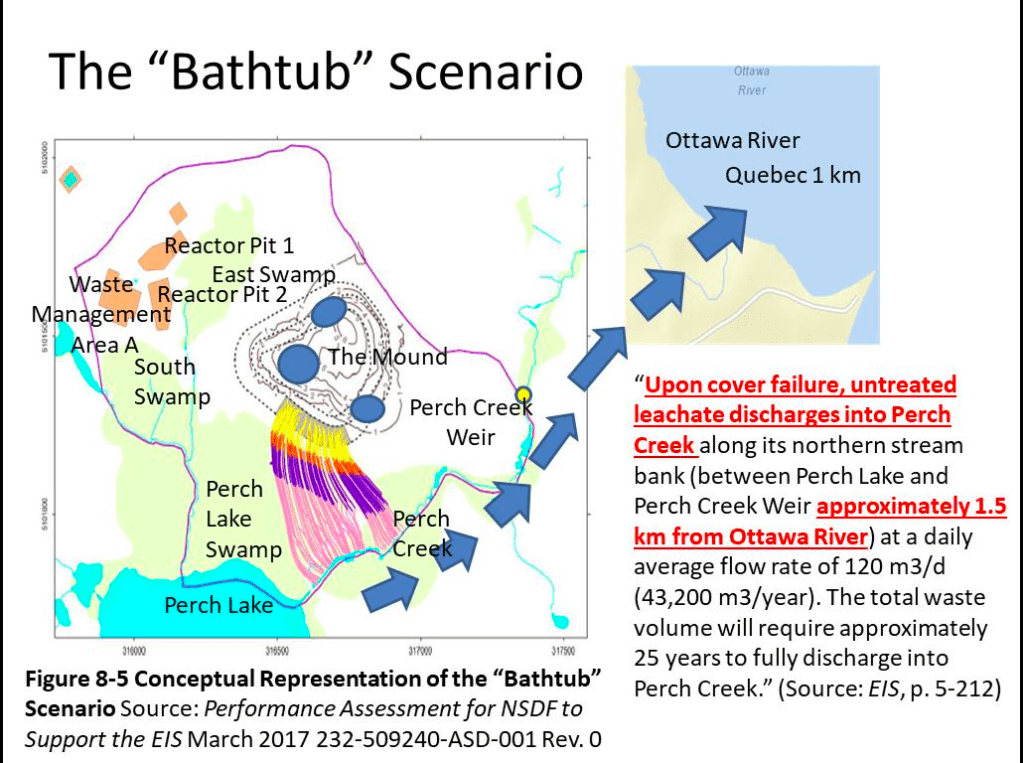
Here is a picture of the Bathtub Scenario from page 187 of CNL’s Performance Assessment for NSDF. The blue arrows and the Ottawa River were added by CCRCA researcher Ole Hendrickson when he incorporated Figure 8-5 into a Powerpoint deck.

And here is part of a table showing radionuclide flow out of the mound (including four isotopes of plutonium) as it disintegrates: (page 763 of the draft EIS)

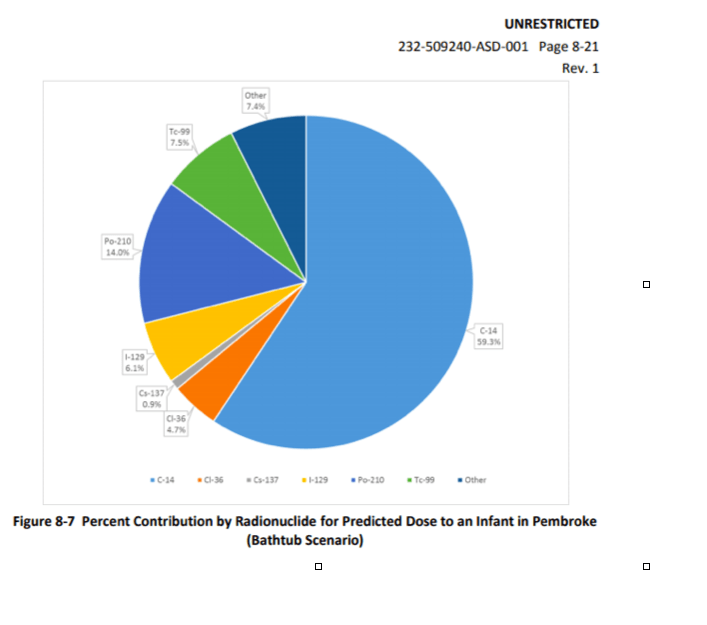
And finally here is a pie chart showing the contribution of various radionuclides (such as Carbon-14, Polonium and Caesium-137 ) to the radiation dose that would be received by an infant downstream in Pembroke, under the “bathtub scenario” of “normal evolution” of the Chalk River Mound: (Page 190 of the Performance Assessment document)

CNL’s Integrated Waste Strategy alarms downstream residents

November 5, 2020

Update: In 2021 the City of Ottawa passed a resolution opposing any further imports of radioactive waste into the Ottawa Valley (More info here) See also: High level radioactive waste imports to Chalk River from Manitoba and Quebec will likely begin in 2025
~~~~

The CNL Integrated Waste Strategy was first published in January 2017, 15 months after the multinational consortium took over the operation of Canada’s nuclear laboratories. It describes many types of radioactive wastes owned by the federal government in nuclear facilities in Manitoba, Ontario and Quebec. The document lays out a plan to consolidate as much of these wastes as possible at the Chalk River Laboratories site beside the Ottawa River upstream of Ottawa, Gatineau and  Montreal for permanent disposal in a highly-controversial, yet-to-be-licensed giant radioactive waste mound.

Ottawa Valley residents are alarmed by this strategy to bring all of Canada’s federal nuclear waste to Chalk River. The site already has much radioactive waste in less than optimum storage conditions; wastes are leaking and contaminating the Ottawa River. See Chalk River’s Toxic Legacy by Ian McLeod in the Ottawa Citizen, December 16, 2011.

Radioactive waste shipments are already underway from other federal nuclear facilities in Canada. There are risks involved in transportation as described in our recent fact sheet “Transport of Radioactive Waste on Canadian Roads- a growing public risk”.  Premature transportation of wastes before long-term management facilities are planned, evaluated, and licensed will result in double-transport and double-handling, creating additional unnecessary risks to workers and the public.

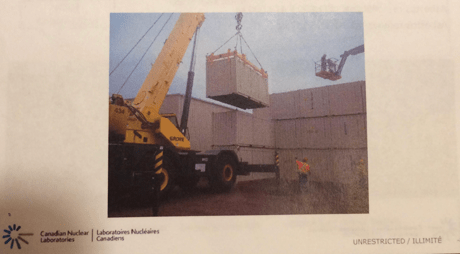
There are no approved disposal facilities at the CRL site; shipping containers full of wastes are presently being piled up at a Waste Management Area H as shown in the photograph below. The metal shipping containers are susceptible to corrosion and are exposed to precipitation in the current location.

The Chalk River Laboratories is not a good site for long-term storage of radioactive waste because it is seismically active, tornado prone, and adjacent to the Ottawa River which serves as a source of drinking water for millions of Canadians including citizens of Ottawa-Gatineau and many other communities. The site is also located on unceded Algonquin territory and Algonquin First Nations have not given their free prior and informed consent to the transport and disposal of radioactive wastes in their territory.

~~~~~~

Here is Version 0 of CNL’s integrated waste strategy, (obtained through ATIP in December 2017, 64 pages, contains many redactions)

The strategy has gone through a number of revisions. Here is a summary of the revised version that was, for a while, posted publicly on the CNL webiste:

See also https://concernedcitizens.net/2024/04/15/geoscientist-raises-concerns-about-storage-of-radioactive-waste-in-the-ottawa-valley-due-to-earthquake-risk/

International Atomic Energy Agency still says “entombment” is not an acceptable decommissioning strategy

November 2, 2020

The Canadian Nuclear Safety Commission, Canada’s “captured” nuclear regulator, had hoped that the latest updated guidance from IAEA would allow entombment of old reactors as a decommissioning strategy.

Here is CNSC in 2017, “dispositioning” critical comments on the proposed entombment of old (and still highly radioactive) nuclear reactors at Rolphton, Ontario and Pinawa, Manitoba:

“Yes, the document referenced, IAEA GSR 6, indicates that
entombment is not recognized internationally, in principle,
as a preferred decommissioning strategy (entombment may
be considered a solution only under exceptional
circumstances, such as following a severe accident). The
IAEA is currently working on a document to provide
guidance with respect to their position on entombment
in situ decommissioning the applicability of entombment in
the context of decommissioning and in particular, the
regulatory requirements and expectations for applying
entombment as a decommissioning option strategy. There is
no scheduled date for the publication of this document;
however, CNSC staff will keep apprised of its development
to inform this EA and licensing review process.
Irrespective of the IAEA guidance document, under the
CNSC’s regulatory framework, applicants are responsible
for selecting and justifying their proposed decommissioning
strategy.”

That quotation is from this document: https://www.ceaa-acee.gc.ca/050/documents/p80124/118863E.pdf
Page 9, top right.

The CNSC must have been disappointed when the new IAEA guidance document was published in 2018 and it STILL says that entombment is not acceptable as a decommissioning strategy.

The new IAEA document is

Decommissioning of Nuclear Power Plants, Research Reactors and Other Nuclear Fuel Cycle Facilities ~ Specific Safety Guide No. SSG-47, Vienna, 2018

The relevant text is section 5.17 on page 32 and it reads as follows:

Entombment, in which all or part of the facility is encased in a structurally long lived material, should not be considered an acceptable strategy for planned decommissioning. It might be considered as a last option for managing facilities that have been damaged in an accident, if other options are not possible owing to high exposures of workers or technical difficulties.

The IAEA explicitly recommended that Canada align its decommissioning strategy with this standard, during a peer review mission in September 2019. See a summary of IAEA recommendations to Canada here.

Undeterred, the CNSC is attempting to make entombment acceptable in its own “RegDocs”, pseudo regulations that rely heavily on nuclear industry created CSA standards, but that is another story, that is covered elsewhere. See Ole Hendrickson’s recent Op Ed in the Hill Times and the recent letter to Prime Minister Justin Trudeau that requests urgent action to address nuclear safety gaps in Canada.

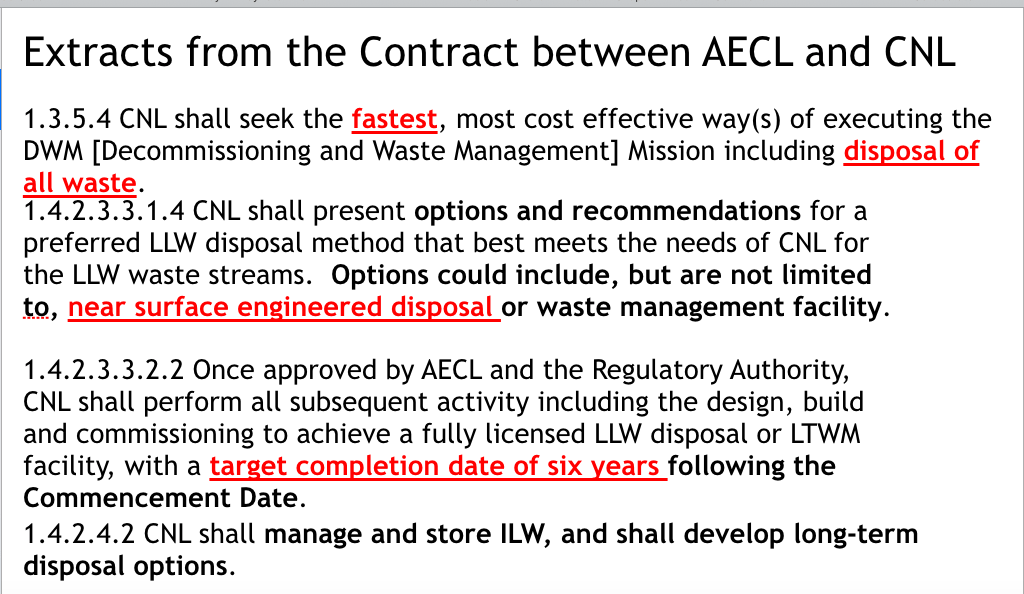
AECL/CNL/CNEA Contract Excerpt ~ ALL Wastes

See also statement from the Draft Environmental Impact Statement about “all wastes” here.

NB. Clause 1.3.5.4 above refers to one specific location, LaPrade heavy water facility in Quebec. Similar clauses in the contract refer to other federal facilities.

This section of the contract refers to all of the federal wastes (key clause highlighted in yellow below):

Contract – Schedule G – Contractor Performance Evaluation and Terms of Payment 

2.2 Award Fee Plan 

      (a) Each Annual PEM Plan will include, as a component thereof, an Award Fee Plan that defines differently weighted, reasonably achievable Performance Objectives and Performance Outcomes that are to be satisfied or achieved by CNL in connection with the performance of the SOC Obligations during the Operating Year (the “Award Fee Criteria”). The Parties agree that the Award Fee Criteria may be comprised, in whole or in part, of performance indicators which will be assessed by AECL. The Award Fee Plan will also specify the Annual Earnable Award Fee for the Operating Year, which will be allocated among the Award Fee Criteria using a scorecard-style rating grid. 

      (b) The Performance Objectives and the Performance Outcomes that are included in the Award Fee Plan for any Operating Year will reflect the following goals (as applicable): 

(i) contain costs associated with the Sites, the Facilities and the Assets (in each case, other than those related to the WL Obligations or the NPD Obligations) by improving efficiency while leveraging their value in delivering on the missions of CNL; 

(ii) implement cost reduction initiatives that result in measurable operating savings at the Sites (other than those related to the WL Obligations or the NPD Obligations); 

(iii) substantially reduce the cost of liabilities in the most cost-effective manner through the optimization of decommissioning and waste management activities; 

Canada’s federal nuclear waste liability is $16 billion

November 2, 2020


…estimates of AECL’s nuclear liability are heavily discounted, such that when the discount rate increases, the liability decreases.[1]  Actual clean-up costs are far higher.  AECL’s 2018 Annual Report stated that “The undiscounted future expenditures, adjusted for inflation, for the planned projects comprising the liability are $15,932.9 million.”[2]  

The accounting firm Deloitte recommends discounting for environmental liabilities and asset retirement obligations only if two criteria are met:

·         The “aggregate amount of the liability or component” is “fixed or reliably determinable.”

·         The “amount and timing of cash payments for the liability or component are fixed or reliably determinable.”[3]

Neither condition is met in the case of the Government of Canada’s nuclear liabilities.  Both liability amounts and timing of cash payments are highly uncertain.  The federal government funds AECL’s decommissioning and waste management expenses on an annual basis. 


[1] Atomic Energy of Canada Limited 2016 Annual Report, p. 20.

[2] Atomic Energy of Canada Limited 2018 Annual Report, p. 50.

[3] A Roadmap to Accounting for Environmental Obligations and Asset Retirement Obligations, Deloitte, 2019.
Excerpt from  “The Government of Canada’s Radioactive Wastes:  Costs and Liabilities Growing under Public-Private Partnership”

Why is there so much plutonium at Chalk River?

October 25, 2020

~~

Update April 29, 2022) five isotopes of plutonium are included in the inventory of radioactive materials destined for the NSDF if it is approved. Details here: https://concernedcitizens.net/2020/12/17/cnls-partial-inventory-of-radionuclides-that-would-go-into-the-chalk-river-mound/

~~~

A consortium of private multinational corporations is proposing to create a giant mound of radioactive wastes at Chalk River, Ontario, less than a kilometer from the Ottawa River.  According to the draft Environmental Impact Statement (EIS) the proposed mega-dump will house a rather large quantity of plutonium.

What is plutonium and why should we worry about it?

Plutonium is a human-made radioactive element that is created as a byproduct in nuclear reactors. The first reactors were built to produce plutonium for use as a nuclear explosive in atomic weapons. Plutonium can also be fabricated into fuel elements for nuclear reactors.

Plutonium remains radioactive for tens of thousands of years after it is created.  It comes in several different varieties or “isotopes”.  The most abundant varieties are plutonium-239, with a half-life of 24,000 years; and plutonium-240, with a half-life of 6,600 years.  The half-life is the time required for half of the atoms to undergo radioactive disintegration. When a plutonium atom disintegrates it is transformed into another radioactive material, sometimes one with a much longer half-life.

All isotopes of plutonium are highly toxic. Even very small doses can lead to radiation-induced illnesses such as cancer, often resulting in death.

Why is there plutonium at Chalk River?

The decision to build the Chalk River Laboratories (CRL) was taken in Washington, D.C. in 1944.  Canada, Great Britain and the United States agreed to build the facility as part of an effort to produce plutonium for bombs.  In fact, plutonium produced at CRL played a role in both the US and UK nuclear weapons programs.

During the late 1940s, British scientists carried out all necessary pilot plant work at Chalk River to design their own large plutonium production plant at Windscale, England.  Plutonium produced at CRL arrived in England just months before the first British nuclear explosion took place in Australia in 1952.

For three decades, plutonium produced in Canadian research reactors was sold to the U.S. military to help finance the Chalk River Laboratories.  A reprocessing plant at Chalk River was built to extract plutonium from irradiated nuclear fuel dissolved in nitric acid. It was shut down in 1954, but irradiated fuel containing Canadian plutonium was shipped to the U.S. until the mid-1970s.  In all, at least 250 kg of plutonium was sold to the U.S. for nuclear weapons and warheads.

Three buildings central to plutonium production are slated for demolition

Various facilities at CRL were used in the 1940s and 1950s to extract plutonium from fuels irradiated in the NRX reactor.  In 2004, environmental assessments were initiated governing the radioactive demolition of three such structures:

•       The Plutonium Tower, used in the late 1940s to extract plutonium from fuel   rods irradiated in the NRX reactor.

•       The Plutonium Recovery Laboratory, used between 1949 and 1957 to extract plutonium isotopes from enriched fuels irradiated in the NRX reactor.

•       The Waste Water Evaporator, used between 1952 and 1958 to process radioactive liquid wastes left behind from the plutonium extraction work. Decommissioning of this facility would include: removal, treatment and storage of plutonium-bearing liquid wastes and sludge in tanks, plutonium-contaminated process lines and equipment; decontamination and removal of process equipment and processing cells for handling plutonium; removal of building structures containing plutonium residues; segregation of solid wastes and transfer of these plutonium-contaminated materials to waste management facilities at CRL.

In December 2011 the Canadian Nuclear Safety Commission gave the go-ahead for dismantling the first of these structures, the Plutonium Tower.  In 2012, changes to the Canadian Environmental Assessment Act introduced by Stephen Harper’s government made it permissible to demolish radioactively contaminated buildings without any environmental assessment (EA).

To date, only the auxiliary buildings associated with the Plutonium Tower have been decommissioned, but the Tower itself is still standing.  And as far as the Plutonium Recovery Lab and Waste Water Evaporator go, neither has been decommissioned. All these decommissioning projects will be difficult, and will generate lots of long-lived, intermediate-level waste.

These buildings are just three examples of demolition projects that would produce plutonium-contaminated rubble likely destined for the proposed megadump. Chalk River scientists were keenly interested in testing plutonium as a reactor fuel.  Some three tonnes of plutonium-based fuel elements were fabricated at Chalk River using remote handling devices called gloveboxes. Such facilities would also result in plutonium-contaminated wastes when demolished.

The draft EIS estimates that total quantities of plutonium to be placed in the planned landfill-type facility would be measured in the trillions of Becquerels. A Becquerel is a unit of radioactivity, indicating that one radioactive disintegration is taking place every second. (Every radioactive atom eventually disintegrates, or explodes, giving off one or two subatomic projectiles called “atomic radiation”. All forms of atomic radiation — alpha particles, beta particles, gamma rays, and neutrons–are damaging to living cells.)

Plutonium will inevitably leak into the Ottawa River (EIS)

The draft EIS indicates that after failure of the landfill cover, which is bound to occur at some point after abandonment, millions of Becquerels of each plutonium isotope would enter Perch Creek every year.  Perch Creek flows into the Ottawa River about 1 km away.

Canadian Coalition for Nuclear Responsibility and Concerned Citizens of Renfrew County and Area

May 2017

SMRs are actually DDDs (Dirty Dangerous Distractions)

Commentary by Dr. Gordon Edwards, President of the Canadian Coalition for Nuclear Responsibility

SMRs are really DDDs and should be called such.


A DDD is a Dirty Dangerous Distraction. It is an acronym much more to the point than SMR.


Nuclear proponents are loathe to even use the N in theiracronym (SMR) for Small Modular Nuclear Reactors (SMNRs)because they want to hide the one aspect – the NUCLEAR aspect – that is the source of all the unmentioned problems with these devices. It is the insidious linages to nuclear waste and to nuclear weapons that are precisely what set these machines apart.But the industry hopes that no one will notice if they leave out the N.It may sound silly or trivial, but it is not silly or trivial. It is deliberate.

SMRs (or SMNRs) are Dirty, Dangerous Distractions. They are DDDs.

They are DIRTY because they produce radioactive waste of all categories – low-level, intermediate-level, and high-level. It is by farthe most deadly waste byproduct that any industry has ever created.

Every SMR is DANGEROUS because it is not just a machine for generating electricity, it is also a warehouse of radioactivepoisons that can do tremendous damage for centuries to comeif anything happens to disperse those poisons into the environment, such as an act of warfare (e.g. aerial bombardment) or sabotage, or a plane crash or a violent earthquake. Once released, these poisons will contaminate the food we eat, the water we drink, and the air we breathe, and the damage will last for generations.

Some SMRs – those that are called “fast” or “advanced” reactors,those that talk about “reusing” or “recycling” or “reprocessing” irradiated nuclear fuel – pose an even more serious existential danger. Such reactors are predicated upon the extraction of plutonium and other human-made elements that are heavier than uranium to extend the nuclear fuel supply. But plutonium is also the primary nuclear explosive in the world’s nuclear arsenals, and extracting it from irradiated fuel makes plutonium that much more accessible to militaristic regimes, as well as criminals and terrorists, thereby facilitating the proliferation of nuclear weapons. Nuclear weapons are the greatest human-made threat to the survival of human civilization (and most advanced forms of life on Earth).

SMNRs are also a DISTRACTION because they prevent us from dealing with climate change right now, rather than waiting 10 or 20 years to see is SMRs are even going to prove worthwhile. So much can be done through prompt investments in energy efficiency and renewables, where benefits are enjoyed in just one orTwo building seasons, using technology that is already proven and inherently safe. Can anyone imagine a catastrophic situation arising from the failure of windmills or solar collectors? Energy efficiency and renewables can be implemented faster and cheaper than nuclear power, creating more jobs and providing more sustainability at the same time. 

SMRs also distract us from realizing that we have no solution to the problem of how to safely keep these radioactive poisons out of the environment of living things for millennia to come, and therefore we should stop creating them. As long as the industry distracts the decision-makers by dangling a charm bracelet of pie-in-the-sky miraculous “clean, safe, cheap nuclear reactors”(All those adjective being demonstrable lies) our political representatives are prevented from focussing on the horrendous radioactive waste problems that we have already accumulated and that will constitute a radioactive legacy forever.

Although we have no cure for the coronavirus, we do have effective methods for limiting its spread and preventing the worsening of the situation. So too we have no way to eliminate or neutralize radioactive wastes or to render them harmless, but we do know how to package them well and repackage them when necessary — as long as we don’t abandon them thereby putting these enormously dangerous materials beyond human control (as some people have abandoned their responsibility to control the spread of the coronavirus). As long as we don’t keep multiplying the sources of radioactive waste (by building a whole new fleet of nuclear reactors called SMRs) we would have a chance of addressing the radioactive waste legacy with some degree of responsibility and maturity.

Nuclear power is the ONLY technology that actually creates hundreds of new toxic elements, most of which were never found in nature prior to 1939. Those elements, once created, cannot be destroyed or rendered harmless. There isno non-nuclear method known to science – heat, pressure, combustion, chemical reactions, NOTHING – that can slow down or stop the rate of atomic disintegration, and those disintegrating atoms will give off the subatomic shrapnel that we call‘“atomic radiation” at a predetermined rate defined by the so-called “half-life”.

I have discovered that every category of radioactive waste associated with theNuclear fuel chain (from uranium mining to reactor operation to decommissioning to waste management) has a significant number of radioactive poisons that will remain a hazard for hundreds of thousands of years. That is true of uranium tailings, of low and intermediate level wastes from reactor operations, of the thousands of truckloads of radioactive rubble from decommissioning a reactor, of the so-called “depleted uranium” stored in the back yards of uranium enrichment plants, and of the irradiated nuclear fuel itself.

Keeping radioactive waste out of the environment of living things for hundreds of thousands of years is an unsolved problem of the human race. We should not be adding to this dreadful legacy, or allowing our attention to be distracted away from dealing with the problem properly (i.e. as best we can!).