Does the CNSC president meet IAEA requirements for “independence”?

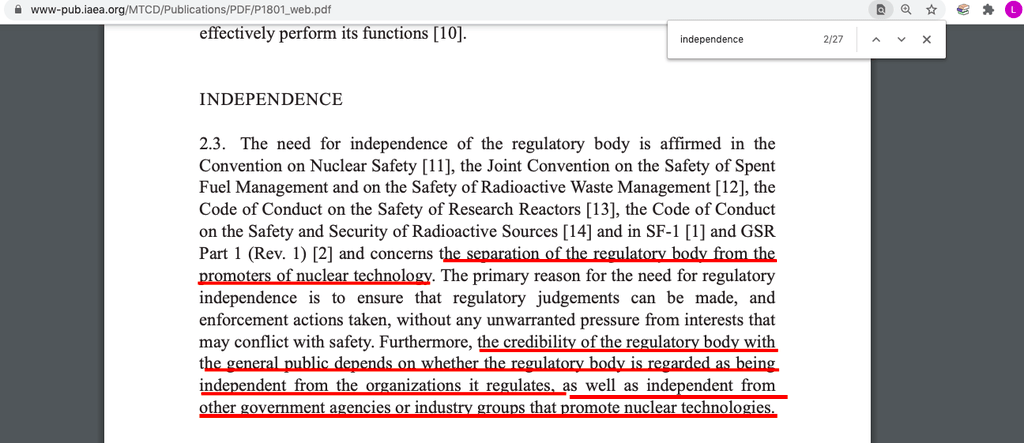
The International Atomic Energy Agency provides explicit guidance on the necessary independence of the nuclear regulatory agency in order to ensure safety and public confidence. The guidance is provided in the  IAEA “General Safety Guide No. GSG-12, Organization, Management and Staffing of the Regulatory Body for Safety”. Here is a screen capture from page 22 of that publication (emphasis added).

The guidance is quite clear that the regulatory body must be separate from the “promoters of nuclear technology”. The guidance also suggests that CNSC should be independent from NRCan; more detail on this is provided in this post.

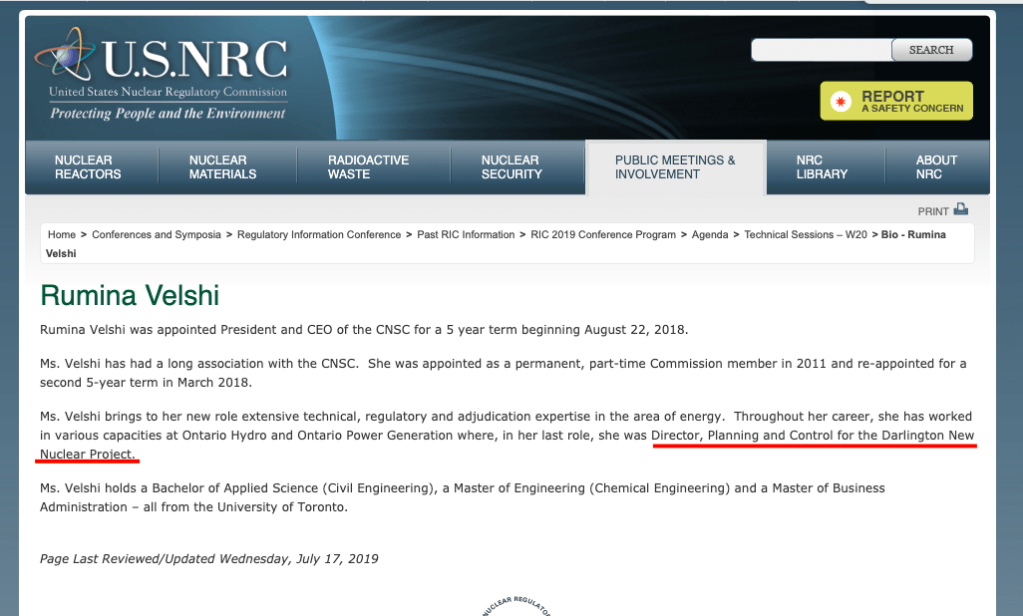
The CNSC’s current president, Rumina Velshi, prior to her appointment at CNSC, worked for Ontario Power Generation for eight years in senior management positions and led the OPG commercial team involved in a multi-billion dollar proposal to procure new nuclear reactors as noted below in the announcement of Ms. Velshi’s appointment on the US Nuclear Regulatory Commission website. 

It would seem that Rumina Velshi fails to meet the IAEA’s guidance that staff of the regulatory body must be separate from “promoters of nuclear technology”. As the leader of a multi-billion dollar project to procure new nuclear reactors, Ms. Velshi was quite clearly a “promoter of nuclear energy” before her appointment at the Canadian Nuclear Safety Commission.

CNSC president should not report to the Minister of Natural Resources, according to IAEA guidance

Having the CNSC report through the Minister of Natural Resources who is charged with producing (and promoting) nuclear energy under the Nuclear Energy Act is not consistent with the IAEA’s guidance on “independence”.  


IAEA General Safety Guide No. GSG-12, Organization, Management and Staffing of the Regulatory Body for Safety says:

2.3  …the credibility of the regulatory body with the general public depends on whether the regulatory body is regarded as being independent from the organizations it regulates, as well as independent from other government agencies or industry groups that promote nuclear technologies.

The IAEA recommends that the CNSC’s independence from Parliament and government not be absolute:

2.6. Paragraph 2.8 of GSR Part 1 (Rev. 1) [2] states that:“To be effectively independent from undue influences on its decision making, the regulatory body: …Shall be free from any pressures associated with political circumstances or economic conditions, or pressures from government departments, authorized parties or other organizations”.  

2.7. The regulatory body should, however, be accountable to the government and to the general public with regard to effectively and efficiently fulfilling its mission to protect workers, the public and the environment…

More specifically, it is unacceptable that the CNSC’s funding requests come through the Minister of Natural Resources:

2.14. …Review and approval of the regulatory body’s budget should be performed only by governmental agencies that are effectively neutral in respect of the development, promotion or operation of facilities and conduct of activities. Such an approach provides additional assurance of the independence of the regulatory body 

Under the Nuclear Energy Act, the Minister of Natural Resources is Canada’s promoter of nuclear technologies:

Powers of Minister 10(1) The Minister may

(a) undertake or cause to be undertaken research and investigations with respect to nuclear energy;

(b) with the approval of the Governor in Council, utilize, cause to be utilized and prepare for the utilization of nuclear energy;

(c) with the approval of the Governor in Council, lease or, by purchase, requisition or expropriation, acquire or cause to be acquired nuclear substances and any mines, deposits or claims of nuclear substances and patent rights or certificates of supplementary protection issued under the Patent Act relating to nuclear energy and any works or property for production or preparation for production of, or for research or investigations with respect to, nuclear energy


The President of Canada’s nuclear regulatory body (CNSC) reports to the Minister of Natural Resources.  The Nuclear Safety and Control Act says

12(4) …the President shall make such reports to the Minister as the Minister may require concerning the general administration and management of the affairs of the Commission…

Hence, the Minister in charge of nuclear energy, including federal (AECL) properties for production and research of nuclear energy, is also in charge of the regulatory body that is supposed to protect workers, the public and the environment. 

 
This creates a lack of independence of the regulatory body. 

 
The Nuclear Safety and Control Act does allow for the President of the CNSC to report to a minister other than the Minister of Natural Resources.  From section 2, Definitions:

Minister means the Minister of Natural Resources or such member of the Queen’s Privy Council for Canada as the Governor in Council may designate as the Minister for the purposes of this Act.


A quick and cheap fix to CNSC’s lack of independence would be to designate the Minister of Environment and Climate Change as the “the Minister for the purposes of this Act”. 

 
That being said, both the Nuclear Safety and Control Act and the Nuclear Energy Act are more than 23 years old and have never been reviewed by Parliament.  Such a review is long overdue.

Canada re-engages in the Nuclear Weapons Business with SMRs

December 3, 2020

Published as an Op Ed by the Hill Times at this link: WWW.HILLTIMES.COM/2020/12/03/CANADA-RE-ENTERS-NUCLEAR-WEAPONS-BUSINESS-WITH-SMALL-MODULAR-REACTORS/274591

Canada Re-enters the Nuclear Weapons Business with SMRs

Natural Resources Minister Seamus O’Regan is expected to announce within weeks his government’s action plan for development of “small modular” nuclear reactors (SMRs).

O'Regan putting nuclear 'front and centre' raises eyebrows, industry hopes  - The Hill Times
 Minister of Natural Resources delivering a keynote speech to the Canadian Nuclear Association. The Hill Times photograph by Andrew Meade

SMR developers already control the federally-subsidized Chalk River Laboratories and other facilities owned by the crown corporation, Atomic Energy of Canada Limited (AECL).  Canada is now poised to play a supporting role in the global nuclear weapons business, much as it did during World War II.

Canada was part of the Manhattan project with the U.S. and U.K. to produce atomic bombs.  In 1943 the three countries agreed to build a facility in Canada to produce plutonium for nuclear weapons.  Researchers who trained at the Chalk River Laboratories went on to launch weapons programs in the U.K. and France.  Chalk River provided plutonium for U.S. weapons until the 1960s.

Canada’s Nuclear Schizophrenia describes a long tradition of nuclear cooperation with the United States:  “For example, in the early 1950s, the U.S. Navy used Canadian technology to design a small reactor for powering its nuclear submarines.”  C.D. Howe, after creating AECL in 1952 to develop nuclear reactors and sell weapons plutonium, remarked that “we in Canada are not engaged in military development, but the work that we are doing at Chalk River is of importance to military developments.”

The uranium used in the 1945 Hiroshima bomb may have been mined and refined in Canada. According to Jim Harding’s book Canada’s Deadly Secret: Saskatchewan Uranium and the Global Nuclear System, from 1953 to 1969, all the uranium mined in Saskatchewan went to make U.S. nuclear weapons. Canada remains the world’s second-largest producer of uranium.  North America’s only currently operating uranium processing facility is owned by Cameco in Port Hope, Ontario.

Canada built India’s CIRUS reactor, which started up in 1960 and produced the plutonium for India’s first nuclear explosion in 1974. Canada also built Pakistan’s first nuclear reactor, which started up in 1972.  Although this reactor was not used to make weapons plutonium, it helped train the engineers who eventually exploded Pakistan’s first nuclear weapons in 1998.

In 2015 the Harper Government contracted a multi-national consortium called Canadian National Energy Alliance – now comprised of two U.S. companies, Fluor and Jacobs, along with Canada’s SNC-Lavalin – to operate AECL’s nuclear sites, the main one being at Chalk River.  Fluor operates the Savannah River Site, a South Carolina nuclear weapons facility, under contract to the U.S. Department of Energy (DOE).  Jacobs also has contracts at DOE weapons facilities and is part of a consortium that operates the U.K. Atomic Weapons Establishment.

Joe McBrearty, the president of the consortium’s subsidiary that operates Chalk River and other federal nuclear sites, was a U.S. Navy nuclear submarine commander and then chief operating officer for the DOE’s nuclear laboratories between 2010 and 2019.

All three consortium partners have investments in SMRs and are ramping up research and development at AECL’s Chalk River facility. Some SMR designs would use uranium enriched to levels well beyond those in current reactors; others would use plutonium fuel; others would use fuel dissolved in molten salt.   All of these pose new and problematic weapons proliferation risks.

Rolls Royce, an original consortium partner that makes reactors for the U.K.’s nuclear submarines, is lead partner in a U.K. consortium (including SNC-Lavalin) that was recently funded by the U.K. government to advance that country’s SMR program. 

A military bromance: SMRs to support and cross-subsidize the UK nuclear weapons program, says “Industry and government in the UK openly promote SMRs on the grounds that an SMR industry would support the nuclear weapons program (in particular the submarine program) by providing a pool of trained nuclear experts, and that in so doing an SMR industry will cross-subsidize the weapons program.” 

The article quotes a 2017 Rolls Royce study as follows: “expansion of a nuclear-capable skilled workforce through a civil nuclear UK SMR programme would relieve the Ministry of Defence of the burden of developing and retaining skills and capability.”

The SMR connection to weapons and submarines could hardly be clearer – without SMRs, the U.S. and U.K. will experience a shortage of trained engineers to maintain their nuclear weapons programs.

With the takeover of AECL’s Chalk River Laboratories by SMR developers, and growing federal government support for SMRs, Canada has become part of a global regime linking nuclear power and nuclear weapons.

Opinion: A new global treaty bans nuclear weapons. But why didn't Canada  sign? - The Globe and Mail

Several ex-AECL scientists have pointed out that all three of CNL’s proposed nuclear waste projects fail to meet international safety standards

November 2020 (updated April 2022)

See also: Critical comments from former AECL officials and scientists on CNL Disposal projects

The most recent critical comments from ex-AECL experts are interventions submitted for the final licensing hearing that starts on May 30.

Dr. JR Walker’s intervention is here: https://api.cnsc-ccsn.gc.ca/dms/digital-medias/CMD22-H7-63B.pdf/object?subscription-key=3ff0910c6c54489abc34bc5b7d773be0

He says: “On the face of the documents provided, there is no justification for approval of the proposed Engineered Containment Mound until the deficiencies are corrected.”

~~~~~~~

Several ex-AECL scientists have pointed out, in comments on the environmental assessments, that all three of CNL’s proposed nuclear waste projects fail to meet international safety standards for radioactive waste facilities. The comments are publicly available on the website of the Impact Assessment Agency. Links to the submissions are compiled in this post. Below we highlight some that are especially pertinent to lack of compliance with international safety guidelines. See also the Globe and Mail article from June 2017 “Scientists decry plan for Ontario nuclear-waste site”

Concerns about the Near Surface Disposal Facility (Chalk River Mound)

Dr. Michael Michael Stephens, former Manager for Strategic Planning for the Canadian Nuclear Legacy Liabilities Program at AECL

I am commenting as a resident of Deep River, as a Canadian taxpayer, and from my 25 years’ working experience in radioactive waste management and decommissioning of nuclear facilities, including as
former Manager for Strategic Planning for the Canadian Nuclear Legacy Liabilities Program.

source: https://www.ceaa.gc.ca/050/documents/p80122/119775E.pdf page 2

The concept of the NSDF project deviates significantly from internationally-accepted waste management principles and practices. Before consideration is given to allowing it to be implemented, it should be,subjected to a comprehensive technical review by an international group of experts arranged through the International Atomic Energy Agency, and the results should be made public.

source: https://www.ceaa.gc.ca/050/documents/p80122/119775E.pdf page 5

DR. J.R. Walker, former Director of Safety Engineering and Licensing at AECL

A must-read submission on the NSDF (Chalk River Mound)

This quote is about non-compliance with international guidlines:

The proposed project does not meet Canadian and international guidance and would require members
of the public to be subject to unacceptable radiological risks into the far future.

source: https://www.ceaa.gc.ca/050/documents/p80122/119034E.pdf page 7

This quote is about eventual failure of the mound:

The institutional control period ends 300 years post-closure, and the design life of the facility is 500 years post-closure. Subsequently, the facility will fail and the radionuclide inventory will be released
into the environment. As noted previously, the predicted doses exceed the public dose limit specified in Canadian Regulations [10] for more than 100,000 years.

source: https://www.ceaa.gc.ca/050/documents/p80122/119034E.pdf page 8

These are Dr. Walker’s concluding remarks about the NSDF environmental impact statement:

5.0 Concluding Remarks
The Draft EIS [1] and the associated project proposal contain numerous deficiencies. For example,


• The proposal employs inadequate technology and is problematically located;
• The proposal does not meet regulatory requirements with respect to the health and safety of
persons and the protection of the environment; and
• The authors have failed to meet the requirements of the Canadian Environmental AssessmentAct 2012.

The extent and gravity of these deficiencies preclude a conclusion that the project is unlikely to cause significant adverse environmental effects, taking into consideration the implementation of mitigation measures.

Source: https://www.ceaa.gc.ca/050/documents/p80122/119034E.pdf page 10

Concerns about the proposed Whiteshell reactor entombment

Dr. J.R. Walker, former Director of Safety Engineering and Licensing at AECL, explains that the Whiteshell Reactor Entombment would not meet IAEA guidelines.

The proposed facility [1] is in noncompliance with international requirements and guidance, for
example:
• Entombment is not acceptable as a decommissioning strategy [2];
• Near surface disposal is not acceptable for intermediate level waste [8]; and
• Perpetual institutional control is not acceptable [6 – 10, 13].

Source: https://www.ceaa-acee.gc.ca/050/documents/p80124/121207E.pdf page 9

Peter Baumgartner and six colleagues, former AECL scientists and engineers, outline many serious concerns and note that IAEA doesn’t consider entombment to be a decommissioning strategy except in emergencies. Read their submission on the IAA website: https://www.ceaa-acee.gc.ca/050/documents/p80124/114856E.pdf page 9

Dr. Michael Stephens, former Manager, Business Operations, Liability Management Unit; and former Manager, Strategic Planning, Nuclear Legacy Liabilities Program at AECL states:

It is surprising that the proponent is proposing to entomb the WR-1 reactor, which was successfully operated throughout its operating lifetime and underwent a planned permanent shutdown in 1985. Entombment is not an accepted practice in the world’s nuclear community in such a situation.

Source: https://www.ceaa-acee.gc.ca/050/documents/p80124/114855E.pdf page 1

Concerns about the Rolphton Entombment

Dr. Michael Stevens and Dr. J.R. Walker both also commented on the proposed entombment of the NPD reactor at Rolphton, noting the lack of compliance with IAEA guidance.

Here are the links to two of their submissions on the Rolphton project:

Here are the links to two of their submissions on the Rolphton project:

Dr. Michael Stephens (former Manager, Business Operations, Liability Management Unit; Manager, Strategic Planning, Nuclear Legacy Liabilities Program, AECL)

“It is surprising that the proponent is proposing to entomb the NPD reactor, which was successfully
operated for 25 years and underwent a planned permanent shutdown in 1987. The proponent must
surely be aware that entombment is not an accepted practice in the world’s nuclear community in such
a situation.”

J.R. Walker (former Director, Safety Engineering & Licensing; Champion, NLLP Protocol, AECL)

“The proposal described in the Draft EIS [1] would cause Canada to be in violation of its obligations
under the Joint Convention [17], since:
• Internationally endorsed criteria and standards have been ignored, e.g., General Safety
Requirements Part 6: Decommissioning of Facilities [4] and Specific Safety Requirements:
Disposal of Radioactive Waste [7];
• Reasonably predictable impacts on future generations are greater than those permitted for the
current generation; and
• Undue burdens are imposed on future generations.”

“4.6 Summary
NPD will remain a radiological hazard for tens of thousands of years (see, for example, Figure G-75 of
[20]). It is absurd to conclude that cement grout, a reinforced concrete cap above the reactor vessel, and
an engineered barrier (fill, geomembrane, soil, and vegetation) over the building footprint will protect
the public for that period of time”

“The Draft EIS [1] and the associated project proposal contain numerous deficiencies.
These deficiencies include:
a) The proposal does not discharge Canada’s liabilities concerning the NPD Reactor, since it
neither safely disposes of the radiological hazard nor does it get the liability off the books;
b) The proposal fails to address Canada’s international obligations, since it fails to meet the
requirements of the Joint Convention on the Safety of Spent Fuel Management and on the
Safety of Radioactive Waste Management [17]; and
c) The proposal and its assessment lack credibility, since it employs inadequate technology that
would result in radiological doses to future residents that exceed those that are permissible in
Canada today.”

Bill Turner also commented on the Rophton project. Mr. Turner is a retired AECL Quality Assurance Specialist and Environmental Assessment Coordinator/Strategic Planner. He points out that according to the IAEA, entombment is not considered a decommissioning strategy and is not an option in the case of planned permanent shutdown. He quotes from IAEA guidance document Decommissioning of Facilities, General Safety Requirements Part 6, IAEA, Vienna, 2014 on page 1 of his 10 page submission. Here is a link to his full submission: https://www.ceaa-acee.gc.ca/050/documents/p80121/114830E.pdf
Since the GoCo contract was signed, costs to Canadian taxpayers appear to have almost quadrupled

(This post was originally created in November 2020. Updated April 2022.)

Since the GoCo contract was signed, costs to Canadian taxpayers appear to have almost quadrupled. According to AECL financial reports, its parliamentary appropriations rose from $327-million in 2015 to $1.3-billion (approved) for the year ending March 31, 2021. AECL’s nuclear waste liabilities have not gone down, but appear to have increased by about $200-million.

Parliamentary Appropriations

Here are the figures and references for parliamentary appropriations to AECL:

$327 million in 2015

$491 million in 2016

$784 million in 2017

$826 million in 2018

Reference is the Five Year Consolidated Financial Summary in AECL’s annual report 2018, page 390

Parliamentary appropriations to AECL:

$829 million in 2019

$868 million in 2020

Reference is the Five-Year Financial Summary table on page 35 of AECL’s annual report 2019-20, page 35

Approved parliamentary appropriations for the year ending March 31, 2021 are $1.3 billion. The reference is Page 30 in this document: https://www.aecl.ca/wp-content/uploads/2020/08/AECL-2020-2021-Q1-Financial-Report.pdf The quote reads as follows:

The appropriations approved for operating and capital expenditures for the year ending March 31, 2021 total $1,254 million.

$1.254 billion rounded to two figures is $1.3 billion. So the parliamentary appropriations for AECL have risen from $327 million in 2015 to $1.3 billion in 2020-21, which is roughly quadrupled.

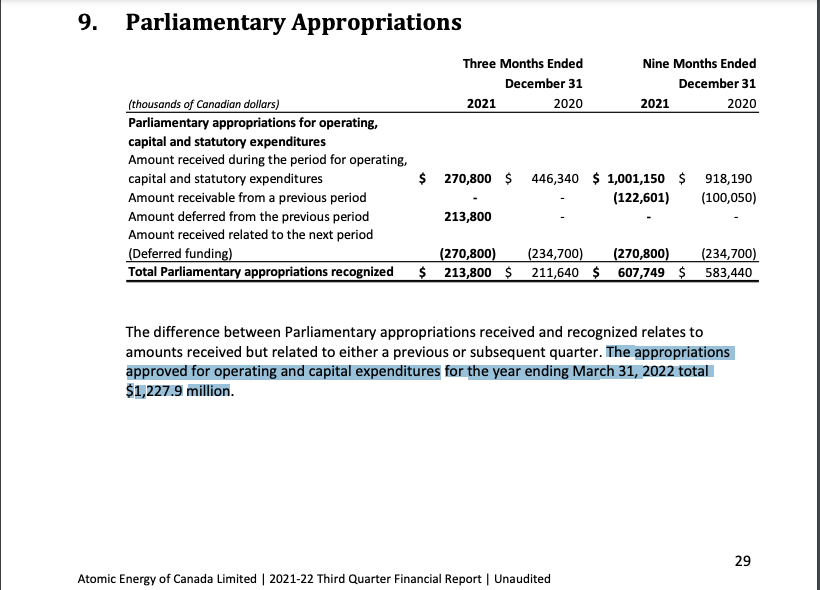
Update April 2022 ~ appropriations approved for year ending March 31, 2022 were $1.23 billion (see blue highlight below).

This table is from the Atomic Energy of Canada Limited 2021-22 Third Quarter Financial Report page 29

Nuclear Waste Liabilities

The figures for the nuclear waste liabilities are in the second last line in the table entitled Five-year financial summary, on page 36 of AECL’s annual report 2019-20 The report refers to the liabilities as “Decommissioning and waste management provision and contaminated sites liabilities”

In the farthest right column, the figure for 2106 is 7.87 billion which matches what the Auditor General reported in his special report in 2017 which said:

“One element of the Corporation’s mandate concerns decommissioning and waste management to deal with the results of decades of nuclear activities at the Corporation’s sites and with the cleanup of waste at orphan sites for which the federal government has assumed responsibility. The cost of this work is estimated at over $7.9 billion as of 31 March 2016.”


Report of the Auditor General of Canada to the Board of Directors of Atomic Energy of Canada Limited—Special Examination—2017 https://www.oag-bvg.gc.ca/internet/English/parl_oag_201711_07_e_42672.html

The figure on the farthest left is the amount of the liabilities for 2020. It is $8.06 billion or 8.1 billion, rounded to two figures.

The difference between the liabilities in 2016 at $7.9 billion and 2020 at $8.1 billion is a small increase of $200 million.

CNSC says climate change is not relevant to environmental assessment of SMRs

Canada’s first formal license application for an SMR is the “Micro Modular Reactor” in Chalk River.

CCRCA, and many others provided written interventions to the CNSC on “the scope of an environmental assessment for the proposed Micro Modular Reactor Project at the Chalk River Laboratories” prior to the one-person “Panel of Commission: R. Velshi, President” that rendered its decision on July 26th.

The CCRCA submission noted, in particular, that under the Impact Assessment Act, the proponent would be required to include as a “factor” in the EA ““the extent to which the effects of the designated project hinder or contribute to the Government of Canada’s ability to meet its environmental obligations and its commitments in respect of climate change.”

We added, “the CNSC has proposed that proponents assess the total GHG production as part of CNSC-led environmental assessments” in its fact sheet entitled “Greenhouse gas emission assessments for the Canadian nuclear fuel cycle,”  

The full CCRCA submission is available here.

Somehow, the Record of Decision on the project scope omits any mention of climate change.  

The CNSC’s decision on the scope of the MMR project indicates that climate change is not a relevant factor in the consideration of environmental impact of SMRs.

Here’s our take-away:

  • Reducing GHG emissions is a government priority.  This is reflected in the Impact Assessment Act.  The Minister of Natural Resources says nuclear power is essential to reduce GHGs (no path to net zero without nuclear) 
  • The CNSC did not include GHG emissions as a factor in assessing its first SMR license application – even when requested to do so – and even when its own “interim strategy for environmental assessments” calls for this.
  • The CNSC should not lead environmental assessments of nuclear reactors, including SMRs. 
  • The Physical Activities Regulations under the Impact Assessment Act should be changed to remove exemptions for new nuclear reactors.
Global Warming vs. Climate Change | Resources – Climate Change: Vital Signs  of the Planet

The Chalk River Mound and two reactor tombs would leak radioactive contaminants into the Ottawa and Winnipeg Rivers

November 5, 2020

The multinational consortium “Canadian National Energy Alliance” is proposing three substandard nuclear waste disposal projects. They are a giant above-ground mound alongside the Ottawa River at Chalk River, Ontario, for one million tons of radioactive waste and two “entombments” of old nuclear reactors beside the Ottawa and Winnipeg rivers, at Rolphton, Ontario and Pinawa, Manitoba.

The consortium was required to prepare Environmental Impact Statements for all three of its proposed disposal projects, as part of the Environmental Assessment process. Here are links to the three studies:

https://iaac-aeic.gc.ca/050/evaluations/document/119303 (Chalk River Mound aka NSDF)

https://iaac-aeic.gc.ca/050/evaluations/document/121057 (Rolphton entombment)

https://iaac-aeic.gc.ca/050/evaluations/document/120775 (Whiteshell entombment)

The EIS for the Chalk River Mound describes many ways that the mound would leak radioactive contaminants into the environment and the Ottawa River. The ways the mound would leak are summarized in this post:

How would the Chalk River Mound leak? Let us count some of the ways

This post describes the expected eventual disintegration of the Chalk River mound, using excerpts from the Environmental Impact Statement for the Chalk River Mound (NSDF) and supporting documents:

Consortium’s study appears to show the Chalk River mound would disintegrate

The cracking and leaking of the entombed reactors planned for Rolphton, Ontario and Pinawa, Manitoba is described in the Environmental Impact Statements and summarized in this post:

Proposed reactor tombs would leak radioactive materials into the Winnipeg and Ottawa Rivers for millennia

Consortium’s nuclear waste dump proposals fail to meet IAEA standards

November 5, 2020

The multinational consortium, Canadian National Energy Alliance, has been managing Canada’s nuclear facilities and radioactive wastes under a GoCo (Government-owned, Contractor-operated) contract since September 2015.

The consortium is proposing to quickly and cheaply dispose of all Canada’s federal radioactive wastes in a giant landfill beside the Ottawa River and two concrete “entombments” of old, highly radioactive nuclear reactors beside the Winnipeg and Ottawa rivers.

The proposals are undergoing protracted Environmental Assessments. They are mired in controversy and years behind schedule. Here are the links to Environmental Impact Statements for the three projects:

https://iaac-aeic.gc.ca/050/evaluations/document/119303 (NSDF)

https://iaac-aeic.gc.ca/050/evaluations/document/121057 (NPD)

https://iaac-aeic.gc.ca/050/evaluations/document/120775 (Whiteshell)

Part of the reason for the controversy is that the consortium’s proposals flout safety standards of the International Atomic Energy Agency. As a member state, Canada is supposed to follow IAEA guidance.

Here are some examples of IAEA guidance that is being flouted:

Decommissioning of Nuclear Power Plants, Research Reactors and Other Nuclear Fuel Cycle Facilities ~ Specific Safety Guide No. SSG-47, Vienna, 2018

The relevant text is section 5.17 on page 32 and it reads as follows:

Entombment, in which all or part of the facility is encased in a structurally long lived material, should not be considered an acceptable strategy for planned decommissioning (emphasis added). It might be considered as a last option for managing facilities that have been damaged in an accident, if other options are not possible owing to high exposures of workers or technical difficulties.

The IAEA Safety Standard for Disposal of Radioactive Waste says that the fundamental safety objective of radioactive waste management, including disposal, is “to protect people and the environment from harmful effects of ionizing radiation.” The strategy to achieve this objective with regard to disposal of radioactive waste is “to contain the waste and to isolate it from the accessible biosphere… [which] is taken generally to include those elements of the environment, including groundwater, surface water and marine resources, that are used by people or accessible to people.”

The NSDF proposal turns the IAEA standard on its head.  Rather than isolating radioactive wastes from groundwater and surface water, and disposing of them in stable environments ensuring long-term safety, it would use a design similar to a municipal landfill, in which wastes would be deliberately and routinely allowed to come into contact with the environment, including rain and snow. 

The NSDF proposal calls for a giant mound exposed to the elements.  Surface run-off from the mound would carry radionuclides into three storm-water management ponds.  These would discharge directly into the East Swamp wetland.  Sub-surface waters leaching through the mound would carry radionuclides through a collection system to a newly constructed water treatment facility.  This facility would remove some radionuclides (presumably for disposal using an unspecified method), while allowing others (e.g., tritium) to pass through untreated for release into the East Swamp stream, Perch Creek and the Ottawa River.

The NSDF proposal flouts IAEA guidance calling for “impermeable and water diverting features” for LLW disposal, and a “stable, geological environment” for ILW disposal.  Canada, which participates actively in development of IAEA Safety Standards, should not be allowed to flagrantly disregard them at a government-owned facility.

CNL’s use of the term NSDF — “Near Surface” Disposal Facility — is misleading.

This IAEA safety guide
“Near Surface Disposal Facilities for Radioactive Waste” Specific Safety Guide SSG-29 says on page 37

4.15. The concept of near surface disposal covers a wide range of facilities
(e.g. disposal at the surface in engineered vaults or trenches, or disposal at
varying depths — from a few metres to a few tens of metres — in facilities with various types of engineered barriers).

Proposed reactor tombs would leak radioactive materials into the Winnipeg and Ottawa Rivers for millennia

November 5, 2020

The proposed entombment at Rolphton, Ontario

Source document: Draft Environmental Impact Statement for the Nuclear Power Demonstration Closure Project

Here is a quote from the document: (emphases in red text added)

Normal Evolution Scenario

In this scenario, the facility is assumed to be closed as planned, with no unforeseen events. Parts of the NPDWF that lie below the water table will gradually resaturate. It is expected that resaturation may take several decades to complete. Once saturated, the soluble contaminants in the facility will begin to be released into the groundwater… The primary point of potential contaminant release into the biosphere is taken to be the riverbed close to the shore of the Ottawa River (pages 9-6 and 9-7)

·        Concrete/grout/cement:It is assumed that the grout will gradually degrade as the cement constituents are slowly leached out upon contact with groundwater… (page 2-24)

·        The cap: It is assumed that the cap starts to degrade 100 years after its emplacement and is assumed to have fully degraded (in terms of hydraulic performance) by 1,000 years after decommissioning is complete…. (page 2-24)

This is table 4.4-1 showing a partial inventory of the radioactive contaminants contained in the old NPD reactor, that will migrate into the Ottawa River in the “Normal Evolution Scenario”:

The proposed entombment at Pinawa, Manitoba

Source document: Draft Environmental Impact Statement for the In Situ Decommissioning of the Whiteshell Reactor #1 Project

Here is a quote from the document: (emphases added)

Following the encapsulation of WR-1 and the cessation of pumping from the sumps, the groundwater elevation will be restored to an equilibrium elevation and the majority of the grout (including the remaining components of the reactor) will be situated below the groundwater table... The assumption is that these materials will experience an increase in hydraulic conductivity as they degrade over time.  Simulations were completed to estimate the groundwater flow through the components of the decommissioned structure and results of these simulations were used as input to the analytical solute transport model.

The solute transport model was defined as a source area (representing the remaining solute mass contained within the decommissioned structure), a barrier for containment (the building foundation), a transport pathway (the bedrock, which receives flow from the decommissioned building via advection and diffusion through the barrier and into the surrounding fill material), and a receptor (the Winnipeg River).  (page 6-148)

The cover, grout, and foundation were assumed to degrade at rates comparable to other projects (i.e., Savannah River), which increased groundwater flow through time, resulting in total failure (degradation) of grout by year 10,000.  (page 6-202)

And here is Table 6.4.2-8 showing the radioactive materials that will migrate into the Winnipeg River after cessation of pumping and failure of the grout:


See also this post on the ways the the giant Chalk River Mound would leak radioactive contaminants into the Ottawa River: https://concernedcitizens.net/2020/11/04/the-proponents-own-study-shows-that-the-chalk-river-mound-will-disintegrate/