by Dr. Gordon Edwards, President of the Canadian Coalition for Nuclear Responsibility
December 19, 2020
Civilian nuclear and military nuclear have always been friendly room-mates, members of a “mutual admiration” society. In today’s announcement of an SMR Action Plan, Natural Resources Minister Seamus O’Regan said that nuclear power in Canada is a “home-grown” technology and referred to C. D. Howe’s role in this connection. In fact C.D. Howe arranged for all Canadian uranium extracted from Canadian mines to be sold to the US military for use in tens of thousands of nuclear weapons from 1945 to 1965. C D Howe was also on the Committee that met in Washington DC in 1944 to approve the first nuclear reactors to be built in Canada (at Chalk River) as part of the ongoing effort to produce plutonium for use as a nuclear explosive. Mr. Howe approved of the policy of selling plutonium produced at Chalk River to the US military for weapons use, a practice that continued until 1975 and beyond. Plutonium from Chalk River was sent to Britain (it was the first sample of plutonium that Britain had ever obtained) just a few months before Britain detonated its first A-Bomb in the Monte Bello Islands off Australia.
To the best of my knowledge, no civilian nuclear power agency – not the Canadian Nuclear Association, nor the Canadian Nuclear Society, nor the Canadian Nuclear Safety Commission, nor Atomic Energy of Canada Limited, nor Canadian Nuclear Laboratories, NOBODY – has ever issued a clear statement denouncing nuclear weapons or even calling for a nuclear weapons free world. Most nuclear scientists and engineers feel a strong kinship and camaraderie with those who are in the nuclear weapons business. The same goes for those in the nuclear division of Natural Resources Canada. I remember on one occasion (prior to the exchange of nuclear tests between India and Pakistan) I expressed alarm at the fact that both neighbours are developing a nuclear war-fighting capability and a couple of senior civil servants said “Would that be so bad? Maybe that’s just what the world needs. More deterrence. Creates stability”
Despite regular denials from our puppet masters that civilian nuclear has nothing to do with military nuclear, it is clear that civilian nuclear (including the frankly discriminatory provisions of the NPT) has adopted an appeasement policy that will never succeed in bringing about a nuclear weapons free world. Why does Canada continue to sell uranium to countries that are in the process of investing hundreds of billions to improve and modernize the nuclear arsenals in utter defiance of the NPT, knowing that the vast bulk of Canadian uranium that is rejected from enrichment plants as DU end up as the raw material for producing plutonium for Bombs, and that the lion’s share of the explosive power – and the overwhelming share of the radioactive fallout – of every H-bomb comes from the fissioning of DU atoms that are freely accessed by the military even if they are the leftovers of “peaceful” fuel production for nuclear power plants?
“The indigenous UK supply chain that supports defence nuclear programmes requires significant ongoing support to retain talent and develop and maintain capability between major programmes. Opportunities for the supply chain to invest in new capability are restricted by the limited size and scope of the defence nuclear programme. A UK SMR programme would increase the security, size and scope of opportunities for the UK supply chain significantly, enabling long-term sustainable investment in people, technology and capability.
“Expanding the talent pool from which defence nuclear programmes can draw from would bring a double benefit. First, additional talent means more competition for senior technical and managerial positions, driving excellence and performance. Second, the expansion of a nuclear-capable skilled workforce through a civil nuclear UK SMR programme would relieve the Ministry of Defence of the burden of developing and retaining skills and capability. This would free up valuable resources for other investments.”
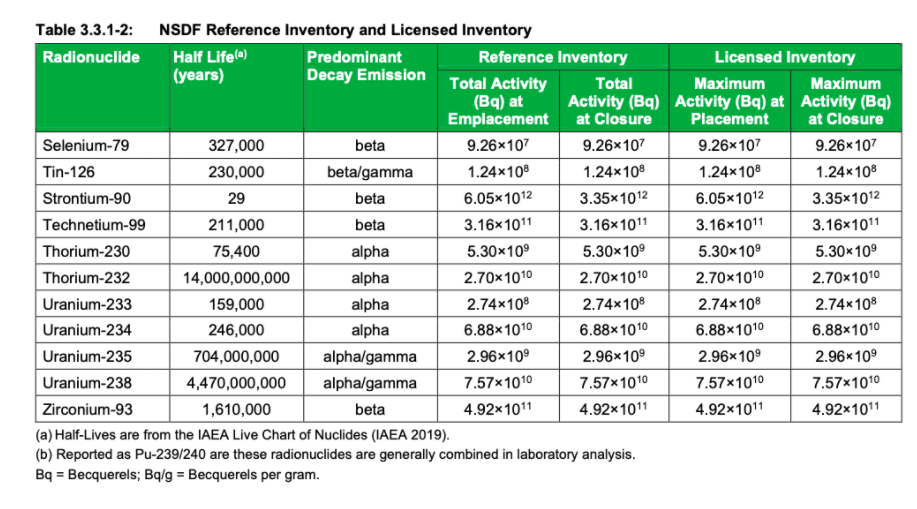
Note that the table includes four isotopes of plutonium.
Note also that Twenty-five out of the 30 radionuclides listed are long-lived, with half-lives ranging from four centuries to more than four billion years. Materials such as these are not supposed to be disposed of in above-ground landfills according to the International Atomic Energy Agency.
As noted in the recent Hill Times op-ed by Eva Schacherl, Political Opposition Growing to New Reactors, both small modular nuclear reactors AND the high-level fuel waste they produce are EXEMPT from environmental assessment in Canada
From the op-ed:
“The Impact Assessment Act was intended to create “greater public trust in impact assessment and decision-making.” But there will be no federal assessment of nuclear reactors up to 200 thermal MW in size, nor of new reactors built at existing nuclear plants (up to 900 MWth). Yet new tidal power projects, as well as offshore wind farms with 10 or more turbines, need an assessment under the regulations, as do many new fossil fuel projects.”
“Also exempted from federal assessment is the “on-site storage of irradiated nuclear fuel or nuclear waste” associated with small modular reactors. This will make it easier for SMRs’ radioactive waste to be potentially left in the northern, remote, and First Nations communities, where they are proposed to be built.”
This SMR fuel waste exemption was a last-minute insertion in the Impact Assessment Act regulations. It is found in section 28 of the Physical Activities Regulations (the so-called ‘project list’ for the new Impact Assessment Act and reads as follows:
28 The construction and operation of either of the following:(a) a new facility for the storage of irradiated nuclear fuel or nuclear waste, outside the licensed boundaries of an existing nuclear facility, as defined in section 2 of the Nuclear Safety and Control Act, other than a facility for the on-site storage of irradiated nuclear fuel or nuclear waste associated with one or more new fission or fusion reactors that have a combined thermal capacity of less than 200 MWth;
As far the fuel waste from the proposed SMR (the “MMR Project“) at Chalk River is concerned, there is another exemption in section 28 – the phrase “outside the licensed boundaries of an existing nuclear facility” allows it to be kept on site at Chalk River, a licensed nuclear facility.
Artist’s rendering of a prototype small nuclear reactor plant. Under Canadian legislation, the whole plant along with the irradiated nuclear fuel it produced could become a radioactive exclusion zone, permanently off limits to humans
The nuclear industry and Liberals have not only been laying the groundwork for government funding. It appears they have been ensuring that the framework for nuclear energy in Canada gets even more accommodating.
Natural Resources Minister Seamus O’Regan has been hyping so-called next-generation reactors for months, portraying the industry as a future utopia. The Hill Times photograph by Andrew Mead.
Many Canadians are anxious to see what our energy future will be. Politically, it’s a question that stirs passions from Alberta’s oil patch to Ontario’s cancelled wind farms.
But political debate is picking up around our nuclear energy future. And with good reason. Government-funded expansion of the nuclear industry, and a simultaneous watering-down of regulations, could be the Liberal government’s toxic legacy.
The Green Party caucus, the NDP’s natural resources critic Richard Cannings, and the Bloc Québécois’s environment critic Monique Pauzé have all slammed O’Regan’s expected small modular reactor (SMR) “action plan.” They say it does not belong in a plan to reduce greenhouse gas emissions. Energy efficiency, wind, solar, and storage technologies are ready to build, and much cheaper, according to Lazard, a financial advisory and asset management firm. The prototype reactors will take years, if not decades, to develop, and could absorb hundreds of millions, even billions, in taxpayer subsidies, according to Greenpeace Canada.
That would mean opportunities lost for those dollars to build many times the amount of zero-emission energy with renewables and energy-efficiency projects. The latter would not create toxic radioactive waste for future generations to contend with.
Independent research says that a nuclear solution for remote communities (as proposed by the government) is likely to cost 10 times more to build and operate than the alternatives.
It seems inevitable that the Liberal action plan will soon be launched with generous handouts for the nuclear industry, whose aspiring players in Canada today include SNC-Lavalin and U.S. corporations like Westinghouse and GE-Hitachi Nuclear Energy. Few Canadians are aware that “Canadian” Nuclear Laboratories (CNL) is owned by a consortium of SNC-Lavalin and two U.S. firms, Fluor and Jacobs.
In recent years, the nuclear industry and Liberals have not only been laying the groundwork for government funding. It appears they’ve also been ensuring that the framework for nuclear energy in Canada gets even more accommodating.
The biggest step was exempting most new reactors from the Impact Assessment Act, which, in 2019, replaced the Canadian Environmental Assessment Act. This was deemed so important to the nuclear industry’s future that the Canadian Nuclear Safety Commission (CNSC) lobbied the Liberal government to exempt small reactors—and won. So much for the CNSC, the regulator that’s supposed to oversee the industry, being seen as objective and “world class.”
The Impact Assessment Act was intended to create “greater public trust in impact assessment and decision-making.” But there will be no federal assessment of nuclear reactors up to 200 thermal MW in size, nor of new reactors built at existing nuclear plants (up to 900 MWth). Yet new tidal power projects, as well as offshore wind farms with 10 or more turbines, need an assessment under the regulations, as do many new fossil fuel projects.
Also exempted from federal assessment is the “on-site storage of irradiated nuclear fuel or nuclear waste” associated with small modular reactors. This will make it easier for SMRs’ radioactive waste to be potentially left in the northern, remote, and First Nations communities, where they are proposed to be built.
The nuclear regulator has also been responsible for introducing a suite of “regulatory documents” on reactor decommissioning and radioactive waste that environmental groups have called “sham regulation.”
Meanwhile, the bureaucrats at the CNSC have been busy signing a memorandum of cooperation with the U.S. Nuclear Regulatory Commission on Small Modular Reactors. This agreement means that Canada can recognize U.S. reviews of reactor designs in order to “streamline the review process.”
CNSC has also outlined its plan in a document called Strategy for Readiness to Regulate Advanced Reactor Technologies. In a nutshell, the document says that regulations for new reactor designs will have to be flexible. It notes that CNSC regulated the earlier generation of water-cooled reactors (such as CANDUs) at first based on “objectives” in the 1950s and ‘60s. Then, as experience with these reactors evolved, regulations became more detailed and prescriptive. It says the same may have to happen with the new next-gen reactor designs.
In the 1950s, there were indeed few “prescriptive requirements” for the newfangled reactors. In 1952, the NRX reactor at Chalk River, Ont., had a meltdown. It was the first large-scale nuclear reactor accident in the world and took two years to clean up—which, by 1950s standards, included pumping 10,000 curies of long-lived fission products into a nearby sandy area. Then in 1958, the NRU reactor at Chalk River—a test bed for developing fuels and materials for the CANDU reactor—had a major accident, a fuel-rod fire that contaminated the building and areas downwind. It took 600 workers and military personnel to do the top-secret clean-up.
Let’s hope today’s regulators and lawmakers can learn from history. Does Canada really need or want to be the “leading-edge” testing ground for new experimental nuclear reactors? Canadians should have their say in a referendum—or at the ballot box.
Eva Schacherl is an Ottawa-based environmentalist.
Honorable Jean-Yves Duclos, président du Conseil du Trésor
Honorable Joyce Murray, vice-présidente du Conseil du Trésor
Honorable Bardish Chagger, membre du Conseil du Trésor
Honorable Catherine McKenna, membre du Conseil du Trésor
Honorable Chrystia Freeland, membre du Conseil du Trésor
Honorable Jonathan Wilkinson, membre du Conseil du Trésor
Distingués Monsieur Duclos et membres du Conseil du Trésor,
Le 21 septembre 2020, nous vous avons écrit en tant que femmes dirigeantes dans des milieux communautaires et autochtones, en sciences, médecine, droit et protection de l’environnement afin de vous demander de cesser de financer le développement de nouveaux petits réacteurs nucléaires modulaires (appelés PRM). Le Canada est membre d’un traité international sur les déchets radioactifs et il doit s’acquitter de ses obligations légales de minimiser la production des déchets radioactifs. Le financement fédéral des PRM serait une abnégation de ses obligations en vertu de ce traité.
Aujourd’hui, d’autres femmes dirigeantes de toutes les provinces et territoires du Canada et de plusieurs sites des Premières Nations se joignent à nous. Nous vous exhortons fortement à rejeter les nouveaux PRM. Le gouvernement fédéral fait la promotion des PRM comme une solution miracle pour faire face à l’urgence climatique. C’est complètement faux!
En fait, les PRM ne constituent certainement pas une action rapide et efficace pour faire face à l’urgence climatique. Ils ne pourront atteindre la phase de production avant 10 ou 15 ans. C’est trop tard pour réduire les gaz à effet de serre. C’est engloutir de l’argent inutilement qui serait mieux dépensé dans des technologies à faible émission de carbone peu coûteuses et prêtes à utiliser.
Les énergies solaire et éolienne sont devenues les sources d’électricité les moins coûteuses et les plus répandues dans le monde. En 2018, le rapport de Deloitte, Global Renewable Energy Trends: Solar and Wind Move from Mainstream to Preferred a conclu que « les sources d’énergie traditionnelles solaires et éoliennes ont franchi un nouveau seuil, car elles sont devenues les sources d’énergie préférées dans une grande partie du monde ». Selon le rapport, les énergies solaire et éolienne alimentent davantage les réseaux électriques. Elles comptent parmi les sources d’énergie les moins chères au monde et elles sont très prometteuses. Le rapport souligne que l’intermittence des énergies solaire et éolienne n’est plus un problème étant donné les progrès rapides des technologies de stockage. Le Canada devrait financer un plus vaste déploiement des sources d’énergie solaire et éolienne.
Le financement pour améliorer l’efficacité et la conservation de l’énergie constituerait une meilleure utilisation des deniers publics que les subventions à l’industrie nucléaire. Un rapport présenté en juin 2018 par le Conseil Génération Énergie au ministre des Ressources naturelles Canada a révélé que : « Les meilleures possibilités qui se présentent au Canada pour économiser, diminuer les émissions de gaz à effet de serre et créer des emplois sont liées à une réduction radicale du gaspillage d’énergie. L’amélioration de l’efficacité énergétique nous permettrait d’atteindre un tiers de notre engagement en matière d’émissions en vertu de l’Accord de Paris sur le climat. »
Nous vous exhortons à dire «non» à l’industrie nucléaire qui demande des milliards de dollars de fonds publics pour subventionner une technologie dangereuse, excessivement polluante et coûteuse, et dont nous n’avons pas besoin. Investissez plutôt dans les énergies renouvelables, et dans l’efficacité et la conservation de l’énergie. Cela créera des milliers d’emplois et réduira rapidement les émissions de gaz à effet de serre.
Il ne faut jamais oublier que le principal produit des réacteurs nucléaires – en termes de répercussions planétaires – sont les déchets radioactifs dangereux et même mortels pour toute vie sur terre, et ce pendant des centaines de milliers d’années.
Il ne faut jamais oublier que le principal produit des réacteurs nucléaires – en termes de répercussions planétaires – sont les déchets radioactifs dangereux et même mortels pour toute vie sur terre, et ce pendant des centaines de milliers d’années. Il n’existe pas de moyen sûr éprouvé pour empêcher les déchets radioactifs de pénétrer dans l’environnement des êtres vivants.
Veuillez consulter la pétition environnementale 419, soumise au vérificateur général du Canada en novembre 2018, pour plus de détails sur les raisons pour lesquelles le Canada devrait refuser d’octroyer des subventions de plusieurs milliards à l’industrie nucléaire.
Nous vous exhortons à porter cette question à l’attention de vos collègues du Cabinet et à mettre fin à tout soutien gouvernemental aux petits réacteurs nucléaires modulaires avec l’argent des contribuables.
Veuillez recevoir l’expression de nos sentiments les plus sincères,
Alexandra Hayward, B. Sc., candidate au diplôme Juris Doctor, St. John’s, Terre-Neuve-et-Labrador.
Alma H. Brooks, Wolastoqew and Eastern Wabanaki (Nouveau-Brunswick)
Angela Bischoff, Toronto, Ontario
Ann Coxworth, M. Sc., Saskatoon, Saskatchewan
Anne Lindsey, O.M., M.A., Winnipeg, Manitoba
Ann Pohl, MEd, Killaloe, Ontario
Anna Tilman, B. Sc. Physique, M.A. Biophysique médicale, Aurora, Ontario
Chef April Adams-Phillips, Conseil Mohawk d’Akwesasne (Québec)
OTTAWA—A contract quietly signed during the 2015 federal election campaign between Atomic Energy of Canada Limited (AECL) and a multinational consortium is costing Canadians billions of dollars and increasing risks to health from deadly radioactive pollutants.
The multi-billion dollar contract was an attempt by the former federal Conservative government to reduce Canada’s $7.9-billion nuclear waste liability quickly and cheaply by creating a public-private partnership or GoCo (government-owned, contractor-operated) contract.
The GoCo contractor is called the “Canadian National Energy Alliance” (CNEA) even though the majority of its members are foreign corporations. It currently consists of Fluor and Jacobs, two Texas-based multinationals involved in nuclear weapons production, and SNC-Lavalin. Under the contract, the consortium assumed control over all Canada’s federal nuclear facilities and radioactive wastes.
Since the GoCo contract was signed, costs to Canadian taxpayers appear to have almost quadrupled. According to AECL financial reports, its parliamentary appropriations rose from $327-million in 2015 to $1.3-billion (approved) for the year ending March 31, 2021. AECL’s nuclear waste liabilities have not gone down, but rather appear to have increased by about $200-million.
The Crown corporation, Atomic Energy of Canada Limited, was supposed to oversee the contract on behalf of the Government of Canada but may not have been in a position to do so. Serious problems at AECL were identified by the Auditor General in a 2017 report. Problems included lack of a board chair, lack of a CEO, no board directors at all for 2016 and most of 2017, failure to hold public meetings and lack of experience with the GoCo model.
Since 2015, it appears that the GoCo contractor has spent hundreds of millions of our tax dollars promoting three radioactive waste facilities that we believe to be quick, cheap, and substandard. They are: a giant, above-ground mound beside the Ottawa River at Chalk River, Ontario, for one million tonnes of mixed radioactive and non-radioactive wastes including plutonium, and entombment in concrete of two old nuclear reactors beside the Ottawa and Winnipeg rivers which provide drinking water to millions of Canadians.
More than two dozen submissions to the Impact Assessment Agency from ex-AECL nuclear waste experts including senior scientists and senior managers highlight serious concerns about the three projects and point out that they fail to meet international safety standards.
The consortium’s own studies show that all three facilities would leak radioactive contaminants into the environment and drinking water sources for millennia.
The consortium’s own studies show that all three facilities would leak radioactive contaminants into the environment and drinking water sources for millennia.
According to the consortium’s draft environmental impact statement, it appears that the giant Chalk River mound is expected to eventually disintegrate, in a process referred to as “normal evolution”. At that time, its radioactive and hazardous contents would flow out of the mound into surrounding wetlands that drain into the Ottawa River less than a kilometre away.
Hundreds of concerns about the three projects have been voiced by federal and provincial government departments, First Nations, civil society groups, 140 Quebec municipalities, nuclear waste experts, and concerned citizens. And yet the projects continue to lumber forward and the consortium continues to receive almost a billion dollars a year from Canadian taxpayers.
Does anyone in government have their eyes on this ball? Did they notice when AECL renewed the GoCo contract early in the pandemic lockdown, 18 months before expiry, despite the recent conviction of consortium partner SNC-Lavalin on a charge of fraud? Are they concerned by the rapidly rising costs and substandard proposals?
…the giant Chalk River mound is expected to eventually disintegrate, in a process referred to as “normal evolution”. At that time, its radioactive and hazardous contents would flow out of the mound into surrounding wetlands that drain into the Ottawa River less than a kilometre away.
Are they aware that the consortium is bringing thousands of truckloads of radioactive waste to Chalk River from other federal facilities in Manitoba, Ontario, and Quebec? The Chalk River Laboratories site is not a good place to consolidate federal nuclear waste either for temporary or for long-term storage. It is seismically active and adjacent to the Ottawa River, source of drinking water for Ottawa-Gatineau, Montreal, and many other communities.
With all of the problems currently facing the world, one might ask, “Why should Canadians care about this nuclear waste problem?”
Radioactive waste is the deadliest waste on the planet. Nuclear reactors create hundreds of dangerous radioactive substances that remain toxic to all life for hundreds of thousands of years. Exposure can cause serious chronic diseases, birth defects, and genetic damage that is passed on to future generations. According to the U.S. National Research Council, there is no safe level of exposure to ionizing radiationreleased from nuclear reactors and nuclear waste facilities. And yet Canada is pouring billions of dollars into projects that will not keep these poisons out of our environment and drinking water.
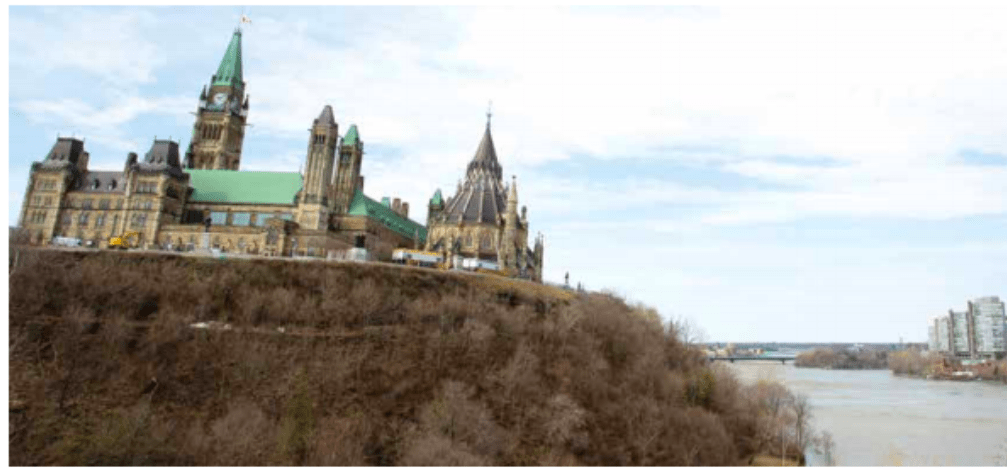
The Ottawa River is a Canadian Heritage River that flows past Parliament Hill—surely we don’t want to be the generation responsible for permanently contaminating it with radioactive waste.
Surely we can and must do better. The Ottawa River is a Canadian Heritage River that flows past Parliament Hill—surely we don’t want to be the generation responsible for permanently contaminating it with radioactive waste.
If we are going to spend a billion dollars a year managing our nuclear waste, let’s do it right. Let’s meet or exceed international standards and build secure storage facilities, well away from drinking water sources. Let’s make sure the wastes are carefully packaged and labelled and stored in monitored and retrievable conditions. This approach will create thousands of good, long-lasting careers in the nuclear waste and decommissioning field and show the world what top tier radioactive waste storage facilities look like.
Dear Mr. Duclos and Members of the Treasury Board:
On September 21, 2020 we wrote to you as women who are Indigenous and non-Indigenous community leaders in science, medicine, law and environmental protection to ask you to stop funding new nuclear reactors. Canada is a member of an international nuclear waste treaty and has a legal obligation to minimize generation of radioactive waste. Federal funding for new nuclear reactors would be an abnegation of this treaty obligation.
Today we are joined by women colleagues from all provinces and territories in Canada and several Indigenous communities. We strongly urge you to reject new nuclear reactors, called “SMRs.” They are being promoted to your government as a silver bullet to address the climate emergency. This is a false notion.
We strongly urge you to reject new nuclear reactors, called “SMRs.” They are being promoted to your government as a silver bullet to address the climate emergency. This is a false notion.
In fact, SMRs prevent swift, effective action to address the climate emergency. SMRs are many years away from production. They would take far too long to reduce greenhouse gas emissions. They suck money and attention away from inexpensive low-carbon technologies that are ready to deploy now.
Solar and wind power are already the cheapest and fastest-growing electricity sources in the world. A 2018 Deloitte report, “Global Renewable Energy Trends: Solar and Wind Move from Mainstream to Preferred” concluded: “Solar and wind power recently crossed a new threshold, moving from mainstream to preferred energy sourcesacross much of the globe”. The report noted that solar and wind power enhance electrical grids. It also pointed out that intermittency is no longer a concern owing to rapid advances in storage technology. Canada should fund much wider deployment of solar and wind power.
More funding for energy efficiency and energy conservation would also be a much better use of tax dollars than handouts to the nuclear industry. The 2018 report presented by the Generation Energy Council to Canada’s Minister of Natural Resources found that: “Canada’s greatest opportunities to save money, cut greenhouse gas emissions and create jobs can be found in slashing energy waste. Fully one-third of our Paris emissions commitment could be achieved by improving energy efficiency.”
We urge you to say “no” to the nuclear industry that is asking for billions of dollars in taxpayer funds to subsidize a dangerous, highly-polluting and expensive technology that we don’t need. Instead, put more money into renewables, energy efficiency and energy conservation. This will create many thousands of jobs and quickly reduce greenhouse gas emissions.
We must never forget that the main product of nuclear reactors — in terms of planetary impact — is deadly radioactive poisons that remain hazardous to all life on earth for hundreds of thousands of years. The electricity they produce for a few short decades is but a minor by-product.
We must never forget that the main product of nuclear reactors — in terms of planetary impact — is deadly radioactive poisons that remain hazardous to all life on earth for hundreds of thousands of years. The electricity they produce for a few short decades is but a minor by-product. There is no proven safe method for keeping radioactive waste out of the environment of living things for hundreds of thousands of years.
Please see Environmental Petition 419, submitted to the Auditor General of Canada in November 2018, for more detail on why Canada should refuse multibillion dollar handouts to subsidize the nuclear industry.
We urge you to bring this matter to the attention of your Cabinet colleagues, and stop all government support and taxpayer funding for so-called small modular nuclear reactors.
Yours sincerely,
Alma H. Brooks, Wolastoqew and Eastern Wabanaki (New Brunswick)
Chief April Adams-Phillips, Mohawk Council of Akwesasne (Quebec)
Candyce Paul, English River First Nation (Saskatchewan)
Ellen Gabriel, Mohawks of Kanehsatà:ke (Quebec)
Eriel Deranger, Member of the Athabasca Chipewyan First Nation, Treaty 8 (Alberta)
Hilu Tagoona, BA, Qairnimiut Inuk, (Nunavut)
Dr. Imelda Perley Opolahsomuwehs, Neqotkuk First Nation (New Brunswick)
Joan Scottie, Inuk, Nunavut Makitagunarngningit, Baker Lake, Nunavut
Lorraine Rekmans, member of the Serpent River First Nation (Ontario)
Dr. Lynn Gehl, PhD, Algonquin – Pikwakanagan First Nation (Ontario)
Mary Alice Smith, BA, Metis Cree, Robinson-Superior Treaty area, Longbow Lake (Ontario)
Mary Lou Smoke, Anishinawbe Kwe, Bear Clan
Neecha Dupuis, Ojibway Nation of SAUGEEN Indian Tribe No. 258 Savant Lake (Ontario)
Renee Abram, Oneida First Nation of the Thames (Ontario)
Serena Kenny, Lac Seul First Nation (Ontario)
Stefanie Bryant, BA, Lac Seul First Nation (Ontario)
Alexandra Hayward, BSc, JD Candidate, St. John’s, Newfoundland and Labrador
Angela Bischoff, Toronto, Ontario
Anna Tilman, BA Physics, MA Medical Biophysics, Aurora, Ontario
Ann Coxworth, MSc, Saskatoon, Saskatchewan
Ann Pohl, MEd, Killaloe, Ontario
Anne Lindsey, Order of Manitoba, MA, Winnipeg, Manitoba
Dr. Auréa Cormier, PhD, Order of Canada, Moncton, New Brunswick
Dr. Barbara Birkett, MDCM, FRCPC, Oakville, Ontario
Beatrice Olivastri, Ottawa, Ontario
Betty L. E. Wilcox, BA, BEd, Stanhope, Prince Edward Island
Brenda Brochu, BA, BEd, Peace River, Alberta
Brennain Lloyd, North Bay, Ontario
Carole Dupuis, Saint-Antoine-de-Tilly, Québec
Carolyn Wagner, MEd, Fredericton, New Brunswick
Catherine Cameron, BSc., MBA, Perth Ontario
Dr. Cathy Vakil, MD, Kingston, Ontario
Dr. Cecily Mills, PhD Microbiology, Edmonton, Alberta
Chantal Levert, Montréal, Québec
Dr. Charlotte Rigby, PhD, Gatineau, Quebec
Chris Cavan, BEd, Almonte, Ontario
Dr. Dale Dewar, MD, Wynyard, Saskatchewan
Dr. Darlene Hammell, MD, Victoria, British Columbia
Deborah Powell, BA, BEd, Bristol, Quebec
Diane Beckett, BES, MA, Churchill, Manitoba
Diane Fortin, Gatineau, Québec
Dr. Dorothy Goldin Rosenberg, PhD, Toronto, Ontario
Elizabeth Logue, Wakefield, Quebec
Elssa Martinez, MSW, Montreal, Quebec
Emma March, MA, JD candidate, Kingston, Ontario
Dr. Erica Frank, MD, MPH, FACPM; Nanoose Bay, British Columbia
Eva Schacherl, MA, Ottawa, Ontario
Evelyn Gigantes, BA, former MPP, Ottawa, Ontario
Gail Wylie, Fredericton, New Brunswick
Gini Dickie, BA, Toronto, Ontario
Ginette Charbonneau, Physicist, Oka, Quebec
Gracia Janes, Ontario Medal for Citizenship, Niagara-on-the-Lake Ontario
Gretchen Fitzgerald, BSc, Halifax, Nova Scotia
Janet Graham, MA, Ottawa, Ontario
Dr. Janet Ray MD, Victoria, British Columbia
Dr. Janice Harvey, PhD, Fredericton, New Brunswick
Jean Brereton, Golden Lake, Ontario
Jean Swanson, Order of Canada, BA, City Councillor, Vancouver, British Columbia
Dr. Jeannie Rosenberg, MD, Huntingdon, Quebec
Jessica Spencer, Moncton, New Brunswick
Joann McCann-Magill, MA, Sheenboro, Quebec
Joanne Mantha, MA, Gatineau, Quebec
Jocelyne Lachapelle, Framton, Québec
Johanna Echlin, MEd, Westmount, Quebec
Julie Reimer, MMM, Kingston, Ontario
Dr. Judith Miller, PhD, Ottawa, Ontario
Kathrin Winkler, BA, Halifax, Nova Scotia
Dr. Kathryn Lindsay, PhD, Renfrew, Ontario
Kay Rogers, BA, MA, MSc, Perth Ontario
Kerrie Blaise, MSc, JD, North Bay, Ontario
Kim Reeder, MEM (Environmental Management), Saint Andrews, New Brunswick
Dr. Kringen Henein, PhD, Ottawa Ontario
Larissa Holman, BSc, MREM, Gatineau, Quebec
Dr. Laure Waridel, PhD, Order of Canada, Montréal, Québec
Lenore Morris, BA, MBA, JD, Whitehorse, Yukon
Liette Parent-Leduc, B.A.A., D. Fisc, Saint-Robert, Québec
Lisa Aitken, MEd, HRM, Winnipeg, Manitoba
Dr. Louise Comeau, PhD, Keswick Ridge, New Brunswick