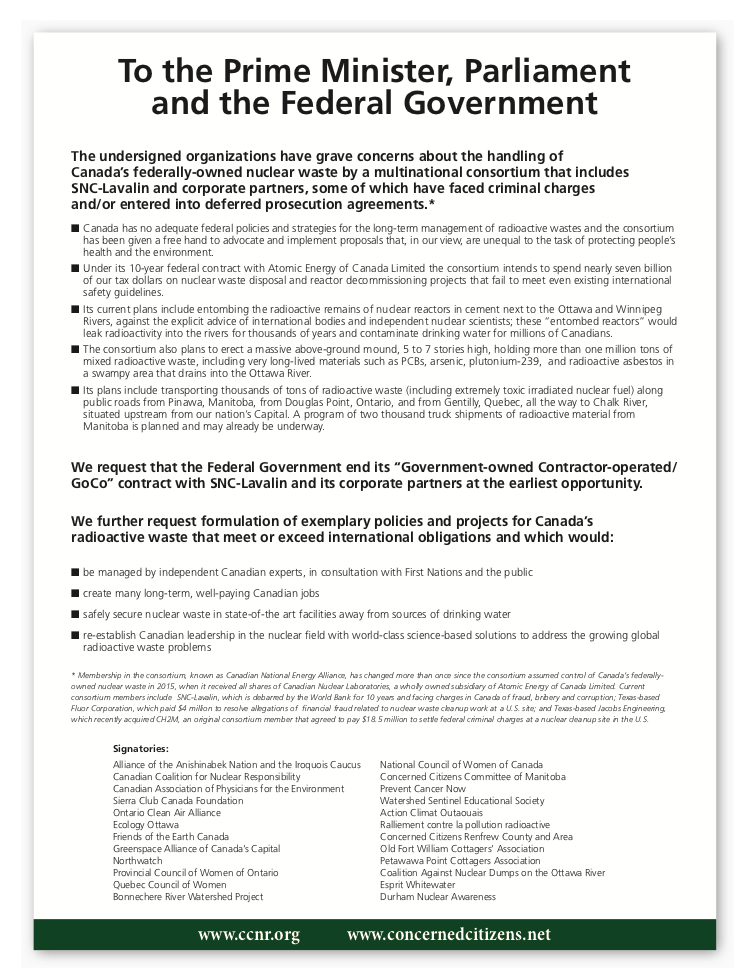
Chalk River Nuclear Waste ~ Full-page statement in the Hill-Times newspaper (April 29, 2019)

To the Prime Minister, Parliament and the Federal Government

The undersigned organizations have grave concerns about the handling of Canada’s federally-owned nuclear waste by a multinational consortium that includes SNC-Lavalin and corporate partners, some of which have faced criminal charges and/or entered into deferred prosecution agreements.*

●      Canada has no adequate federal policies and strategies for the long-term management of radioactive wastes and the consortium has been given a free hand to advocate and implement proposals that, in our view, are unequal to the task of protecting people’s health and the environment.

●       Under its 10-year federal contract with Atomic Energy of Canada Limited the consortium intends to spend nearly seven billion of our tax dollars on nuclear waste disposal and reactor decommissioning projects that fail to meet even existing international safety guidelines.

●      Its current plans include entombing the radioactive remains of nuclear reactors in cement next to the Ottawa and Winnipeg Rivers, against the explicit advice of international bodies and independent nuclear scientists; these “entombed reactors” would leak radioactivity into the rivers for thousands of years and contaminate drinking water for millions of Canadians.

●     The consortium also plans to erect a massive above-ground mound, 5 to 7 stories high, holding more than one million tons of mixed radioactive waste, including very long-lived materials such as PCBs, arsenic, plutonium-239,  and radioactive asbestos in a swampy area that drains into the Ottawa River.

●     Its plans include transporting thousands of tons of radioactive waste (including extremely toxic irradiated nuclear fuel) along public roads from Pinawa, Manitoba, from Douglas Point, Ontario, and from Gentilly, Quebec, all the way to Chalk River, situated upstream from our nation’s Capital. A program of two thousand truck shipments of radioactive material from Manitoba is planned and may already be underway.

We request that the Federal Government end its “Government-owned Contractor-operated/GoCo” contract with SNC-Lavalin and its corporate partners at the earliest opportunity.

We further request formulation of exemplary policies and projects for Canada’s radioactive waste that meet or exceed international obligations and which would:

●      be managed by independent Canadian experts, in consultation with First Nations and the public 

●      create many long-term, well-paying Canadian jobs

●      safely secure nuclear waste in state-of-the art facilities away from sources of drinking water

●      re-establish Canadian leadership in the nuclear field with world-class science-based solutions to address the growing global radioactive waste problems 

Membership in the consortium, known as Canadian National Energy Alliance, has changed more than once since the consortium assumed control of Canada’s federally-owned nuclear waste in 2015, when it received all shares of Canadian Nuclear Laboratories, a wholly owned subsidiary of Atomic Energy of Canada Limited.  Current consortium members include  SNC-Lavalin, which is debarred by the World Bank for 10 years and facing charges in Canada of fraud, bribery and corruptionTexas-based Fluor Corporation, which paid $4 million to resolve allegations of  financial fraud related to nuclear waste cleanup work at a U.S. site; and Texas-based Jacobs Engineering, which recently acquired CH2M, an original consortium member that agreed to pay $18.5 million to settle federal criminal charges at a nuclear cleanup site in the U.S.

Signatories:

Alliance of the Anishinabek Nation and the Iroquois Caucus, Canadian Coalition for Nuclear Responsibility, Canadian Association of Physicians for the Environment, Sierra Club Canada Foundation, Ontario Clean Air Alliance, Ecology Ottawa, Friends of the Earth Canada, Greenspace Alliance of Canada’s Capital, Northwatch, Provincial Council of Women of Ontario, Quebec Council of Women, National Council of Women of Canada, Concerned Citizens Committee of Manitoba, Prevent Cancer Now, Watershed Sentinel Educational Society, Action Climat Outaouais, Ralliement contre la pollution radioactive, Concerned Citizens Renfrew County,  and Area, Old Fort William Cottagers’ Association, Petawawa Point Cottagers Association, Coalition Against Nuclear Dumps on the Ottawa River,  Esprit Whitewater, Durham Nuclear Awareness, Bonnechere River Watershed Project

As it appeared in the Hill Times on April 29, 2019…

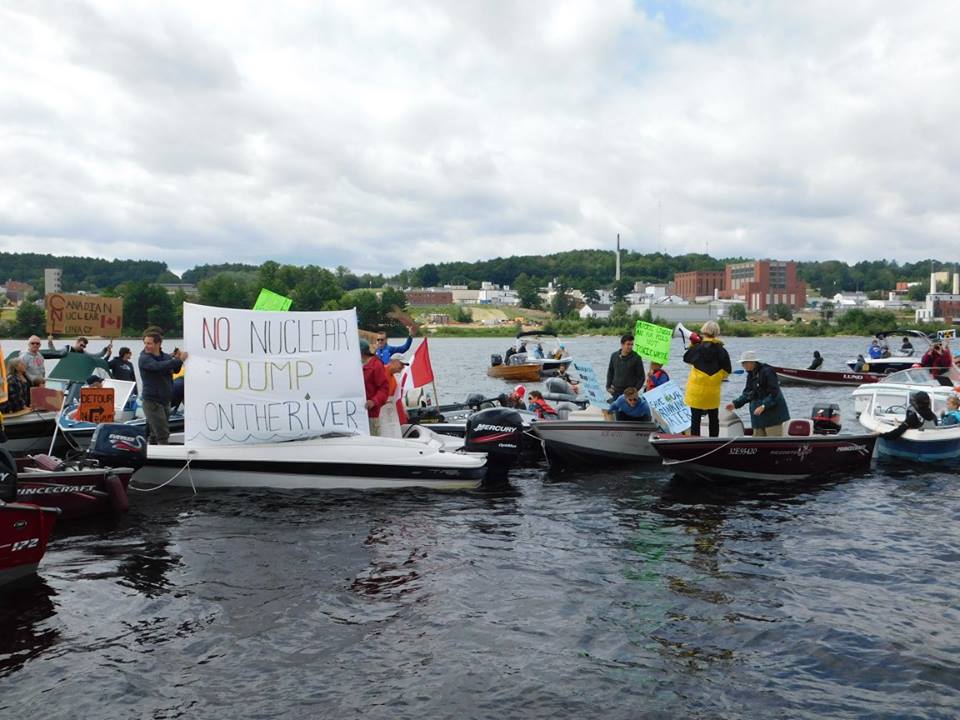
Boat flotilla protest planned for July 27, 2019

Protect the Ottawa River! ~Join us for this peaceful protest in opposition to Canadian Nuclear Laboratories’ proposed radioactive waste dump on the shores of the Ottawa River

This photo is from Chalk River Boat Flotilla Protest V1 in July 2017


Details:

Morning conference: 10:00 – 11:30 am on July 27 at Hotel Pontiac, Fort William (all invited)Several speakers will discuss CNL’s proposals for radioactive waste mound at Chalk River, entombment of NPD reactor at Rolphton, and the transport of nuclear waste to Chalk River from other locations. There will be networking and refreshments.
Media will be invited for conference and flotilla
Following the morning conference, there will be two boating options. Motor boats will leave Fort William Dock at 12:00 noon to arrive in the water in front of Chalk River Laboratories by 1:00 pm

Canoes and kayaks will go for a guided scenic tour of the shoreline and nearby islands.

If you’d like to help promote this event, you can download the poster here.

ACTION ALERT ~ tell the federal government that nuclear energy is not “clean”

ACTION ALERT ~ Tell the federal government that nuclear energy is not clean


The government of Canada is asking for comments on its “sustainable development” strategy. The deadline for comments is Tuesday April 2, 2019.
In its glossary of terms, the strategy includes the following definition:
“Clean energy: Renewable, nuclear, and carbon capture and storage technologies, as well as demand reduction through energy efficiency”

Can you help get the message across to our government that nuclear energy is not clean? It only takes a minute to send a comment using the comment box on this page: http://fsds-sfdd.ca/index.html#/en/detail/all/goal:G05

If you prefer, you can submit your comment by email to this address: ec.bdd-sdo.ec@canada.ca

Nuclear energy produces hazardous radioactive waste that must be isolated from the biosphere for hundreds of thousands of years. This is the main reason, we don’t think it should be called “clean”. See below for further information on why we think it is wrong to include nuclear in the definition of “clean energy”.

If you agree with us, please consider sending a simple message in the comment box (access through the link above). You should first enter “clean energy” the subject line and then add your comment for example, “Please remove “nuclear” from the definition of “clean energy” in your glossary of terms”. or “I object to the inclusion on “nuclear” in the definition of clean energy in your glossary of terms in the sustainable development strategy”. Of course you could say much more if you have time.

See environmental petition 419 to the Auditor General of Canada for background on why nuclear energy is not clean. Here is a link to the petition:https://tinyurl.com/AG-petition-419

Here are some excerpts from the petition:
…Nuclear reactors release a wide variety of air and water pollutants. Nuclear reactors routinely emit radioactive gases to the atmosphere during operation. These include fission and activation products such as tritium (the radioactive form of hydrogen); radioactive carbon-14; radioactive noble gases such as argon, krypton and xenon; radioactive halogens such as iodine-131; and a wide variety of radioactive aerosols. Fuel reprocessing facilities, spent fuel storage facilities and other radioactive waste facilities also release radioactive gases. (7) (8)
…The principal radionuclide in liquid effluents from nuclear reactors is tritium. Other liquid reactor effluents include radioactive isotopes of carbon, sulfur, chromium, manganese, iron, cobalt, zinc, strontium, zirconium, niobium and cesium. Radioactive effluents from fuel reprocessing facilities, spent fuel storage facilities and other radioactive waste facilities can greatly exceed those from nuclear reactors during normal operation.
…Liquid and gaseous effluents from nuclear reactors contain a wide variety of radioactive substances thatpose health risks to people living near reactors. These risks vary according to ingestion and absorption pathways, sites of accumulation in the body, and residence times for different radioactive substances.
…Radioactive wastes (spent fuel, resins, filters, chemical sludges, fuel cladding, contaminated metal and concrete reactor components, etc.) steadily accumulate during reactor operations. Most reactor wastes cannot be reused or recycled. Artificial radioactive substances produced by nuclear reactors can have half-lives of thousands to millions of years. Health risks associated with exposure to these substances may impose serious burdens upon future generations if these risks are not promptly addressed by the present generation that benefits from nuclear power.

Small Modular Nuclear Reactors make no economic sense

Are Thousands of New Nuclear Generators in Canada’s Future?


Ottawa is pushing a new smaller, modular nuclear plant that could only pay off if mass produced.

By M.V. Ramana 7 Nov 2018 | TheTyee.ca
 

Canada’s government is about to embrace a new generation of small nuclear reactors that do not make economic sense. 

Amidst real fears that climate change will wreak devastating effects if we don’t shift away from fossil fuels, the idea that Canada should get deeper into nuclear energy might seem freshly attractive to former skeptics.

For a number of reasons, however, skepticism is still very much warranted.

On Nov. 7, Natural Resources Canada will officially launch something called the Small Modular Reactor Roadmap. The roadmap was previewed in February of this year and is the next step in the process set off by the June 2017 “call for a discussion around Small Modular Reactors in Canada” issued by Canadian Nuclear Laboratories, which is interested in figuring out the role the organization “can play in bringing this technology to market.”

Environmental groups and some politicians have spoken out against this process. A petition signed by nearly two dozen civil society groups has opposed the “development and deployment of SMRs when renewable, safer and less financially, socially and environmentally costly alternatives exist.”

SMRs, as the name suggests, produce relatively small amounts of electricity in comparison with currently common nuclear power reactors. The last set of reactors commissioned in Canada is the four at Darlington. These started operating between 1990 and 1993 and can generate 878 megawatts of electricity (although, on average, they only generate around 75 to 85 per cent of that). In comparison, SMRs are defined as reactors that generate 300 MW or less — as low as 5 MW even. For further comparison, the Site C dam being built in northeastern B.C. is expected to provide 1,100 MW and BC Hydro’s full production capacity is about 11,000 MW.

Various nuclear institutions, such as Canadian Nuclear Laboratories, Canadian Nuclear Association and the CANDU Owners Group are strongly supportive of SMRs. Last October, Mark Lesinski, president and CEO of CNL announced: “Small modular reactors, or SMRs, represent a key area of interest to CNL. As part of our long-term strategy, announced earlier this year, CNL established the ambitious goal of siting a new SMR on a CNL site by 2026.”

Likewise, the CANDU Owners Group announced that it was going to use “their existing nuclear expertise to lead the next wave of nuclear generation — small modular reactors, that offer the potential for new uses of nuclear energy while at the same time offering the benefits of existing nuclear in combating climate change while providing reliable, low-cost electricity.”

A fix for climate change, says Ottawa

Such claims about the benefits of SMRs seems to have influenced the government too. Although NRCan claims to be just “engaging partners and stakeholders, as well as Indigenous representatives, to understand priorities and challenges related to the development and deployment of SMRs in Canada,” its personnel seem to have already decided that SMRs should be developed in Canada.

“The Government of Canada recognizes the potential of SMRs to help us deliver on a number of priorities, including innovation and climate change,” declared Parliamentary Secretary Kim Rudd. Diane Cameron, director of the Nuclear Energy Division at Natural Resources Canada, is confident: “I think we will see the deployment of SMRs in Canada for sure.” Such talk is premature, and unwise.

Canada is a late entrant to this game of talking up SMRs. For the most part it has only been talk, with nothing much to show for all that talk. Except, of course, for millions of dollars in government funding that has flown to private corporations. This has been especially on display in the United States, where the primary agency that has been pumping money into SMRs is the Department of Energy.

In 2001, based on an overview of around 10 SMR designs, DOE’s Office of Nuclear Energy concluded that “the most technically mature small modular reactor designs and concepts have the potential to be economical and could be made available for deployment before the end of the decade, provided that certain technical and licensing issues are addressed.” Nothing of that sort happened by the end of that decade, i.e., 2010. But in 2012 the U.S. government offered money: up to $452 million to cover “the engineering, design, certification and licensing costs for up to two U.S. SMR designs.” The two SMR designs that were selected by the DOE for funding were called mPower and NuScale.

The first pick was mPower and, a few months later, the DOE projected that a major electricity generation utility called the Tennessee Valley Authority “plans to deploy two 180 megawatt small modular reactor units for commercial operation in Roane County, Tennessee, by 2021, with as many as six mPower units at that site.”

The company developing mPower was described by the New York Times as being in the lead in the race to develop SMRs, in part because it had “the Energy Department and the T.V.A. in its camp.”

But by 2017, the project was essentially dead.

Few if any buyers

Why this collapse? In a nutshell, because there is no market for the expensive electricity that SMRs will generate. Many companies presumably enter this business because of the promise of government funding. No company has invested large sums of its own money to commercialize SMRs.

An example is the Westinghouse Electric Co., which worked on two SMR designs and tried to get funding from the DOE. When it failed in that effort, Westinghouse stopped working on SMRs and shifted its focus to decommissioning reactors that are being shut down at an increasing rate, which is seen as a growing business opportunity. Explaining this decision in 2014, Danny Roderick, then president and CEO of Westinghouse, said“The problem I have with SMRs is not the technology, it’s not the deployment — it’s that there’s no customers…. The worst thing to do is get ahead of the market.” 

Many developing countries claim to be interested in SMRs but few seem to be willing to invest in the construction of one. Although many agreements and memoranda of understanding have been signed, there are still no plans for actual construction. Examples are the cases of JordanGhana and Indonesia, all of which have been touted as promising markets for SMRs, but none of which are buying one because there are significant problems with deploying these.

A key problem is poor economics. Nuclear power is already known to be very expensive. But SMRs start with a disadvantage: they are too small. One of the few ways that nuclear power plant operators could reduce the cost of nuclear electricity was to utilize what are called economies of scale, i.e., taking advantage of the fact that many of the expenses associated with constructing and operating a reactor do not change in linear proportion to the power generated. This is lost in SMRs. Most of the early small reactors built in the U.S. shut down early because they couldn’t compete economically.

Reactors by the thousands?

SMR proponents argue that they can make up for the lost economies of scale two ways: by savings through mass manufacture in factories, and by moving from a steep learning curve early on to gaining rich knowledge about how to achieve efficiencies as more and more reactors are designed and built. But, to achieve such savings, these reactors have to be manufactured by the thousands, even under very optimistic assumptions about rates of learning. Rates of learning in nuclear power plant manufacturing have been extremely low. Indeed, in both the United States and France, the two countries with the highest number of nuclear plants, costs went up, not down, with construction experience. 

In the case of Canada, the potential markets that are most often proffered as a reason for developing SMRs are small and remote communities and mines that are not connected to the electric grid. That is not a viable business proposition. There are simply not enough remote communities, with adequate purchasing capacity, to be able to drive the manufacture of the thousands of SMRs needed to make them competitive with large reactors, let alone other sources of power.

There are thus good reasons to expect that small modular reactors, like large nuclear power plants, are just not commercially viable. They will also impose the other well-known problems associated with nuclear energy — the risk of severe accidents, the production of radioactive waste, and the linkage with nuclear weapons — on society. Rather than seeing the writing on the wall, unfortunately, NRCan and other such institutions are regurgitating industry propaganda and wasting money on technologies that will never be economical or contribute to any meaningful mitigation of climate change. There is no justification for such expensive distractions, especially as the climate problem becomes more urgent. 

Communiqué de presse: Le Canada devrait rejeter les nouveaux réacteurs nucléaires en tant que solution au changement climatique

Ottawa, le 6 novembre 2018 – Des groupes de citoyens défilent aujourd’hui dans le centre-ville d’Ottawa et ont adressé une pétition au vérificateur général du Canada, exhortant le gouvernement du Canada à rejeter de nouvelles subventions pour l’énergie nucléaire et à donner la priorité au financement d’énergies renouvelables, d’une meilleure efficacité énergétique et de la conservation d’énergie afin de réduire les émissions de gaz à effet de serre.


Au début d’octobre 2018, le Groupe d’experts intergouvernemental sur l’évolution du climat (GIEC) a lancé un appel dans le monde entier pour que tous déploient des efforts rapides, de grande envergure et sans précédent afin de réduire les émissions de gaz à effet de serre et prévenir ce que les scientifiques appellent désormais un risque planétaire presque irréversible de niveau dangereux jusqu’à catastrophique du réchauffement de la planète.


« Le Canada doit réagir rapidement à cet appel à l’action lancé par le Groupe d’experts intergouvernemental sur l’évolution du climat pour réduire considérablement les émissions de gaz à effet de serre », a déclaré Elizabeth May, chef du Parti vert du Canada. « La technologie nucléaire prendra trop de temps à se développer et investir dans le nucléaire détournerait l’argent de solutions réelles qui, nous le savons, peuvent fonctionner. »


Le mercredi 7 novembre, le gouvernement fédéral dévoilera une « feuille de route » pour le développement et le déploiement d’un nouveau parc de réacteurs nucléaires « modulaires », qui, selon le gouvernement, « optimisera notre transition vers une économie à faibles émissions de carbone ». La feuille de route ciblera probablement des applications « hors réseau » de ces réacteurs, dans les communautés éloignées et nordiques.


Un rapport détaillé, publié récemment par le Centre de solutions énergétiques de Deloitte, souligne l’évolution rapide des sources d’énergie solaire et éolienne et conclut que « l’énergie solaire et l’énergie éolienne, qui étaient des sources d’énergie classiques, ont récemment franchi un nouveau seuil, en devenant les énergies préférées dans une grande partie du globe.  « L’ancien argument contre l’énergie éolienne et l’énergie solaire, leur intermittence, est dorénavant sans objet en raison des progrès dans la technologie de stockage d’énergie.


« Le Canada ne peut pas se permettre de perdre du temps et des milliards de dollars pour de nouveaux petits réacteurs nucléaires. Nous devrions nous inspirer de la ville de Séoul dont les dix millions d’habitants ont récemment éliminé le besoin d’une grande centrale nucléaire en utilisant pendant deux ans et demi des énergies renouvelables, avec plus d’efficacité et de conservation énergétique », a déclaré Lynn Jones, porte-parole de Concerned Citizens of Renfrew County and Area.


Dans une pétition envoyée hier au vérificateur général, le groupe de citoyens affirme que les investissements dans les nouvelles technologies nucléaires réduiraient la capacité du Canada à répondre à l’appel du GIEC pour des changements rapides, d’une portée considérable et sans précédent, en immobilisant des fonds qui pourraient être utilisés autrement pour réduire rapidement et efficacement les émissions de gaz à effet de serre.


– 30 –


—–

Pétition au vérificateur général sur les investissements dans le nouveau nucléaire :

https://concernedcitizens.net/environmental-petition-to-the-auditor-general-of-canada-november-5-2018/


Rapport Deloitte: https://www2.deloitte.com/insights/us/en/industry/power-and-utilities/global-renewable-energy-trends.html

Programme “One less nuclear power plant”  à Séoul, en République de Corée NB ~ Au cours de la phase 1 de ce projet, les citoyens de Séoul (10 millions d’habitants) ont éliminé la nécessité de construire une grande centrale nucléaire d’une taille équivalente à celle de la centrale nucléaire de Pickering avec six réacteurs fonctionnant en deux ans et demi avec combinaison d’efficacité, de conservation et d’énergies renouvelables. Rapport de la ville de Séoul

https://seoulsolution.kr/sites/default/files/policy/One%20Less%20Nuclear%20Power%20Plant.pdf

Vidéo en anglais sur le projet One Less Nuclear Power Plant https://vimeo.com/248840136


Headline Politics: Elizabeth May se prononce contre le nouvel investissement dans la technologie nucléaire | CPAC ~ vidéo complète en anglais de la conférence de presse

http://www.cpac.ca/en/programs/headline-politics/episodes/65476551

Feu rouge contre la feuille de route nucléaire d’Ottawa

Feu rouge contre la feuille de route nucléaire d’Ottawa
Le gouvernement est invité à cesser ses pressions en faveur d’une nouvelle flotte de réacteurs nucléaires
 
 
Ottawa, le 5 novembre 2018. Les groupes d’intérêt public du Canada se mobilisent contre la « feuille de route » fédérale visant à promouvoir un nouveau parc de petits réacteurs nucléaires, et qui sera dévoilée le 7 novembre lors d’une conférence de l’industrie nucléaire subventionnée par le gouvernement à Ottawa.
 
 « Les Canadiens n’ont pas mandaté le gouvernement du Canada pour subventionner ces nouveaux modèles de réacteurs nucléaires », a déclaré Gordon Edwards, président du Regroupement canadien pour la surveillance du nucléaire. « On parle des nouveaux réacteurs nucléaires plus petits depuis des décennies, mais ils n’ont jamais dépassé le stade du développement conceptuel et nous ne pensons pas qu’ils devraient le faire. Ils s’avèrent dangereux et beaucoup plus chers que d’autres sources d’électricité à faible émission de carbone comme l’énergie éolienne et l’énergie solaire ». 
 
Gordon Edwards et ses collègues d’autres groupes de tout le Canada affirment que les Premières Nations et le public canadien doivent être consultés avant toute décision concernant un nouveau financement des petits réacteurs nucléaires. Récemment, lorsque les communautés autochtones de la région de Yellowknife ont été invitées à une réunion sur l’apport d’énergie nucléaire dans le Nord canadien, des représentants de Terrestrial Energy (un développeur de petits réacteurs nucléaires) ont été hués et invités à « rentrer chez eux ». 
 
Outre le manque de soutien du public, le coût élevé et les risques associés à la technologie nucléaire, les groupes d’intérêt public et les ONG sont également préoccupés par les déchets radioactifs potentiels des nouveaux réacteurs et ils demandent une évaluation environnementale du concept. Si le gouvernement adopte une stratégie de promotion et de subvention des petits réacteurs pour les communautés éloignées et nordiques, le Nord canadien pourrait devenir encombré de sites de déchets radioactifs.
 
Les préoccupations de ces groupes sont résumées dans une lettre envoyée la semaine dernière aux ministres de l’Environnement et du Changement climatique, des Ressources naturelles, des Sciences et du Sport par plus de 20 groupes de la société civile au Canada.
 
« Le gouvernement du Canada doit donner priorité à la gestion des déchets radioactifs, ce qui coûterait huit milliards de dollars », a déclaré Ginette Charbonneau du Ralliement contre la pollution radioactive. « Certains de ces déchets sont hautement radioactifs et constitueront un grave danger pour le public pendant 100 000 ans et plus. Si nous ne réglons pas cette problématique maintenant, nous ferons supporter un lourd fardeau aux générations futures. Une gestion responsable des déchets radioactifs est urgente et devrait avoir lieu avant toute subvention pour un nouveau développement nucléaire. »
 
Les laboratoires de Chalk River, en Ontario, en amont d’Ottawa-Gatineau, sur la rivière des Outaouais, sont le site probable du premier nouveau petit réacteur nucléaire. Les laboratoires de Chalk River et d’autres sites nucléaires fédéraux sont gérés pour le compte des contribuables canadiens par les Laboratoires nucléaires canadiens (LNC), qui appartiennent à un consortium multinational de sociétés du secteur privé, notamment SNC Lavalin et CH2M. Selon les LNC, « les petits réacteurs nucléaires modulaires sont de plus en plus reconnus pour leur potentiel de fournir une source attrayante d’énergie propre et sûre ».
 
« Nous nous opposons à la qualification « propre » pour décrire l’énergie nucléaire », a déclaré Ole Hendrickson de Concerned Citizens of Renfrew County and Area. « L’énergie nucléaire n’est pas propre et ne devrait pas bénéficier de fonds pour le développement durable », a ajouté Ole Hendrickson. Le groupe Concerned Citizens soumettra une pétition en matière d’environnement au vérificateur général du Canada afin de clarifier les types d’énergie propres et celles qui ne le sont pas.
 
Robert Del Tredici, photographe professionnel et fondateur de l’Atomic Photographers Guild, a photographié des installations nucléaires dans le monde entier. Il s’oppose à la demande d’un nouveau parc de réacteurs nucléaires surtout en raison du problème non résolu de disposer des déchets générés. « Les déchets radioactifs ne sont pas transformés en or comme sous la touche de Midas », a déclaré Del Tredici, « tout ce qu’ils touchent devient radioactif ».
 
-30-

Eva Schacherl, liaison avec les médias, Citoyens concernés : 613 316-9450

Réal Lalande, co-coordonnateur Ralliement contre la pollution radioactive : 819 778-0147 et  819 360-4610

Lucie Massé, co-coordonnatrice Ralliement contre la pollution radioactive : 450 479-6550

Visitez le site Internet Concerned Citizens à l’adresse www.concernedcitizens.net pour des documents d’information et des documents supplémentaires.

Environmental Petition: Concerns about investment in “new” nuclear technologies

November 2018

Purpose of Petition

The Government of Canada is presently investing millions of dollars in early stage development of “new” nuclear technologies. This may not be a prudent use of federal funds. In September 2018 the World Nuclear Industry Status Report noted that nuclear electricity generation is being rapidly outpaced by renewable technologies that are faster to deploy and less expensive than nuclear reactors. (1) The same month, a report published by the accounting firm Deloitte stated that “renewable energy is rapidly becoming a “preferred”, mainstream energy source”. (2) 

In early October 2018, the International Panel on Climate Change (IPCC) called for rapid, far-reaching, and unprecedented efforts worldwide to reduce greenhouse gas emissions and limit global warming to less than 1.5 C (3), and to prevent what scientists now call a near-term risk of dangerous to catastrophic levels of global warming (4). 

This petition seeks to determine whether the Government of Canada will re-evaluate its investment in “new” nuclear technologies in light of the IPCC’s clarion call for an urgent transition to a low carbon future and the availability of much faster-to-deploy and cheaper alternatives for electricity generation.

Background

“New” nuclear reactor concepts are often referred to as “Generation IV” or “small modular reactor” (SMR) technologies.  These include unconventional designs that employ liquid rather than solid fuels, and scaled-down versions of conventional reactor designs.  Recent activities in support of SMRs include:

  • Natural Resources Canada (NRCan) support for an International Conference on Generation IV and Small Modular Reactors, November 6-8, 2018 in Ottawa 
  • NRCan hosting of a Small Modular Roadmap Secretariat and grants to the Canadian Nuclear Association to develop “Canada’s SMR Roadmap” 
  • NRCan support for a Nuclear Innovation: Clean Energy Future “NICE Future” initiative launched under the Ninth Clean Energy Ministerial (CEM) in May 2018 and plans to promote “NICE Future” at the Tenth CEM Ministerial (May 2019, Vancouver)
  • Canadian Nuclear Safety Commission regulatory frameworks, workshops, consultations and presentations on “SMR readiness” 
  • Canadian Nuclear Laboratories (CNL) solicitation of SMR proposals, delivery of workshops and development of SMR promotional materials; with a stated goal of siting an SMR at a federally-owned nuclear facility by 2026.  CNL is privately owned but receives approximately $1 billion each year from Canadian taxpayers. 
  • Sustainable Development Technology Canada’s $5.74 million grant to Terrestrial Energy Inc. and Caterpillar Inc. for a reactor concept that uses nuclear fuel dissolved in molten salt.

A common thread running through promotional materials and press releases for these federally- funded activities is that new nuclear reactors represent a form of clean energy that will be a key element of Canada’s greenhouse gas reduction strategy. 

Recent developments call into question the wisdom of investing in new nuclear technology as a strategy for reducing greenhouse gases in Canada

IPCC report

On October 8, 2018, the United Nations Intergovernmental Panel on Climate Change released its report “Global Warming of 1.5°C”.  The report warns that global warming is likely to reach 1.5°C as early as 2030 “if it continues to increase at the present rate.” The report calls for “rapid and far-reaching transitions in energy, land, urban and infrastructure (including transport and buildings), and industrial systems.”  The report adds that such transitions “are unprecedented in terms of scale, but not necessarily in terms of speed, and imply deep emissions reductions in all sectors, a wide portfolio of mitigation options and a significant upscaling of investments.”  (3)

Deloitte Report 

A recent in-depth report by the Deloitte Centre for Energy Solutions highlights rapid changes in the landscape for solar and wind power.  It concludes:

Solar and wind power recently crossed a new threshold, moving from mainstream to preferred energy sources across much of the globe. As they reach price and performance parity with conventional sources, demonstrate their ability to enhance grids, and become increasingly competitive via new technologies, deployment obstacles and ceilings are dissolving. Already among the cheapest energy sources globally, solar and wind have much further to go: The enabling trends have not even run their full course yet. Costs are continuing to fall, and successful integration is proceeding apace, undergirded by new technologies that are bringing even greater efficiencies and capabilities. (2)

The old argument against wind and solar, their intermittency, has become irrelevant owing to advances in storage technology.  Solar and wind can enhance the grids they are connected to, according to Deloitte:

Once seen as an obstacle, wind and solar power are now viewed as a solution to grid balancing. They have demonstrated an ability to strengthen grid resilience and reliability and provide essential grid services. Smart inverters and advanced controls have enabled wind and solar to provide grid reliability services related to frequency, voltage, and ramping as well or better than other generation sources. When combined with smarter inverters, wind and solar can ramp up much faster than conventional plants, help stabilize the grid even after the sun sets and the wind stops, and, for Solar PV, show much higher response accuracy than any other source. (2)

The global electricity generation landscape has shifted dramatically in the last few years. The Government of Canada would get faster, greater and more far-reaching reductions in greenhouse gas emissions for Canadians by investing in wind and solar technologies.  

Government of Canada funding for energy efficiency, energy conservation and intelligent design, rather than new nuclear technology, could help accelerate the transition to an affordable, sustainable energy future

According to a June 2018 report presented by the Generation Energy Council to Canada’s Minister of Natural Resources:

Canada’s greatest opportunities to save money, cut greenhouse gas emissions and create jobs can be found in slashing energy waste. Fully one-third of our Paris emissions commitment could be achieved by improving energy efficiency, which will also make our businesses more competitive internationally and leave more money in consumers’ pockets (5)

There is a huge, untapped potential in this arena. For inspiration the Government of Canada could look to the “One Less Nuclear Power Plant” initiative launched in 2012 by the City of Seoul, Republic of Korea. The target of this initiative was to cut energy consumption by two million tonnes of oil equivalent (TOE), equivalent to the annual energy generation of one nuclear power plant (corresponding to the output in 2017 of the six remaining Pickering reactors) by directly engaging citizens in energy-saving, energy efficiency and renewable energy generation. 

This target was exceeded in June 2014, six months ahead of schedule, as Seoul had reduced the city’s energy consumption by 2.04 million TOE. (6)  Reallocating funds from development of Generation IV/SMRs to energy saving, energy efficiency and renewable energy generation would yield much faster reductions in greenhouse gas emissions for Canadians.

Government of Canada investment in new nuclear technology reduces Canada’s ability to rapidly reduce its greenhouse gas emissions

By tying up funds that could otherwise quickly and effectively reduce greenhouse gas emissions (such as through energy efficiency, energy conservation and intelligent design, wind and solar electricity), investing in Generation IV/SMRs reduces Canada’s ability to respond to the IPCC call for rapid, far-reaching, and unprecedented transitions.

Canadian Nuclear Laboratories (CNL) is a privately-owned corporation that manages federal nuclear facilities under contract to the crown corporation Atomic Energy of Canada Limited. Earlier this year, CNL issued an Invitation for SMR demonstration projects from nuclear businesses around the world. Reporting in June 2018 on the results of its request for proposals, CNL stated that it had set a goal to site an SMR on one of the sites it manages by 2026. (7)

Given that the year 2026 is the most optimistic projection for siting a demonstration SMR at a Government of Canada nuclear facility managed by CNL, it is clear that SMR deployment cannot be part of the “rapid, far-reaching” transitions called for by the IPCC by 2030. By 2026, two thirds of the short time window identified by the IPCC in which to drastically reduce emissions will have already elapsed.

Questions

Canada needs to engage in rapid, far-reaching and unprecedented efforts to reduce greenhouse gas emissions.  A key federal commitment in this regard is to develop a Canadian energy strategy that will provide results such as “greater energy conservation and greater inclusion of clean energy and innovative technologies in Canada’s energy future.”  

Decisions around funding to accomplish this task are of great importance to Canada and Canadians.  We note that the Minister of Finance has mandates to work with:

  • the Minister of Natural Resources to enhance existing tax measures to generate more clean technology investments;
  • the Minister of Environment and Climate Change in creating a new Low Carbon Economy Trust to help fund projects that materially reduce carbon emissions under the new pan-Canadian framework; 
  • the Minister of Innovation, Science and Economic Development to encourage innovation, trade and the growth of Canadian businesses; and
  • all Ministerial colleagues to reduce poorly targeted and inefficient measures, wasteful spending, and government initiatives that are ineffective.

We therefore request the Ministers of Finance, Natural Resources, Environment and Climate Change, and Innovation, Science & Economic Development to respond to this petition. 

We also request that this petition be sent to the Minister of Intergovernmental Affairs for information, given that the Government of New Brunswick has committed $10 million for research and development of SMR technology, and the Government of Ontario has also funded SMR studies; and noting his mandate to support the Minister of Environment and Climate Change and provinces and territories on the implementation of the Pan-Canadian Framework on Clean Growth and Climate Change.

We ask:

  1. Will the Government of Canada re-evaluate its funding for development of Generation IV/SMRs in light of the information presented in this petition? If yes, please explain the timelines and mechanisms for doing so. If no, please provide a detailed rationale for not doing so.
  2. Will the Government of Canada consider re-allocating funding for new nuclear technology to wind and solar electricity, energy efficiency and energy conservation?

References

  1. The World Nuclear Industry Status Report 2018.  Schneider, Mycle et al. Sep. 2018.  https://www.worldnuclearreport.org/
  2. Global Renewable Energy Trends: Solar and Wind Move from Mainstream to Preferred.  Deloitte Centre for Energy Solutions.  Sep. 2018.  https://www2.deloitte.com/insights/us/en/industry/power-and-utilities/global-renewable-energy-trends.html
  3. IPCC Special Report on Global Warming of 1.5 °C. Oct. 2018.  Intergovernmental Panel on Climate Change.  http://www.ipcc.ch/report/sr15/
  4. Well below 2 C: Mitigation strategies for avoiding dangerous to catastrophic climate changes. Xu, Y. and Ramanathan, V. Proceedings of the National Academy of Sciences114(39): 10315-10323.  Sep. 2017. http://www.pnas.org/content/pnas/114/39/10315.full.pdf
  5. Canada’s Energy Transition: Getting to Our Energy Future, Together.  Generation Energy Council Report.  June 2018.  https://www.nrcan.gc.ca/20380
  6. One Less Nuclear Power Plant.  Reframing Urban Energy Policy.  Challenges and Opportunities in the City of Seoul.  Seoul Metropolitan Government. Aug. 2017. http://www.waltpatterson.org/seoulbook.pdf
  7. CNL announces strong interest in siting an SMR demonstration unit.  June 2018.  http://www.cnl.ca/en/home/news-and-publications/news-releases/2018/cnl-announces-strong-interest-in-siting-an-smr-dem.aspx
  8. Mandate Letter Tracker: Delivering results for Canadians.  https://www.canada.ca/en/privy-council/campaigns/mandate-tracker-results-canadians.html

We hereby submit this petition to the Auditor General of Canada under section 22 of the Auditor General Act.

Signatures of petitioners:

Date: November 4, 2018

Information about Concerned Citizens of Renfrew County and Area (CCRCA)

CCRCA, a volunteer-based citizens’ group, formed in 1978 in response to a 15-year federal-provincial, $700 million study of the feasibility of disposing of high level nuclear waste in plutonic rock.  For more than 20 years, CCRCA has intervened at all licensing hearings on Chalk River Laboratories (CRL) held by the Canadian Nuclear Safety Commission (and prior to the year 2000, by the Atomic Energy Control Board).  Our interventions have highlighted pollution issues such as the plumes from the leaking fuel bays and waste management areas and major safety concerns such as the high level liquid wastes in the “Fissile Solution Storage Tank”. We have expressed support for new CRL facilities that have reduced pollution levels (such as the Liquid Waste Treatment Centre) and that have placed radioactive wastes in more secure, monitored above-ground storage. We have consistently called for greater transparency and openness in monitoring and reporting on the state of the CRL environment.  We believe that our efforts have raised public awareness about risks associated with Canada’s nuclear waste liabilities, and have helped persuade government decision-makers to allocate significant resources to clean-up projects such as the Nuclear Legacy Liabilities Program.

Report card on Ottawa’s municipal candidates shows broad opposition to Chalk River nuclear waste dump

La version française suit

October 19, 2018, Ottawa — Ottawa’s candidates for Mayor and City Council have agreed by a large majority to oppose the construction of a nuclear waste dump at Chalk River, on the Ottawa River about 200 km upstream from Ottawa-Gatineau.

Candidates were first surveyed by Ecology Ottawa early in the campaign. One of the questions in the survey read:

Canadian Nuclear Laboratories (CNL) is proposing a permanent radioactive waste facility alongside the Ottawa River, upstream from Ottawa. Mayors of over 100 Quebec municipalities have banded together to oppose this proposal, citing a serious risk to drinking water from the Ottawa River.

If elected, will you join them in opposing this dangerous nuclear waste dump?

The Coalition Against Nuclear Dumps on the Ottawa River (CANDOR) and the Concerned Citizens of Renfrew County and Area (CCRCA) contacted candidates who had not yet responded and gave them another chance to do so. The final tally is:


73 — YES


6 — NO


34 — NO RESPONSE

This means that 92% of the candidates who responded have committed to oppose construction of a permanent radioactive waste facility at Chalk River. If one includes the non-respondents, 65% of all candidates are on record as opposing the nuclear waste facility.

Of the 12 mayoral candidates, only Michael Pastien answered in the negative. Hamid Alakozai, Ahmed Bouragba, Clive Doucet, Joey Drouin, Craig MacAulay, Bruce McConville and Moises Schachtler agreed they would oppose the dump, while the remaining mayoral candidates did not answer the question.

Six City Council incumbents said they would oppose the nuclear waste facility: Riley Brockington, David Chernushenko, Keith Egli, Mathieu Fleury, Jeff Leiper and Catherine McKenney.

“This waste will be hazardous and radioactive for hundreds of thousands of years,” says Dr. Ole Hendrickson, an ecologist and researcher who has studied Canadian Nuclear Laboratories’ plan for the waste facility. “The plan does not meet international guidelines – this is a ‘quick and dirty’ approach. We have a responsibility to future generations to keep nuclear waste out of the environment and out of the Ottawa River, which provides drinking water for millions of people.”

CANDOR and other citizen groups are opposed to the current plan for a number of reasons:

  • Radioactive materials including tritium and plutonium would leak into the Ottawa River from the waste facility. CNL’s own environmental impact statement estimates that every litre of waste water discharged from the facility into an adjacent wetland during operations would contain 9.1 million Becquerels of radioactive tritium. The wetland flows into a small lake that discharges into the Ottawa River less than a kilometre away.


  • A consortium of for-profit multinational corporations now owns CNL and operates the Chalk River Laboratories, following a 2015 privatization initiative by the Conservative government. The consortium receives nearly $500 million per year from taxpayers for these and other federal nuclear waste plans, but the federal government has never consulted the public about nuclear waste policy.


  • Consortium member CH2M Hill was successfully prosecuted for fraud by the US Department of Justice in May 2013 related to nuclear waste clean-up activities, and fraud and corruption charges were laid against Canadian consortium member SNC-Lavalin in 2015.


  • Exposure to radiation is linked to cancer, heart disease, diabetes, lower IQ and birth defects.


See the full report card results here and attached.


For more information about the nuclear waste plans at Chalk River, visit www.concernedcitizens.net and follow @RadWasteAlert on Twitter and Facebook.


  • 30 –


MEDIA CONTACT:

Eva Schacherl

Coalition Against Nuclear Dumps on the Ottawa River (CANDOR)

Cell: 613-316-9450

evaschacherl@gmail.com

Un sondage des candidats municipaux à Ottawa montre une large opposition à la décharge de déchets nucléaires de Chalk River

19 octobre 2018, Ottawa – Les candidats d’Ottawa à la mairie et au conseil municipal ont convenu à une large majorité de s’opposer à la construction d’une décharge nucléaire à Chalk River, à environ 200 km en amont d’Ottawa-Gatineau sur la rivière des Outaouais.

Écologie Ottawa a d’abord sondé les candidats au début de la campagne. L’une des questions du sondage était la suivante:

Les Laboratoires nucléaires canadiens ont proposé une installation permanente de déchets radioactifs au bord de la rivière des Outaouais, en amont de la rivière. Les maires de plus de 100 municipalités au Québec se sont unis pour s’opposer à cette installation, mentionnant un risque sérieux pour l’eau potable de la rivière.

 Si vous êtes élu, rejoindrez-vous ce mouvement qui s’oppose à cette dangereuse décharge nucléaire ?

La Coalition contre les décharges nucléaires sur la rivière des Outaouais (CANDOR) et les Concerned Citizens of Renfrew County and Area  (CCRCA) ont contacté les candidats qui n’avaient pas encore répondu à cette question et leur ont donné une autre chance de le faire. Le décompte final est:


73 — OUI


6 — NON


34 — AUCUNE RÉPONSE 


Cela signifie que 92% des candidats qui ont répondu se sont engagés à s’opposer à la construction d’une installation permanente de traitement des déchets radioactifs à Chalk River. Si l’on inclut les non-répondants, 65% de tous les candidats se sont déclarés opposés à l’installation de gestion des déchets nucléaires.

Sur les 12 candidats à la mairie, seul Michael Pastien a répondu par la négative. Hamid Alakozai, Ahmed Bouragba, Clive Doucet, Joey Drouin, Craig MacAulay, Bruce McConville et Moises Schachtler ont convenu qu’ils s’opposeraient à la décharge, tandis que les candidats à la mairie restants n’ont pas répondu à la question.

Six titulaires du conseil municipal ont déclaré qu’ils s’opposeraient à l’installation de gestion des déchets nucléaires: Riley Brockington, David Chernushenko, Keith Egli, Mathieu Fleury, Jeff Leiper et Catherine McKenney.

«Ces déchets seront dangereux et radioactifs pendant des centaines de milliers d’années», explique Ole Hendrickson, écologiste et chercheur, qui a étudié le plan des Laboratoires Nucléaires Canadiens (LNC) pour l’installation de traitement des déchets. «Le plan n’est pas conforme aux directives internationales – c’est une approche rapide et sale. Nous avons la responsabilité envers les générations futures d’isoler les déchets nucléaires de l’environnement et de la rivière des Outaouais, qui fournit de l’eau potable à des millions de personnes. »

CANDOR et d’autres groupes de citoyens s’opposent au plan actuel pour plusieurs raisons:

  • Des matières radioactives, notamment du tritium et du plutonium, se déverseraient dans la rivière des Outaouais de l’installation de traitement des déchets. Selon les études d’impact sur l’environnement des LNC, chaque litre d’eaux usées rejetées par l’installation dans une zone humide adjacente au cours de l’exploitation contiendrait 9,1 millions de becquerels de tritium radioactif. La zone humide se déverse dans un petit lac qui se déverse dans la rivière des Outaouais à moins d’un kilomètre.
  • Un consortium de sociétés multinationales à but lucratif est maintenant propriétaire de CNL et exploite les laboratoires de Chalk River, à la suite d’une initiative de privatisation lancée en 2015 par le gouvernement conservateur. Le consortium reçoit près de 500 millions de dollars par an de la part des contribuables pour ces plans et d’autres plans fédéraux relatifs aux déchets nucléaires, mais le gouvernement fédéral n’a jamais consulté le public au sujet de la politique en matière de déchets nucléaires.
  • En mai 2013, CH2M Hill, membre du consortium, a été poursuivi avec succès par le ministère de la Justice des États-Unis,  pour fraude liée à des activités de nettoyage de déchets nucléaires. Des accusations de fraude et de corruption ont également été portées contre SNC-Lavalin, membre du consortium canadien, en 2015.
  • L’exposition aux radiations est liée au cancer, aux maladies cardiaques, au diabète, à un QI bas et aux anomalies congénitales.

Voir les résultats complets du bulletin ici et en annexe.

Pour plus d’informations sur les plans de gestion des déchets nucléaires à Chalk River, visitez le site www.concernedcitizens.net et suivez @RadWasteAlert sur Twitter et Facebook.

– 30 –

CONTACT MEDIAS:

Eva Schacherl

Coalition contre les décharges nucléaires sur la rivière des Outaouais (CANDOR)

Cell: 613-316-9450

evaschacherl@gmail.com

Eighty-seven groups call for inquiry into federal nuclear waste management; recent strong tornadoes in Ottawa-Gatineau underline their concerns

For immediate release
 
(Ottawa, September 26, 2018) Two Grand Chiefs of Canadian First Nations are among 43 new co-signers who added their voices on September 21 to an official call for an inquiry by Auditor General Michael Ferguson into the handling of highly toxic, long-lived radioactive materials by the Government of Canada.
 
The request for an inquiry, first sent to the Office of the Auditor General of Canada on August 21, has now been signed by 87 organizations, citizens groups and First Nations from across Canada. Grand Chiefs Glen Hare of the Anishinabek Nation and Joseph Tokwiro Norton of the Mohawk Council of Kahnawake, are among five aboriginal co-signers.
 
Concerns focus on disposal of large quantities of long-lived, highly toxic nuclear waste beside the Ottawa and Winnipeg Rivers. Plans to create a giant above-ground mound of nuclear waste (other than used nuclear fuel) at the federally-owned Chalk River Laboratories, and to “entomb” two federally-owned defunct nuclear reactors in concrete, conflict with guidance from the International Atomic Energy Agency (IAEA), a UN body of which Canada is a Member State.
 
On Friday September 21, the same day that the revised letter was sent to the Auditor General, the region of Ottawa-Gatineau was hit by two strong tornadoes that caused widespread severe damage to homes and electricity infrastructure. Four additional lower-strength tornadoes caused significant damage to the west and to the north of Ottawa-Gatineau around the same time.
 
Johanna Echlin of the Old Fort William (Quebec) Cottagers’ Association, one of the groups appealing to the Auditor General, suggested that the tornadoes are a wake up call to the Government of Canada that should cause it to rethink plans to create a giant above-ground mound for disposal of long-lived radioactive waste beside the Ottawa River.
 
“One look at the horrific destruction that took place in Ottawa-Gatineau last week, should make it clear that you can’t put long-lived radioactive waste in a giant pile on top of the ground” said Echlin. “There are very good reasons why the IAEA says to put it below ground and the Government of Canada needs to start paying attention”, she added.


Ole Hendrickson, researcher with Concerned Citizens of Renfrew County and Area, notes that there is scientific evidence that tornadoes are becoming stronger in our changing climate. Extreme rainfall and severe flooding such as that which occurred in the Ottawa Valley last year are also characteristic of a changing climate.  “This emphasizes that leaving radioactive waste exposed in an above-ground mound or abandoning it next to waterways that provide drinking water for millions of people is unacceptable,” he said.


One hundred and thirty-five Quebec municipalities have passed resolutions expressing concerns and/or opposing federal nuclear waste disposal plans that would contaminate the Ottawa River.


The letter to Auditor General Michael Ferguson describes serious issues such as grossly deficient national radioactive waste policies, rapidly increasing expenditures under a privatization arrangement, regulatory capture of the Canadian Nuclear Safety Commission, and bungled environmental assessments. These problems are further detailed in a series of environmental petitions to the Commissioner of Environment and Sustainable Development, who works for the Auditor General.


“These failures and inappropriate expenditures of public funds create serious risks to the health of current and future generations of Canadians and our environment,” according to Theresa McClenaghan, Executive Director and Counsel for the Canadian Environmental Law Association. “We believe that money is being spent without due regard for economy, efficiency, and environmental protection,” she added.


Duties of the Auditor General include bringing to the attention of Parliament instances of expenditures of money without due regard to economy, efficiency and environmental effects of those expenditures in the context of sustainable development.


-30-
 
 
Media Contact: Lynn Jones, 613-293-6065
 

Updated Letter to Auditor General Michael Ferguson from 87 organizations, citizens groups and First Nations

From the cover note to the Office of the Auditor General ~

 
… This letter is a revised version of a letter sent to Mr. Ferguson on August 21, 2018 by 44 First Nations, NGOs and citizens groups. Wording in the introductory paragraphs has been changed slightly to clarify the type of nuclear waste about which we are most concerned at present.
 
In the interval since the letter was first sent, 43 additional parties including two First Nations Grand Chiefs, NGOs and citizens group from eight provinces across Canada,  along with five national and two international organizations, have requested the opportunity to sign the letter. This confirms our view that Canada’s current approach to nuclear waste management is a matter of great and widespread concern …

De la note de couverture au Bureau du vérificateur général ~

… Cette lettre est une version révisée de la lettre que 44 Premières nations, ONG et groupes de citoyens avaient déjà expédiée à M. Ferguson le 21 août 2018. L’introduction a été légèrement modifiée pour dire plus clairement que nous sommes surtout inquiets des déchets nucléaires qui ne sont pas du combustible irradié.En outre, les signataires se sont multipliés: 43 autres groupes, dont deux grands chefs des Premières nations, des ONG et des groupes de citoyens de huit provinces canadiennes, cinq organisations nationales et deux organisations internationales ont demandé à signer la lettre. Cela confirme que la manière dont le Canada gère ses déchets nucléaires est une source de grande préoccupation…

Le français suite 

September 21, 2018

Michael Ferguson

Auditor General of Canada

240 Sparks Street

Ottawa, Ontario K1A 0G6

Dear Mr. Ferguson

We are writing to express as an urgent matter our deep concern that the Government of Canada is failing to meet its commitments to sustainable development in its handling of radioactive waste other than irradiated nuclear fuel. The nuclear wastes we refer to include a wide variety of post-fission wastes, including those involved in nuclear reactor decommissioning. Our concerns also have to do with the regulation of all these activities.

We are equally concerned that money is being spent by Atomic Energy of Canada (AECL) without due regard for economy, efficiency, and environmental protection. We believe these failures and inappropriate expenditures of public funds create serious risks to the health of current and future generations of Canadians and our environment.

In May 2014, the Government of Canada “launched” the Canadian Nuclear Laboratories, Limited (CNL) as a “wholly-owned subsidiary” of AECL.  In 2015, the Government of Canada entered into a “Government-owned, Contractor-operated” (GoCo) arrangement with the multinational consortium Canadian National Energy Alliance (CNEA), giving the consortium all the shares in CNL, and awarding contracts (to both CNL and CNEA) to manage all of Canada’s federally-owned nuclear facilities.

AECL itself was reduced to a 40-person contract management organization with a mandate to “enable nuclear science and technology and fulfill Canada’s radioactive waste and decommissioning responsibilities.”  These “responsibilities” include dealing with a federal nuclear liability estimated at over $7.9 billion as of 31 March 2016 (1).

One of the contracts between AECL and CNL emphasizes speed in reducing this liability:

1.3.5.4 CNL shall seek the fastest, most cost effective way(s) of executing the DWM [Decommissioning and Waste Management] Mission including disposal of all waste. (emphasis added)

In the first three fiscal years of the GoCo arrangement (2016-17, 2017-18, 2018-19), Parliamentary appropriations to AECL for “nuclear decommissioning and radioactive waste management” averaged $547,577,479 per year.  This represented a four-fold increase over the $137,800,000 per year appropriated during the 2006/08 to 2015-16 period when decommissioning and waste management was funded by Natural Resources Canada through the Nuclear Legacy Liabilities Program.

It does not appear that increased funding has yielded good results.  CNL, supported by AECL, is proposing three projects that do not meet Canada’s international commitments for responsible radioactive waste management:

  • An above-ground landfill for one million cubic meters of “low level”radioactive waste, including significant quantities of long-lived alpha and beta/gamma emitters, beside the Ottawa River at Chalk River, Ontario.   The International Atomic Energy Agency (IAEA) says above-ground disposal is unsuitable for waste with long-lived radionuclides.  It recommends isolating such waste from the biosphere below ground for the duration of its radiological hazard (3).


  • “Entombment”of the Whiteshell WR-1 reactor beside the Winnipeg River in Pinawa, Manitoba; and of the Nuclear Power Demonstration reactor beside the Ottawa River in Rolphton, Ontario.  During entombment, the highly radioactive remains of the reactor would be covered in concrete and left in place, even though they contain radionuclides that will remain hazardous for hundreds of thousands of years beyond the lifetime of their concrete “tombs”. The IAEA does not recommend reactor entombment except in emergencies (4).

These projects are mired in controversy.  Their environmental assessments have been delayed owing to numerous critical comments submitted by provincial and federal government agencies, retired AECL scientists, First Nations, and NGOs. Contracting for the fastest and cheapest “disposal of all waste” creates perverse incentives to downplay negative environmental effects of the projects, to place undue burdens on future generations, and to ignore sustainable development principles.

We are concerned that “entombment” may be under consideration for other federally- owned defunct nuclear reactors, such as the Gentilly-1 reactor at Bécancour, Quebec; the Douglas Point reactor near Kincardine, Ontario; and the NRX and NRU reactors at Chalk River, Ontario.  We are also concerned that Canada may be actively promoting entombment internationally and pressuring the IAEA to sanction “entombment” for routine decommissioning. These concerns are addressed in a new environmental petition entitled “Need for a national policy on decommissioning of nuclear reactors”.

Environmental Petition 411, submitted to your office in September 2017, notes that the Government of Canada is grossly deficient in policies and strategies to guide the disposal or long-term management of the federal government’s 600,000 cubic meters of radioactive waste (excluding irradiated nuclear fuel) (5). The Government of Canada has only ever released a “Radioactive Waste Policy Framework” composed of three bullets (6). This “Framework”, developed with no public discussion or consultation, is now more than 20 years old. It states that waste owners must meet their responsibilities “in accordance with approved waste disposal plans.” However, the Government of Canada, as “owner” of the vast majority of Canada’s non-fuel radioactive wastes, has never released an approved plan for long-term management of its own wastes.

The Canadian Nuclear Safety Commission (CNSC) appears to be promoting the three nuclear waste disposal projects described above. As responsible authority under the Canadian Environment Assessment Act, CNSC initiated environmental assessments (EAs) of the projects even though they do not align with IAEA guidance. CNSC dismissed warnings from scientific experts about serious flaws in the three projects during the project description/scoping phase (7) (8) (9).  This allowed CNL to issue sub-contracts for environmental impact studies and for supporting documentation – a waste of millions of dollars of public funds.  CNSC’s mishandling of these EAs is the subject of Environmental Petition 413, submitted to your office in January 2018 (10).

CNSC is widely perceived to be subject to “regulatory capture” (11). To the extent that CNSC serves the interests of the industry it is supposed to regulate – rather than the interests of current and future generations of Canadians – this creates waste and inefficiency. We believe that Canada lacks checks and balances in its nuclear governance system, and that the involvement of multiple agencies and departments is needed to strengthen the system.

All of the above concerns lead to our urgent request that you undertake an inquiry into whether the Government of Canada, Atomic Energy of Canada Limited and the Canadian Nuclear Safety Commission are expending public funds for nuclear waste management and nuclear reactor decommissioning in a responsible manner, and whether they are handling these matter in ways that are compatible with sustainable development principles. We feel it is urgent to address these questions now, as Canada has just begun to face the monumentally difficult and expensive task of safely managing over seven decades’ accumulation of nuclear waste.

Yours sincerely,

Ole Hendrickson, Ph.D., Concerned Citizens of Renfrew County and Area

Theresa McClenaghan, Canadian Environmental Law Association


Grand Chief Glen Hare, Anishinabek Nation

Grand Chief Joseph Tokwiro Norton,Mohawk Council of Kahnawake

Chief James Marsden, Alderville First Nation

Norm Odjick, Director General, Algonquin Anishinabeg Nation Tribal Council

Candace Day Neveau, Bawating Water Protectors


Andrea Harden, The Council of Canadians (National)

Angela Bischoff, Ontario Clean Air Alliance

Beatrice Olivastri, Friends of the Earth Canada

Brennain Lloyd, Northwatch

Chandler Davis, Science for Peace

Cheryl Keetch, Ottawa River Institute

Christian Simard, Nature Québec

Elizabeth Hutchinson, Provincial Council of Women of Quebec

Dr. Éric Notebaert, Canadian Association of Physicians for the Environment

Gordon Edwards, Ph.D., Canadian Coalition for Nuclear Responsibility

Gracia Janes, Provincial Council of Women of Ontario

Gretchen Fitzgerald, Sierra Club Canada Foundation

Guy Garand, Conseil régional de l’environnement de Laval

Jacinthe Châteauvert, Conseil régional de l’environnement de l’Abitibi-Témiscamingue

Joceline Sanschagrin, Coalition Eau Secours

Kathryn Lindsay, Ph.D., Bonnechere River Watershed Project

Marc Bureau, Conseil régional de l’environnement et du développement durable de l’Outaouais

Mark Mattson, Swim, Drink, Fish Canada

Meg Sears, Prevent Cancer Now

Nicole DesRoches, Agence de bassin versant des 7

Patrick Nadeau, Ottawa Riverkeeper

P. T. Dang, Ph.D., Biodiversity Conservancy International

Pierre Cartier, Organisme de bassin versant du Témiscamingue
Raymond Thibert, Unifor

Rob Barnes, Ecology Ottawa

Robert Del Tredici, Atomic Photographers’ Guild

Sandra Cohen-Rose, National Council of Women

Shawn-Patrick Stensil, Greenpeace Canada

Dr. Vinay Jindal (M.D.), Physicians for Global Survival
Abdul Pirani, Montreal Chapter of Council of Canadians (Québec)

André Belisle, Association québécoise de lutte contre la pollution atmosphérique

André Michel, Les Artistes pour la Paix

Anna Tilman, Watershed Sentinel Educational Society

Candyce Paul, Committee for Future Generations (Saskatchewan)

Carolynn Coburn, Environment Haliburton!

Cassie Barker, Women’s Healthy Environments Network (Ontario)

Céline Lachapelle, Action Environnement Basses-Laurentides

Chris Rouse, New Clear Solutions (New Brunswick)

Daniel Stringer, National Capital Peace Council

Dave Taylor, Concerned Citizens of Manitoba

David G.Newman, Q.C., Donor Advisor for the Walter C. Newman, Q. C. Legal Research Fund (Manitoba)

Don Ross, Prince Edward County Sustainability Group

Elaine Hughes, Quill Plains Chapter of the Council of Canadians (Saskatchewan)

Elena Schacherl, Citizens Advocating the Use of Sustainable Energy (Alberta)

Eugene Bourgeois, Friends of Bruce (Ontario)

Eva Schacherl, Coalition Against Nuclear Dumps on the Ottawa River

Faye Moore, Port Hope Community Health Concerns Committee

Gareth Richardson, Green Coalition Verte

Gary Schneider, Environmental Coalition of Prince Edward Island (PEI)

Georges Karpat, Coalition Vigilance Oléoducs

Gilles Provost and Ginette Charbonneau, Ralliement contre la pollution radioactive

Jacques Boucher, le Centre Wampum (Québec)

Jamie Kneen, Mining Watch Canada

Jo Hayward-Haines, Peterborough Chapter of Council of Canadians

Johanna Echlin, Old Fort William Cottagers’ Association (Quebec)

John Jackson, Nuclear Waste Watch Canada

Janet McNeill, Durham Nuclear Awareness

Karen Weingeist & Dave Geary, Clean Green Saskatchewan

Kate Chung, Raging Grannies of Toronto (Ontario)

Kirk Groover, Petawawa Point Cottagers’ Association

Laura Tylor, Manitoba Energy Justice Coalition

Linda Murphy, Inter-Church Uranium Committee Educational Co-operative (Saskatchewan)

Louise Morand, Comité vigilance hydrocarbures de L’Assomption

Marc Brullemans, Regroupement vigilance hydrocarbures Québec

Marc Nantel, Regroupement Vigilance Mines de l’Abitibi et du Témiscamingue (Québec)

Marie Durand, Alerte Pétrole Rive-Sud

Marlyn Rannou,  Association pour la Préservation du Lac Témiscamingue

Martha Ruben, Ottawa Raging Grannies

Maryanne MacDonald, Water Care Allies, First United Church, Ottawa

Michael J. Keegan, Coalition for a Nuclear-Free Great Lakes (International)

Michelle Blanchette, Renewable Power The Intelligent Choice (Saskatchewan)

Patrick Rasmussen, Mouvement Vert Mauricie

Dr. Paula Tippett (MD), Concerned Citizens of St John (New Brunswick)

Paul Johannis, Greenpeace Alliance of Canada’s Capital

Phyllis Creighton, Hiroshima Nagasaki Day Coalition (Ontario)

Réal Lalande, Action Climat Outaouais

Roger Short, Lecourt Renewables (Ontario)

Samuel Arnold, Sustainable Energy Group, New Brunswick

Siegfried (Ziggy) Kleinau, Bruce Peninsula Environment Group

Theodora Carroll, MySea-to-Sky and Squamish Environment Society (British Columbia)

cc.

The Right Hon. Justin Trudeau, Prime Minister of Canada

Chief Perry Bellegarde, Chief of the Assembly of First Nations

Ms. Julie Gelfand, Commissioner of Environment and Sustainable Development, Canada


The Hon. Amarjeet Sohi, Minister of Natural Resources, Canada

The Hon. Carolyn Bennett, Minister of Crown-Indigenous Relations, Canada,

The Hon. Catherine McKenna, Minister of Environment and Climate Change, Canada

The Hon. Ginette Petitpas Taylor, Minister of Health, Canada


Elizabeth May, Leader of the Green Party of Canada

Luc Thériault, Bloc Québécois

Mario Beaulieu, Bloc Québécois

Shannon Stubbs, Conservative Party of Canada Natural Resources Critic

Marilyn Gladu, Conservative Party of Canada, Health Critic

Ed Fast, Conservative Party of Canada, Environment and Climate Change Critic

Richard Cannings, NDP Natural Resources Critic

Don Davies, NDP Health Critic

Alexandre Boulerice, NDP Environment and Climate Change Critic

Monique Pauzé, Bloc Québécois Environment Critic


L’Hon. Isabelle Melançon, Minister of Sustainable Development, the Environment and the Fight against Climate Change, Québec

The Hon. Rod Phillips, Minister of the Environment, Conservation and Parks, Ontario

The Hon. Rochelle Squires, MLA, Minister of Sustainable Development, Manitoba

Jim Watson, Mayor of Ottawa

____________________________________________________________________________

References

(1)  Report of the Auditor General of Canada to the Board of Directors of Atomic Energy of Canada Limited. Independent Audit Report, Special Examination – 2017.  Cat. No. FA3-126/2017E-PDF.  http://www.aecl.ca/site/media/aecl/2017_OAG_SE_AECL_En.pdf

(2) Canadas Nuclear Legacy Liabilities: Cleanup Costs for the Chalk River Laboratories. Environmental Petition number 405 to the Auditor General of Canada, June 20, 2017, summary and response at http://www.oag-bvg.gc.ca/internet/English/pet_405_e_42449.html, full text of petition at https://tinyurl.com/environmental-petition-405

(3) IAEA 2009. Policies and Strategies for Radioactive Waste Management. Nuclear Energy Series Guide No. NW-G-1.1. International Atomic Energy Agency, Vienna, https://wwwpub.iaea.org/MTCD/Publications/PDF/Pub1093_scr.pdf.

(4) IAEA 2011. Policies and Strategies for the Decommissioning of Nuclear and Radiological Facilities.  Nuclear Energy Series No. NW-G-2.1. International Atomic Energy Agency, Vienna. https://www-pub.iaea.org/MTCD/Publications/PDF/Pub1525_web.pdf

(5) Policies and Strategies for Managing Non-Fuel Radioactive Waste.  Environmental Petition number 411 to the Auditor General of Canada, September 21, 2017, summary and response at http://www.oag-bvg.gc.ca/internet/English/pet_411_e_42850.html, full text of petition at  https://tinyurl.com/AG-petition-411

(6) Radioactive Waste Policy Framework. Natural Resources Canada, Ottawa, 1996.   https://www.nrcan.gc.ca/energy/uranium-nuclear/7725

(7) CNSC Disposition Table of Public and Aboriginal Groups’ Comments on Project Description – Near Surface Disposal Facility Project.  http://www.ceaa-acee.gc.ca/050/documents/p80122/118862E.pdf

(8) CNSC Disposition Table of Public and Aboriginal Groups’ Comments on Project Description – Nuclear Power Demonstration Closure Project.  http://www.ceaa-acee.gc.ca/050/documents/p80121/118857E.pdf

(9) CNSC Disposition Table of Public and Aboriginal Groups’ Comments on Project Description – In Situ Decommissioning of Whiteshell Reactor #1 Project. http://www.ceaa-acee.gc.ca/050/documents/p80124/118863E.pdf

(10) Environmental Assessment of Nuclear Projects. Environmental Petition number 413 to the Auditor General of Canada, January 29, 2018, summary and response at http://www.oag-bvg.gc.ca/internet/English/pet_413_e_43085.html, and full text of petition at  https://tinyurl.com/Environmental-Petition-413

(11) Building Common Ground: A New Vision for Impact Assessment in Canada. The final report of the Expert Panel for the Review of Environmental Assessment Processes. April 2017.https://www.canada.ca/en/services/environment/conservation/assessments/environmental-reviews/environmental-assessment-processes/building-common-ground.html

Note: this letter replaces the letter sent on August 21 and includes 43 additional co-signers representing First Nations, NGOs and citizens groups from across Canada, for a total of 87 signatures. There has been a slight change in wording in the introduction to clarify the types of nuclear waste being referred to.


21 septembre 2018

Michael Ferguson

Vérificateur général du Canada

240 rue Sparks

Ottawa (Ontario) K1A 0G6

Monsieur Ferguson,

Nous vous écrivons pour exprimer avec urgence notre grave préoccupation relative au fait que le gouvernement du Canada ne respecte pas ses engagements en faveur du développement durable dans le traitement des déchets radioactifs autres que le combustible nucléaire irradié. Les déchets auxquels nous faisons référence incluent une large gamme de déchets post-fission. Ils résultent parfois du déclassement des réacteurs nucléaires. Nous nous préoccupons aussi de la réglementation de toutes ces activités.

Nous nous inquiétons également de voir Énergie atomique du Canada Limitée (ÉACL) dépenser tant d’argent sans assez d’égard à l’économie, à la performance ou à la protection de l’environnement. Nous croyons que ces défaillances et ce gaspillage des fonds publics mettent gravement en péril la santé des Canadiens présents et futurs ainsi que celle de notre environnement.

En mai 2014, le gouvernement du Canada a «lancé» les Laboratoires nucléaires canadiens Ltée. (CNL) à titre de «filiale en propriété exclusive» d’EACL. En 2015, le gouvernement du Canada a conclu avec le consortium multinational Canadian National Energy Alliance (CNEA) un accord «d’organisme gouvernemental exploité par un entrepreneur» (OGEE) en vertu duquel il cédait au consortium toutes les actions des LNC et confiait par contrat (à la fois aux LNC et à CNEA) la tâche de gérer toutes les installations nucléaires du gouvernement fédéral canadien.

EACL elle-même a été réduite à une organisation de 40 personnes qui gère ce contrat avec mandat de «mettre en œuvre la science et la technologie nucléaires et d’assumer les responsabilités du Canada en matière de déchets radioactifs et de déclassement».  Ces « responsabilités » incluent la gestion d’obligations nucléaires fédérales que l’on évaluait  à plus de 7,9 milliards $ au 31 mars 2016 (1)

L’un des contrats entre EACL et les LNC met l’accent sur la rapidité dans la réduction de ces obligations:

1.3.5.4 Les LNC rechercheront les moyens les plus rapides et les plus performants d’exécuter la mission DWM [Déclassement et gestion des déchets], et l’élimination de tous les déchets. (soulignement ajouté)

Au cours des trois premiers exercices de l’accord OGEE (2016-2017, 2017-2018, 2018-2019), les crédits parlementaires accordés à EACL pour le «déclassement nucléaire et la gestion des déchets radioactifs» s’élevaient en moyenne à 547 577 479 $ par année. C’est quatre fois plus que les 137 800 000 $ par année affectés pour la période de 2006-2008 à 2015-2016 pendant laquelle Ressources naturelles Canada finançait les déclassements et la gestion des déchets dans le cadre du Programme des responsabilités nucléaires héritées.

Il ne semble pas qu’un financement accru ait donné de bons résultats. Les LNC, avec l’appui d’EACL, proposent trois projets qui ne respectent pas les engagements internationaux du Canada en matière de gestion responsable des déchets radioactifs:

  • Un site d’enfouissement hors-sol qui doit recevoir un million de mètres cubes de déchets radioactifs de «faible activité», dont d’importantes quantités d’émetteurs alpha et bêta / gamma à vie longue, à côté de la rivière des Outaouais à Chalk River, en Ontario. L’Agence internationale de l’énergie atomique (AIEA) affirme que l’élimination en surface ne convient pas aux déchets qui incluent des radionucléides de longue vie. L’AIEA recommande d’isoler ces déchets de la biosphère à des dizaines de mètres sous la surface du sol, aussi longtemps qu’ils présenteront un risque radiologique (3).
  • La «mise en tombeau» du réacteur Whiteshell WR-1 en bordure de la rivière Winnipeg à Pinawa, au Manitoba, ainsi que celle du réacteur de la centrale nucléaire de démonstration, en bordure de la rivière des Outaouais à Rolphton en Ontario. Pendant la mise en tombeau, les restes fortement radioactifs du réacteur seraient recouverts de béton et laissés en place, même si les radionucléides qu’ils contiennent resteront dangereux pendant des centaines de milliers d’années après la défaillance de leur «tombe» en béton. L’AIEA ne recommande pas la mise au tombeau du réacteur, sauf en cas d’urgence (4).

Ces projets sont enlisés dans la controverse. Leur évaluation environnementale a été reportée en raison des nombreux commentaires critiques qu’ont formulés des organismes gouvernementaux provinciaux et fédéraux, des scientifiques  à la retraite d’EACL, des Premières nations et des ONG. Le fait d’exiger par contrat «l’élimination de tous les déchets» la plus rapide et la moins chère incite de manière perverse à sous-estimer l’impact sanitaire et environnemental des projets, à imposer un fardeau excessif aux générations futures et à négliger les règles du développement durable.

Nous craignons que cette mise en tombeau ne soit aussi envisagée pour d’autres réacteurs nucléaires désaffectés de propriété fédérale, comme le réacteur Gentilly-1 à Bécancour au Québec, le réacteur Douglas Point près de Kincardine en Ontario et les réacteurs NRX et NRU à Chalk River en Ontario. Nous craignons également que le Canada ne fasse la promotion de cette mise en tombeau sur la scène internationale et  qu’il ne fasse pression sur l’AIEA pour qu’elle permette la «mise en tombeau» lors des déclassements de routine.

La pétition 411 en matière d’environnement, soumise à votre bureau en septembre 2017, note que le gouvernement du Canada souffre d’un manque flagrant de politiques et de stratégies pour guider l’élimination ou la gestion à long terme des 600 000 mètres cubes de déchets radioactifs du gouvernement fédéral (5). Le gouvernement du Canada n’a publié qu’une «politique-cadre en matière de déchets radioactifs» qui tient en trois alinéas (6). Cette “politique-cadre”, développée sans discussion ni consultation publique, a maintenant plus de 20 ans. Elle stipule que les propriétaires de déchets doivent s’acquitter de leurs responsabilités «conformément aux plans approuvés d’évacuation des déchets». Cependant, le gouvernement du Canada, à titre de «propriétaire» de la vaste majorité des déchets radioactifs canadiens autre que le combustible irradié, n’a jamais publié de plan approuvé pour la gestion à long terme de ses propres déchets.

La Commission canadienne de sûreté nucléaire (CCSN) semble faire la promotion des trois projets d’évacuation des déchets nucléaires décrits ci-dessus. Comme autorité responsable en vertu de la Loi canadienne sur l’évaluation environnementale, la CCSN a entrepris des évaluations environnementales (EE) des projets même s’ils contreviennent aux directives de l’AIEA. La CCSN a écarté les mises en garde des experts scientifiques relatives aux graves lacunes des trois projets, pendant leur phase de description/définition de projet (7) (8) (9). Cela a permis aux LNC d’émettre des sous-contrats pour des études d’impact environnemental et pour la documentation justificative – un gaspillage de millions de dollars des fonds publics. La mauvaise gestion de ces évaluations environnementales par la CCSN fait l’objet de la pétition 413 en matière d’environnement qui a été soumise à votre bureau en janvier 2018 (10).

La CCSN est largement perçue comme victime  d’une «capture du régulateur» (11). Dans la mesure où la CCSN sert les intérêts de l’industrie qu’elle devrait réglementer – plutôt que les intérêts des Canadiens actuels et futurs – cela crée du gaspillage et de l’improductivité. Nous croyons que le Canada manque de freins et de contrepoids dans son système de gouvernance nucléaire et qu’il faudrait renforcer le système en y impliquant plusieurs organismes et ministères.

Toutes ces préoccupations nous incitent à demander avec urgence  que vous fassiez enquête pour savoir si le gouvernement du Canada, Énergie atomique du Canada limitée et la Commission canadienne de sûreté nucléaire dépensent de manière responsable les fonds publics destinés à la gestion des déchets nucléaires ou au déclassement des réacteurs nucléaires et s’ils traitent ces questions en conformité avec les règles du développement durable. Nous pensons qu’il est urgent de répondre à ces questions dès maintenant, alors que le Canada s’attaque tout juste à la tâche éminemment difficile et coûteuse de gérer de manière sécuritaire tous les déchets nucléaires que nous avons accumulés pendant plus de sept décennies.

Veuillez agréer, monsieur, nos salutations distinguées,


Ole Hendrickson, Ph.D., Concerned Citizens of Renfrew County and Area

Theresa McClenaghan, L’Association canadienne du droit de l’environnement


Grand Chief Glen Hare, Anishinabek Nation

Grand Chief Joseph Tokwiro Norton, Mohawk Council of Kahnawake

Chief James Marsden, Alderville First Nation

Norm Odjick, Director General, Algonquin Anishinabeg Nation Tribal Council

Candace Day Neveau, Bawating Water Protectors


Andrea Harden, Le Conseil des Canadiens

Angela Bischoff, Ontario Clean Air Alliance

Beatrice Olivastri, Friends of the Earth Canada

Brennain Lloyd, Northwatch

Chandler Davis, Science for Peace

Cheryl Keetch, Ottawa River Institute

Christian Simard, Nature Québec

Elizabeth Hutchinson, Conseil des Femmes du Québec

Dr. Éric Notebaert, Association Canadienne des Médecins pour l’Environnement

Gordon Edwards, Ph.D., Regroupement pour la surveillance du nucléaire

Gracia Janes, Provincial Council of Women of Ontario

Gretchen Fitzgerald, Fondation Sierra Club Canada

Guy Garand, Conseil régional de l’environnement de Laval

Jacinthe Châteauvert, Conseil régional de l’environnement de l’Abitibi-Témiscamingue

Joceline Sanschagrin, Coalition Eau Secours

Kathryn Lindsay, Ph.D., Bonnechere River Watershed Project

Marc Bureau, Conseil régional de l’environnement et du développement durable de l’Outaouais

Mark Mattson, Swim, Drink, Fish Canada

Meg Sears, Prevent Cancer Now

Nicole DesRoches, Agence de bassin versant des 7

Patrick Nadeau, Garde-rivière des Outaouais

P. T. Dang, Ph.D., Biodiversity Conservancy International

Pierre Cartier, Organisme de bassin versant du Témiscamingue

Raymond Thibert, Unifor

Robb Barnes, Ecologie Ottawa

Robert Del Tredici, Atomic Photographers’ Guild

Sandra Cohen-Rose, Conseil National des Femmes du Canada

Shawn-Patrick Stensil, Greenpeace Canada

Dr. Vinay Jindal (M.D.), Physicians for Global Survival


Abdul Pirani, Montreal Chapter du Conseil des Canadiens

André Belisle, Association québécoise de lutte contre la pollution atmosphérique

André Michel, Les Artistes pour la Paix

Anna Tilman, Watershed Sentinel Educational Society

Candyce Paul, Committee for Future Generations (Saskatchewan)

Carolynn Coburn, Environment Haliburton!

Cassie Barker, Women’s Healthy Environments Network (Ontario)

Céline Lachapelle, Action Environnement Basses-Laurentides

Chris Rouse, New Clear Solutions (New Brunswick)

Daniel Stringer, National Capital Peace Council

Dave Taylor, Concerned Citizens of Manitoba

David G.Newman, Q.C., Donor Advisor for the Walter C. Newman, Q. C. Legal Research Fund (Manitoba)

Don Ross, Prince Edward County Sustainability Group

Elaine Hughes, Quill Plains Chapter du Conseil des Canadiens (Saskatchewan)

Elena Schacherl, Citizens Advocating the Use of Sustainable Energy (Alberta)
Eugene Bourgeois, Friends of Bruce (Ontario)

Eva Schacherl, Coalition Against Nuclear Dumps on the Ottawa River

Faye Moore, Port Hope Community Health Concerns Committee

Gareth Richardson, Green Coalition Verte

Gary Schneider, Environmental Coalition of Prince Edward Island (PEI)

Georges Karpat, Coalition Vigilance Oléoducs

Gilles Provost et Ginette Charbonneau, Ralliement contre la pollution radioactive

Jacques Boucher, le Centre Wampum (Québec)

Jamie Kneen, Mining Watch Canada

Jo Hayward-Haines, Peterborough Chapter du Conseil des Canadiens

Johanna Echlin, Old Fort William (Quebec) Cottagers’ Association

John Jackson, Nuclear Waste Watch Canada

Janet McNeill, Durham Nuclear Awareness

Karen Weingeist & Dave Geary, Clean Green Saskatchewan

Kate Chung, Raging Grannies of Toronto (Ontario)

Kirk Groover, Petawawa Point Cottagers’ Association

Laura Tylor, Manitoba Energy Justice Coalition

Linda Murphy, Inter-Church Uranium Committee Educational Co-operative (Saskatchewan)

Louise Morand, Comité vigilance hydrocarbures de L’Assomption

Marc Brullemans, Regroupement vigilance hydrocarbures Québec

Marc Nantel, Regroupement Vigilance Mines de l’Abitibi et du Témiscamingue

Marie Durand, Alerte Pétrole Rive-Sud

Marlyn Rannou, Association pour la Préservation du Lac Témiscamingue

Martha Ruben, Ottawa Raging Grannies

Maryanne MacDonald, Water Care Allies, First United Church, Ottawa

Michael J. Keegan, Coalition for a Nuclear-Free Great Lakes (International)

Michelle Blanchette, Renewable Power The Intelligent Choice (Saskatchewan)

Patrick Rasmussen, Mouvement Vert Mauricie

Dr. Paula Tippett (MD), Concerned Citizens of St John (New Brunswick)

Paul Johannis, Greenpeace Alliance of Canada’s Capital

Phyllis Creighton, Hiroshima Nagasaki Day Coalition (Ontario)

Réal Lalande, Action Climat Outaouais

Roger Short, Lecourt Renewables (Ontario)

Samuel Arnold, Sustainable Energy Group, New Brunswick

Siegfried (Ziggy) Kleinau, Bruce Peninsula Environment Group

Theodora Carroll, MySea-to-Sky and Squamish Environment Society (British Columbia)


cc.

Le très honorable Justin Trudeau, Premier ministre du Canada

Perry Bellegarde, Chef de l’Assemblée des Premières nations

Mme. Julie Gelfand, la commissaire à l’Environnement et au Développement durable

L’Hon. Amarjeet Sohi, ministre des Ressources Naturelles, Canada

L’Hon. Carolyn Bennett, ministre des Relations Couronne-Autochtones, Canada,

L’Hon. Catherine McKenna, ministre de l’Environnement et du Changement Climatique, Canada

L’Hon. Ginette Petitpas Taylor, ministre de la Santé, Canada


Elizabeth May, Chef, Parti vert du Canada

Luc Thériault, Bloc Québécois

Mario Beaulieu, Bloc Québécois

Shannon Stubbs, Parti conservateur, critique en matière des Ressources naturelles, Canada

Marilyn Gladu, Parti conservateur, critique en matière de Santé et Services sociaux, Canada

Ed Fast, Parti conservateur, critique en matière de l’Environnement et Changement climatique

Richard Cannings, NPD, critique en matière de Ressources naturelles, Canada

Don Davies, NPD, critique en matière de Santé et Services sociaux, Canada

Alexandre Boulerice, NPD, critique en matière d’Environnement et de changement climatique

Monique Pauzé, Bloc Québécois, critique en matière d’Environnement

L’Hon. Isabelle Melançon, ministre du Développement durable, de l’Environnement et de la Lutte contre les changements climatiques, Québec

L’Hon. Rod Phillips, Minister of the Environment, Conservation and Parks, Ontario

L’Hon. Rochelle Squires, ministre du Développement durable, Manitoba

Jim Watson, Maire d’Ottawa

_______________________________________________________________

Références

(1) Rapport du vérificateur général du Canada au Conseil d’administration d’Énergie atomique du Canada limitée — Examen spécial — 2017 Cat. No. FA3-126/2017  http://www.oag-bvg.gc.ca/internet/Francais/parl_oag_201711_07_f_42672.html

(2) Responsabilités nucléaires héritées du Canada : Le coût du nettoyage des Laboratoires de Chalk River,  pétition 405 en matière d’environnement, adressée au vérificateur général du Canada le 20 juin 2017. Sommaire et réponse: http://www.oag-bvg.gc.ca/internet/Francais/pet_405_f_42449.html Texte complet de la pétition: https://tinyurl.com/environmental-petition-405

(3) IAEA 2009. Policies and Strategies for Radioactive Waste Management. Nuclear Energy Series Guide No. NW-G-1.1. International Atomic Energy Agency, Vienna, https://wwwpub.iaea.org/MTCD/Publications/PDF/Pub1093_scr.pdf.

(4) IAEA 2011.  Policies and Strategies for the Decommissioning of Nuclear and Radiological Facilities.  Nuclear Energy Series No. NW-G-2.1. International Atomic Energy Agency, Vienna.  https://www-pub.iaea.org/MTCD/Publications/PDF/Pub1525_web.pdf

(5) Politiques et stratégies de gestion des déchets radioactifs non combustibles,  pétition 411 en matière d’environnement, adressée au vérificateur général du Canada le 21 septembre 2017. Sommaire et réponse:  http://www.oag-bvg.gc.ca/internet/Francais/pet_411_f_42850.html Texte complet de la pétition: https://tinyurl.com/AG-petition-411

(6) Politique-cadre en matière de déchets radioactifs , Ressources naturelles Canada, Ottawa, 1996.  https://www.rncan.gc.ca/energie/uranium-nucleaire/7726

(7)  Tableau des observations du public et des groupes autochtones sur la description du Projet d’installation de gestion des déchets près de la surface (IGDS)  http://www.ceaa-acee.gc.ca/050/documents/p80122/118862F.pdf

(8)  Tableau des commentaires du public et des groupes autochtones sur la description du Projet de fermeture du réacteur nucléaire de démonstration http://www.ceaa-acee.gc.ca/050/documents/p80121/118857F.pdf

(9)   Tableau des observations du public et des groupes autochtones sur la description du projet – Déclassement in situ du réacteur nucléaire de Whiteshell-1 http://www.ceaa-acee.gc.ca/050/documents/p80124/118863F.pdf

(10) Évaluation environnementale des projets nucléaires , pétition 413 en matière d’environnement, adressée au vérificateur général du Canada le 29 janvier 2018. Sommaire et réponse: http://www.oag-bvg.gc.ca/internet/Francais/pet_413_f_43085.html Texte complet de la pétition: https://tinyurl.com/Environmental-Petition-413

(11) Bâtir un terrain d’entente : une nouvelle vision pour l’évaluation des impacts au Canada, Rapport final du comité d’experts,    https://www.canada.ca/content/dam/themes/environment/conservation/environmental-reviews/building-common-ground/batir-terrain-entente.pdf

Note: cette lettre remplace la lettre envoyée le 21 août et inclut 43 autres signataires représentant des Premières Nations, des ONG et des groupes de citoyens de partout au Canada. Un total de 87 signataires. Il y a eu un léger changement de formulation dans l’introduction pour clarifier les types de déchets nucléaires auxquels cette lettre fait référence.