The request was sent to the Canadian Nuclear Safety Commission on April 1, 2022.
The Algonquins of Barriere Lake joined the Kebaowek Algonquins and numerous civil society groups and elected officials in calling for adjournment of the hearings.
The request was sent to the Canadian Nuclear Safety Commission on April 1, 2022.
The Algonquins of Barriere Lake joined the Kebaowek Algonquins and numerous civil society groups and elected officials in calling for adjournment of the hearings.
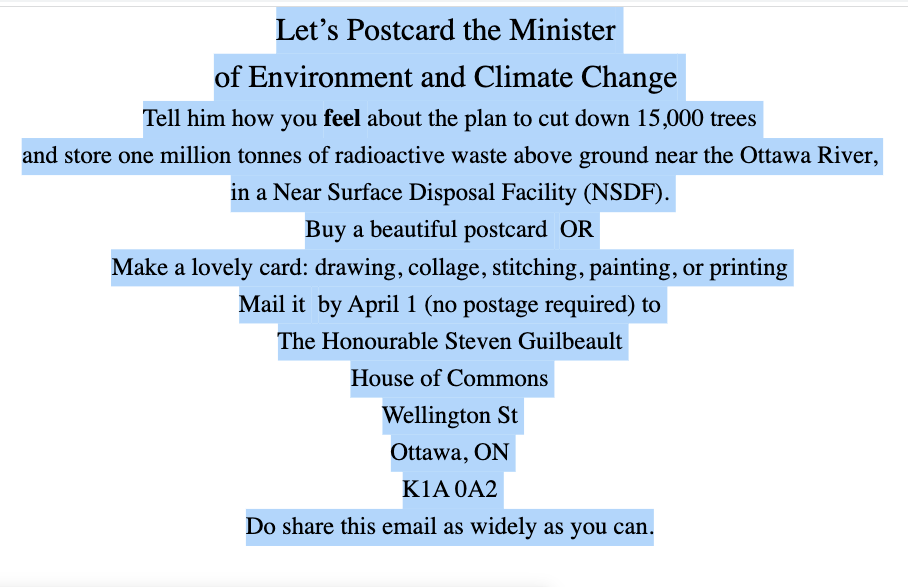
This postcard campaign was initiated by our friend and colleague Dr. Judith Miller of the First United Church Water Care Allies. Please also send a card, email or phone message to your own MP!
On May 31st the final licensing hearing for giant Chalk River radioactive waste mound will begin. The Commission will hear interentions (10 minute presentations) from First Nations, NGOs, municipal representatives, citizens’ groups and others.
This will be the final opportunity for the public to comment on this flawed proposal that will endanger the Ottawa River when this mound leaks and disintegrates, which the proponent’s own studies show is inevitable. There are many good reasons to stop this dump. For a simple summary of six of the most compelling see this post.
You do not need to have any scientific or technical expertise to intervene. Your intervention/submission/letter can be short or more substantial. Some of the most effective interventions in past hearings have involved singing and/or strong visual images. You can present a slide show that could include a short video. Passionate pleas for common sense are good too! Let’s press the CNSC to uphold its mandate to protect the environment and current and future generations of Canadians.
Contact us if you would like more guidance than is contained in this post.
Please send a copy of your intervention to your Member of Parliament.
April 11 is the deadline to request to intervene
Your request must include:
To Send: two options ~ send by email or use on-line form (link just below):
1. Send via email to CNSC:interventions@cnsc-ccsn.gc.ca
To identify your request, write in the subject line and as a heading:
May 31 Public Commission Hearing – Canadian Nuclear Laboratories Near Surface Disposal Facility
OR
2. Use on-line CNSC Request Form
Date: May 31 Licensee: Canadian Nuclear Laboratories (CNL)
Subject: Public Commission Hearing – Near Surface Disposal Facility
http://www.nuclearsafety.gc.ca/eng/the-commission/intervention/
What to expect: The Commission Registry will acknowledge receipt of your request to intervene and will later confirm if your intervention has been accepted by the Commission.
Your intervention will be given a Commission member document (CMD) reference number and will be added to the public record. Submissions will be publicly available on the CNSC website.
Reference material to possibly inspire your intervention:
Six Reasons to Stop the Ottawa River Radioactive Waste Dump
Critical Flaws, Errors and Omissions in CNSC staff’s case to approve the Chalk River Mound
Défauts, erreurs et omissions critiques dans le dossier d’approbation du monticule de Chalk River
Media Release: February 16, 2022 ~ MPs and groups oppose hearings to license Canada’s first permanent radioactive waste dump. The media release in English and in French.
The statement referred to in the media release was sent to Ms. Rumina Velshi, CNSC President, and to the federal ministers of Environment, Natural Resources, Indigenous Services and Crown Indigenous Relations.

This is an excerpt from the NSDF proponent’s draft Environmental Impact Statement (March 2017)


March 2022 , updated January 2025
A 2016 Access to Information request revealed the following information about the salaries of senior executives under the GoCo scheme for operating Canada’s Chalk River Laboratories (and other federal nuclear sites). Scroll down to the end of this post for the updated information from the 2024 ATIP request.
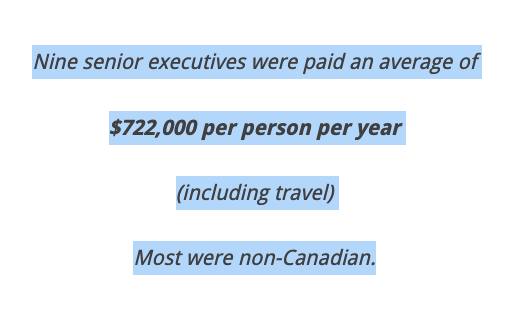
Nine senior executives were paid an average of $722,000 per person per year (including travel)
Most were non-Canadian.
Twenty-eight senior contractors were paid an average of $377,275 per year per person.
27 of the 28 senior contractors were non-Canadian.
The documents obtained trough the ATIP program are as follows:
File 1: Executive and senior contractor files (9 executive salaries + travel) = $722, 000 / yr per person. Senior contractor costs (28 persons) at $377, 275 / yr per person. (For comparison purposes, consider that the salary of the Prime Minister of Canada is $347,400 per year)
File 2. Confirmation that 27 out of 28 senior contractors were non-Canadian. It is not known if any Canadian tax is paid by the non Canadians.
Files 3. CNEA fees ~ CNEA fees are all redacted despite being taxpayer funded and Science Advisory Board, SAB, costs. Typically the CNEA fees would likely be 15-20% of overall contract value per year but there is no way to confirm what these CNEA fees are. Also on p4 of 7 is the Science Advisory Board cost for one year. ($183,254) where 4 out of 5 members were non-Canadian (advising Canadians on science policy).
~~~~~~~~~~~~~~
The following updated information was obtained in an ATIP request in 2024:
“In 2023, via contract money funneled through AECL, Canadian taxpayers paid average salaries of $510,301 to each of 44 CNL executives and non-executive contract staff, mostly non-Canadians — well above the Prime Minister’s $406,200 salary. ” Ole Hendrickson, Rabble.ca
GoCo contract costs – Total labour and total non-labour costs
| Number | Total cost ($)4,5,6 | Average cost ($) | ||||
| 2023 | 2016 | 2023 | 2016 | 2023 | 2016 | |
| CNL executives1 | 14 | 9 | 7,969,646 | 6,498,000 | 569,260 | 722,000 |
| CNL non-executive contract staff2 | 30 | 28 | 14,483,594 | 10,563,700 | 482,786 | 377,275 |
| CNL total or average | 44 | 37 | 22,453,240 | 17,061,700 | 510,301 | 461,127 |
| AECL executives3 | 11 | 5,710,125 | 519,102 | |||
| CNL + AECL total or average | 55 | 28,163,365 | 512,061 | |||
1Total Canadian National Energy Alliance executive management labour and non-labour costs included in expenses (not necessarily paid) of all CNL managers working on management type functions relating to the GoCo. Labour costs include salaries, bonuses, performance-related fees and other compensation. Non-labour costs include all other costs (e.g., relocation costs).
2Total labour and total non-labour costs included in expenses (not necessarily paid) of GoCo contract staff working on management type functions related to the GoCo: (30 staff including 20 non-Canadians in 2023; 28 staff including 27 non-Canadians in 2016). Labour costs include salaries, bonuses, performance-related fees and other compensation paid by CNL for contractors. Non-labour costs include all other costs paid by CNL for contractors (e.g., relocation costs).
3Total labour and total non-labour costs included in expenses for AECL’s 11 executive staff for the most recent fiscal year, 2023-24.
4Total travel costs (non-labour) for CNL executives in 2016 were $200,732.
5Total labour costs for non-executive contract staff in 2016 were $6,207,952; total non-labour costs for non-executive contract staff in 2016 were $4,355,748.
6Total cost of CNL executives increased by 22.6% between 2016 and 2023; total cost of CNL non-executive contract staff increased by 37.1% between 2016 and 2023.
*** Cliquez sur l’hyperlien bleu pour lire dans votre navigateur sans téléchargement
February 21, 2022
February 25 (revised version with footnotes, submitted to the House of Commons standing committee on Environment and Sustainable Development)
*Click on the blue file name, just above to read in your browser without downloading.
This Original version was sent to the CNSC president Rumina Velshi on February 21, 2021
*** Click on the blue hyperlink to read in your browser without downloading

