The Chalk River Mound and two reactor tombs would leak radioactive contaminants into the Ottawa and Winnipeg Rivers

November 5, 2020

The multinational consortium “Canadian National Energy Alliance” is proposing three substandard nuclear waste disposal projects. They are a giant above-ground mound alongside the Ottawa River at Chalk River, Ontario, for one million tons of radioactive waste and two “entombments” of old nuclear reactors beside the Ottawa and Winnipeg rivers, at Rolphton, Ontario and Pinawa, Manitoba.

The consortium was required to prepare Environmental Impact Statements for all three of its proposed disposal projects, as part of the Environmental Assessment process. Here are links to the three studies:

https://iaac-aeic.gc.ca/050/evaluations/document/119303 (Chalk River Mound aka NSDF)

https://iaac-aeic.gc.ca/050/evaluations/document/121057 (Rolphton entombment)

https://iaac-aeic.gc.ca/050/evaluations/document/120775 (Whiteshell entombment)

The EIS for the Chalk River Mound describes many ways that the mound would leak radioactive contaminants into the environment and the Ottawa River. The ways the mound would leak are summarized in this post:

How would the Chalk River Mound leak? Let us count some of the ways

This post describes the expected eventual disintegration of the Chalk River mound, using excerpts from the Environmental Impact Statement for the Chalk River Mound (NSDF) and supporting documents:

Consortium’s study appears to show the Chalk River mound would disintegrate

The cracking and leaking of the entombed reactors planned for Rolphton, Ontario and Pinawa, Manitoba is described in the Environmental Impact Statements and summarized in this post:

Proposed reactor tombs would leak radioactive materials into the Winnipeg and Ottawa Rivers for millennia

Consortium’s nuclear waste dump proposals fail to meet IAEA standards

November 5, 2020

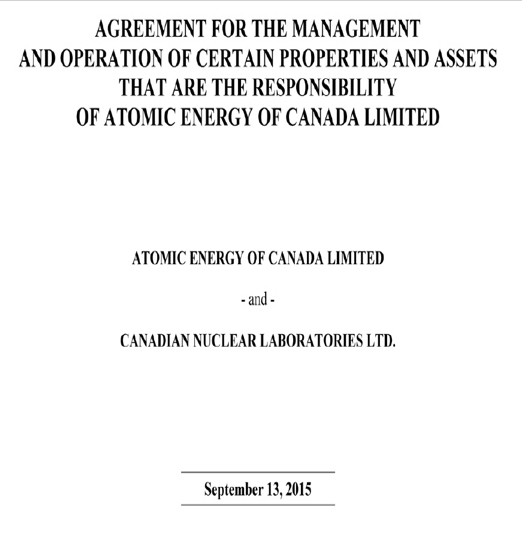
The multinational consortium, Canadian National Energy Alliance, has been managing Canada’s nuclear facilities and radioactive wastes under a GoCo (Government-owned, Contractor-operated) contract since September 2015.

The consortium is proposing to quickly and cheaply dispose of all Canada’s federal radioactive wastes in a giant landfill beside the Ottawa River and two concrete “entombments” of old, highly radioactive nuclear reactors beside the Winnipeg and Ottawa rivers.

The proposals are undergoing protracted Environmental Assessments. They are mired in controversy and years behind schedule. Here are the links to Environmental Impact Statements for the three projects:

https://iaac-aeic.gc.ca/050/evaluations/document/119303 (NSDF)

https://iaac-aeic.gc.ca/050/evaluations/document/121057 (NPD)

https://iaac-aeic.gc.ca/050/evaluations/document/120775 (Whiteshell)

Part of the reason for the controversy is that the consortium’s proposals flout safety standards of the International Atomic Energy Agency. As a member state, Canada is supposed to follow IAEA guidance.

Here are some examples of IAEA guidance that is being flouted:

Decommissioning of Nuclear Power Plants, Research Reactors and Other Nuclear Fuel Cycle Facilities ~ Specific Safety Guide No. SSG-47, Vienna, 2018

The relevant text is section 5.17 on page 32 and it reads as follows:

Entombment, in which all or part of the facility is encased in a structurally long lived material, should not be considered an acceptable strategy for planned decommissioning (emphasis added). It might be considered as a last option for managing facilities that have been damaged in an accident, if other options are not possible owing to high exposures of workers or technical difficulties.

The IAEA Safety Standard for Disposal of Radioactive Waste says that the fundamental safety objective of radioactive waste management, including disposal, is “to protect people and the environment from harmful effects of ionizing radiation.” The strategy to achieve this objective with regard to disposal of radioactive waste is “to contain the waste and to isolate it from the accessible biosphere… [which] is taken generally to include those elements of the environment, including groundwater, surface water and marine resources, that are used by people or accessible to people.”

The NSDF proposal turns the IAEA standard on its head.  Rather than isolating radioactive wastes from groundwater and surface water, and disposing of them in stable environments ensuring long-term safety, it would use a design similar to a municipal landfill, in which wastes would be deliberately and routinely allowed to come into contact with the environment, including rain and snow. 

The NSDF proposal calls for a giant mound exposed to the elements.  Surface run-off from the mound would carry radionuclides into three storm-water management ponds.  These would discharge directly into the East Swamp wetland.  Sub-surface waters leaching through the mound would carry radionuclides through a collection system to a newly constructed water treatment facility.  This facility would remove some radionuclides (presumably for disposal using an unspecified method), while allowing others (e.g., tritium) to pass through untreated for release into the East Swamp stream, Perch Creek and the Ottawa River.

The NSDF proposal flouts IAEA guidance calling for “impermeable and water diverting features” for LLW disposal, and a “stable, geological environment” for ILW disposal.  Canada, which participates actively in development of IAEA Safety Standards, should not be allowed to flagrantly disregard them at a government-owned facility.

CNL’s use of the term NSDF — “Near Surface” Disposal Facility — is misleading.

This IAEA safety guide
“Near Surface Disposal Facilities for Radioactive Waste” Specific Safety Guide SSG-29 says on page 37

4.15. The concept of near surface disposal covers a wide range of facilities
(e.g. disposal at the surface in engineered vaults or trenches, or disposal at
varying depths — from a few metres to a few tens of metres — in facilities with various types of engineered barriers).

Proposed reactor tombs would leak radioactive materials into the Winnipeg and Ottawa Rivers for millennia

November 5, 2020

The proposed entombment at Rolphton, Ontario

Source document: Draft Environmental Impact Statement for the Nuclear Power Demonstration Closure Project

Here is a quote from the document: (emphases in red text added)

Normal Evolution Scenario

In this scenario, the facility is assumed to be closed as planned, with no unforeseen events. Parts of the NPDWF that lie below the water table will gradually resaturate. It is expected that resaturation may take several decades to complete. Once saturated, the soluble contaminants in the facility will begin to be released into the groundwater… The primary point of potential contaminant release into the biosphere is taken to be the riverbed close to the shore of the Ottawa River (pages 9-6 and 9-7)

·        Concrete/grout/cement:It is assumed that the grout will gradually degrade as the cement constituents are slowly leached out upon contact with groundwater… (page 2-24)

·        The cap: It is assumed that the cap starts to degrade 100 years after its emplacement and is assumed to have fully degraded (in terms of hydraulic performance) by 1,000 years after decommissioning is complete…. (page 2-24)

This is table 4.4-1 showing a partial inventory of the radioactive contaminants contained in the old NPD reactor, that will migrate into the Ottawa River in the “Normal Evolution Scenario”:

The proposed entombment at Pinawa, Manitoba

Source document: Draft Environmental Impact Statement for the In Situ Decommissioning of the Whiteshell Reactor #1 Project

Here is a quote from the document: (emphases added)

Following the encapsulation of WR-1 and the cessation of pumping from the sumps, the groundwater elevation will be restored to an equilibrium elevation and the majority of the grout (including the remaining components of the reactor) will be situated below the groundwater table... The assumption is that these materials will experience an increase in hydraulic conductivity as they degrade over time.  Simulations were completed to estimate the groundwater flow through the components of the decommissioned structure and results of these simulations were used as input to the analytical solute transport model.

The solute transport model was defined as a source area (representing the remaining solute mass contained within the decommissioned structure), a barrier for containment (the building foundation), a transport pathway (the bedrock, which receives flow from the decommissioned building via advection and diffusion through the barrier and into the surrounding fill material), and a receptor (the Winnipeg River).  (page 6-148)

The cover, grout, and foundation were assumed to degrade at rates comparable to other projects (i.e., Savannah River), which increased groundwater flow through time, resulting in total failure (degradation) of grout by year 10,000.  (page 6-202)

And here is Table 6.4.2-8 showing the radioactive materials that will migrate into the Winnipeg River after cessation of pumping and failure of the grout:


See also this post on the ways the the giant Chalk River Mound would leak radioactive contaminants into the Ottawa River: https://concernedcitizens.net/2020/11/04/the-proponents-own-study-shows-that-the-chalk-river-mound-will-disintegrate/

AECL is paying the CNEA consortium close to a billion dollars annually

November 5, 2020

According to the AECL Annual report for 2019-20
http://www.aecl.ca/wp-content/uploads/2020/10/FINAL-AECL-19-20-Annual-Report-.pdf
Contractual amounts paid or payable were:

2020 – $973,838 thousand or 974 million

2019 – $897,657 thousand or 898 million (see pages 59-60)

Previous AECL reports provide the following for contractual amounts:

2018 – $903,527 thousand or 904 million (https://www.aecl.ca/wp-content/uploads/2018/12/AECL-Annual-Report-2017-18-FINAL-EN.pdf page 54)

2017 – $864,930 thousand or 865 million (https://www.aecl.ca/wp-content/uploads/2018/12/AECL-Annual-Report-2017-18-FINAL-EN.pdf page 54)

2016 – $432,444 thousand or 432 million(https://www.aecl.ca/wp-content/uploads/2019/02/AECL-2016-2017-ANNUAL-REPORT.pdf page 49)

The total amount paid to the CNEA consortium to date (November 3, 2020) $4,072,396 thousand – just over $4 billion over five years.

Consortium’s study appears to show the Chalk River mound would disintegrate

November 2020

The proponent of the Chalk River Mound, Canadian Nuclear Laboratories, was required to produce an Environmental Impact Statement (EIS) as part of the very flawed and protracted Environmental Assessment process that is still underway.

The draft EIS was published in March 2017. It is 990 pages long. The full document is posted on the Impact Assessment Agency registry for the project. Here is the link to the full document: https://iaac-aeic.gc.ca/050/documents/p80122/118380E.pdf

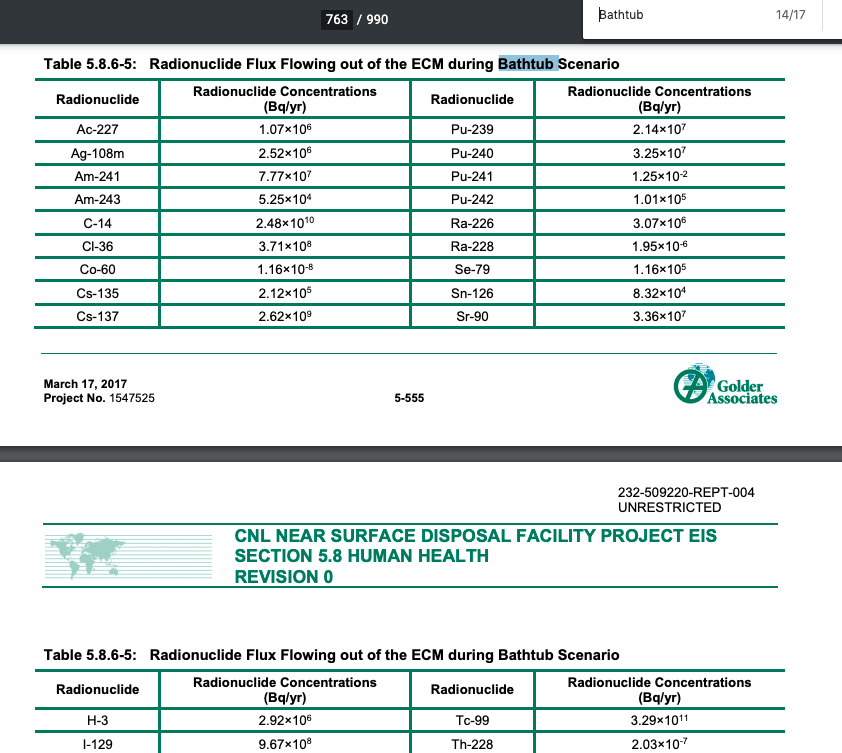
The draft EIS includes 25 occurrences of the phrase “liner and cover failure as a result of normal evolution”. The document also includes 11 occurrences of the term “bathtub effect” during which there is a flow of radioactive materials out of the mound. Table 5.8.6-5 lists quantities of radioactive materials, including four isotopes of plutonium, that would flow out of the mound under the “bathtub scenario”.

Here’s a screenshot from page 723 of the pdf document, that describes the liner and cover failure as a result of “normal evolution” followed by two scenarios for disintegration of the mound and migration of contaminants into Perch Creek and the Ottawa River.

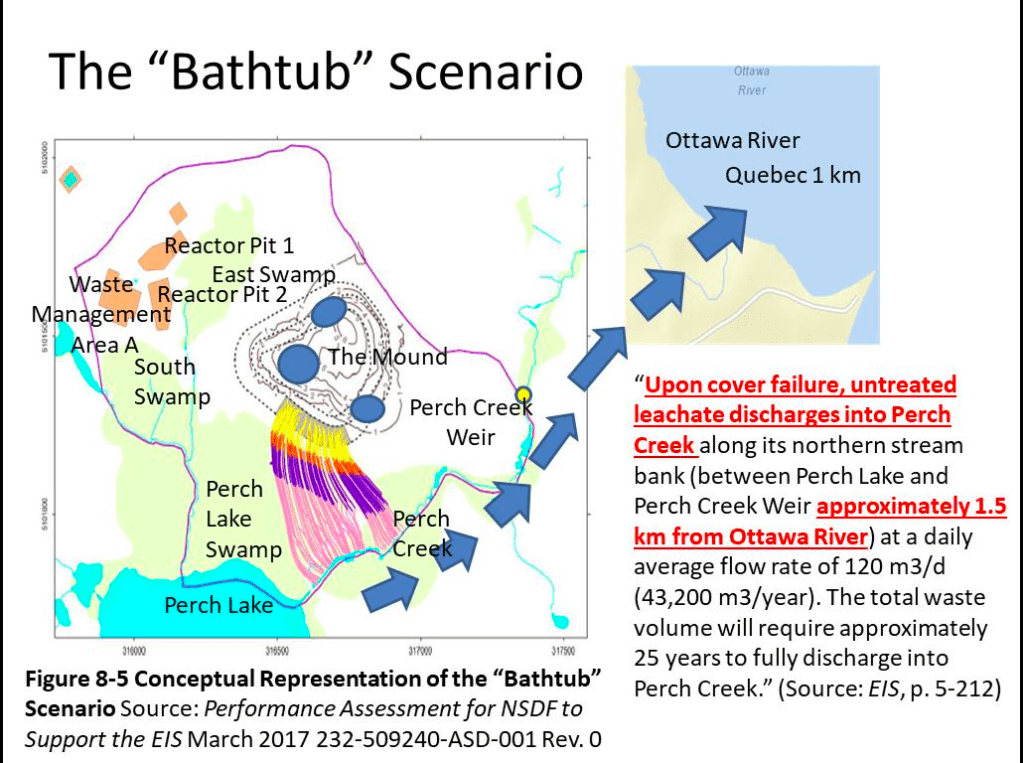
Here is a picture of the Bathtub Scenario from page 187 of CNL’s Performance Assessment for NSDF. The blue arrows and the Ottawa River were added by CCRCA researcher Ole Hendrickson when he incorporated Figure 8-5 into a Powerpoint deck.

And here is part of a table showing radionuclide flow out of the mound (including four isotopes of plutonium) as it disintegrates: (page 763 of the draft EIS)

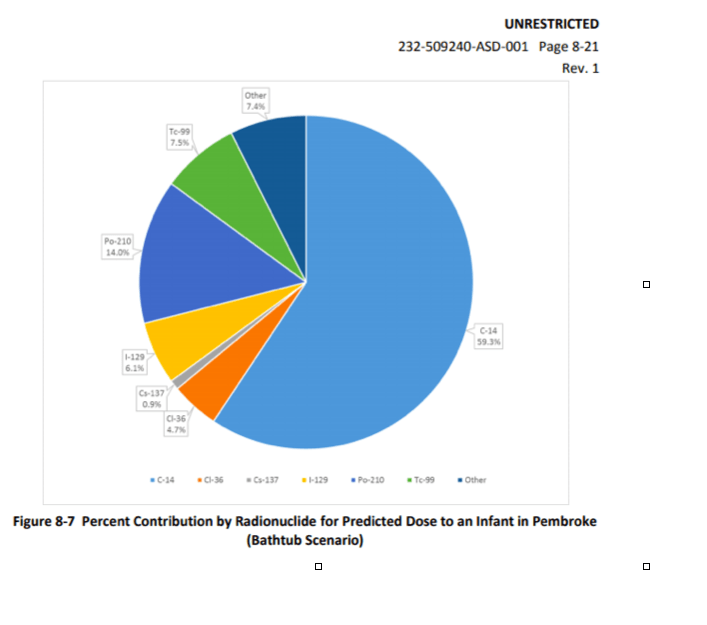
And finally here is a pie chart showing the contribution of various radionuclides (such as Carbon-14, Polonium and Caesium-137 ) to the radiation dose that would be received by an infant downstream in Pembroke, under the “bathtub scenario” of “normal evolution” of the Chalk River Mound: (Page 190 of the Performance Assessment document)

CNL’s Integrated Waste Strategy alarms downstream residents

November 5, 2020

Update: In 2021 the City of Ottawa passed a resolution opposing any further imports of radioactive waste into the Ottawa Valley (More info here) See also: High level radioactive waste imports to Chalk River from Manitoba and Quebec will likely begin in 2025
~~~~

The CNL Integrated Waste Strategy was first published in January 2017, 15 months after the multinational consortium took over the operation of Canada’s nuclear laboratories. It describes many types of radioactive wastes owned by the federal government in nuclear facilities in Manitoba, Ontario and Quebec. The document lays out a plan to consolidate as much of these wastes as possible at the Chalk River Laboratories site beside the Ottawa River upstream of Ottawa, Gatineau and  Montreal for permanent disposal in a highly-controversial, yet-to-be-licensed giant radioactive waste mound.

Ottawa Valley residents are alarmed by this strategy to bring all of Canada’s federal nuclear waste to Chalk River. The site already has much radioactive waste in less than optimum storage conditions; wastes are leaking and contaminating the Ottawa River. See Chalk River’s Toxic Legacy by Ian McLeod in the Ottawa Citizen, December 16, 2011.

Radioactive waste shipments are already underway from other federal nuclear facilities in Canada. There are risks involved in transportation as described in our recent fact sheet “Transport of Radioactive Waste on Canadian Roads- a growing public risk”.  Premature transportation of wastes before long-term management facilities are planned, evaluated, and licensed will result in double-transport and double-handling, creating additional unnecessary risks to workers and the public.

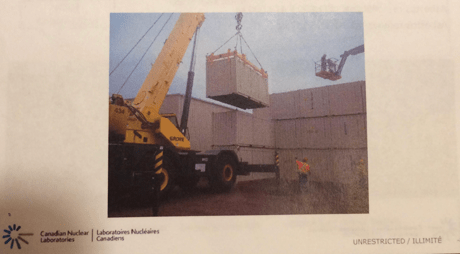
There are no approved disposal facilities at the CRL site; shipping containers full of wastes are presently being piled up at a Waste Management Area H as shown in the photograph below. The metal shipping containers are susceptible to corrosion and are exposed to precipitation in the current location.

The Chalk River Laboratories is not a good site for long-term storage of radioactive waste because it is seismically active, tornado prone, and adjacent to the Ottawa River which serves as a source of drinking water for millions of Canadians including citizens of Ottawa-Gatineau and many other communities. The site is also located on unceded Algonquin territory and Algonquin First Nations have not given their free prior and informed consent to the transport and disposal of radioactive wastes in their territory.

~~~~~~

Here is Version 0 of CNL’s integrated waste strategy, (obtained through ATIP in December 2017, 64 pages, contains many redactions)

The strategy has gone through a number of revisions. Here is a summary of the revised version that was, for a while, posted publicly on the CNL webiste:

See also https://concernedcitizens.net/2024/04/15/geoscientist-raises-concerns-about-storage-of-radioactive-waste-in-the-ottawa-valley-due-to-earthquake-risk/

International Atomic Energy Agency still says “entombment” is not an acceptable decommissioning strategy

November 2, 2020

The Canadian Nuclear Safety Commission, Canada’s “captured” nuclear regulator, had hoped that the latest updated guidance from IAEA would allow entombment of old reactors as a decommissioning strategy.

Here is CNSC in 2017, “dispositioning” critical comments on the proposed entombment of old (and still highly radioactive) nuclear reactors at Rolphton, Ontario and Pinawa, Manitoba:

“Yes, the document referenced, IAEA GSR 6, indicates that
entombment is not recognized internationally, in principle,
as a preferred decommissioning strategy (entombment may
be considered a solution only under exceptional
circumstances, such as following a severe accident). The
IAEA is currently working on a document to provide
guidance with respect to their position on entombment
in situ decommissioning the applicability of entombment in
the context of decommissioning and in particular, the
regulatory requirements and expectations for applying
entombment as a decommissioning option strategy. There is
no scheduled date for the publication of this document;
however, CNSC staff will keep apprised of its development
to inform this EA and licensing review process.
Irrespective of the IAEA guidance document, under the
CNSC’s regulatory framework, applicants are responsible
for selecting and justifying their proposed decommissioning
strategy.”

That quotation is from this document: https://www.ceaa-acee.gc.ca/050/documents/p80124/118863E.pdf
Page 9, top right.

The CNSC must have been disappointed when the new IAEA guidance document was published in 2018 and it STILL says that entombment is not acceptable as a decommissioning strategy.

The new IAEA document is

Decommissioning of Nuclear Power Plants, Research Reactors and Other Nuclear Fuel Cycle Facilities ~ Specific Safety Guide No. SSG-47, Vienna, 2018

The relevant text is section 5.17 on page 32 and it reads as follows:

Entombment, in which all or part of the facility is encased in a structurally long lived material, should not be considered an acceptable strategy for planned decommissioning. It might be considered as a last option for managing facilities that have been damaged in an accident, if other options are not possible owing to high exposures of workers or technical difficulties.

The IAEA explicitly recommended that Canada align its decommissioning strategy with this standard, during a peer review mission in September 2019. See a summary of IAEA recommendations to Canada here.

Undeterred, the CNSC is attempting to make entombment acceptable in its own “RegDocs”, pseudo regulations that rely heavily on nuclear industry created CSA standards, but that is another story, that is covered elsewhere. See Ole Hendrickson’s recent Op Ed in the Hill Times and the recent letter to Prime Minister Justin Trudeau that requests urgent action to address nuclear safety gaps in Canada.

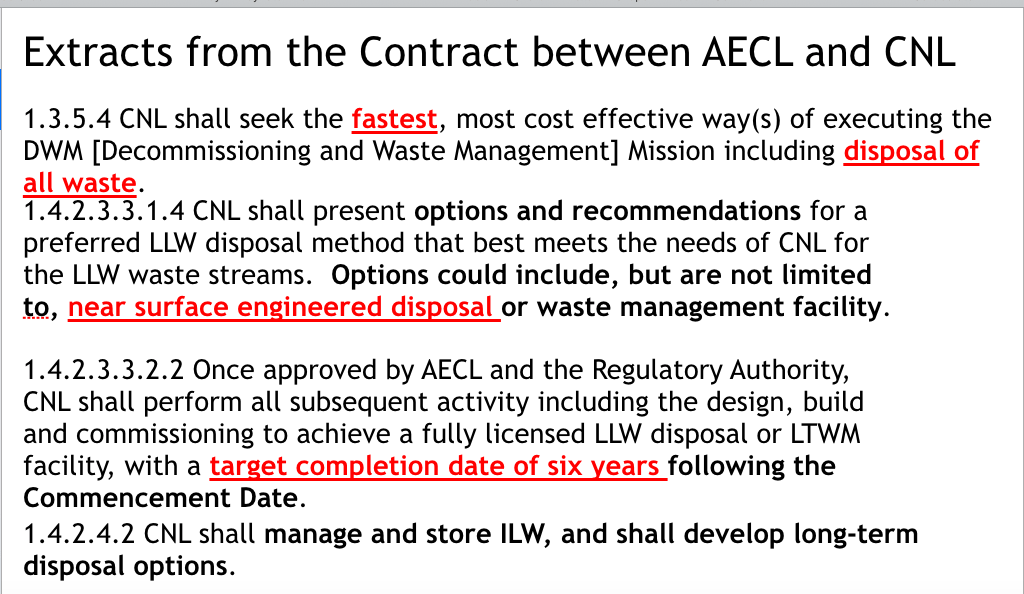
AECL/CNL/CNEA Contract Excerpt ~ ALL Wastes

See also statement from the Draft Environmental Impact Statement about “all wastes” here.

NB. Clause 1.3.5.4 above refers to one specific location, LaPrade heavy water facility in Quebec. Similar clauses in the contract refer to other federal facilities.

This section of the contract refers to all of the federal wastes (key clause highlighted in yellow below):

Contract – Schedule G – Contractor Performance Evaluation and Terms of Payment 

2.2 Award Fee Plan 

      (a) Each Annual PEM Plan will include, as a component thereof, an Award Fee Plan that defines differently weighted, reasonably achievable Performance Objectives and Performance Outcomes that are to be satisfied or achieved by CNL in connection with the performance of the SOC Obligations during the Operating Year (the “Award Fee Criteria”). The Parties agree that the Award Fee Criteria may be comprised, in whole or in part, of performance indicators which will be assessed by AECL. The Award Fee Plan will also specify the Annual Earnable Award Fee for the Operating Year, which will be allocated among the Award Fee Criteria using a scorecard-style rating grid. 

      (b) The Performance Objectives and the Performance Outcomes that are included in the Award Fee Plan for any Operating Year will reflect the following goals (as applicable): 

(i) contain costs associated with the Sites, the Facilities and the Assets (in each case, other than those related to the WL Obligations or the NPD Obligations) by improving efficiency while leveraging their value in delivering on the missions of CNL; 

(ii) implement cost reduction initiatives that result in measurable operating savings at the Sites (other than those related to the WL Obligations or the NPD Obligations); 

(iii) substantially reduce the cost of liabilities in the most cost-effective manner through the optimization of decommissioning and waste management activities;