Statement on suspension of licensing hearings for a radioactive waste dump beside the Ottawa River

February 16, 2022

Le français suit

We oppose the holding of licensing hearings for the construction of a Near Surface Disposal Facility for nuclear waste at Chalk River, Ontario, on unceded Algonquin Anishinaabeg lands alongside the Ottawa River.

Recently, staff of the Canadian Nuclear Safety Commission (CNSC) recommended approval of this controversial above-ground nuclear waste dump for one million tonnes of mixed radioactive and hazardous waste. The CNSC has scheduled licensing hearings on February 22 and May 31, 2022.

We stand with the Kebaowek First Nation who has asked that the hearings be halted until a consultation framework between them and the CNSC is in place. This has been a longstanding request from Kebaowek First Nation, and it remains outstanding. Reconciliation and meaningful dialogue must be a starting point for any government decision affecting Indigenous lands and rights.

The parliamentary Standing Committee on Environment and Sustainable Development has just begun a “comprehensive review of the governance of nuclear waste in Canada and its impacts on the environment.” An audit on nuclear waste management is currently underway by the Auditor General of Canada. We call for both processes to be completed before any licensing hearings for nuclear waste disposal facilities.

The Assembly of First Nations and more than 140 downstream municipalities, including the City of Gatineau and the Montreal Municipal Council, have passed resolutions opposing the NSDF plan.

Citizen and environmental groups have identified serious flaws and omissions in the CNSC’s environmental assessment (EA) report. When the facility leaks and eventually disintegrates, as expected, radioactive and other wastes will contaminate groundwater, wetlands and the Ottawa River, the source of drinking water for millions of people, the National Capital and the metropolitan community of Montreal.

The EA report fails to consider other locations or types of facilities that would better protect the environment. The chosen site has a high water table and risk of flooding and is also earthquake prone.

The report overlooks risks to workers who will handle industrial cobalt-60 devices that will go into the dump. In addition, it neglects pollution by lead and other hazardous industrial wastes that would leak into the Ottawa River.

The facility is proposed by Canadian Nuclear Laboratories (CNL), operated by a consortium of SNC-Lavalin and multinational corporations. They run Canada’s nuclear laboratories under a contract signed by the Harper federal government in 2015.

In 2021, the City of Ottawa passed a resolution urging the CNSC and CNL to stop importing radioactive waste from other provinces to Chalk River, to increase safeguards to protect the Ottawa River during site demolition and waste transfer activities, and to prevent precipitation from entering the NSDF. The city also called for a regional assessment of radioactive disposal projects in the Ottawa Valley under the Impact Assessment Act, but the request was turned down by the federal Minister of Environment and Climate Change.

For all of these reasons, we call on the Government of Canada to halt licensing hearings for the NSDF and to set up an independent body to address Canada’s radioactive waste problem in ways that are socially acceptable and will not compromise the safety of future generations.

SIGNERS/SIGNATAIRES

Elected representatives

Laurel Collins, MP, Critic for the Environment and Climate Change, New Democratic Party

Elizabeth May, Parliamentary Leader of the Green Party of Canada

Monique Pauzé, Députée et porte-parole de l’environnement pour le Bloc Québécois

Theresa Kavanagh, Ottawa City Councillor

Catherine McKenney, Ottawa City Councillor

National organizations

Canadian Association of Physicians for the Environment     

Canadian Coalition for Nuclear Responsibility

Friends of the Earth

National Council of Women of Canada

Nuclear Waste Watch

Prevent Cancer Now

Organizations based in Ontario

Concerned Citizens of Renfrew County and Area 

Council of Canadians – Kitchissippi-Ottawa Valley Chapter

Council of Canadians – Ottawa Chapter

Greenspace Alliance of Canada’s Capital        

Integral North

Northwatch

Ontario Clean Air Alliance

Petawawa Point Cottagers’ Association

Pontiac Environment Protection

United Church Water Care Allies

Watershed Sentinel Educational Society

Westboro Beach Community Association         

Organizations based in Québec/N.B.

Action Climat Outaouais 

Action Environnement Basses-Laurentides

AmiEs de la Terre – Québec

Artistes pour la Paix

Association Canadienne des Médecins pour l’Environnement

Association québécoise des médecins pour l’environnement

Association Québécoise de Lutte contre la Pollution Atmosphérique 

Coalition for Responsible Energy Development in New Brunswick

Coalition Verte/Green Coalition

Collectif Femmes pour le climat

Comité de santé, sécurité et environnement d’Unifor Québec

Eau Secours

Extinction Rebellion Québec 

Fédération des travailleurs et travailleuses du Québec (FTQ)

Fondation Rivières

Front commun pour la transition énergétique

Lucie Sauvé, professeure émérite, UQAM

Laurence Brière, professeure, UQAM

Mouvement d’éducation populaire et d’action communautaire du Québec

Old Fort William Cottagers’ Association

Oxygène Laval en amont

Ralliement contre la pollution radioactive

Regroupement des citoyens de Saraguay

Regroupement pour la surveillance du nucléaire

Regroupement vigilance hydrocarbures Québec

Réseau québécois des groupes écologistes

Santé Cannabis

Sauvons la falaise

Sierra Club – chapitre Québec

Société pour vaincre la pollution

Syndicat canadien de la fonction publique (SCFP) – Québec

TerraVie

Vigilance OGM

Déclaration pour suspendre les audiences d’autorisation d’un monticule de déchets radioactifs au bord de la rivière des Outaouais

Nous nous opposons à la tenue d’audiences d’autorisation pour la construction d’une « installation de gestion des déchets près de la surface » (IGDPS)  à Chalk River, en Ontario, sur les terres algonquines Anishinaabeg non cédées le long de la rivière des Outaouais.

Récemment, le personnel de la Commission canadienne de sûreté nucléaire (CCSN) a recommandé l’approbation de ce dépotoir controversé pour un million de tonnes de déchets radioactifs et dangereux mixtes. La CCSN a prévu des audiences sur les permis demandés les 22 février et 31 mai 2022.

Nous appuyons la Première Nation de Kebaowek qui a demandé que les audiences soient suspendues jusqu’à ce qu’un cadre de consultation entre elle et la CCSN soit en place. Il s’agit d’une demande de longue date de la Première Nation de Kebaowek, et elle demeure en suspens. La réconciliation et un dialogue significatif doivent être le point de départ de toute décision gouvernementale affectant les terres et les droits autochtones.

Le Comité parlementaire permanent de l’environnement et du développement durable vient d’entreprendre un « examen complet de la gouvernance des déchets radioactifs au Canada et de ses impacts sur l’environnement ». Une vérification sur la gestion des déchets radioactifs est actuellement en cours par le vérificateur général du Canada. Nous exigeons que les deux processus soient terminés avant toute audience d’autorisation pour les installations de gestion des déchets radioactifs.

L’Assemblée des Premières Nations et plus de 140 municipalités en aval, dont la Ville de Gatineau et le Conseil municipal de Montréal, ont adopté des résolutions s’opposant au plan de l’IGDPS.

Des citoyens et des groupes environnementaux ont relevé de graves lacunes et omissions dans le rapport d’évaluation environnementale (EE) de la CCSN. Quand l’installation aura des fuites et commencera à se décomposer, les déchets radioactifs et autres contamineront les eaux souterraines, les terres humides et la rivière des Outaouais, la source d’eau potable de millions de personnes, de la capitale nationale et de la communauté métropolitaine de Montréal.

Le rapport d’EE ne tient pas compte d’autres emplacements ou types d’installations qui protégeraient mieux l’environnement. Le site choisi a une nappe phréatique élevée et un risque d’inondation et est également sujet aux tremblements de terre.

Le rapport néglige les risques pour les travailleurs qui manipuleront des sources de cobalt 60 dans la décharge. De plus, il néglige la pollution par le plomb et par d’autres déchets industriels dangereux qui se déverseraient dans la rivière des Outaouais.

L’installation est proposée par les Laboratoires Nucléaires Canadiens (LNC), exploités par un consortium de SNC-Lavalin et de sociétés multinationales. Ils dirigent les Laboratoires nucléaires du Canada en vertu d’un contrat signé par le gouvernement fédéral Harper en 2015.

En 2021, la Ville d’Ottawa a adopté une résolution exhortant la CCSN et les LNC à cesser de transporter des déchets radioactifs provenant d’autres provinces vers Chalk River, à renforcer les mesures de protection pour la rivière des Outaouais pendant les activités de démolition du site et de transfert des déchets, et à empêcher les précipitations de pénétrer dans l’IGDPS. La ville a également demandé une évaluation régionale des projets de déchets radioactifs dans la vallée de l’Outaouais en vertu de la Loi sur l’évaluation d’impact, mais la demande a été rejetée par le ministre fédéral de l’Environnement et du Changement climatique.

Pour toutes ces raisons, nous demandons au gouvernement du Canada de mettre fin aux audiences pour l’autorisation de licence pour le projet de l’IGDPS et de mettre sur pied un organisme indépendant pour aborder le problème des déchets radioactifs du Canada d’une manière qui soit socialement acceptable et qui ne compromette pas la sécurité des générations futures.
CNSC’s EA report for the Chalk River Mound – failure to consider “end state objectives”

By comparing the unconditional clearance levels in Schedule 2 of the Nuclear Substances and Radiation Devices Regulations to the Radionuclide Concentration Limits in Table 4 of the NSDF Waste Acceptance Criteria (WAC), one can conclude that long-lived radionuclides proposed for disposal – if present in packaged wastes at maximum permitted limits – would not decay to clearance levels for thousands to millions of years.

Summing the radioactivity quantities in Table 11 of the WAC, at 1600 years post-closure, the entire contents of the mound would exceed unconditional clearance levels by more than 5-fold, even if all radionuclides were evenly distributed throughout.  Hence removal from regulatory control would not be possible for millennia.

CNSC’s environmental assessment report makes confusing/contradictory statements about removal from regulatory control:

The Post-Institutional Control Period will occur after the IC period and continues indefinitely, subject to either federal or provincial regulatory control.

 At a given time in the future and/or after year 2400, and taking into consideration the regulatory requirements in effect at that time, CNL will seek Commission approval for the removal of the NSDF from CNSC regulatory control.

CNL’s licence specifically allows “Release from Regulatory Control — The licensee shall only release the decommissioned property, or any part thereof, for reuse upon the acceptance of the final end-state report by the CNSC.”

CNSC’s environmental assessment report is supposed to cover all licensing stages, including decommissioning and abandonment (removal from regulatory control).  But it contains absolutely no mention of an end-state report, and only the following passing reference to end state:

CNL indicated that although it is outside the scope of the NSDF project, CNL is establishing the Land Use Program to determine next land uses and end state objectives for all CNL managed sites in Canada.

End state objectives for the NSDF are definitely NOT outside the scope of the project.  End state is absolutely central to the whole concept of a disposal facility.  This is a fatal omission in the environmental assessment.

***The real end state would be a degrading mound that would expose the public to nuclear substances in excess of clearance levels for millennia.***

CNSC’s EA report on the Chalk River Mound -failure to consider exemption levels for abandonment

CNSC here is ignoring its own regulatory requirements.  Radiation levels in any waste disposal facility must be compared to the regulatory requirements in the Nuclear Substances and Radiation Devices Regulations.

Section 5.1 (1), Abandonment or Disposal

“A person may, without a licence, abandon or dispose of a radioactive nuclear substance if the activity or the activity concentration of the substance does not exceed

(a) its exemption quantity;

(b) its conditional clearance level; or

(c) its unconditional clearance level.

The NSDF “Licensed Inventory” quantities for nearly all isotopes exceed the exemption quantities, generally by many orders of magnitude, e.g., by 3.65 million times for radium-226, 7.57 million times for uranium-238, 6.88 million times for uranium-234, 2.7 million times for thorium-232, 5.07 million times for plutonium-239/240, 303 thousand times for iodine-129, 171 thousand times for carbon-14, 296 thousand times for uranium-235 and 530 thousand times for thorium-230. 

Even when “averaged” over the estimated NSDF total waste mass of just under a million tonnes (9.57E+08 kg), the activity concentrations of carbon-14 and iodine-129 alone exceed the unconditional clearance levels.  The “sum of quotients” for all the NSDF isotopes with half-lives greater than 1600 years (see the definition in section 1 of the Regulations) would exceed the unconditional clearance levels by a factor of five.

The unconditional clearance levels in Column 2, Schedule 2 of the Nuclear Substances and Radiation Devices Regulations are also found in IAEA Safety Standard RS-G-1.7 (Application of the Concepts of Exclusion, Exemption and Clearance). That document says “Doses to individuals as a consequence of these activity concentrations would be unlikely to exceed about 1 mSv in a year.”  The 5-fold excess of the unconditional clearance levels in the NSDF at 1600 years would be equivalent to a dose of about 5 mSv in a year.

Furthermore, as former AECL staff have noted, the higher-activity packaged wastes that CNL proposes to put in the facility would grossly violate the Regulations. 

Consider cesium-137 (Cs-137).  In the Waste Acceptance Criteria for the NSDF, the proposed limit for “leachate-controlled” packages containing Cs-137 is 10,000 Bq/g. For a Cs-137 package to decay by a factor of 100,000 and reach the unconditional clearance level would take over 16 half-lives – 16.61 to be precise.  With Cs-137’s half-life of 30.17 years, it would take 501 years for a package Cs-137 at the “leachate-controlled” WAC limit to decay enough to be released from regulatory control and abandoned – far beyond the proposed 300-year institutional control period. 

A package of plutonium-239 would take 288,380 years, uranium-233 would take 1.37 million years, and so forth.

MEDIA RELEASE: Nuclear regulator recommends approval of giant radioactive waste dump beside the Ottawa River; citizens’ groups say report is flawed and recommendation to approve dump is irresponsible

OTTAWA, February 3, 2022 – Staff of Canada’s nuclear regulatory agency, the Canadian Nuclear Safety Commission (CNSC), have recommended approval of a controversial giant above-ground nuclear waste dump for one million tonnes of mixed radioactive and hazardous waste alongside the Ottawa River. The recommendation was contained in a licensing document and environmental assessment report released on January 25. Citizens’ groups say the document is seriously flawed and vow to fight the recommendation in licensing hearings scheduled for February 22 and May 31, 2022.

Ole Hendrickson, scientist and researcher for the group Concerned Citizens of Renfrew County and Area, said the CNSC “has failed to assess the project in an objective and scientifically credible manner.”  Hendrickson noted a number of “critical omissions in the document” that he says “make it impossible for the Commission to make a sound decision about whether or not to license the dump.”

“The recommendation to approve this dump, given that it would leak and eventually disintegrate, is reckless and irresponsible on the part of CNSC staff,” said Johanna Echlin of the Old Fort William (Quebec) Cottagers’ Association. “The CNSC is supposed to protect Canadians from radioactive pollution created by the nuclear industry, not enable it,” she added.

Some of the critical omissions in the environmental assessment report noted by citizens’ groups include the following:

  • Failure to consider future human exposures to nuclear waste packages containing plutonium and other long-lived substances that will remain dangerously radioactive for tens of thousands of years
  • No identification of the impacts of constructing a pipeline to discharge contaminated effluent into Perch Lake, which drains into the Ottawa River; presented un-ironically as a “mitigation measure”
  • Failure to seriously consider alternative sites that would avoid rapid discharge of radioactive and hazardous substances to a major water body, and avoid placing wastes in an area of high water table with risk of flooding
  • Inadequate consideration of alternative facility types that would not expose wastes to rain, wind, and snow; and that would not require unproven water treatment and “weather cover structure” technologies
  • No consideration of risks to workers from accidents involving highly-radioactive industrial cobalt-60 irradiator wastes
  • Failure to consider contamination of groundwater from the hundreds of tonnes of lead required to shield these highly-radioactive commercial wastes
  • Astonishingly, the environmental assessment report contains no references
  • The report fails to address the fact that the mound would degrade and that mixed radioactive and hazardous industrial wastes (arsenic, beryllium, mercury, benzene, dioxins, PCBs, etc.) would leak into the Ottawa River, essentially forever.

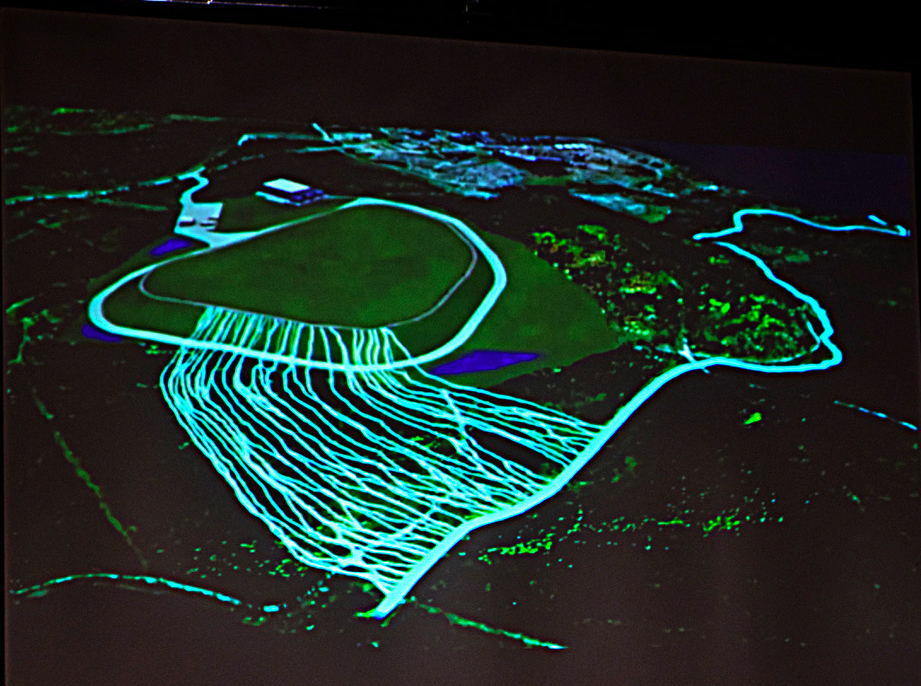
Echlin and Hendrickson point to previous studies by the dump proponent that identified many ways the mound would leak, and described the inevitable disintegration of the mound within 400 years through a process of “normal evolution.” Leakage from the dump is expected to flow into surrounding wetlands that drain into the Ottawa River less than a kilometre away, contaminating a drinking water source for millions of Canadians downstream.

(Photo above from Radio Canada Découverte, March 2018, showing the mound overflowing as part of the degradation and erosion process, described by the proponent in its Performance Assessment report.)

According to Hendrickson, “CNSC has outdone itself in promoting the dump project.  This is an object lesson in what happens when government agencies are captured by the industries they are supposed to regulate.”

The release of the environmental assessment report marks the end of a long “underground” phase of the licensing process for the giant radioactive dump, called the “NSDF” by the proponent, Canadian Nuclear Laboratories, owned by a consortium of multinational corporations that run Canada’s nuclear laboratories under a contract initiated by the Harper government in 2015.


Opportunities for public comments on the project’s environmental impacts ended in August 2017 after a flood of negative comments and concerns from First Nations communities, civil society groups, municipalities, independent scientists and individuals. 


The Assembly of First Nations, and more than 140 downstream municipalities have passed resolutions opposing the dump plan. Members of the public will have their final opportunity to submit concerns about the proposed project at the “Part 2 licensing hearing” that is scheduled to begin on May 31, 2022.  

“Interventions at that point are very unlikely to influence the Commission’s decision,” says Hendrickson, adding that “it is basically a rubber stamping process.”  A planned environmental assessment hearing that was to have preceded the licensing hearing was canceled by the CNSC.

April 11 is the deadline to apply to “intervene” inn the May 31 public hearing. Interventions can be oral or written.  Information about the intervention process is available here. If you are submitting written comments, your final intervention must be submitted with your application. If you wish to make an oral presentation at the hearing, you need to submit an outline of your presentation by April 11.

-30-

Updated list of First Nations and Municipal resolutions against CNLs plans for radioactive dumps on the Ottawa River

updated July 2023

The Assembly of First Nations and more than 140 municipalities including Ottawa, Gatineau and Montreal have passed resolutions of concern or opposition to the proposed radioactive waste facilities on the Ottawa River.

NEW resolution by the Assembly of First Nations July 2023

Resolution by the LA COMMUNAUTÉ MÉTROPOLITAINE DE MONTRÉAL 28 Avril 2022

Assembly of First Nations resolution is here: http://www.ccnr.org/AFN_Resolution_2017.pdf

Example d’une resolution municipale en français:

qc-mrc-collines-de-loutaouais-Download

Example resolution in English:champlain-resolution-2019-160april-2019Download

Montreal Municipal Council’s unanimous resolution (press release and full resolution): https://cmm.qc.ca/communiques/depotoir-nucleaire-a-chalk-river-la-cmm-soppose-au-projet/

This is the latest list, last updated on March 14, 2022. Click on the blue hyperlink below the box to view the pdf in your browser without downloading.

Petitions to the Auditor General of Canada on radioactive waste

8 January 2022

Back several years ago when we were beginning to mobilize to oppose the giant Ottawa River radioactive waste mound (NSDF), a colleague suggested submitting an environmental petition to the Auditor General. The Environmental Petitions process is a formal means (covered in the Auditor General Act), whereby citizens can submit questions to government officials about environmentally important issues. The OAG mediates the process and the officials are required to answer the questions within a 120 day time frame.

The NSDF proposal was (and is) so substandard and irresponsible, that it prompted a series of petitions to the AG from Concerned Citizens and various colleagues and NGOs.

Here are links to the petitions on various aspects of radioactive waste since 2017. Petition summaries can be found on the website of OAG here: https://www.oag-bvg.gc.ca/internet/English/pet_lp_e_938.html


405 – Canada’s Nuclear Legacy Liabilities: Clean-up Costs for the Chalk River Laboratories

405 B – Follow-up petition on Canada’s nuclear legacy liabilities

411 – Policies and strategies for managing non-fuel radioactive wastes

413 – Environmental Assessment of Nuclear Projects

418 – Need for a national policy on decommissioning of nuclear reactors

419 – Concerns about investment in “new” nuclear technologies

421 – Questioning nuclear power as clean energy

427 – Nuclear governance problems in Canada

443 – Reporting relationship of the Canadian Nuclear Safety Commission

According to the Office of the Auditor General of Canada, one of the environment and sustainable development audits currently in progress is “Nuclear Waste Management”. The report is expected to be published in 2022.

MEDIA RELEASE: Citizens’ groups say licensing hearings for the giant Chalk River nuclear waste dump beside the Ottawa River should be stopped

OTTAWA, November 10, 2021 – The recent announcement of licensing hearings in February and May 2022 for a controversial nuclear waste dump beside the Ottawa River got a strong reaction from citizens’ groups who have been fighting the plan for five years. The groups say the environmental assessment has not been properly conducted and licensing hearings should be stopped because there are so many serious flaws in the plan.

The license would authorize a giant above-ground mound (called NSDF by the proponent) for more than a million tonnes of radioactive waste beside the Ottawa River, upstream of Ottawa-Gatineau.The Chalk River site is right beside a drinking water source for millions of Canadians and underlain with porous and fractured bedrock. 

Many citizens’ groups, along with NGOs, First Nations, and more than 140 downstream municipalities are opposed to the plan. Many say it fails to meet international guidelines for keeping radioactive waste out of the biosphere. As a disposal facility, it will eventually be abandoned.

“The facility would not keep radioactive waste out of the environment,” according to Concerned Citizens of Renfrew County and Area researcher Ole Hendrickson. “The proponent’s own studies identify many ways the mound would leak, and suggest the mound would disintegrate within 400 years and its contents would flow into surrounding wetlands that drain into the Ottawa River less than a kilometre away,” he said. Hendrickson also noted that the groundwater table would be right at the base of the mound, disregarding an Ontario standard for waste disposal sites that protects aquifers. 

fact sheet produced by Concerned Citizens, based on the information prepared by the dump proponent, Canadian Nuclear Laboratories, identifies materials that would be disposed of. They include:

  • Radioactive materials such as tritium, carbon-14, strontium-90, four types of plutonium (one of the most dangerous radioactive materials if inhaled or ingested), and several tonnes of uranium and thorium. Twenty-five of 30 radionuclides listed in the reference inventory for the mound are long-lived. This suggests the dump would remain radioactive for 100,000 years. 
  • A very large quantity of cobalt-60 in disused radiation devices used in food irradiation and medical procedures. These materials would give off so much intense gamma radiation that workers would need lead shielding to avoid dangerous radiation exposures while handling them. The International Atomic Energy Agency says high-activity cobalt-60 is “intermediate-level waste” and must be stored underground.
  • Dioxins, PCBs, asbestos, mercury, and up to 13 tonnes of arsenic and 300 tonnes of lead would go into the dump. It would also contain up to 7000 tonnes of copper, 3500 tonnes of iron and 66 tonnes of aluminum, tempting scavengers to dig into the mound after closure.

“The so-called environmental assessment of this project has been a sham from day one,” says Johanna Echlin of the Old Fort William Cottagers’ Association (OFWCA) based in Sheenboro, Quebec. 

Echlin says the serious flaws in the assessment process include failure to properly consult Indigenous Peoples, failure to properly consult the public, failure to consider substantive input at the project description and scoping stage, and changing the rules in midstream to benefit the proponent. 

In an August 2020 letter to the Minister of Natural Resources, the Kebaowek First Nation and the Algonquin Anishinabeg Nation Tribal Council called for suspension of the environmental assessment, stating that “the CNSC’s approach does not even meet the Government of Canada’s modernized standards of consultation, engagement and reconciliation with First Nations.”

“The fact that dates have now been set for licensing the radioactive waste mound is a sign of failure by the Government of Canada to listen to First Nations and hundreds of intervenors in the environmental assessment. It is past time for the government to step up and stop this licensing process and prevent permanent contamination of the Ottawa River,” Echlin says.

Echlin and others characterize the Canadian Nuclear Safety Commission (CNSC), the agency responsible for the assessment and licensing of the dump project, as “a captured regulator” that acts more like a “nuclear industry cheerleader” than a protector of the public and the environment. 

Echlin added that “It’s not just us saying that the CNSC is widely seen to be a captured regulator — the Expert Panel on Environmental Assessment noted the same in its final report to the Trudeau government in 2017.” A document obtained by the Canadian Coalition for Nuclear Responsibility notes that the CNSC has never refused to grant a license in its 20-year history. 

The import of radioactive waste into the Ottawa Valley from other federal sites to be placed in the facility is a big red flag for citizens’ groups and First Nations.They say the Chalk River site is not suitable for long term storage of nuclear waste. According to a Joint Declaration from the Anishinabek Nation and Iroquois Caucus, “Rivers and lakes are the blood and the lungs of Mother Earth.  When we contaminate our waterways, we are poisoning life itself.  That is why radioactive waste must not be stored beside major water bodies for the long-term.” 

Importation of radioactive waste to the Ottawa Valley was also opposed by a City of Ottawa resolution in April 2021.

The economics of the project are also fraught with problems according to Hendrickson, whose study concluded the facility would not reduce Canada’s $8 billion nuclear waste cleanup liability and could even increase it. 

Citizens’ groups have also called into question the Government-owned Contractor-operated model for Canada’s nuclear facilities brought in by the Harper government in 2015 and renewed by the Trudeau government in 2020. Under the model, costs to the Canadian taxpayer have skyrocketed, and decisions about Canadian nuclear waste are being made by foreign nationals and corporations. The groups have called for cancellation of the contract and creation of a radioactive waste management organization in Canada, independent of the nuclear industry, similar to what exists in a number of European countries. 

–  30  –

Additional resources:

The environmental assessment registry for the giant mound (NSDF) can be found at this link: https://iaac-aeic.gc.ca/050/evaluations/proj/80122

Open Letter: To Prime Minister Trudeau and members of the federal cabinet ~ Stop the Ottawa River radioactive waste dump

Kitchissippi (Ottawa River) Summer 2021, photo by Frank Style

Communiqué de presse – Des groupes de citoyens demandent l’arrêt des audiences d’autorisation pour le dépôt géant de déchets nucléaires de Chalk River

OTTAWA, le 10 novembre 2021—L’annonce récente de la tenue d’audiences pour l’autorisation d’un dépôt controversé de déchets radioactifs près de la rivière des Outaouais a suscité une vive réaction de la part des groupes de citoyens qui s’opposent à ce projet depuis cinq ans.  Les audiences sont annoncées pour février et mai 2022.

Ces groupes affirment que l’évaluation environnementale n’a pas été menée correctement et que les audiences d’autorisation devraient être interrompues en raison des nombreuses et graves lacunes du projet. Dans une lettre d’août 2020 adressée au ministre des Ressources naturelles, la Première nation Kebaowek et le Conseil tribal de la nation Algonquine Anishinabeg ont demandé la suspension de l’évaluation environnementale, déclarant que « l’approche de la CCSN ne respecte même pas les normes modernisées du gouvernement du Canada en matière de consultation, d’engagement et de réconciliation avec les Premières Nations ».

Le permis autoriserait la construction d’un gigantesque monticule près de la surface* pour loger plus d’un million de tonnes de déchets radioactifs le long de la rivière des Outaouais, en amont d’Ottawa-Gatineau. Le site de Chalk River se trouve juste à côté de la source d’eau potable pour des millions de Canadiens et repose sur un substrat rocheux poreux et fracturé.

De nombreux groupes de citoyens, ainsi que des ONG, des Premières nations et plus de 140 municipalités en aval s’opposent au projet. Beaucoup affirment qu’il ne respecte pas les directives internationales visant à empêcher les déchets radioactifs d’entrer dans la biosphère. En tant qu’installation d’élimination, le monticule sera finalement abandonné.

« L’installation de gestion des déchets radioactifs ne les empêcherait d’atteindre la rivière des Outaouais » déclare Ole Hendrickson, chercheur de Concerned Citizens of Renfrew County and Area , ajoutant que « les propres études du promoteur démontrent que le dépôt devrait se dégrader d’ici 400 ans et que son contenu s’écoulerait dans les zones humides environnantes qui s’écoulent dans la rivière des Outaouais, à moins d’un kilomètre. » 

Une fiche d’information produite par Concerned Citizens, basée sur les informations contenues dans l’étude d’impact environnemental du promoteur, identifie les matériaux qui seraient déposés dans le monticule, notamment : 

·        Des matériaux radioactifs tels que le tritium, le carbone 14, le strontium 90, quatre types de plutonium (l’un des matériaux radioactifs les plus dangereux s’il est inhalé ou ingéré), et plusieurs tonnes d’uranium et de thorium. Vingt-cinq des 30 radionucléides répertoriés dans l’inventaire de référence pour le monticule ont une longue durée de vie. Certains déchets dans le dépôt resteraient radioactifs pendant au moins 100 000 ans. 

·        Une très grande quantité de cobalt 60 provenant de sources radioactives retirées du service, qui étaient utilisées pour l’irradiation des aliments et les procédures médicales. Ces sources dégagent des rayonnements beta et gamma si intenses qu’elles nécessitent un blindage en plomb pour éviter une exposition dangereuse des travailleurs lors de leur manipulation. Selon l’Agence internationale de l’énergie atomique, les sources de Co-60 sont classifiées comme des déchets radioactifs de niveau intermédiaire, et la plupart devront être stockés sous terre.

·        La décharge contiendrait des dioxines, des PCB, de l’amiante, du mercure, jusqu’à 13 tonnes d’arsenic et des centaines de tonnes de plomb. Elle contiendrait également des milliers de tonnes de cuivre et de fer et 33 tonnes d’aluminium, ce qui inciterait les charognards à creuser dans le monticule après sa fermeture.

« La soi-disant évaluation environnementale de ce projet est une imposture depuis le premier jour » déclare Johanna Echlin de l’Association des propriétaires de chalets d’Old Fort William (OFWCA), basée à Sheenboro, au Québec. Selon Mme Echlin, le processus d’évaluation présente de graves lacunes, notamment l’absence de consultation adéquate des peuples autochtones et l’absence de prise en compte des commentaires substantiels reçus du public. De plus, les règles ont été modifiées en cours de route au profit du promoteur.  

« Le fait que des dates aient maintenant été fixées pour l’octroi de permis pour le monticule de déchets radioactifs est un signe de l’échec abject du gouvernement du Canada à écouter les centaines d’intervenants dans l’évaluation environnementale. Il est plus que temps pour le gouvernement d’intervenir et d’arrêter ce processus d’autorisation afin d’empêcher la contamination permanente de la rivière des Outaouais » déclare Mme Echlin.

Mme Echlin et d’autres personnes qualifient la Commission canadienne de sûreté nucléaire (CCSN) d’un organisme sous l’«emprise réglementaire ».  C’est-à-dire qu’il  agit comme un « chef de claque » à l’égard de l’industrie nucléaire, ce qui nuit à son mandat de protéger le public et  l’environnement. Elle ajoute :

« Nous ne sommes pas les seuls à parler d’emprise réglementaire. Le Comité d’experts en évaluation environnementale l’a signalé dans son rapport final au gouvernement Trudeau en 2017. »  Un document obtenu par le Regroupement pour la surveillance du nucléaire note que la CCSN n’a jamais refusé d’accorder un permis au cours de ses 20 ans d’existence.

L’importation de déchets radioactifs dans la vallée de l’Outaouais à partir d’autres sites fédéraux (pour être placés dans l’installation) est un grand signal d’alarme pour les groupes de citoyens et les Premières nations. Ils disent que le site de Chalk River ne convient pas au stockage à long terme de déchets nucléaires. Selon une déclaration conjointe de la Nation Anishinabek et du Caucus iroquois, « Les rivières et les lacs sont le sang et les poumons de la Terre-Mère. Lorsque nous contaminons nos cours d’eau, nous empoisonnons la vie elle-même. C’est pourquoi les déchets radioactifs ne doivent pas être stockés à long terme à côté des grands plans d’eau. »

L’importation de déchets radioactifs dans la vallée de l’Outaouais a également été contestée par une résolution de la Ville d’Ottawa en avril 2021.

Les aspects économiques du projet soulèvent également de nombreux problèmes, selon Ole Hendrickson; son analyse conclut que l’installation ne réduirait pas la responsabilité de 8 milliards de dollars du Canada de nettoyer ses déchets radioactifs. 

Des groupes de citoyens remettent en question le modèle d’exploitation des installations nucléaires du Canada par un entrepreneur sous-contracté par le gouvernement; ce modèle a été mis en place par le gouvernement Harper en 2015 et le contrat a été renouvelé par le gouvernement Trudeau en 2020. Dans le cadre de ce contrat, les coûts pour les contribuables canadiens sont montés en flèche et les décisions concernant les déchets radioactifs canadiens sont prises par des ressortissants et sociétés de l’étranger. Les groupes de citoyens ont demandé l’annulation du contrat et la création d’un organisme de gestion des déchets radioactifs au Canada, indépendant de l’industrie nucléaire, comme dans un certain nombre de pays européens.

* Appelé l’installation de gestion des déchets près de la surface (IGDPS) par le promoteur.

– 30 –

Liens:

Nous nous excusons pour les liens en anglais ci-dessus; les ressources en français sont disponibles sur demande.

Le registre d’évaluation environnementale du monticule géant (IGDPS) se trouve à ce lien :  https://iaac-aeic.gc.ca/050/evaluations/proj/80122?&culture=fr-CA