November 2020
The proponent of the Chalk River Mound, Canadian Nuclear Laboratories, was required to produce an Environmental Impact Statement (EIS) as part of the very flawed and protracted Environmental Assessment process that is still underway.
The draft EIS was published in March 2017. It is 990 pages long. The full document is posted on the Impact Assessment Agency registry for the project. Here is the link to the full document: https://iaac-aeic.gc.ca/050/documents/p80122/118380E.pdf
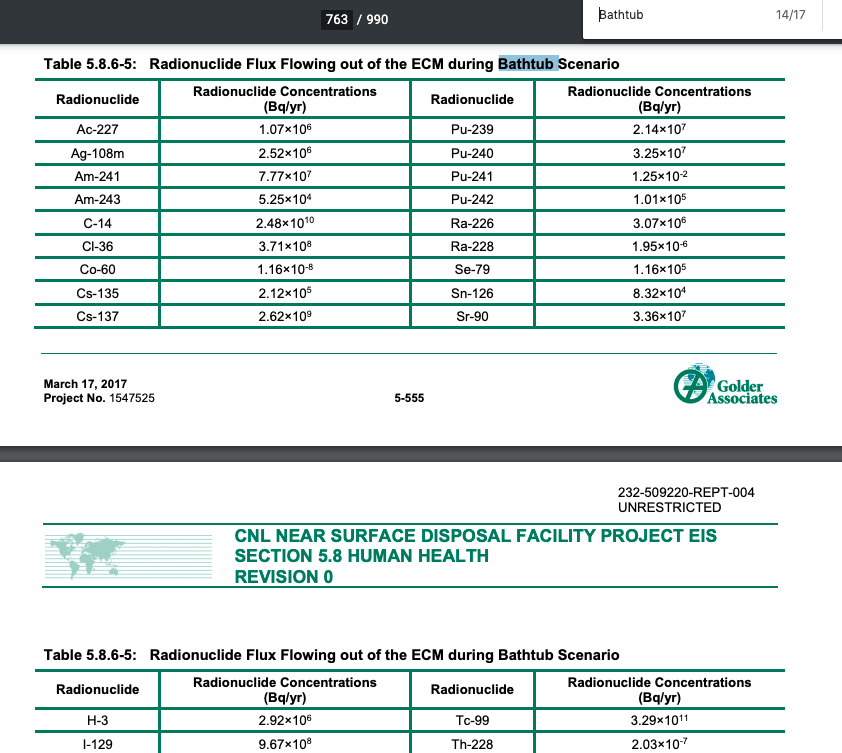
The draft EIS includes 25 occurrences of the phrase “liner and cover failure as a result of normal evolution”. The document also includes 11 occurrences of the term “bathtub effect” during which there is a flow of radioactive materials out of the mound. Table 5.8.6-5 lists quantities of radioactive materials, including four isotopes of plutonium, that would flow out of the mound under the “bathtub scenario”.
Here’s a screenshot from page 723 of the pdf document, that describes the liner and cover failure as a result of “normal evolution” followed by two scenarios for disintegration of the mound and migration of contaminants into Perch Creek and the Ottawa River.

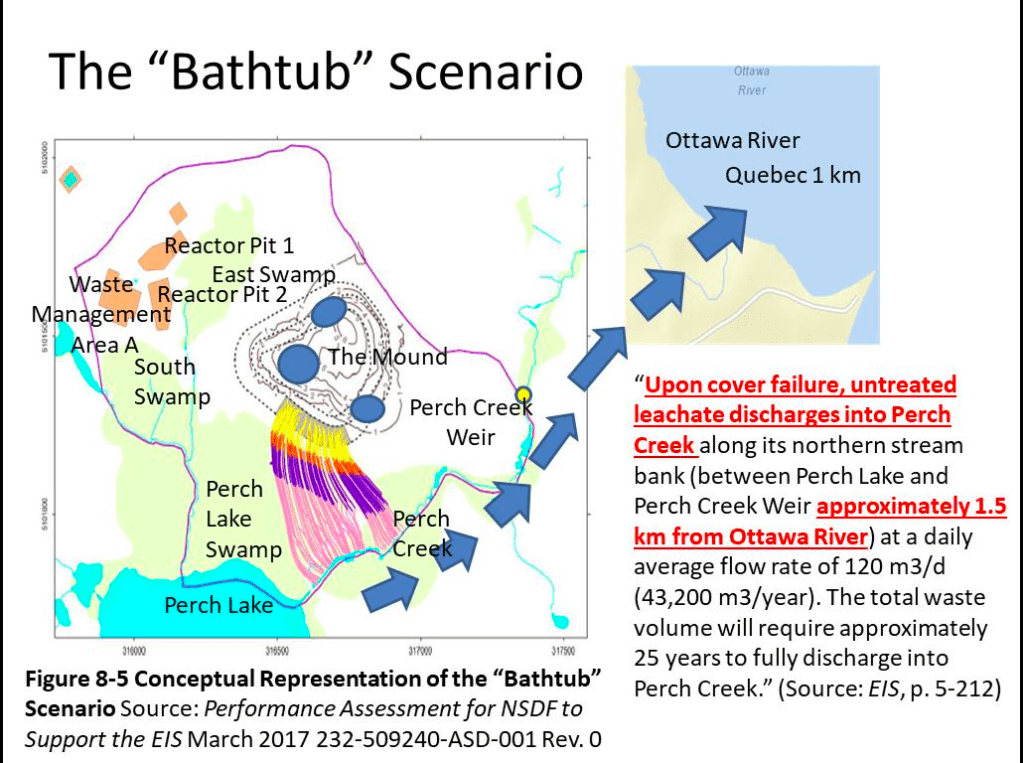
Here is a picture of the Bathtub Scenario from page 187 of CNL’s Performance Assessment for NSDF. The blue arrows and the Ottawa River were added by CCRCA researcher Ole Hendrickson when he incorporated Figure 8-5 into a Powerpoint deck.
And here is part of a table showing radionuclide flow out of the mound (including four isotopes of plutonium) as it disintegrates: (page 763 of the draft EIS)
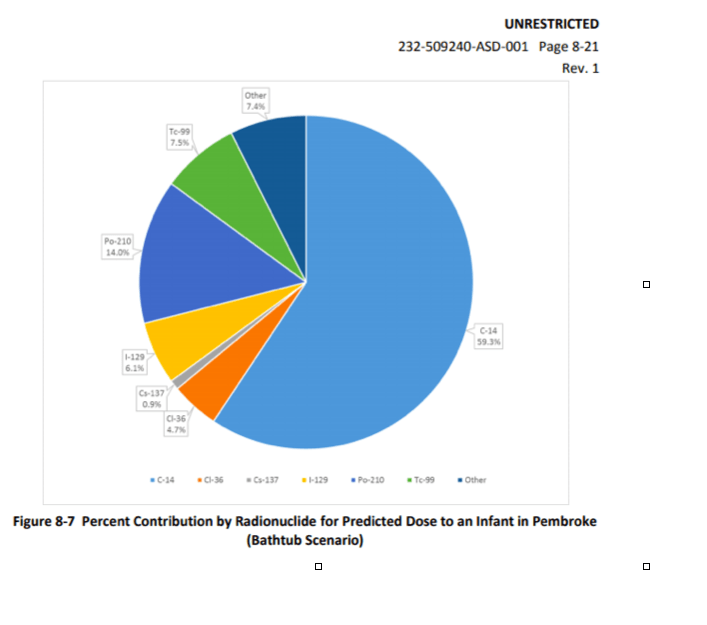
And finally here is a pie chart showing the contribution of various radionuclides (such as Carbon-14, Polonium and Caesium-137 ) to the radiation dose that would be received by an infant downstream in Pembroke, under the “bathtub scenario” of “normal evolution” of the Chalk River Mound: (Page 190 of the Performance Assessment document)
 Concerned Citizens of Renfrew County and Area
[…] mound would leak are described in the environmental impact statement. The mound is expected to eventually disintegrate in a process referred to as “normal […]
LikeLike
[…] to Environmental Impact Statements produced by the proponent. The giant Chalk River Mound is expected to disintegrate as part of a process of “normal evolution” according to the proponent’s […]
LikeLike
[…] proponent’s own studies identify many ways the mound would leak, and suggest the mound would disintegrate within 400 years and its contents would flow into surrounding wetlands that drain into the […]
LikeLike
[…] studies by the dump proponent that identified many ways the mound would leak, and described the inevitable disintegration of the mound within 400 years through a process of “normal evolution.” Leakage from the dump is expected to […]
LikeLike
[…] March 2018, showing the mound overflowing as part of the degradation and erosion process, described by the proponent in its Performance Assessment […]
LikeLike
[…] by the dump proponent that identified many ways the mound would leak, and described the inevitable disintegration of the mound within 400 years through a process of “normal evolution.” Leakage from the dump is […]
LikeLike
[…] Performance Assessment report prepared by the proponent describes the mound’s eventual degradation after 300 years. At that time the mound would still contain large quantities of dangerous […]
LikeLike
[…] contents would remain dangerously radioactive for thousands of years, but the mound itself is only expected to last a few hundred years according to studies produced by the proponent, Canadian Nuclear Laboratories, owned by a consortium […]
LikeLike
[…] March 2018, showing the mound overflowing as part of the degradation and erosion process, described by the proponent in its Performance Assessment […]
LikeLike
[…] to comment on this flawed proposal that will endanger the Ottawa River when this mound leaks and disintegrates, which the proponent’s own studies show is […]
LikeLike
[…] façons dont le monticule pourrait laisser fuir son contenu. On prévoit que le monticule se désintégrera avec le temps, un processus qualifié d’« évolution normale ».4. Il n’existe pas de niveau sécuritaire […]
LikeLike
[…] safety standards. CNL’s own studies show that the NSDF would leak and disintegrate long before radioactive components like plutonium decayed to a harmless […]
LikeLike
[…] proponent’s own studies show that the giant mound would leak and disintegrate long before radioactive components like plutonium decayed to a harmless […]
LikeLike
[…] Ottawa River during operation and after closure. It is expected to eventually disintegrate through a process of “normal evolution.” It could also contaminate the river through the effects of earthquakes, wildfires, flooding and […]
LikeLike
[…] and hazardous contaminants into the Ottawa River during operation and after closure. The mound is expected to eventually disintegrate in a process referred to as “normal […]
LikeLike
[…] The site for the proposed “NSDF” is on the side of a hill surrounded by wetlands that drain into the Ottawa River – less than one kilometre away. The proponent’s environmental impact statement documents many ways the dump could leak during operation and after closure. Three isotopes of plutonium are included in the long list of radionuclides that would be discharged into the Ottawa River in “treated effluent” from the dump. The mound is expected to degrade and erode and eventually disintegrate due to “natural evolution.” […]
LikeLike
[…] for US nuclear weapons. The proposed facility is expected to leak during and after construction and to disintegrate after a few hundred years due to “natural evolution.” Ten Algonquin First Nations, the Assembly […]
LikeLike
[…] its operation and after its closure. These materials are expected to degrade through a process of “normal evolution”. The NSDF could also contaminate the river following earthquakes, wildfires, floods, and other […]
LikeLike
[…] proponent’s Performance Assessment study suggests the mound will break down after its predicted design life of 550 years and contents will be released to the environment and […]
LikeLike
[…] from the Province of Quebec. Studies show the mound would leak during operation and break down due to erosion after a few hundred […]
LikeLike
[…] de déchets aura des fuites radioactives pendant son exploitation et elle s’effondrera après quelques centaines d’années à cause de […]
LikeLike
[…] from the Province of Quebec. Studies show the mound would leak during operation and break down due to erosion after a few hundred years, contaminating the Ottawa River, the source of drinking water for […]
LikeLike
[…] facility is expected to leak during operation and break down and release its contents to the environment after 550 years, while many of the dangerous, post-fission, man-made […]
LikeLike
[…] There are concerns the facility will leak radioactive contaminants during operation, and break down due to erosion after a few hundred […]
LikeLike
[…] Ottawa on the Chalk River Laboratories property. The mound is expected to leak during operation and break down due to erosion after a few hundred […]
LikeLike
[…] There are concerns the facility will leak radioactive contaminants during operation, and break down due to erosion after a few hundred […]
LikeLike
[…] is less than one kilometer from the dumpsite. The dump is expected to leak during operation and break down due to erosion after a few hundred […]
LikeLike
[…] design, similar to a municipal landfill. Studies show the mound would leak during operation and break down due to erosion after a few hundred years, releasing its contents to the environment, even though much of the […]
LikeLike