The NSDF site is exceptionally rich in biodiversity; granting a Species at Risk permit for the site is not supportable based on evidence

November 2025

See also this post: The Ottawa River nuclear waste megadump would destroy irreplaceable wildlife habitat

In March 2024, Canadian Nuclear Laboratories (CNL) was granted a Species at Risk permit by Environment and Climate Change Canada. The permit would allow CNL to harm, harass and kill destroy endangered species and destroy their residences during construction of the “NSDF,” a giant radioactive waste dump alongside the Ottawa River, upstream of Ottawa and Montreal.

Kebaowek First Nation, Concerned Citizens of Renfrew County and Area, the Canadian Coalition for Nuclear Responsibility and Sierra Club Canada Foundation applied for a judicial review of the decision to award the permit. During the judicial review, we reviewed evidence produced during the environmental assessment and 4,000 pages provided to us as applicants for judicial review. We concluded that there is considerable evidence that CNL did not meet the requirements of the Species at Risk Act and should not have been given a permit.

In his ruling issued on March 14, 2025, Justice Russel Zinn said the environment minister’s issuing of the species-at-risk permit was “unreasonable due to fatal flaws” in interpreting and applying the federal Species at Risk Act, adding that the issuing of the permit must be reconsidered. 

The ruling by Justice Zinn was appealed by Canadian Nuclear Laboratories. A hearing in the Federal Court of Appeal took place on November 12, 2025.

We feel strongly that the mature ecosystem and rich biodiversity present on the NSDF site are highly valuable and irreplaceable. Much as we may wish to be able to do so, humans cannot recreate a rich, biodiverse mature forest on the side of a southwest-facing slope surrounded by wetlands. Only Nature can create such an ecosystem that supports hundreds to thousands of species in a thriving matrix of interrelated life.

Background and context:

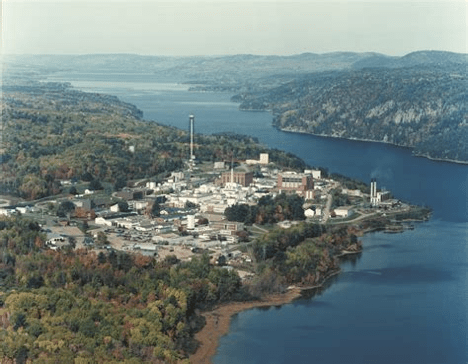
The federally owned Chalk River Laboratories site is heavily contaminated with radioactive and other hazardous waste accumulated over eight decades of operation including three decades of plutonium production for US nuclear weapons. The contamination was described by Ottawa Citizen journalist Ian McLeod in 2011: Chalk River’s toxic legacy. The legacy wastes at Chalk River are “poorly documented and misunderstood” according to NRCan (Ottawa Citizen) and are likely to require underground disposal according to the International Atomic Energy Agency. The cost to clean up the site has been estimated at $16 billion, more than the combined total cost of cleaning up all other federal environmental liabilities across Canada.

The federal government initiated the Nuclear Legacy Liabilities Program (NLLP) in 2006, a long-term strategy to clean up Chalk River Laboratories and other federal nuclear sites in Ontario, Quebec and Manitoba. As part of the program, a Comprehensive Preliminary Decommissioning Plan was produced. The cleanup was to take place over eighty-five years. One of the first steps was a “Very Low Level” (VLLW) waste facility to dispose of 160,000 cubic meters of waste. A “Low Level” waste facility was not planned until later because waste characterization was in progress and would take considerable time. It is important to note that the “Low Level” radioactive waste at Chalk River is much more dangerous than the “Very Low Level” waste and will remain hazardous and radioactive for many thousands of years.

However, the federal government’s long-term NLLP strategy was abandoned prematurely in September 2015 when Atomic Energy of Canada Ltd. was re-structured and privatized. The contract to manage the nuclear laboratories was awarded to a multinational consortium, the “Canadian National Energy Alliance”, of which SNC-Lavalin was a key player. The contract between the Government of Canada and the new contractor-operated entity, Canadian Nuclear Laboratories (CNL), required CNL to seek the “fastest, most cost-effective ways” of disposing of all waste and required that a “Low Level” Waste facility be built within six years of commencement of the contract (by September 2021). 

Only a few months later, in February 2016, CNL issued a project description for the NSDF (Near Surface Disposal Facility), a giant above-ground mound for one million tons/cubic metres of radioactive and hazardous waste that experts say clearly contravenes international safety standards. The proposed NSDF would be six times larger than the proposed VLLW facility and would use the same basic design, similar to a municipal landfill. Studies show the mound would leak during operation and break down due to erosion after a few hundred years, releasing its contents to the environment, even though much of the inventory will remain radioactive for many millennia. 

The NSDF project was supposed to be completed in September 2021 but met with strong opposition from Indigenous communities, more than 140 downstream municipalities, civil society groups and many individual Canadians. It became caught up for almost eight years in protracted closed-door negotiations between the consortium and the regulator, the Canadian Nuclear Safety Commission (CNSC), as a deeply-flawed environmental assessment was carried out. The project was approved in January 2024 by the CNSC, a body widely viewed to be a captured regulator that promotes the projects it is supposed to regulate.

Inadequate siting process for the NSDF

A proper siting process for “all” the legacy federal radioactive waste would have taken several years and would have seriously considered federal lands farther away from the Ottawa River, such as the extensive sand barrens at Garrison Petawawa adjacent to Chalk River Laboratories. That was not to be the case. Within five months of assuming responsibility for federal nuclear wastes, CNL was defending a site for its NSDF on CRL property, less than one kilometer from the Ottawa River. CNL’s February 2016 project description described two prospective sites but declared that one, the “EMR site”, was preferred. Reasons for the preference did not mention biodiversity or species at risk. Instead they emphasized proximity to the wastes slated for disposal in the facility.

A site selection report for the NSDF was released in February 2016 at about the same time as the hastily prepared project description. It relied heavily on the previous study to find a site for the Very Low Level Waste Facility. The report ruled out locations off the CRL site on economic (not biodiversity) grounds. The study also relaxed the exclusion criteria to allow steep slopes, rock outcrops and proximity to critical habitat for endangered species. This enabled CNL to insert its new “preferred” site (the East Mattawa Road or “EMR site”) into the process even though it consisted of a densely forested hillside rising 140 feet above five named wetlands at its base. To create a flat surface area for the facility, clear cutting and extensive blasting would convert 28 hectares of mature forest into 170,000 cubic metres of rock, with unknown but likely adverse effects on the surrounding wetlands that drain into the nearby Ottawa River. 

Later in 2016, CNL issued a report entitled “Biodiversity review for the NSDF project” (attached). This study was not provided to ECCC during the SARA permit application process. The report concluded that the preferred “EMR site” would have the least impact on biodiversity even though data presented in the report showed the opposite – greater biodiversity at the chosen EMR site than at the Alternate site. For example, 11 species at risk were documented at the EMR site versus 8 at the Alternate site. One hundred and twelve species of animals and plants were present at the EMR site versus 46 species at the Alternate site. The study failed to document the presence of species such as Black Bears and Eastern Wolves in the EMR/NSDF local study area. This flawed study was used to support selection of the EMR site for the NSDF, a clearly unsupportable choice if lesser impact on biodiversity was truly the objective.

Exceptionally rich biodiversity at the NSDF site

The Chalk River Laboratories site is uniquely rich in biodiversity. As a restricted area for 80 years, there has been very little human access to most of the 3,700-hectare site. Some forests, such as those at the EMR site, have acquired old growth characteristics from lack of disturbance. The site is dotted with lakes and wetlands that, combined with proximity to the Ottawa River, provide habitats and feeding grounds for many species at risk and large mammals. According to the Biodiversity review for the NSDF project, fifty species at risk have the potential to be present on the CRL site and 26 have been confirmed to be present.  According to the Environmental Impact Statement for the NSDF, 123 migratory bird species are present or likely to be present on the CRL property.

The NSDF/EMR site is even richer in biodiversity than the CRL site as a whole. As depicted on the map below of the CRL site, the NSDF/EMR site and vicinity include key components that combine to support exceptionally rich biodiversity: a densely forested south-west facing slope, surrounded at the base by wetlands. Riparian zones abound in this area, including as it does five named wetlands in addition to Perch Creek, Perch Lake and the Ottawa River shoreline less than one kilometer away. It is not surprising that the Biodiversity Review noted 112 plant and animal species present here compared to only 46 at the Alternate site. 

Compared to all other forest stands within the Chalk River Laboratories property, the NSDF site’s forested hillside, proposed for blasting and leveling, has relatively old stands of mature trees, which provide important habitat for species at risk (Appendix 5.6-4 in the final EIS). The forest stands in the NSDF/EMR site have by far the greatest number of bat roost trees of any forest stands on the entire Chalk River Laboratories property. The EIS reports 6,485 bat roost trees in the NSDF/EMR site, compared to approximately 1,567 in the Alternate site. This is shown graphically in the appended bat habitat suitability maps that show the great concentration of suitable bat nesting habitat in the local study area for the NSDF site, which is closer to ideal foraging habitat above Perch Lake and surrounding wetlands. The bat habitat suitability maps were were produced by Trent University and provided to ECCC by Annie Morin of CNL in a memo dated October 24, 2023.

The EMR site’s southwest-facing hillside with sandy soil provides preferred conditions for bear dens, of which three active ones have been observed recently. Bears are very important to the Algonquin Anishinaabe people on whose unceded territory the CRL property is located. It is surprising therefore that Black Bears were not considered as a valued component, or even listed as a mammal species observed in the local study area for the NSDF. It was Indigenous-led research by Kebaowek First Nation that documented the three active bear dens in winter 2023. KFN also documented the presence of Eastern Wolves, another species of great cultural and spiritual importance to Algonquin Anishinaabe people, in the NSDF local study area. 

The southwest-facing slope of old growth forest stands – in close proximity to abundant insect breeding grounds in adjacent wetlands – also provides preferred nesting conditions for many migratory songbirds. According to Appendix 5.6-3 of the Environmental Impact Statement, 111 migratory bird species are likely or confirmed in the local study area for the NSDF site, a high density of species in a relatively small area. 

The Biodiversity Review noted that Perch Lake contains 17 fish species, all of which were under consideration as valued components but ruled out on the basis that the lake water would be unaffected by the project. However, a pipeline to Perch Lake from the NSDF, added to the plan in 2020, is expected to discharge very high levels of radioactive tritium and smaller quantities of many other radioactive and hazardous substances directly into Perch Lake. CNL would allow the concentration of tritium in Perch Lake to rise as high as 360,000 Bq/l, fifty times higher than the very permissive Canadian drinking water standard for tritium. This would have adverse effects on the 17 fish species mentioned above and many other aquatic species. Tritium is readily incorporated into genetic material and causes genetic damage, cancer and birth defects. It readily bioaccumulates in the food chain and has the potential to affect all animals feeding in the Perch Lake basin. It is our understanding that the Department of Fisheries and Oceans should review this plan, but we have not seen any evidence that they have yet done so. 

It cannot be said that CNL chose the location and site expected to have the least impact on species at risk

CNL chose the EMR site for the NDSF even though it contains more habitat for species at risk and is richer in biodiversity than the Alternate site. It cannot be reasonably said that CNL chose the location and site expected to have the least impact on species at risk or chose the best solution to reduce the impact on species at risk. Given that the entire CRL property is rich in biodiversity, failing to seriously consider off-site alternatives is another way in which CNL did not choose the site and location expected to have the least impact on species at risk.

CNL’s actions with respect to the Eastern Wolf suggest that biodiversity conservation was considered an impediment rather than a goal

According to the Canada Gazette (page 25), CNL raised concerns about uplisting of the Eastern Wolf in 2017 stating they could incur costs of up to $160 million from uplifting. CNL did not mention Eastern Wolves in its application for a SARA permit in 2017 despite the fact that, according to a letter from George Dolinar of CNL to ECCC in March 2024, Eastern Wolf pups had been observed within the CRL boundary in 2012. The Eastern Wolf was also not mentioned in George Dolinar’s letter to ECCC in April 2020 providing additional information in support of the SARA permit application. These actions suggest that CNL considered protection of Eastern Wolves to be something to be avoided. In George Dolinar’s letter of March 2024, “Protecting the Eastern Wolf in Preparation to the Near Surface Disposal Facility Construction,” Mr Dolinar does not mention Indigenous-led research by Kebaowek First Nation in 2023 that documented the presence of Eastern wolves and pups on the CRL site with extensive use of trail cameras and “ground truthing.” The failure to mention the role of Kebaowek First Nation and its findings is deeply concerning. Kebaowek First Nation presented detailed results of its research to the Canadian Nuclear Safety Commission in a submission dated May 1, 2023.

Attachment: Bat Habitat suitability maps

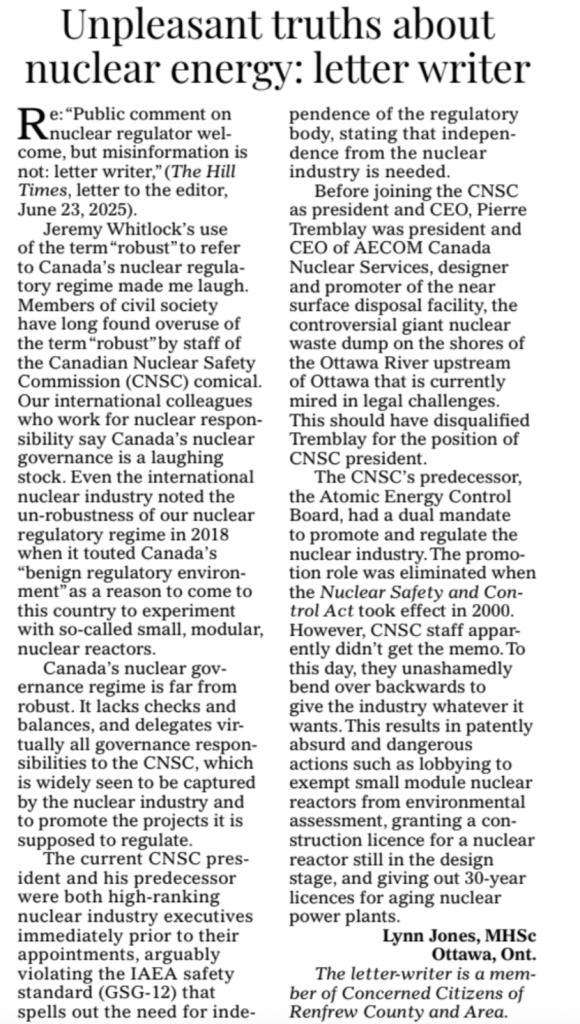
Canada’s inadequate nuclear regulatory regime highlighted in Hill Times letters to the editor

This letter appeared in the July 7 edition of the Hill Times. (subscribe here)

It was in response to a letter by Jeremy Whitlock, indefatigable cheerleader for all things nuclear. His letter, published on June 23, 2025 is here.

Jeremy Whitlock was responding to this letter, published in the Hill Times on June 16, 2025:

Canada is failing to meet a fundamental principle of nuclear safety according to international experts

March 2025 report  by the International Atomic Energy Agency (IAEA) flagged a serious problem in Canada’s nuclear governance regime. Canada has not incorporated the fundamental safety principle of justification into its legal framework, despite being urged to do so by an international peer review team in 2019.

The IAEA principle of justification in nuclear safety requires that any practice involving human exposures to ionizing radiation be justified during the licensing process for a facility. It must be demonstrated that the overall benefits of the project to individuals and society, outweigh the potential health detriments of the radiation exposures it will cause.

Justification is necessary because there is no safe level of exposure to ionizing radiation from nuclear reactors and radioactive waste. Ionizing radiation causes cancers of all kinds, many other chronic diseases and damage to the human gene pool. Human-made nuclear waste will remain hazardous and radioactive for millions of years.

Canada’s failure to justify nuclear projects is a serious deficiency that urgently needs to be addressed given the Government of Canada’s professed interest in funding and expanding nuclear electricity generation in Canada. We need to ask: can we justify creating more and more radioactive waste that future generations will have to deal with even though they will receive zero benefit from the activities that created it.

Other serious deficiencies were flagged by the IAEA experts in 2019. For example, Canada allows pregnant nuclear workers to be exposed to a radiation dose four times larger than is tolerated by IAEA standards. This issue remains unaddressed five years later.

These problems are just the tip of the iceberg. An environmental petition to the Auditor General of Canada in 2019 described many problems with Canada’s nuclear governance regime suggesting it compares unfavourably with more robust regimes in other OECD countries.  See Hill Times letters to the editor: “Who will fix Canada’s nuclear governance gaps?” and “Reforms needed at the Canadian Nuclear Safety Commission,” for more details.

Lynn Jones, Ottawa (Concerned Citizens of Renfrew County and Area)

The challenge of long-lived alpha emitters in the Chalk River legacy wastes

January 22, 2024 (revised September 17, 2024)

Why is so little Chalk River waste suitable for near surface disposal? 

Extensive research work at the Chalk River Laboratories on nuclear reactor fuels, and in the early days, on materials for nuclear weapons, produced waste with large quantities of long-lived alpha emitters.  This waste is difficult to manage and can even become increasingly radioactive over time.  

According to the International Atomic Energy Agency, because of the presence of long-lived alpha emitters, waste from nuclear research facilities is generally classified as intermediate level, and even in some cases, as high level. This waste cannot be put in a near surface disposal facility because its radioactivity will not decay to harmless levels during the period that the facility remains under institutional control.   

Alpha emitters decay by throwing off an alpha particle, the equivalent of a helium nucleus, with two protons and two neutrons.  The external penetrating power of an alpha particle is low, but alpha emitters have extremely serious health effects if ingested or inhaled. They can lodge in your lungs and cause cancer.

Research at Chalk River and all other nuclear laboratories is ultimately based on three long-lived alpha emitters — thorium-232, uranium-235, and uranium-238. These are the “naturally occurring” or “primordial” radionuclides.  They were created by large stars and then incorporated into the Earth and the solar system when they formed some 4.5 billion years ago.  The waste inventory proposed by Canadian Nuclear Laboratories for the Near Surface Disposal Facility (NSDF) includes over six tons each of thorium-232 and uranium-238.

Each “natural” alpha emitter initiates a decay chain with roughly a dozen radioactive isotopes of other elements such as radium, radon, and polonium.  These elements also occur naturally, but in much smaller amounts because of their more rapid decay. 

When a radioactive element releases an alpha particle, the atomic weight of the product goes down by four.  Uranium-238 decays to uranium-234, with a 245,000-year half-life. Uranium-234 decays to thorium-230, with a 75,000-year half-life. Thorium-230 decays to radium-226, with a 1,600-year half-life.  Shorter half-lives mean greater initial radioactivity. Radium-226 decays to radon-222, with a 4-day half-life.  Radon-222, a gas, builds up in the basements of houses built over uranium-rich rocks.  When it is inhaled it decays into polonium-218, a highly toxic, cancer-causing substance with a 3-day half-life. “Naturally occurring” alpha emitters are clearly harmful.

Hazards increase when uranium and thorium are mined and concentrated from ores and used in their pure form.  Marie Curie, who spent much of her career isolating radium and polonium from uranium, died of radiation-induced leukemia at age 66. She was buried in a lead-lined tomb because her corpse emitted so much radiation.

When thorium-232, uranium-235, and uranium-238 are irradiated in a reactor, as at Chalk River, they absorb neutrons and produce significant quantities of new, man-made, long-lived alpha-emitters.  Irradiated uranium-238 absorbs a neutron and temporarily forms uranium-239.  Uranium-239 transmutes to neptunium-239, which quickly transmutes to long-lived plutonium-239, with a half-life of 24,000 years. 

Plutonium-239 is “fissile” – it can readily support a chain reaction.  It is what the early Chalk River researchers produced for the manufacture of U.S. nuclear weapons, by separating the plutonium from irradiated reactor fuel.  They also used the separated plutonium to make “mixed oxide” (MOX) reactor fuel, mixing it with fresh uranium.

Thorium-232, when put in a nuclear reactor, will absorb a neutron and transmute to uranium-233, with a half-life of 160,000 years.  Uranium-233 also can support a chain reaction, so it can be used in atomic bombs and reactor fuels as well. Chalk River researchers did a lot of work to separate uranium-233 from irradiated thorium-232.

All reactor fuel contains uranium-235.  It is the only naturally occurring isotope that readily undergoes fission and can sustain a chain reaction.  But not all uranium-235 atoms undergo fission in a nuclear reactor.  Instead they can absorb either one or two neutrons and form yet two more very long-lived, man-made alpha-emitters, uranium-236 (half-life of 23.4 million years) and neptunium-237 (half-life of 2.14 million years). 

Nuclear engineers don’t like uranium-236 because it acts as a “neutron poison”, absorbing neutrons instead of undergoing fission.  The longer that uranium-235 fuel remains in a reactor, the more uranium-236 and neptunium-237 are produced. 

Uranium-236 is certainly a part of the Chalk River waste. It is the longest-lived of all the man-made alpha emitters, but for some reason it was omitted from the NSDF inventory.

As noted above, thorium-232, uranium-235, and uranium-238 are the start of three naturally occurring decay chains.  A fourth decay chain starts with man-made neptunium-237 and ends with thallium-205 (the element before lead in the periodic table).  Neptunium and its “progeny” have all decayed away during Earth’s 4.5-billion-year history, but production of neptunium-237 in nuclear reactors (and uranium-233 by thorium-232 irradiation) has “resurrected” this hitherto extinct fourth decay chain.  

Americium-241, found in significant quantities in Chalk River waste, is another starting point for the man-made nepturium-237 decay chain.  Nuclear reactors have also greatly augmented the amounts of radionuclides in the uranium-235 decay chain by producing plutonium-239, and in the thorium-232 decay chain by producing uranium-236.

Early research done at Chalk River to extract (or “reprocess”) plutonium-239 and uranium-233 from irradiated fuel and irradiated thorium targets has created a legacy of buildings (e.g., the Plutonium Recovery Laboratory) and soils (e.g., the Thorium Pit) that are contaminated with long-lived alpha emitters.  Reprocessing was dangerous and caused several accidents. The resulting contamination has never been cleaned up.

Until 2018, highly enriched uranium-235 targets were irradiated in the NRU reactor at Chalk River, followed by dissolving the targets in nitric acid and extracting the fission product molybdenum-99, a “medical isotope”. After extraction of “moly-99”, the other fission products, and the long-lived alpha emitters uranium-236 and neptunium-237 (produced when uranium-235 atoms absorb neutrons instead of undergoing fission), remain in the medical isotope waste.  This waste resembles high-level spent fuel waste and represents one of Chalk River’s most dangerous legacies.

Fuel reprocessing, medical isotope production, and other research activities at Chalk River have produced very significant amounts of waste containing ­­long-lived alpha emitters.  This waste is unsuitable for near-surface disposal.  Much of it is mixed with shorter-lived fission products and cannot be separated from them.  This mixed waste should not be put in the NSDF. 

Detecting alpha emitters in mixed waste is expensive and challenging. Putting inadequately characterized waste in the NSDF would invalidate its safety case.

Unfortunately, the NSDF Project lacks adequate waste characterization procedures.  If the project is allowed to proceed, workers and future Ottawa valley residents could be exposed to unknown quantities of long-lived alpha emitters and suffer the serious health effects associated with them.

~~~~~~~~~~

Canadian Nuclear Safety Commission enabled Chalk River debacle in the making ~ Hill Times letter to the editor

Published in the Hill-Times on Mar 4, 2024

https://www.hilltimes.com/story/2024/03/04/canadian-nuclear-safety-commission-has-enabled-this-debacle-in-the-making-at-chalk-river-protesters/412986

Dear Editor

The “NSDF,” a giant, above-ground landfill beside the Ottawa River, for one million tonnes of radioactive waste, approved by the Canadian Nuclear Safety Commission on January 9, is a debacle-in-the-making. 

The NSDF fails to meet International safety standards according to experts who for years were in charge of the waste at Chalk River. Industry veterans say much of the waste is too long-lived for permanent emplacement in an above-ground mound.  

The facility is expected to leak during operation and break down and release its contents to the environment after 550 years, while many of the dangerous, post-fission, man-made radioactive toxins in the mound will remain hazardous for many millennia. Plutonium and other radioactive pollutants will leak into the Ottawa River that drains into the St. Lawrence River at Montreal. This leakage will contaminate drinking water for millions of Canadians. All radioactive contaminants increase risks of cancer, birth defects and genetic mutations in exposed populations. The larger the population exposed, the greater the incidence of maladies.

Ten out of 11 Algonquin First Nations that have lived in the Ottawa River watershed for millennia say they do not consent to the NSDF on their unceded territory. The Assembly of First Nations and more than 140 municipalities including Ottawa, Gatineau and Montreal have passed resolutions of concern and/or opposition to the facility.

We wonder who the beneficiaries of the NSDF would be, besides shareholders of the three multinationals involved: SNC-Lavalin (now called Atkins Réalis), and two Texas-based multinationals, Fluor and Jacobs. The three multinationals comprise the “Canadian National Energy Alliance,” contracted by the Harper government in 2015 to quickly and cheaply reduce Canada’s multibillion dollar federal nuclear waste cleanup liability.

Canada’s deficient nuclear governance regime and its “nuclear-industry-captured” regulator, the Canadian Nuclear Safety Commission, have enabled this debacle-in-the-making to be taken seriously and to receive a license for construction.

Two legal challenges to the CNSC’s decision have been launched in Federal Court. More may follow if a species-at-risk permit to clearcut the NSDF site is approved .

There is a positive way forward for the Liberal government. The Federal Cabinet could request an ARTEMIS review by the International Atomic Energy Agency. ARTEMIS reviews are expert peer reviews, available to all member states of IAEA.

An ARTEMIS review could provide the Government of Canada with valuable advice about how to manage its legacy radioactive waste. Responsibility for managing this waste was handed over to profit-seeking multinationals in 2015 by the Harper government. Costs to taxpayers have ballooned since then. An ARTEMIS review could advise the Government of Canada on how to get value for money in its radioactive waste management projects while ensuring that safety is the top priority.

House of Commons e-petition 4676 calling for an ARTEMIS review garnered 3000 signatures in 30 days over the recent Christmas and New Years holiday period. The petition also called on the Government of Canada to uphold the principle, from the UN Declaration on the Rights of Indigenous Peoples, that “free, prior and informed consent” must be obtained before hazardous waste is stored in the territory of Indigenous people.

We and others have written to the Prime Minister and several Cabinet Ministers urging Cabinet to request an IAEA ARTEMIS review as soon as possible for the benefit of all Canadians and future generations.

Gordon Edwards, PhD, Montreal

Canadian Coalition for Nuclear Responsibility

Lynn Jones, MHSc, Ottawa

Concerned Citizens of Renfrew County and Area

Groups warn : radioactive waste piled in a giant mound beside the Ottawa River will remain hazardous for many millennia

February 5, 2024

Le français suit

For immediate release

Citizens’ groups from Ontario and Quebec warn that radioactive waste destined for a giant mound beside the Ottawa River must be stored underground

The groups call on the federal government to halt the project and stop all funding for construction

Ottawa, February 5, 2024 — Citizens’ groups have issued an urgent warning about waste slated for disposal in a giant radioactive waste mound one kilometre from the Ottawa River, upstream from Ottawa, Gatineau and Montreal. The groups cite nuclear experts who say the waste will remain hazardous to the public for many thousands of years and needs to be emplaced underground.

In a letter sent on February 4 to elected officials, the citizens’ groups call for the Government of Canada to halt the disposal project and stop all funding for construction. The letter cites  evidence that waste destined for the mound is heavily contaminated with very long-lived radioactive materials produced in nuclear reactors, which are capable of causing cancer, birth defects and genetic mutations in exposed populations.

The seven-storey radioactive mound is known as the “Near Surface Disposal Facility” (NSDF). It was recently licenced by the Canadian Nuclear Safety Commission (CNSC). The CNSC is widely perceived to be a captured regulator that promotes the projects it is supposed to regulate, as reported by an Expert Panel in 2017. 

If built, the mound will hold one million tons of radioactive and other hazardous waste from eight decades of operations of the Chalk River Laboratories (CRL), a highly contaminated federal nuclear research facility owned by the Government of Canada. Commercial waste and waste imported from other federal nuclear sites would also be put into the mound. 

The site for the NSDF is on the CRL property, 180 km northwest of Canada’s capital, on the Ottawa River directly across from the Province of Quebec. Studies show the mound would leak during operation and break down due to erosion after a few hundred years, contaminating the Ottawa River, the source of drinking water for millions of Canadians.

Concerned Citizens of Renfrew County and Area, the Old Fort William (Quebec) Cottagers’ Association, Ralliement contre la pollution radioactive, and the Canadian Coalition for Nuclear Responsibility have been opposing the giant radioactive waste mound since 2016. They say there is widespread ignorance about what would go in the mound due to repeated statements by the regulator and the proponent that “it’s only low level waste.”

“If I hear one more time that the mound will hold ‘only low-level’ radioactive waste including mops and shoe covers, I’m going to scream so loud they will hear me at the IAEA headquarters in Vienna,” said Johanna Echlin of the Old Fort William (Quebec) Cottagers’ Association. “People need to wake up and realize the truth that this waste is full of deadly long-lived, man-made radioactive poisons such as plutonium that will be hazardous for many thousands of years.”

The International Atomic Energy Agency (IAEA) referred to by Echlin says waste from research facilities such as Chalk River Laboratories generally belongs to the “Intermediate-level” waste class and must be kept underground, tens of metres or more below the surface.

A former senior manager in charge of “legacy” radioactive waste at Chalk River told the Canadian Nuclear Safety Commission that, in reality, the waste proposed for emplacement in the NSDF “is ‘intermediate level waste’ that requires a greater degree of containment and isolation than that provided by a near surface facility.” He pointed out the mound would be hazardous and radioactive for many thousands of years, and that radiation doses from the facility will, in the future, exceed regulatory limits.

“We believe Cabinet or Parliament has the power to reverse this decision and they need to do so as soon as possible,” said Lynn Jones of Concerned Citizens of Renfrew County and Area. “It’s clear that the only benefit from the NSDF would go to shareholders of the three multinational corporations involved, AtkinsRéalis (formerly SNC-Lavalin), Fluor and Jacobs. Everyone else would get only harm—a polluted Ottawa River, plummeting property values, increased health risks, never-ending costs to remediate the mess and a big black mark on Canada’s international reputation.”

The citizens’ groups say Canada should commit to building world class facilities for managing radioactive waste that would keep Canadians safe and provide good jobs in the nuclear industry, safely managing and containing the waste for generations to come. 

The cleanup of the Chalk River Laboratories site was originally estimated to cost $8 billion in 2015 when a multinational consortium called “Canadian National Energy Alliance”** was contracted by the Harper government to manage the Chalk River site and clean up the radioactive waste there and at other federally owned facilities. 

Since the consortium took over, the annual costs to Canadian taxpayers for the operation and cleanup at Canada’s nuclear labs have ballooned from $336 million dollars per year to over $1.5 billion per year.

-30-

**The consortium known as Canadian National Energy Alliance is comprised of AtkinsRéalis(formerly SNC-Lavalin,) which was debarred by the World Bank for 10 years and faced charges in Canada of fraud, bribery and corruption; Texas-based Fluor Corporation, which paid $4 million to resolve allegations of financial fraud related to nuclear waste cleanup work at a U.S. site; and Texas-based Jacobs Engineering, which recently acquired CH2M, an original consortium member that agreed to pay $18.5 million to settle federal criminal charges at the same nuclear cleanup site in the U.S.

Background

Ten Things Canadians need to know about the giant radioactive waste mound coming to the Ottawa River 

~~~~~~~~~~

Communiqué:

Des groupes de citoyens de l’Ontario et du Québec soutiennent que certains déchets destinés à une gigantesque décharge de déchets radioactifs, près de la rivière des Outaouais, devraient être enfouis en profondeur.

Les groupes demandent au gouvernement d’interrompre le projet et de refuser son financement.

Ottawa, le 5 février 2024 — Des groupes de citoyens ont lancé un avertissement urgent au sujet des déchets radioactifs qui seraient enfouis dans une gigantesque décharge sur une colline, à 1 km de la rivière des Outaouais en amont d’Ottawa, Gatineau et Montréal. Ces groupes citent des experts dans le domaine du nucléaire qui affirment que certains déchets seront fortement radioactifs pendant des milliers d’années et que nous devons les enfouir en profondeur pour protéger la population.

La Commission canadienne de sûreté nucléaire (CCSN) a approuvé récemment cette déchargé haute comme un édifice de sept étages, connue sous le nom d’Installation de gestion des déchets près de la surface (IGDPS).

En 2017, le rapport d’un comité d’experts a mentionné les perceptions selon lesquelles la CCSN est en relation trop étroite avec l’industrie nucléaire et qu’elle promeut des projets qu’elle devrait réglementer.

Si elle était construite, l’IGDPS contiendrait plus d’un million de tonnes de déchets radioactifs et d’autres déchets dangereux résultant de 80 ans d’exploitation des Laboratoires de Chalk River ; cette installation de recherche nucléaire contaminée appartient au gouvernement fédéral. Des déchets radioactifs commerciaux et provenant d’autres sites du gouvernement fédéral y seront placés.

L’IGDPS est sur le site des Laboratoires nucléaires canadiens (LNC), à 180 km au nord-ouest d’Ottawa, sur la rivière des Outaouais, juste en face de la province de Québec. Des études démontrent que cette décharge de déchets aura des fuites radioactives pendant son exploitation et qu’elle s’effondrera après quelques centaines d’années à cause de l’érosion. Cela contaminera la rivière des Outaouais, source d’eau potable de millions de Canadiens.

Concerned Citizens of Renfrew County and Area, l’Association des propriétaires de chalets d’Old Fort William, le Ralliement contre la pollution radioactive et le Regroupement pour la surveillance du nucléaire figurent parmi les nombreux organismes qui critiquent depuis 2016 la conception de cette décharge géante de déchets radioactifs. Selon eux, l’information est trop vague concernant les déchets destinés à l’IGDPS même si la Commission de sureté nucléaire et les Laboratoires nucléaires canadiens ont affirmé à plusieurs reprises que seulement des déchets radioactifs de faible activité y seront placés.

” Les installations de gestion des déchets près de la surface ne conviennent pas aux déchets radioactifs de moyenne activité qu’on voulait y mettre au début, “déclare Ginette Charbonneau du Ralliement contre la pollution radioactive. ” À la suite des protestations du public, les promoteurs du projet disent maintenant que l’IGDPS n’acceptera que des déchets de faible activité. Malheureusement, ce n’est pas crédible. Il est très difficile de séparer des déchets de faible activité et de moyenne activité qui ont été stockés ensemble dans des colis non marqués. Il est donc inévitable qu’il y ait encore des déchets de moyenne activité dans cette décharge en surface. C’est très dangereux “.

Johanna Echlin de l’Association des propriétaires de chalets d’Old Fort William (Québec) mentionne que l’Agence internationale de l’énergie atomique (AIEA) est l’organisme responsable de la sûreté et de la sécurité nucléaires au niveau mondial. Selon l’AIEA, les déchets hérités par les Laboratoires de Chalk River sont de “moyenne activité ” et ils devraient être enfouis à des dizaines ou des centaines de mètres sous terre.

Les groupes de citoyens citent également les déclarations de James R. Walker (Ph.D), un ancien cadre supérieur responsable des déchets radioactifs hérités des Laboratoires de Chalk River. M. Walker énonce clairement dans ses commentaires à la CCSN que certains déchets destinés à l’IGDPS sont des ” déchets de moyenne activité ” qui nécessitent plutôt un stockage souterrain. Il affirme que la décharge serait dangereusement radioactive pendant des milliers d’années et que les radiations provenant de l’installation dépasseraient les niveaux autorisés.

” Le Cabinet et le Parlement ont le pouvoir et le devoir de renverser cette décision le plus tôt possible “, déclare Lynn Jones de Concerned Citizens of Renfrew County and Area. ” Il est clair que les actionnaires d’Atkins Realis (anciennement SNC-Lavalin), de Fluor et de Jacobs seront les seuls à bénéficier du projet d’IGDPS. Tous les autres n’en tireraient que des problèmes : pollution de la rivière des Outaouais, risques sanitaires accrus, coûts de nettoyage astronomiques et une grande tache noire sur la réputation internationale du Canada “.

Dans une lettre envoyée le 5 février aux élus et aux responsables locaux, les groupes de citoyens demandent au gouvernement canadien de stopper ce projet et de couper son financement. Les études menées par le promoteur lui-même démontrent clairement que les déchets destinés à l’IGDPS sont fortement contaminés par de grandes quantités de substances radioactives de très longue durée de vie provenant des réacteurs nucléaires, expliquent-ils dans leur lettre. Ces déchets pourraient provoquer des cancers, des malformations congénitales et des mutations génétiques chez les populations exposées.

Le Canada devrait s’engager à construire des installations de gestion des déchets radioactifs de classe mondiale, afin de garantir la sécurité des Canadiens et de créer de bons emplois dans l’industrie nucléaire, tout en gérant les déchets de manière sûre pour les générations futures, disent ces groupes de citoyens.

Le coût de la dépollution du site des Laboratoires de Chalk River a été estimé à 8 milliards de dollars lorsque le site a été confié au secteur privé par le gouvernement Harper en 2015. Le consortium multinational appelé “Canadian National Energy Alliance “**, dirigé par SNC-Lavalin (aujourd’hui appelé Atkins Realis), a remporté le contrat de plusieurs milliards de dollars pour gérer et nettoyer “rapidement et à moindre coût” le site de Chalk River et d’autres sites fédéraux. Depuis que le consortium a pris le relais, les contribuables canadiens ont vu le coût d’exploitation des Laboratoires nucléaires canadiens (autrefois les Laboratoires de Chalk River) gonfler de 336 millions de dollars par an à plus de 1,5 milliard de dollars par année. 

-30 –

 **Le consortium connu sous le nom de Canadian National Energy Alliance est composé d’Atkins Realis (anciennement SNC-Lavalin), qui a été radié par la Banque mondiale pendant 10 ans et qui a fait l’objet d’accusations de fraude, de pots-de-vin et de corruption au Canada. La société texane Fluor Corporation a payé 4 millions de dollars pour mettre fin à des allégations de fraude financière liées à des travaux de nettoyage de déchets radioactifs sur un site américain ; et la société texane Jacobs Engineering, qui a récemment acquis CH2M, un membre initial du consortium, a accepté de payer 18,5 millions de dollars pour mettre fin à des accusations criminelles fédérales sur un site de nettoyage de déchets radioactifs aux États-Unis.

Contexte
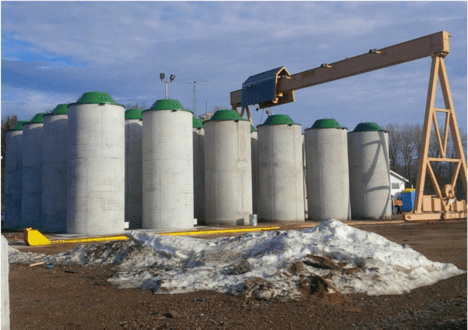
Dix choses que les Canadiens doivent savoir sur le monticulede déchets radioactifs en bordure de la rivière des Outaouais

‘We have a broken nuclear governance system’ ~ Regulator comes under fire for approving waste facility at Chalk River (iPolitics)

January 11, 2024

Excerpts:

“A decision to approve the construction of a nuclear waste storage facility two hours west of Ottawa has led Indigenous leaders, activists and experts to voice concerns about what they describe as fundamental aws within Canada’s nuclear regulator.”

“Critics of the decision believe the recent approval is the latest example of the CNSC prioritizing the nuclear industry over Canadians, which they say stems from a lack of regulatory independence.”

“Bloc Québécois MP Monique Pauzé lamented the approval what she described in French as an “insane and inconceivable project.”

“Ottawa confirms to us the bogus status of the hearings conducted by the CNSC where the Commission heard the opposition of multiple stakeholders only to nally brush them aside in the decision rendered yesterday,” Pauzé said in a statement.”

Letter to CCRCA members and friends

Ottawa River radioactive waste dump ~ license approved by the CNSC

January 13, 2024

Dear Friends

Yesterday afternoon Canada’s captured nuclear regulator, the CNSC, announced its approval of the license to build the giant above-ground radioactive waste mound beside the Ottawa River, aka the NSDF. See below a few links to good coverage of reactions to the announcement. 

There was never any doubt that the CNSC would approve the license. The surprise is how long it took them to do so — seven and a half years! That is a testament to the incredible opposition that mobilized to fight the ill-conceived plan. In a David and Goliath battle, opponents effectively derailed the original plan of the CNSC and the consortium to have shovels in the ground six years ago, in January 2018. That is an accomplishment worth celebrating!

The battle is not over. It will move to the courts now. And along with our allies, we will continue to push for an international ARTEMIS review of the proposal. On that note, thank you to everyone who signed and shared House of Commons e-Petition 4676; the petition just closed for signatures today having been signed by well over 3000 Canadians in just 30 days. A meeting with MP Sophie Chatel about how to move the request for an ARTEMIS review forward will take place soon. Other next steps are in the works and we will keep you posted about them as the plans crystalize. 

We are very grateful to our Algonquin brothers and sisters for their strong stand against irresponsible nuclear waste projects in their unceded territory. We look forward to continuing to work with them toward an ultimate victory at some point down the road. 🙂

This seems a good time to share the inspiring words of Algonquin Elder Claudette Commanda, delivered during a press conference at 50 Sussex Drive on August 10, 2023. The press conference can be viewed at this link and Claudette’s statement begins at 13 minutes. Here is some of what she said that day, to rousing applause:

“This nuclear waste facility will damage the water and we all know that. 

Conscientious people are rising. We must rise together, we are all in that medicine wheel. No matter our colour, our creed or our title, we are all related in the human family and we must stand together

We have a responsibility to our brothers the animals, to our sisters the animals. To the water life and to the land.

We cannot stop the thunder.

We cannot stop the rain from falling.

We cannot stop the lightning from shining

We cannot stop the rivers from flowing

But together as human beings, as brothers and sisters, we can certainly stop the nuclear waste facility from coming here on the Ottawa River.Meegwetch”

Thank you everyone for your ongoing interest and support. Please feel free to forward this message to anyone you think might be interested. Good overviews for people new to the issue are here and here. 

Best wishes,

Lynn

concernedcitizens.net

Facebook https://www.facebook.com/RadWasteAlert

https://twitter.com/RadWasteAlert

Photo above of Kitchi Sibi on November 15, 2023, by Bev Moses

Radioactive waste site in Chalk River a go (National Observer, Natasha Bulowski)

Déchets nucléaires à Chalk River : « aucune surprise » pour Dylan Whiteduck, (Radio Canada)

Une installation de déchets nucléaires autorisée à Chalk River | Radio-Canada (Julien David-Pelletier, Radio Canada)

Kebaowek First Nation condemns CNSC decision to license the Chalk River nuclear waste dump and calls on the federal government to intervene

Kebaowek First Nation condemns CNSC decision to license the Chalk River nuclear waste dump and calls on the federal government to intervene

PRESS RELEASE

FOR IMMEDIATE RELEASE

NUCLEAR WASTE AT CHALK RIVER: KEBAOWEK FIRST NATION CONDEMNS CNSC DECISION AND CALLS ON THE CANADIAN GOVERNMENT

KEBAOWEK, January 9, 2024 – Despite concerns expressed by First Nations and increased support from over 140 municipalities across Canada, the Canadian Nuclear Safety Commission (CNSC) has granted the license for the Near Surface Disposal Facility (NSDF) project at Chalk River. In response, the Kebaowek First Nation strongly condemns this decision and calls on the federal government to intervene to stop this environmentally high-risk project.

“The Commission’s decision is unacceptable, notably because it goes against the rights of Indigenous peoples and environmental protection. The Canadian government must act promptly and immediately assert the suspension of the project. The Commission’s final decision is totally wrong when it states that the NSDF project will not cause significant environmental effects. While the decision states that CNL will take appropriate measures to safeguard the environment, the health, safety of individuals, and national security and to comply with national obligations, it is undeniable that the safety and health of people and the environment will be profoundly impacted for generations to come through this project, ” reacted Chief Lance Haymond of Kebaowek.

It is worth noting that the NSDF would release radioactive and hazardous materials into a nearby wetland and the Ottawa River during its operation and after its closure. The mound is expected to degrade through a process of “normal evolution”. The NSDF could also contaminate the river following earthquakes, wildfires, floods, and other extreme weather events. Not only is the Kichi Sibi sacred to the Algonquin Peoples, but the Chalk River site is also close to the sacred Algonquin sites of Oiseau Rock and Baptism Point.

In 2017, the Assembly of First Nations adopted a resolution stating that the CNSC and the Canadian government had not fulfilled their constitutional obligation to consult and accommodate First Nations regarding the NSDF. The Anishinabek Nation and the Iroquois caucus issued a joint statement on radioactive waste, asserting that “we must protect the land, water, and all living beings for future generations” and calling for no abandonment of radioactive waste, moving it away from major waterways, and eliminating the practice of importing or exporting radioactive waste.

In addition to the opposition of Algonquin First Nations to the project, over 140 municipalities in Quebec and Ontario, including Gatineau and Montreal, as well as several civil society organizations, have expressed their opposition to the NSDF plan. In 2021, the City of Ottawa adopted a resolution expressing its concern.

The Kebaowek First Nation, committed to defending the rights of Indigenous peoples and environmental preservation, expresses its eagerness to collaborate with the government and other stakeholders to ensure a careful consideration of Indigenous concerns and compliance with the obligations of the United Nations Declaration on the Rights of Indigenous Peoples (UNDRIP) in the context of this project. The First Nation maintains its categorical opposition to the establishment of a permanent NSDF on unceded Anishinabe territory, emphasizing the crucial importance of protecting Indigenous rights, the environment, and cultural heritage. Faced with a lack of trust in the CNSC and its persistent failure to uphold UNDRIP, the First Nation calls on the federal government, including the Minister of Environment and Natural Resources, to intervene and end the project.

“I want to be very clear: the Algonquin Peoples did not consent to the construction of this radioactive waste dump on our unceded territory. We believe the consultation was inadequate, to say the least, and that our Indigenous rights are threatened by this proposal. We demand the cancellation of the NSDF project. The focus should instead be on a real and successful cleanup of the site to permanently eliminate old radioactive waste,” explains Chief Haymond.

Kebaowek First Nation Chief Lance Haymond speaking at a press conference in Ottawa in June 2023

For more information: https://www.stopnuclearwaste.com/ 

To obtain the Board’s decision: https://www.cnsc-ccsn.gc.ca/eng/resources/news-room/nsdf-media-kit.cfm  

-30-

Source: 

Kebaowek First Nation

For information and interview requests: 

Mathilde Robitaille-Lefebvre 

Media Relations 

m.robitaille-lefebvre@seize03.ca 

819-852-4762

Justin Roy

Advisor 

Kebaowek First Nation 

Jroy@kebaowek.ca 

819-627-3309

La Presse: Chalk River nuclear waste site project “The place is wrong and the method is wrong”.

November 24, 2023

https://www.lapresse.ca/actualites/2023-11-24/projet-de-site-d-enfouissement-de-dechets-nucleaires-de-chalk-river/l-endroit-est-mauvais-et-la-methode-est-mauvaise.php?sharing=true

Chalk River nuclear waste site project “The place is wrong and the method is wrong”.

A proposed nuclear waste disposal site near the Ottawa River should be rejected because of the environmental risks it poses and because the authorization procedure is tainted by a conflict of interest, argue various aboriginal nations.

Jean-Thomas Léveillé – La Presse

Published Nov. 24, 2023

The development of a “near-surface waste management facility” (NSWMF) – a nuclear waste burial site – at Chalk River Laboratories, on the Ontario side of the river, has been the subject of an application for authorization studied since 2016 by the Canadian Nuclear Safety Commission (CNSC). A decision is expected in the coming weeks.

The proposed landfill would receive low-level radioactive waste for at least 50 years in the municipality of Deep River, near Chalk River, Ontario, one kilometer from the Ottawa River, close to a wetland.

It would consist of a man-made mound, equivalent in height to a five-storey building, made up of different storage cells and equipped with leachate collection, leak detection and environmental monitoring systems.

This design is “essentially the same” as that of any domestic hazardous waste landfill in Canada, whereas radioactive waste requires a “much stricter” level of protection, astonishes lawyer Theresa A. McClenaghan, Executive Director of the Canadian Environmental Law Association.

“You would never, ever, ever put a landfill in a wetland, and never this close to a major river […]. […] It’s absolutely appalling, we can’t believe it.”

Theresa A. McClenaghan, Executive Director, Canadian Environmental Law Association

In the event of a leak, radioactive material could enter the wetland and reach the Ottawa River, says Ms. McClenaghan, warning that the consequences could be multiplied tenfold in the event of an extreme weather event.

In this artificial mound, “there would be room for a million tonnes of radioactive waste”, which would remain there for centuries, says Justin Roy, band council member and economic development advisor for the Kebaowek First Nation in Quebec, one of a dozen Algonquin communities opposing the project.

The Ottawa River, which the First Nations call Kichi Sibi, is of great spiritual and cultural importance to them, not least because of the presence of sacred sites.

The cities of Gatineau and the Communauté métropolitaine de Montréal are also opposed to the project, pointing out that the Ottawa River and the St. Lawrence River, into which it flows, are the source of drinking water for millions of people downstream of the Chalk River site.

Potential impacts “not trivial at all”

The health impacts of a potential leak “are not trivial at all”, worries Dr. Éric Notebaert, vice-president of the Association québécoise des médecins pour l’environnement and professor at the Université de Montréal’s Faculty of Medicine.

“Any exposure to ionizing radiation, no matter how small, carries risks, especially if it’s chronic,” he explains. He is also concerned about the tritiated water, “radioactive water”, generated at Chalk River.

Its rapid penetration into DNA, demonstrated by animal studies, “can induce cancers, birth defects, deaths in utero,” says Dr. Notebaert, whose organization also opposes the project.

“The location is wrong and the containment method is wrong. Sooner or later, there will be runoff into the river. That’s very worrying.”

The Canadian Nuclear Laboratories, for their part, maintain that their project will enable safe storage of waste thanks to a one-and-a-half-meter-thick bottom liner, a two-meter-thick cover, site monitoring and the possibility of carrying out repairs if necessary.

Apparent conflict of interest

One of the two commissioners responsible for reviewing the project application, Marcel Lacroix, previously worked at Chalk River Laboratories, according to his biography on the CNSC website. He holds a doctorate in nuclear engineering, is a professor at the Université de Sherbrooke and is an engineering consultant. The second commissioner has completed her term.

The Kebaowek and Kitigan Zibi First Nations see this as “a big problem”, says Justin Roy. He hopes the Commission will study the project objectively.

“The CNSC has never said no to a project, not once. Every time a project has been submitted, the CNSC has approved it.”

Justin Roy, Kebaowek First Nation

The CNSC “is very close to the industry it regulates,” says lawyer Theresa A. McClenaghan.

“You have to wonder whether the regulator is sufficiently independent when there are too many people from the regulated industry,” she says, arguing that this fuels the perception of bias or lack of independence on the part of the Commission.

For its part, the Commission assures us that the evaluation process is impartial.

“There is no conflict of interest. The Commissioners are appointed by the Governor in Council, that is, the Governor General, on the advice of Cabinet,” responded a spokesman for the organization, Braeson Holland, by e-mail, after declining La Presse’s request for an interview.

“Commissioners are committed to the highest ethical standards and guidelines regarding conflict of interest,” he added, noting Marcel Lacroix’s extensive expertise.

Contacted for this article, Marcel Lacroix did not return La Presse’s calls.

Rights denied

The First Nations deplore the fact that the project was able to go ahead without their free, prior and informed consent, a notion enshrined in Canadian legislation, and accuse the CNSC of failing to consult them properly.

The chiefs of three Algonquin communities were heard at the Commission’s final hearing in August, but were not allowed to ask the project proponent any questions, deplores Justin Roy.

The First Nations have not ruled out taking their case to court to challenge the Commission’s eventual authorization of the project.

They have also launched a petition, sponsored by the Bloc Québécois, calling on the federal government to submit nuclear reactor decommissioning and permanent waste disposal projects, such as Chalk River, to the International Atomic Energy Agency for review, and for the Commission to stay its decision on the matter until their rights have been respected.

READ MORE

1945

Chalk River Laboratories begin operations, leading to the development of the CANDU nuclear reactor.

SOURCE: CANADIAN NUCLEAR SAFETY COMMISSION

1952

Chalk River Laboratories are the scene of the world’s first nuclear accident, on December 12. A second accident occurred in 1958.

SOURCE: HEALTH CANADA