Les Premières Nations algonquines s’opposent au monticule géant de déchets radioactifs à proximité de la rivière des Outaouais sur leur territoire non cédé

enregistrement de la conférence de presse sur la CPAC

POUR DIFFUSION IMMÉDIATE 

Les Premières Nations algonquines s’opposent au monticule géant de déchets radioactifs à proximité de la rivière des Outaouais sur leur territoire non cédé

OTTAWA, le 20 juin 2023 — Aujourd’hui, les chefs de deux Premières Nations algonquines et les grandes cheffes du Conseil tribal de la Nation algonquine-anishinabeg (CTNAA) et du Secrétariat de la Nation algonquine (SNA), représentant dix des onze Premières Nations algonquines, ont enjoint le gouvernement fédéral à abandonner son projet de dépotoir massif de déchets radioactifs en surface sur le territoire algonquin non cédé à proximité de la rivière des Outaouais ou la Kichi Sibi. Elizabeth May, cheffe du Parti vert du Canada et députée de Saanich-Gulf Islands s’est jointe aux chefs et elle a vivement encouragé le gouvernement à respecter les droits des Autochtones dans ses relations avec les Premières Nations algonquines. 

Les chefs des Premières Nations Kebaowek et Kitigan Zibi Anishinabeg ont rendu public leur évaluation dirigée par les Autochtones de la proposition relative aux déchets radioactifs et de l’impact qu’aura le projet sur leur culture, la terre, l’eau et la faune. 

« La Kichi Sibi est sacrée pour nos peuples et elle se trouve au cœur de notre terre natale non cédée », a déclaré le chef Lance Haymond, de la Première Nation Kebaowek. « Les peuples algonquins n’ont jamais consenti à ce que le site de Chalk River soit utilisé pendant plus de 75 ans pour des réacteurs nucléaires et la recherche, ni qu’il devienne un dépotoir permanent de déchets radioactifs. La consultation a trop tardé et elle s’est avérée inadéquate. Nous rejetons le plan ».  

Le 10 août, les Nations algonquines présenteront leurs conclusions sur le projet « Installation de gestion des déchets près de la surface » (IGDPS) lors d’une audience de la Commission canadienne de sûreté nucléaire (CCSN).  

Le chef Haymond et le chef Dylan Whiteduck de la Première Nation Kitigan Zibi Anishinabeg affirment que la CCSN n’a pas rempli son obligation de consulter. La consultation a eu lieu trop tard dans le processus et le personnel de la CCSN a traité l’IGDPS comme un fait accompli. 

Les deux chefs invoquent l’article 29(2) de la Déclaration des Nations Unies sur les droits des peuples autochtones, dont le Canada est signataire, qui stipule que les Premières Nations doivent donner leur consentement libre, préalable et éclairé au stockage ou à l’élimination de déchets radioactifs sur leurs terres ou territoires. 

« Nous avons constaté que le monticule de déchets radioactifs pouvait avoir de très graves répercussions sur nos droits et intérêts autochtones », a déclaré le chef Whiteduck. « Pour avoir un sens, la consultation doit être entamée dès le début de la planification du projet. Une consultation digne de ce nom devra permettre à Kitigan Zibi Anishinabeg un consentement libre, préalable et éclairé ». 

Il a ajouté que l’emplacement de l’installation proposée inquiète beaucoup les Premières Nations. Aucune justification n’a été donnée pour établir une installation de déchets radioactifs si près de Kichi Sibi. « Nous n’avons reçu aucune explication satisfaisante sur les raisons pour lesquelles d’autres sites éloignés de la rivière n’ont pas été envisagés ». 

Selon la grande cheffe Savanna McGregor du CTNAA, qui représente sept Premières Nations algonquines, « le projet de dépotoir de déchets radioactifs s’inscrit dans une longue histoire d’assimilation et d’oppression depuis l’arrivée des Européens. Nous avons vécu des traumatismes intergénérationnels, le déplacement de notre territoire non cédé et l’exclusion historique de la prise de décision sur le site des Laboratoires de Chalk River ». 

« En tant que personnes et dirigeants présents aujourd’hui, il nous incombe de préserver et de protéger la Terre nourricière pour les générations futures. Nous ne pouvons pas risquer la destruction de la terre et de l’eau, qui assurent la vie de tous les êtres », a déclaré la grande cheffe de la SNA, Lisa Robinson, qui est aussi cheffe de la Première Nation Wolf Lake. 

AUTRES CITATIONS 

« Lorsqu’il s’agit de respecter la DNUDPA et son exigence de ‘consentement libre, préalable et éclairé,’ les gouvernements à tous les niveaux préfèrent contraindre et soudoyer les peuples autochtones. Les préoccupations des peuples autochtones ne sont honorées que lorsqu’elles sont conformes aux plans du gouvernement. Au nom du Parti vert du Canada, nous demandons au gouvernement fédéral de respecter les appels du Conseil tribal de la Nation algonquine-anishinabeg et du Secrétariat de la Nation algonquine de rejeter un site de déchets radioactifs toxiques à côté de la rivière des Outaouais ». 

– Elizabeth May, chef du Parti vert du Canada et députée de Saanich-Gulf Islands 

« Le Regroupement pour la surveillance du nucléaire n’a pas la prétention de parler au nom des peuples autochtones. Mais, à titre de citoyens canadiens, nous affirmons clairement et sans équivoque que si la CCSN approuve l’IGDPS malgré l’absence de consentement libre, préalable et éclairé des Premières Nations Kebaowek et Kitigan Zibi, nous considérerons que cet acte déshonore le Canada et tous les Canadiens ». 

– Dr Gordon Edwards, président du Regroupement pour la surveillance du nucléaire 

« L’IGDPS ne répondrait pas à l’exigence la plus élémentaire d’une installation de gestion de déchets radioactifs, à savoir leur confinement et leur isolement. Nous apprécions grandement la position prise par les Premières Nations Kebaowek et Kitigan Zibi pour protéger leurs terres et leurs eaux pour le bien de toute vie dans le bassin versant de la rivière des Outaouais. » 

– Dr Ole Hendrickson, président de l’Ottawa River Institute et chercheur, Concerned Citizens of Renfrew County and Area 

« Nous invitons tous les alliés à manifester leur soutien au consentement libre, préalable et éclairé des peuples algonquins dans les prochaines semaines. Ce n’est là que le dernier exemple d’une histoire de colonialisme et d’absence de consentement pour le développement sur les terres autochtones ». 

– Vi Bui, organisatrice régionale, Conseil des Canadiens 

– 30 –

Contacts médias : 

Justin Roy, conseiller 

Jroy@kebaowek.ca 

(819) 627-3309 

Première nation Kebaowek 

Eva Schacherl 

evaschacherl@gmail.com  

Cellulaire : 613-316-9450 

Conseil des Canadiens – Chapitre d’Ottawa 

CONTEXTE 

Les dernières soumissions des Premières Nations Kebaowek et Kitigan Zibi font état de graves préoccupations concernant les impacts que le dépotoir de déchets radioactifs aura sur la Kichi Sibi (la rivière des Outaouais), sur les générations futures et sur les droits des Autochtones. 

Les Premières Nations algonquines n’ont pas été consultées de manière significative depuis l’annonce initiale de l’évaluation environnementale du projet en 2016.  

Pendant son exploitation et après sa fermeture, l’IGDPS laisserait échapper des matières radioactives et dangereuses dans une zone humide avoisinante et dans la rivière des Outaouais, qui devraient finir par se désintégrer par un processus « d’évolution normale ». Elles pourraient aussi contaminer la rivière sous l’effet de tremblements de terre, de feux de forêt, d’inondations et de phénomènes météorologiques extrêmes. La Kichi Sibi est non seulement sacrée pour les Algonquins, mais le site de Chalk River se trouve également à proximité des sites sacrés algonquins Oiseau Rock et Pointe au Baptême. 

En 2017, l’Assemblée des Premières Nations a adopté une résolution à l’effet que la CCSN et le gouvernement canadien avaient manqué à leur obligation constitutionnelle de consulter et d’accommoder les Premières Nations en ce qui concerne l’IGDPS. La Nation Anishinabek et le Caucus iroquois ont fait une déclaration conjointe sur les déchets radioactifs, à savoir « nous devons protéger les terres, les eaux et tous les êtres vivants pour les générations futures », ne pas abandonner les déchets radioactifs, les tenir éloignés des principaux plans d’eau et ne pas en importer ou en exporter. 

Outre l’opposition des Premières Nations algonquines au projet, plus de 140 municipalités du Québec et de l’Ontario, dont Gatineau et Montréal, ainsi que d’autres voix de la société civile, s’opposent à l’IGDPS, tandis que la ville d’Ottawa a adopté une résolution de préoccupation en 2021. 

REMARQUE : l’évaluation et la soumission finale de Kebaowek et Kitigan Zibi sur l’IGDPS peuvent être consultées à l’adresse http://www.kebaowek.ca/NSDF.html. 

Algonquin First Nations oppose giant radioactive waste mound beside the Ottawa River on their unceded territory

Recording of Press conference on CPAC

FOR IMMEDIATE RELEASE  

Algonquin First Nations oppose giant radioactive waste mound beside the Ottawa River on their unceded territory

OTTAWA, June 20, 2023 — Today Chiefs of two Algonquin First Nations and the Grand Chiefs of the Algonquin Anishinabeg Nation Tribal Council (AANTC) and the Algonquin Nation Secretariat (ANS) – representing 10 of the 11 Algonquin First Nations – called on the federal government to abandon the current plan for a massive, aboveground radioactive waste dump on unceded Algonquin territory near the Ottawa River or Kichi Sibi. The chiefs were joined by Elizabeth May, Leader of the Green Party of Canada and MP for Saanich-Gulf Islands, who strongly urged the government to respect Indigenous Rights in its dealings with Algonquin First Nations. 

The Chiefs of Kebaowek and Kitigan Zibi Anishinabeg First Nations made public their Indigenous-led assessment of the radioactive waste proposal and the project’s impact on their culture, land, water and wildlife.   

“The Kichi Sibi is sacred to our peoples and at the heart of our unceded homeland,” said Chief Lance Haymond, of Kebaowek First Nation. “The Algonquin peoples never consented to the Chalk River site being used for over 75 years for nuclear reactors and research, and now being the site for a permanent radioactive waste dump. Consultation was far too late and inadequate, and we reject the plan.”  

Algonquin Nations will present their conclusions about the Near Surface Disposal Facility (NSDF) to a hearing of the Canadian Nuclear Safety Commission (CNSC) on August 10. Chief Haymond and Chief Dylan Whiteduck of Kitigan Zibi Anishinabeg First Nation say the CNSC has failed to fulfill the duty to consult. Consultation occurred too late in the process, and CNSC’s staff treated the NSDF as a foregone conclusion.  

Both Chiefs point to Article 29(2) of the UN Declaration on the Rights of Indigenous Peoples, to which Canada is a signatory, and which says there must be free, prior and informed consent by First Nations to storage or disposal of radioactive waste on their lands or territories.  

“We have found very severe potential impacts to our Indigenous rights and interests from the radioactive waste mound,” said Chief Whiteduck. “To have any meaning, the consultation has to start back from the very beginning of project planning. Meaningful consultation will have to allow Kitigan Zibi Anishinabeg free, prior, and informed consent.”  

He added that the First Nations are very concerned about the location of the proposed facility, and no justification was offered for putting a radioactive waste facility so close to the Kichi Sibi. “We have received no satisfactory explanation for why other sites well away from the river were not considered.” 

According to Grand Chief Savanna McGregor of the AANTC, representing seven Algonquin First Nations, “The radioactive waste dump plan follows a long history of assimilation and oppression since European arrival.  We have faced intergenerational trauma, displacement from our unceded territory, and historical exclusion from decision-making at the Chalk River Laboratories site.”  

“As leaders and as people here today, it is our responsibility to preserve and protect Mother Earth for future generations. We cannot risk the destruction of land and water, which sustains life for all beings,” said Grand Chief Lisa Robinson of the ANS, who is also Chief of Wolf Lake First Nation.  

ADDITIONAL QUOTES: 

“When it comes to respecting UNDRIP and its requirement for ‘free, prior and informed consent,’ governments at all levels prefer to coerce and bribe Indigenous peoples. Indigenous concerns are only honoured when they are consistent with the government’s plans. On behalf of the Green Party of Canada, we call on the federal government to respect the calls from the Algonquin Anishinabeg Nation Tribal Council and the Algonquin Nation Secretariat to reject a toxic radioactive waste site on the Ottawa River.” 
– Elizabeth May, Leader of the Green Party of Canada and MP for Saanich-Gulf Islands  

“The Canadian Coalition for Nuclear Responsibility does not presume to speak on behalf of Indigenous peoples, but as Canadian citizens we wish to state clearly and unequivocally that if CNSC approves the NSDF despite the lack of free, prior and informed consent from the Kebaowek and Kitigan Zibi First Nations, we will consider this act as one that dishonours Canada and all Canadians.” 
– Dr. Gordon Edwards, President, Canadian Coalition for Nuclear Responsibility 

“The NSDF would fail to meet the most basic requirement for a radioactive waste facility — to contain and isolate waste. We greatly appreciate the stand taken by Kebaowek and Kitigan Zibi First Nations to protect their land and water for the good of all life in the Ottawa River watershed.”  
– Dr. Ole Hendrickson, President, Ottawa River Institute, and Researcher, Concerned Citizens of Renfrew County and Area 

“We are asking all allies to show their support for free, prior and informed consent by the Algonquin Peoples in the coming weeks. This is just the latest example of a history of colonialism and lack of consent for development on Indigenous lands.”  
– Vi Bui, Regional Organizer, Council of Canadians  

– 30 –

Media contacts:  

Justin Roy, Councillor  

Jroy@kebaowek.ca  

(819) 627-3309  

Kebaowek First Nation  


Eva Schacherl  

evaschacherl@gmail.com   

Cell: 613-316-9450  

Council of Canadians – Ottawa Chapter  


BACKGROUND 

The final written submissions from Kebaowek First Nation and Kitigan Zibi outline serious concerns about the effects the radioactive waste dump will have on Kichi Sibi (the Ottawa River), future generations and Indigenous rights.   

Meaningful consultation with the Algonquin First Nations has been lacking since the environmental assessment for the project was first announced in 2016.  

The NSDF would leak radioactive and hazardous materials into a nearby wetland and the Ottawa River during operation and after closure. It is expected to eventually disintegrate through a process of  “normal evolution.” It could also contaminate the river through the effects of earthquakes, wildfires, flooding and extreme weather events. Not only is the Kichi Sibi sacred to the Algonquin peoples, the Chalk River site is also near Algonquin sacred sites at Oiseau Rock and Pointe au Baptême.     

In 2017 the Assembly of First Nations passed a resolution stating that the CNSC and Canadian government had failed their constitutional duty to consult and accommodate First Nations with respect to the NSDF. The Anishinabek Nation and Iroquois Caucus made a Radioactive Waste Joint Declaration stating that “we need to protect the lands, waters and all living things for future generations” and calling for no abandonment of radioactive wastes, keeping them away from major water bodies, and no imports or exports of radioactive waste.  

In addition to the Algonquin First Nations’ opposition to the project, more than 140 Quebec and Ontario municipalities, including Gatineau and Montreal, and other civil society voices oppose the NSDF plan, while the City of Ottawa passed a resolution of concern in 2021.  

NOTE:  Kebaowek and Kitigan Zibi’s Indigenous NSDF Assessment and final submission can be found here: http://www.kebaowek.ca/NSDF.html  

One Algonquin First Nation agrees to provide consent to the giant nuclear waste dump proponent in exchange for economic and business opportunities; other Algonquin First Nations stand firm in opposition

June 14, 2023

Two Algonquin First Nations, Kebaowek First Nation (KFN) and Kitigan Zibi Anishinabeg (KZA), are opposed to the giant nuclear waste dump (NSDF) and have not given their consent.  Their joint final submission says:

  • the duty to consult has not been fulfilled;
  • there is insufficient information to assess the NSDF’s environmental effects or, in the alternative, the NSDF is likely to cause significant adverse environmental effects and the question of whether the adverse environmental effects are justified in the circumstance must be referred to the Lieutenant [an error] Governor in Council as required under the Canadian Environmental Assessment Act, 2012 (“CEAA 2012”); 
  • there is insufficient information to determine that CNL will “make adequate provision for the protection of the environment, the health and safety of persons and the maintenance of national security and measures required to implement international obligations to which Canada has agreed”, as required under the Nuclear Safety and Control Act (“NSCA”); and
  • approving this project would violate the United Nations Declaration on Rights of Indigenous People (“UNDRIP”), which is a universal human rights instrument with application in Canadian law.

The Algonquins of Pikwakanagan First Nation (AOPFN) have given their consent to construction of the “NSDF” radioactive waste dump at the Chalk River Laboratories on the Ottawa River. Pikwakanagan is situated on the shores of Golden Lake and the Bonnechere River in Renfrew County, Ontario.

The final paragraph of a June 9th announcement on the Canadian Nuclear Laboratories website (https://www.cnl.ca/algonquins-of-pikwakanagan-first-nation-aecl-and-cnl-sign-historic-long-term-relationship-agreement/) reads as follows:

“Since 2020, AECL and CNL have participated in extensive engagements with the AOPFN. As a direct result of this process, CNL has made improvements to the project to address concerns raised through these engagements. With those changes in place and other AOPFN conditions and commitments met by CNL, the organizations have reached agreement on the NSDF project, and the AOPFN will provide its consent to CNL and the Canadian Nuclear Safety Commission (CNSC) to move forward with the construction of the proposed facility. “[emphasis added]

The CNL announcement says “The agreement “resolves and addresses key areas of concern identified by the AOPFN, including environmental protection, radioactive waste management, cultural protection and promotion, and, the pursuit of collaborative economic and business opportunities.”  It quotes Pikwakanagan Chief Greg Sarazin as saying “this agreement is the best path forward as we seek to protect mother earth and ensure the safety of future generations.”

To date, there has been very little media coverage of this development. We learned about it today from an article, “CNL signs safety and oversight agreement with Algonquins of Pikwakanagan First Nation,” on the website of a local radio station, dated June 12th.  

In public hearings in June 2022, five Algonquin First Nations, including KFN, KZA and AOPFN told the Canadian Nuclear Safety Commission that they did not consent to the licensing of the NSDF and hadn’t been adequately consulted.

KFN and KZA will speak at a final (virtual only) CNSC hearing on the NSDF Project.  The hearing was recently rescheduled from June 27 to August 10.  It is unclear if AOPFN will also speak at the hearing.

Plutonium extraction promotes the proliferation of nuclear weapons

January 16, 2023

by Dr. Gordon Edwards, president of the Canadian Coalition for Nuclear Responsibility

There are two kinds of proliferation of nuclear weapons – vertical proliferation, whereby a nuclear weapons state expand its nuclear arsenal or its nuclear weapons delivery capabilities, and horizontal proliferation, whereby a non-nuclear weapons state acquires a nuclear weapons capability.

In the past, Canada has contributed to both vertical proliferation by selling uranium and plutonium to the USA for weapons use and horizontal proliferation by giving India the technology needed to produce and extract plutonium for weapons use.

Canada is not in a position to contribute to vertical proliferation except in very indirect ways, and no nuclear weapon state wishing to expand its nuclear arsenal would be depending on Canada for that purpose,

However there are many non-nuclear-weapons states that have a desire to acquire a nuclear weapons capability. Canadian technology and nuclear materials could play a key role in helping them to acquire that capability.

Canada could play a very important role in horizontal proliferation by making plutonium production and its extraction that much easier.

If Canada develops nuclear reactors that depend on producing and extracting plutonium as fuel, (e.g. Moltex or ARC) and proceeds to sell those reactors to other countries around the world (as is the intention), then those countries that acquire the Canadian technology will be very much closer to building an arsenal of nuclear weapons.

By far the most difficult part of building a nuclear weapons is simply acquiring a sufficient quantity of nuclear explosive material.

Building a nuclear explosive device, once the necessary weapons-usable explosive material is available, is not nearly as difficult as people think.  The best testimony to this fact comes from men who were directly involved in building nuclear weapons themselves, such as the people who expressed their concerns in the TV program whose transcript is found here: www.ccnr.org/Peaceful_Atom.html

Giving a commercial value to plutonium as a fuel, as proponents of “small modular” nuclear reactors want to do, makes it virtually inevitable that it will fall into criminal hands.

Unlike uranium, all plutonium is weapons-usable; no “enrichment” is required as is the case with uranium.

There is a great danger in making plutonium into a commercial fuel because anything that is commercially traded will end up, to a small but significant extent, in the hands of criminals and/or terrorists. We cannot keep drugs, money, guns or diamonds out of the hands of criminals, and there is no reason to think that we can keep plutonium out of the hands of criminals either.

It is entirely credible for a subnational group to make a devastatingly powerful nuclear explosive device that could be delivered in the trunk of a car parked on a downtown city street and detonated by remote control.

In the meantime, as more states acquire nuclear weapons materials, they will also build nuclear arsenals and then any military conflict in any part of the world can turn into a nuclear war.  It is foolish to think that a country that is losing a conventional war will refuse to use the most powerful weapon in its arsenal.

~~~~~~~~~~

The photo below by Japanese military photographer Yosuke Yamahata shows the extent of the devastation of Nagasaki, one day after the plutonium bomb was dropped on it by the United States.

Concerned Citizens of Renfrew County and Area supports the Campaign to Ban Plutonium Reprocessing in Canada. Visit the campaign website for more information and suggestions for adding your voice to the campaign.

Chalk River Labs ~ Comprehensive Preliminary Decommissioning Plan (CPDP)

Update December 2025 ~ THE CPDP appears to have been replaced by CNL with a document called  The Overview Decommissioning and Cleanup Plan (ODCP).  The ODCP does not appear to qualify as a preliminary decommissioning plan.  It seems to be more of a public relations document.  CNL has deleted information about actual quantities of radionuclides in the different waste management areas.  

Original post January 15.2023

This document, dated 2014 is the current version of the plan developed over many years for decommissioning and cleanup of the Chalk River Laboratories property. It is a requirement under the Nuclear Safety and Control Act that licensed nuclear facilities have decommissioning plans in place.

The plan was developed as part of the multimillion dollar “Nuclear Legacy Liabilities Project” prior to privatization of CRL in 2015. The work outlined in this plan will cost billions of dollars, possibly close to $16 billion which is a recent government of Canada estimate for the cost of cleaning up its federal nuclear legacy liability, the bulk of which is at Chalk River.

Interestingly, the CPDP includes no mention of a “Near Surface” disposal facility, aka the giant Chalk River Mound that has caused so much consternation on the part of Indigenous communities, downstream municipalities, and civil society groups over the last six years.

The private sector consortium that owns Canadian Nuclear Laboratories (CNL) and is now running Chalk River Laboratories and other Canadian federal nuclear facilities, does not appear to be following this CPDP, and the plan is not publicly accessible on the CNLwebsite.

We are posting the CPDP here because it is an important document that should guide decision making about Canada’s largest federal environmental liability and we believe it should be publicly available.

There is a Canadian Nuclear Safety Commission requirement (in REGDOC 2.11-2, Decommissioning) that a Preliminary Decommissioning Plan shall include… a public consultation plan.   The IAEA also says that planning for decommissioning includes activities for public consultation in accordance with national requirements.

 The photo above is the “active area” at Chalk River Laboratories on June 24, 2022, showing some of the buildings and structures that need to be decommissioned. The NRU reactor, closed in 2018, is the red brick building in the foreground. The Plutonium Tower – the grey structure to the left of the “Molybdenum-99 Stack” – is also visible in the photo,

ARC-100 SMR: Does the Impact Assessment Agency of Canada do anything other than recommending not to do impact assessments?

December 23, 2022

The ARC-100 reactor is a proposed sodium-cooled “small,” “modular,” nuclear reactor (SMR). It is one of two nuclear reactors comprising a proposed demonstration project at the Point Lepreau nuclear site in New Brunswick along with a Moltex Energy molten salt SMR and spent fuel reprocessing unit.

​​In July 2022, a coalition of groups from New Brunswick, and other provinces asked environment minister Steven Guilbeault to designate the Small Modular Reactor (SMR) Demonstration Project at the Point Lepreau nuclear site for assessment under the Impact Assessment Act.  Small modular nuclear reactors have been on the drawing board for decades. Serious accidents have occurred in prototype reactors. Spent fuel reprocessing is highly controversial due to attendant risks of serious accidents and nuclear weapons proliferation.

Concerned Citizens of Renfrew County and Area provided a letter in support of the designation request, in part because Canadian Nuclear Laboratories in Chalk River is conducting work to produce fuel for the ARC-100 reactor.

On December 22nd Minister Guilbeault denied the request for impact assessment, following an analysis done by the Impact Assessment Agency of Canada. 

One must ask: Does the Impact Assessment Agency of Canada do much anything other than recommending not to do impact assessments?

In November 2022 the Agency provided the following information about all its completed assessments under the new Act (which entered into force in August 2019):

Phase or Assessment TypeHighway and RoadsMines and MineralsOil and GasPorts and HarboursBridgesN/ATotal
Planning06212011
IA by Agency2210005
IA by Integrated Assessment0010001
IA by Review Panel0011002
IA by Substitution0020002
Regional Assessment0010034
Total28.  822325

So the answer to the question is no, the Agency doesn’t appear to do much in addition to recommending against doing impact assessments. It has completed an average of eight assessments per year since 2019.

According to the Government Electronic Directory Services there are 360 staff in the Agency.

As outsiders with a keen interest in seeing the serious impacts of nuclear energy and radioactive waste thoroughly assessed, it appears that the Impact Assessment Agency of Canada might be a tad overstaffed for its underwhelming performance.

Given the numerous serious potential impacts, we find it to be irresponsible that the Agency recommended against an assessment of the Small Modular Reactor (SMR) Demonstration Project at the Point Lepreau nuclear site.

The Agency also recommended in 2021 against a regional assessment of radioactive waste management in the Ottawa Valley, despite a very clear need and a call for one by the City of Ottawa and many civil society groups.

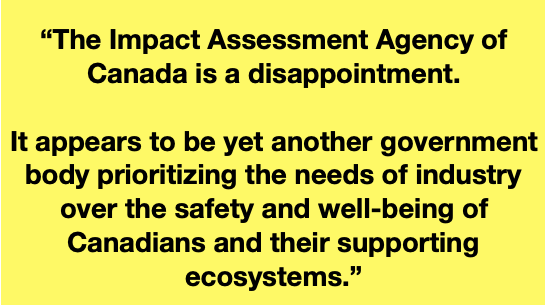
The Impact Assessment Agency of Canada is a disappointment. It appears to be yet another government body prioritizing the needs of industry over the safety and well-being of Canadians and their supporting ecosystems.

Further ~ Dec 24/2022 per the comment added below, the Agency appears to turn down dozens of requests every year, and to ONLY do assessments that are required by the legislation and captured by the seriously flawed project list.

Chalk River Mound (NSDF) would release plutonium to the Ottawa River in “treated effluent”

June 7, 2022

It is clear that The NSDF would not contain and isolate radioactive waste from the accessible biosphere. One only needs to look at the table in the proponent’s Environmental Impact Statement entitled “Maximum concentrations of radionuclides in the treated effluent and east swamp stream.” (reproduced below)

Just above the table is the statement “both aquatic and terrestrial species will be exposed to contaminated surface water and sediment in the East Swamp stream, perch lake, perch creek, and Ottawa River.”

The table lists 29 radionuclides that would be present in the treated effluent. These are the “maximum concentrations” that CNSC expects, and the CNSC license would approve. They include a large quantity of tritium and three isotopes of plutonium. The maximum concentration of Pu 241 increased 50 fold between the draft EIS and final EIS. It would be good to know the reason for that and why the tritium more than doubled.

Table 5.7.6-2 is excerpted from CNL’s Environmental Impact Statement pages 5-698 – 5-699

As Dr. Gordon Edwards, President of the Canadian Coalition for Nuclear Responsibility said in his intervention at the licensing hearings last week:

“CNSC and CNL may say these levels are negligible, but why should any citizens of Ontario or Quebec be exposed to any amount of plutonium in their drinking water?”

Thursday June 2 is INDIGENOUS Day at the hearings for the Chalk River Mound (NSDF)

Junes 2 is a special day at the hearings for the Chalk River Mound.

It is the day the Commission will consider Indigenous issues. Five Algonquin First Nations delegations will address the tribunal. The Five Algonquin First Nations intervening are; Algonquins of Pikwàkanagàn First Nation, Kitigan Zibi Anishinabeg, Kebaowek First Nation, Wolf Lake First Nation, Mitchikanibikok Inik Algonquins of Barriere Lake. All five of the Indigenous delegations are coming to Pembroke to make their interventions. The Indigenous presentations will begin at 9:00 am. One Non-Indigenous delegation, The Kitchisippi Ottawa Valley Chapter of the Council of Canadians will also intervene.

Here is the schedule for tomorrow:

9:00 Smudging Ceremony9:30 Algonquins of Pikwakanagan First Nation

10:45 Kitigan Zibi Anishinabe (Elder Verna McGregor)

Lunch

Drumming (Mitchikanibikok Inik Algonquins of Barriere Lake)

Kebaowek First Nation, 

Wolf Lake First Nation, 

Mitchikanibikok Inik Algonquins of Barriere Lake.

Kitchisippi Ottawa Valley Chapter of the Council of Canadians

Please join us in the hearing room for part or all of the day, if you can!

We are suggesting that you bring a piece of paper with FPIC on it for Free Prior Informed Consent, which refers to the requirement under the UN Convention on the Rights of Indigenous Peoples for states to ensure that no storage or disposal of hazardous materials shall take place in the lands or territories of indigenous peoples without their free prior and informed consent. 

We may hold up our signs at certain points during the hearing. The aim is to quietly and respectufully show our support for our Indigenous friends and allies. Some of us will put signs with FPIC on our cars while they are parked at the hotel.

If you can’t join us in person, please send one or more messages to decision makers to let them know that five Algonquin First Nations say they have not been adequately consulted and do not support the proposal to build the giant radioactive waste mound on their unceded territory. For more info and sample messages start here.

Photo below of Kitchi Sibi September 20. 2019