Uncategorized
AECL to get more than $1.9B; most of it goes to the multinational consortium under the GoCo contract
See also: American-owned consortium assumes control of Canada’s premier nuclear research facility. Globe and Mail, 11 Dec 2025
Updated November 2025
See below for the original 2024 post reporting $1.6 Billion in funding for Atomic Energy of Canada.
In June of 2025, the North Renfrew Times reported that AECL funding topped $1.9 B in 2025. https://northrenfrewtimes.ca/news/aecl-funding-tops-1-9-billion/
Most of this funding goes to the multinational consortium under the GoCo contract, but it is difficult to determine exactly how much. AECL itself is a small organization; privatization by the Harper government in 2015 reduced its staff complement from several thousand to just 57 employees. According to a recent financial statement from AECL the organization’s annual operating costs are under $100 million therefore it seems reasonable to conclude that the multinational consortium’s contract with the Government of Canada is now worth in excess of $1.5 billion annually, up from about $400 million in 2016.
The most recent publicly reported value for the GoCo contract was in this Globe and Mail article which reported that the GoCo contract to operate Canadian Nuclear Laboratories is worth about $1.2 billion annually.
March 6, 2024
Please subscribe to the North Renfrew Times here.

Another year, another record level of funding for Atomic Energy of Canada Ltd.
AECL will receive almost $1.6 billion in funding next year, to support both decommissioning and development at the Chalk River Laboratories, according to the federal government’s main spending estimates, published last week.
Total funding for AECL will be $1.591 billion for the fiscal year 2024-25, which begins April 1.
The funding is broken down into two components: $1.196 billion for “nuclear decommissioning and radioactive waste management” and $394.8 million for “nuclear laboratories.”
The money allocated to the laboratories includes $235.8 million in operating funding and $159 million for capital projects.
This is the ninth year in a row that funding for AECL, CNL and Chalk River has remained at unprecedented levels.
Federal funding for AECL was approved at $1.541 billion this year, up from $1.326 billion in 2022-23.
Meanwhile, funding beyond this year seems less certain.
The company’s latest five-year corporate plan notes that current rates of funding are only approved until the end of the current GoCo (government owned, contractor operated) contract for CNL in September 2025…
- For the full story, pick up a copy of this week’s NRT.
The NRT website offers just a sample of what you’ll find inside each week’s issue. To get the full NRT delivered directly to your mail box or inbox each week, subscribe to our print or digital editions here.
Yes the radioactive waste at Chalk River needs to be cleaned up, but the NSDF will make things worse not better
May 5, 2024
Background
The multi-billion dollar radioactive waste cleanup liability at Chalk River Laboratories was described in an Ottawa Citizen article in 2011, Chalk River’s toxic legacy. The waste at Chalk River was produced during eight decades of operation of one of the world’s first nuclear laboratories that was originally set up to produce plutonium for US nuclear weapons. The cleanup cost is estimated at between $8 billion and $16 billion and is expected to take many decades to be completed.
In September 2015, the outgoing Conservative government contracted a multinational private sector consortium comprised of SNC-Lavalin and two US-based multinationals to reduce the radioactive waste cleanup liability quickly and cheaply. The consortium’s proposal, that won it the contract, was to create a giant above-ground landfill for one million tons of radioactive and other hazardous wastes.This giant mound is known as the “Near Surface” Disposal Facility (NSDF) even though it is expected to rise seven stories above the ground. The consortium’s plan includes bringing federal radioactive wastes to Chalk River from Manitoba, Quebec and other sites in Ontario for disposal in the mound. The NSDF received a licesne from Canada’s “nuclear industry captured regulator,” the Canadian Nuclear Safety Commission in January 2024.
The proposed facility is not appropriate for the types of waste that would go into it. The waste is heavily contaminated with post fission nuclear reactor waste and includes many radioactive materials such as plutonium that will remain hazardous and radioactive for thousands of years. Nuclear industry veterans who were in charge of managing the waste before privatization say the facility does not meet international safety standards and that the waste should be stored underground. An International Atomic Energy Agency (IAEA) safety standard says “waste produced by research facilities generally belongs to the ILW [intermediate-level waste] class and even, in some circumstances, to the HLW [high-level waste] class.” (Details)
For the purposes of this article, we are comparing the impacts of the NSDF on the status quo of leaving the wastes where they are at the present time, until state-of-the-art facilities that meet international safety standards can be designed and sited appropriately, well away from the Ottawa River. While awaiting design and siting of proper disposal facilities, existing groundwater treatment facilities at Chalk River Laboratories could be upgraded to fully capture the existing plumes from the leaking waste areas.
Here are ten ways the NSDF will make the radioactive waste cleanup problem at Chalk River worse rather than better:
1. Increasing contamination of the Ottawa River with radioactive and other hazardous substances
Most of the radioactive liquid effluent discharges from Chalk River Laboratories go directly into the Ottawa River. Discharge points include the Process Outfall, the Sanitary Outfall, storm water outfalls, and the groundwater contaminant plumes from the NRX and NRU reactor facilities. Radioactivity is also released to the Ottawa River from Perch Creek, which receives tritium, carbon-14, strontium-90, chlorinated solvents, mercury, and other toxic substances from the Liquid Dispersal Area and Waste Management Areas A and B.
However, construction and operation of the NSDF would increase the quantity of regular ongoing radioactive and other hazardous discharges into the river and increase risks of large discharges during extreme weather events or earthquakes. (See for example: Chalk River Mound (NSDF) would release plutonium to the Ottawa River in “treated effluent”)
The NSDF location could not have been more poorly chosen.
Much of the public concern about the project site revolves around its proximity to the Kichi Sibi, the Ottawa River. Algonquin peoples have lived on the Kichi Sibi and used it as a source of food and water and a means of transport since time immemorial. Building a permanent radioactive waste disposal site a kilometer from a drinking water source for millions of Canadians makes no sense whatever. Spills or accidents during operation of the NSDF would risk its permanent contamination.
The Ottawa River occupies an active fault line. The NSDF site is underlain by fractured rock, allowing rapid groundwater movement. After closure of the NSDF, its artificial engineered barriers such as the plastic cover and the plastic bottom liner would disintegrate. The mound would erode and release its contents to the environment. Migration of contaminants into the Ottawa River would be inevitable.
The IAEA safety standard for disposal says that “A host geological formation and/or environment and site has to be identified that provide favourable conditions for the isolation of the waste from the accessible biosphere and the preservation of the engineered barriers (e.g. low groundwater flow rates and a favourable geochemical environment over the long term).”
If one disregards international safety standards and environmental considerations (as CNL and CNSC appear to have done), one might argue that the NSDF “makes things better” for the current management at the Chalk River Laboratories. The NSDF would “beautify the campus” — a place to dump the radioactive debris from demolition of over a hundred unused structures at Chalk River, and additional debris shipped from Whiteshell. Canadian nuclear companies could continue to get rid of their waste cheaply.
But – even if the NSDF were to perform perfectly during its 50-year operational phase – building it so close to the Ottawa River would impose undue burdens on future generations.
This represents a morally unacceptable approach, and one that is inconsistent with Canada’s international obligations.
2. Burdening future generations with a major remediation challenge
CNL claims that “only low-level waste” would go in the NSDF. This claim is not backed by evidence.
Nuclear industry veterans – those who were in charge of waste management before the 2015 privatization of CNL — say the proposed NSDF does not meet international safety standards and that long-lived waste (25 of the 30 radionuclides in the NSDF inventory) must be stored underground. They say, “The waste acceptance criteria are insufficiently protective for the material… to qualify as low level waste — the radionuclides do not decay to an acceptable level during the time that institutional controls can be relied upon.”
Putting long-lived radioactive waste in a giant mound would make it much more difficult to remediate in the future. This is not responsible “environmental remediation.”
Responsible management would involve carefully characterizing, packaging and labelling the waste and storing it in a place where it can be monitored and containers can be repaired as necessary.
3. Discharging waste directly into Perch Lake which drains into the Ottawa River
The IAEA safety standard for disposal emphasizes that the “fundamental safety objective in respect of the disposal of radioactive waste is to contain the waste and to isolate it from the accessible biosphere.” It’s hard to imagine any design for a disposal facility that would conform less to this objective than the NSDF.
Parts of the NSDF mound would remain uncovered for 50 years, exposing the waste to precipitation and melting snow and ice. The resulting leachate would need to be pumped uphill to a water treatment plant to remove a portion of its radioactive and hazardous contaminants.
The initial plan was to send leachate from the treatment plant back downhill through an “exfiltration gallery” into one of the adjacent wetlands. CNL argued that this would “promote the exfiltration of treated water into the local groundwater regime” and compensate for water lost from nearby wetlands when drains were installed under the NSDF itself.
CNL estimated it would take roughly ten years for contaminants to move through the wetlands into Perch Lake and Perch Creek, and that this would provide some time for shorter-lived radioactive substances such as cobalt-60 and tritium to undergo radioactive decay before emerging in these surface water bodies.
Later, however, CNL decided that if only an exfiltration gallery were used, at certain times of the year there would be “insufficient infiltration capacity at the exfiltration gallery which could result in overland flow of treated effluent.” This would cause erosion and rapid contaminant movement. Therefore, a late addition to the NSDF project was a pipeline that could discharge contaminants directly into Perch Lake (a pipeline to the Ottawa River was also considered).
Water treatment cannot remove tritium, the substance that would contain the second highest amount of radioactivity in the NSDF at closure. CNL assigned a limit of 360,000 Becquerels per liter (Bq/L) for the allowable tritium concentration at the point of discharge of the pipeline,18,000 times the 20 Bq/L standard recommended by the Ontario Drinking Water Advisory Council (but never acted upon because of nuclear industry pressure).
CNL maintains that these high levels of tritium are not a problem, because Perch Lake is a big lake (45 hectares). If the tritium were diluted evenly throughout the lake, it would approach the current 7,000 Bq/L Ontario drinking water standard, roughly tripling the concentration in Perch Lake, Perch Creek, and the Ottawa River at the point of discharge of Perch Creek. For the animals that live in and around Perch Lake, the NSDF would make things worse. For people living downstream who swim and fish in the Ottawa River and drink its water, the NSDF would be a source of ongoing anxiety.
4. Blasting away a forested hillside to create the NSDF site will change hydrology and is likely to mobilize contaminants in adjacent wetlands
Construction at the NSDF site would require “slope depressurization”. The water table is only five centimeters below the surface at the lowest point on the NSDF site. Horizontal drains would be drilled in the rock mass to lower the water table prior to rock blasting.
This would greatly alter local hydrology.
The NSDF site is adjacent to wetlands contaminated by past dumping practices. The possibility that lowering the water table would increase movement of the plumes of radioactive and hazardous substances discharging from the Liquid Dispersal Area and Waste Management Areas A and B was ignored in the CNSC’s Record of Decision.
Drying out of these wetlands would damage their vegetation cover and speed oxidation of their organic soils, which contain radioactive tritium, carbon-14, and strontium-90.
Subsequent blasting away of the forested hillside to create a more level surface for the NSDF would further alter local hydrology and promote erosion. Higher runoff from the deforested area – including from the access roads to the NSDF — would disturb downslope wetlands and cause an additional increase in the flow of contaminated groundwater into Perch Lake, Perch Creek, and the Ottawa River.
5. Airborne spreading of radioactive dust
Negative impacts of the NSDF would not be limited to nearby portions of the Perch Creek basin. As much as 370,000 cubic meters of contaminated soil found in other parts of the 3,700-hectare Chalk River Laboratories property could be put in the NSDF. At present, vegetation growth covers the plumes from other leaking waste management areas. This vegetation cover limits wind and water erosion, dust production, and surface runoff.
Digging up and exposing this material would subject it to precipitation, winds, and the drying forces of elevated temperatures. This would create additional contaminant migration. Higher wind speeds, such as those associated with tornadoes, are increasingly common in the Ottawa Valley.
Loading the contaminated soil in trucks, transporting it to the mound, dumping it, rolling over it with heavy equipment, and leaving it uncovered on the surface of the mound – all these activities would generate dust and allow the spread of radioactive and hazardous substances.
There is also potential for contaminant spread during the decommissioning, demolition, and transport of parts of unused structures on the Chalk River “campus”, such as the Plutonium Tower and the Plutonium Recovery Laboratory.
Wind speeds at a mound cleared of all vegetation would likely be elevated compared to surrounding areas.
Well-planned remediation activities are needed at Chalk River. However, a geological waste management facility in which waste would be put underground would represent a safer alternative to a mound for containment and isolation of remediation waste. This alternative would largely eliminate the problem of dust generation at the disposal facility itself.
6. Exposing workers to Inhalation of radioactive particulates
Worker inhalation of radioactive particulates – especially those containing alpha-emitting radionuclides – would be a major new radiation exposure pathway associated with the NSDF. The proposed mitigation measures in a “dust management plan” would only partially alleviate this problem, such as “Postponing work activities likely to cause dust if sustained wind speeds are predicted to exceed 40 km/hr, unless it can be shown that the work site is sufficiently protected that wind will not generate unacceptable amounts of dust.” Adding water to reduce dust generation at the NSDF site could turn contaminated soil into a muddy mess and create a major equipment cleaning problem.
Questions include: “What are acceptable amounts of dust?” “How effective would the dust management measures be?” “Why do CNL’s models assume near-zero radiation doses to workers from inhalation of radioactive particulate matter and dust?” The CNSC’s Record of Decision does not address these questions.
7. Concealing the intermediate-level radioactive waste problem
CNL claims that there is an urgent need to build the NSDF, and it is the “right solution”. But the Government of Canada — when asked at an IAEA meeting about the impact of delay in building the NSDF, and whether current storage facilities have sufficient capacity for low-level waste — replied that CNL has “plans that would allow it to continue to operate to approximately 2030 without building new storage facilities.”
Focusing on the NSDF as an urgently needed “solution” for so-called “low-level” waste – and falsely characterizing this waste as mops, gloves, shoe covers and overalls — are distractions from the large quantities of intermediate- and high-level waste in shallow burial at Chalk River. The older Chalk River waste areas contain highly varied, dangerous, long-lived, wastes that are “source terms” for plumes of radioactive and hazardous substances that are discharging into wetlands and streams draining into the Ottawa River. CNL claims that it will eventually remediate the waste areas and hints that it will transfer their contents to the NSDF, but it seems to be in no hurry to get started – or even to make a proper assessment of their contents to determine if they would conform to the NSDF “waste acceptance criteria”.
Waste Management Area B, one of the oldest areas at Chalk River, remains an active site for waste “storage”, even though the concrete bunkers in the southern portion used for storage of intermediate level solid wastes are sources of contaminant plumes discharging into Perch Creek and the Ottawa River. The GoCo contract under which the consortium of private companies operate Chalk River requires them to develop a plan for dealing with intermediate-level waste, but there is no publicly available evidence that they have made such a plan. The IAEA says that intermediate-level waste must be put at least a few tens of meters underground.
This delay in developing an approach for the more dangerous waste at Chalk River allows the continuing spread of the plumes of hazardous and long-lived radioactive waste emanating from Waste Management Area B and other waste sites.
CNL’s only strategy for dealing with intermediate-level waste (ILW) appears to be to reclassify it as low-level waste (LLW) so it can go in the NSDF. Fully 95% of the volume of the federal government’s ILW in past Canadian government reports to the IAEA is now shown as LLW. CNL initially stated that “all of the waste” from decommissioning and remediation “is intended to be disposed” in the NSDF.
CNL no longer claims that the NSDF is a solution for “all of the waste”, but it declines to estimate how much of the federal nuclear liability could be safely disposed of, either in terms of volume or radioactivity, in the NSDF. This raises suspicions that CNL has no intent of properly characterizing the waste it intends to put in the NSDF.
The focus on the NSDF as a “solution” for Canada’s nuclear legacy waste diverts attention from the need for a robust plan that encompasses all the federal radioactive waste – a plan that would deal in a more responsible manner with long-lived radionuclides than dumping them in an above-ground mound.
8. Accelerating the import of radioactive waste from other locations
The Chalk River Laboratories on the shore of the Ottawa River north-west of Ottawa is a poor location for storage of radioactive waste because the area is seismically active. The risk of a major earthquake in the Ottawa Valley is high relative to many other places in Canada. (details here)
Many of the initial municipal resolutions opposing the NSDF focused on waste imports. CNL estimates that 5% of waste to put in the NSDF would come from federal nuclear sites other than Chalk River, and 5% from industry, universities, and hospitals.
Over 99% of the initial radiation in the NSDF would be in cobalt-60, found in “sealed sources”: devices such as gamma irradiators. After cobalt-60 decays to the point where these devices no longer kill bacteria or cancer cells, companies such as Nordion and Best Theratronics import the “disused sources” from around the world and ship them to Chalk River for storage. Waste cobalt-60 devices still emit highly dangerous levels of radiation and must be shielded.
Not all these waste devices were made in Canada. Companies are not required to track their origins before importing them.
Another Canadian company, SRB Technologies, imports waste devices such as exit signs that contain tritium. Most exit signs are imported from the U.S., which prohibits their disposal in municipal landfills (Canada allows this). Tritium would represent the second highest initial amount of radiation in the NSDF inventory.
Chalk River is Canada’s only licensed commercial waste storage facility. The NSDF would represent a convenient way for industry to get rid of its waste, at taxpayers’ expense.
Imports from other federal sites are also a concern. CNL’s 2019 submission to the CNSC for renewal of the operating licence for the Whiteshell Laboratories in Manitoba anticipates that “a total of approximately 1500 shipments of Low-Level Waste, 500 shipments of Intermediate-Level Wastes and 46 shipments of High-Level Waste (the baskets of irradiated reactor fuel from the Concrete Canister Storage Facility) will be transferred to Chalk River during the completion of the Whiteshell Labs Closure Project.”
Bringing waste to Chalk River from other locations means higher worker and public radiation exposures during waste transport, increased risks of accidents and spills, increased emissions to air and water, and more pollution for future generations to deal with. Many Ottawa Valley residents are willing to look after the waste already at Chalk River, having benefited from the good jobs there, but don’t want to be the dumping ground for all of Canada’s (or the world’s) radioactive waste.
The City of Ottawa specifically asked for cessation of radioactive waste imports to the Ottawa Valley in April 2021.
9. Destruction of irreplaceable wildlife habitat
After the May/June 2022 CNSC hearing on the NSDF Project , Kebaowek First Nation insisted on being allowed to conduct its own field work at the site chosen by CNL..
Even though much of their work had to be done in the fall and winter, what they found was stunning.
Using motion-sensitive cameras, they recorded the presence of three active Black Bear dens, with video footage of bears entering them to hibernate. Ontario provincial regulations prohibit the destruction of bear dens.
Why would the NSDF site provide such good Black Bear habitat? A 2018 study found that slope is the main predictor of where bears make their dens. In that study, the likelihood of a site being used increased 6.15% for each 1° increase in slope. Advantages of denning on steeper slopes relate to safety from disturbance and avoidance of heat loss, with dens on steep slopes having drier and better drained soils that lessen heat loss compared with wetter dens. Many studies report that bears den primarily in forested habitat types. A 2005 study of den selection by Grizzly Bears in British Columbia showed that their dens were primarily in mature forest stands.
The NSDF site, with its steep slope; its sandy, well-drained soil that lessens heat loss and is easy for bears to excavate; its healthy, mature forest cover; its lack of human disturbance; and its distance from road traffic – represents irreplaceable Black Bear denning habitat. Destruction of this habitat would likely have significant negative impacts on the regional Black Bear population in the upper Ottawa Valley.
Kebaowek First Nation documented how rich in biodiversity the NSDF site is overall. A pack of Eastern (or “Algonquin”) Wolves – a distinct species found only in Canada that is threatened with extinction — was denning nearby and preying on the deer and moose that winter at the NSDF site. Three endangered bat species preferentially use the NSDF site, with its abundance of old trees that are suitable for maternity roosts and are close to ideal foraging habitat (Perch Lake and surrounding wetlands). Endangered Blanding’s Turtles, which make long overland migrations before laying their eggs in spring, also use the NSDF site, as do many species of at-risk migratory birds, including Whip-poor-wills, Golden-winged Warblers, and Canada Warblers.
We should all be grateful to the Kebaowek First Nation for doing independent field work. In its 2016 NSDF Site Selection report, CNL did not record the presence of Black Bears, nor their dens. Nor was there any mention of the use of the site by Eastern Wolves. CNL’s final environmental impact statement makes no mention of bear dens, and scant mention of the presence of wolves.
10. Squandering billions of dollars that would be better spent on a state-of-the-art facility that meets international safety standards.
Hundreds of millions of dollars have already been spent on the ill-conceived NSDF and millions more would be spent to build and operate it. This money would be much better spent on designing and siting a state-of-the-art facility, well away from the Ottawa River, that is compliant with IAEA safety standards.
In the short term, waste in leaking sites at Chalk River could be dug up and stored above ground in concrete structures while awaiting a plan for a carefully sited facility well away from the Ottawa River.

Le Devoir ~ Québec s’inquiète du projet de dépotoir nucléaire de Chalk River
le 16 avril, 2024

François Carabin à Québec
Le ministre québécois de l’Environnement, Benoit Charette, a fait part au gouvernement fédéral de ses « inquiétudes » en lien avec le projet de site d’enfouissement de déchets nucléaires de Chalk River, lui demandant notamment de mieux consulter les communautés touchées.
C’est ce qu’a indiqué l’élu caquiste mardi, lors de l’étude des crédits budgétaires de son ministère, un important exercice de reddition de comptes qui se déroule annuellement à l’Assemblée nationale.
Pressé de questions par le député péquiste Pascal Paradis, M. Charette a répété ne pas avoir pris de position officielle sur le projet. Le gouvernement fédéral a toutefois été mis au courant de ses réserves. « Le Québec a eu l’occasion de faire état de ses inquiétudes par rapport au projet », a-t-il dit.
« Ce que l’on demande au gouvernement fédéral […], c’est de mieux consulter […] les communautés autochtones qui sont dans le secteur de la rivière des Outaouais. On demande au gouvernement de mieux consulter les municipalités de ce secteur-là, aussi, qui se montrent inquiètes. »
Une centaine de municipalités établies le long de la rivière des Outaouais et du fleuve Saint-Laurent, Montréal et Gatineau comprises, contestent publiquement la décision de la Commission canadienne de sûreté nucléaire (CCSN) d’accorder en janvier l’autorisation nécessaire à la construction d’« une installation de gestion des déchets près de la surface » sur le site des laboratoires de Chalk River, en Ontario.
La communauté anichinabée de Kebaowek est également au front pour stopper le projet, qui se situe tout près de la frontière québéco-ontarienne, en bordure de la rivière des Outaouais.
En février, Kebaowek a d’ailleurs entrepris une action en Cour fédérale pour faire annuler la décision de la CCSN. Quelques jours plus tôt, le conseiller de bande Justin Roy avait indiqué au Devoir que sa communauté avait détecté des ours noirs, des loups de l’Est, ainsi que plusieurs espèces de chauves-souris, de tortues et d’oiseaux dans le secteur englobant les installations du promoteur, Laboratoires nucléaires canadiens.
Toujours pas de prise de position
Plus tôt cette année, le ministre Charette et son collègue responsable des Relations avec les Premières Nations et les Inuit, Ian Lafrenière, avaient eu l’occasion de discuter avec la communauté. Les représentants de Kebaowek avaient incité leurs vis-à-vis à se joindre aux groupes opposés au projet.
Québec solidaire est de ceux qui demandent également que Québec se positionne en bonne et due forme. « L’opposition au projet de dépotoir nucléaire de Chalk River est trop importante pour le silence actuel de François Legault », avait soutenu en janvier le député solidaire Sol Zanetti. En février, le Parti québécois avait pour sa part déposé une motion pour dénoncer l’autorisation délivrée par la CCSN ; le gouvernement caquiste s’y était opposé.
Benoit Charette n’exclut pas de se ranger aux côtés de Kebaowek et des municipalités québécoises qui demandent l’annulation du projet. « On demande dans un premier temps que le fédéral puisse consulter les communautés, mais c’est certain qu’on fait des évaluations de notre côté. Lorsqu’on aura tranché sur un positionnement particulier, on pourra s’en reparler », a-t-il dit mardi.
Le Devoir ~ Quebec concerned about Chalk River nuclear dump project
April 16, 2024
François Carabinin Quebec
The Quebec Minister of the Environment, Benoit Charette, expressed to the federal government his “concerns” related to the proposed Chalk River nuclear waste landfill site, asking it in particular to better consult the affected communities.
This is what the CAQ elected official indicated on Tuesday, during the study of his ministry’s budgetary appropriations, an important accountability exercise which takes place annually in the National Assembly.
Pressed with questions by PQ MP Pascal Paradis, Mr. Charette reiterated that he had not taken an official position on the project. The federal government was, however, made aware of its reservations. “Quebec had the opportunity to express its concerns about the project,” he said.
“What we are asking the federal government […] is to better consult […] the indigenous communities in the Ottawa River sector. We are asking the government to better consult the municipalities in this sector, too, who are showing concern. »
Around a hundred municipalities along the Ottawa and St. Lawrence Rivers, including Montreal and Gatineau, are publicly contesting the decision of the Canadian Nuclear Safety Commission (CNSC) to grant the necessary authorization for construction in January of “a near-surface waste management facility” at the Chalk River Laboratories site in Ontario.
The Anishinaabe community of Kebaowek is also at the front to stop the project , which is located very close to the Quebec-Ontario border, on the edge of the Ottawa River.
In February, Kebaowek also took action in Federal Court to overturn the CNSC’s decision. A few days earlier, band councilor Justin Roy had indicated to Le Devoir that his community had detected black bears, eastern wolves, as well as several species of bats, turtles and birds in the area encompassing the facilities of the proponent, Canadian Nuclear Laboratories.
Still no position
Earlier this year, Minister Charette and his colleague responsible for Relations with First Nations and Inuit, Ian Lafrenière, had the opportunity to speak with the community. Kebaowek representatives had encouraged their counterparts to join the groups opposed to the project.
Québec solidaire is among those who also demand that Quebec position itself in due form. “The opposition to the Chalk River nuclear dump project is too important for the current silence of François Legault ,” supported solidarity MP Sol Zanetti in January. In February, the Parti Québécois for its part tabled a motion to denounce the authorization issued by the CNSC; the CAQ government was opposed to it.
Benoit Charette does not exclude siding with Kebaowek and the Quebec municipalities who are calling for the cancellation of the project. “We first ask that the federal government be able to consult the communities, but we are sure to make assessments on our side. When we have decided on a particular positioning, we can talk about it again,” he said on Tuesday.
High level radioactive waste imports to Chalk River from Manitoba and Quebec will likely begin in 2025
April 14, 2024
See also CNL’s Integrated Waste Strategy alarms downstream residents and 2000 nuclear waste shipments planned, from Pinawa Manitoba to Chalk River, Ontario and Transport of radioactive waste on Canadian roads ~ a growing public risk
This correspondence from the Canadian Nuclear Safety Commission dated February 23, 2024 suggests that Canadian Nuclear Laboratories has applied for a license to transport used nuclear fuel from Whiteshell Laboratories to Chalk River Laboratories and that the shipments are tentatively planned to commence in June 2025. High level waste shipments from Quebec to Chalk River are also planned they will likely pass through the cities of Montreal and Ottawa or Gatinueau.
— Original message —
Subject: RE: Use of NMWO Used Fuel Transportation Package for Whiteshell HLWshipments to Chalk River
From: “Campbell, Kimberley” <Kimberley.Campbell@cnsc-ccsn.gc.ca>
To: ole@nrtco.net <ole@nrtco.net>
Cc: “Gacem, Mohamed Cherif” <MohamedCherif.Gacem@cnsc-ccsn.gc.ca>, “Stewart, Andrew” <Andrew.Stewart@cnsc-ccsn.gc.ca>, “Islam, Wasif” <Wasif.Islam@cnsc-ccsn.gc.ca>, “Igric, Petar” <petar.igric@cnsc-ccsn.gc.ca>, “Lemoine, Eric” <eric.lemoine@cnsc-ccsn.gc.ca>, <Dagenais>, François <Francois.Dagenais@cnsc-ccsn.gc.ca>, “Pyne, Jennifer” <Jennifer.Pyne@cnsc-ccsn.gc.ca>, Information / Information (CNSC/CCSN) <cnsc.info.ccsn@cnsc-ccsn.gc.ca>
Date: Friday, 23/02/2024 7:10 AM
Good morning Mr. Hendrickson:
The Canadian Nuclear Safety Commission (CNSC) has received an application from CNL to support the use of Nuclear Waste Management Organization’s (NWMO) Used Fuel Transport Package (UFTP) for the shipment of used nuclear fuel from Whiteshell Laboratories to Chalk River Laboratories. CNSC’s Transport Licensing and Strategic Support Division (TLSSD) is currently reviewing the application; however, a final certification decision has not yet been made. Pending an approved CNSC package certificate for the UFTP, and a CNSC licence authorizing the transport, used fuel shipments are tentatively planned to commence in June 2025. (emphasis added)
Additional information on CNSC’s processes for the certification of packages and transport licences can be found at Packaging and transport of nuclear substances (nuclearsafety.gc.ca).
Regards,
Kim
Kim Campbell (she/her/elle)
Director Canadian Nuclear Laboratories Regulatory Program Division
Canadian Nuclear Safety Commission
Kimberley.campbell@cnsc-ccsn.gc.ca
613-295-6143
From: ole@nrtco.net <ole@nrtco.net>
Sent: Tuesday, February 20, 2024 1:32 PM
To: Campbell, Kimberley <Kimberley.Campbell@cnsc-ccsn.gc.ca>
Cc: Gacem, Mohamed Cherif <MohamedCherif.Gacem@cnsc-ccsn.gc.ca>
Subject: Use of NMWO Used Fuel Transportation Package for Whiteshell HLW shipments to Chalk River
EXTERNAL EMAIL – USE CAUTION / COURRIEL EXTERNE – FAITES PREUVE DE PRUDENCE
To: Kimberley Campbell
Director, Canadian Nuclear Laboratories Regulatory Program Division
Canadian Nuclear Safety Commission
Date: February 20, 2024
Subject: Use of NMWO Used Fuel Transportation Package for Whiteshell HLW shipments to Chalk River
The following question was posed during this morning’s Canadian Nuclear Laboratories webinar, “Restoring the Whiteshell Laboratories site”:
We have read that an application was submitted to the CNSC in 2023 to allow the use of the NWMO’s Used Fuel Transportation Package for the transfer of high level radioactive waste from Whiteshell to Chalk River. What is the status of that application and what is the status of the transportation, including have shipments begun or when are they currently expected to begin?
There was no answer or acknowledgement of this question during the webinar.
Given that this question refers in part to an application submitted to the CNSC, I would be grateful if you could provide an answer.
Thank you,
Ole Hendrickson
Researcher, Concerned Citizens of Renfrew County and Area

Geoscientist raises concerns about storage of radioactive waste in the Ottawa Valley due to earthquake risk
Chalk River Laboratories is located on a major fault line in the Western Quebec Seismic Zone, one of the areas in Canada with a relatively high risk of earthquakes.
This memo was received by Chief Lance Haymond of Kebaowek First Nation on Feb 15, 2024.
Begin forwarded message:
From: xxxxxxxxxxxxxxxxxxxxxxxxxxxxx
Date: February 15, 2024 at 10:28:32 AM EST
To: lhaymond@kebaowek.ca
Subject: Chalk River nuclear waste
Hi Lance
I studied the geology and geophysics in the Ottawa area, and I can attest to the fact that this nuclear waste facility is planned in a geologically unsound area.
It’s located in the middle of the Ottawa-Bonnechere graben. Ottawa-Bonnechere Graben – Wikipedia
Natural Resources Canada, and the Geological Survey of Canada is well aware of the seismic hazard of this area, and a whole new building code was added to the Canada Building Code based on studies conducted in this area of which I was a part.
I’m a Doctor of Geophysics. I specialized in near-surface geophysics.
This publication here was the basis for the earthquake hazard assessment rules added to the Building Code of Canada in 2009.
GEOSCAN Search Results: Fastlink (nrcan.gc.ca)It details the unstable nature of the Ottawa-Bonnechere Graben and how it’s the second most Earthquake intensive area in Canada. This is the worst place to be constructing a nuclear waste site.
Please let me know if you have any questions.
xxxxxxxxxxxxxxxxxxxxxxxxxxxxxxxxxxxxxxxxxxxxxxxxxxxxxxxxxxxxxxxxxxxxxxxxxxxxxxxxxEngineers are notorious for overlooking bedrock stability because they don’t understand it.
xxx
xxxxxxxxxxxxxxxx
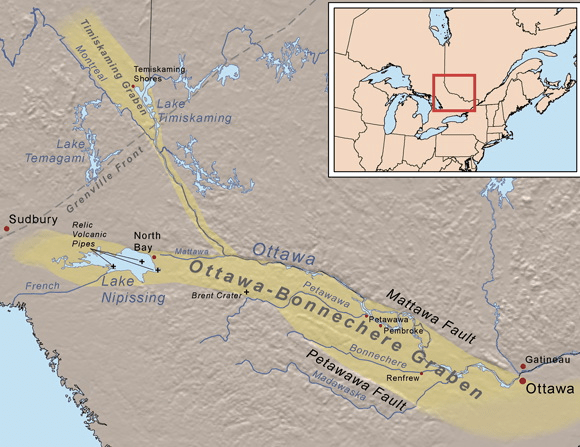
Image above of the Ottawa-Bonnechere Graben from Wikipedia
~~~~~~~~~~~~~~~~~~~~~~~~~
This book “On Borrowed Time” contains a chapter entitled “Un violent tremblement de terre” about the Ottawa Valley. It describes the category 5 quake that hit the valley in 2010 and the subsequent multibillion dollar earthquake proofing to buildings on Parliament Hill in Ottawa. And yet…. earthquake hazard has not prevented approval of the giant above ground mound of one million tons of radioactive waste one kilometer from the Ottawa River at Chalk River Ontario, or the importation to the Ottawa Valley of vast quantities of radioactive waste from Canada and other countries for storage beside the Ottawa River. The multinational consortium running Chalk River Laboratories for the federal government even plans to import High Level irradiated waste nuclear fuel for storage beside the river.

The Image below is from EarthquakesCanada.nrcan.gc.ca

More maps that show the Ottawa Valley is a major earthquake zone in Canada:
Canada  https://www.earthquakescanada.nrcan.gc.ca/historic-historique/caneqmap-en.php
Canada https://totalprepare.ca/earthquakes-in-canada-intro/
Eastern Canada https://www.seismescanada.rncan.gc.ca/zones/eastcan-en.php
عشرة أشياء يحتاج الكنديون إلى معرفتها عن كومة النفايات المشعة العملاقة القادمة إلى نهر أوتاوا
15 مارس 2014
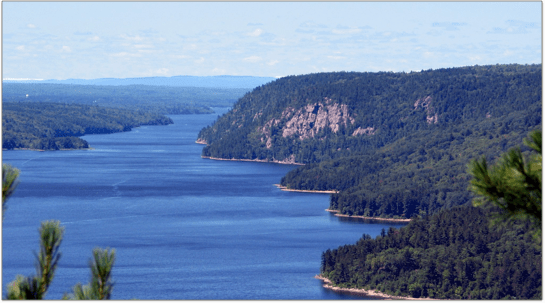
نهر أوتاوا هو نهر تراثي كندي يتدفق عبر تل البرلمان. وله قيمة لا توصف ككنز طبيعي وتاريخي جميل. فالنهر مقدس بالنسبة لشعب ألغونكوين الذي يحدد أراضيه التقليدية.
~~~
وافقت اللجنة الكندية للأمان النووي (CNSC) مؤخرًا على ترخيص بناء كومة مشعة مكونة من سبعة طوابق بجانب نهر أوتاوا على أرض تابعة لمختبرات نهر الطباشير، وهي منشأة أبحاث نووية فيدرالية شديدة التلوث على بعد 180 كم شمال غرب أوتاوا. تُعرف الكومة المشعة العملاقة باسم “مرفق التخلص من المواد المشعة القريبة من السطح” أو “NSDF”. وقد تمت الموافقة عليه من قبل اللجنة الوطنية للأمن النووي في 8 يناير 2024. ويُنظر على نطاق واسع إلى اللجنة الوطنية للأمن السيبراني على أنها جهة تنظيمية أسيرة تروج للمشاريع التي من المفترض أن تنظمها، كما ذكرت لجنة خبراء في عام 2017.
يقع الموقع على بعد أقل من كيلومتر واحد من نهر أوتاوا
تم اختيار موقع مرفق الدفاع الوطني لقربه من مواقع النفايات المتسربة الحالية في نهر تشالك؛ فهو يقع على جانب تل، وتحيط به جزئياً الأراضي الرطبة التي تصب في نهر أوتاوا على بعد أقل من كيلومتر واحد. الموقع معرض للأعاصير والزلازل؛ فنهر أوتاوا هو خط صدع رئيسي. الصخور الأساسية في الموقع مسامية ومتصدعة ومنسوب المياه الجوفية قريب جداً من السطح.
وستحتوي الكومة الضخمة على مليون طن من النفايات المشعة وغيرها من النفايات الخطرة11
وسيرتفع المرفق الوطني للنفايات المشعة إلى سبعة طوابق ويغطي مساحة تعادل مساحة 70 حلبة هوكي في دوري الهوكي الوطني.
وقد تراكمت النفايات المخصصة للتل على مدى ثمانية عقود من العمل في مختبرات نهر الطباشير؛ كما يتم استيراد النفايات لوضعها في التل.
وستحتوي على عشرات المواد المشعة والخطرة وأطنان من المعادن الثقيلة. وتشمل المواد المشعة الموجهة إلى مكب النفايات التريتيوم، والكربون-14، والسترونتيوم-90، وأربعة أنواع من البلوتونيوم (أحد أخطر المواد المشعة إذا تم استنشاقه أو ابتلاعه)، وما يصل إلى 6.3 طن من اليورانيوم.
وستطلق مصادر الكوبالت-60 والسيزيوم-137 في المكب الكثير من أشعة غاما الشديدة لدرجة أن العمال يجب أن يستخدموا واقيات من الرصاص لتجنب التعرض للإشعاع الخطير. وتقول الوكالة الدولية للطاقة الذرية إن هذه “نفايات من المستوى المتوسط” وتتطلب وضعها تحت الأرض.
كما أن الديوكسين ومركبات ثنائي الفينيل متعدد الكلور والأسبستوس والزئبق وما يصل إلى 13 طناً من الزرنيخ ومئات الأطنان من الرصاص ستدخل في مكب النفايات. كما أنها ستحتوي على آلاف الأطنان من النحاس والحديد، مما يغري الزبالين بالحفر في الكومة بعد الإغلاق.
تعارض الأمم الأولى لأمة ألغونكوين وجمعية الأمم الأولى الصندوق الوطني للتنمية الريفية.
عاش شعب أمة ألغونكوين في مستجمع مياه نهر أوتاوا منذ زمن سحيق؛ ولم يوقعوا أبدًا معاهدة مع التاج أو حكومة كندا.
وينص إعلان الأمم المتحدة بشأن حقوق الشعوب الأصلية على أنه “لا يجوز تخزين المواد الخطرة أو التخلص منها في أراضي أو أقاليم الشعوب الأصلية دون موافقتها الحرة والمسبقة والمستنيرة”.
تحدث الزعماء الذين يمثلون 10 من أصل 11 أمة من أمم ألغونكوين الأولى ضد الصندوق الوطني للتنمية المستدامة في مؤتمر صحفي في أوتاوا في 20 يونيو 2023.
وفي جلسة الاستماع النهائية لمنح التراخيص في 10 أغسطس 2023، صرحت الأمم الأولى كيباويك وأمم ألغونكوين في بحيرة باريير وكيتيغان زيبي أنيشينابيج الأولى بوضوح أنهم لا يوافقون على بناء الصندوق الوطني للتنمية الزراعية على أراضيهم غير المتنازل عنها
أقرت جمعية الأمم الأولى قرارات تعارض بناء الصندوق الوطني للتنمية الريفية في عامي 2018 و2023
مياه الشرب لملايين الكنديين مهددة بسبب مكب النفايات
يحيط بموقع مكب نفايات نيو ساوث ويلز جزء من الأراضي الرطبة التي تصب عبر بحيرة بيرش في نهر أوتاوا، وهو مصدر مياه الشرب لملايين الكنديين في اتجاه مجرى النهر بما في ذلك أوتاوا وغاتينو وأجزاء من مونتريال
من المتوقع أن تتسرب الكومة أثناء التشغيل وتنهار بسبب التآكل
تتوقع الدراسات حدوث عدة أنواع من التسرب أثناء الملء وبعد إغلاق المنشأة
ستقوم محطة الصرف الصحي لمياه الصرف الصحي لمرفق التخلص من النفايات النووية بتصريف المياه الملوثة التي تحتوي على كميات كبيرة من التريتيوم (الهيدروجين المشع) وكميات أقل من العديد من المواد المشعة الأخرى مثل البلوتونيوم؛ وستدخل هذه التصريفات إلى نهر أوتاوا.
وتشير دراسة تقييم الأداء التي أجراها المؤيد إلى أن الكومة سوف تتحلل بعد عمرها التصميمي المتوقع البالغ 550 سنة وستنطلق محتوياتها إلى البيئة ونهر أوتاوا.
لا يوجد مستوى آمن للتعرض للإشعاع الذي قد يتسرب إلى نهر أوتاوا من الكومة
ستزيد جميع المواد المشعة المتسربة من مخاطر العيوب الخلقية والأضرار الوراثية والسرطان والأمراض المزمنة الأخرى. وتقول الوكالة الدولية للطاقة الذرية إنه يجب عزل النفايات المشعة عن المحيط الحيوي.
ويقول الخبراء إن النفايات ستبقى مشعة وخطرة لآلاف السنين
تقول الوكالة الدولية للطاقة الذرية (IAEA) إن نفايات مثل تلك التي أنتجتها مختبرات تشالك ريفر، حيث قامت الحكومة الفيدرالية بتشغيل مفاعلات نووية وأجرت تجارب نووية لمدة ثمانية عقود، من المرجح أن تكون “متوسطة المستوى” وفي بعض الحالات “عالية المستوى”، مما يتطلب وضع عشرات الأمتار أو أكثر تحت الأرض.
يقول مدير كبير سابق مسؤول عن النفايات المشعة القديمة في مختبرات نهر الطباشير إن النفايات المقترحة للمنشأة “متوسطة المستوى” وتتطلب وضعاً تحت الأرض. ويقول إن الكومة ستكون خطرة ومشعة لعدة آلاف من السنين، وأن الجرعات الإشعاعية من المنشأة ستتجاوز المستويات المسموح بها.
خمسة وعشرون من أصل 31 نويداً مشعاً مدرجة في قائمة الجرد المرجعية للتل هي نويدات مشعة طويلة العمر مع أنصاف أعمار تتراوح بين آلاف وملايين السنين. (انظر أيضًا قائمة الجرد المرخصة)
ستعمر النفايات المشعة أكثر من المنشأة لعدة آلاف من السنين.
أكثر من 140 بلدية في كيبيك وأونتاريو تعارض مشروع NSDF
أصدرت أكثر من 140 بلدية، بما في ذلك مقاطعة بونتياك وأوتاوا وغاتينو ومونتريال، قرارات معارضة أو قلق شديد بشأن المشروع المقترح.
طلب قرار مدينة أوتاوا على وجه التحديد وقف واردات النفايات إلى وادي أوتاوا؛ وقد تجاهل الكونسورتيوم هذا الطلب
دافعو الضرائب الكنديون يدفعون ولكن اتحاد شركات متعدد الجنسيات هو من يدير الأمور
تعود ملكية مختبرات تشالك ريفر إلى الحكومة الكندية، وقُدرت تكلفة تنظيف الموقع في الأصل بثمانية مليارات دولار في عام 2015 عندما تعاقدت حكومة هاربر مع اتحاد متعدد الجنسيات يسمى “التحالف الوطني الكندي للطاقة” لإدارة موقع تشالك ريفر وتنظيف النفايات المشعة هناك وفي المرافق الأخرى المملوكة للحكومة الفيدرالية.
ومنذ أن تولى الكونسورتيوم هذه المهمة، تضخمت التكاليف التي يتحملها دافعو الضرائب الكنديون لتشغيل وتنظيف المختبرات النووية الكندية من 336 مليون دولار سنوياً إلى أكثر من 1.5 مليار دولار سنوياً.
الأعضاء الحاليون في الكونسورتيوم هم شركة AtkinsRéalis (المعروفة سابقًا باسم SNC-Lavalin)، التي تم حظرها من قبل البنك الدولي لمدة 10 سنوات وواجهت اتهامات في كندا بالاحتيال والرشوة والفساد؛ وشركة Fluor Corporation ومقرها تكساس، التي دفعت 4 ملايين دولار لتسوية مزاعم الاحتيال المالي المتعلقة بأعمال تنظيف النفايات النووية في موقع في الولايات المتحدة؛ وشركة Jacobs Engineering ومقرها تكساس، التي استحوذت مؤخرًا على شركة CH2M، وهي عضو أصلي في الكونسورتيوم وافقت على دفع 18.5 مليون دولار لتسوية اتهامات جنائية فيدرالية في موقع تنظيف نووي في الولايات المتحدة.
سيؤدي بناء الصندوق الوطني للتنمية الريفية إلى تدمير الموائل الحرجة للأنواع المحمية.
ويعد موقع الحديقة الوطنية للثروة الحيوانية غنياً جداً بالتنوع البيولوجي نظراً لكونه مُسيّجاً أمام البشر منذ 80 عاماً. كما أن قربه من نهر أوتاوا وبحيرة بيرش يجعله أرضاً جيدة لتغذية الثدييات الكبيرة.
وتوفر الأراضي الرطبة التي تحيط جزئياً بموقع الصندوق الوطني للثروة الحيوانية والنباتية موطنًا لسلاحف بلاندينج المهددة بالانقراض.
وتستضيف الغابة الناضجة في الموقع ثلاثة أنواع من الخفافيش المهددة بالانقراض، والعديد من الطيور المهاجرة المعرضة للخطر، بما في ذلك طائر الوالبرز الذهبي المجنح والوالز الكندي والويلات السوطية
كشفت الأبحاث التي قادها السكان الأصليون عن وجود مجموعة سليمة من الذئاب الشرقية المهددة بالانقراض تستخدم الموقع على نطاق واسع؛ كما وجد الباحثون من السكان الأصليين ثلاثة أوكار نشطة للدببة السوداء، المحمية بموجب قانون أونتاريو لحماية الأسماك والحياة البرية.
في يناير 2024، كتبت أمة كيباويك الأولى إلى وزير البيئة وتغير المناخ الكندي تطلب رفض التصريح بقطع الأشجار في الموقع.
يجب تنظيف النفايات ولكن هناك طرق أفضل للقيام بذلك.
يمكن أن يوفر استعراض الأقران ARTEMIS الذي تنسقه الوكالة الدولية للطاقة الذرية معلومات قيمة للحكومة الكندية حول أفضل الممارسات لإدارة نفايات مثل تلك الموجودة في نهر الطباشير.
في ديسمبر 2023، وقّع أكثر من 3000 كندي على العريضة الإلكترونية لمجلس العموم الكندي رقم 4676 التي تطالب بإجراء مراجعة ARTEMIS
يجب على كندا أن تلتزم ببناء مرافق عالمية المستوى لإدارة النفايات المشعة التي من شأنها أن تحافظ على سلامة الكنديين وتوفر وظائف جيدة في الصناعة النووية، وإدارة النفايات واحتوائها بأمان للأجيال القادمة.
ومن شأن المرافق ذات المستوى العالمي أن تتضمن أحكاماً للتغليف الدقيق، ووضع العلامات ووضعها في مرفق تحت الأرض؛ وستكون النفايات قابلة للاسترجاع حتى تتمكن الأجيال القادمة من مراقبتها وإعادة تغليفها حسب الحاجة.
~~~
هناك حاجة ماسة إلى اتخاذ إجراء حكومي اتحادي لوقف مشروع الصندوق الوطني للتنمية الزراعية. ومن شأن مراجعة ARTEMIS للوكالة الدولية للطاقة الذرية أن تحدد طريقة أفضل للمضي قدمًا.
اطلب من عضوك في البرلمان دعم مراجعة ARTEMIS لمشروع الصندوق الوطني للتنمية النووية.
Canada is unique among OECD countries in giving its national regulatory agency sole responsibility for decisions about nuclear waste disposal projects (Letter to Ministers Wilkinson and Guilbeault)
La version française suit….
February 21, 2024
Dear Ministers Guilbeault and Wilkinson,
Canada is unique among OECD countries in giving its national regulatory agency sole responsibility for decisions about nuclear waste disposal projects. This is unacceptable to Canadians.
The Near Surface Disposal Facility (NSDF) is a proposed disposal facility for radioactive waste at the federally owned Chalk River Laboratories site. The NSDF project was approved by the Canadian Nuclear Safety Commission (CNSC) on January 9, 2024.
On February 16, 2024, Mme Monique Pauzé (Repentigny, BQ) asked the following question in the House of Commons:
“Given that there is no social licence for the Chalk River Project, will the minister reverse the decision?”
The feds are the ones are jeopardizing Quebec’s drinking water with a nuclear dump. Will the government stop hiding and say no to Chalk River?
Marc Serré, Parliamentary Secretary to the Minister of Natural Resources, replied:
“The government is not the one deciding on these projects. Canadians do not want politicians to decide on these projects.”
Canadians want to know that there are experts who will study the decision and carry out consultations. Canadians have made it clear that they do not want politicians making this decision.
However, radioactive waste experts who worked at the Chalk River Laboratories and studied the NSDF project in detail warn that it is unsafe.
Indigenous and non-Indigenous Canadians want elected officials and the Government of Canada to be accountable for decisions on the NSDF and other nuclear waste disposal projects.
On January 29, 2024, MP Sophie Chatel (Pontiac, Liberal Party) presented e-petition 4676 to the House of Commons. Signed by 3127 Canadians, it calls on the Government of Canada to order the CNSC to make no decision on licensing of a radioactive waste disposal facility unless Canada’s obligations under the United Nations Declaration on the Rights of Indigenous Peoples (UNDRIP) are met.
On February 14, 2024, the Kebaowek First Nation, along with the Bloc Québécois, organized a press conference to demand that the Government of Canada put an end to the Near Surface Disposal Facility Project. The press conference was attended by leaders of several other Algonquin First Nations who have never ceded the land on which the NSDF would be built. Nor have these nations given their free, prior and informed consent to the project, as required by article 29, paragraph 2, of the UNDRIP.
The CNSC is an unelected body that is not accountable to the electorate. It has neither the expertise nor the mandate to determine whether the NSDF has met UNDRIP requirements and obtained the necessary social license from Canadians. From a strictly technical point of view, the regulator is faced with a very difficult problem: How to ensure the safety of human beings and the environment for the next ten millennia?
It is the Government of Canada, not the CNSC, that must comply with the UNDRIP. The CNSC is not qualified to implement UNDRIP. The UNDRIP action plan does not apply to the CNSC. The assessment and authorization of a radioactive waste site should not be entrusted to a body that is not accountable to Indigenous peoples or to the public.
CNSC impact assessment (IA) processes lack public trust. A 2017 Expert Panel Report, Building Common Ground: A New Vision for Impact Assessment in Canada, said:
“To restore public trust and confidence in assessment processes, the conduct of IAs must respect the principles of being transparent, inclusive, informed and meaningful. Any authority given the mandate to conduct federal assessments should be aligned with these principles…”
After the creation of the Impact Assessment Agency of Canada in 2019, assessments done by the National Energy Board (NEB) were transferred to the Agency. However, the CNSC continues to act as a “responsible authority” (RA) that conducts its own assessments for projects that it regulates, such as the NSDF.
In 2017, the Expert Panel noted several concerns about assessments conducted by the CNSC (and the NEB):
…there is a perception of a lack of independence and neutrality because of their close relationship with the industries they regulate. For example, participants noted the cross mobility of personnel between these regulators and their regulated industries and voiced concerns that these RAs promote the projects they are tasked with regulating.
CNSC’s sole authority to assess and license nuclear waste disposal projects has resulted in the absence of social licence for the NSDF project, as Mme Pauzé observed.
On this matter, the Expert Panel’s report seems almost prophetic:
Public trust and confidence is crucial to all parties. Without it, an assessment approval will lack the social acceptance necessary to facilitate project development. While some would likely favour the NEB and CNSC for the assessment of projects in their particular industries, the erosion of public trust in the current assessment process has created a belief among many interests that the outcomes are illegitimate. This, in turn, has led some to believe that outcomes are pre-ordained and that there is no use in participating in the review process because views will not be taken into account. The consequence of this is a higher likelihood of protests and court challenges, longer timeframes to get to decisions and less certainty that the decision will actually be realized – in short, the absence of social license.
In all OECD countries except Canada, decisions on the disposal of radioactive waste are the responsibility of government agencies, and in many cases, more than one. Canada is the only country to give its regulator, the CNSC, sole and final decision-making authority in this area, according to the document “The Regulatory Infrastructure in NEA Member Countries,” published by the OECD Nuclear Energy Agency (NEA).
In the U.S. and U.K., environment agencies are given decision-making power in respect of nuclear waste disposal. In the case of the NSDF, it appears that Environment and Climate Change Canada has decision-making power because of the requirement for a permit to destroy habitat for species at risk.
The government could ask the International Atomic Energy Agency (IAEA) to carry out an ARTEMIS review. ARTEMIS reviews are carried out by competent peers, available to all IAEA member states. An ARTEMIS review could provide the Government of Canada with valuable advice on how to manage its legacy radioactive waste.
We have the following three requests:
- No disposal of radioactive waste until Canada has met its UNDRIP obligations;
- No permits to destroy habitat for species at risk at the NSDF site; and
- An international ARTEMIS review of long-term management of the Government of Canada’s radioactive waste.
Yours sincerely,
Ginette Charbonneau, Ralliement contre la pollution radioactive
Gordon Edwards, Canadian Coalition for Nuclear Responsibility
Ole Hendrickson, Concerned Citizens of Renfrew County and Area
—————————
Le 21 février 2024
Messieurs les Ministres Guilbeault et Wilkinson,
Le Canada est le seul pays de l’OCDE qui confie à la CCSN, son agence nationale de réglementation, la responsabilité exclusive des décisions relatives aux projets d’élimination des déchets radioactifs. Cette situation est inacceptable pour les Canadiens.
Le Projet d’installation de gestion des déchets près de la surface (IGDPS) est un projet d’élimination permanente de déchets radioactifs sur le site des Laboratoires nucléaires de Chalk River, propriété du gouvernement fédéral. Le projet a été approuvé par la Commission canadienne de sûreté nucléaire (CCSN) le 9 janvier 2024.
Le 16 février 2024, Mme Monique Pauzé (Repentigny, Bloc Québécois) a posé les questions suivantes à la Chambre des communes :
Puisqu’il n’y a pas d’acceptabilité sociale pour le projet de Chalk River, est-ce que le ministre va annuler cette décision?
C’est le fédéral qui met en péril l’eau potable des Québécois avec un dépotoir nucléaire. Le gouvernement va-t-il cesser de se cacher et dire non au projet de Chalk River?
Marc Serré, secrétaire parlementaire du ministre des Ressources naturelles, a répondu :
Ce n’est pas le gouvernement qui décide de ces projets. Les Canadiens ne veulent pas que les politiciens décident de ces projets.
Les Canadiens veulent savoir que ce sont des experts qui vont étudier la décision et qui vont faire les consultations. Les Canadiens sont clairs: ils ne veulent pas que ce soient des politiciens qui prennent cette décision.
Cependant, des experts en déchets radioactifs qui ont travaillé aux Laboratoires de Chalk River et qui ont étudié en détail le projet d’IGDPS concluent qu’il n’est pas sécuritaire.
Tous les Canadiens, autochtones et non autochtones, veulent que les élus et le gouvernement du Canada soient responsables des décisions sur l’IGPDS et sur les autres projets d’élimination de déchets radioactifs.
Le 29 janvier 2024, la députée Sophie Chatel (Pontiac, Parti Libéral) a présenté la pétition 4676 à la Chambre des communes. Elle était signée par 3127 Canadiens qui demandent au gouvernement d’ordonner que la CCSN n’autorise aucune installation de stockage de déchets radioactifs sans que le Canada n’ait respecté la Déclaration des Nations Unies sur les droits des peuples autochtones (DNUDPA).
Le 14 février 2024, la Première nation Kebaowek a organisé avec le Bloc Québécois une conférence de presse pour demander que le gouvernement du Canada mette fin au Projet d’installation de gestion des déchets près de la surface. Cette conférence de presse s’est tenue en présence des dirigeants de plusieurs autres Premières nations algonquines qui n’ont jamais cédé leur territoire sur lequel l’IGDPS serait érigée. Ces nations n’ont pas donné non plus leur consentement libre, préalable et éclairé au projet, contrairement à ce que demande l’article 29, paragraphe 2, de la DNUDPA.
La CCSN est un organisme non élu et qui n’est pas responsable devant l’électorat. Elle n’a ni l’expertise ni le mandat pour déterminer si l’IGDPS a satisfait aux exigences de la DNUDPA et a obtenu l’acceptabilité sociale nécessaire de la part des Canadiens. Même d’un point de vue strictement technique, l’autorité de réglementation est confrontée à un problème très difficile : Comment assurer la sécurité des êtres humains et de l’environnement pour les dix prochains millénaires?
C’est le gouvernement du Canada, et non la CCSN, qui doit se conformer à la DNUDPA. La CCSN n’est pas qualifiée pour appliquer la DNUDPA. Le plan d’action de la DNUDPA ne la concerne pas. On ne doit pas confier l’évaluation et l’autorisation d’un site de déchets radioactifs à un organisme qui n’a aucun compte à rendre aux peuples autochtones, ni au grand public.
Les évaluations d’impact environnemental de la CCSN n’ont pas la confiance du public. La Rapport du Comité d’experts, Bâtir un terrain d’entente : une nouvelle vision pour l’évaluation des impacts au Canada, concluait :
Afin de restaurer la confiance du public, les évaluations d’impact doivent être transparentes, inclusives, éclairées et significatives. Toute autorité qui reçoit mandat de mener des évaluations fédérales devrait respecter ces principes…
Depuis la création de l’Agence d’évaluation d’impact du Canada en 2019, celle-ci assume toutes les évaluations qui relevaient auparavant de l’Office national de l’énergie (ONE). Par contre, la CCSN continue d’être une “autorité responsable” qui effectue ses propres évaluations sur les projets qu’elle réglemente, dont le projet d’IGDPS.
En 2017, le groupe d’experts a relevé plusieurs préoccupations envers les évaluations de la CCSN (et de l’ONE) :
…on perçoit un manque d’indépendance et de neutralité à cause de leur étroite relation avec les industries qu’ils réglementent. Des participants ont noté par exemple la mobilité du personnel entre ces organismes de réglementation et le secteur industriel qu’ils règlementent. Ils sont inquiets quand ils voient ces organismes faire la promotion des projets qu’ils doivent réglementer.
Le fait que la CCSN soit seule pour évaluer et autoriser les projets d’élimination des déchets radioactifs enlève toute acceptabilité sociale au projet IGDPS, souligne Mme Pauzé.
À cet égard, le rapport du groupe d’experts semble prophétique :
La confiance du public est cruciale. Sans elle, aucune approbation ne recevra l’appui social requis pour que le projet se réalise. Plusieurs secteurs industriels préfèrent que leurs projets soient évalués par l’ONE et par la CCSN mais cela entraîne une telle perte de confiance du public que les conclusions de ces évaluations ne semblent plus légitimes. Certains croient que les résultats sont déterminés d’avance et qu’il est inutile de participer au processus d’évaluation puisque leurs points de vue ne seront pas pris en compte. Cela entraîne des risques accrus de protestations, de contestations judiciaires, de procédures qui s’éternisent et cela mène à douter de la mise en œuvre des décisions. Bref, absence d’acceptabilité sociale.
Dans tous les pays de l’OCDE, sauf au Canada, les décisions sur l’élimination des déchets radioactifs relèvent des organismes gouvernementaux et même de plusieurs organismes bien souvent. Le Canada est le seul pays qui donne à la CCSN un pouvoir de décision unique et final dans ce domaine, révèle le document “The Regulatory Infrastructure in NEA Member Countries,” publié par l’Agence de l’OCDE pour l’énergie nucléaire (NEA).
Aux États-Unis et au Royaume-Uni, les ministères de l’environnement ont un pouvoir décisionnel sur l’élimination des déchets nucléaires. Dans le cas de l’IGDPS, il semble qu’Environnement et Changement climatique Canada pourrait aussi avoir un vrai pouvoir de décision puisque ce ministère doit autoriser toute destruction de l’habitat des espèces en péril.
Le gouvernement pourrait demander à l’Agence internationale de l’énergie atomique (AIEA) de procéder à un examen ARTEMIS. Les examens ARTEMIS sont effectués par des pairs compétents, disponibles pour tous les États membres de l’AIEA. Un examen ARTEMIS pourrait fournir au gouvernement du Canada des conseils précieux sur la manière de gérer ses déchets radioactifs hérités.
Nous formulons les trois demandes suivantes:
- Aucune élimination de déchets radioactifs tant que le Canada n’aura pas satisfait à ses obligations au titre de l’UNDRIP ;
- Aucun permis de détruire l’habitat des espèces en péril sur le site de l’IGPDS ; et
- Tenue d’un examen international ARTEMIS sur la gestion à long terme des déchets radioactifs du gouvernement du Canada.
Nous vous prions d’agréer l’expression de nos sentiments distingués,
Ginette Charbonneau, Ralliement contre la pollution radioactive
Gordon Edwards, Regroupement pour la surveillance du nucléaire
Ole Hendrickson, Citoyens inquiets du comté de Renfrew et de sa région
Canadian taxpayers are paying for the NSDF but a multinational consortium is calling the shots
February 18, 2024
Chalk River Laboratories is owned by the Government of Canada. Cleanup of the site was originally estimated to cost $8 billion in 2015 when a multinational consortium called “Canadian National Energy Alliance” was contracted by the Harper government to manage the Chalk River site and clean up the radioactive waste there and at other federally owned facilities.
Since the consortium took over, costs to Canadian taxpayers for the operation and cleanup at Canada’s nuclear labs have ballooned from $336 million dollars per year to over $1.5 billion per year.
Current members in the consortium are: AtkinsRéalis (formerly SNC-Lavalin,) which was debarred by the World Bank for 10 years and faced charges in Canada of fraud, bribery and corruption; Texas-based Fluor Corporation, which paid $4 million to resolve allegations of financial fraud related to nuclear waste cleanup work at a U.S. site; and Texas-based Jacobs Engineering, which recently acquired CH2M, an original consortium member that agreed to pay $18.5 million to settle federal criminal charges at a nuclear cleanup site in the U.S.
A 2016 access to information request revealed that nine senior CNL executives were paid an average of $722,000 per person per year and twenty-eight senior contractors were paid an average of $377,275 per year per person. Almost all of these senior executives and senior contractors were non-Canadian.
There has been no decrease in the federal nuclear waste liabilities since the consortium took over control of Chalk River Laboratories.
 Concerned Citizens of Renfrew County and Area