Why did the CNSC say it would request an IAEA review of the NSDF safety case in 2018 and then back away?

The International Atomic Energy Agency (IAEA) has an Integrated Review Service for Radioactive Waste and Spent Fuel Management, Decommissioning and Remediation (ARTEMIS) that provides independent advice on radioactive waste management policies and projects.

On Thursday, May 17, 2018, Ramzi Jammal, former Executive Vice-President and Chief Regulatory Operations Officer of the Canadian Nuclear Safety Commission (CNSC), who is now the acting CEO of the CNSC, presented an update on the CNSC’s regulatory activities at the 42nd International Nuclear Regulators Association Meeting in Gyeongju, Republic of Korea. 

His presentation, “Canadian Update to the International Nuclear Regulators Association”, is on the CNSC website at https://nuclearsafety.gc.ca/eng/resources/presentations/2018.cfm (scroll down to May 17th).

On Slide 27 of his presentation on “RECENT NOTABLE ACTIVITIES”, under Peer Review Missions, he says 

“The CNSC to request an IAEA review mission for radioactive waste and spent fuel management, decommissioning and remediation programs (ARTEMIS) to review the safety cases for CNL’s proposed major projects” (last line on slide 27, below)

The reference to “CNL’s proposed major projects” means i) the Near Surface Disposal Facility (NSDF) project at the Chalk River Laboratories, ii) the proposed entombment of the Nuclear Power Demonstration reactor located on the Ottawa River 25 km upstream from Chalk River in Rolphton, Ontario, and iii) the proposed entombment of the Whiteshell-1 Reactor on the Winnipeg River in Pinawa, Manitoba.  

All three projects have been criticized by retired staff from Atomic Energy of Canada Limited as not conforming to IAEA safety standards.  An IAEA ARTEMIS review could resolve this.

An access to information request for information about why the CNSC backed away from its intent to request an ARTEMIS review, was unsuccessful in discovering the reason. The material provided in response to the request is presented below. There is not much in it, but it is curious that one long email from someone at the IAEA is entirely redacted. Why the secrecy about this we wonder?

Hill Times ~ Le déluge souligne l’importance de l’audience finale pour le dépôt de déchets nucléaires – Audience finale des délégations de trois premières nations

THE HILL TIMES | LUNDI 21 AOÛT 2023

Il est grand temps que le gouvernement s’occupe de cette catastrophe environnementale en devenir, un problème grave qui s’aggravera si on l’ignore.

OTTAWA – Le 10 août, la Commission canadienne de sûreté nucléaire a tenu une audience finale sur l’autorisation d’un gigantesque dépôt de déchets radioactifs en surface près de la rivière des Outaouais, en amont d’Ottawa-Gatineau et de Montréal, à Chalk River (Ontario), qui a créé un précédent.

Des délégations de trois Premières Nations algonquines – Kebaowek, Kitigan Zibi et Barriere Lake – se sont réunies au 50 Sussex Dr. à Ottawa pour faire leurs présentations finales en personne aux membres de la communauté, aux alliés non autochtones et à une poignée de représentants élus, au mépris d’un décret de la Commission canadienne de sûreté nucléaire (CCSN) stipulant que l’audience ne serait que virtuelle. La CCSN a présidé l’audience via Zoom.

Pendant l’audience, une tempête sans précédent s’est abattue sur le site, avec d’énormes quantités de pluie, de tonnerre, de grêle et de vent qui ont soufflé sur les chaises de la terrasse extérieure couverte où la foule en surnombre regardait les débats. Malgré la férocité de l’orage, les aînés algonquins ont entretenu un feu sacré cérémoniel tout au long de la cérémonie.

Si le projet est approuvé, la décharge géante, appelée “installation de stockage en surface” (IGDPS) par le promoteur, contiendrait un million de tonnes de déchets radioactifs et dangereux dans un monticule en surface sur la propriété des laboratoires de Chalk River, une installation nucléaire fédérale fortement contaminée établie sur des terres algonquines volées en 1944 afin de produire du plutonium pour les armes nucléaires américaines. Les laboratoires de Chalk River représentent un énorme passif environnemental pour le gouvernement du Canada, avec un coût de dépollution estimé à plusieurs milliards de dollars.

Le promoteur de la décharge est un consortium multinational composé de SNC-Lavalin et de deux multinationales basées au Texas : Fluor et Jacobs. Le consortium a été engagé par le gouvernement conservateur en 2015 pour réduire rapidement et à moindre coût l’énorme responsabilité fédérale en matière de déchets nucléaires hérités. Paradoxalement, les coûts pour les contribuables de la gestion des déchets radioactifs hérités du gouvernement fédéral canadien ont grimpé à plus d’un milliard de dollars par an après la privatisation.

L’audition du 10 août a créé un précédent à deux égards. Si elle est approuvée, l’IGDPS sera la toute première installation de stockage permanent des déchets de réacteurs nucléaires au Canada. Deuxièmement, la décision d’autoriser ou non l’installation est un test important de l’engagement du Canada envers la Déclaration des Nations unies sur les droits des peuples autochtones, qui interdit le stockage de déchets radioactifs sur les terres des peuples autochtones sans leur consentement libre, préalable et éclairé. Dix des onze Premières nations algonquines, dont les membres vivent dans la vallée de l’Outaouais depuis des temps immémoriaux, ont déclaré qu’elles ne consentaient pas à ce que l’ IGDPS soit implanté sur leur territoire non cédé.

Bon nombre des déchets qu’il est proposé d’éliminer dans le NSDF resteront dangereux et radioactifs pendant des milliers, voire des millions d’années, selon le Dr. J.R. Walker, le plus grand expert canadien en matière de déchets radioactifs hérités du gouvernement fédéral et de la meilleure façon de les gérer. M. Walker a clairement indiqué que les déchets proposés pour l’IGDPS ne sont pas des déchets de faible activité, mais des déchets radioactifs de “niveau intermédiaire” qui devraient être éliminés à des dizaines, voire des centaines de mètres sous la surface du sol. Il a également affirmé que la proposition n’était pas conforme aux normes de sécurité internationales.

Le site proposé pour l’IGDPS se trouve sur le flanc d’une colline entourée de zones humides qui se jettent dans la rivière des Outaouais, à moins d’un kilomètre de là.

La déclaration d’impact sur l’environnement du promoteur documente les nombreuses façons dont la décharge pourrait fuir pendant son exploitation et après sa fermeture. Trois isotopes du plutonium figurent sur la longue liste des radionucléides qui seraient rejetés dans la rivière des Outaouais dans les “effluents traités” de la décharge. Le monticule devrait se dégrader, s’éroder et finalement se désintégrer en raison de “l’évolution naturelle”.

La plupart des gens pensent qu’il est répréhensible de déverser délibérément des matières radioactives dans une importante source d’eau potable telle que la rivière des Outaouais, car il n’existe pas de niveau d’exposition sûr à ces poisons fabriqués par l’homme. Chaque rejet accidentel ou délibéré augmente les risques de cancer, de malformations congénitales et de dommages génétiques chez les populations exposées.

L’Assemblée des Premières Nations et plus de 140 municipalités situées en aval, dont Ottawa, Gatineau et Montréal, ont adopté des résolutions exprimant leur inquiétude à l’égard de la proposition du IGDPS.

Malgré les nombreuses lacunes et la forte opposition, le personnel de la Commission canadienne de sûreté nucléaire n’a jamais hésité à soutenir le projet de décharge. Il semble qu’il n’ait jamais reçu le mémo en 2000 lorsque le mandat de l’organisation a été modifié par une nouvelle législation, passant d’un rôle de promotion de l’industrie nucléaire à un mandat strictement axé sur la protection des Canadiens et de l’environnement.

L’audience du 10 août a été présidée par un seul commissaire, ainsi que par la présidente de la CCSN. Leurs curriculum vitae respectifs font état de longs états de service et d’allégeance à l’industrie nucléaire. Les deux fonctionnaires n’ont pas posé une seule question aux équipes d’intervenants des Premières nations, qui étaient manifestement choquées par le manque d’intérêt pour les informations qu’elles s’étaient donné tant de mal à rassembler et à partager. Un membre de l’équipe a demandé : “Pouvons-nous vous poser des questions ?”, ce à quoi le président a sèchement répondu : “Ce n’est pas notre façon de procéder.”

Le régime de gouvernance nucléaire gravement déficient du Canada a été décrit précédemment dans le Hill Times. La gouvernance nucléaire au Canada s’appuie fortement sur la CCSN pour presque tous les aspects de la surveillance de l’industrie nucléaire. La CCSN est largement perçue comme un “régulateur capturé” qui promeut les projets qu’elle est censée réglementer.

Il est clair que notre régime de gouvernance nucléaire gravement déficient a permis à l’IGDPS – un simulacre grotesque d’installation de gestion responsable des déchets radioactifs – d’être proposée et prise au sérieux au Canada. La décision de la CCSN d’approuver le permis pour l’IGDPS est attendue prochainement.

La puissante tempête qui s’est abattue sur le 50 Sussex Dr. pendant que l’on entendait des témoignages en langue algonquine sur la cupidité et la destruction inconsidérée de l’environnement a souligné la gravité de la décision envisagée. Il ne fait aucun doute qu’une tempête record comme celle qui a frappé l’IGDPS au cours de sa phase de remplissage de 50 ans – alors que les déchets sont exposés aux éléments – pourrait facilement provoquer d’importants déversements de poisons radioactifs et d’autres matières dangereuses dans la rivière des Outaouais.

Il est grand temps que le gouvernement se réveille et s’attaque à cette catastrophe environnementale en cours, un problème grave qui ne fera que s’aggraver au fur et à mesure qu’il sera ignoré.

————————————————————————–

Lynn Jones est une gestionnaire de programme de santé publique à la retraite qui travaille maintenant pour Concerned Citizens of Renfrew County and Area, une organisation non gouvernementale qui œuvre depuis plus de 40 ans à l’assainissement et à la prévention de la pollution radioactive provenant de l’industrie nucléaire dans la vallée de l’Outaouais. Elle est basée à Ottawa.

L’image ci-dessous est une simulation de l’effet baignoire tirée du documentaire de Découverte “Chalk River Heritage”.

Hill Times ~ Deluge underlines the importance of final hearing for nuclear waste dump beside the Ottawa River

Published in the Hill Times Monday August 21, 2023

On August 10, 2023, the Canadian Nuclear Safety Commission held a precedent-setting final licensing hearing for a giant above-ground radioactive waste dump beside the Ottawa River upstream of Ottawa-Gatineau and Montreal at Chalk River, Ontario.

Delegations from three Algonquin First Nations – Kebaowek, Kitigan Zibi and Barriere Lake – gathered at 50 Sussex Drive to make their final presentations in-person to community members, non-Indigenous allies and a handful of elected officials, in defiance of a Canadian Nuclear Safety Commission (CNSC) decree that the hearing would be virtual only. The CNSC presided over the hearing by Zoom.

While the hearing was taking place, an unprecedented storm hit the venue with huge amounts of rain, thunder, hail and wind that blew over the chairs on the outdoor covered terrace where the overflow crowd was watching the proceedings. Despite the ferocious storm, Algonquin Elders kept a ceremonial sacred fire burning throughout.

If approved, the giant dump, called a “near-surface disposal facility” (NSDF) by the proponent, would hold one million tonnes of radioactive and hazardous waste in an above-ground mound on the property of Chalk River Laboratories, a heavily contaminated federal nuclear facility established on stolen Algonquin land in 1944 to produce plutonium  for US nuclear weapons. Chalk River Laboratories is a huge environmental liability for the Government of Canada, with an estimated cleanup cost in the billions of dollars.

The dump proponent is a multinational consortium comprised of SNC-Lavalin, and two Texas-based multinationals, Fluor and Jacobs. The consortium was contracted by the Harper government in 2015 to quickly and cheaply reduce the enormous federal legacy nuclear waste liability. Perversely, costs to Canadian taxpayers for managing Canada’s federal legacy radioactive wastes ballooned to more than 1 billion dollars per year after privatization.

The August 10 hearing was precedent-setting in two ways.  If approved, the NSDF would be the first ever facility for permanent disposal of nuclear reactor waste in Canada. Secondly, the decision whether or not to license the facility is an important test of Canada’s commitment to the United Nations Declaration on the Rights of Indigenous Peoples, which forbids storage of radioactive waste on the land of Indigenous Peoples without their free, prior and informed consent. Ten of the eleven Algonquin First Nations whose people have lived in the Ottawa Valley since time immemorial say they  do not consent to the NSDF on their unceded territory.

Many of the wastes proposed for disposal in the NSDF will be hazardous and radioactive for thousands to millions of years, according to Canada’s foremost expert on the federal legacy radioactive wastes and how best to manage them, Dr. JR Walker.  Dr. Walker has clearly stated that wastes proposed for the NSDF do not qualify as low level waste but are in fact “intermediate level” radioactive waste that should be disposed of tens to hundreds of meters below the ground surface. He also notes that the proposal is non-compliant with International Safety Standards.

The site for the proposed “NSDF” is on the side of a hill surrounded by wetlands that drain into the Ottawa River – less than one kilometre away. The proponent’s environmental impact statement documents many ways the dump could leak during operation and after closure. Three isotopes of plutonium are included in the long list of radionuclides that would be discharged into the Ottawa River in “treated effluent” from the dump. The mound is expected to degrade and erode and eventually disintegrate due to “natural evolution.”  

Most people believe it is wrong to deliberately discharge radioactive materials into a major drinking water source such as the Ottawa River, since there is no safe level of exposure to these man-made poisons. Every accidental and deliberate discharge increases risks of cancer, birth defects and genetic damage in the populations exposed.

The Assembly of First Nations and more than 140 downstream municipalities – including Ottawa, Gatineau and Montreal – have passed resolutions of concern about the NSDF proposal. 

Despite the many serious shortcomings and strong opposition, the Canadian Nuclear Safety Commission staff have never wavered in their support for the dump. It appears they never “got the memo” back in 2000, when the organization’s mandate changed under new legislation from a role that included promotion of the nuclear industry, to a mandate strictly focused on protecting Canadians and the environment.

The August 10 hearing was presided over by only one Commissioner – along with the CNSC President. Both of their CVs tout long service and allegiance to the nuclear industry. The two officials askednot one single question of the First Nation intervenor teams, who were clearly shocked by the lack of interest in the information they had gone to such great lengths to gather and share. A member of the team asked, “Well, can we ask you some questions?” to which the President curtly replied, “That’s not our process.”

Canada’s seriously deficient nuclear governance regime has been described previously in the Hill Times here and here.  Nuclear governance in Canada relies heavily on the Canadian Nuclear Safety Commission for almost all aspects of nuclear industry oversight. The CNSC is widely perceived to be a “captured regulator”  that promotes the projects it is supposed to regulate.

It is clear that our seriously deficient nuclear governance regime has enabled the NSDF — a grotesque mockery of a responsible radioactive waste management facility—  to be proposed and taken seriously in Canada. A CNSC decision to approve the license for the NSDF is expected soon.

The powerful storm that pounded 50 Sussex Drive while testimony was being heard in the Algonquin language about greed and heedless destruction of the environment, underlined the serious decision being contemplated. There is no question that a record-breaking storm like that one, hitting the NSDF during its 50-year long filling stage – while wastes are exposed to the elements, could readily cause large spills of radioactive poisons and other hazardous materials into the Ottawa River.

It’s long past time that the government woke up and dealt with this environmental catastrophe in the making, a serious problem that will only grow steadily worse the longer it is ignored.

Lynn Jones is a retired public health program manager now with Concerned Citizens of Renfrew County and Area, a non-governmental organization that has been working for the clean-up and prevention of radioactive pollution from the nuclear industry in the Ottawa Valley for over 40 years. She is based in Ottawa.

Image below is a simulation of the bathtub effect from the Decouverte documentary “Chalk River Heritage.”

Algonquin First Nations standing firm to protect Kitchi Sibi (the Ottawa River) from a giant radioactive waste dump

August 3, 2023 by Lynn Jones Ottawa River Institute

The Ottawa River is a Canadian Heritage River that flows for 1300 kilometers from its origin in Central Quebec to its confluence with the St. Lawrence River at Montreal.

The Ottawa River is sacred for the Algonquin Anishinabe People whose traditional territory it defines. In Algonquin it is called Kitchi Sibi, or “Great River.”

The Algonquin People have lived in the Ottawa River watershed since time immemorial. A strong ethic of environmental stewardship is part of their Anishinabe worldview and they consider it their responsibility to protect the land and water for all life and future generations.

We are fortunate that the Algonquin People take their stewardship responsibility so seriously. Right now, they are a strong protective force standing between a proposed, giant, bargain-basement, nuclear waste dump and the beautiful Kitichi Sibi that supports so many lifeforms and provides drinking water to millions of people downstream.

A multinational consortium (SNC-Lavalin, Fluor and Jacobs) is promoting a giant seven-story mound on the grounds of the Chalk River Laboratories, northwest of Ottawa, directly across the Ottawa River from the province of Quebec. If approved, it would hold one million tonnes of radioactive and other hazardous waste. The proposed dump is called the “NSDF,” and the proponent is “Canadian Nuclear Laboratories,” a wholly-owned subsidiary of the multinational consortium.

The Chalk River Laboratories site is heavily contaminated from eight decades of nuclear activities including production of plutonium for the US nuclear weapons program. The accumulated radioactive wastes at Chalk River were described in a 2011 Ottawa Citizen article “Chalk River’s Toxic Legacy.”  The estimated cost for a proper cleanup is $16 billion. Chalk River Laboratories was privatized by the federal government in 2015 to quickly and cheaply reduce this enormous environmental liability.

The Chalk River site needs to be cleaned up but the proposed giant landfill is not the right approach according to many who have studied the proposal including Algonquin First Nations, retired senior scientists from Atomic Energy of Canada Limited, civil society groups and concerned citizens. The Assembly of First Nations and more than 140 municipalities, including Pontiac County, Ottawa, Gatineau and Montreal have passed resolutions of concern about the proposed project.

Critics say that the proposed site is unsuitable for a dump of any kind. It is located less than one kilometre from the Ottawa River and is surrounded by wetlands that drain into the river. The site is tornado and earthquake prone and the underlying bedrock is porous and fractured.

Other concerns include:

  • Many of the radioactive materials destined for the dump, such as plutonium, will be hazardous for 100,000 years. The International Atomic Energy Agency says radioactive wastes such as these must be carefully stored out of the biosphere, not in an above-ground mound.
  • Dioxins, PCBs, asbestos, mercury, up to 13 tonnes of arsenic and hundreds of tonnes of lead would go into the dump along with  thousands of tonnes of copper and iron and 33 tonnes of aluminum, tempting scavengers to dig into the mound after closure.
  • The dump proponent is importing commercial and federal nuclear wastes to Chalk River for disposal in the NSDF. These shipments are happening despite a specific request from the City of Ottawa for cessation of radioactive waste imports into the Ottawa Valley.
  • There is no safe level of exposure to the radiation that would leak into the Ottawa River from the Chalk River mound. All of the escaping radioactive materials would increase risks of birth defects, genetic damage, cancer and other chronic diseases.
  • The giant pile of leaking radioactive waste would be difficult to remediate. Remediation costs could exceed those of managing the wastes had they not been put in the mound. There are far better ways to manage radioactive waste and keep it out of the biosphere but they cost more money. It would be better to spend the money up front on high quality facilities farther away from a major drinking water source.

The environmental assessment for the NSDF has dragged on for seven years and the final licensing hearing is now scheduled for August 10, 2023. The assessment and the final decision about whether or not to license the dump are in the hands of Canada’s “captured nuclear regulator,” the Canadian Nuclear Safety Commission. CNSC staff continue to recommend approval of the dump. An Expert Panel  recommended in 2017 that the CNSC not be in charge of environmental assessment for nuclear projects. Participants in the environmental assessment for the NSDF have noted many serious flaws in the process. 

Weeklong licensing hearings in June 2022 were to have been the “final” hearings for the NSDF but in a surprise move, the CNSC decided to “keep the record open” for continued consultations with Kebaowek and Kitigan Zibi First Nations, two of the 11 Algonquin First Nations whose people have lived in the Ottawa River watershed for thousands of years and who have never ceded their territory to the Crown or the Canadian government.

During the extended consultations which wrapped up this past spring, Kebaowek and Kitigan Zibi First Nations conducted research at the proposed dump site. They documented extensive threats to their Indigenous rights and to biodiversity in the NSDF footprint in a booklet available online here. Their joint final submission outlines numerous potential legal failures and violations should the CNSC decide to license the NSDF on their unceded territory.

On June 20 at a press conference in Ottawa, Chiefs of Kebaowek and Kitigan Zibi First Nations along with two Algonquin Grand-Chiefs, together representing 10 of the 11 Algonquin First Nations, said very clearly that they do not consent to the construction of the NSDF on their unceded territory and that approving the dump without their consent would contradict the United Nations Declaration on the Rights of Indigenous Peoples.  Earlier in June, their sister First Nation, the Algonquins of Pikwakanagan, signed an agreement with the proponent, offering consent for the NSDF in exchange for economic and business opportunities and a role in monitoring at the site.

This struggle seems destined to play out in the courts over many years. It seems tragic that so much time, energy and money have been expended on such a bad proposal. Canada’s poor nuclear governance system is largely to blame for this; there is literally no one minding the shop other than our captured nuclear regulator, the CNSC and nuclear reactor proponents at Natural Resources Canada. 

Thank goodness for our Algonquin brothers and sisters who are standing firm to protect Kitchi Sibi and actually have a good chance to eventually stop the madness.

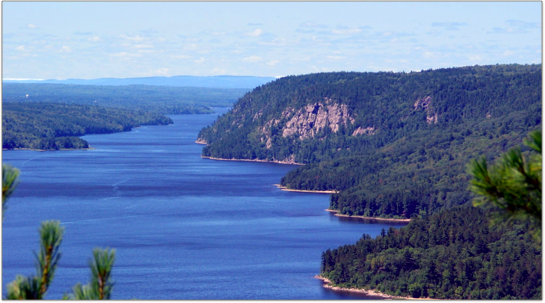
Photo below of the Ottawa River looking north, near the Chalk River Laboratories.

Lynn Jones is a founding member of the Ottawa River Institute, a non-profit, charitable organization based in the Ottawa Valley. ORI’s mission is to foster sustainable communities and ecological integrity in the Ottawa River watershed. 

Final licensing hearing for the NSDF August 10

July 2023

The Algonquins of Kebaowek, Kitigan Zibi and Barriere Lake First Nations are holding a public meeting on August 10, 2023, at 50 Sussex Drive in Ottawa, to make their final presentations to the Canadian Nuclear Safety Commission about the proposed nuclear waste facility beside the Ottawa River, the NSDF.

This is a very important hearing because it is the final step in the licensing process for the NSDF, the first ever proposal for permanent nuclear reactor waste disposal in Canada. It is also a test of Canada’s commitment to the United Nations Declaration on the Rights of Indigenous Peoples. A decision to license the NSDF would contradict four articles of UNDRIP ( see details here).

There were “final” licensing hearings for the NSDF last year, in May/June 2022, but at the end of those proceedings it was recognized that consultation with Algonquin First Nations has been inadequate. Consultations with Kebaowek and Kitigan Zibi First Nations continued over the past year and included an Indigenous-led assessment of the potential impacts of the NSDF on Indigenous Rights. The findings of the assessment are summarized in this booklet.

The hearing on August 10 is the culmination of a seven-year long environmental assessment process for the NSDF – a giant above-ground mound which would hold up to one million tons of radioactive and other hazardous waste. The proposed facility would be located on unceded Algonquin territory, less than one kilometer from the Kitchi Sibi (Ottawa River) on the side of a hill surrounded by wetlands which drain via a creek into the river. The proponent of the waste facility is a multinational consortium (SNC-Lavalin, Fluor and Jacobs), which was contracted by the federal government in 2015 to quickly and cheaply reduce the multibillion dollar cleanup bill for Chalk River Labs, site of eight decades of nuclear activities such as plutonium production for US nuclear weapons. The proposed facility is expected to leak during and after construction and to disintegrate after a few hundred years due to “natural evolution.” Ten Algonquin First Nations, the Assembly of First Nations, and more than 150 municipalities including Ottawa, Gatineau and Montreal, have serious concerns about the proposed facility. More information can be found here, here and here.

During this event, three Algonquin First Nations (Kebaowek, Kitigan Zibi Anishinabe and Barriere Lake) will make their final presentations to the Canadian Nuclear Safety Commission via videolink. They will present the findings of their Indigenous-led study of the NSDF proposal, outline their concerns and highlight the threats to their Indigenous rights that would occur if the facility were granted a license. Other participants in the hearing — the proponent, CNSC staff and Commissioners — will participate remotely by webcast. 

A CNSC decision to license the NSDF would contradict four articles of UNDRIP

The United Nations Declaration on the Rights of Indigenous Peoples (UNDRIP) is a resolution passed by the United Nations in 2007. In Canada, on June 21, 2021, the United Nations Declaration on the Rights of Indigenous Peoples Act received Royal Assent and came into force. The Act affirms the United Nations Declaration and requires the Government of Canada to work towards its implementation.

A CNSC decision to license the giant Chalk River Radioactive Waste Mound also known as the NSDF, this contradicts the following four UNDRIP articles:

Article 25: “Indigenous peoples have the right to maintain and strengthen their distinctive, spiritual relationship with their traditionally owned and otherwise occupied and used lands, territories, water and coastal seas and other resources and to uphold their responsibilities to future generations in this regard.”

Article 29 (2): 2. “States shall take effective measures to ensure that no storage or disposal of hazardous materials shall take place in the lands or territories of indigenous peoples without their free, prior and informed consent.”

Article 32 (1): “Indigenous peoples have the right to determine and develop priorities and strategies for the development or use of their lands or territories and other resources.”

Article 32 (2): “States shall consult and cooperate in good faith with the Indigenous peoples concerned through their own representative institutions in order to obtain free and informed consent prior to the approval of any project affecting their lands or territories and other resources, particularly in connection with the development, utilization or exploitation of mineral, water or other resources.” 

Assembly of First Nations passes a new resolution against the Chalk River Near Surface Disposal Facility

National Observer article by Matteo Cimellaro here

At its annual meeting in Halifax, the AFN passed a resolution introduced by Kebaowek First Nation Chief, Lance Haymond. Here is an excerpt from the press release that is posted on Kebaowek FN website:

NUCLEAR DISPOSAL ON THE CHALK RIVER LABORATORIES SITE: THE ASSEMBLY
OF FIRST NATIONS CALLS FOR URGENT MEETING WITH THE FEDERAL
GOVERNMENT
KEBAOWEK, July 20, 2023 — Last week, at the General Assembly of the Assembly of First
Nations (AFN), a resolution was adopted regarding the proposed project of a Near Surface
Disposal Facility (NSDF) on the Chalk River Laboratories site, calling for “an urgent meeting
between the AFN and the Government of Canada regarding the consultation policy of the
Canadian Nuclear Safety Commission (CNSC) as it relates to nuclear waste transport and
disposal decision”.

The full press release is here: http://documents.kebaowek.ca/PressReleaseAFNsupportsoppositionofNSDF.pdf

And here is the resolution:

Concerned Citizens’ submissions on the proposed nuclear waste dump (NSDF)

July 2023

Concerned Citizens of Renfrew County and Area has actively participated in the Environmental Assessment of the proposed radioactive waste dump at Chalk River Laboratories since the EA began in 2016.

Our group has made the following submissions:

Comments on the project description for the NSDF, June 24, 2016

Comments on the revised project description for the NSDF, November 18, 2016

Comments on the revised project description for the NSDF, November 21, 2016

Comments on the Environmental Impact Statement for the NSDF, May 26, 2017

Comments on the Environmental Impact Statement for the NSDF, August 3, 2017

CMD 22-H7.74 – Submission from CCRCA, published April 19, 2022 

CMD 22-H7.74A – Presentation from CCRCA, published May 18, 2022 

CMD 22-H7.74B – Final submission from the Concerned Citizens of Renfrew County and Area June 15, 2023

Our final submission covers the following topics:

1. Has the CNSC dealt appropriately with Algonquin Anishinaabe First Nations on whose unceded, unsurrendered traditional territory the NSDF would be constructed?

2. Would the NSDF result in significant adverse environmental effects that cannot be mitigated?

3. Is a license amendment needed for the NSDF and if so, can the Commission conclude with confidence that the risks that would be created by the facility are justified?

4. Deficiencies in the Environmental Assessment process (detailed post on this here)

~~~~~~

The section below is an excerpt that supports our position that the NSDF is highly likely to cause significant adverse environmental effects. 

Significant adverse environmental effects that cannot be mitigated include:

  • Emissions of greenhouse gases from forest clearing at the NSDF site; 
  • Loss of the carbon sink potential of the NSDF footprint;
  • Loss of significant habitat for wildlife, including for many species at risk; 
  • Deposit of deleterious substances into water frequented by fish;
  • Spread of contaminated materials beyond the Local Study Area owing to a tornado or microburst during waste emplacement
  • Human intrusion for recovery of radioactive scrap metal from the mound;
  • Contamination of the Perch Creek Basin and the Ottawa River with radioactive and hazardous substances

Proposed mitigation measures – the “Consolidated Commitment Lists”

According to CNSC staff, mitigation measures proposed by CNL in its “Consolidated Commitments Report”  will successfully mitigate all of the significant adverse environmental effects that would be created by the NSDF. We find this conclusion by CNSC staff to be irresponsible and not based on evidence. 

CNL’s “Consolidated Commitments Report” received essentially no attention during the May-June 2022 hearing on the NSDF.  In our view, the commitments in it would do little, if anything, to mitigate the NSDF’s adverse effects.  Some could worsen them.  

As explained in our CMD 22-H7.74:

  • Most of the 856 “commitments” merely repeat statements found in CNL’s 1661-page EIS. Some are new, such as the provision that radioactive waste remaining in the Port Hope area after the closure of the two mounds there would be sent to Chalk River for disposal.  Shipping additional Port Hope waste to CRL would worsen, not mitigate, the environmental impacts of the NSDF. 
  • The Consolidated Commitments Lists says that weather cover structure “designs are being evaluated for compatibility with the NSDF Project configuration and if feasible, could be implemented as a mitigation measure…” An evaluation of the feasibility of a mitigation measure is not a real mitigation measure.
  • The Consolidated Commitment Lists – the supposed mitigation measures if the NSDF is approved – would even allow vegetation clearing activities during the migratory bird nesting period (or bat maternity roosting period) if nest searches are conducted.
  • No effective means of mitigating these significant adverse environmental impacts on species at risk is foreseen, or likely even possible. For example, the promise to temporarily suspend blasting activities “if wildlife are [sic] observed in the blasting area” is pathetically weak. 
  • CMD 22-H7 (p. 290 of 590) says “CNSC staff have found that the NSDF Project is not likely to cause significant adverse environmental effects on the species at risk.” This assertion is not supported by evidence. Habitat loss would be long-term and irreversible. Impacts will inevitably be felt well beyond the local study area.

CMD 22-H7.111C, the supplementary written submission from the Kebaowek First Nation (KFN), describes the seeming indifference of CNSC staff to CNL’s proposed “sustainable forest management plan” — supposedly the key measure to mitigate the adverse impacts of the NSDF Project on wildlife and species at risk:

Staff have relied too heavily on CNL’s promise to implement a sustainable forest management plan (“SFMP”) to mitigate the deforestation. Staff have not received baseline information on animal populations for the NSDF necessary to determine whether a SFMP would actually address the impacts of deforestation or not. KFN does not understand how Staff can determine the proposed deforestation as minimal or justifiable, when they have not actually assessed the proposed measures to mitigate the impact.

Judging by information in the Consolidated Commitments Report, CNL’s promised sustainable forest management plan – yet to be released – would clear more forest areas in other parts of the CRL site.  The notion is that this would allow Large-Toothed Aspen to regenerate in those areas, providing (after several decades) a possible replacement for the bat maternity trees that would be destroyed by deforestation of the NSDF site.  

This would have uncertain future benefits for endangered bat species.  However, they would suffer immediate losses from removal of their existing habitat.  Their current habitat is likely to be of particular importance because of its proximity to Perch Lake and the Ottawa River.   Additional removal of mature forests would result in adverse effects on other species, adding to the impacts created by the NSDF itself.

Following the May/June 2022 hearing, KFN conducted on-site field research in the NSDF “footprint”.  This research, described in CMD 22-H7.111C, documents the extensive use of the area by wildlife species that have cultural, spiritual, and economic importance to Algonquin peoples, including three active bear dens, winter moose and deer habitat, and eastern wolves:

After starting fieldwork, it quickly became evident to KFN technical staff that there were significant gaps in the baseline environmental work done for the NSDF. Specifically… CNL had not conducted animal population counts in the NSDF for moose, deer, or bear, nor studied prey-predator relations; in particular, there was a lack of documentation of eastern wolf presence, population, and prey-predator relations since the beginning of the NSDF EIS process in 2016.

Has the Commission adequately studied the proposed mitigation measures? 

In June 2022 our group submitted the following question to the CNSC registrar: 

“Will Commissioners discuss and review the 856 mitigation measures in the 105-page Consolidated Commitment Lists under Licence Condition G.8 prior to prescribing them?” 

The CNSC has not responded.  There is no indication that the Commission has reviewed these measures. There was virtually no review or discussion of the Consolidated Commitment Report in the five days of public hearings in May/June 2022.  

In our view, it is not possible for the Commission to render a decision about the appropriateness and adequacy of proposed mitigation measures. The fact that 856 mitigation measures are proposed by the proponent suggests there are indeed significant adverse environmental effects.  A cursory review reveals that many of the mitigation measures will do nothing, and some might make matters worse.  A prudent approach would be for the Commission to conclude that the project will cause significant adverse environmental effects that cannot be mitigated.

Scope, application and verification of the proposed mitigation measures

Buried in proposed Revision 3 of the License Conditions Handbook for the CRL site (NRTEOL-LCH-01.00/2028), under the new licence condition G.8, is a statement that CNL would be required to “implement EA regulatory commitment [sic] as outlined in the Near Surface Disposal Facility Project Consolidated Commitments Report, 232-513440-REPT-001 that are applicable to construction and pre-operation activities.” (CMD 22-H7, p. 532 of 590, emphasis added)

In essence, mitigation measures would only apply to site preparation and construction activities. 

Most of the significant adverse impacts of the NSDF Project will occur during the operation and post-closure phases. By limiting mitigation measures to construction and pre-operation activities, the proposed licence amendment G.8 would not address most of the significant adverse impacts of the NSDF Project.  Amending the site licence in this manner would not prevent unreasonable risk to the environment and to the health and safety of persons. The Commission would fail to meet its object found in section 9(a)(i) of the Nuclear Safety and Control Act.

Of particular concern is that this proposed amendment would allow serious adverse impacts on the rights of Indigenous peoples who have lived in the project area since time immemorial.

As already noted, evidence is lacking that the conditions in the Consolidated Commitments Report have been properly taken into account by the decision maker.  Section 53 of CEAA 2012 says it is the decision maker — either the Governor in Council or the CNSC’s Commission, and not the proponent – that must establish the conditions that would permit the NSDF Project to be carried out.  These conditions must include:

(a) the implementation of the mitigation measures that were taken into account in making the decisions under subsection 52(1); and

(b) the implementation of a follow-up program (for determining the effectiveness of any mitigation measures)

There is essentially no follow-up program in the Consolidated Commitments Report. to determine the effectiveness of the proposed mitigation measures. Only a small minority of the commitments would be formally tracked (through an environmental monitoring program).  The “Commitment Tracking Methods” shown in the Report for other mitigation measures are vague phrases or words such as “Good Corporate Responsibility”, “Public Information Program”, “Maintenance”, “Security”, etc.  

This means that there would be no verifiable means for determining the effectiveness of mitigation measures.

CNSC staff nonetheless assert that CNL’s proposed mitigation and follow-up measures – limited to the pre-operation phases of the NSDF Project – would mean there will be “no new impacts” on Indigenous rights.  CNSC staff further assert that Indigenous Nations have been thoroughly engaged on this matter:

Taking into consideration the location of the NSDF site and CNL’s identified mitigation measures and follow-up program measures, CNSC staff conclude that there will be no new impacts on any potential or established Indigenous and/or treaty rights as a result of the NSDF Project (CMD 22-H7, p. 30 of 590) 

Taking into consideration CNL’s list of EA regulatory commitments (including mitigation measures and follow-up program measures) identified to address potential impacts and project-specific concerns, CNSC staff have determined that CNL has conducted a thorough engagement process with the public, Indigenous Nations and communities, and other stakeholders.  (CMD 22-H7, p. 113 of 590)

Indigenous Nations do not agree.  They assert that the engagement process, and the resulting mitigation and follow-up measures proposed by the proponent, will not adequately address the impacts on their established/potential/asserted rights. 

In relation to CNL’s engagement process and the Crown’s Duty to Consult and Governance on the Lands (UNDRIP Articles 18, 29(2), and 32) — and also in relation to KZA’s right to the dignity of its culture (UNDRIP Article 15) — KZA asserts, under the heading “Mitigation and followup measures (proponent)”:

“No suitable accommodation measures have been discussed on this matter. To do so, the consultation has to start back from the beginning, at the project planning phase, to open a window for meaningful consultation and accommodations.” (CMD 22-H7-113.B, Table 9.3: Summary of the severity of potential impacts to Indigenous rights for Kitigan Zibi Anishinabeg with respect to the NSDF)

KZA also finds CNL’s mitigation measures to be incomplete in relation to impacts on its Traditional activities and the right of enjoyment and occupancy of the land, its Right of maintaining and protecting a healthy environment and wholesome resources, and its Right of harvesting (hunting, trapping, fishing and gathering of natural resources for food, social or ceremonial purposes).

CNL’s Draft Environmental Assessment Follow-Up Monitoring Program for the Near Surface Disposal Facility (232-509220-PLA-001 R0 Revision 0) essentially confirms the lack of monitoring and follow-up programs related to rights of Indigenous Nations:

Since the EIS has not suggested any likelihood of adverse NSDF Project effects on… traditional land and resource use, nor on Indigenous use and enjoyment of private property, monitoring and follow-up programs are not specifically identified for these.

Monitoring and follow-up programs are not specifically identified for traditional land and resource use; rather, monitoring for environmental pathways (i.e., for air quality, surface water quality, groundwater quality and terrestrial biota) will be implemented.

What must the Commission do in this case?

Although not mentioned by the CNSC staff in CMD 22-H7, there is an important option to be followed in this matter. Slide 10 (“Remedies”) of the presentation by the Ottawa Chapter of the Council of Canadians (CMD 22-H7-117.A) points out that if the Commission decides that the project is likely to cause significant adverse environmental effects, “the matter can be submitted to Cabinet pursuant to section 52 of the Canadian Environmental Assessment Act.” 

In our view, this is the appropriate course of action for the Commission, given that it has apparently not taken into account the proposed mitigation measures, or considered whether they are appropriate. 

Flaws and deficiencies in the CNSC-led Environmental Assessment for the NSDF

June 29, 2023

The seven year long, CNSC-led, Environmental Assessment of the proposed giant radioactive waste mound or “NSDF” has been fraught with serious problems and deficiencies.  These deficiencies, in our view, have led to a poor-quality assessment, leaving the Commission with poor recommendations on which to base its EA decision.

Inadequate consultation with Indigenous Peoples on whose unceded territory the proposed radioactive dump would be built

CNSC and the proponent announced the design, site and commencement of an EA for the dump in 2016. No consultation with Algonquin First Nations occurred prior to the announcement of the design, site and EA. Some consultations occurred during the protracted EA, but not all Algonquin First Nations were consulted. As a seeming afterthought, after the final NSDF licensing hearing concluded in June 2022, the CNSC decided to leave the record open for further consultations with two of the eleven Algonquin First Nations whose peoples have lived in the Ottawa River watershed since time immemorial, and whose people never ceded their territory to the Crown via a treaty.

Problems in the early stages with the project description and scoping for the EA

1 The CNSC dismissed critical comments on the project description, submitted by radioactive waste management experts, that should have resulted in a fundamental rethinking of the project design, or at least major changes to the scope of the Environmental Assessment.

2  The CNSC’s scoping of the Near Surface Disposal Project (NSDF) was seriously flawed. A combined scoping decision for three separate projects (the NSDF, and the entombment of the NPD and WR-1 reactors) was made nine days before the draft environmental impact statement (EIS) for the NSDF project was released. The CNSC allowed the proponent to conduct environmental impact studies before the project scope was determined. The scoping decision ignored many serious criticisms of the NSDF project description. It was released by a 1-person “Panel” comprised solely of the CNSC President. The public was not apprised of the “Panel” hearing, which may never have actually taken place.

Obstacles to “meaningful public participation”

3  The CNSC did not require the NSDF proponent to translate documents into French, despite a clear potential for adverse environmental impacts in the Province of Quebec. The closest residents to the NSDF project site are in Quebec. Lack of access to French language documents led to a complaint from a Quebec citizen and a decision by the Commissioner of Official Languages to require translation of the draft EIS.

4  The CNSC delayed or refused to provide access to documents referenced in the draft EIS for the Near Surface Disposal Project. A footnote on page 3-14 of the draft EIS (12) states that “The Safety Analysis Report demonstrates that even after failure of some of the design features, the wastes do not present a risk to the public and environment.” However, the Safety Analysis Report was not released until after the public comment period on the draft EIS ended. Key portions of this document (such as section 4.2.1.3 on “Nuclear Criticality Safety”) were redacted.

5  The CNSC did not provide the “meaningful opportunities for public participation” required by section 4(1)(e) of CEAA 2012.  CNSC closed  the record for public comments pursuant to the Environmental Assessment in August 2017 following CNL’s release of a draft Environmental Impact Statement.  This created nearly a 5-year gap before the May/June 2022 hearing.  CNSC provided no opportunity for the public to provide formally recorded comments on the final EIS, despite the numerous changes made to the project that are reflected in it.

6 The CNSC arbitrarily decided that written intervenors at the May/June 2022 hearing would not have the right to make final submissions.

7  The CNSC’s January 31, 2023 Notice of Public Hearing and Procedural Guidance for Final Submissions said that “new information may not be presented.”  This was changed very close to the submission deadline (on May 17, 2023) to “Final submissions may reference any material on the record.”

8  The CNSC public hearings provided no opportunity for witnesses to be cross-examined.

9 During public hearings, the proponent (CNL), its contractor (AECL) and the regulator (CNSC) were given unlimited time to make their arguments, but intervenors (other than First Nations) were restricted to 10 minute presentations. In some cases this required thousands of hours of research to be summarized in 10 minutes.

10 The document registry for the NSDF EA was very cumbersome and awkward and did not facilitate access to submissions by all interested parties.

CNSC staff recommendations to Commissioners fail to mention that the Commission is required to refer the decision to Cabinet if the project is likely to cause significant adverse environmental effects 

12 There is no mention of CEAA 2012 Section 52 in CMD 22-H7.  In this document CNSC staff recommend that the Commission decide that the NSDF is not likely to cause significant adverse environmental effects.  However, Section 52 says the Commission could decide that the NSDF is likely to cause significant adverse environmental effects; in which case the Commission must refer the matter to the Governor in Council (Cabinet).  Were CNSC staff so certain that the Commission would never dare to disagree with one of their recommendations that they felt it was not worth mentioning this option?  Regardless, this is a serious omission.  Information provided in CMD 22-H7 about “matters of regulatory interest” with respect to the proposed NSDF should be complete and objective.

CNSC staff allowed the proponent to write its own conditions (856 “mitigation measures”) and the manner in which they are written makes them impossible to enforce.

13. Section 53 of CEAA 2012 says that it is the decision maker — either the Commission or Cabinet  and not the proponent – that “must establish the conditions… that would permit a designated project to be carried out.”  However, CNSC staff allowed the proponent to write its own conditions (the 856 mitigation measures in CNL’s 105-page NSDF Consolidated Commitments List) in a manner that they would be impossible to enforce. There is no evidence that the Commission ever reviewed these conditions.  Furthermore, the CNSC staff draft licence handbook for the NSDF Project requires CNL to only implement mitigation measures during construction and pre-operation activities. Most of the significant adverse impacts of the NSDF Project would occur in the operation and post-closure phases. By only requiring mitigation of adverse effects occurring during construction and pre-operation activities, the CNSC’s approach would not mitigate the most significant adverse impacts of the NSDF Project.

“With regard to section 53, it is astounding that the CNSC has allowed the proponent, CNL, to write its own mitigation measures, and to write them in such a way that nearly all of them would be unverifiable.”

Ole Hendrickson, CCRCA researcher

Problems with the “Administrative Protocol” document

The “Administrative Protocol” is a document co-signed by the regulator and the proponent. It described the steps to be followed for the Environmental Assessment with milestones and target dates. 

Six different versions of Appendix A to the Protocol were published between 2016 and 2022.

The Administrative Protocol omitted any mention of the Duty to Consult with First Nations

At one point in the middle of the EA process all the dates for milestones were removed.  Interested parties were left with no idea when they might be required to allocate time to preparing final briefs and oral presentations.

An original provision for a dedicated Environmental Assessment hearing was removed. No Environmental Assessment hearing was ever held. The Environmental Assessment report was buried in a staff document and contained no references whatsoever.

And finally…

The CNSC, as responsible authority, was unable to complete the Environmental Assessment in a “timely manner” as required by section 4(1)(f) of CEAA 2012.

EAs normally are completed within one or two years. The EA of the NSDF is currently in its seventh year and counting.

Should the CNSC be responsible for environmental assessment?

The Expert Panel on Reform of Environmental Assessment recommended in its final report to the Minister of Environment and Climate Change in 2017 that the CNSC not be in charge of Environmental or Impact Assessments. The CNSC-led EA of the NSDF proposal was started before the Expert Panel review so it was conducted under previous legislation, but the flaws and failings documented above seem to suggest that removing the CNSC from involvement in Impact Assessment would be prudent.

Photo below by Robert Del Tredici, August 2018, Ottawa