To the Prime Minister, Parliament and the Federal Government
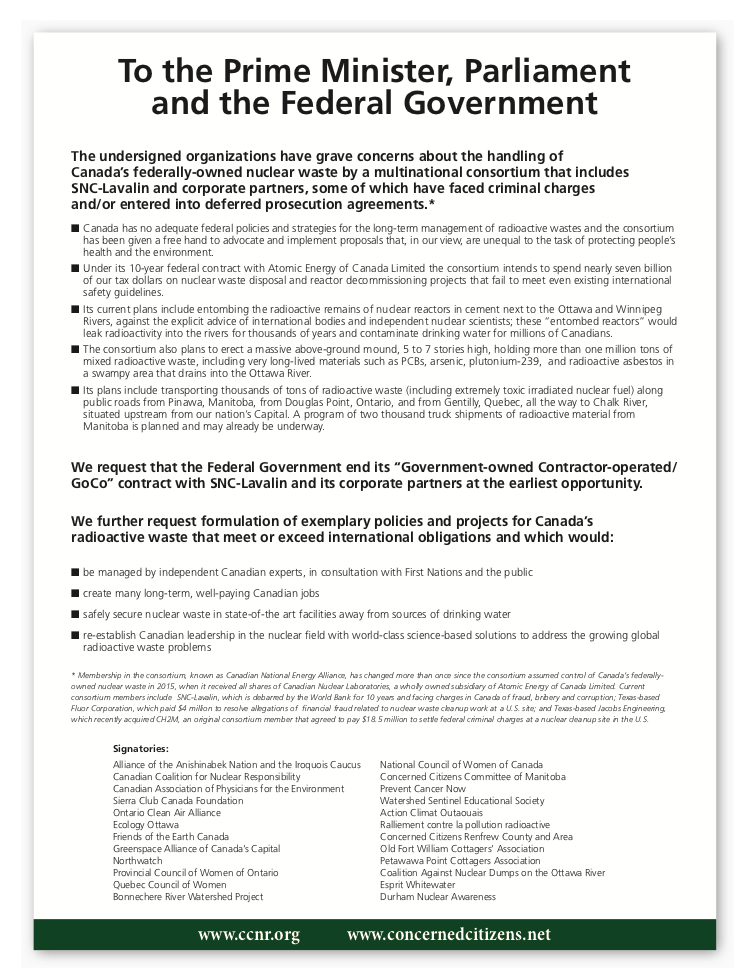
The undersigned organizations have grave concerns about the handling of Canada’s federally-owned nuclear waste by a multinational consortium that includes SNC-Lavalin and corporate partners, some of which have faced criminal charges and/or entered into deferred prosecution agreements.*
● Canada has no adequate federal policies and strategies for the long-term management of radioactive wastes and the consortium has been given a free hand to advocate and implement proposals that, in our view, are unequal to the task of protecting people’s health and the environment.
● Under its 10-year federal contract with Atomic Energy of Canada Limited the consortium intends to spend nearly seven billion of our tax dollars on nuclear waste disposal and reactor decommissioning projects that fail to meet even existing international safety guidelines.
● Its current plans include entombing the radioactive remains of nuclear reactors in cement next to the Ottawa and Winnipeg Rivers, against the explicit advice of international bodies and independent nuclear scientists; these “entombed reactors” would leak radioactivity into the rivers for thousands of years and contaminate drinking water for millions of Canadians.
● The consortium also plans to erect a massive above-ground mound, 5 to 7 stories high, holding more than one million tons of mixed radioactive waste, including very long-lived materials such as PCBs, arsenic, plutonium-239, and radioactive asbestos in a swampy area that drains into the Ottawa River.
● Its plans include transporting thousands of tons of radioactive waste (including extremely toxic irradiated nuclear fuel) along public roads from Pinawa, Manitoba, from Douglas Point, Ontario, and from Gentilly, Quebec, all the way to Chalk River, situated upstream from our nation’s Capital. A program of two thousand truck shipments of radioactive material from Manitoba is planned and may already be underway.
We request that the Federal Government end its “Government-owned Contractor-operated/GoCo” contract with SNC-Lavalin and its corporate partners at the earliest opportunity.
We further request formulation of exemplary policies and projects for Canada’s radioactive waste that meet or exceed international obligations and which would:
● be managed by independent Canadian experts, in consultation with First Nations and the public
● create many long-term, well-paying Canadian jobs
● safely secure nuclear waste in state-of-the art facilities away from sources of drinking water
● re-establish Canadian leadership in the nuclear field with world-class science-based solutions to address the growing global radioactive waste problems
* Membership in the consortium, known as Canadian National Energy Alliance, has changed more than once since the consortium assumed control of Canada’s federally-owned nuclear waste in 2015, when it received all shares of Canadian Nuclear Laboratories, a wholly owned subsidiary of Atomic Energy of Canada Limited. Current consortium members include SNC-Lavalin, which is debarred by the World Bank for 10 years and facing charges in Canada of fraud, bribery and corruption; Texas-based Fluor Corporation, which paid $4 million to resolve allegations of financial fraud related to nuclear waste cleanup work at a U.S. site; and Texas-based Jacobs Engineering, which recently acquired CH2M, an original consortium member that agreed to pay $18.5 million to settle federal criminal charges at a nuclear cleanup site in the U.S.
Signatories:
Alliance of the Anishinabek Nation and the Iroquois Caucus, Canadian Coalition for Nuclear Responsibility, Canadian Association of Physicians for the Environment, Sierra Club Canada Foundation, Ontario Clean Air Alliance, Ecology Ottawa, Friends of the Earth Canada, Greenspace Alliance of Canada’s Capital, Northwatch, Provincial Council of Women of Ontario, Quebec Council of Women, National Council of Women of Canada, Concerned Citizens Committee of Manitoba, Prevent Cancer Now, Watershed Sentinel Educational Society, Action Climat Outaouais, Ralliement contre la pollution radioactive, Concerned Citizens Renfrew County, and Area, Old Fort William Cottagers’ Association, Petawawa Point Cottagers Association, Coalition Against Nuclear Dumps on the Ottawa River, Esprit Whitewater, Durham Nuclear Awareness, Bonnechere River Watershed Project
As it appeared in the Hill Times on April 29, 2019…
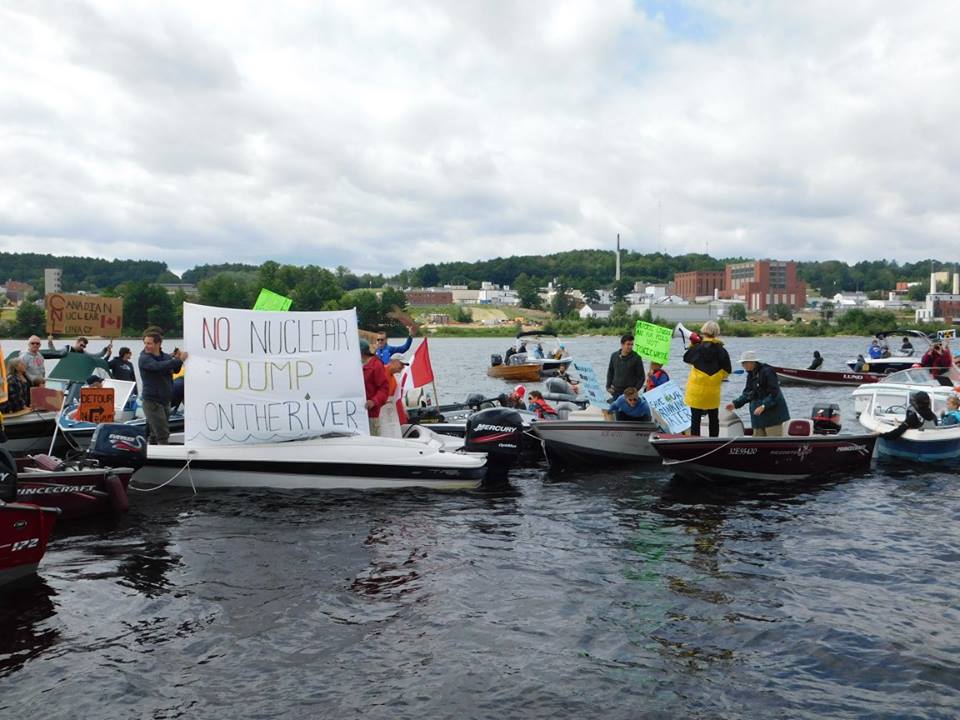
Protect the Ottawa River! ~Join us for this peaceful protest in opposition to Canadian Nuclear Laboratories’ proposed radioactive waste dump on the shores of the Ottawa River
This photo is from Chalk River Boat Flotilla Protest V1 in July 2017
Details:
Morning conference: 10:00 – 11:30 am on July 27 at Hotel Pontiac, Fort William (all invited)Several speakers will discuss CNL’s proposals for radioactive waste mound at Chalk River, entombment of NPD reactor at Rolphton, and the transport of nuclear waste to Chalk River from other locations. There will be networking and refreshments. Media will be invited for conference and flotilla Following the morning conference, there will be two boating options. Motor boats will leave Fort William Dock at 12:00 noon to arrive in the water in front of Chalk River Laboratories by 1:00 pm
Canoes and kayaks will go for a guided scenic tour of the shoreline and nearby islands.
If you’d like to help promote this event, you can download the poster here.
Three recent submissions to the Canadian Nuclear Safety Commission by Dr. J.R. Walker, Canada’s foremost expert on the Government of Canada’s legacy radioactive wastes and how to properly manage them can be accessed here and here. (Backup source in case CNSC website not working)
According to his Linked In, Dr. Walker was the Director of Safety Engineering and Licensing at AECL when he retired before the multinational consortium took over management of Chalk River Laboratories. He was identified as “champion” on behalf of AECL in this CNSC protocol for the Nuclear Legacy Liabilities Program. He states very clearly in his submissions to the CNSC that the wastes proposed for disposal in the NSDF are “intermediate level wastes” that require underground disposal. He says the dump would be hazardous and radioactive for many thousands of years and that radiation doses from the facility would exceed allowable levels.
“No inventory management system is in place to comprehensively verify that waste packages and unpackaged waste accepted for emplacement comply with the radiological parameters of the stated waste acceptance criteria;
“The waste acceptance criteria are insufficiently protective for the material permitted to be emplaced in the proposed Engineered Containment Mound to qualify as low level waste — the radionuclides do not decay to an acceptable level during the time that institutional controls can be relied upon. Consequently, the emplaced material is intermediate level radioactive waste that should not be emplaced in a near surface facility because it requires a greater degree of containment and isolation than that provided by near surface disposal;
“Using the waste acceptance criteria credited in the proponent’s Environmental Impact Statement, it possible to calculate when the constituent radionuclides of the stated inventory would decay sufficiently to meet Canada’s regulatory criteria for disposal. This calculation reveals that many radionuclides would not decay sufficiently to meet Canada’s disposal criteria for many thousands of years and, in some cases, for many millions of years. This means that the safety of humans and nonhuman biota would be dependent upon institutional controls in perpetuity.
“The proposal is non-compliant with International Safety Standards, for example, no verification of the radioactive content of emplaced waste and reliance on institutional controls to ensure long-term safety. Canada is bound by international treaty to have due regard to internationally endorsed criteria and standards concerning radioactive waste management. Consequently, giving approval to the proposed ECM would appear to place Canada in contravention of its international treaty obligations.“
Original post ~ April 2019
Fifteen former AECL officials and scientists have submitted critical comments on the CNL nuclear waste disposal projects. These people point out many serious flaws in the proposals and the environmental impact statements.
These comments were all submitted to CNSC/CEAA. Links are to the CEAA pages for the environmental assessments for the disposal projects Most of these former AECL employees identify themselves as “residents of Deep River” or “residents of Pinawa” and do not refer to their employment at AECL in their submissions (but see Michael Stephens’ second NSDF submission). All are retired, but their former job titles or responsibilities – found through internet searching – are shown in parentheses, below.
A multinational consortium wants to build two nuclear waste dumps alongside the Ottawa River upstream of Ottawa-Gatineau, one at Chalk River, Ontario and the other at Rolphton, Ontario. Both dumps disregard international safety guidelines and would leak radioactive materials into the Ottawa River, endangering drinking water for millions of Canadians living downstream.
Background:
In 1944 Chalk River Laboratories (CRL) were established to produce plutonium for nuclear weapons. Starting in 1952 the Labs were operated by “Atomic Energy of Canada Limited” (AECL). Besides producing plutonium, the labs established a prototype nuclear power reactor (NPD) upstream of Chalk River at Rolphton, and extracted “medical isotopes” from irradiated fuel. These activities and two serious accidents created large quantities of dangerous radioactive wastes. Cleanup costs are estimated at $8 billion.
The Harper government radically restructured AECL in 2015, creating a subsidiary called Canadian Nuclear Laboratories (CNL) and contracting a multinational consortium including SNC Lavalin, to operate the subsidiary and reduce the federal government’s nuclear cleanup liabilities quickly and cheaply. All four consortium members face or have faced criminal charges for fraud and corruption*. Annual costs to taxpayers tripled shortly after restructuring.
In 2016, CNL proposed to construct a giant, above-ground mound of radioactive waste (NSDF) at Chalk River and to entomb in concrete the NPD reactor at Rolphton. Both proposals disregard International Atomic Energy Agency safety standards and would permanently contaminate the Ottawa River with radioactive materials such as plutonium, caesium, strontium and tritium, some of which will be remain hazardous for over 100,000 years. CNL is also moving to bring thousands of shipments of radioactive waste (including highly toxic used fuel rods) to Chalk River from other federal sites in Manitoba, Ontario and Quebec.
Independent experts, retired AECL scientists, Citizens’ groups, NGOs, 140 Quebec municipalities and several First Nations have been sounding alarm bells about the projects via written comments, resolutions, press conferences, and protests including a boat flotilla on the Ottawa River in August 2017 and a Red Canoe March for Nuclear Safety through the streets of downtown Ottawa in January of 2018.
In April 2018, CNL was granted a 10-year license despite widespread concern over license changes that would make it easier for the consortium to get its nuclear waste projects approved. Canada’s nuclear regulator, the Canadian Nuclear Safety Commission (CNSC), granted the new license. The CNSC is also in charge of environmental assessment (EA) and licensing for nuclear waste projects. The CNSC is perceived to be a “captured” regulator that promotes projects it is charged with regulating, according to Canada’s Expert Panel on EA reform. The CNSC’s mishandling of EAs for the consortium’s nuclear waste projects is described in Environmental Petition 413 to the Auditor General of Canada.
* The consortium, known as Canadian National Energy Alliance, includes: SNC-Lavalin,debarred by the World Bank for 10 years and facing charges in Canada of fraud, bribery and corruption; CH2M agreed to pay $18.5 million to settle federal criminal charges at a nuclear cleanup site in the U.S.; Fluor paid $4 million to resolve allegations of financial fraud related to nuclear waste cleanup work at a U.S. site; Rolls-Royce PLC, parent company of consortium member Rolls-Royce Civil Nuclear Canada Ltd., recently agreed to pay more than CAN$1 billion in fines for bribery and corruptionin the U.K., U.S. and Brazil. **NB** since this post was first published, membership in the consortium has changed. Rolls Royce is no longer listed as a consortium member on the CNEA website and Texas based Jacobs Engineering has recently acquired CH2M.
ACTION ALERT ~ Tell the federal government that nuclear energy is not clean
The government of Canada is asking for comments on its “sustainable development” strategy. The deadline for comments is Tuesday April 2, 2019. In its glossary of terms, the strategy includes the following definition: “Clean energy: Renewable, nuclear, and carbon capture and storage technologies, as well as demand reduction through energy efficiency”
Can you help get the message across to our government that nuclear energy is not clean? It only takes a minute to send a comment using the comment box on this page: http://fsds-sfdd.ca/index.html#/en/detail/all/goal:G05
If you prefer, you can submit your comment by email to this address: ec.bdd-sdo.ec@canada.ca
Nuclear energy produces hazardous radioactive waste that must be isolated from the biosphere for hundreds of thousands of years. This is the main reason, we don’t think it should be called “clean”. See below for further information on why we think it is wrong to include nuclear in the definition of “clean energy”.
If you agree with us, please consider sending a simple message in the comment box (access through the link above). You should first enter “clean energy” the subject line and then add your comment for example, “Please remove “nuclear” from the definition of “clean energy” in your glossary of terms”. or “I object to the inclusion on “nuclear” in the definition of clean energy in your glossary of terms in the sustainable development strategy”. Of course you could say much more if you have time.
See environmental petition 419 to the Auditor General of Canada for background on why nuclear energy is not clean. Here is a link to the petition:https://tinyurl.com/AG-petition-419
Here are some excerpts from the petition: …Nuclear reactors release a wide variety of air and water pollutants. Nuclear reactors routinely emit radioactive gases to the atmosphere during operation. These include fission and activation products such as tritium (the radioactive form of hydrogen); radioactive carbon-14; radioactive noble gases such as argon, krypton and xenon; radioactive halogens such as iodine-131; and a wide variety of radioactive aerosols. Fuel reprocessing facilities, spent fuel storage facilities and other radioactive waste facilities also release radioactive gases. (7) (8) …The principal radionuclide in liquid effluents from nuclear reactors is tritium. Other liquid reactor effluents include radioactive isotopes of carbon, sulfur, chromium, manganese, iron, cobalt, zinc, strontium, zirconium, niobium and cesium. Radioactive effluents from fuel reprocessing facilities, spent fuel storage facilities and other radioactive waste facilities can greatly exceed those from nuclear reactors during normal operation. …Liquid and gaseous effluents from nuclear reactors contain a wide variety of radioactive substances thatpose health risks to people living near reactors. These risks vary according to ingestion and absorption pathways, sites of accumulation in the body, and residence times for different radioactive substances. …Radioactive wastes (spent fuel, resins, filters, chemical sludges, fuel cladding, contaminated metal and concrete reactor components, etc.) steadily accumulate during reactor operations. Most reactor wastes cannot be reused or recycled. Artificial radioactive substances produced by nuclear reactors can have half-lives of thousands to millions of years. Health risks associated with exposure to these substances may impose serious burdens upon future generations if these risks are not promptly addressed by the present generation that benefits from nuclear power.
Posted By Alexandra Bly In Biodiversity & Habitat,Canada,Energy Politics,Finance & Investment,Health & Safety,Nuclear,Opinion & Analysis,United States |Full Story: The Energy Mix @theenergymix March 10, 2019Primary Author Paul McKay7 Comments
Jeangagnon/Wikimedia Commons
On the anniversary of the 2011 Fukushima nuclear disaster, investigative journalist Paul McKay reveals that the trade in radioactive waste is becoming a lucrative opportunity for SNC-Lavalin and its U.S. partner.
If it is true that one person’s garbage can be another’s gold, then Montreal-based multinational SNC-Lavalin and its new U.S. partner, Holtec International, plan to be big global players in what promises to be a very lucrative, long-term business: handling highly radioactive nuclear wastes until permanent disposal methods and sites might be found, approved, and built.
That problem is pressing because the volume of spent reactor fuel is cresting in the U.S., Canada, Europe, China, India, Russia, and Japan. There are also hundreds of intensively contaminated reactors which must sooner or later be entombed, dismantled, chopped up by robots, then sent in special, sealed containers to interim storage sites somewhere.
But no country in the world has yet found a proven, permanent solution for the 250 million kilograms of spent fuel now in limbo[2] in storage pools and canisters, let alone the atomic furnaces which created them. There are now[3] about 413 operable civilian reactors in 31 countries, and another 50 under construction.
Physics tells us precisely how “hot” atomic garbage is. Every commercial power reactor—regardless of model, type, country, or owner/operator—contains the radioactive equivalent of many atomic bombs locked within its spent fuel, reactor core, pumps, valves, and extensive cooling circuits.
To illustrate this, consider that only a small fraction of the “fission inventory” at the Fukushima nuclear site escaped during the terrifying March, 2011 accident. All operating civilian reactors eventually create and contain more than 200[4] such “hot” elements and isotopes. Known as transuranic elements, actinides, and activation products, they comply with the laws of physics but defy ordinary definitions of danger, technological assurance, and even human-calibrated time itself.
Some fission products transmute or decay within days, while others (like plutonium-239) can take 24,000 years or more[5] to lose half their deadly mass. As this happens alpha, beta, or gamma radiation is constantly emitted, which in turn can directly damage living cells and organs. Many of these particles can accumulate like silent assassins in the food chain, then strike later.
Worse, they have the ability to invade human bodies by mimicking needed minerals like the calcium, potassium, magnesium, or iron we find in milk, meat, or vegetables. Worse still, they can impair human reproductive organs, causing health damage and intergenerational genetic defects. If exposed, adult women are more vulnerable to radiation than men, because they have one lifetime store of ova while male sperm is replenished over time. Children are most vulnerable of all, because they produce especially defenseless cells at a torrid rate as they grow.
And finally, the “hot” inventory of every reactor contains some irradiated elements which will remain latently lethal for hundreds of centuries or more. Each has its own emission signature and decay rate. The fissile isotope Uranium 235[6], for example, will lose half its mass after 700 million years.
This is not speculative; it is a matter of fundamental physics and biology. Fukushima illustrated why achieving even a 98% containment success rate means catastrophic consequences. The risk of any such failure for millennia to come is an embedded liability for every power reactor operating today, and for its spent fuel legacy.
So it bears examining just who is taking charge of the most dangerous garbage on Earth. Enter SNC-Lavalin and Holtec International.
**********
Canadians might recognize century-old SNC-Lavalin as a venerable engineering giant, but with past decades of technical success and corporate gravitas ruined by 21st century bribery, fraud, and corruption scandals, and by recent convictions of employees and executives for corporate malfeasance.
In 2013, following sordid proof of bribery and kickback schemes from Libya to Bangladesh, the World Bank banned[7] SNC-Lavalin and its 100 global affiliates from bidding on contracts for 10 years. The company is also facing criminal charges[8] for its tactics to win a new hospital construction contract in Montreal, and another criminal probe[9] related to a Montreal bridge contract. A reputation that was once impeccable now may be irredeemable.
SNC-Lavalin also has a well-documented history of manipulating compliant federal and Quebec politicians, and securing endless subsidies, concessions, sweetheart loans, and preferential tax and legal treatments sanctioned by both Liberal and Conservative prime ministers. In 2018, the federal election watchdog reported[10] the company had made more than $117,000 in illegal political donations (the lion’s share of which went to the Liberals) by secretly conscripting employee donations and routing them through obscure pathways. In January 2019, a disgraced company executive pleaded guilty[11] to orchestrating the illegal election finance scheme.
Most recently, the federal minister of justice and attorney general, the top law enforcement official in the country, is alleged to have lost her cabinet post after she rebuffed efforts by Prime Minister Justin Trudeau and his top advisors to have her waive potential criminal penalties (which would preclude SNC-Lavalin bidding on federal contracts for 10 years) in favour of fines and anti-corruption measures. That followed a recent, under-the-radar revision of the federal Criminal Code to allow for such corporate leniency, for which SNC-Lavalin lobbied repeatedly[12].
In 2011, under the former Stephen Harper government, SNC-Lavalin managed to acquire key commercial nuclear contracts, intellectual property, and personnel of the federal Crown corporation Atomic Energy of Canada Ltd. (AECL). The purchase price was C$15 million (plus possible future royalty payments to Ottawa) for an entity into which Canadian taxpayers had sunk[13] more than $17 billion during six previous decades.
Why would the Canadian engineering company pay even that much, when global nuclear growth was barely 1% last year, and capital investment in renewable power generation (nearly US$300 billion[14] in 2016) is more than double that for new nuclear and fossil-based generation (coal, oil, gas) combined? Wasn’t that fatal trend already obvious?
Perhaps it was. But perhaps someone in Montreal also cunningly calculated that there might be much more money to be made during the demise of the global nuclear industry, like a company specializing in dangerous demolitions, or removing asbestos). Because the cumulative volume of atomic garbage is still climbing—and especially since Fukushima, governments and utilities are willing to pay extortionate sums to remove nuclear wastes from densely-populated areas and keep them out of sight for decades or more.
If there are few rivals in that “hot garbage” business, all the better, because that will fetch more contracts at higher prices. Then fortune will favour the brazen.
Such a business model also apparently appeals to U.S.-based Holtec International. It has not designed, financed, or built typical nuclear power plants. Instead, it has created a global contracting business supplying nuclear replacement parts, equipment, and services. For two decades, a core business has been providing concrete casks for spent fuel storage.
During that time, Holtec paid a US$2-million fine[15] related to bribery payments to a convicted federal utility manager, and was the subject of scathing safety reviews by a U.S. quality assurance engineer who was later terminated for suspected whistleblowing. A federal Nuclear Regulatory Commission specialist in nuclear cask safety, Dr. Ross Landsman, contemporaneously concluded[16]: “As far as I am concerned, Holtec has no quality assurance. This is the same kind of thinking that led to the NASA Space Shuttle disaster.”
More recently, Holtec has pursued its plan to buy now-defunct U.S. reactors, cut and gut their radioactive innards, then send the scrap along with the spent fuel to a 1,000-acre property it has acquired in remote New Mexico. But the proposed site is facing stiff public and political opposition[17], because Holtec also plans to store wastes from many retired reactors there.
In 2014, Holtec received promises of US$260 million in New Jersey state subsidies to move its headquarters 12 miles to South Camden, and modernize a vast shipyard building at an estimated cost of US$320 million. The subsidies are contingent on creating 320 permanent jobs, and are to be dispensed over 10 years.
Last September, police formed a protective barricade at the plant entrance after Holtec founder Krishna P. Singh complained[18] to a business journal: “There is no tradition of work in [Camden] families. They don’t show up to work. They can’t stand getting up in the morning and coming to work every single day. They haven’t done it, and they didn’t see their parents do it. Of course, some of them get into drugs and things. So, it’s difficult.”
**********
Back in Canada, SNC-Lavalin is leading a consortium Ottawa belatedly convened to clean up Canada’s first nuclear research and reactor site at Chalk River, Ontario. The “hot garbage” there includes contaminated buildings, instruments, pipes and clothing. Reactors at Chalk River and nearby Rolphton await entombment. An estimated one million cubic meters of atomic wastes are slated to be buried near the upper Ottawa River. Even some former AECL scientists have condemned[19] the planned mega-dump.
The site is 200 kilometres upstream of Parliament Hill, where the $15-million deal to sell key AECL assets was approved. But SNC-Lavalin was indemnified from liabilities in that deal, and the federal government retains ownership of the Chalk River property, buildings, and contaminated materials. So the private consortium is now being paid nearly $1 billion[20] each year by federal taxpayers to manage and bury radioactive[21] wastes at Chalk River, and to operate labs to conduct nuclear research there.
The controversial company has also embedded itself in the Ontario nuclear power sector by way of its Trojan horse purchase of AECL assets. That federal Crown company held key CANDU reactor design patents, decades of crucial calculations and technical drawings, and employed remnants of the irreplaceable cadre of nuclear physicists, chemists, and engineers needed to repair, rebuild, and run Ontario’s nuclear fleet.
Once these assets were bestowed upon SNC-Lavalin by Ottawa, it had the leverage to negotiate lucrative contracts with Bruce Power and Ontario Power Generation (OPG), guaranteeing a major share of work related to $26 billion in combined nuclear power plant reconstruction costs during the next decade. Under the $13-billion Darlington refurbishment contract, up to 93% of any project cost overruns[22] will be borne by the province of Ontario (sole owner of OPG), not SNC-Lavalin or allied private contractors—which gives a big, influential engineering firm with no discernable competition very little incentive to bring the project in on budget.
Those two $13-billion contracts involve removing and replacing major CANDU reactor components. That experience, in turn, will leave the company uniquely positioned to eventually decommission Canada’s fleet of reactors, and handle a projected 5.4 million spent fuel bundles. That work will cost another estimated $23 billion (in 2015 dollars), which reactor operators will be compelled to collect[23] from power consumers and preserve for that use.
In America, Holtec has homed in on similarly alluring pots of “hot” honey, only there they are much, much bigger. That’s because nearly 100 commercial reactors in the U.S. are facing eventual retirement, and federal laws force the utilities that own the reactors to collect a constant stream of payments from consumers to cover plant decommissioning and spent fuel disposal costs. Those multi-billion-dollar pools of money have grown over time, but American utilities cannot draw from them without regulatory approval.
But there is no licenced federal facility in all of America to permanently immobilize and bury the “hot” spent fuel currently being stored at some 80 sites, and only one federal disposal site in South Carolina which will accept both nuclear weapons waste (including military reactors) and a rare few dismantled civilian reactor cores.
Think plugged toilet. Think Fukushima, because Japan has no permanent nuclear waste disposal site. So spent fuel bundles there were stacked in improvised swimming pools—outside the crucial containment shell. Think Pickering, Ontario, where decades of spent fuel is accumulating in swimming pools and concrete canisters because Canada has no approved final disposal site for “hot garbage”.
Everyone in the civilian nuclear business—from reactor operators to their regulators—understands that they might be one extended pump system failure, blackout, earthquake, extreme storm, or cyber-attack away from a public health catastrophe. They are desperate for some saviour to make it all go away.
**********
Re-enter SNC-Lavalin and Holtec. Last summer, instead of competing as rivals, they created a joint venture to collaborate on “hot garbage” contracts across the continent. To the great relief of reactor operators and regulators, their subsidiary CDI is promising to buy defunct nuclear plants, dismantle contaminated components, then ship those and spent fuel bundles in concrete canisters to its isolated New Mexico property. All, CDI claims, at a price and speed individual utilities could not hope to achieve on their own.
For the U.S. utilities, such a deal would get rid of their worst liability nightmare in a hurry and clean up their bottom line, because CDI would get paid from the dedicated funds utilities are forbidden to use for any other purpose. For state utility regulators and the federal Nuclear Regulatory Commission, it would banish the problem to one remote patch of scrubland, far away in the U.S. southwest.
Emphasis on “one”. If the Holtec site in New Mexico does receive final approval, the CDI joint venture will have sole access to the first and only such private facility in North America. Naturally, owning the only toilet in town would confer an effective monopoly, giving the two joint venture partners enough leverage to win most future nuclear disposal contracts, while cashing in as platinum-priced plumbers.
But even if Holtec’s proposed US$2.4-billion project in New Mexico gets licenced and built, and the CDI joint venture does a booming business sending “hot garbage” there from some 80 sites in 35 states, Ernest Hemingway’s curt counsel to “never confuse movement with action” applies here.
The New Mexico facility will not be designed or licenced as a permanent disposal site. Holtec’s sealed canisters will not be designed or licenced to hold nuclear wastes for more than a few decades. And if recent troubles are any indication, some might not last a year—let alone decades.
Holtec and the federal Nuclear Regulatory Commission have now locked horns over the integrity of its newest sealed containers at the San Onofre nuclear complex, 60 miles north of San Diego. It was shut down in 2013, after breakdowns and repair costs made it uneconomic to operate.
Now, the utility owner is prepping the reactors for dismantling at a cost of US$4.4 billion, and some 3.6 million pounds of hot spent fuel waste remains on the site. This year, most of the San Onofre fuel bundles were expected to be transferred from an indoor swimming pool to an outdoor morgue, where new Holtec caskets waited on a ridge overlooking the Pacific Ocean.
However, Holtec made design changes to its casks without notifying the utility or the federal regulator. Only a few had been filled before workers noticed a loose bolt which could jam hot fuel bundles, or puncture the metal cask lining, or prevent future inspections or removal of spent fuel. Work was stopped for 10 days and the NRC was notified. It in turn ordered[24] Holtec to stop supplying casks with the modified design, but many had already been delivered to other nuclear plant sites.
Then fuel transfers were halted again because inexperienced Holtec employees allowed[25] a 50-ton Holtec canister—filled with hot spent fuel bundles—to be dangerously misaligned as it was being lifted by a crane and inserted into a vault at the San Onofre site. The NRC reprimanded Holtec sharply[26] for lax training and oversight related to the incident.
The episodes illustrate the vanishingly small margins of error when dealing with nuclear wastes. Luckily, no leak or accident occurred at San Onofre. But the errant four-inch stainless steel bolt (and the unauthorized cask design change by Holtec) was discovered only by chance, just as 43 identical Holtec casks were waiting to be filled at San Onofre. Others had already been filled at nuclear sites from New England to Alabama.
**********
The shape-shifting lethality of “hot” fission products, and their immutable longevity, tests the limits of not just human technology, but most measures of human conduct.
Once it’s created, such “hot garbage” demands all companies involved be immune to greed, bribery, cutting corners, masking quality control failures, or deceiving safety auditors.
It requires regulators that are relentlessly vigilant, trained to detect flaws and complacency, impervious to bribes or coercion, and who place a far higher priority on public safety than on reactor performance, career promotions, pleasing the boss, or pay raises.
It requires politicians who refuse to dispense favours, subsidies, or serial excuses to preferred players, and who always keep the lethality and longevity of nuclear wastes foremost in their minds when making related policy.
This matrix of perfection, of course, does not exist anywhere on this planet.
So there have been horrific accidents such as Chernobyl and Fukushima. Nuclear plants like San Onofre have been built atop known earthquake faults, a stone’s throw from the Pacific Ocean. In France, massive reactor core containment vessels were belatedly found to be defective—years after startup. In 2016, the French national nuclear safety authority found[27] that a state-owned forging company had falsified quality control reports for four decades while as many as 400 defective parts were supplied.
At the eight-reactor Pickering[28] nuclear complex, located in Canada’s densest population corridor, the plutonium locked inside spent fuel bundles is equal to that embedded in 11,000 nuclear weapons. Even more atomic waste is lurking at the eight-reactor Bruce complex and four-reactor Darlington plant in Ontario, and at the Point Lepreau reactor in New Brunswick.
The Fukushima tragedy, physics, and biology tell us the only tolerable nuclear containment breach rate is zero per cent. For forever. Yet the “hot garbage” keeps piling up, even though it can imperil our biosphere for centuries. This is not just tempting fate. It is giving it the middle finger.
Paul McKay has won Canada’s top awards for investigative, business and feature reporting multiple times, and is the author of two books about nuclear technology and policy. This report was researched and written pro bono. No funding from any source was sought or received.7 Comments (Open | Close)
7 COMMENTS TO “HOT GARBAGE GRIFTERS: SNC-LAVALIN’S PLAN TO TURN NUCLEAR WASTE INTO LONG-TERM GOLD”
#1 Pingback By Hot Garbage Grifters: SNC-Lavalin’s Plan to Turn Nuclear Waste into Long-Term Gold – Enjeux énergies et environnement On March 10, 2019 @ 9:09 PM
[…] The Energy Mix [29]; via […]
#2 Comment By Paul Gervan On March 11, 2019 @ 10:12 AM
Brilliant investigative work. Here’s to independent media. Bravo Paul McKay!
#3 Comment By Mireille LaPointe On March 12, 2019 @ 11:27 AM
Absolutely brilliant! Miigwech, Paul.
#4 Comment By Donna Gilmore On March 15, 2019 @ 8:56 AM
Excellent article! The story is even worse at San Onofre and with Holtec and the NRC. The Holtec system the NRC approved damages the walls of every canister downloaded into the storage holes. The utility, Southern California Edison, and these other players are trying to hide or downplay this issue. The NRC refuses to formally document this issue or hold anyone accountable for a system that immediately shortens the life of these uninspectable and unrepairable thin-wall canisters (only 5/8″ thick). They have no fix other than to recall and replace this system. The root cause is Holtec’s poorly engineered imprecise downloading system that gouges the walls of every canister downloaded. Edison admitted to the NRC that the entire length of the canister wall scrapes against a steel metal guide ring as it is lowered past the ring over 18 feet. More information at SanOnofreSafety.org
#5 Comment By Brennain Lloyd On April 3, 2019 @ 9:06 AM
Excellent. A detailed analysis for the SNC-Lavelin’s sordid past and aspired to future and the connecting point (radioactive wastes) from a reliable investigative journalist. Thank you, Paul McKay.
#6 Comment By Ole Hendrickson On August 2, 2019 @ 11:05 AM
Anyone who has children or who cares about the future should read this article.
#7 Comment By Nira Dookeran On August 2, 2019 @ 1:22 PM
Omg. It’s even worse than I thought. And I thought it was very bad.:-(
(Fiche d’information préparée par les associations Old Fort William Cottager’s Association,Concerned Citizens of Renfrew County and area, le Ralliement contre la pollution radioactive et la Coalition contre le dépotoir nucléaire sur la rivière des Outaouais.)
Trois projets pour gérer l’héritage radioactif du Canada menacent de contaminer de matières radioactives l’eau potable de millions de Canadiens :
Le projet de dépotoir nucléaire à Chalk River, en Ontario
Le projet de mise en tombeau du réacteur nucléaire de Rolphton, en Ontario
Le projet de mise en tombeau du réacteur nucléaire de Whiteshell, au Manitoba
Le projet de dépotoir nucléaire abandonnerait un million de mètres cube de déchets radioactifs de faible activité – à moins d’un kilomètre de la rivière des Outaouais-source d’eau potable pour des millions de Québécois.
Le site choisi pour le dépotoir nucléaire se trouve à flanc de colline, à moins d’un kilomètre de la rivière des Outaouais, le principal affluent du fleuve Saint-Laurent et la source d’eau potable de millions de Québécois.
Il se draine dans une zone marécageuse vers le lac Perch et son ruisseau qui se déverse directement dans la rivière des Outaouais.
Le méga-dépotoir aurait une superficie équivalente à la taille de 70 patinoires de hockey de la LNH.
Cette installation s’étendrait sur 16 hectares et s’élèverait jusqu’à 18 mètres de hauteur.
Le site pour le dépotoir nucléaire se trouve sur une ligne de faille sismique majeure, au-dessus d’un substrat rocheux poreux et fracturé.
Des études, menées dans les années 90, ont déterminé que les couches rocheuses sous-jacentes au site étaient poreuses et fracturées, et que les eaux souterraines affluaient vers la rivière des Outaouais.
Le site se trouve dans la zone sismique de l’Ouest du Québec. Selon Ressources naturelles Canada, un tremblement de terre peut y atteindre une magnitude de 6 sur l’échelle de Richter.
Le méga-dépotoir va contenir des déchets radioactifs de longues durées de vie
Les normes de sécurité établies par l’Agence internationale d’énergie atomique (AIEA) prévoient que seuls des déchets radioactifs de « très faible activité » peuvent être enfouis dans une telle instal Selon ces normes, les déchets doivent devenir inoffensifs avant que les revêtements perdent leur intégrité et leur étanchéité.
Cependant, certains des déchets faussement classés comme étant de « faible activité» que proposent d’enfouir les Laboratoires nucléaires canadiens ont une demi-vie radioactive de plusieurs dizaines de milliers d’années, alors que les membranes géotextiles du dépotoir ont une durée de vie de 500 ans, selon les promoteur
Les déchets radioactifs seront exposés à la pluie, à la neige et aux autres intempéries de plus en plus imprévisibles avec les changements climatiques en plus d’interagir entre eux à cause de la radioactivité
Durant les cinquante années requises pour remplir le dépotoir, les déchets radioactifs seraient exposés aux précipitations de pluie, de neige et à d’autres intempéries (tornades, etc.).
Les promoteurs ont prévu une station de traitement pour les eaux contaminées, mais il n’existe aucun moyen d’éliminer le tritium qui rend l’eau radioactive. De plus, plusieurs substances radioactives peuvent être présentes dans l’eau sans qu’il soit possible de les mesurer.
Les interactions critiques et dangereuses entre toutes les substances radioactives contenues dans le dépotoir sont inconnus, surtout à cause des radiations, de la chaleur et de l’humidité.
Les projets de mise en tombeau des réacteurs nucléaires de Rolphton (Ontario) et de Whiteshell (Manitoba) vont également contaminer des sources d’eau potable
La mise en tombeau des réacteurs nucléaires de Rolphton et de Whiteshell consiste à laisser les réacteurs en place et à les remplir d’un coulis de béton, alors qu’ils sont situés à quelques dizaines de mètres de la rivière des Outaouais, en Ontario et de la rivière Winnipeg, au Manitoba.
Les projets contreviennent aux normes de sécurité établies par l’AIEA qui déconseille la mise en tombeau, sauf quand on ne peut faire autrement, à cause d’un accident grave.
Ces trois projets dangereux sont présentés par un consortium d’entreprises privées
En 2015, le gouvernement Harper a transféré l’exploitation et la gestion des Laboratoires nucléaires canadiens à un consortium de sociétés multinationales à but lucratif basées aux États-Unis, au Royaume-Uni et au Canada, selon un modèle de partenariat public-privé. Bien que le dépotoir serait administré par le consortium, le site de Chalk River et son méga-dépotoir, tout comme les réacteurs nucléaires cimentés sur place demeurent la propriété du Gouvernement du Canada.
Le processus d’évaluation environnementale en vue de l’approbation de ces trois projets est sous la responsabilité de la même agence qui fait la promotion de l’industrie nucléaire.
Depuis les modifications apportées par le gouvernement Harper en 2012 à la Loi canadienne sur l’évaluation environnementale, la Commission canadienne de sûreté nucléaire (CCSN), un organisme non élu, a la responsabilité exclusive de l’approbation des projets nucléaires. Les modifications de la loi, ont notamment aboli l’obligation d’obtenir l’avis d’une commission indépendante pour les projets nucléaires et ont exclu le ministre de l’Environnement de la prise de dé
La CCSN a démontré par le passé son incapacité à protéger l’environnement et une tendance à favoriser d’avantage les intérêts de l’industrie nucléaire que la sécurité publique.
9. Les municipalités en aval ont vivement exprimé leur objection contre le dépotoir nucléaire de Chalk River
135 municipalités et MRC québécoises ont adopté des résolutions contre le projet de méga-dépotoir à Chalk River parce que le site et la technologie proposés leur semblent inadéquats.
Il faut agir maintenant: citoyens, gouvernements municipaux, provinciaux et Premières Nations doivent concerter leurs actions pour s’opposer aux projets et protéger la rivière des Outaouais et la rivière Winnipeg- sources d’eau potable de millions de Canadiens.
Actions proposées:
Communiquez avec les élus municipaux, les membres du Parlement, les députés de l’Assemblée nationale pour exprimer votre opposition aux projets.
Contactez les médias et les groupes environnementaux, civiques, sociaux et syndicaux de votre région pour les sensibiliser à la situation et leur demander de s’opposer à ces projets insensés.
Fiche d’information préparée par les associations Old Fort William Cottager’s Association,Concerned Citizens of Renfrew County and area, le Ralliement contre la pollution radioactive et la Coalition contre le dépotoir nucléaire sur la rivière des Outaouais.
Ten Things to Know About Radioactive Waste Management in Canada
Three projects to manage Canada’s radioactive waste heritage threaten to radioactively contaminate the drinking water of millions of Canadians:
• The radioactive waste dump on the Ottawa River in Chalk River, Ontario
• The entombment of the nuclear reactor on the Ottawa River in Rolphton, Ontario
• The entombment of the Whiteshell nuclear reactor on the Winnipeg River in Pinawa, Manitoba
1. The radioactive waste dump project would abandon one million cubic metres of radioactive waste – less than one kilometre from the Ottawa River – a source of drinking water for millions of Quebecers.
• The site chosen for the nuclear dump will be located on a hillside, less than one kilometre from the Ottawa River, the main tributary of the St. Lawrence River and the source of drinking water for millions of Quebecers.
• The site is surrounded by a swamp which drains into Perch Lake and Perch creek, which flow directly into the Ottawa River.
2. The mega-dump would be about the size of 70 NHL hockey rinks.
• This facility would span 16 hectares and be 18 metres in height.
3. The site for the nuclear dump is located on a major seismic fault, above porous and fractured bedrock.
• Studies in the 1990s determined that the underlying rock layers at the site are porous and fractured, and that groundwater flows into the Ottawa River.
• The site is in the seismic zone of western Quebec. According to Natural Resources Canada, an earthquake in this area can reach a magnitude of 6 on the Richter scale.
4. The mega-dump will contain long-lived radionuclides.
• The safety standards established by the International Atomic Energy Agency (IAEA) indicate that only “very low-level” radioactive waste can be buried in such an installation. According to these standards, the waste must become harmless before the geotextile membrane cover loses its integrity and watertightness.
• However, some of the waste that is falsely classified as “low activity” that is proposed to be included in this dump by Canadian Nuclear Laboratories has a radioactive half-life of several tens of thousands of years, while the geotextile membrane has a duration of 500 years, according to the promoters.
5. Radioactive waste will be exposed to rain, snow and all weather conditions that are increasingly unpredictable with climate change and the wastes will interact with each other due to radioactivity.
• During the fifty years required to fill the dump, radioactive waste would be exposed to rain, snow and other inclement weather (tornadoes, etc.).
• Proponents include a water treatment plant for contaminated water, but there is no way to remove the tritium that makes the water radioactive. In addition, several radioactive substances may be present in the water without it being possible to measure them.
• The critical and dangerous interactions between all radioactive substances in the dump are unknown, mainly because of radiation, heat and humidity.
6. Reactor entombment projects at Rolphton, Ontario, and Pinawa, Manitoba will also contaminate drinking water sources.
• The entombment of the Rolphton and Whiteshell nuclear reactors consists in leaving the reactors in place and filling them with concrete grout. These reactors are located only several hundred metres from the Ottawa River, in Ontario and the Winnipeg River, in Manitoba.
• Entombment contravenes IAEA safety standards except in the case of a serious accident.
7. These three dangerous projects are presented by a consortium of private companies.
• In 2015, the Harper Government transferred the operation and management of Canadian Nuclear Laboratories to a consortium of for-profit multinational corporations based in the United States, the United Kingdom and Canada, using a public-private partnership model. Although the dump would be administered by the consortium, the Chalk River site and its mega-dump, just like the cemented on-site nuclear reactors, remain the property of the Government of Canada.
8. The environmental assessment process for approval of these three projects is the responsibility of the same agency that promotes the nuclear industry.
• Since the Harper Government’s 2012 amendments to the Canadian Environmental Assessment Act, the Canadian Nuclear Safety Commission (CNSC), an unelected body, has sole responsibility for the approval of nuclear projects. The amendments to the act, in particular, abolished the requirement to obtain the opinion of an independent commission for nuclear projects and excluded the Minister of the Environment from the decision-making process.
• The CNSC has demonstrated in the past its inability to protect the environment and a tendency to favour the interests of the nuclear industry more than public safety.
9. Downstream Municipalities Strongly Oppose the Chalk River Nuclear Dump.
• 135 Quebec municipalities and MRCs passed resolutions against the Chalk River mega-dump project because the proposed site and technology seem inadequate.
10. We must act now: citizens, municipal, provincial and First Nations governments must work together to oppose projects and protect the Ottawa River and the Winnipeg River – sources of drinking water for millions of Canadians.
Proposed actions:
• Communicate with elected municipal officials, members of Parliament, deputies of the National Assembly to express your opposition to projects.
• Contact the media and environmental, civic, social and labor groups in your area to raise awareness of the situation and ask them to oppose these foolish projects.
Fact sheet prepared by the Old Fort William Cottagers’ Association, Concerned Citizens of Renfrew County and Area, Ralliement contre la pollution radioactive and the Coalition Against Nuclear Dumps on the Ottawa River.
Canada’s government is about to embrace a new generation of small nuclear reactors that do not make economic sense.
Amidst real fears that climate change will wreak devastating effects if we don’t shift away from fossil fuels, the idea that Canada should get deeper into nuclear energy might seem freshly attractive to former skeptics.
For a number of reasons, however, skepticism is still very much warranted.
On Nov. 7, Natural Resources Canada will officially launch something called the Small Modular Reactor Roadmap. The roadmap was previewed in February of this year and is the next step in the process set off by the June 2017 “call for a discussion around Small Modular Reactors in Canada” issued by Canadian Nuclear Laboratories, which is interested in figuring out the role the organization “can play in bringing this technology to market.”
Environmental groups and some politicians have spoken out against this process. A petition signed by nearly two dozen civil society groups has opposed the “development and deployment of SMRs when renewable, safer and less financially, socially and environmentally costly alternatives exist.”
SMRs, as the name suggests, produce relatively small amounts of electricity in comparison with currently common nuclear power reactors. The last set of reactors commissioned in Canada is the four at Darlington. These started operating between 1990 and 1993 and can generate 878 megawatts of electricity (although, on average, they only generate around 75 to 85 per cent of that). In comparison, SMRs are defined as reactors that generate 300 MW or less — as low as 5 MW even. For further comparison, the Site C dam being built in northeastern B.C. is expected to provide 1,100 MW and BC Hydro’s full production capacity is about 11,000 MW.
Various nuclear institutions, such as Canadian Nuclear Laboratories, Canadian Nuclear Association and the CANDU Owners Group are strongly supportive of SMRs. Last October, Mark Lesinski, president and CEO of CNL announced: “Small modular reactors, or SMRs, represent a key area of interest to CNL. As part of our long-term strategy, announced earlier this year, CNL established the ambitious goal of siting a new SMR on a CNL site by 2026.”
Likewise, the CANDU Owners Group announced that it was going to use “their existing nuclear expertise to lead the next wave of nuclear generation — small modular reactors, that offer the potential for new uses of nuclear energy while at the same time offering the benefits of existing nuclear in combating climate change while providing reliable, low-cost electricity.”
A fix for climate change, says Ottawa
Such claims about the benefits of SMRs seems to have influenced the government too. Although NRCan claims to be just “engaging partners and stakeholders, as well as Indigenous representatives, to understand priorities and challenges related to the development and deployment of SMRs in Canada,” its personnel seem to have already decided that SMRs should be developed in Canada.
“The Government of Canada recognizes the potential of SMRs to help us deliver on a number of priorities, including innovation and climate change,” declared Parliamentary Secretary Kim Rudd. Diane Cameron, director of the Nuclear Energy Division at Natural Resources Canada, is confident: “I think we will see the deployment of SMRs in Canada for sure.” Such talk is premature, and unwise.
Canada is a late entrant to this game of talking up SMRs. For the most part it has only been talk, with nothing much to show for all that talk. Except, of course, for millions of dollars in government funding that has flown to private corporations. This has been especially on display in the United States, where the primary agency that has been pumping money into SMRs is the Department of Energy.
In 2001, based on an overview of around 10 SMR designs, DOE’s Office of Nuclear Energy concluded that “the most technically mature small modular reactor designs and concepts have the potential to be economical and could be made available for deployment before the end of the decade, provided that certain technical and licensing issues are addressed.” Nothing of that sort happened by the end of that decade, i.e., 2010. But in 2012 the U.S. government offered money: up to $452 million to cover “the engineering, design, certification and licensing costs for up to two U.S. SMR designs.” The two SMR designs that were selected by the DOE for funding were called mPower and NuScale.
The first pick was mPower and, a few months later, the DOE projected that a major electricity generation utility called the Tennessee Valley Authority “plans to deploy two 180 megawatt small modular reactor units for commercial operation in Roane County, Tennessee, by 2021, with as many as six mPower units at that site.”
The company developing mPower was described by the New York Times as being in the lead in the race to develop SMRs, in part because it had “the Energy Department and the T.V.A. in its camp.”
Why this collapse? In a nutshell, because there is no market for the expensive electricity that SMRs will generate. Many companies presumably enter this business because of the promise of government funding. No company has invested large sums of its own money to commercialize SMRs.
An example is the Westinghouse Electric Co., which worked on two SMR designs and tried to get funding from the DOE. When it failed in that effort, Westinghouse stopped working on SMRs and shifted its focus to decommissioning reactors that are being shut down at an increasing rate, which is seen as a growing business opportunity. Explaining this decision in 2014, Danny Roderick, then president and CEO of Westinghouse, said: “The problem I have with SMRs is not the technology, it’s not the deployment — it’s that there’s no customers…. The worst thing to do is get ahead of the market.”
Many developing countries claim to be interested in SMRs but few seem to be willing to invest in the construction of one. Although many agreements and memoranda of understanding have been signed, there are still no plans for actual construction. Examples are the cases of Jordan, Ghana and Indonesia, all of which have been touted as promising markets for SMRs, but none of which are buying one because there are significant problems with deploying these.
A key problem is poor economics. Nuclear power is already known to be very expensive. But SMRs start with a disadvantage: they are too small. One of the few ways that nuclear power plant operators could reduce the cost of nuclear electricity was to utilize what are called economies of scale, i.e., taking advantage of the fact that many of the expenses associated with constructing and operating a reactor do not change in linear proportion to the power generated. This is lost in SMRs. Most of the early small reactors built in the U.S. shut down early because they couldn’t compete economically.
Reactors by the thousands?
SMR proponents argue that they can make up for the lost economies of scale two ways: by savings through mass manufacture in factories, and by moving from a steep learning curve early on to gaining rich knowledge about how to achieve efficiencies as more and more reactors are designed and built. But, to achieve such savings, these reactors have to be manufactured by the thousands, even under very optimistic assumptions about rates of learning. Rates of learning in nuclear power plant manufacturing have been extremely low. Indeed, in both the United States and France, the two countries with the highest number of nuclear plants, costs went up, not down, with construction experience.
In the case of Canada, the potential markets that are most often proffered as a reason for developing SMRs are small and remote communities and mines that are not connected to the electric grid. That is not a viable business proposition. There are simply not enough remote communities, with adequate purchasing capacity, to be able to drive the manufacture of the thousands of SMRs needed to make them competitive with large reactors, let alone other sources of power.
There are thus good reasons to expect that small modular reactors, like large nuclear power plants, are just not commercially viable. They will also impose the other well-known problems associated with nuclear energy — the risk of severe accidents, the production of radioactive waste, and the linkage with nuclear weapons — on society. Rather than seeing the writing on the wall, unfortunately, NRCan and other such institutions are regurgitating industry propaganda and wasting money on technologies that will never be economical or contribute to any meaningful mitigation of climate change. There is no justification for such expensive distractions, especially as the climate problem becomes more urgent.
Ottawa, November 6, 2018— Citizens groups are marching in downtown Ottawa today and petitioning Canada’s Auditor General, urging the Government of Canada to reject new subsidies for nuclear energy and instead to prioritize funding for renewables, efficiency and conservation in its efforts to reduce greenhouse gas emissions.
In early October 2018, the Intergovernmental Panel on Climate Change (IPCC) called for rapid, far-reaching, and unprecedented efforts worldwide to reduce greenhouse gas emissions and to prevent what scientists now call a near-term risk of dangerous to catastrophic levels of global warming.
“Canada must respond rapidly to the Intergovernmental Panel on Climate Change’s call for action to dramatically reduce greenhouse gas emissions” said Elizabeth May, Green Party of Canada leader. “Nuclear technology is too slow to develop and investing in nuclear now would take money away from the real solutions that we know can work.”
On Wednesday November 7th the federal government will unveil a “roadmap” towards development and deployment of a new fleet of “small modular” nuclear reactors, which it claims will “make the most of our ongoing transition to a low-carbon economy.” The roadmap will likely target “off-grid” applications of these reactors, such as remote and northern communities.
A recent in-depth report by the Deloitte Centre for Energy Solutions highlights rapid changes in the landscape for solar and wind power and concludes that “Solar and wind power recently crossed a new threshold, moving from mainstream to preferred energy sources across much of the globe.” The old argument against wind and solar, their intermittency, has become irrelevant owing to advances in storage technology.
“Canada cannot afford to waste time and billions of dollars on new small nuclear reactors. We should look to the City of Seoul whose ten million citizens recently eliminated the need for a large nuclear generating station in 2.5 years with renewables, efficiency and conservation” said Lynn Jones a spokesperson for Concerned Citizens of Renfrew County and Area.
In a petition sent yesterday to the Auditor General, the citizens’ group argues that investments in new nuclear technology at this time would reduce Canada’s ability to respond to the IPCC call for rapid, far-reaching, and unprecedented changes by tying up funds that could otherwise quickly and effectively reduce greenhouse gas emissions.
– 30 –
Important Background resources:
Petition to the Auditor General on investment in new nuclear
One Less Nuclear Power Plant program in Seoul, Republic of Korea
NB. ~ in phase 1 of this project, the citizens of Seoul, population 10 million, eliminated the need for a large nuclear generating station, equivalent in size to the Pickering Nuclear Generating Station with six reactors operating, in two and a half years, with a combination of efficiency, conservation and renewables.
Canada’s nuclear regulator has urged the federal government to allow smaller nuclear reactors to avoid lengthy impact assessments, a move that would create an easier and faster path for commercialization of the technology.
So-called “small module reactors,” or SMRs, have been touted as a low-carbon energy option for remote communities. But briefing notes from the Canadian Nuclear Safety Commission (CNSC) show it is worried that protracted impact assessment hearings could be detrimental to the commercialization of the reactors in Canada. The commission told the government it should retain responsibility to conduct environmental reviews when construction projects are proposed, according to documents obtained under access to information laws.
The SMRs represent the nuclear industry’s latest effort to reduce its high capital costs and would have a capacity ranging from 1.5 megawatts to a utility-scale 300 megawatts.
In one briefing document for internal discussions, the regulator notes the nuclear industry’s concerns about “longer regulatory timelines” that would result from passage of the government’s Impact Assessment Act – Bill C-69, which is now before the Senate. The CNSC encourages the government to exempt small modular reactors from the list of designated projects that would receive a full panel review, and warns that lengthy regulatory delays could kill a promising industry. The documents were obtained by Greenpeace Canada.
Proponents argue the small modular reactors could supply a wide range of electricity needs, from replacing dirty, unreliable diesel generation in remote communities, to providing low-carbon electricity for oil sands operations. They paint a vision of impoverished Indigenous communities getting reliable and affordable power from 1.5-megawatt reactors that would replace diesel, or off-grid mines and oil sands plants using larger reactors to provide low-carbon energy to their operations, and of units that would anchor “energy parks” and complement solar and wind generation.
“The future of the nuclear industry, especially for Canadian participants, is dependent on the success of SMRs,” says the April, 2018, note to CNSC’s then-president Michael Binder, who has since retired. “It is very important to get the project list right so that there is a reasonable threshold on what kind of projects require an IA [impact assessment].” Another briefing note also says CNSC is recommending the government adopt thresholds to ensure proposals to build small reactors do not face a full impact review.
Panel members of a full impact assessment would come from a broad cross-section of the public representing various disciplines, appointed by the government.
Greenpeace researcher Shawn-Patrick Stensil argues the CNSC’s preferred approach would prevent a broad-based review of the safety and environmental risks from untested reactor technology that will produce highly radioactive waste.
CNSC spokesman Aurele Gervais said the commission believes there should be a threshold for full impact assessments “based on risk.”
“Regardless, all projects would still be subject to environmental assessments under the Nuclear Safety Control Act,” which is administered by the CNSC, he said.
On Wednesday, Natural Resources Minister Amarjeet Sohi is scheduled to release a “road map” – prepared by industry with support from the federal government – on how Canada can participate in the development of next generations of reactors. “We will make sure that we are looking at every aspect of this industry from safety, from regulation, to the potential for northern communities, the potential of co-generation for large industrial complexes,” he told reporters on Tuesday.
In an interview, Mr. Sohi said the government will consider the industry proposals, but has not committed to providing any support for the commercialization of SMRs. In an Oct. 30 letter to Mr. Sohi and Environment Minister Catherine McKenna, critics representing 25 advocacy groups argue SMRs would be more expensive per kilowatt of power than traditional reactors and would continue to produce radioactive waste with no permanent disposal methods available.
Government-owned Canadian Nuclear Laboratories (CNL) is in talks with several companies that are developing SMRs and is aiming to have several demonstration plants at its site on Chalk River, 200 kilometres northwest of Ottawa, assuming the developers receive a safety licence from the CNSC. Currently, 10 companies have submitted plans to the commission for a “pre-licensing design review” in which the regulator provides high-level feedback on whether their technology would meet with Canadian standards.
CNL is hosting an international gathering of SMR developers in Ottawa this week. That list includes Pittsburgh-based Westinghouse Electric Co., which is now owned by Brookfield Asset Management Inc., and Terrestrial Energy Inc., which has cleared the first stage of the pre-licensing review with the CNSC.
At a presentation on Monday evening, CNL president Mark Lesinski said it is critical for the industry to be able to build demonstration plants at an existing nuclear site like Chalk River, in order to prove and fine-tune its technology before pursuing commercial deals. Industry officials suggest it would likely take five years before an SMR design is licensed in Canada, and another five years before they are sold commercially. However, in their letter to the ministers, the advocacy groups urged the government to refuse any support for new nuclear reactor technology.
“The nuclear lobby’s promises of affordable new reactors able to fight climate change are always conditional on government subsidies, watering down safety and limiting the public’s right to information,” Greenpeace’s Mr. Stensil said on Tuesday. He argued it is inappropriate for the CNSC to lobby on behalf of the industry that it regulates. The commission provided a submission to the government on the Impact Assessment Act, but has refused to release it, he said.