Transport of radioactive waste on Canadian roads ~ a growing public risk

See also High level radioactive waste imports to Chalk River from Manitoba and Quebec will likely begin in 2025

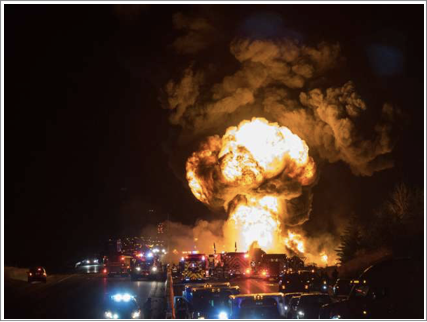
On  November 1, 2017 Canadians were horrified by news of a fiery crash involving tanker trucks and several cars on a highway north of Toronto, Ontario, that shocked first responders by its absolute devastation. 

Now consider this…

The Government of Canada has hired a multinational consortium of SNC Lavalin and two US based corporations to deal with several million tons of radioactive waste ultimately owned by the taxpayers of Canada. These wastes were created during seven decades of Canadian involvement in the production of nuclear weapons materials for the US, production of medical isotopes, and nuclear power research and development. The radioactive wastes are currently located in three provinces: Ontario, Quebec and Manitoba. 

The consortium plans to “consolidate” these wastes at Chalk River, Ontario, next to the Ottawa river which supplies drinking water to millions of people. 

This will require thousands of shipments of radioactive waste along Canadian roads from Pinawa, Manitoba, Douglas Point, Ontario and Gentilly, Quebec to Chalk River.  (See possible transport routes below)  

Radioactive waste is among the most toxic waste on earth…

Much of the federally owned radioactive waste is a result of “fissioning” of uranium in nuclear reactors. Hundreds of radioactive substances are produced by fissioning, almost none of which existed in nature prior to the creation of nuclear reactors. Individual radioactive substances vary greatly in the types of damaging radiation they give off and the length of time they remain hazardous, with some of them remaining lethal and carcinogenic for millions of years.  

All man-made radioactive substances can cause damage to human genetic material. They can cause birth defects, cancers, genetic damage and many diseases and disorders in humans, including their unborn children and their descendants, and in all other living things.  It is important to keep radioactive waste away from living things.

These radioactive waste shipments are already being transported through many Canadian cities and towns including Kenora, Thunder Bay, North Bay, Ottawa, Montreal and Trois Rivières, in simple ship-standard containers.

Municipalities and first responders have not been consulted or briefed about these shipments, putting them at risk should an accident occur in their territory.

A serious accident on any of these routes could result in widespread radioactive contamination of land, air, water bodies and communities.  A person in a car, sitting in trafficnext to a truck carrying a container full of radioactive waste could be receiving a dose of gamma radiation, which penetrates the walls of these containers.

Chalk River, Ontario, the final destination of these shipments, is a poor location for permanent storage of radioactive waste. It is located on a major earthquake fault line; the underlying bedrock is porous and fractured, and groundwater moves rapidly though the rock into the Ottawa River which is a source of drinking water for millions of Canadians downstream in Ottawa, Gatineau, Montreal and many other communities. 

Current facilities for waste storage at Chalk River are inadequate in the long-term, and a highly controversial planned new “radioactive waste mound” has been criticized extensively by independent scientists and does not comply with international safety standards. This raises the question of why these shipments of wastes are being allowed. The Crown Agency responsible for the nuclear waste, Atomic Energy Canada Limited (AECL), has given much freedom to the SNC-Lavalin consortium contractors to decide how they want to handle the waste.Risky in and of themselves, these shipments are contributing to making an already-existing problem of radioactive waste at Chalk River even worse.

Despite all of these concerns, shipments are already underway.

The photo below shows containers full of radioactive waste being piled up at “Waste Management Area H” at the Chalk River Labs site in Chalk River, Ontario. The lifespan of these containers is unknown. They are exposed to weather and therefore are likely to eventually corrode and deteriorate. Tornadoes also are known to affect the region and are occurring with increasing frequency and strength. The consortium says it can pile the containers five high and store close to 7,000 containers in this location. Each container contains roughly 10 tons of radioactive waste.  The photo below was part of a presentation to the Chalk River Labs Environmental Stewardship Council in March 2019.

Quick facts about low level waste

July 2019 (updated April 11, 2022)

The Chalk River Mound is a proposed above-ground landfill facility for more than one million tons of federally-owned “legacy” radioactive wastes. It would stand 5-7 stories high and be located on the side of a hill surrounded by wetlands, less that one kilometre from the Ottawa River.

It is often said that the Chalk River mound would “only contain low level waste”. It is incorrect to assume that this means the wastes and the mound would be innocuous and low risk. Here are some quick facts:

Low level does not mean low hazard. All categories of radioactive waste contain materials that emit ionizing radiation that can cause DNA damage, birth defects, leukaemia, cancer and chronic diseases. Low level waste is no exception to this.

Low level refers to how much protection a worker needs to handle the waste. Canada’s nuclear industry uses the terms “low”, “intermediate”, and “high” to designate short-term risks of waste handling by workers — not long-term risks of public exposure. “High-level waste” – irradiated nuclear fuel – gives off very intense heat and gamma radiation that can kill an exposed human in seconds. Such wastes must be handled remotely and workers must be shielded from the radiation. Workers must also be shielded from “intermediate-level waste” such as reactor parts, filters, resins, and solidified medical isotope waste. “Low-level waste” is a term for materials that pose risks with longer exposures, or that emit less penetrating forms of alpha and beta radiation. Alpha and beta emitters can be handled by workers without shielding but are highly dangerous if inhaled or ingested.

Many long-lived hazardous radioactive materials are destined for disposal in the mound. Radionuclides with half-lives* of up to billions of years would be disposed of in the mound. Over six metric tons of uranium-238, with a 4.5-billion-year half-life, are destined for disposal in the mound according to the environmental impact statement. More than six tonnes of Thorium-232 and significant quantities of man-made alpha emitters such as americium, neptunium, and plutonium are destined for the mound. In fact, five plutonium isotopes, including plutonium-239 with a 24,000-year half-life, are proposed for disposal. The waste inventory includes strontium-90 and cesium-137, with half-lives of around 30 years. It also includes large amounts of carbon-14, with a 5,700-year half-life. Carbon-14 is a “weak” beta emitter, but if inhaled or ingested it incorporates into human DNA and other biological molecules, where it persists for a longer period, and can cause biological damage.

Low level waste only refers to the radioactive portion of the materials destined for the mound. According to the environmental impact statement, many other toxic, hazardous and long-lived substances would go into the mound, including materials contaminated with PCBs, asbestos, arsenic, and mercury.

In many cases it may be impossible to separate low level from intermediate level waste. Canada’s legacy nuclear wastes are a complex mixture of hundreds of manmade radioactive substances created by nuclear fission. Nuclear weapons research at Chalk River generated a very wide range of wastes – far more complex than those from power reactors.  Wastes were not consistently analyzed over the years, and records prior to 1954 were lost.  Wastes were dumped in the sand, creating radioactive plumes of tritium, carbon-14 and strontium-90 that have contaminated large quantities of soil. A former AECL waste expert has warned that separating long-lived, higher-activity waste from short-lived, low-activity waste may be impossible. Shipping containers with building demolition debris from the Chalk River and Whiteshell Laboratories are being stacked near the mound site.  If the mound proposal is approved, these would be driven into the mound area and covered with contaminated soil. 

The mound would not contain and isolate waste. The Chalk River mound would fail to meet international safety standards that require that radioactive waste be kept out of the biosphere for the duration of its radiological hazard. Putting long-lived radioactive wastes on the surface increases risks of accidents and leaks during disposal operations and extreme weather events such as downbursts, tornadoes and extreme rainfall. Long-lived wastes would permanently contaminate the Ottawa River and expose large numbers of people to low levels of radiation over millennia. International safety standards require that these wastes be stored underground. Properly managing these wastes by packaging them, labelling and storing them underground in stable rock away from drinking water sources would create many long term well-paying jobs and establish Canadian leadership to deal with the global radioactive waste problem.

* The “half life” of a radionuclide is the period of time required for half of its atoms to disintegrate (explode) giving off harmful “atomic radiation”.  If you multiply the half-life by 10, that’s how long it takes for the amount of the radionuclide to be reduced by a factor of a thousand. 

Why it is imperative for nuclear reactors to undergo environmental assessment

WHY IT IS IMPERATIVE FOR NUCLEAR REACTORS TO UNDERGO ENVIRONMENTAL ASSESSMENT… (comments from Dr. Gordon Edwards, President, Canadian Coalition for Nuclear Responsibility, May 29, 2019)

“All nuclear reactors must be subject to environmental assessment without exception, given that all reactors (regardless of size) produce every category of human made radioactive waste materials — low-level, intermediate level and high-level — which if released to the environment can cause long-lasting damage due to radioactive contamination.

These materials are capable in principle of causing thousands to millions of human cancers if released through any means whatsoever.

Given that the world’s first major nuclear accident occurred in 1952 at the NRX reactor at Chalk River, a very small reactor producing only 10 to 20 megawatts of heat (and no electricity), and creating high-level radioactive waste (irradiated nuclear fuel) much of which is still on site, that will remain dangerous for hundreds of millennia, as well as highly radioactive structural materials (including the destroyed reactor vessel) that will remain radioactive for tens of thousands of years, it is clear that any reactor producing as little as 10 megawatts of heat can have extraordinary impacts on the environment.

Basic environmental justice demands that remote and indigenous communities that may be the intended recipients of such reactors must have the opportunity to question the plans and challenge the assumptions of the promoters, and educate themselves to the range of risks that they may be facing as well as the long-lived radioactive legacy that such a reactor will create.”

comments submitted by Dr. Gordon Edwards on the Draft project list and proposal to exempt most nuclear reactors from impact assessment. May 29, 2019

Comments may be submitted until Friday May 31, by registering and using the purple button to type your comments in the comment box on this webpage: https://www.impactassessmentregulations.ca/consultation-on-the-proposed-Project-List?preview=true

ACTION ALERT ~ Tell the federal government NOT to exempt nuclear reactors from impact assessment

**** if you have problems submitting comments to Environment Canada, send them directly to Catherine.McKenna@parl.gc.ca ****


The government of Canada is inviting comments on the “project list” for its new proposed and controversial Impact Assessment Act. The deadline for comments is Friday May 31, 2019.


This is important and will determine which nuclear projects are fully assessed as to potential impacts and which ones get a free pass, for years into the future.


Yielding to intense nuclear industry pressure, the government has exempted most nuclear reactors from the project list, meaning they will not have to undergo thorough impact assessment by an independent panel prior to licensing.


This is astounding, and very unwise. The new project list would allow so-called “small modular reactors” to be built anywhere in Canada without impact assessment. Consider that environmental contamination has still not been cleaned up from the 1952 partial meltdown of the NRX reactor (a very small reactor by today’s standards) at the Chalk River Laboratories. Radioactive wastes such as tritium, strontium-90 and carbon-14 are leaking into the Ottawa River from where the damaged reactor core is buried and liquid wastes from the accident were dumped.

 
Can you spare five minutes to tell the government NOT to exempt nuclear reactors from the Project List for Bill C-69? Here is a link to the webpage for submitting comments. You need to register but it just takes a minute to do so.


Your comment could be as simple as “Please do not exempt ANY nuclear reactors from the project list for the new impact assessment system”. You might add that every nuclear reactor has the potential to create devastating and deadly environmental damage. Of course you could say much more. There are other nuclear project exemptions that are problematic such as the ones for nuclear reactor decommissioning and transport of irradiated nuclear fuel and other high level radioactive wastes.


Please check out these links for background and additional information if you have more time and would like to know more:


1) Civil society groups condemn plan to exempt nuclear reactors from Bill C-69 impact assessment

2) Serious deficiencies in the Draft Project List for Bill C-69 create risks for Canadians ~ Draft CCRCA comments on the draft project list

3) Why it is imperative for all new nuclear reactors to undergo environmental assessment ~ Comments from Dr. Gordon Edwards, Canadian Coalition for Nuclear Responsibility

3) With Bill C-69, a weak environmental assessment system is about to get worse

CCRCA comments on draft project list for Bill C-69

see also comments by Dr. Gordon Edwards, President of the Canadian Coalition for Nuclear Responsibility here

Comments on the Discussion Paper on the Proposed Project List

Concerned Citizens of Renfrew County and Area (Ole Hendrickson)

May 29, 2019

The proposed new project list attempts to identify so-called “major” projects, or projects with “the greatest potential for adverse environmental effects.”  The list makes extensive use of the concept of “thresholds”.  Only projects that exceed a threshold would be assessed under the new Impact Assessment Act.  The discussion paper says that projects “below these thresholds will be considered by the other regulatory regimes.”  

However, even a small project, such as a uranium mine or a small nuclear reactor, can have significant adverse environmental effects on the community where it is located.  Furthermore, impact assessments differ from regulatory regimes by providing important features such as an early planning tool with public participation, and enhanced information access – features that are important for projects of any size.

Annex 1 of the discussion paper – entitled “What we heard when we consulted on the approach to creating a new project list” states the following:

Many commenters recommended against using thresholds at all or if thresholds were used, they should be precautionary for environmental protection and should be based on science and not practical considerations like the number of projects that might require assessment.  

However, the discussion paper provides no explanation of why these comments were rejected and thresholds were used.  It does not state whether thresholds were based on science, or if so, how they were determined.  These serious deficiencies in the discussion paper raise concerns about all the entries in the new project list.

Annex 2 of the discussion paper compares the proposed new project list to the current list.  It indicates that for many project types, thresholds for triggering an assessment have been increased.  For example, the length of a pipeline or the production capacity of a mine that would trigger assessment are increased with no justification.

In the absence of any justification for the use of thresholds, or any explanation for how thresholds were determined, use of thresholds in the proposed new project list should be rejected.  All federally-funded or federally-regulated projects, or projects taking place on federal land, have a potential to cause significant adverse environmental effects, and should receive at least a basic level of federal assessment.  Thresholds should not be used to allow smaller projects to proceed without assessment.

Specifically, with regard to the section of the project list dealing with nuclear activities:

1.  “The construction, operation and decommissioning of a new nuclear fission or fusion reactor”, which is on the current project list, should be retained on the new project list.

The current Regulations Designating Physical Activities (the “project list”) require assessment of any new nuclear reactor.  The Discussion Paper on the Proposed Project List proposes that a new nuclear reactor with a thermal capacity of less than 200 MW thermal capacity that is not on an existing nuclear site, or a new reactor with a thermal capacity of less than 900 MW on an existing site, be exempted from impact assessment.  

According to the discussion paper, the 200 MW “threshold” is intended to allow so-called “small modular reactors” to be built anywhere in Canada without impact assessment.  An accident in a nuclear reactor much smaller than 200 MW could have major adverse environmental and health effects.  Environmental contamination has still not been cleaned up from the 1952 partial meltdown of the NRX reactor (which was 10 MW thermal at the time) at the Chalk River Laboratories   Radioactive wastes such as tritium, strontium-90 and carbon-14 are leaking into the Ottawa River from where the damaged reactor core is buried and liquid wastes from the accident were dumped.  

Section 22(1)(a) of the new Impact Assessment Act  states that “The impact assessment of a designated project, whether it is conducted by the Agency or a review panel, must take into account… the effects of malfunctions or accidents that may occur in connection with the designated project.”  The current requirement to assess all new nuclear reactors should be retained on the project list.

2.  “The decommissioning, abandonment or refurbishment of a nuclear fission reactor” should be on the project list.

The Comprehensive Study Regulations, which applied to the pre-2012 version of the Canadian Environmental Assessment Act, required a comprehensive study assessment of decommissioning or abandonment of “a Class IA nuclear facility that is a nuclear fission reactor that has a production capacity of more than 25 MW (thermal).”  Decommissioning of smaller nuclear reactors, and of other class IA nuclear facilities, required at least a basic environmental screening before 2012.

Six nuclear power and research reactors built by the federal government in Manitoba, Ontario and Quebec are shut down and await decommissioning, as is the case for Hydro-Quebec’s Gentilly-2 reactor.  All six units at the Pickering Nuclear Generating Station are scheduled to be shut down by 2024.  Reactor decommissioning is major looming challenge for the federal government and for utilities.  It requires determination of a preferred “end state” for the reactor site (Will it be restored for general use?), assessment of radiation exposures to workers carrying out decommissioning operations, remediation of soil and groundwater contaminated by reactor leaks, and planning for long-term management of decommissioning wastes, among other issues.

Nuclear reactor “refurbishment” – removal and replacement of major components – also should trigger an assessment that includes consideration of issues such as alternatives to refurbishment (such as renewable energy sources or enhanced conservation initiatives), and planning for long-term waste management.

With a growing number of nuclear reactors awaiting decommissioning, and ongoing debates about refurbishment of currently operating nuclear reactors, nuclear reactor decommissioning and refurbishment should be added to the project list.

3.  “The transfer of irradiated fuel or other high-level waste for off-site reprocessing, storage or disposal” should be on the project list.

High-level irradiated fuel waste is accumulating at operating nuclear reactor sites. Considerable quantities are also found at shut-down reactors.  The federal government has contracted a private consortium that includes SNC Lavalin and two U.S. companies to operate federal nuclear reactor sites (Gentilly-1, Douglas Point, Whiteshell, Chalk River) where nuclear fuel waste is stored.  The consortium wants to “consolidate” all federal high-level at Chalk River Laboratories for temporary storage.  Fifty high-level waste shipments are proposed from Whiteshell alone.  

High-level radioactive waste transport on public highways, whether for temporary storage or permanent disposal, entails serious risks to the public in the event of an accident.  If high-level wastes are shipped to Chalk River for consolidation, they will later need to be shipped again to a geological repository at a site being studied by the Nuclear Waste Management Organization.  Waste consolidation increases handling, transport and accident risks. All proposed off-site transfers of irradiated fuel or other high-level wastes (including liquids) should be added to the project list.  This will allow assessment of alternatives such as leaving wastes where they are, or transferring them to alternative locations.

4. The current project list includes a “Facility for the processing, reprocessing or separation of an isotope of uranium, thorium, or plutonium, with a production capacity of 100 t/year or more.” Separate listings should be made for processing, reprocessing, and isotope separation, and the 100-tonne threshold should be eliminated.

This current wording is problematic and confusing.  Each of these activities should be defined, and the end products of these activities should be described.  No justification is given for the 100-tonne threshold.  Separation of far smaller quantities of uranium or plutonium isotopes would create unacceptable risks of nuclear weapons proliferation.

Reprocessing traditionally refers to the chemical separation (extraction) of fissile and/or fertile material from irradiated nuclear fuel.  New reprocessing concepts would involve insertion of irradiated nuclear fuel into another reactor without actually separating the fissile or fertile materials.  Both types of “reprocessing” involve the release of fission gases and the handling of intensely radioactive irradiated nuclear fuel.  Environmental assessment should be required.

With regard to separation of isotopes, this is highly sensitive technology used to make nuclear bombs.  Uranium enrichment has never been carried out in Canada.  This activity should be listed separately, with no threshold

Unlike “reprocessing” and “isotope separation”, uranium processing is a purely chemical process.  It involves the generation of end products that can be used either for reactor fuel or further processed into nuclear weapons materials.  It generates wastes that are long-lived and pose serious health risks.  It also requires a separate listing, and any new processing facility should be assessed.

5. Any new uranium mine or mill should be on the project list, and any expansion of more than 50% in the production capacity of an existing uranium mine or mill should be on the project list.

The current project list has the following entries:  “Uranium mine or uranium mill on a site that is not within the licensed boundaries of an existing uranium mine or uranium mill;” and “Expansion of an existing uranium mine that would result in an increase in the area of mine operations of 50% or more.”  The discussion paper proposes to add a new 2,500 tonne per day production capacity threshold below which no assessment would be done; either for a new mine or mill, or for an expanded mine or mill.  

Even small uranium mines and mills can have significant adverse environmental effects.  Waste management and environmental remediation are important considerations, as well as potential adverse effects on local communities. No justification is provided for the proposed new 2,500 tonne per day threshold.  It should be rejected.  
Parliament should investigate what Canadians have gotten for their nuclear waste funding (online version)

Online version of letter to the editor in the Hill Times

May. 27, 2019

Natural Resources Minister Amarjeet Sohi is in charge of Canada’s Radioactive Waste Policy Framework, a policy that his predecessor, Jim Carr, said does not cover the long-term management of non-fuel radioactive waste. The Hill Times photograph by Andrew Meade

On April 29, 23 civil society groups and a First Nations alliance published a joint statement in The Hill Times expressing concerns about the alarming manner in which federally-owned radioactive waste is being handled by a multinational consortium of SNC-Lavalin and two U.S.-based corporations.

It is disturbing that the president of Atomic Energy of Canada Limited (AECL), himself an American and former executive from one of SNC-Lavalin’s original consortium partners, now accuses the authors of spreading “inaccuracies”—“misleading and incorrect” information that, “distorts” the truth—without citing a single example, (The Hill Times, May 13.)

The endorsing organizations stand behind every point raised in their joint statement. Any one of those concerns provides enough reason for the prime minister, Parliament and the federal government to change the current approach to the handling of long-lived radioactive wastes in Canada—a toxic liability estimated at $7.9-billion by the auditor general. Each concern is legitimate, well-founded and echoed by many others: independent scientists, municipalities and concerned citizens, including fifteen former AECL managers and scientists.

AECL has received more than $3-billion of taxpayers’ money in the past three federal budgets, handing most of that money over to the private consortium. The 2019-2020 budget alone has $737-million earmarked for radioactive waste management and decommissioning at federally-owned sites, a significant increase since the 2015 government-owned, contractor-operated (“GoCo”) private contracting model was brought in by the Harper government.

We call on Parliament to investigate whether this funding has translated into significant reductions in federal radioactive waste liabilities, and whether taxpayers are receiving real long-term value for the money being spent.

The consortium’s plan to erect a gigantic surface mound containing over one million tonnes of mixed radioactive wastes, seven stories high and 11 hectares in area, just one kilometre from the Ottawa River, is shocking. This proposal flouts international guidance and is opposed by 140 downstream municipalities that use the river for drinking water, including Gatineau and the Montreal Metropolitan Community.

Equally troubling is the consortium’s plan to “entomb” two contaminated nuclear reactors in cement right beside the Ottawa and Winnipeg Rivers. Far from being a “modern solution,” as the AECL head claims, the International Atomic Energy Agency states that “entombment is not considered an acceptable strategy” unless exceptional circumstances prevail, such as a core meltdown—and even then alternatives should be explored.

We are concerned by the absence of any adequate federal policy or regulations specifically for reactor decommissioning and radioactive waste management (other than irradiated nuclear fuel). Canada’s sole policy document, a 143-word “Radioactive Waste Policy Framework” lacks substantive content and fails to meet minimal international requirements. Minister of Natural Resources Jim Carr wrote in July 2018, “Canada does not yet have a federal policy for the long-term management of non-fuel radioactive waste.”

These wastes are the sole responsibility of the government of Canada. Roughly half of them were generated during the development of the atomic bomb and the subsequent Cold War buildup of American nuclear weapons. Now is the time for our government to take a serious, direct proprietary interest in these wastes, to ensure the protection of current and future generations of Canadians from the health risks of exposure to dangerous long-lived radioactive materials, risks that include genetic damage, chronic diseases, birth defects and cancer.

Canada’s radioactive waste legacy has been growing for over 70 years; the hazard will last for tens of thousands of years; the problem cannot be dealt with “quickly and cheaply”.

We repeat our call to end the “Go-Co” contract with SNC-Lavalin and its partners, and to consult First Nations and other Canadians with a view to formulating exemplary polices and projects for radioactive waste that meet and exceed our international obligations. We believe these wastes must be safely secured in state-of-the art facilities well away from sources of drinking water, packaged and labeled in such a way as to enable future generations to monitor, retrieve, repair, and repackage such wastes if and when the need arises. We urge that the import, export, and transport of radioactive waste not be allowed without full consultation with affected communities and careful consideration of alternatives.

Such actions will begin to re-establish Canadian leadership in the nuclear field by addressing the growing global radioactive waste problem in a responsible manner while creating many long-term, well-paying Canadian jobs.

Gordon Edwards

President

Canadian Coalition for Nuclear Responsibility

Montreal, Que.

Parliament should investigate what Canadians are getting for their nuclear waste funding ~ letter to the editor of the Hill Times (print edition)

For an easier to read version, see below.

On April 29, twenty-three civil society groups and a First Nations alliance published a joint statement in the Hill Times expressing concerns about the alarming manner in which federally-owned radioactive waste is being handled by a multinational consortium of SNC-Lavalin and two US-based corporations.

It is disturbing that the President of Atomic Energy of Canada Limited (AECL), himself an American and former executive from one of SNC-Lavalin’s original consortium partners, now accuses the authors of spreading “inaccuracies” – “misleading and incorrect” information that “distorts” the truth – without citing a single example. (Letter, Hill Times, May 13)

The endorsing organizations stand behind every point raised in their joint statement. Any one of those concerns provides enough reason for the Prime Minister, Parliament and the Federal Government to change the current approach to the handling of long-lived radioactive wastes in Canada – a toxic liability estimated at $7.9 billion by the Auditor General. Each concern is legitimate, well-founded and echoed by many others: independent scientists, municipalities and concerned citizens, including fifteen former AECL managers and scientists

AECL has received over $3 billion of taxpayers’ money in the past three federal budgets, handing most of that money over to the private consortium.The 2019-2020 budget alone has $737 million earmarked for radioactive waste management and decommissioning at federally-owned sites, a significant increase since the 2015 Government-owned, Contractor-operated (“GoCo”) private contracting model was brought in by the Harper government. 

We call on Parliament to investigate whether this funding has translated into significant reductions in federal radioactive waste liabilities, and whether taxpayers are receiving real long-term value for the money being spent.

The consortium’s plan to erect a gigantic surface mound containing over one million tonnes of mixed radioactive wastes, seven stories high and 11 hectares in area, just one kilometre from the Ottawa River, is shocking. This proposal flouts international guidance and is opposed by 140 downstream municipalities that use the river for drinking water, including Gatineau and the Montreal Metropolitan Community. 

Equally troubling is the consortium’s plan to “entomb” two contaminated nuclear reactors in cement right beside the Ottawa and Winnipeg Rivers. Far from being a “modern solution”, as the AECL head claims, the International Atomic Energy Agency states that “entombment is not considered an acceptable strategy” unless exceptional circumstances prevail, such as a core meltdown – and even then alternatives should be explored.

We are concerned by the absence of any adequate federal policy or regulations specifically for reactor decommissioning and radioactive waste management (other than irradiated nuclear fuel). Canada’s sole policy document, a 143-word “Radioactive Waste Policy Framework” lacks substantive content and fails to meet minimal international requirements. Minister of Natural Resources Jim Carr wrote in July 2018, “Canada does not yet have a federal policy for the long-term management of non-fuel radioactive waste.”

These wastes are the sole responsibility of the government of Canada. Roughly half of them were generated during the development of the atomic bomb and the subsequent Cold War buildup of American nuclear weapons. Now is the time for our government to take a serious, direct proprietary interest in these wastes, to ensure the protection of current and future generations of Canadians from the health risks of exposure to dangerous long-lived radioactive materials, risks that include genetic damage, chronic diseases, birth defects and cancer.

Canada’s radioactive waste legacy has been growing for over 70 years; the hazard will last for tens of thousands of years; the problem cannot be dealt with “quickly and cheaply”.

We repeat our call to end the “Go-Co” contract with SNC-Lavalin and its partners, and to consult First Nations and other Canadians with a view to formulating exemplary polices and projects for radioactive waste that meet and exceed our international obligations. We believe these wastes must be safely secured in state-of-the art facilities well away from sources of drinking water, packaged and labeled in such a way as to enable future generations to monitor, retrieve, repair, and repackage such wastes if and when the need arises. We urge that the import, export and transport of radioactive waste not be allowed without full consultation with affected communities and careful consideration of alternatives. 

Such actions will begin to re-establish Canadian leadership in the nuclear field by addressing the growing global radioactive waste problem in a responsible manner while creating many long-term, well-paying Canadian jobs.

Gordon Edwards, President,

Canadian Coalition for Nuclear Responsibility.

Des groupes citoyens dénoncent le projet d’exempter certains réacteurs nucléaires de l’évaluation d’impact du projet de loi C-69

Ottawa, le 7 mai 2019 – Le gouvernement du Canada veut exclure plusieurs réacteurs nucléaires de la « liste des projets désignés » qui devront subir une évaluation environnementale en vertu du projet de loi C-69, la Loi sur l’évaluation d’impact. Des groupes de la société civile dénoncent cette exemption et exigent que tous les nouveaux réacteurs nucléaires subissent une évaluation environnementale formelle, comme c’est déjà le cas maintenant.

Le document de travail du gouvernement fédéral, publié le 1er mai, propose de soustraire à la Loi sur l’évaluation d’impact tous les réacteurs nucléaires qui produiraient moins de 200 mégawatts de puissance thermique, de même que les réacteurs nucléaires qui produiraient jusqu’à 900 mégawatts de puissance thermique, et qui seraient construits sur des sites nucléaires existants. 

« Ces exclusions de l’évaluation d’impact signifient qu’il n’y aurait aucune évaluation préalable crédible, dans une perspective de développement durable, des impacts environnementaux, sanitaires, économiques ou sociaux des projets d’énergie nucléaire, qu’ils soient nouveaux, agrandis ou en réfection », déclare Theresa McClenaghan, directrice exécutive et conseillère pour l’Association canadienne du droit de l’environnement. « À notre avis, donner à l’industrie nucléaire le droit de contourner les dispositions de la Loi sur l’évaluation d’impact est l’antithèse d’une planification environnementale judicieuse et prudente, et le Parlement ne devrait jamais approuver cela. » 

 « Il est choquant de constater que le gouvernement fédéral prévoit que les projets nucléaires se feront sans évaluation d’impact », déclare Ole Hendrickson, scientifique à la retraite d’Environnement Canada et membre du conseil d’administration de la Fondation Sierra Club Canada. Cela pourrait profiter à l’industrie nucléaire, mais aux dépens de l’environnement, de la santé, de la sécurité publique et des droits des communautés autochtones. »

Dans le cadre d’une conférence de l’industrie nucléaire qui se tenait à Ottawa en novembre dernier, le ministre fédéral des Ressources naturelles, Amarjeet Sohi, a présenté une « feuille de route » qui prévoyait la construction de petits réacteurs modulaires (PRM) dans les communautés autochtones et nordiques ainsi que dans des sites miniers isolés au Canada. Les recommandations de la feuille de route incluaient des commentaires à l’effet que les PRM devraient être exemptés du projet de loi C-69.

Le document de travail sur le règlement d’application du projet de loi C-69 affirme que les effets des PRM sont « bien connus » car ils « partagent certaines des caractéristiques principales de la technologie des réacteurs classiques ». Cependant, tous les PRM proposés utiliseraient de nouvelles conceptions et des technologies non testées, parfois avec des réfrigérants à base de métaux liquides et de sels fondus qui ont provoqué des accidents graves dans les premiers réacteurs prototypes; certains PRM seraient alimentés avec des combustibles controversés jamais autorisés commercialement ou avec du plutonium, du thorium ou de l’uranium enrichi.

« Les personnes qui vivent dans les communautés nordiques et autochtones, où l’industrie nucléaire veut construire ces réacteurs, ont le droit de connaître les risques », déclare Ole Hendrickson. « Il est essentiel d’avoir une évaluation d’impact formelle, avec accès public à l’information, pour identifier ces risques, notamment les émissions radioactives et la contamination à long terme du sol et des eaux souterraines, causées entre autres par un mauvais fonctionnement ou par des accidents ».

L’évaluation d’impact des PRM a attiré l’attention des médias en novembre dernier quand ils ont révélé que la Commission canadienne de la sûreté nucléaire (CCSN), l’organisme de réglementation nucléaire du Canada, faisait secrètement pression pour que le gouvernement exempte les PRM de toute évaluation environnementale. Le Globe and Mail a dévoilé que la CCSN avait incité le gouvernement à exclure les PRM de la liste des projets désignés (voir Federal nuclear regulator urges Liberals to exempt smaller reactors from full panel review, le 6 novembre 2018).

Le document de travail exclut aussi la démolition des réacteurs et des installations nucléaires de la liste des projets désignés en vertu du projet de loi C-69. Cette démolition inclut le nettoyage, le démantèlement et l’enlèvement des installations nucléaires contaminées, le stockage des déchets radioactifs qui en résultent et la restauration des sites nucléaires pour en permettre un usage public. On le fait sans égard aux risques environnementaux de ces activités ni aux demandes des communautés hôtes.  

La réhabilitation des sites nucléaires contaminés, les nouvelles installations de stockage de déchets radioactifs sur les sites nucléaires existants et le transport des déchets nucléaires ne sont pas non plus désignés pour une évaluation d’impact dans le document de travail.

Le gouvernement fédéral donne aux Canadiens jusqu’au 31 mai pour soumettre leurs commentaires sur le document de travail concernant la liste des projets désignés dans le projet de loi C-69. Se référer à l’adresse web suivante : https://www.evaluationsimpactsreglements.ca/

À propos de la Fondation Sierra Club Canada 

La Fondation Sierra Club Canada est une organisation nationale ouverte à tous, à but non lucratif, qui a pour mission de donner aux gens les moyens de protéger, de restaurer et de profiter d’une planète saine et sûre.

À propos du Ralliement contre la pollution radioactive (RCPR)

Le RCPR a comme mission d’agir bénévolement et collectivement pour favoriser des solutions responsables de gestion des déchets radioactifs qui soient sans risque pour l’environnement et pour la santé de la population.

À propos des Concerned Citizens of Renfrew County and Area (CCRCA)

Le regroupement CCRCA a été fondé en 1978 pour faire des investigations et intervenir concernant les déchets nucléaires et d’autres problèmes de pollution dans l’Est de l’Ontario et dans le bassin versant de la rivière des Outaouais. Le groupe travaille avec d’autres groupes de la société civile pour promouvoir une gestion responsable des déchets radioactifs et la protection de l’environnement.

À propos du Regroupement pour la surveillance du nucléaire (RSN) 

Le RSN est un organisme sans but lucratif, incorporé auprès du gouvernement fédéral en 1978. Il est voué à l’éducation et à la recherche concernant toutes les questions qui touchent à l’énergie nucléaire, qu’elles soient civiles ou militaires, et tout particulièrement celles concernant le Canada.

À propos de l’Association canadienne du droit de l’environnement (CELA)

CELA est un groupe de droit d’intérêt public créé en 1970 dans le but d’utiliser et d’améliorer les lois existantes pour préserver l’environnement et protéger la santé humaine. Les avocats de CELA plaident pour les communautés vulnérables à faible revenu devant les cours de justice et les tribunaux pour adresser une grande variété de problèmes liés à l’environnement et à la santé publique.

– 30 –

Contacts pour les médias

Theresa McClenaghan
Directrice exécutive et conseillère pour l’Association canadienne du droit de l’environnement 

theresa@cela.ca

416-960-2284 ext.7219

Lynn Jones
Concerned Citizens of Renfrew County and Area
hendrickson.jones@gmail.com 

613-234-0578

Ginette Charbonneau 

Porte-parole du Ralliement contre la pollution radioactive

ginettech@hotmail.ca
514-246-6439

Civil society groups condemn plan to exempt nuclear reactors from Bill C-69 impact assessment

FOR IMMEDIATE RELEASE

Ottawa, May 7, 2019 — The Government of Canada is proposing that the “project list” for Bill C-69, the Impact Assessment Act, exempt many nuclear reactors from any environmental assessment.  Civil society groups are condemning the exemption from environmental assessment under Bill C-69 and demanding that all new nuclear reactors be subjected to formal environmental assessment, as is now the case.

The federal government’s discussion paper, released on May 1, proposes that all nuclear reactors that produce less than 200 megawatts of thermal power be excluded from the Impact Assessment Act, as well as nuclear reactors built on existing nuclear sites that produce up to 900 megawatts of thermal power. 

“Excluding nuclear energy projects from impact assessment means there will be no credible sustainability-based assessment of the environmental, health, economic or social impacts of new, expanded or refurbished nuclear energy projects before they proceed,” says Theresa McClenaghan, Executive Director and Counsel for the Canadian Environmental Law Association. “In our view, giving the nuclear power industry a free pass under the Impact Assessment Act is the antithesis of sound and precautionary environmental planning, and should not be countenanced by Parliament.” 

“It is shocking that the federal government expects nuclear projects to go ahead with no impact assessment,” says Dr. Ole Hendrickson, a retired Environment Canada scientist and board member of Sierra Club Canada Foundation. “This may benefit the nuclear industry, but at the expense of the environment, public health and safety and the rights of Indigenous communities.”

In November, federal Minister of Natural Resources Amarjeet Sohi launched a “roadmap” at a nuclear industry conference in Ottawa that outlines plans to build Small Modular Reactors (SMRs) in Indigenous and northern communities and at remote mining sites across Canada. The Roadmap’s recommendations included comments suggesting that SMRs should be exempted from Bill C-69. 

The discussion paper for Bill C-69 regulations says that the effects from SMRs are “well known” and “share core characteristics” with existing conventional reactor technology. However, all proposed SMRs would employ new and untested designs, or technologies, some involving liquid metal and molten salt coolants that caused serious accidents in early prototype reactors, and some using controversial fuels never commercially allowed in Canada before, based on plutonium, thorium, or enriched uranium. 

“People in northern and Indigenous communities where the nuclear industry wants to build these reactors have a right to know what the risks are,” says Hendrickson. “A formal impact assessment with public disclosure is essential to identify these risks, including radioactive emissions and long-lasting contamination of soil and groundwater, especially due to malfunctions or accidents.”

Impact assessment of SMRs became a focus of media attention last November when it was revealed that Canada’s nuclear regulator, the Canadian Nuclear Safety Commission (CNSC), had been secretly lobbying the Government for the reactors to be exempted from environmental assessment. The Globe and Mail reported that CNSC encouraged the government to exempt small modular reactors from the list of designated projects (see Federal nuclear regulator urges Liberals to exempt smaller reactors from full panel review – November 6, 2018).

The discussion paper also does not include decommissioning of nuclear reactors and facilities on the project list for Bill C-69.   Decommissioning includes cleaning up, dismantling and removing contaminated nuclear facilities; storing the resulting radioactive waste; and returning the nuclear sites back to public use. This is despite the environmental risks of these activities and direct requests from host communities.  

Remediation of contaminated nuclear sites, new radioactive waste storage facilities at existing nuclear sites, and nuclear waste transport are also not identified for impact assessment in the discussion paper.

The federal government is giving Canadians until May 31 to submit comments on the discussion paper regarding the Bill C-69 Project List at the following address: impactassessmentregulations.ca    

ABOUT CCRCA

The Concerned Citizens of Renfrew County and Area was formed in 1978 to research and advocate about nuclear waste and other pollution issues in Eastern Ontario and the Ottawa River watershed. The group works closely with other civil society groups to promote responsible management of radioactive wastes and protection of the environment.

ABOUT CCNR
The Canadian Coalition for Nuclear Responsibility is a not-for-profit organization, federally incorporated since 1978, dedicated to education and research on all issues related to nuclear energy, whether civilian or military, especially those pertaining to Canada.

ABOUT SIERRA CLUB CANADA FOUNDATION

Sierra Club Canada Foundation is a national and grassroots non-profit organization committed to empowering people to protect, restore and enjoy a healthy and safe planet.

ABOUT RALLIEMENT CONTRE LA POLLUTION RADIOACTIVE

The mission of the Ralliement contre la pollution radioactive (RCPR) is to act voluntarily and collectively to promote responsible solutions for the management of radioactive waste that are safe for the environment and for the health of the population.

ABOUT CELA

The Canadian Environmental Law Association is a public interest law group founded in 1970 for the purposes of using and enhancing environmental laws to protect the environment and safeguard human health. CELA lawyers represent low-income and vulnerable communities in the courts and before tribunals on a wide variety of environmental and public health issues.   

– 30 –

Media contacts:

Theresa McClenaghan
Executive Director and Counsel, 

Canadian Environmental Law Association

theresa@cela.ca

416-960-2284 ext.7219

Lynn Jones 

(to arrange an interview with Dr. Ole Hendrickson of SCCF or Dr. Gordon Edwards of CCNR)
Concerned Citizens of Renfrew County and Area
hendrickson.jones@gmail.com 
613-234-0578

Ginette Charbonneau

Ralliement contre la pollution radioactive

ginettech@hotmail.ca

514-246-6439

2000 nuclear waste shipments planned, from Pinawa Manitoba to Chalk River, Ontario

This is page 41 of the application for renewal of the Whiteshell Labs license. The CNSC hearing for this license renewal is scheduled for October 2-3, 2019. This page outlines CNL’s plans for transport of low, intermediate and high level radioactive waste from Pinawa, Manitoba to Chalk River, Ontario. The full license application can be viewed at http://www.cnl.ca/en/home/about/WLSiteRelicensing2018.aspx

A total of 2,000 shipments are described in this excerpt, including shipments of liquid waste and irradiated nuclear fuel rods. Shipments are already underway as of March, 2019.