Five good reasons to support the City of Ottawa’s call for an assessment of Ottawa Valley radioactive disposal projects

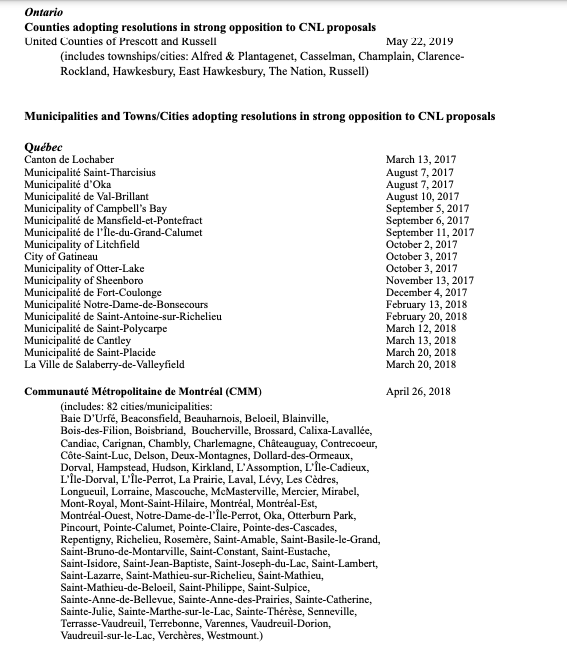
On April 14, 2021 the City of Ottawa council passed a resolution of concern about the Chalk River and Rolphton radioactive waste disposal projects, joining more than 140 municipalities, the Anishinabek Nation and Iroquois Caucus, and the Assembly of First Nations.

Prior to being passed by the full Ottawa City Council, the resolution was studied and passed unanimously by the City’s environment committee after an eight hour meeting on March 30, 2021 which can be viewed here. Among other things, the resolution calls on the Minister of Environment and Climate Change to initiate a regional assessment of Ottawa Valley radioactive disposal projects under the Impact Assessment Act of 2019.  (See Mayor Jim Watson’s letter to Minister Wilkinson here.)

Here are five reasons to support the City of Ottawa’s call to Minister Jonathan Wilkinson:

1. Radioactive waste in the Ottawa Valley is a very large and complex problem. It makes up the lion’s share of federally-owned “legacy” radioactive wastes, an $8 billion liability for the citizens of Canada.

The radioactive wastes currently on site at the Chalk River Laboratories, upstream of Ottawa-Gatineau, make up most of the Government of Canada’s eight billion dollar nuclear liability. This federal radioactive cleanup liability exceeds the sum total of 2000 other federal environmental liabilities . As Canada’s largest and most complex federal environmental liability, this challenge is worthy of the best and most thorough assessment available under the new Impact Assessment Act.

2. Proposed Ottawa Valley radioactive disposal projects are substandard, highly controversial, and would NOT address many parts of the needed cleanup.

The proposed Chalk River Mound (“Near Surface Disposal Facility”) and Rolphton Reactor Tomb (“NPD Closure Project”) are low budget, inadequate proposals meant to quickly and cheaply reduce Canada’s federal nuclear liabilities. The two projects were proposed five years ago by a consortium of private companies contracted by the Harper government in 2015. The proposals ignore safety standards of the International Atomic Energy Agency and have been found wanting in thousands of critical comments submitted by Indigenous communities, municipalities, former AECL scientists and managers, NGOs, citizens’ groups and individuals.

The projects are expected to leak radioactive contaminants into the Ottawa River for millennia, according to Environmental Impact Statements produced by the proponent. The giant Chalk River Mound is expected to disintegrate as part of a process of “normal evolution” according to the proponent’s “performance assessment” study.

The vast majority of radioactive wastes in the Ottawa Valley would NOT be addressed by these two projects.

3. Environmental assessments of the giant mound and reactor tomb are being badly fumbled.

The environmental assessments of the NSDF and NPD closure projects were initiated in 2016 by the Canadian Nuclear Safety Commission. Numerous problems with the CNSC’s handling of the EAs were identified in Environmental Petition 413 to the Auditor General of Canada in January 2018. Problems have continued to arise including lack of opportunity for public input, lack of transparency, and lack of firm deadlines for completion of the assessments. The EAs have been ongoing for far longer than is normal or reasonable for such assessments.

The Canadian Nuclear Safety Commission has been identified as a captured regulator that promotes the projects it is supposed to regulate. The CNSC is therefore not an ideal agency to be overseeing assessments of radioactive disposal projects in the Ottawa Valley.

4. The complex challenge of nuclear waste in the Ottawa Valley is NOT addressed by the assessments that are currently ongoing.

Again, the eight billion dollar federal radioactive cleanup liability is the biggest and most expensive federal environmental challenge by far. The vast majority of the wastes comprising this liability are already in the Ottawa Valley at the Chalk River Laboratories. For an indication of the complexity of this challenge at Chalk River see the Ottawa Citizen article by Ian McLeod, Chalk River’s Toxic Legacy. Radioactive wastes not addressed by the mound and the tomb proposals include the three reactor cores dumped in the sand at Chalk River (including one from the 1952 NRX partial meltdown), the highly radioactive solidified medical isotope production wastes (including weapons-grade uranium-235), the tanks of intermediate- and high-activity liquid wastes at the ‘Waste Tank Farm”, the spent fuel from the NRX, NRU and NPD reactors, and the NRX and NRU reactors themselves.

The private sector consortium running Canadian Nuclear Laboratories plans to consolidate the federal governments’s radioactive waste from across Canada in the Ottawa Valley and is already shipping radioactive wastes from Manitoba, Quebec and elsewhere in Ontario to Chalk River. There are serious concerns about consolidating federal nuclear wastes at the Chalk River site, in a seismically-active area, beside a major river (The Kitchissippi/ Ottawa) that provides drinking water for millions of Canadians. Serious concerns about long term storage of radioactive waste in close proximity to water bodies are noted in the Joint Declaration of the Anishinabek Nation Iroquois Caucus on transport and abandonment of radioactive waste. Consolidation of federal government nuclear wastes in the Ottawa Valley and First Nations’ guidance to store waste away from major water bodies are not addressed by the current NSDF and NPD environmental assessments.

CCRCA recently learned that the consortium is going ahead with radioactive waste projects such as a new cask facility to receive shipments of highly-radioactive spent fuel from the Whiteshell (MB) and Gentilly-1 (QC) reactors, and a new intermediate-level waste storage facility that would likely contain dangerous commercial wastes. The consortium is making determinations about the significance of the impacts of these projects on behalf of Atomic Energy of Canada (AECL) with no transparency or public input. Assessment of the risks and implications of these projects should be done through a transparent public process. AECL, which has been reduced from thousands of employees to around 40, appears to be shirking its role of overseeing its contract with the consortium. 

The cumulative impacts of all wastes and all current and future projects need to be considered together. A regional assessment could do this.

5. A regional assessment of radioactive waste disposal in the Ottawa Valley could address all problems noted above.

A regional assessment could:

  • make existing baseline data publicly accessible and produce a broad-based analysis of the problem
  • look at cumulative impacts of all the current and proposed management strategies for Ottawa Valley radioactive wastes, and transport of wastes from Manitoba, southern Ontario and Quebec to Chalk River.
  • address leaking waste management areas at the Chalk River Labs, radioactive waste imports to the Ottawa Valley and the potential creation of new wastes associated with the proposed new “small modular” reactor research and development
  • incorporate Indigenous knowledge and priorities
  • look at the big picture including the need to protect drinking water, property values and tourism and provide secure long-term employment opportunities for Ottawa Valley communities.
  • provide assurance to the federal government and other levels of government that the largest federal environmental cleanup liability is being properly addressed.


To support the City of Ottawa’s call, please consider writing to the Minister of Environment and Climate Change Canada  For your reference, Mayor Jim Watson’s letter to Minister Wilkinson is available for download here.

Letters should be sent to The Honourable Jonathan Wilkinson <Jonathan.Wilkinson@parl.gc.ca>

with cc to: OttawaValley-ValleeOutaouais (IAAC/AEIC) <iaac.ottawavalley-valleeoutaouais.aeic@canada.ca> Please be sure to state that you letter is Re: Canadian Impact Assessment Registry reference number 81624, “Potential regional assessment of radioactive waste disposal in the Ottawa Valley”

and: your member of parliament. Please forward a copy of your letter to us at <concernedcitizensofrca@gmail.com>

The Minister is required to respond to Ottawa’s request by July 31, 2021, so send your letters as soon as possible. But don’t hesitate to send them after July 31st too, as this issue is not going away any time soon.

Debunking myths about the Chalk River Mound (aka “NSDF”)

The Chalk River Mound or “near surface disposal facility” is a proposed giant above ground landfill for one million tons of radioactive waste on the property of Canadian Nuclear Labs, less than one kilometre from the Ottawa River upstream of Ottawa-Gatineau and Montreal. We debunk below two of the most misleading myths about the proposed facility. Please contact us if you need more references for the material presented below, or browse our list of all posts for more information.

Myth # 1: It’s only “low level waste”


“Low level” in the context of radioactive waste does not mean “low hazard”

This is a really big mistake that almost everyone makes. “Low level” simply means the wastes can be handled by nuclear industry workers without the use of lead shielding because the wastes give off relatively low levels of gamma radiation. But they can and do contain high levels of other types of radiation such as “alpha” and “beta.”  “Low level” radioactive waste can remain hazardous for hundreds of thousands of years and includes some of the most toxic radioactive poisons known such as plutonium.

No “Intermediate waste” in the NSDF is a red herring.
Neither “Low level” OR “Intermediate level” radioactive wastes are supposed to be disposed of in above-ground engineered mounds (landfills) according to the International Atomic Energy Agency. That is because both categories are dangerous and pose risks to all life on earth for the duration of their radiological hazard, which is hundreds of thousands of years for BOTH CATEGORIES of waste.  The main thing that distinguishes “Low level” from “intermediate level” radioactive waste is that “low level” can be handled without shielding or robots because its risks come from inhalation or ingestion. “Intermediate level” waste on the other hand gives off strong gamma radiation and therefore requires lead shielding and/or remote handling.

Much of the legacy waste at the Chalk River site is a poorly characterized or uncharacterized MIXTURE of “low” and “intermediate” level wastes.
The dividing lines between the categories are blurry. There are many different definitions around the world. Canada’s definitions are inferior to those in other countries. The wastes are not all sitting around in nice neat packages labelled “low level” and “intermediate level”. It would be the work of decades to properly categorize, package and label all the legacy wastes, and arguably, this should be done before choosing technologies for managing the wastes. We are in touch with a former engineer at AECL who was in charge of waste characterization for decades and worked as a consultant for the IAEA. He says the knowledge level of legacy wastes at Chalk River was and likely still is “abysmal”.

The proponent is playing games with Waste Acceptance Criteria to enable maximum disposal of legacy wastes in the NSDF
Definitions are being finagled to enable claims that “only” low-level wastes would go in the facility.  Canada’s nuclear regulator, the Canadian Nuclear Safety Commission, allows proponents to make up their own definitions of waste classes.  The NSDF proponent defines wastes with long-lived beta/gamma activity as high as ten thousand radioactive disintegrations per second per gram of waste (Bq/g) as “low level”.  Finland puts any waste with activity greater than one hundred Bq/g in an underground facility, 65-90 meters deep in crystalline rock.5.

The proponent’s contract with Atomic Energy of Canada states that it will dispose of ALL wastes quickly and cheaply.
The main objective of the GoCo contract was to reduce Canada’s legacy radioactive waste liabilities. The ONLY strategies being advanced by the consortium are the above ground engineered mound (landfill) and in-situ burial of reactors on the Ottawa and Winnipeg rivers.  Thus, the contract provides a strong incentive for the consortium to dispose of uncharacterized legacy wastes in the NSDF since it’s the only project on the table.

Myth #2: It’s a “sound project from an engineering point of view.”

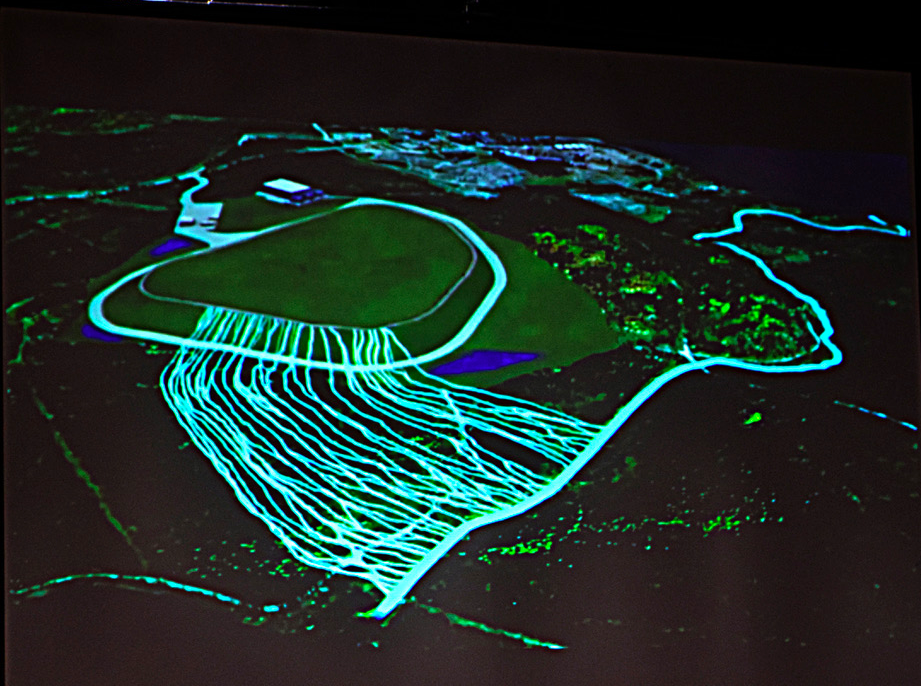
The engineered containment mound is expected to disintegrate within a few hundred years and the contents flow out of the mound into the surrounding wetlands that drain into the Ottawa River. The NSDF draft environmental impact statement includes 25 occurrences of the phrase “liner and cover failure as a result of normal evolution” and three occurrences of the phrase “inevitable failure of the cover.”  The “bathtub scenario” is mentioned 30 times in the draft EIS. It is projected to occur in the year 2400 when the cover fails, water enters the mound and overflows, and takes contaminants into Perch Creek and the Ottawa River. The Performance Assessment for the NSDF includes a graphic illustration of the bathtub scenario, a table listing quantities of radionuclides flowing out of the mound into the Ottawa River, and a pie chart showing estimated doses of various radionuclides to an infant downstream in Pembroke. Given the expected eventual disintegration of the mound and migration of its contents into the Ottawa River, it would seem to be inappropriate to refer to the project as “a sound proposal from an engineering point of view.” 

The image below is a simulation of the “bathtub effect” from the Radio Canada Decouverte documentary “Chalk River Heritage.”

Updated list of First Nations and Municipal Resolutions against the CNL’s current plans for nuclear waste dumps

May 27, 2021

Newer updated post on this here: https://concernedcitizens.net/2022/02/02/updated-list-of-first-nations-and-municipal-resolutions-against-cnls-plans-for-radioactive-dumps-on-the-ottawa-river/

Assembly of First Nations resolution is here: http://www.ccnr.org/AFN_Resolution_2017.pdf

Example resolution in English:

Montreal Municipal Council’s unanimous resolution (press release and full resolution): https://cmm.qc.ca/communiques/depotoir-nucleaire-a-chalk-river-la-cmm-soppose-au-projet/

City of Ottawa urges CNL and its regulator, the CNSC, to take action on the City’s concerns about the Chalk River mound, Rolphton Reactor tomb and related activities

May 3, 2021

In this letter Mayor Jim Watson urges CNL and the CNSC to take action on Ottawa’s concerns about the giant radioactive waste mound (NSDF) proposed for Chalk River and the entombment of a nuclear reactor beside the Ottawa River at Rolphton.

Specifically the letter and the resolution on which it is based calls on CNL/CNSC to:

  • stop current and future import or transfer of radioactive waste to Chalk River from other provinces
  • increase safeguards to protect the Ottawa River
  • prevent precipitation from entering the Chalk River Mound (NSDF)
  • provide timely environmental monitoring data
  • commit to prompt notification of spills/releases

City of Ottawa requests a regional assessment of radioactive waste disposal projects in the Ottawa Valley

The City of Ottawa is requesting a regional assessment of radioactive waste disposal projects in the Ottawa Valley under Canada’s new Impact Assessment Act. This review, if undertaken as requested, would address cumulative impacts of radioactive waste projects planned for the Ottawa Valley. It would be conducted by a committee appointed for the task by the Minister of Environment and Climate Change or by the Impact Assessment Agency.

Trudeau’s got to walk the talk on nuclear waste (Hill Times op-ed by Michael Harris)

https://www.hilltimes.com/2021/04/26/294820/294820

The Hill Times
By MICHAEL HARRIS       APRIL 26, 2021

If the Trudeau government is doing more than virtue signalling in its most recent budget, if it is truly committed to making environmental issues top of agenda goals, there are two things that it should be leading on. 
Photo: Prime Minister Justin Trudeau, pictured March 3, 2021, walking down Wellington Street in Ottawa to the Sir John A. Macdonald Building for that day’s press conference. The government should have condemned Japan’s nuclear dump into the Pacific Ocean—as both bad practice, and dangerous precedent, writes Michael Harris.


HALIFAX—Holding the Tokyo Olympics during a pandemic was always a bad idea.

Sending a national team to compete in Japan, which has just declared a third state of emergency for the Tokyo, Osaka region, is simply insanity.

With more than three million people dead worldwide, vaccine shortages, and several countries like India, Pakistan, and Brazil struggling with a third wave of this constantly mutating killer-virus, why would you?  In COVID Times, travelling and congregating are the new Russian Roulette.

With Earth Day fresh in everyone’s mind, there is another reason not to attend the Olympic Games in Japan. As I have recently reported in The Hill Times, after seven years of handwringing, Japan’s government has decided to dump radioactive waste water from the doomed Fukushima nuclear plant into the Pacific Ocean. The toilet of last resort. The shit-show is set to begin in 2023, and go on for decades.

Three neighbours are glow-in-the-dark furious about Japan’s decision. Taiwan is livid. China called the announced nuclear dump into fishing grounds “unilateral” and “extremely irresponsible.” South Korea, a huge fish-consuming nation, said the move was “totally unacceptable.”

Don’t be surprised if these countries take counter-measures, including reconsidering their attendance at the Olympics. (North Korea has already opted out because of COVID).

There is another group profoundly impacted by this crime against the planet.

Japanese fishermen devastated by the March 11, 2011, nuclear disaster at Fukushima, remain adamantly opposed to their government’s plan. They have struggled for eight years to rebuild their fishery.

That appears to have been the death march of futility. The market for Fukushima fish will be about as brisk as the demand for Chernobyl potatoes, or vacation packages to Montserrat, after the volcano erupted on the Caribbean Island.

What country that is truly committed to rescuing the environment from damage inflicted by humans, hopefully before Earth morphs into Mars, could attend an athletic contest hosted by a government that is deliberately poisoning the ocean with nuclear waste?

And not just a little radioactive water—a million tonnes worth. The now contaminated water was once used to cool the Daiichi nuclear facility at Fukushima. That was before an earthquake and 15-metre tsunami triggered a triple meltdown at the installation. This caused hydrogen explosions, widespread contamination of land in and around the reactor site, and a huge public evacuation.

Now that contaminated water sits in a thousand storage tanks on the wrecked site. Every day, 170 tonnes of freshly contaminated ground water flowing into the installation is added to this dread inventory of nuclear sewage.

The Japanese government argues that it is not just dumping nuclear waste into the Pacific, but treated radioactive waste. It will only be somewhat contaminated.

And even though it won’t be able to remove any of the tritium in the treated toxic stew from Fukushima, tritium is the least harmful of all the radioactive elements. That’s because it’s only a mildly radioactive isotope of hydrogen, you see, trivial really. And besides it will be diluted, and it will meet global standards of practice, blah, blah, blah.

And who will be in charge of this operation? The Tokyo Electric Power Company, the same company that built and operated the Fukushima Daiichi nuclear power plant, and is now in charge of the 40-year recovery plan for this catastrophic property.

Feel comforted? Who will ever know if they “treat” and remove all the radioactive iodine and strontium 90 from the ocean-bound contaminated water? The fish I guess.

The International Atomic Energy Agency clearly doesn’t seem concerned. Rafael Grossi, the agency’s Director-General, tweeted this endorsement: “I welcome Japan’s announcement on how it will dispose of the treated water stored at Fukushima nuclear power plant. @IAEA will work with Japan before, during, and after the discharge of the water to help ensure this is carried out without an adverse impact on health and environment.”

A further statement from the IAEA reinforced the director general’s glad-handing.

“Today’s decision by the government of Japan is a milestone that will help pave the way for continued progress in the decommissioning of the Fukushima Daiichi nuclear power plant.”

The United States gave its own PR pat on the back to Japan’s mind-numbing decision, claiming that the approach being taken appeared to be in line with global standards, “without an adverse impact on human health and the environment.”

Not a thing to worry about. Whenever something truly awful happens involving the nuclear industry, or a terrible decision is made by government, the watch words of the day are “downplay,” “minimize,” and “deny.”

The plain fact is that energy produced from nuclear plants has a fundamental flaw that no one in the nuclear industry has been able to solve: there is still no safe, long-term way to dispose of the nuclear waste that these plants produce.

The U.S., for example, still doesn’t have a deep depository dump for all the radioactive waste from 70 years of being in the nuclear weapons business.

They tried for decades to sell Nevada on making Yucca Mountain the permanent storage site for America’s nuclear waste. They failed because no rational population wants a product that retains its chemical toxicity for millennia to be stored in their backyard.

That might have something to do with what happened at the Waste Isolation Pilot Plant in New Mexico in 2014. A drum containing radioactive plutonium and americium waste blew up deep in the mine.  Plumes of radioactive foam contaminated 35 per cent of the installation.

The radioactive waste had been packaged at the Los Alamos National Laboratory. Not the boys in shipping and receiving. The best in the business. And it still ended in catastrophe.

If the Trudeau government is doing more than virtue signalling in its most recent budget, if it is truly committed to making environmental issues top of agenda goals, there are two things that it should be leading on.

First, the government should have condemned Japan’s nuclear dump into the Pacific Ocean—as both bad practice, and dangerous precedent.

Second, before investing any more public money in the nuclear route to achieve net zero carbon emissions by 2050, including small modular reactors, they have to have a safe, long-term option for handling Canada’s growing heap of nuclear waste.

Having that contaminated waste stored at nuclear reactor sites in Ontario, Quebec, and New Brunswick is merely an “interim” solution. Those sites are rapidly running out of space. Besides, the dry containers that hold the nuclear waste are designed to work for fifty years. The contamination persists for 250,000 years.

Japan wants the world to come to the Tokyo Olympics in the middle of a deadly pandemic, despite its dreadful decision to dump nuclear waste into the ocean, and a COVID emergency in that country. For both of these reasons, Canada should not attend.

Who wants to spread a plague to watch someone win a hundred-yard dash? And who wants a Radioactive Earth Day somewhere down the road?

Michael Harris is an award-winning author and journalist. 

Hendrickson: Council can do more to protect the Ottawa River from radioactive leaks (Ottawa Citizen)

Canadian Nuclear Laboratories’ plan for a radioactive waste landfill and a nuclear reactor disposal facility upstream from Ottawa must be rethought. Our local politicians should insist on it.Author of the article:Ole HendricksonPublishing date:Apr 13, 2021  •  

An aerial view of Chalk River laboratories on the shores of the Ottawa River.
An aerial view of Chalk River laboratories on the shores of the Ottawa River. SunMedia

Canadian Nuclear Laboratories (CNL) is planning a radioactive waste landfill and a nuclear reactor disposal facility near the Ottawa River, upstream from Ottawa and many other communities.

CNL claims these plans would be an improvement over the status quo. How credible is that claim? While a landfill might help in the short term, exposing wastes to extreme weather events is risky. In the longer term, CNL’s own reports suggest that our descendants could be living downstream from a leaking and disintegrating pile.

CNL says 10 per cent of the landfill’s radioactive waste would be imported. That would mean 100,000 tonnes of a total of one million tonnes: 50,000 tonnes from other contaminated federal nuclear sites in Manitoba, southern Ontario and Quebec; and another 50,000 tonnes of commercial wastes from across Canada.

Ottawa’s environmental protection committee recently heard from dozens of groups and individuals opposed to CNL’s plans. The committee passed a motion urging CNL to stop transferring radioactive waste from other provinces to the Chalk River federal site.

The remaining waste would be buildings and soil contaminated by nuclear operations at Chalk River since 1945, and waste containers already stored there. Once in the giant landfill, the containers would rust and disintegrate. The concentrated radioactive wastes in them would mingle with the soil and other materials. The result: a radioactive mess where it’s impossible to tell what’s what or to ever separate or extract the more toxic elements if things go wrong.

Meanwhile, the landfill would release large amounts of tritium which, when swallowed or breathed in, increases the risk of cancer and other diseases.

One way it could go wrong, described in CNL’s own report, is called the bathtub scenario. The top cover of the landfill is breached, the base fills up with water from rain and snow, and the now-contaminated precipitation overflows downhill to the Ottawa River a kilometre away.

CNL claims the landfill’s liner is good for 550 years. Many are skeptical of this claim. But eventually it is certain to fail.

Even after hundreds of years, the landfill would contain radioactive forms of plutonium, radium, polonium, uranium, thorium, chlorine, iodine and more. These radioactive substances take thousands to billions of years to decay. The landfill would also hold dioxins, PCBs, asbestos, mercury, arsenic and lead.

Nearby, CNL plans to “entomb” the Nuclear Power Demonstration (NPD) reactor that was shut down in 1987. Instead of removing the reactor, it would fill it with cement and grout. Like the landfill idea, this would leave no option for removing wastes once they start to leak into groundwater and the Ottawa River.

Both the proposed landfill and the NPD reactor site are on fractured bedrock with high rates of groundwater movement into the river.

In my presentation to Ottawa‘s environment committee I outlined a better approach:

• Stop transferring wastes from other federal nuclear sites to Chalk River;

• Dismantle (do not entomb) the NPD reactor;

• Upgrade the existing Chalk River groundwater treatment facilities to fully capture plumes of pollution coming from areas where wastes (even reactor cores) were dumped in the past;

• Remove the wastes that are the sources of these plumes, analyze them, repackage them, record the results, and put the packages in above-ground storage units as an interim measure; and

• Find a site well away from the river with stable, solid rock for an underground repository that can isolate long-lived radioactive wastes from the biosphere.

Ottawa’s environment committee has recognized this potential threat to our drinking water by requesting a regional impact assessment of radioactive disposal projects in the Ottawa Valley. This would fall under the federal minister of environment and the 2019 Impact Assessment Act.

Let’s hope city council agrees and claims a place at the table as decisions are made that will affect countless future generations of Ottawa residents.

Ole Hendrickson, PhD., is an environmental scientist living in Ottawa.

City of Ottawa passes resolution of concern about CNL’s radioactive waste activities

Note: for the full resolution on City of Ottawa letterhead, see either of these two posts:

Mayor Jim Watson’s letter to Minister Jonathan Wilkinson April 2021

Mayor Jim Watson’s letter to nuclear regulator (CNSC) and nuclear waste dump proponent, CNL April 2021

OTTAWA CITY COUNCIL 8 AGENDA 51 WEDNESDAY, APRIL 14 2021

OTTAWA CITY COUNCIL ACTS ON COMMITTEE RECOMMENDATIONS

That Council: 

1. Approve that the City of Ottawa urge the Canadian Nuclear Laboratories and its regulator, the Canadian Nuclear Safety Commission, to take action on the City of Ottawa’s concerns related to the proposed Near Surface Disposal Facility (NSDF), Nuclear Power Demonstration (NPD) and related activities, including: 

a. stopping current and future import or transfer of external Atomic Energy of Canada Limited (AECL) waste from other provinces (e.g. Manitoba); 

b. increasing safeguards to protect the river during site demolition and waste transfer activities; 

c. preventing precipitation from entering the NSDF; 

d. providing the City of Ottawa with timely access to ongoing environmental monitoring data on the Ottawa River; and 

e. committing to prompt notification of spill/release events to City of Ottawa, and; 

2. Direct the Public Works and Environmental Services Department to provide an update to the Standing Committee on Environmental Protection, Water and Waste Management on City concerns being submitted through the NSDF Environmental Assessment process, and provide an annual update on radioactivity as part of the Drinking Water Summary Report that is issued to Council in fulfillment of the Safe Drinking Water Act 2002, and;

3. Request that the Minister of Environment and Climate Change initiate a regional assessment of radioactive disposal projects in the Ottawa Valley under the Impact Assessment Act, as amended in 2019, and; 

4. Direct the Mayor to write to the Ministers of Natural Resources, Environment and Climate Change, Infrastructure and Crown-Indigenous Relations, as well as the Canadian Nuclear Safety Commission and the Canadian Nuclear Laboratories to express the City of Ottawa’s concerns and call for action; and, 

5. Direct the City Clerk to share Council’s position and call to action with the Iroquois Anishinabek Nuclear Alliance as well as the Federation of Canadian Municipalities and the Association of Municipalities of Ontario.

Passed at

OTTAWA CITY COUNCIL 9 AGENDA 51 WEDNESDAY, APRIL 14 2021

Reforms needed at Canadian Nuclear Safety Commission ~ Hill Times letter to the editor

April 12, 2021

https://www.hilltimes.com/2021/04/12/reforms-needed-at-canadian-nuclear-safety-commission/292381

(en français ici)

Canada’s nuclear regulatory agency, the Canadian Nuclear Safety Commission says it’s the “World’s best nuclear regulator” on its website. That “self-image” of the CNSC’s is inconsistent with statements made in recent years by international peer reviewers, high-ranking Canadian officials, international nuclear proponents and others.

The International Atomic Energy Agency recently reviewed Canada’s nuclear safety framework. It identified numerous serious deficiencies including: not following IAEA guidance on nuclear reactor decommissioning, failure to justify practices involving radiation sources, inadequate management systems for transporting nuclear materials and allowing pregnant nuclear workers four times higher radiation exposures than IAEA would permit.


In testimony before the House Standing Committee on Natural Resources, in November 2016, Canada’s Environment Commissioner said:

“the Canadian Nuclear Safety Commission… was quite difficult to work with… I would say that the commission was aggressive with the auditors.”

In April 2017, the Expert Panel on reform of environmental assessment, in its final report noted that it had heard many concerns about lack of independence at the CNSC:

“There were concerns that these Responsible Authorities (CNSC and NEB) promote the projects they are tasked with regulating…The term “regulatory capture” was often used when participants described their perceptions of these two entities.”

Counter to Expert Panel recommendations, the CNSC is the agency responsible for making environmental assessment and licensing decisions for three controversial radioactive waste disposal projects on the Ottawa and Winnipeg rivers. 


The nuclear industry publication, Nuclear Energy Insider, recently touted Canada’s “benign regulatory environment” as a reason for SMR developers to come to Canada to experiment with and promote “small”, “modular”, nuclear reactors.


Globe and Mail article in November 2018, revealed that CNSC officials had engaged in backroom lobbying to exempt small modular nuclear reactors from environmental assessment. 


A June 2020 briefing session for MPs and media,“Sham regulation of radioactive waste in Canada,” by the Canadian Environmental Law Association and other NGOs, outlined several ways in which the CNSC was creating “pseudo regulations” to benefit the nuclear industry and allow cheap and ineffective nuclear waste facilities to receive approval and licensing.

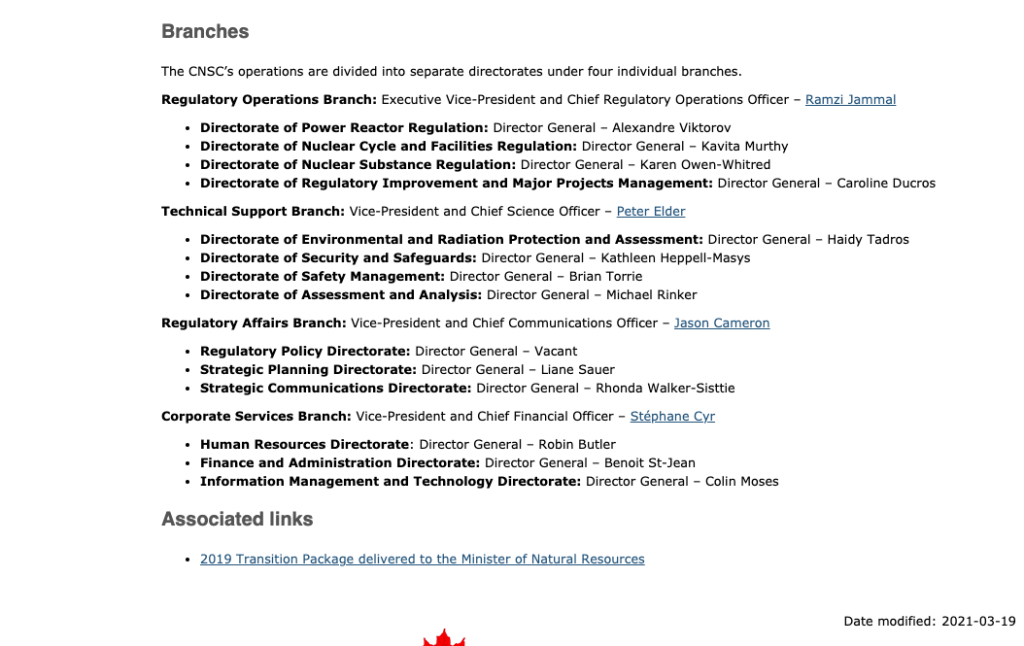
A recent petition to the Auditor General from our respective public interest citizens’ groups and Quebec colleagues, entitled “Nuclear governance problems in Canada,” noted that the CNSC has a mandate to protect health but lacks a health department.  A review of CNSC’s organizational chart reveals that the word health does not appear on it.


We believe the CNSC is in need of serious reform if Canadians want it to become a world-class nuclear regulator that prioritizes the health of Canadians and the environment over the health of the nuclear industry. The Government of Canada should address regulatory capture and other serious problems at the CNSC as soon as possible.

Lynn Jones, MHSc, Ottawa, Ontario, Concerned Citizens of Renfrew County and Area

Anne Lindsey, OM, MA, Winnipeg, Manitoba, Concerned Citizens of Manitoba

~~~~~

The images below are screen shots from the CNSC website, on April 13, 2021, illustrating that the word “health” does not appear on the organizational chart, despite the fact that CNSC’s primary legal mandate is to protect the health of Canadians from the adverse effects of exposure to ionizing radiation.