Canadian Nuclear Safety Commission enabled Chalk River debacle in the making ~ Hill Times letter to the editor

Published in the Hill-Times on Mar 4, 2024

https://www.hilltimes.com/story/2024/03/04/canadian-nuclear-safety-commission-has-enabled-this-debacle-in-the-making-at-chalk-river-protesters/412986

Dear Editor

The “NSDF,” a giant, above-ground landfill beside the Ottawa River, for one million tonnes of radioactive waste, approved by the Canadian Nuclear Safety Commission on January 9, is a debacle-in-the-making. 

The NSDF fails to meet International safety standards according to experts who for years were in charge of the waste at Chalk River. Industry veterans say much of the waste is too long-lived for permanent emplacement in an above-ground mound.  

The facility is expected to leak during operation and break down and release its contents to the environment after 550 years, while many of the dangerous, post-fission, man-made radioactive toxins in the mound will remain hazardous for many millennia. Plutonium and other radioactive pollutants will leak into the Ottawa River that drains into the St. Lawrence River at Montreal. This leakage will contaminate drinking water for millions of Canadians. All radioactive contaminants increase risks of cancer, birth defects and genetic mutations in exposed populations. The larger the population exposed, the greater the incidence of maladies.

Ten out of 11 Algonquin First Nations that have lived in the Ottawa River watershed for millennia say they do not consent to the NSDF on their unceded territory. The Assembly of First Nations and more than 140 municipalities including Ottawa, Gatineau and Montreal have passed resolutions of concern and/or opposition to the facility.

We wonder who the beneficiaries of the NSDF would be, besides shareholders of the three multinationals involved: SNC-Lavalin (now called Atkins Réalis), and two Texas-based multinationals, Fluor and Jacobs. The three multinationals comprise the “Canadian National Energy Alliance,” contracted by the Harper government in 2015 to quickly and cheaply reduce Canada’s multibillion dollar federal nuclear waste cleanup liability.

Canada’s deficient nuclear governance regime and its “nuclear-industry-captured” regulator, the Canadian Nuclear Safety Commission, have enabled this debacle-in-the-making to be taken seriously and to receive a license for construction.

Two legal challenges to the CNSC’s decision have been launched in Federal Court. More may follow if a species-at-risk permit to clearcut the NSDF site is approved .

There is a positive way forward for the Liberal government. The Federal Cabinet could request an ARTEMIS review by the International Atomic Energy Agency. ARTEMIS reviews are expert peer reviews, available to all member states of IAEA.

An ARTEMIS review could provide the Government of Canada with valuable advice about how to manage its legacy radioactive waste. Responsibility for managing this waste was handed over to profit-seeking multinationals in 2015 by the Harper government. Costs to taxpayers have ballooned since then. An ARTEMIS review could advise the Government of Canada on how to get value for money in its radioactive waste management projects while ensuring that safety is the top priority.

House of Commons e-petition 4676 calling for an ARTEMIS review garnered 3000 signatures in 30 days over the recent Christmas and New Years holiday period. The petition also called on the Government of Canada to uphold the principle, from the UN Declaration on the Rights of Indigenous Peoples, that “free, prior and informed consent” must be obtained before hazardous waste is stored in the territory of Indigenous people.

We and others have written to the Prime Minister and several Cabinet Ministers urging Cabinet to request an IAEA ARTEMIS review as soon as possible for the benefit of all Canadians and future generations.

Gordon Edwards, PhD, Montreal

Canadian Coalition for Nuclear Responsibility

Lynn Jones, MHSc, Ottawa

Concerned Citizens of Renfrew County and Area

Groups warn : radioactive waste piled in a giant mound beside the Ottawa River will remain hazardous for many millennia

February 5, 2024

Le français suit

For immediate release

Citizens’ groups from Ontario and Quebec warn that radioactive waste destined for a giant mound beside the Ottawa River must be stored underground

The groups call on the federal government to halt the project and stop all funding for construction

Ottawa, February 5, 2024 — Citizens’ groups have issued an urgent warning about waste slated for disposal in a giant radioactive waste mound one kilometre from the Ottawa River, upstream from Ottawa, Gatineau and Montreal. The groups cite nuclear experts who say the waste will remain hazardous to the public for many thousands of years and needs to be emplaced underground.

In a letter sent on February 4 to elected officials, the citizens’ groups call for the Government of Canada to halt the disposal project and stop all funding for construction. The letter cites  evidence that waste destined for the mound is heavily contaminated with very long-lived radioactive materials produced in nuclear reactors, which are capable of causing cancer, birth defects and genetic mutations in exposed populations.

The seven-storey radioactive mound is known as the “Near Surface Disposal Facility” (NSDF). It was recently licenced by the Canadian Nuclear Safety Commission (CNSC). The CNSC is widely perceived to be a captured regulator that promotes the projects it is supposed to regulate, as reported by an Expert Panel in 2017. 

If built, the mound will hold one million tons of radioactive and other hazardous waste from eight decades of operations of the Chalk River Laboratories (CRL), a highly contaminated federal nuclear research facility owned by the Government of Canada. Commercial waste and waste imported from other federal nuclear sites would also be put into the mound. 

The site for the NSDF is on the CRL property, 180 km northwest of Canada’s capital, on the Ottawa River directly across from the Province of Quebec. Studies show the mound would leak during operation and break down due to erosion after a few hundred years, contaminating the Ottawa River, the source of drinking water for millions of Canadians.

Concerned Citizens of Renfrew County and Area, the Old Fort William (Quebec) Cottagers’ Association, Ralliement contre la pollution radioactive, and the Canadian Coalition for Nuclear Responsibility have been opposing the giant radioactive waste mound since 2016. They say there is widespread ignorance about what would go in the mound due to repeated statements by the regulator and the proponent that “it’s only low level waste.”

“If I hear one more time that the mound will hold ‘only low-level’ radioactive waste including mops and shoe covers, I’m going to scream so loud they will hear me at the IAEA headquarters in Vienna,” said Johanna Echlin of the Old Fort William (Quebec) Cottagers’ Association. “People need to wake up and realize the truth that this waste is full of deadly long-lived, man-made radioactive poisons such as plutonium that will be hazardous for many thousands of years.”

The International Atomic Energy Agency (IAEA) referred to by Echlin says waste from research facilities such as Chalk River Laboratories generally belongs to the “Intermediate-level” waste class and must be kept underground, tens of metres or more below the surface.

A former senior manager in charge of “legacy” radioactive waste at Chalk River told the Canadian Nuclear Safety Commission that, in reality, the waste proposed for emplacement in the NSDF “is ‘intermediate level waste’ that requires a greater degree of containment and isolation than that provided by a near surface facility.” He pointed out the mound would be hazardous and radioactive for many thousands of years, and that radiation doses from the facility will, in the future, exceed regulatory limits.

“We believe Cabinet or Parliament has the power to reverse this decision and they need to do so as soon as possible,” said Lynn Jones of Concerned Citizens of Renfrew County and Area. “It’s clear that the only benefit from the NSDF would go to shareholders of the three multinational corporations involved, AtkinsRéalis (formerly SNC-Lavalin), Fluor and Jacobs. Everyone else would get only harm—a polluted Ottawa River, plummeting property values, increased health risks, never-ending costs to remediate the mess and a big black mark on Canada’s international reputation.”

The citizens’ groups say Canada should commit to building world class facilities for managing radioactive waste that would keep Canadians safe and provide good jobs in the nuclear industry, safely managing and containing the waste for generations to come. 

The cleanup of the Chalk River Laboratories site was originally estimated to cost $8 billion in 2015 when a multinational consortium called “Canadian National Energy Alliance”** was contracted by the Harper government to manage the Chalk River site and clean up the radioactive waste there and at other federally owned facilities. 

Since the consortium took over, the annual costs to Canadian taxpayers for the operation and cleanup at Canada’s nuclear labs have ballooned from $336 million dollars per year to over $1.5 billion per year.

-30-

**The consortium known as Canadian National Energy Alliance is comprised of AtkinsRéalis(formerly SNC-Lavalin,) which was debarred by the World Bank for 10 years and faced charges in Canada of fraud, bribery and corruption; Texas-based Fluor Corporation, which paid $4 million to resolve allegations of financial fraud related to nuclear waste cleanup work at a U.S. site; and Texas-based Jacobs Engineering, which recently acquired CH2M, an original consortium member that agreed to pay $18.5 million to settle federal criminal charges at the same nuclear cleanup site in the U.S.

Background

Ten Things Canadians need to know about the giant radioactive waste mound coming to the Ottawa River 

~~~~~~~~~~

Communiqué:

Des groupes de citoyens de l’Ontario et du Québec soutiennent que certains déchets destinés à une gigantesque décharge de déchets radioactifs, près de la rivière des Outaouais, devraient être enfouis en profondeur.

Les groupes demandent au gouvernement d’interrompre le projet et de refuser son financement.

Ottawa, le 5 février 2024 — Des groupes de citoyens ont lancé un avertissement urgent au sujet des déchets radioactifs qui seraient enfouis dans une gigantesque décharge sur une colline, à 1 km de la rivière des Outaouais en amont d’Ottawa, Gatineau et Montréal. Ces groupes citent des experts dans le domaine du nucléaire qui affirment que certains déchets seront fortement radioactifs pendant des milliers d’années et que nous devons les enfouir en profondeur pour protéger la population.

La Commission canadienne de sûreté nucléaire (CCSN) a approuvé récemment cette déchargé haute comme un édifice de sept étages, connue sous le nom d’Installation de gestion des déchets près de la surface (IGDPS).

En 2017, le rapport d’un comité d’experts a mentionné les perceptions selon lesquelles la CCSN est en relation trop étroite avec l’industrie nucléaire et qu’elle promeut des projets qu’elle devrait réglementer.

Si elle était construite, l’IGDPS contiendrait plus d’un million de tonnes de déchets radioactifs et d’autres déchets dangereux résultant de 80 ans d’exploitation des Laboratoires de Chalk River ; cette installation de recherche nucléaire contaminée appartient au gouvernement fédéral. Des déchets radioactifs commerciaux et provenant d’autres sites du gouvernement fédéral y seront placés.

L’IGDPS est sur le site des Laboratoires nucléaires canadiens (LNC), à 180 km au nord-ouest d’Ottawa, sur la rivière des Outaouais, juste en face de la province de Québec. Des études démontrent que cette décharge de déchets aura des fuites radioactives pendant son exploitation et qu’elle s’effondrera après quelques centaines d’années à cause de l’érosion. Cela contaminera la rivière des Outaouais, source d’eau potable de millions de Canadiens.

Concerned Citizens of Renfrew County and Area, l’Association des propriétaires de chalets d’Old Fort William, le Ralliement contre la pollution radioactive et le Regroupement pour la surveillance du nucléaire figurent parmi les nombreux organismes qui critiquent depuis 2016 la conception de cette décharge géante de déchets radioactifs. Selon eux, l’information est trop vague concernant les déchets destinés à l’IGDPS même si la Commission de sureté nucléaire et les Laboratoires nucléaires canadiens ont affirmé à plusieurs reprises que seulement des déchets radioactifs de faible activité y seront placés.

” Les installations de gestion des déchets près de la surface ne conviennent pas aux déchets radioactifs de moyenne activité qu’on voulait y mettre au début, “déclare Ginette Charbonneau du Ralliement contre la pollution radioactive. ” À la suite des protestations du public, les promoteurs du projet disent maintenant que l’IGDPS n’acceptera que des déchets de faible activité. Malheureusement, ce n’est pas crédible. Il est très difficile de séparer des déchets de faible activité et de moyenne activité qui ont été stockés ensemble dans des colis non marqués. Il est donc inévitable qu’il y ait encore des déchets de moyenne activité dans cette décharge en surface. C’est très dangereux “.

Johanna Echlin de l’Association des propriétaires de chalets d’Old Fort William (Québec) mentionne que l’Agence internationale de l’énergie atomique (AIEA) est l’organisme responsable de la sûreté et de la sécurité nucléaires au niveau mondial. Selon l’AIEA, les déchets hérités par les Laboratoires de Chalk River sont de “moyenne activité ” et ils devraient être enfouis à des dizaines ou des centaines de mètres sous terre.

Les groupes de citoyens citent également les déclarations de James R. Walker (Ph.D), un ancien cadre supérieur responsable des déchets radioactifs hérités des Laboratoires de Chalk River. M. Walker énonce clairement dans ses commentaires à la CCSN que certains déchets destinés à l’IGDPS sont des ” déchets de moyenne activité ” qui nécessitent plutôt un stockage souterrain. Il affirme que la décharge serait dangereusement radioactive pendant des milliers d’années et que les radiations provenant de l’installation dépasseraient les niveaux autorisés.

” Le Cabinet et le Parlement ont le pouvoir et le devoir de renverser cette décision le plus tôt possible “, déclare Lynn Jones de Concerned Citizens of Renfrew County and Area. ” Il est clair que les actionnaires d’Atkins Realis (anciennement SNC-Lavalin), de Fluor et de Jacobs seront les seuls à bénéficier du projet d’IGDPS. Tous les autres n’en tireraient que des problèmes : pollution de la rivière des Outaouais, risques sanitaires accrus, coûts de nettoyage astronomiques et une grande tache noire sur la réputation internationale du Canada “.

Dans une lettre envoyée le 5 février aux élus et aux responsables locaux, les groupes de citoyens demandent au gouvernement canadien de stopper ce projet et de couper son financement. Les études menées par le promoteur lui-même démontrent clairement que les déchets destinés à l’IGDPS sont fortement contaminés par de grandes quantités de substances radioactives de très longue durée de vie provenant des réacteurs nucléaires, expliquent-ils dans leur lettre. Ces déchets pourraient provoquer des cancers, des malformations congénitales et des mutations génétiques chez les populations exposées.

Le Canada devrait s’engager à construire des installations de gestion des déchets radioactifs de classe mondiale, afin de garantir la sécurité des Canadiens et de créer de bons emplois dans l’industrie nucléaire, tout en gérant les déchets de manière sûre pour les générations futures, disent ces groupes de citoyens.

Le coût de la dépollution du site des Laboratoires de Chalk River a été estimé à 8 milliards de dollars lorsque le site a été confié au secteur privé par le gouvernement Harper en 2015. Le consortium multinational appelé “Canadian National Energy Alliance “**, dirigé par SNC-Lavalin (aujourd’hui appelé Atkins Realis), a remporté le contrat de plusieurs milliards de dollars pour gérer et nettoyer “rapidement et à moindre coût” le site de Chalk River et d’autres sites fédéraux. Depuis que le consortium a pris le relais, les contribuables canadiens ont vu le coût d’exploitation des Laboratoires nucléaires canadiens (autrefois les Laboratoires de Chalk River) gonfler de 336 millions de dollars par an à plus de 1,5 milliard de dollars par année. 

-30 –

 **Le consortium connu sous le nom de Canadian National Energy Alliance est composé d’Atkins Realis (anciennement SNC-Lavalin), qui a été radié par la Banque mondiale pendant 10 ans et qui a fait l’objet d’accusations de fraude, de pots-de-vin et de corruption au Canada. La société texane Fluor Corporation a payé 4 millions de dollars pour mettre fin à des allégations de fraude financière liées à des travaux de nettoyage de déchets radioactifs sur un site américain ; et la société texane Jacobs Engineering, qui a récemment acquis CH2M, un membre initial du consortium, a accepté de payer 18,5 millions de dollars pour mettre fin à des accusations criminelles fédérales sur un site de nettoyage de déchets radioactifs aux États-Unis.

Contexte

Dix choses que les Canadiens doivent savoir sur le monticulede déchets radioactifs en bordure de la rivière des Outaouais

Hill Times ~ Le déluge souligne l’importance de l’audience finale pour le dépôt de déchets nucléaires – Audience finale des délégations de trois premières nations

THE HILL TIMES | LUNDI 21 AOÛT 2023

Il est grand temps que le gouvernement s’occupe de cette catastrophe environnementale en devenir, un problème grave qui s’aggravera si on l’ignore.

OTTAWA – Le 10 août, la Commission canadienne de sûreté nucléaire a tenu une audience finale sur l’autorisation d’un gigantesque dépôt de déchets radioactifs en surface près de la rivière des Outaouais, en amont d’Ottawa-Gatineau et de Montréal, à Chalk River (Ontario), qui a créé un précédent.

Des délégations de trois Premières Nations algonquines – Kebaowek, Kitigan Zibi et Barriere Lake – se sont réunies au 50 Sussex Dr. à Ottawa pour faire leurs présentations finales en personne aux membres de la communauté, aux alliés non autochtones et à une poignée de représentants élus, au mépris d’un décret de la Commission canadienne de sûreté nucléaire (CCSN) stipulant que l’audience ne serait que virtuelle. La CCSN a présidé l’audience via Zoom.

Pendant l’audience, une tempête sans précédent s’est abattue sur le site, avec d’énormes quantités de pluie, de tonnerre, de grêle et de vent qui ont soufflé sur les chaises de la terrasse extérieure couverte où la foule en surnombre regardait les débats. Malgré la férocité de l’orage, les aînés algonquins ont entretenu un feu sacré cérémoniel tout au long de la cérémonie.

Si le projet est approuvé, la décharge géante, appelée “installation de stockage en surface” (IGDPS) par le promoteur, contiendrait un million de tonnes de déchets radioactifs et dangereux dans un monticule en surface sur la propriété des laboratoires de Chalk River, une installation nucléaire fédérale fortement contaminée établie sur des terres algonquines volées en 1944 afin de produire du plutonium pour les armes nucléaires américaines. Les laboratoires de Chalk River représentent un énorme passif environnemental pour le gouvernement du Canada, avec un coût de dépollution estimé à plusieurs milliards de dollars.

Le promoteur de la décharge est un consortium multinational composé de SNC-Lavalin et de deux multinationales basées au Texas : Fluor et Jacobs. Le consortium a été engagé par le gouvernement conservateur en 2015 pour réduire rapidement et à moindre coût l’énorme responsabilité fédérale en matière de déchets nucléaires hérités. Paradoxalement, les coûts pour les contribuables de la gestion des déchets radioactifs hérités du gouvernement fédéral canadien ont grimpé à plus d’un milliard de dollars par an après la privatisation.

L’audition du 10 août a créé un précédent à deux égards. Si elle est approuvée, l’IGDPS sera la toute première installation de stockage permanent des déchets de réacteurs nucléaires au Canada. Deuxièmement, la décision d’autoriser ou non l’installation est un test important de l’engagement du Canada envers la Déclaration des Nations unies sur les droits des peuples autochtones, qui interdit le stockage de déchets radioactifs sur les terres des peuples autochtones sans leur consentement libre, préalable et éclairé. Dix des onze Premières nations algonquines, dont les membres vivent dans la vallée de l’Outaouais depuis des temps immémoriaux, ont déclaré qu’elles ne consentaient pas à ce que l’ IGDPS soit implanté sur leur territoire non cédé.

Bon nombre des déchets qu’il est proposé d’éliminer dans le NSDF resteront dangereux et radioactifs pendant des milliers, voire des millions d’années, selon le Dr. J.R. Walker, le plus grand expert canadien en matière de déchets radioactifs hérités du gouvernement fédéral et de la meilleure façon de les gérer. M. Walker a clairement indiqué que les déchets proposés pour l’IGDPS ne sont pas des déchets de faible activité, mais des déchets radioactifs de “niveau intermédiaire” qui devraient être éliminés à des dizaines, voire des centaines de mètres sous la surface du sol. Il a également affirmé que la proposition n’était pas conforme aux normes de sécurité internationales.

Le site proposé pour l’IGDPS se trouve sur le flanc d’une colline entourée de zones humides qui se jettent dans la rivière des Outaouais, à moins d’un kilomètre de là.

La déclaration d’impact sur l’environnement du promoteur documente les nombreuses façons dont la décharge pourrait fuir pendant son exploitation et après sa fermeture. Trois isotopes du plutonium figurent sur la longue liste des radionucléides qui seraient rejetés dans la rivière des Outaouais dans les “effluents traités” de la décharge. Le monticule devrait se dégrader, s’éroder et finalement se désintégrer en raison de “l’évolution naturelle”.

La plupart des gens pensent qu’il est répréhensible de déverser délibérément des matières radioactives dans une importante source d’eau potable telle que la rivière des Outaouais, car il n’existe pas de niveau d’exposition sûr à ces poisons fabriqués par l’homme. Chaque rejet accidentel ou délibéré augmente les risques de cancer, de malformations congénitales et de dommages génétiques chez les populations exposées.

L’Assemblée des Premières Nations et plus de 140 municipalités situées en aval, dont Ottawa, Gatineau et Montréal, ont adopté des résolutions exprimant leur inquiétude à l’égard de la proposition du IGDPS.

Malgré les nombreuses lacunes et la forte opposition, le personnel de la Commission canadienne de sûreté nucléaire n’a jamais hésité à soutenir le projet de décharge. Il semble qu’il n’ait jamais reçu le mémo en 2000 lorsque le mandat de l’organisation a été modifié par une nouvelle législation, passant d’un rôle de promotion de l’industrie nucléaire à un mandat strictement axé sur la protection des Canadiens et de l’environnement.

L’audience du 10 août a été présidée par un seul commissaire, ainsi que par la présidente de la CCSN. Leurs curriculum vitae respectifs font état de longs états de service et d’allégeance à l’industrie nucléaire. Les deux fonctionnaires n’ont pas posé une seule question aux équipes d’intervenants des Premières nations, qui étaient manifestement choquées par le manque d’intérêt pour les informations qu’elles s’étaient donné tant de mal à rassembler et à partager. Un membre de l’équipe a demandé : “Pouvons-nous vous poser des questions ?”, ce à quoi le président a sèchement répondu : “Ce n’est pas notre façon de procéder.”

Le régime de gouvernance nucléaire gravement déficient du Canada a été décrit précédemment dans le Hill Times. La gouvernance nucléaire au Canada s’appuie fortement sur la CCSN pour presque tous les aspects de la surveillance de l’industrie nucléaire. La CCSN est largement perçue comme un “régulateur capturé” qui promeut les projets qu’elle est censée réglementer.

Il est clair que notre régime de gouvernance nucléaire gravement déficient a permis à l’IGDPS – un simulacre grotesque d’installation de gestion responsable des déchets radioactifs – d’être proposée et prise au sérieux au Canada. La décision de la CCSN d’approuver le permis pour l’IGDPS est attendue prochainement.

La puissante tempête qui s’est abattue sur le 50 Sussex Dr. pendant que l’on entendait des témoignages en langue algonquine sur la cupidité et la destruction inconsidérée de l’environnement a souligné la gravité de la décision envisagée. Il ne fait aucun doute qu’une tempête record comme celle qui a frappé l’IGDPS au cours de sa phase de remplissage de 50 ans – alors que les déchets sont exposés aux éléments – pourrait facilement provoquer d’importants déversements de poisons radioactifs et d’autres matières dangereuses dans la rivière des Outaouais.

Il est grand temps que le gouvernement se réveille et s’attaque à cette catastrophe environnementale en cours, un problème grave qui ne fera que s’aggraver au fur et à mesure qu’il sera ignoré.

————————————————————————–

Lynn Jones est une gestionnaire de programme de santé publique à la retraite qui travaille maintenant pour Concerned Citizens of Renfrew County and Area, une organisation non gouvernementale qui œuvre depuis plus de 40 ans à l’assainissement et à la prévention de la pollution radioactive provenant de l’industrie nucléaire dans la vallée de l’Outaouais. Elle est basée à Ottawa.

L’image ci-dessous est une simulation de l’effet baignoire tirée du documentaire de Découverte “Chalk River Heritage”.

Hill Times ~ Deluge underlines the importance of final hearing for nuclear waste dump beside the Ottawa River

Published in the Hill Times Monday August 21, 2023

On August 10, 2023, the Canadian Nuclear Safety Commission held a precedent-setting final licensing hearing for a giant above-ground radioactive waste dump beside the Ottawa River upstream of Ottawa-Gatineau and Montreal at Chalk River, Ontario.

Delegations from three Algonquin First Nations – Kebaowek, Kitigan Zibi and Barriere Lake – gathered at 50 Sussex Drive to make their final presentations in-person to community members, non-Indigenous allies and a handful of elected officials, in defiance of a Canadian Nuclear Safety Commission (CNSC) decree that the hearing would be virtual only. The CNSC presided over the hearing by Zoom.

While the hearing was taking place, an unprecedented storm hit the venue with huge amounts of rain, thunder, hail and wind that blew over the chairs on the outdoor covered terrace where the overflow crowd was watching the proceedings. Despite the ferocious storm, Algonquin Elders kept a ceremonial sacred fire burning throughout.

If approved, the giant dump, called a “near-surface disposal facility” (NSDF) by the proponent, would hold one million tonnes of radioactive and hazardous waste in an above-ground mound on the property of Chalk River Laboratories, a heavily contaminated federal nuclear facility established on stolen Algonquin land in 1944 to produce plutonium  for US nuclear weapons. Chalk River Laboratories is a huge environmental liability for the Government of Canada, with an estimated cleanup cost in the billions of dollars.

The dump proponent is a multinational consortium comprised of SNC-Lavalin, and two Texas-based multinationals, Fluor and Jacobs. The consortium was contracted by the Harper government in 2015 to quickly and cheaply reduce the enormous federal legacy nuclear waste liability. Perversely, costs to Canadian taxpayers for managing Canada’s federal legacy radioactive wastes ballooned to more than 1 billion dollars per year after privatization.

The August 10 hearing was precedent-setting in two ways.  If approved, the NSDF would be the first ever facility for permanent disposal of nuclear reactor waste in Canada. Secondly, the decision whether or not to license the facility is an important test of Canada’s commitment to the United Nations Declaration on the Rights of Indigenous Peoples, which forbids storage of radioactive waste on the land of Indigenous Peoples without their free, prior and informed consent. Ten of the eleven Algonquin First Nations whose people have lived in the Ottawa Valley since time immemorial say they  do not consent to the NSDF on their unceded territory.

Many of the wastes proposed for disposal in the NSDF will be hazardous and radioactive for thousands to millions of years, according to Canada’s foremost expert on the federal legacy radioactive wastes and how best to manage them, Dr. JR Walker.  Dr. Walker has clearly stated that wastes proposed for the NSDF do not qualify as low level waste but are in fact “intermediate level” radioactive waste that should be disposed of tens to hundreds of meters below the ground surface. He also notes that the proposal is non-compliant with International Safety Standards.

The site for the proposed “NSDF” is on the side of a hill surrounded by wetlands that drain into the Ottawa River – less than one kilometre away. The proponent’s environmental impact statement documents many ways the dump could leak during operation and after closure. Three isotopes of plutonium are included in the long list of radionuclides that would be discharged into the Ottawa River in “treated effluent” from the dump. The mound is expected to degrade and erode and eventually disintegrate due to “natural evolution.”  

Most people believe it is wrong to deliberately discharge radioactive materials into a major drinking water source such as the Ottawa River, since there is no safe level of exposure to these man-made poisons. Every accidental and deliberate discharge increases risks of cancer, birth defects and genetic damage in the populations exposed.

The Assembly of First Nations and more than 140 downstream municipalities – including Ottawa, Gatineau and Montreal – have passed resolutions of concern about the NSDF proposal. 

Despite the many serious shortcomings and strong opposition, the Canadian Nuclear Safety Commission staff have never wavered in their support for the dump. It appears they never “got the memo” back in 2000, when the organization’s mandate changed under new legislation from a role that included promotion of the nuclear industry, to a mandate strictly focused on protecting Canadians and the environment.

The August 10 hearing was presided over by only one Commissioner – along with the CNSC President. Both of their CVs tout long service and allegiance to the nuclear industry. The two officials askednot one single question of the First Nation intervenor teams, who were clearly shocked by the lack of interest in the information they had gone to such great lengths to gather and share. A member of the team asked, “Well, can we ask you some questions?” to which the President curtly replied, “That’s not our process.”

Canada’s seriously deficient nuclear governance regime has been described previously in the Hill Times here and here.  Nuclear governance in Canada relies heavily on the Canadian Nuclear Safety Commission for almost all aspects of nuclear industry oversight. The CNSC is widely perceived to be a “captured regulator”  that promotes the projects it is supposed to regulate.

It is clear that our seriously deficient nuclear governance regime has enabled the NSDF — a grotesque mockery of a responsible radioactive waste management facility—  to be proposed and taken seriously in Canada. A CNSC decision to approve the license for the NSDF is expected soon.

The powerful storm that pounded 50 Sussex Drive while testimony was being heard in the Algonquin language about greed and heedless destruction of the environment, underlined the serious decision being contemplated. There is no question that a record-breaking storm like that one, hitting the NSDF during its 50-year long filling stage – while wastes are exposed to the elements, could readily cause large spills of radioactive poisons and other hazardous materials into the Ottawa River.

It’s long past time that the government woke up and dealt with this environmental catastrophe in the making, a serious problem that will only grow steadily worse the longer it is ignored.

Lynn Jones is a retired public health program manager now with Concerned Citizens of Renfrew County and Area, a non-governmental organization that has been working for the clean-up and prevention of radioactive pollution from the nuclear industry in the Ottawa Valley for over 40 years. She is based in Ottawa.

Image below is a simulation of the bathtub effect from the Decouverte documentary “Chalk River Heritage.”

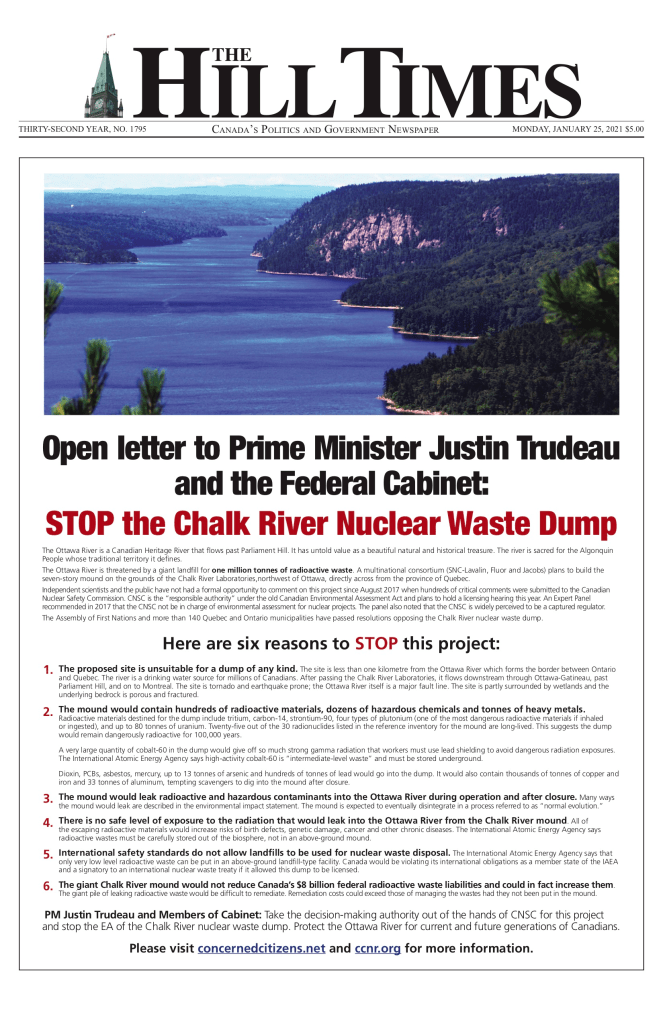
Serious problems with federally-owned radioactive waste in Canada ~ Full Page Statement in the Hill Times

January 27, 2020

To the Prime Minister, Parliament and the Federal Government
The undersigned organizations have grave concerns about the handling of Canada’s federally-owned radioactive waste by a private-sector consortium that includes SNC-Lavalin and two Texas-based multinational corporations. *


●      Canada has no adequate federal policies and strategies for the long-term management of radioactive wastes and the consortium has been given a free hand to advocate and implement proposals that, in our view, are unequal to the task of protecting people’s health and the environment.
●       Under its federal contract with Atomic Energy of Canada Limited the consortium is receiving billions of our tax dollars to advance radioactive waste disposal and reactor “decommissioning” projects that fail to even meet existing international safety guidelines. 
●      The consortium’s current plans include entombingthe radioactive remains ofnuclear reactors in cement next to the Ottawa and Winnipeg Rivers, against the explicit advice of international bodies and independent nuclear scientists; these “entombed reactors” would leak radioactivity into the rivers for thousands of years and contaminate drinking water for millions of Canadians.
●     The consortium also plans to erect a massive above-ground mound adjacent to a swampy area that drains into the nearby Ottawa River; the mound would hold more than one million tons of mixed radioactive waste including a multitude of long-lived, human-made radioactive materials such as plutonium-239 and hazardous non-radioactive materials such as PCBs, lead, arsenic and asbestos.
●     The consortium is already transporting large quantities of radioactive waste along public roadsfrom Pinawa, Manitoba, from Douglas Point, Ontario, and from Gentilly, Quebec, all the way to Chalk River, site of the proposed mound, located upstream from our nation’s Capital.

We request that the Federal Government terminate its contract with the consortium at the end of the first six-year term in 2021 or as soon as possible.

We also request formulation of exemplary policies and projects for Canada’s radioactive waste that meet or exceed international obligations. Such policies and projects would:
●      be developed with meaningful consultation with First Nations and the broader Canadian public 
●      create many long-term, well-paying Canadian jobs while protecting health and property 
●      safely store radioactive waste in state-of-the-art facilities away from sources of drinking water
●     re-establish Canadian leadership in the nuclear field with world-class science-based solutions to address the growing global radioactive waste problems 

* Membership in the consortium, known as Canadian National Energy Alliance, has changed more than once since the consortium assumed control of Canada’s federally-owned nuclear waste in 2015, when it received all shares of Canadian Nuclear Laboratories, a wholly owned subsidiary of Atomic Energy of Canada Limited.  Current consortium members include  SNC-Lavalin, which is debarred by the World Bank for 10 years and faced charges in Canada for fraud, bribery and corruption; Texas-based Fluor Corporation, which paid $4 million to resolve allegations of  financial fraud related to nuclear waste cleanup work at a U.S. site; and Texas-based Jacobs Engineering, which recently acquired CH2M, an original consortium member that agreed to pay $18.5 million to settle federal criminal charges at a nuclear cleanup site in the U.S.

Signatories  

Alliance of the Anishinabek Nation and the Iroquois Caucus

Canadian Coalition for Nuclear Responsibility

Canadian Association of Physicians for the Environment

Sierra Club Canada Foundation

Friends of the Earth Canada

Ontario Clean Air Alliance

Ecology Ottawa

 Ottawa River Institute

Unifor

FTQ – Fédération des travailleurs et travailleuses du Québec

Greenspace Alliance of Canada’s Capital

National Council of Women of Canada

Provincial Council of Women of Quebec

Provincial Council of Women of Ontario

Concerned Citizens of Renfrew County and Area

Northwatch

Les Artistes pour la Paix

Concerned Citizens Committee of Manitoba

Prevent Cancer Now

Action Climat Outaouais

Ralliement contre la pollution radioactive

Bonnechere River Watershed Project

Old Fort William (Quebec) Cottagers’ Association

Pontiac Environmental Protection

Petawawa Point Cottagers Association

Coalition Against Nuclear Dumps on the Ottawa River

Esprit Whitewater

Durham Nuclear Awareness

First United Church (Ottawa) Water Care Allies

Citizens’ groups and multinational consortium still at odds over plans for two nuclear waste dumps beside the Ottawa River

SNC-Lavalin and two Texas-based corporations fail to convince the public that radioactive dumps will be safe

For immediate release
(December 17, 2019, Ottawa, Ontario). Civil society groups remain staunchly opposed to two radioactive waste dumps beside the Ottawa River, despite new studies released December 12 by the embattled multinational consortium behind the proposals. Citizens groups and NGOs say no amount of tweaking by Canadian Nuclear Laboratories can make the proposed projects meet international safety standards.


Announced in 2016, the consortium’s plans to build a giant mound for more than one million tonnes of radioactive waste and to entomb a defunct reactor in concrete along side the Ottawa River have raised the ire of citizens and retired nuclear scientists alike. First Nations, NGOs, federal government departments, the Quebec government, and over 140 municipalities have also weighed in with serious concerns about the proposed projects.


“These proposals violate the principle that radioactive waste must be kept out of contact with the biosphere for as long as it remains radioactive,” according to Ole Hendrickson, a scientist and researcher for the group Concerned Citizens of Renfrew County and Area. “The mound and the tomb are the wrong strategies; they simply can’t do the job of keeping radioactive toxins out of our air and drinking water,” Hendrickson said. “In addition to radioactive materials, both facilities would release heavy metals and toxic organic compounds during and after construction.” 


Critics are calling on the federal government to cancel these quick-and-dirty radioactive dumps and step up with funding to support world class radioactive waste storage facilities for Canada’s $8 to $10 billion nuclear waste legacy. Ottawa has admitted it has not even formulated a detailed policy on the long-term management of radioactive wastes.


“Radioactive wastes should never be abandoned right beside major water bodies”, says Gordon Edwards, president of the Canadian Coalition for Nuclear Responsibility, “They should be maintained in a monitored and retrievable fashion so that future generations can cope with them. These wastes will be hazardous and radioactive for more than one hundred thousand years, essentially for eternity. They must be carefully packaged and labelled and stored securely, well away from drinking water sources.”

Hendrickson adds that the lack of a careful siting process concerns many citizens groups and NGOs. “It is obvious that the consortium chose the proposed sites based on convenience and low cost, not public safety.” 

The proposed facilities do not comply with International Atomic Energy Agency (IAEA) guidelines. The IAEA requires that long-lived radioactive waste be placed in a moderately deep or very deep underground facility.  The IAEA also says that flooding a defunct reactor with concrete can only be used in cases of extreme emergency such as a meltdown.


Canadian Nuclear Laboratories misrepresents the amount of long-lived radioactive material that would go in its gigantic five-to-seven story surface mound. The revised environmental impact statement includes a partial inventory of 30 radioactive materials destined for the dump, and 25 of them are very long-lived indeed, each with a half-life of more than four centuries. Of the 30 materials listed, 22 have half-lives over a thousand years, 17 have half-lives over 100,000 years, and 7 have half-lives over a million years.  None of these materials would meet the IAEA definition of short-lived waste. Nevertheless, the revised environmental impact statement, released last week by the consortium, asserts only low level waste that “primarily contains short-lived radionuclides” would go into the mound.


“This is a clear example of the ways that CNL misleads the public and decision-makers by playing fast and loose with terms such as “near surface” “low level” and “short-lived”, says Johanna Echlin, of the Old Fort William (Quebec) Cottagers’ Association.


According to Echlin, a federal commitment to create world class facilities for its radioactive waste is urgently needed and would have many benefits.
“We have the expertise in Canada to be a world leader in looking after these radioactive wastes,” Echlin said. “Many well-paying jobs and careers will be created when the government of Canada takes this issue seriously and does the right thing. We can do this. We can keep radioactive waste out of our rivers. We’ll all sleep easier knowing that our health, our property values, the beautiful Ottawa River, and future generations are all protected.”

The proponent of the two nuclear waste dumps, Canadian Nuclear Laboratories is owned by the “Canadian National Energy Alliance”, a consortium of SNC-Lavalin and two Texas-based engineering firms. Canadian Nuclear Laboratories is under contract by the federal government to reduce Canada’s $8 billion federal nuclear waste “legacy” liabilities quickly and cheaply.


Environmental assessments of the giant mound and the reactor tomb are in progress. Licensing hearings for the projects are expected in late 2020. 
-30-

More information:
Quick Facts about Low Level Waste
How would the Chalk River Mound leak? Let us count some of the ways
International agency’s findings confirm serious concerns  about Canada’s radioactive waste handling and radiation protection practices
Petition to the Auditor General: Nuclear governance problems in Canada
Scientists decry plan for Ontario nuclear-waste site
Revised Environmental Impact Statement and supporting documents

Canada’s Eight Billion Dollar Nuclear Liability – Backgrounder

In 2012, the Conservative government under Prime Minister Stephen Harper amended the Canadian Environmental Assessment Act to give the Canadian Nuclear Safety Commission (CNSC) total authority and decision-making power over all nuclear-related projects. 

The CNSC is currently conducting environmental assessments of three contentious radioactive waste “disposal” projects. Each is the brainchild of a consortium of private multinational corporations operating under the name “Canadian National Energy Alliance.”  The consortium consists of the scandal-ridden SNC-Lavalin, currently facing criminal charges for fraud and corruption in a Canadian court, and two U.S.-based corporate partners (Fluor and Jacobs), both of whom have also faced criminal charges of a similar nature in the past.

This consortium was hired in 2015 by the Harper government to operate the Government of Canada’s nuclear sites and reduce Canada’s eight billion dollar radioactive waste liability. The consortium received all the shares in a new corporation called “Canadian Nuclear Laboratories” (CNL) that had been created the previous year as a subsidiary of the federal crown corporation Atomic Energy of Canada Limited (AECL).  In effect, this privatized AECL.  Roughly 3000 former AECL employees now work for CNL, mostly at the Chalk River Laboratories. Billions of taxpayers’ dollars are funneled into the private consortium through the ghost of AECL.

The three proposals being assessed by CNSC are:

(1) an above-ground mound, five to seven stories high, covering 11 hectares of land, for permanent disposal of one million cubic meters of mixed radioactive wastes at Chalk River, less than a kilometer from the Ottawa River;

 (2) the permanent entombment of Canada’s first electricity-producing nuclear reactor, the Nuclear Power Demonstration reactor, by encasing its radioactive remains in concrete and abandoning them only 100 meters from the Ottawa River; 

(3) the permanent entombment of the radioactive remains of another prototype nuclear reactor, the Whiteshell Reactor No. 1, at the Whiteshell Laboratories, right beside the Winnipeg River in Manitoba. 

All three projects run counter to guidance of the International Atomic Energy Agency. 

Even as the consortium and CNL promote their disposal projects, they are soliciting proposals to build new nuclear reactors at the Chalk River and Whiteshell federal nuclear sites.  The CNSC secretly lobbied the government to have new nuclear reactors under a certain size exempted from Bill C-69, the new Impact Assessment Act. However, any reactor–regardless of size–will create accident risks and its own legacy of radioactive wastes. 

CNSC has long been recognized as a “captured” regulator. It has never denied a license for any major nuclear project. Its lobbying to have small reactors exempted from impact assessments–if successful–would minimize effective public participation in planning and decision-making for nuclear projects. 

The other SNC-Lavalin affair: Nuclear waste

Media release from the Ottawa Centre Green Party Campaign September 5, 2019

Green Party candidates blast Liberals’ and Conservatives’ cosy relationship with the nuclear industry

Plans to abandon toxic radioactive waste next to drinking water sources

OTTAWA, September 5, 2019 — Three Green Party candidates have given an “F” to recent Liberal and Conservative governments for handing control of Canada’s federal nuclear waste to SNC-Lavalin and two American corporations.

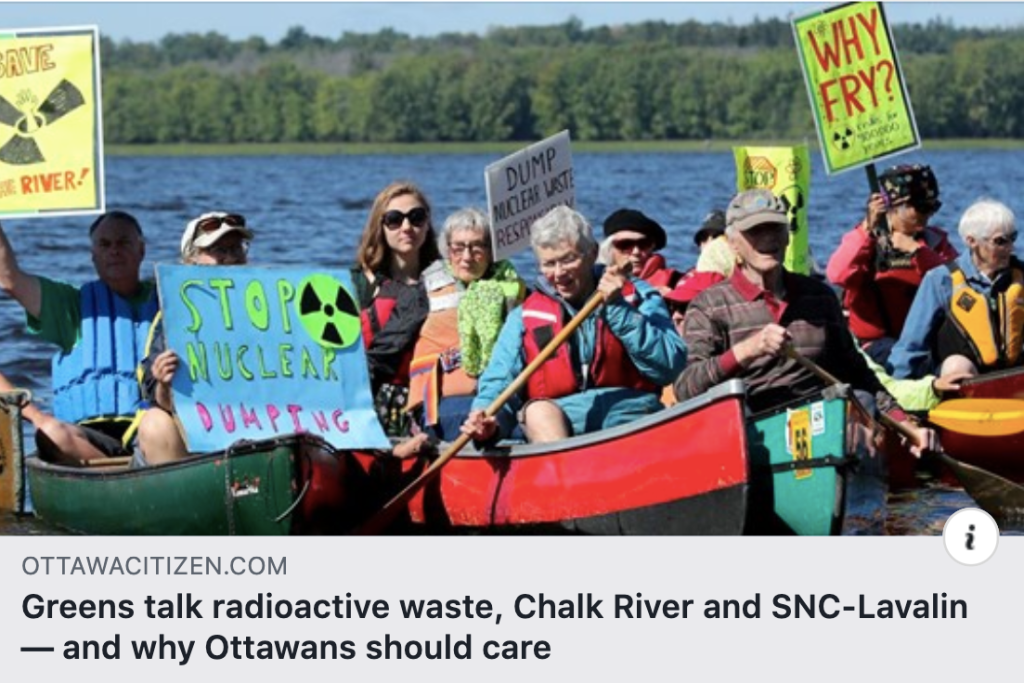
Candidates Angela Keller-Herzog, Claude Bertrand and Lorraine Rekmans say that the Harper and Trudeau governments deserve a “Fail” because decisions about nuclear waste that will last for millennia are being driven by corporate profits, not health protection. The candidates gathered today with a flotilla of canoes and kayaks on the Ottawa River to protest plans for a nuclear waste dump at Chalk River.

“Both the previous Conservative and Liberal governments have handed the dirty job of cleaning up nuclear waste to SNC-Lavalin and American corporations. We have to end this cosy relationship and stop funneling billions of taxpayer dollars to corporations for plans that may worsen, not improve, Canada’s nuclear waste problem,” said Keller-Herzog.

Releases of radioactive waste increase the risks of cancer, birth defects and genetic mutations in people who drink the contaminated water or breathe the contaminated air, she said.

The Harper government signed a 10-year, multibillion-dollar contract with a consortium of SNC-Lavalin and several foreign corporations in September 2015, very shortly before the last federal election. The consortium’s plan for an aboveground engineered mound that holds one million cubic metres of radioactive waste – less than a kilometre from the Ottawa River – does not meet International Atomic Energy Agency (IAEA) guidelines. Nor do its plans to bury two defunct reactors in cement next to the Winnipeg and Ottawa rivers.

In November 2018, the Liberal government released a roadmap to introduce “small modular” nuclear reactors across Canada, and in regulations enacted on August 28, 2019, the government has exempted new nuclear reactors under 200 thermal megawatts from environmental impact assessment under Bill C-69. “There are already large quantities of radioactive waste being transported from Manitoba, Québec and even the United States to Chalk River over public roads. First Nations are rightly concerned, as we all should be, about what’s happening to this nuclear waste, and we want to see transparency about the shipments and full consultation with Indigenous communities,” said Lorraine Rekmans, Green Party candidate for Leeds-Grenville-Thousand Islands and Rideau Lakes. Rekmans is the Green Party of Canada critic for Indigenous Affairs and Shadow Cabinet Co-chair. 

Claude Bertrand, running in the Pontiac riding that stretches over 200 km along the Ottawa River, noted the strong opposition in Québec to abandonment of nuclear waste near the river. “Over 140 communities in Quebec and Ontario are strongly opposed to the Canadian Nuclear Laboratories’ plans, including the Metropolitan Community of Montréal,” Bertrand said. “It’s our drinking water, and we don’t want to take risks with it in the name of short-term corporate profits.”

Chalk River Laboratories are located in Green Party candidate Ian Pineau’s riding, Renfrew-Nipissing-Pembroke. “We need the right plan in the right location,” Pineau (not present at the event) said. “That would protect, not risk, our river and our drinking water, stimulate the local economy, and provide long-term, well-paying careers in responsible waste management.”

The candidates called on Ottawa to abandon the current nuclear waste plans and aim to meet or exceed international standards. They also called for full public consultation to create a federal policy for the long-term management of non-fuel radioactive waste.

“The Canadian Nuclear Safety Commission should not be approving nuclear waste plans with no oversight by Parliament, and no federal policies spelling out how low-level and intermediate-level waste must be managed,” said Keller-Herzog.-30-

Greens talk radioactive waste, Chalk River and SNC-Lavalin

September 5, 2019, Ottawa Citizen, TAYLOR BLEWETT

Leveraging one of the year’s top political controversies, federal Green party candidates staged an event Thursday to highlight their concerns about potential contamination of the Ottawa River and a government they describe as too cosy with SNC-Lavalin to care.

Standing in the sand on Westboro Beach, Ottawa Centre Green party candidate Angela Keller-Herzog gave the assembled crowd a quick refresher on the nuclear situation at Chalk River, 200 kilometres northwest of Ottawa.

On the eve of the 2015 federal election, former prime minister Stephen Harper’s government selected a consortium of companies, including engineering firm SNC-Lavalin, as its preferred proponent to manage and operate Canadian Nuclear Laboratories — the organization proposing a “near surface disposal facility” for radioactive waste at Chalk River.

It’s a plan, now under review, that’s been in the works for several years, and CNL is adamant about its safety. “It will actually take waste out of areas with very little containment, and put it into an area that is engineered and contained away from the environment,” said Sandra Faught, manager of regulatory approvals for the facility at CNL.

Despite such assurances, the proposed facility has generated fierce criticism from community, Indigenous and environmental advocates for as long as it’s been in the public eye.

At Thursday’s press conference, the Greens breathed fresh life into these concerns by emphasizing the involvement of one of the most controversial names in politics right now: SNC-Lavalin.

“Poor nuclear waste decisions have fallout for millennia — this is too important a job to be handed to SNC and corner-cutting, profit-seeking foreign corporations with dubious ethical background,” said Keller-Herzog.

As an MP, she said, she would champion the creation of a federal policy guiding the management of non-fuel radioactive waste (the kind the Chalk River disposal facility would deal with.)

She also raised a new concern — that the Liberal government, including Environment Minister and Ottawa Centre MP Catherine McKenna, have created an exemption that would allow small modular nuclear reactors to skip the new environmental review process they introduced in Bill C-69.

Both CNL and the federal government are focused on the opportunities presented by these portable, less powerful reactors.

“Canada is well positioned to become a global leader in the development and deployment of SMR technology,” reads a Natural Resources Canada webpage, while CNL envisions itself as a “global hub” for small modular reactor innovation.

In the spring of 2018, CNL invited SMR proposals to develop a “demonstration project” at one of its sites. This would be the first small modular reactor in Canada.

“I ask you: If experimental, unproven nuclear reactors don’t have to undergo impact assessment, then what’s the point?” said Keller-Herzog. “In other words, the Liberal government, Minister McKenna and senior public servants are lining up their ducks to pave the way for the plans of SNC-Lavalin and its American partners. Does that sound familiar?”

This newspaper contacted McKenna’s ministerial office about the decision to exempt small nuclear reactors — under 200 thermal megawatts —  from the list of projects that would require environmental assessment under Bill C-69.

“Previously all nuclear reactors would have been designated projects, regardless of size and location,” according to the Canada Gazette entry regarding the exemption.

In response, spokesperson Caroline Thériault sent a statement: 

“A robust project list ensures good projects can move forward in a timely and transparent way that protects the environment, rebuilds public trust and strengthens our economy. This list covers all major projects within federal jurisdiction those pose significant environmental risk.”

Even without a spot on the Bill C-69 project list, small modular reactor would still be subject to scrutiny.

According to a statement from the Impact Assessment Agency of Canada, “New nuclear projects below the 200 MW thermal‎ threshold are subject to licensing and assessment processes by the Canadian Nuclear Safety Commission.”

Alexandre Deslongchamps, spokesperson for the minster of natural resources, noted that the CNSC “is peer-reviewed and world-renowned” and “will only approve projects if it concludes that they are safe for people and the environment, both now and in the future.”

With files from the Financial Post

Comment from Mark Mackenzie: I am flabbergasted as to how a facility can get away with calling a 7 storey high dump a ‘Near Surface Disposal Facility’. At 7 stories high, I invite any Chalk River executive to jump off and tell us how close they were to the surface…. There is no reason to jeopardize the incredible value of the Ottawa River for a nuclear dump within 1 kilometre. The CNSC is hardly an effective regulatory body as they merely rubber stamp whatever the profit oriented nuclear industry wants. SNC Lavelin ‘anything for a buck’ is the Canadian partner. Great group today bringing awareness to the importance of this issue. Three Green Party candidates – Angela Keller-Herzog, Lorraine Rekmans and Claude Bertrand were highly articulate about how the Ottawa River needs to be protected.

Comment from Lynn Jones: Someone should tell the NRCan spokesperson that CNSC was outed long ago as a “captured regulator” that is world renowned for nothing other than promoting the industry and the projects it is supposed to regulate. Even the international nuclear industry refers to Canada’s “benign regulatory environment” when touting Canada as the place to come and tap into the public purse to develop small nuclear reactors.