Ottawa River radioactive waste dump ~ license approved by the CNSC
January 13, 2024
Dear Friends
Yesterday afternoon Canada’s captured nuclear regulator, the CNSC, announced its approval of the license to build the giant above-ground radioactive waste mound beside the Ottawa River, aka the NSDF. See below a few links to good coverage of reactions to the announcement.
There was never any doubt that the CNSC would approve the license. The surprise is how long it took them to do so — seven and a half years! That is a testament to the incredible opposition that mobilized to fight the ill-conceived plan. In a David and Goliath battle, opponents effectively derailed the original plan of the CNSC and the consortium to have shovels in the ground six years ago, in January 2018. That is an accomplishment worth celebrating!
The battle is not over. It will move to the courts now. And along with our allies, we will continue to push for an international ARTEMIS review of the proposal. On that note, thank you to everyone who signed and shared House of Commons e-Petition 4676; the petition just closed for signatures today having been signed by well over 3000 Canadians in just 30 days. A meeting with MP Sophie Chatel about how to move the request for an ARTEMIS review forward will take place soon. Other next steps are in the works and we will keep you posted about them as the plans crystalize.
We are very grateful to our Algonquin brothers and sisters for their strong stand against irresponsible nuclear waste projects in their unceded territory. We look forward to continuing to work with them toward an ultimate victory at some point down the road.
This seems a good time to share the inspiring words of Algonquin Elder Claudette Commanda, delivered during a press conference at 50 Sussex Drive on August 10, 2023. The press conference can be viewed at this link and Claudette’s statement begins at 13 minutes. Here is some of what she said that day, to rousing applause:
“This nuclear waste facility will damage the water and we all know that.
Conscientious people are rising. We must rise together, we are all in that medicine wheel. No matter our colour, our creed or our title, we are all related in the human family and we must stand together
We have a responsibility to our brothers the animals, to our sisters the animals. To the water life and to the land.
We cannot stop the thunder.
We cannot stop the rain from falling.
We cannot stop the lightning from shining
We cannot stop the rivers from flowing
But together as human beings, as brothers and sisters, we can certainly stop the nuclear waste facility from coming here on the Ottawa River.Meegwetch”
Thank you everyone for your ongoing interest and support. Please feel free to forward this message to anyone you think might be interested. Good overviews for people new to the issue are here and here.
Projet de site d’enfouissement de déchets nucléaires de Chalk River « L’endroit est mauvais et la méthode est mauvaise »
Un projet de site d’enfouissement de déchets nucléaires près de la rivière des Outaouais doit être rejeté en raison des risques environnementaux qu’il représente et parce que la procédure d’autorisation est entachée par un conflit d’intérêts, plaident différentes nations autochtones.
Jean-Thomas Léveillé – La Presse
Publié le 24 nov. 2023
L’aménagement d’une « installation de gestion des déchets près de la surface » (IGDPS) – soit un site d’enfouissement de déchets nucléaires – aux Laboratoires de Chalk River, du côté ontarien de la rivière, fait l’objet d’une demande d’autorisation étudiée depuis 2016 par la Commission canadienne de sûreté nucléaire (CCSN). Elle doit rendre sa décision dans les prochaines semaines.
Le site d’enfouissement projeté recevrait des déchets radioactifs de faible activité pendant au moins 50 ans dans la municipalité de Deep River, voisine de Chalk River, en Ontario, à un kilomètre de la rivière des Outaouais, à proximité d’un milieu humide.
Il consisterait en un monticule artificiel, d’une hauteur équivalente à un édifice de cinq étages, composé de différentes cellules de stockage et doté de systèmes de collecte du lixiviat, de détection des fuites et de surveillance de l’environnement.
Cette conception est « essentiellement la même » que celle de n’importe quel site d’enfouissement de déchets domestiques dangereux au Canada, alors que des déchets radioactifs exigent un niveau de protection « beaucoup plus strict », s’étonne l’avocate Theresa A. McClenaghan, directrice générale de l’Association canadienne du droit de l’environnement.
« On ne mettrait jamais, jamais, jamais un site d’enfouissement dans une zone humide, et jamais si près d’une rivière importante. […] C’est absolument épouvantable, on ne peut pas le croire. »
Theresa A. McClenaghan, directrice générale de l’Association canadienne du droit de l’environnement
En cas de fuite, de la matière radioactive pourrait donc pénétrer dans la zone humide et atteindre la rivière des Outaouais, indique Mme McClenaghan, prévenant que les conséquences pourraient être décuplées en cas d’évènement météorologique extrême.
Dans ce monticule artificiel, « il y aurait de la place pour un million de tonnes de déchets radioactifs », qui le demeureraient pendant des siècles, s’indigne Justin Roy, membre du conseil de bande et conseiller en développement économique de la Première Nation de Kebaowek, au Québec, qui fait partie de la dizaine de communautés algonquines s’opposant au projet.
La rivière des Outaouais, que les Premières Nations appellent Kichi Sibi, est d’une grande importance spirituelle et culturelle pour elles, notamment en raison de la présence de sites sacrés.
Les villes de Gatineau et de la Communauté métropolitaine de Montréal s’opposent aussi au projet, soulignant que la rivière des Outaouais et le fleuve Saint-Laurent, dans lequel elle se jette, sont la source d’eau potable de millions de personnes, en aval du site de Chalk River.
Impacts potentiels « pas banals du tout »
Les impacts sur la santé d’une éventuelle fuite « ne sont pas banals du tout », s’inquiète le docteur Éric Notebaert, vice-président de l’Association québécoise des médecins pour l’environnement et professeur à la faculté de médecine de l’Université de Montréal.
« Toute exposition au rayonnement ionisant, même faible, a des risques, surtout s’il s’agit d’une exposition chronique », explique-t-il. Il se dit aussi préoccupé par l’eau tritiée, « de l’eau radioactive », générée à Chalk River.
Sa pénétration rapide dans l’ADN, démontrée par des études sur les animaux, « peut induire des cancers, des malformations congénitales, des morts in utero », dit le Dr Notebaert, dont l’organisation s’oppose aussi au projet.
« L’endroit est mauvais et la méthode de confinement est mauvaise. Il va tôt ou tard y avoir un ruissellement dans la rivière et dans le fleuve. Ça, c’est fort inquiétant. »
Les Laboratoires nucléaires canadiens soutiennent de leur côté que leur projet permettra un stockage sûr des déchets grâce à une membrane de fond d’une épaisseur d’un mètre et demi, une couverture de deux mètres d’épaisseur, une surveillance du site et la possibilité d’effectuer des réparations au besoin.
Apparence de conflit d’intérêts
L’un des deux commissaires chargés d’étudier la demande d’autorisation du projet, Marcel Lacroix, a déjà travaillé aux Laboratoires de Chalk River, indique sa biographie sur le site internet de la CCSN. Il est titulaire d’un doctorat en génie nucléaire, professeur à l’Université de Sherbrooke et consultant en ingénierie. La seconde commissaire a, quant à elle, terminé son mandat.
Les Premières Nations de Kebaowek et Kitigan Zibi y voient « un gros problème », dit Justin Roy. Il espère que la Commission étudiera objectivement le projet.
« La CCSN n’a jamais dit non à un projet, pas une fois. Chaque fois qu’un projet a été soumis, la CCSN l’a approuvé. »
Justin Roy, Première Nation de Kebaowek
La CCSN « est très proche de l’industrie qu’elle réglemente », affirme l’avocate Theresa A. McClenaghan.
« Il faut se demander si le régulateur est suffisamment indépendant lorsqu’il y a en son sein trop de personnes issues de l’industrie réglementée », dit-elle, estimant que cela alimente la perception de partialité ou de manque d’indépendance de la Commission.
La Commission assure de son côté que le processus d’évaluation est impartial.
« Il n’y a aucun conflit d’intérêts. Les commissaires sont nommés par le gouverneur en conseil, c’est-à-dire la gouverneure générale, sur l’avis du Cabinet », a répondu par courriel un porte-parole de l’organisme, Braeson Holland, après avoir refusé la demande d’entrevue de La Presse.
« Les commissaires s’engagent à respecter les normes d’éthique les plus élevées et les lignes directrices les plus rigoureuses concernant les conflits d’intérêts », a-t-il ajouté, soulignant la vaste expertise de Marcel Lacroix.
Sollicité pour cet article, Marcel Lacroix n’a pas rappelé La Presse.
Droits bafoués
Les Premières Nations déplorent que le projet ait pu avancer sans leur consentement libre, préalable et éclairé, une notion pourtant enchâssée dans la législation canadienne, et accusent la CCSN de ne pas les avoir consultées convenablement.
Les chefs de trois communautés algonquines ont été entendus lors de l’audience finale de la Commission, en août, mais ils n’ont pas été autorisés à poser des questions au promoteur du projet, déplore Justin Roy.
Les Premières Nations n’excluent pas de saisir les tribunaux pour contester une éventuelle autorisation du projet par la Commission.
Elles ont aussi lancé une pétition parrainée par le Bloc québécois réclamant que le gouvernement fédéral soumette à un examen de l’Agence internationale de l’énergie atomique les projets de déclassement de réacteurs nucléaires et d’élimination permanente des déchets, comme celui de Chalk River, et que la Commission sursoie à sa décision dans ce dossier tant que leurs droits n’auront pas été respectés.
EN SAVOIR PLUS
1945
Début des activités des Laboratoires de Chalk River, qui ont notamment permis le développement du réacteur nucléaire CANDU
SOURCE : COMMISSION CANADIENNE DE SÛRETÉ NUCLÉAIRE
1952
Les Laboratoires de Chalk River sont le théâtre du premier accident nucléaire au monde, le 12 décembre. Un second surviendra en 1958.
SOURCE : SANTÉ CANADA
Chalk River nuclear waste site project “The place is wrong and the method is wrong”.
Le site proposé pour l’IGDPS de Chalk River se trouve sur le flanc d’une colline boisée escarpée, dont la base est entourée de zones humides qui se déversent dans la rivière des Outaouais, à moins d’un kilomètre de là. Cette proposition d’emplacement préoccupe vivement de nombreux détracteurs du projet, notamment les Premières nations d’Algoqnuin, plus de 150 municipalités du Québec et de l’Ontario, ainsi que de nombreux groupes de citoyens et ONG.
Le choix d’un site aussi inadapté pour l’IGDPS peut être attribué à une procédure d’implantation inadéquate qui n’a pas respecté les normes de sécurité internationales et les recommandations de l’Agence internationale de l’énergie atomique, dont le Canada est un État membre.
Le guide de sûreté SSG-29 de l’AIEA, annexe 1, Siting of Near Surface Disposal Facilities, indique que le choix du site est une “activité fondamentalement importante dans l’élimination des déchets radioactifs”. (Réf. : https://www-pub.iaea.org/MTCD/publications/PDF/Pub1637_web.pdf, p. 83)
Le SSG-29 indique que les deux premières étapes du processus de choix du site sont une “étape conceptuelle et de planification”, au cours de laquelle “les volumes de déchets et les activités projetés doivent être quantifiés”, et une “étape d’étude de la zone”, impliquant “une cartographie ou une enquête régionale”.
Le type d’installation et le site de l’ IGDPS ont été sélectionnés sans quantifier les volumes et les activités des déchets fédéraux en attente d’élimination, et sans enquête régionale, sautant ainsi les deux premières étapes identifiées dans le guide de sûreté de l’AIEA.
La proximité des structures contaminées en cours de démolition aux Laboratoires de Chalk River – et non la sécurité ou la protection de l’environnement – semble avoir été la priorité dans le choix du site de l’IGDPS. Aucune considération sérieuse n’a été accordée à d’autres sites que ceux situés sur la propriété de 3700 ha d’EACL à Chalk River.
La proximité des structures contaminées en cours de démolition aux Laboratoires de Chalk River – et non la sécurité ou la protection de l’environnement – semble avoir été la priorité dans le choix du site de l’IGDPS.
D’autres sites doivent être recherchés pour éviter le déversement rapide de substances radioactives et dangereuses dans une masse d’eau importante et pour éviter de placer les déchets dans une zone où la nappe phréatique est élevée (Réf. : CMD 22-H7, section 3.2, Évaluation des options de conception).
Les parties plates et sablonneuses de la propriété de 30 770 ha de la Base de soutien de la 4e Division du Canada Petawawa du ministère de la Défense nationale, adjacente aux Laboratoires de Chalk River, pourraient accueillir une installation en voûte de béton souterraine plus grande, moins coûteuse et plus sûre. La végétation a été enlevée sur de vastes portions de cette propriété pour créer une zone d’entraînement au parachutisme pour le Régiment aéroporté du Canada, qui a été dissous en 1995.
Il conviendrait également de mener une enquête régionale sur les terres de la Couronne afin de déterminer si les formations géologiques se prêtent à la construction d’une caverne rocheuse peu profonde.
L’exigence de sûreté SSR-5 de l’AIEA, Disposal of Radioactive Waste, indique qu’une voûte en béton enterrée ou une caverne rocheuse peu profonde pourrait contenir une gamme plus large de types de déchets qu’une installation en surface de type décharge telle que le NSDF. (Réf. : https://www-pub.iaea.org/MTCD/Publications/PDF/Pub1449_web.pdf)
La partie sud du site choisi pour l’IGDPS repose sur une caractéristique classée en 1994 comme une “zone de fracture à haute probabilité”, large de dix mètres et longue de plus d’un kilomètre – une voie d’écoulement potentielle des eaux souterraines avec des “valeurs de perméabilité supérieures de plusieurs ordres de grandeur à la masse rocheuse en vrac”. (Ref : https://www.iaac-aeic.gc.ca/050/evaluations/document/139596, p.5-109). Cette caractéristique aurait dû éliminer le site proposé de tout examen ultérieur.
Les critères initiaux de sélection du site annoncés par le promoteur auraient exclu tout site présentant une pente supérieure à 10 %. Ce critère a été modifié à 25 % pour permettre le choix du site souhaité par CNL (Ref : Near Surface Disposal Facility Site Selection Report 232-10300-TN-001 Revision 2. Oct. 2016). En fait, le site proposé pour l’IGDPS a été rejeté comme site pour les déchets très faiblement radioactifs en raison de sa pente et de son substratum rocheux exposé, avant la privatisation des Laboratoires de Chalk River.
Les critères de sélection des sites devaient également exclure les habitats critiques connus ou proposés pour les espèces inscrites sur la liste de la loi fédérale sur les espèces en péril (LEP) ou du Comité sur la situation des espèces en péril au Canada (COSEPAC)”. Cependant, la construction du NSDF détruirait 30 hectares de forêts matures et semi-matures (y compris des frênes noirs en voie de disparition) qui fournissent un habitat de maternité de haute qualité à trois espèces de chauves-souris en voie de disparition (le myotis brun, le myotis du Nord et la chauve-souris tricolore) et un habitat de nidification à cinq espèces d’oiseaux en voie de disparition (la paruline du Canada, la paruline à ailes dorées, la grive des bois, le pioui de l’Est, l’engoulevent bois-pourri). Le projet aurait également des incidences négatives sur le loup de l’Est (Algonquin), une espèce clé en raison de sa prédation sur les orignaux et les cerfs, et sur les espèces aquatiques en péril telles que la tortue mouchetée.
Le site proposé pour le NSDF se trouve à flanc de colline, sur des roches fracturées, avec une nappe phréatique élevée, entouré sur trois côtés par des zones humides qui se jettent dans le lac Perch à 50 mètres de la base de la colline. Le ruisseau Perch s’écoule du lac Perch vers la rivière des Outaouais, à un kilomètre de là. L’ensemble de la propriété des Laboratoires de Chalk River – avec sa proximité de la rivière des Outaouais, sa nappe phréatique élevée, son terrain accidenté et sa roche-mère fracturée – est un très mauvais emplacement pour le stockage permanent de déchets radioactifs. Le NSDF détruirait l’habitat de nombreuses espèces à risque.
The International Atomic Energy Agency (IAEA) has an Integrated Review Service for Radioactive Waste and Spent Fuel Management, Decommissioning and Remediation (ARTEMIS) that provides independent advice on radioactive waste management policies and projects.
On Thursday, May 17, 2018, Ramzi Jammal, former Executive Vice-President and Chief Regulatory Operations Officer of the Canadian Nuclear Safety Commission (CNSC), who is now the acting CEO of the CNSC, presented an update on the CNSC’s regulatory activities at the 42nd International Nuclear Regulators Association Meeting in Gyeongju, Republic of Korea.
On Slide 27 of his presentation on “RECENT NOTABLE ACTIVITIES”, under Peer Review Missions, he says
“The CNSC to request an IAEA review mission for radioactive waste and spent fuel management, decommissioning and remediation programs (ARTEMIS) to review the safety cases for CNL’s proposed major projects” (last line on slide 27, below)
The reference to “CNL’s proposed major projects” means i) the Near Surface Disposal Facility (NSDF) project at the Chalk River Laboratories, ii) the proposed entombment of the Nuclear Power Demonstration reactor located on the Ottawa River 25 km upstream from Chalk River in Rolphton, Ontario, and iii) the proposed entombment of the Whiteshell-1 Reactor on the Winnipeg River in Pinawa, Manitoba.
An access to information request for information about why the CNSC backed away from its intent to request an ARTEMIS review, was unsuccessful in discovering the reason. The material provided in response to the request is presented below. There is not much in it, but it is curious that one long email from someone at the IAEA is entirely redacted. Why the secrecy about this we wonder?
August 3, 2023 by Lynn Jones Ottawa River Institute
The Ottawa River is a Canadian Heritage River that flows for 1300 kilometers from its origin in Central Quebec to its confluence with the St. Lawrence River at Montreal.
The Ottawa River is sacred for the Algonquin Anishinabe People whose traditional territory it defines. In Algonquin it is called Kitchi Sibi, or “Great River.”
The Algonquin People have lived in the Ottawa River watershed since time immemorial. A strong ethic of environmental stewardship is part of their Anishinabe worldview and they consider it their responsibility to protect the land and water for all life and future generations.
We are fortunate that the Algonquin People take their stewardship responsibility so seriously. Right now, they are a strong protective force standing between a proposed, giant, bargain-basement, nuclear waste dump and the beautiful Kitichi Sibi that supports so many lifeforms and provides drinking water to millions of people downstream.
A multinational consortium (SNC-Lavalin, Fluor and Jacobs) is promoting a giant seven-story mound on the grounds of the Chalk River Laboratories, northwest of Ottawa, directly across the Ottawa River from the province of Quebec. If approved, it would hold one million tonnes of radioactive and other hazardous waste. The proposed dump is called the “NSDF,” and the proponent is “Canadian Nuclear Laboratories,” a wholly-owned subsidiary of the multinational consortium.
The Chalk River Laboratories site is heavily contaminated from eight decades of nuclear activities including production of plutonium for the US nuclear weapons program. The accumulated radioactive wastes at Chalk River were described in a 2011 Ottawa Citizen article “Chalk River’s Toxic Legacy.” The estimated cost for a proper cleanup is $16 billion. Chalk River Laboratories was privatized by the federal government in 2015 to quickly and cheaply reduce this enormous environmental liability.
The Chalk River site needs to be cleaned up but the proposed giant landfill is not the right approach according to many who have studied the proposal including Algonquin First Nations, retired senior scientists from Atomic Energy of Canada Limited, civil society groups and concerned citizens. The Assembly of First Nations and more than 140 municipalities, including Pontiac County, Ottawa, Gatineau and Montreal have passed resolutions of concern about the proposed project.
Critics say that the proposed site is unsuitable for a dump of any kind. It is located less than one kilometre from the Ottawa River and is surrounded by wetlands that drain into the river. The site is tornado and earthquake prone and the underlying bedrock is porous and fractured.
Other concerns include:
Many of the radioactive materials destined for the dump, such as plutonium, will be hazardous for 100,000 years. The International Atomic Energy Agency says radioactive wastes such as these must be carefully stored out of the biosphere, not in an above-ground mound.
Dioxins, PCBs, asbestos, mercury, up to 13 tonnes of arsenic and hundreds of tonnes of lead would go into the dump along with thousands of tonnes of copper and iron and 33 tonnes of aluminum, tempting scavengers to dig into the mound after closure.
The dump proponent is importing commercial and federal nuclear wastes to Chalk River for disposal in the NSDF. These shipments are happening despite a specific request from the City of Ottawa for cessation of radioactive waste imports into the Ottawa Valley.
The mound would leak radioactive and hazardous contaminants into the Ottawa River during operation and after closure. The mound is expected to eventually disintegrate in a process referred to as “normal evolution.”
There is no safe level of exposure to the radiation that would leak into the Ottawa River from the Chalk River mound. All of the escaping radioactive materials would increase risks of birth defects, genetic damage, cancer and other chronic diseases.
The giant pile of leaking radioactive waste would be difficult to remediate. Remediation costs could exceed those of managing the wastes had they not been put in the mound. There are far better ways to manage radioactive waste and keep it out of the biosphere but they cost more money. It would be better to spend the money up front on high quality facilities farther away from a major drinking water source.
The environmental assessment for the NSDF has dragged on for seven years and the final licensing hearing is now scheduled for August 10, 2023. The assessment and the final decision about whether or not to license the dump are in the hands of Canada’s “captured nuclear regulator,” the Canadian Nuclear Safety Commission. CNSC staff continue to recommend approval of the dump. An Expert Panel recommended in 2017 that the CNSC not be in charge of environmental assessment for nuclear projects. Participants in the environmental assessment for the NSDF have noted many serious flaws in the process.
Weeklong licensing hearings in June 2022 were to have been the “final” hearings for the NSDF but in a surprise move, the CNSC decided to “keep the record open” for continued consultations with Kebaowek and Kitigan Zibi First Nations, two of the 11 Algonquin First Nations whose people have lived in the Ottawa River watershed for thousands of years and who have never ceded their territory to the Crown or the Canadian government.
During the extended consultations which wrapped up this past spring, Kebaowek and Kitigan Zibi First Nations conducted research at the proposed dump site. They documented extensive threats to their Indigenous rights and to biodiversity in the NSDF footprint in a booklet available online here. Their joint final submission outlines numerous potential legal failures and violations should the CNSC decide to license the NSDF on their unceded territory.
On June 20 at a press conference in Ottawa, Chiefs of Kebaowek and Kitigan Zibi First Nations along with two Algonquin Grand-Chiefs, together representing 10 of the 11 Algonquin First Nations, said very clearly that they do not consent to the construction of the NSDF on their unceded territory and that approving the dump without their consent would contradict the United Nations Declaration on the Rights of Indigenous Peoples. Earlier in June, their sister First Nation, the Algonquins of Pikwakanagan, signed an agreement with the proponent, offering consent for the NSDF in exchange for economic and business opportunities and a role in monitoring at the site.
This struggle seems destined to play out in the courts over many years. It seems tragic that so much time, energy and money have been expended on such a bad proposal. Canada’s poor nuclear governance system is largely to blame for this; there is literally no one minding the shop other than our captured nuclear regulator, the CNSC and nuclear reactor proponents at Natural Resources Canada.
Thank goodness for our Algonquin brothers and sisters who are standing firm to protect Kitchi Sibi and actually have a good chance to eventually stop the madness.
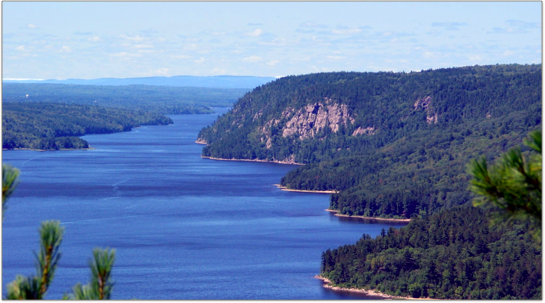
Photo below of the Ottawa River looking north, near the Chalk River Laboratories.
Lynn Jones is a founding member of theOttawa River Institute, a non-profit, charitable organization based in the Ottawa Valley. ORI’s mission is to foster sustainable communities and ecological integrity in the Ottawa River watershed.
The Algonquins of Kebaowek, Kitigan Zibi and Barriere Lake First Nations are holding a public meeting on August 10, 2023, at 50 Sussex Drive in Ottawa, to make their final presentations to the Canadian Nuclear Safety Commission about the proposed nuclear waste facility beside the Ottawa River, the NSDF.
This is a very important hearing because it is the final step in the licensing process for the NSDF, the first ever proposal for permanent nuclear reactor waste disposal in Canada. It is also a test of Canada’s commitment to the United Nations Declaration on the Rights of Indigenous Peoples. A decision to license the NSDF would contradict four articles of UNDRIP ( see details here).
There were “final” licensing hearings for the NSDF last year, in May/June 2022, but at the end of those proceedings it was recognized that consultation with Algonquin First Nations has been inadequate. Consultations with Kebaowek and Kitigan Zibi First Nations continued over the past year and included an Indigenous-led assessment of the potential impacts of the NSDF on Indigenous Rights. The findings of the assessment are summarized in this booklet.
The hearing on August 10 is the culmination of a seven-year long environmental assessment process for the NSDF – a giant above-ground mound which would hold up to one million tons of radioactive and other hazardous waste. The proposed facility would be located on unceded Algonquin territory, less than one kilometer from the Kitchi Sibi (Ottawa River) on the side of a hill surrounded by wetlands which drain via a creek into the river. The proponent of the waste facility is a multinational consortium (SNC-Lavalin, Fluor and Jacobs), which was contracted by the federal government in 2015 to quickly and cheaply reduce the multibillion dollar cleanup billfor Chalk River Labs, site of eight decades of nuclear activities such as plutonium production for US nuclear weapons. The proposed facility is expected to leak during and after construction and to disintegrate after a few hundred years due to “natural evolution.” Ten Algonquin First Nations, the Assembly of First Nations, and more than 150 municipalities including Ottawa, Gatineau and Montreal, have serious concerns about the proposed facility. More information can be found here, here and here.
During this event, three Algonquin First Nations (Kebaowek, Kitigan Zibi Anishinabe and Barriere Lake) will make their final presentations to the Canadian Nuclear Safety Commission via videolink. They will present the findings of their Indigenous-led study of the NSDF proposal, outline their concerns and highlight the threats to their Indigenous rights that would occur if the facility were granted a license. Other participants in the hearing — the proponent, CNSC staff and Commissioners — will participate remotely by webcast.
The United Nations Declaration on the Rights of Indigenous Peoples (UNDRIP) is a resolution passed by the United Nations in 2007. In Canada, on June 21, 2021, the United Nations Declaration on the Rights of Indigenous Peoples Act received Royal Assent and came into force. The Act affirms the United Nations Declaration and requires the Government of Canada to work towards its implementation.
A CNSC decision to license the giant Chalk River Radioactive Waste Mound also known as the NSDF, this contradicts the following four UNDRIP articles:
Article 25: “Indigenous peoples have the right to maintain and strengthen their distinctive, spiritual relationship with their traditionally owned and otherwise occupied and used lands, territories, water and coastal seas and other resources and to uphold their responsibilities to future generations in this regard.”
Article 29 (2): 2. “States shall take effective measures to ensure that no storage or disposal of hazardous materials shall take place in the lands or territories of indigenous peoples without their free, prior and informed consent.”
Article 32 (1): “Indigenous peoples have the right to determine and develop priorities and strategies for the development or use of their lands or territories and other resources.”
Article 32 (2): “States shall consult and cooperate in good faith with the Indigenous peoples concerned through their own representative institutions in order to obtain free and informed consent prior to the approval of any project affecting their lands or territories and other resources, particularly in connection with the development, utilization or exploitation of mineral, water or other resources.”
National Observer article by Matteo Cimellaro here
At its annual meeting in Halifax, the AFN passed a resolution introduced by Kebaowek First Nation Chief, Lance Haymond. Here is an excerpt from the press release that is posted on Kebaowek FN website:
NUCLEAR DISPOSAL ON THE CHALK RIVER LABORATORIES SITE: THE ASSEMBLY OF FIRST NATIONS CALLS FOR URGENT MEETING WITH THE FEDERAL GOVERNMENT KEBAOWEK, July 20, 2023 — Last week, at the General Assembly of the Assembly of First Nations (AFN), a resolution was adopted regarding the proposed project of a Near Surface Disposal Facility (NSDF) on the Chalk River Laboratories site, calling for “an urgent meeting between the AFN and the Government of Canada regarding the consultation policy of the Canadian Nuclear Safety Commission (CNSC) as it relates to nuclear waste transport and disposal decision”.


 Concerned Citizens of Renfrew County and Area