Why it is imperative for nuclear reactors to undergo environmental assessment

WHY IT IS IMPERATIVE FOR NUCLEAR REACTORS TO UNDERGO ENVIRONMENTAL ASSESSMENT… (comments from Dr. Gordon Edwards, President, Canadian Coalition for Nuclear Responsibility, May 29, 2019)

“All nuclear reactors must be subject to environmental assessment without exception, given that all reactors (regardless of size) produce every category of human made radioactive waste materials — low-level, intermediate level and high-level — which if released to the environment can cause long-lasting damage due to radioactive contamination.

These materials are capable in principle of causing thousands to millions of human cancers if released through any means whatsoever.

Given that the world’s first major nuclear accident occurred in 1952 at the NRX reactor at Chalk River, a very small reactor producing only 10 to 20 megawatts of heat (and no electricity), and creating high-level radioactive waste (irradiated nuclear fuel) much of which is still on site, that will remain dangerous for hundreds of millennia, as well as highly radioactive structural materials (including the destroyed reactor vessel) that will remain radioactive for tens of thousands of years, it is clear that any reactor producing as little as 10 megawatts of heat can have extraordinary impacts on the environment.

Basic environmental justice demands that remote and indigenous communities that may be the intended recipients of such reactors must have the opportunity to question the plans and challenge the assumptions of the promoters, and educate themselves to the range of risks that they may be facing as well as the long-lived radioactive legacy that such a reactor will create.”

comments submitted by Dr. Gordon Edwards on the Draft project list and proposal to exempt most nuclear reactors from impact assessment. May 29, 2019

Comments may be submitted until Friday May 31, by registering and using the purple button to type your comments in the comment box on this webpage: https://www.impactassessmentregulations.ca/consultation-on-the-proposed-Project-List?preview=true

ACTION ALERT ~ Tell the federal government NOT to exempt nuclear reactors from impact assessment

**** if you have problems submitting comments to Environment Canada, send them directly to Catherine.McKenna@parl.gc.ca ****


The government of Canada is inviting comments on the “project list” for its new proposed and controversial Impact Assessment Act. The deadline for comments is Friday May 31, 2019.


This is important and will determine which nuclear projects are fully assessed as to potential impacts and which ones get a free pass, for years into the future.


Yielding to intense nuclear industry pressure, the government has exempted most nuclear reactors from the project list, meaning they will not have to undergo thorough impact assessment by an independent panel prior to licensing.


This is astounding, and very unwise. The new project list would allow so-called “small modular reactors” to be built anywhere in Canada without impact assessment. Consider that environmental contamination has still not been cleaned up from the 1952 partial meltdown of the NRX reactor (a very small reactor by today’s standards) at the Chalk River Laboratories. Radioactive wastes such as tritium, strontium-90 and carbon-14 are leaking into the Ottawa River from where the damaged reactor core is buried and liquid wastes from the accident were dumped.

 
Can you spare five minutes to tell the government NOT to exempt nuclear reactors from the Project List for Bill C-69? Here is a link to the webpage for submitting comments. You need to register but it just takes a minute to do so.


Your comment could be as simple as “Please do not exempt ANY nuclear reactors from the project list for the new impact assessment system”. You might add that every nuclear reactor has the potential to create devastating and deadly environmental damage. Of course you could say much more. There are other nuclear project exemptions that are problematic such as the ones for nuclear reactor decommissioning and transport of irradiated nuclear fuel and other high level radioactive wastes.


Please check out these links for background and additional information if you have more time and would like to know more:


1) Civil society groups condemn plan to exempt nuclear reactors from Bill C-69 impact assessment

2) Serious deficiencies in the Draft Project List for Bill C-69 create risks for Canadians ~ Draft CCRCA comments on the draft project list

3) Why it is imperative for all new nuclear reactors to undergo environmental assessment ~ Comments from Dr. Gordon Edwards, Canadian Coalition for Nuclear Responsibility

3) With Bill C-69, a weak environmental assessment system is about to get worse

CCRCA comments on draft project list for Bill C-69

see also comments by Dr. Gordon Edwards, President of the Canadian Coalition for Nuclear Responsibility here

Comments on the Discussion Paper on the Proposed Project List

Concerned Citizens of Renfrew County and Area (Ole Hendrickson)

May 29, 2019

The proposed new project list attempts to identify so-called “major” projects, or projects with “the greatest potential for adverse environmental effects.”  The list makes extensive use of the concept of “thresholds”.  Only projects that exceed a threshold would be assessed under the new Impact Assessment Act.  The discussion paper says that projects “below these thresholds will be considered by the other regulatory regimes.”  

However, even a small project, such as a uranium mine or a small nuclear reactor, can have significant adverse environmental effects on the community where it is located.  Furthermore, impact assessments differ from regulatory regimes by providing important features such as an early planning tool with public participation, and enhanced information access – features that are important for projects of any size.

Annex 1 of the discussion paper – entitled “What we heard when we consulted on the approach to creating a new project list” states the following:

Many commenters recommended against using thresholds at all or if thresholds were used, they should be precautionary for environmental protection and should be based on science and not practical considerations like the number of projects that might require assessment.  

However, the discussion paper provides no explanation of why these comments were rejected and thresholds were used.  It does not state whether thresholds were based on science, or if so, how they were determined.  These serious deficiencies in the discussion paper raise concerns about all the entries in the new project list.

Annex 2 of the discussion paper compares the proposed new project list to the current list.  It indicates that for many project types, thresholds for triggering an assessment have been increased.  For example, the length of a pipeline or the production capacity of a mine that would trigger assessment are increased with no justification.

In the absence of any justification for the use of thresholds, or any explanation for how thresholds were determined, use of thresholds in the proposed new project list should be rejected.  All federally-funded or federally-regulated projects, or projects taking place on federal land, have a potential to cause significant adverse environmental effects, and should receive at least a basic level of federal assessment.  Thresholds should not be used to allow smaller projects to proceed without assessment.

Specifically, with regard to the section of the project list dealing with nuclear activities:

1.  “The construction, operation and decommissioning of a new nuclear fission or fusion reactor”, which is on the current project list, should be retained on the new project list.

The current Regulations Designating Physical Activities (the “project list”) require assessment of any new nuclear reactor.  The Discussion Paper on the Proposed Project List proposes that a new nuclear reactor with a thermal capacity of less than 200 MW thermal capacity that is not on an existing nuclear site, or a new reactor with a thermal capacity of less than 900 MW on an existing site, be exempted from impact assessment.  

According to the discussion paper, the 200 MW “threshold” is intended to allow so-called “small modular reactors” to be built anywhere in Canada without impact assessment.  An accident in a nuclear reactor much smaller than 200 MW could have major adverse environmental and health effects.  Environmental contamination has still not been cleaned up from the 1952 partial meltdown of the NRX reactor (which was 10 MW thermal at the time) at the Chalk River Laboratories   Radioactive wastes such as tritium, strontium-90 and carbon-14 are leaking into the Ottawa River from where the damaged reactor core is buried and liquid wastes from the accident were dumped.  

Section 22(1)(a) of the new Impact Assessment Act  states that “The impact assessment of a designated project, whether it is conducted by the Agency or a review panel, must take into account… the effects of malfunctions or accidents that may occur in connection with the designated project.”  The current requirement to assess all new nuclear reactors should be retained on the project list.

2.  “The decommissioning, abandonment or refurbishment of a nuclear fission reactor” should be on the project list.

The Comprehensive Study Regulations, which applied to the pre-2012 version of the Canadian Environmental Assessment Act, required a comprehensive study assessment of decommissioning or abandonment of “a Class IA nuclear facility that is a nuclear fission reactor that has a production capacity of more than 25 MW (thermal).”  Decommissioning of smaller nuclear reactors, and of other class IA nuclear facilities, required at least a basic environmental screening before 2012.

Six nuclear power and research reactors built by the federal government in Manitoba, Ontario and Quebec are shut down and await decommissioning, as is the case for Hydro-Quebec’s Gentilly-2 reactor.  All six units at the Pickering Nuclear Generating Station are scheduled to be shut down by 2024.  Reactor decommissioning is major looming challenge for the federal government and for utilities.  It requires determination of a preferred “end state” for the reactor site (Will it be restored for general use?), assessment of radiation exposures to workers carrying out decommissioning operations, remediation of soil and groundwater contaminated by reactor leaks, and planning for long-term management of decommissioning wastes, among other issues.

Nuclear reactor “refurbishment” – removal and replacement of major components – also should trigger an assessment that includes consideration of issues such as alternatives to refurbishment (such as renewable energy sources or enhanced conservation initiatives), and planning for long-term waste management.

With a growing number of nuclear reactors awaiting decommissioning, and ongoing debates about refurbishment of currently operating nuclear reactors, nuclear reactor decommissioning and refurbishment should be added to the project list.

3.  “The transfer of irradiated fuel or other high-level waste for off-site reprocessing, storage or disposal” should be on the project list.

High-level irradiated fuel waste is accumulating at operating nuclear reactor sites. Considerable quantities are also found at shut-down reactors.  The federal government has contracted a private consortium that includes SNC Lavalin and two U.S. companies to operate federal nuclear reactor sites (Gentilly-1, Douglas Point, Whiteshell, Chalk River) where nuclear fuel waste is stored.  The consortium wants to “consolidate” all federal high-level at Chalk River Laboratories for temporary storage.  Fifty high-level waste shipments are proposed from Whiteshell alone.  

High-level radioactive waste transport on public highways, whether for temporary storage or permanent disposal, entails serious risks to the public in the event of an accident.  If high-level wastes are shipped to Chalk River for consolidation, they will later need to be shipped again to a geological repository at a site being studied by the Nuclear Waste Management Organization.  Waste consolidation increases handling, transport and accident risks. All proposed off-site transfers of irradiated fuel or other high-level wastes (including liquids) should be added to the project list.  This will allow assessment of alternatives such as leaving wastes where they are, or transferring them to alternative locations.

4. The current project list includes a “Facility for the processing, reprocessing or separation of an isotope of uranium, thorium, or plutonium, with a production capacity of 100 t/year or more.” Separate listings should be made for processing, reprocessing, and isotope separation, and the 100-tonne threshold should be eliminated.

This current wording is problematic and confusing.  Each of these activities should be defined, and the end products of these activities should be described.  No justification is given for the 100-tonne threshold.  Separation of far smaller quantities of uranium or plutonium isotopes would create unacceptable risks of nuclear weapons proliferation.

Reprocessing traditionally refers to the chemical separation (extraction) of fissile and/or fertile material from irradiated nuclear fuel.  New reprocessing concepts would involve insertion of irradiated nuclear fuel into another reactor without actually separating the fissile or fertile materials.  Both types of “reprocessing” involve the release of fission gases and the handling of intensely radioactive irradiated nuclear fuel.  Environmental assessment should be required.

With regard to separation of isotopes, this is highly sensitive technology used to make nuclear bombs.  Uranium enrichment has never been carried out in Canada.  This activity should be listed separately, with no threshold

Unlike “reprocessing” and “isotope separation”, uranium processing is a purely chemical process.  It involves the generation of end products that can be used either for reactor fuel or further processed into nuclear weapons materials.  It generates wastes that are long-lived and pose serious health risks.  It also requires a separate listing, and any new processing facility should be assessed.

5. Any new uranium mine or mill should be on the project list, and any expansion of more than 50% in the production capacity of an existing uranium mine or mill should be on the project list.

The current project list has the following entries:  “Uranium mine or uranium mill on a site that is not within the licensed boundaries of an existing uranium mine or uranium mill;” and “Expansion of an existing uranium mine that would result in an increase in the area of mine operations of 50% or more.”  The discussion paper proposes to add a new 2,500 tonne per day production capacity threshold below which no assessment would be done; either for a new mine or mill, or for an expanded mine or mill.  

Even small uranium mines and mills can have significant adverse environmental effects.  Waste management and environmental remediation are important considerations, as well as potential adverse effects on local communities. No justification is provided for the proposed new 2,500 tonne per day threshold.  It should be rejected.  

Parliament should investigate what Canadians have gotten for their nuclear waste funding (online version)

Online version of letter to the editor in the Hill Times

May. 27, 2019

Natural Resources Minister Amarjeet Sohi is in charge of Canada’s Radioactive Waste Policy Framework, a policy that his predecessor, Jim Carr, said does not cover the long-term management of non-fuel radioactive waste. The Hill Times photograph by Andrew Meade

On April 29, 23 civil society groups and a First Nations alliance published a joint statement in The Hill Times expressing concerns about the alarming manner in which federally-owned radioactive waste is being handled by a multinational consortium of SNC-Lavalin and two U.S.-based corporations.

It is disturbing that the president of Atomic Energy of Canada Limited (AECL), himself an American and former executive from one of SNC-Lavalin’s original consortium partners, now accuses the authors of spreading “inaccuracies”—“misleading and incorrect” information that, “distorts” the truth—without citing a single example, (The Hill Times, May 13.)

The endorsing organizations stand behind every point raised in their joint statement. Any one of those concerns provides enough reason for the prime minister, Parliament and the federal government to change the current approach to the handling of long-lived radioactive wastes in Canada—a toxic liability estimated at $7.9-billion by the auditor general. Each concern is legitimate, well-founded and echoed by many others: independent scientists, municipalities and concerned citizens, including fifteen former AECL managers and scientists.

AECL has received more than $3-billion of taxpayers’ money in the past three federal budgets, handing most of that money over to the private consortium. The 2019-2020 budget alone has $737-million earmarked for radioactive waste management and decommissioning at federally-owned sites, a significant increase since the 2015 government-owned, contractor-operated (“GoCo”) private contracting model was brought in by the Harper government.

We call on Parliament to investigate whether this funding has translated into significant reductions in federal radioactive waste liabilities, and whether taxpayers are receiving real long-term value for the money being spent.

The consortium’s plan to erect a gigantic surface mound containing over one million tonnes of mixed radioactive wastes, seven stories high and 11 hectares in area, just one kilometre from the Ottawa River, is shocking. This proposal flouts international guidance and is opposed by 140 downstream municipalities that use the river for drinking water, including Gatineau and the Montreal Metropolitan Community.

Equally troubling is the consortium’s plan to “entomb” two contaminated nuclear reactors in cement right beside the Ottawa and Winnipeg Rivers. Far from being a “modern solution,” as the AECL head claims, the International Atomic Energy Agency states that “entombment is not considered an acceptable strategy” unless exceptional circumstances prevail, such as a core meltdown—and even then alternatives should be explored.

We are concerned by the absence of any adequate federal policy or regulations specifically for reactor decommissioning and radioactive waste management (other than irradiated nuclear fuel). Canada’s sole policy document, a 143-word “Radioactive Waste Policy Framework” lacks substantive content and fails to meet minimal international requirements. Minister of Natural Resources Jim Carr wrote in July 2018, “Canada does not yet have a federal policy for the long-term management of non-fuel radioactive waste.”

These wastes are the sole responsibility of the government of Canada. Roughly half of them were generated during the development of the atomic bomb and the subsequent Cold War buildup of American nuclear weapons. Now is the time for our government to take a serious, direct proprietary interest in these wastes, to ensure the protection of current and future generations of Canadians from the health risks of exposure to dangerous long-lived radioactive materials, risks that include genetic damage, chronic diseases, birth defects and cancer.

Canada’s radioactive waste legacy has been growing for over 70 years; the hazard will last for tens of thousands of years; the problem cannot be dealt with “quickly and cheaply”.

We repeat our call to end the “Go-Co” contract with SNC-Lavalin and its partners, and to consult First Nations and other Canadians with a view to formulating exemplary polices and projects for radioactive waste that meet and exceed our international obligations. We believe these wastes must be safely secured in state-of-the art facilities well away from sources of drinking water, packaged and labeled in such a way as to enable future generations to monitor, retrieve, repair, and repackage such wastes if and when the need arises. We urge that the import, export, and transport of radioactive waste not be allowed without full consultation with affected communities and careful consideration of alternatives.

Such actions will begin to re-establish Canadian leadership in the nuclear field by addressing the growing global radioactive waste problem in a responsible manner while creating many long-term, well-paying Canadian jobs.

Gordon Edwards

President

Canadian Coalition for Nuclear Responsibility

Montreal, Que.

Parliament should investigate what Canadians are getting for their nuclear waste funding ~ letter to the editor of the Hill Times (print edition)

For an easier to read version, see below.

On April 29, twenty-three civil society groups and a First Nations alliance published a joint statement in the Hill Times expressing concerns about the alarming manner in which federally-owned radioactive waste is being handled by a multinational consortium of SNC-Lavalin and two US-based corporations.

It is disturbing that the President of Atomic Energy of Canada Limited (AECL), himself an American and former executive from one of SNC-Lavalin’s original consortium partners, now accuses the authors of spreading “inaccuracies” – “misleading and incorrect” information that “distorts” the truth – without citing a single example. (Letter, Hill Times, May 13)

The endorsing organizations stand behind every point raised in their joint statement. Any one of those concerns provides enough reason for the Prime Minister, Parliament and the Federal Government to change the current approach to the handling of long-lived radioactive wastes in Canada – a toxic liability estimated at $7.9 billion by the Auditor General. Each concern is legitimate, well-founded and echoed by many others: independent scientists, municipalities and concerned citizens, including fifteen former AECL managers and scientists

AECL has received over $3 billion of taxpayers’ money in the past three federal budgets, handing most of that money over to the private consortium.The 2019-2020 budget alone has $737 million earmarked for radioactive waste management and decommissioning at federally-owned sites, a significant increase since the 2015 Government-owned, Contractor-operated (“GoCo”) private contracting model was brought in by the Harper government. 

We call on Parliament to investigate whether this funding has translated into significant reductions in federal radioactive waste liabilities, and whether taxpayers are receiving real long-term value for the money being spent.

The consortium’s plan to erect a gigantic surface mound containing over one million tonnes of mixed radioactive wastes, seven stories high and 11 hectares in area, just one kilometre from the Ottawa River, is shocking. This proposal flouts international guidance and is opposed by 140 downstream municipalities that use the river for drinking water, including Gatineau and the Montreal Metropolitan Community. 

Equally troubling is the consortium’s plan to “entomb” two contaminated nuclear reactors in cement right beside the Ottawa and Winnipeg Rivers. Far from being a “modern solution”, as the AECL head claims, the International Atomic Energy Agency states that “entombment is not considered an acceptable strategy” unless exceptional circumstances prevail, such as a core meltdown – and even then alternatives should be explored.

We are concerned by the absence of any adequate federal policy or regulations specifically for reactor decommissioning and radioactive waste management (other than irradiated nuclear fuel). Canada’s sole policy document, a 143-word “Radioactive Waste Policy Framework” lacks substantive content and fails to meet minimal international requirements. Minister of Natural Resources Jim Carr wrote in July 2018, “Canada does not yet have a federal policy for the long-term management of non-fuel radioactive waste.”

These wastes are the sole responsibility of the government of Canada. Roughly half of them were generated during the development of the atomic bomb and the subsequent Cold War buildup of American nuclear weapons. Now is the time for our government to take a serious, direct proprietary interest in these wastes, to ensure the protection of current and future generations of Canadians from the health risks of exposure to dangerous long-lived radioactive materials, risks that include genetic damage, chronic diseases, birth defects and cancer.

Canada’s radioactive waste legacy has been growing for over 70 years; the hazard will last for tens of thousands of years; the problem cannot be dealt with “quickly and cheaply”.

We repeat our call to end the “Go-Co” contract with SNC-Lavalin and its partners, and to consult First Nations and other Canadians with a view to formulating exemplary polices and projects for radioactive waste that meet and exceed our international obligations. We believe these wastes must be safely secured in state-of-the art facilities well away from sources of drinking water, packaged and labeled in such a way as to enable future generations to monitor, retrieve, repair, and repackage such wastes if and when the need arises. We urge that the import, export and transport of radioactive waste not be allowed without full consultation with affected communities and careful consideration of alternatives. 

Such actions will begin to re-establish Canadian leadership in the nuclear field by addressing the growing global radioactive waste problem in a responsible manner while creating many long-term, well-paying Canadian jobs.

Gordon Edwards, President,

Canadian Coalition for Nuclear Responsibility.

Des groupes citoyens dénoncent le projet d’exempter certains réacteurs nucléaires de l’évaluation d’impact du projet de loi C-69

Ottawa, le 7 mai 2019 – Le gouvernement du Canada veut exclure plusieurs réacteurs nucléaires de la « liste des projets désignés » qui devront subir une évaluation environnementale en vertu du projet de loi C-69, la Loi sur l’évaluation d’impact. Des groupes de la société civile dénoncent cette exemption et exigent que tous les nouveaux réacteurs nucléaires subissent une évaluation environnementale formelle, comme c’est déjà le cas maintenant.

Le document de travail du gouvernement fédéral, publié le 1er mai, propose de soustraire à la Loi sur l’évaluation d’impact tous les réacteurs nucléaires qui produiraient moins de 200 mégawatts de puissance thermique, de même que les réacteurs nucléaires qui produiraient jusqu’à 900 mégawatts de puissance thermique, et qui seraient construits sur des sites nucléaires existants. 

« Ces exclusions de l’évaluation d’impact signifient qu’il n’y aurait aucune évaluation préalable crédible, dans une perspective de développement durable, des impacts environnementaux, sanitaires, économiques ou sociaux des projets d’énergie nucléaire, qu’ils soient nouveaux, agrandis ou en réfection », déclare Theresa McClenaghan, directrice exécutive et conseillère pour l’Association canadienne du droit de l’environnement. « À notre avis, donner à l’industrie nucléaire le droit de contourner les dispositions de la Loi sur l’évaluation d’impact est l’antithèse d’une planification environnementale judicieuse et prudente, et le Parlement ne devrait jamais approuver cela. » 

 « Il est choquant de constater que le gouvernement fédéral prévoit que les projets nucléaires se feront sans évaluation d’impact », déclare Ole Hendrickson, scientifique à la retraite d’Environnement Canada et membre du conseil d’administration de la Fondation Sierra Club Canada. Cela pourrait profiter à l’industrie nucléaire, mais aux dépens de l’environnement, de la santé, de la sécurité publique et des droits des communautés autochtones. »

Dans le cadre d’une conférence de l’industrie nucléaire qui se tenait à Ottawa en novembre dernier, le ministre fédéral des Ressources naturelles, Amarjeet Sohi, a présenté une « feuille de route » qui prévoyait la construction de petits réacteurs modulaires (PRM) dans les communautés autochtones et nordiques ainsi que dans des sites miniers isolés au Canada. Les recommandations de la feuille de route incluaient des commentaires à l’effet que les PRM devraient être exemptés du projet de loi C-69.

Le document de travail sur le règlement d’application du projet de loi C-69 affirme que les effets des PRM sont « bien connus » car ils « partagent certaines des caractéristiques principales de la technologie des réacteurs classiques ». Cependant, tous les PRM proposés utiliseraient de nouvelles conceptions et des technologies non testées, parfois avec des réfrigérants à base de métaux liquides et de sels fondus qui ont provoqué des accidents graves dans les premiers réacteurs prototypes; certains PRM seraient alimentés avec des combustibles controversés jamais autorisés commercialement ou avec du plutonium, du thorium ou de l’uranium enrichi.

« Les personnes qui vivent dans les communautés nordiques et autochtones, où l’industrie nucléaire veut construire ces réacteurs, ont le droit de connaître les risques », déclare Ole Hendrickson. « Il est essentiel d’avoir une évaluation d’impact formelle, avec accès public à l’information, pour identifier ces risques, notamment les émissions radioactives et la contamination à long terme du sol et des eaux souterraines, causées entre autres par un mauvais fonctionnement ou par des accidents ».

L’évaluation d’impact des PRM a attiré l’attention des médias en novembre dernier quand ils ont révélé que la Commission canadienne de la sûreté nucléaire (CCSN), l’organisme de réglementation nucléaire du Canada, faisait secrètement pression pour que le gouvernement exempte les PRM de toute évaluation environnementale. Le Globe and Mail a dévoilé que la CCSN avait incité le gouvernement à exclure les PRM de la liste des projets désignés (voir Federal nuclear regulator urges Liberals to exempt smaller reactors from full panel review, le 6 novembre 2018).

Le document de travail exclut aussi la démolition des réacteurs et des installations nucléaires de la liste des projets désignés en vertu du projet de loi C-69. Cette démolition inclut le nettoyage, le démantèlement et l’enlèvement des installations nucléaires contaminées, le stockage des déchets radioactifs qui en résultent et la restauration des sites nucléaires pour en permettre un usage public. On le fait sans égard aux risques environnementaux de ces activités ni aux demandes des communautés hôtes.  

La réhabilitation des sites nucléaires contaminés, les nouvelles installations de stockage de déchets radioactifs sur les sites nucléaires existants et le transport des déchets nucléaires ne sont pas non plus désignés pour une évaluation d’impact dans le document de travail.

Le gouvernement fédéral donne aux Canadiens jusqu’au 31 mai pour soumettre leurs commentaires sur le document de travail concernant la liste des projets désignés dans le projet de loi C-69. Se référer à l’adresse web suivante : https://www.evaluationsimpactsreglements.ca/

À propos de la Fondation Sierra Club Canada 

La Fondation Sierra Club Canada est une organisation nationale ouverte à tous, à but non lucratif, qui a pour mission de donner aux gens les moyens de protéger, de restaurer et de profiter d’une planète saine et sûre.

À propos du Ralliement contre la pollution radioactive (RCPR)

Le RCPR a comme mission d’agir bénévolement et collectivement pour favoriser des solutions responsables de gestion des déchets radioactifs qui soient sans risque pour l’environnement et pour la santé de la population.

À propos des Concerned Citizens of Renfrew County and Area (CCRCA)

Le regroupement CCRCA a été fondé en 1978 pour faire des investigations et intervenir concernant les déchets nucléaires et d’autres problèmes de pollution dans l’Est de l’Ontario et dans le bassin versant de la rivière des Outaouais. Le groupe travaille avec d’autres groupes de la société civile pour promouvoir une gestion responsable des déchets radioactifs et la protection de l’environnement.

À propos du Regroupement pour la surveillance du nucléaire (RSN) 

Le RSN est un organisme sans but lucratif, incorporé auprès du gouvernement fédéral en 1978. Il est voué à l’éducation et à la recherche concernant toutes les questions qui touchent à l’énergie nucléaire, qu’elles soient civiles ou militaires, et tout particulièrement celles concernant le Canada.

À propos de l’Association canadienne du droit de l’environnement (CELA)

CELA est un groupe de droit d’intérêt public créé en 1970 dans le but d’utiliser et d’améliorer les lois existantes pour préserver l’environnement et protéger la santé humaine. Les avocats de CELA plaident pour les communautés vulnérables à faible revenu devant les cours de justice et les tribunaux pour adresser une grande variété de problèmes liés à l’environnement et à la santé publique.

– 30 –

Contacts pour les médias

Theresa McClenaghan
Directrice exécutive et conseillère pour l’Association canadienne du droit de l’environnement 

theresa@cela.ca

416-960-2284 ext.7219

Lynn Jones
Concerned Citizens of Renfrew County and Area
hendrickson.jones@gmail.com 

613-234-0578

Ginette Charbonneau 

Porte-parole du Ralliement contre la pollution radioactive

ginettech@hotmail.ca
514-246-6439

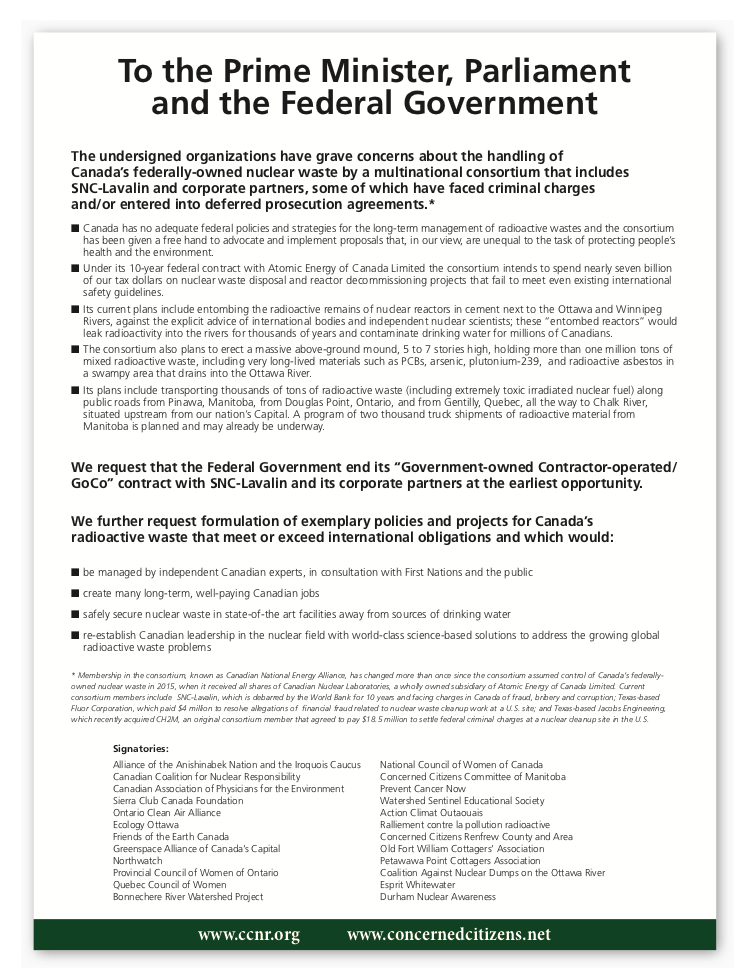
Chalk River Nuclear Waste ~ Full-page statement in the Hill-Times newspaper (April 29, 2019)

To the Prime Minister, Parliament and the Federal Government

The undersigned organizations have grave concerns about the handling of Canada’s federally-owned nuclear waste by a multinational consortium that includes SNC-Lavalin and corporate partners, some of which have faced criminal charges and/or entered into deferred prosecution agreements.*

●      Canada has no adequate federal policies and strategies for the long-term management of radioactive wastes and the consortium has been given a free hand to advocate and implement proposals that, in our view, are unequal to the task of protecting people’s health and the environment.

●       Under its 10-year federal contract with Atomic Energy of Canada Limited the consortium intends to spend nearly seven billion of our tax dollars on nuclear waste disposal and reactor decommissioning projects that fail to meet even existing international safety guidelines.

●      Its current plans include entombing the radioactive remains of nuclear reactors in cement next to the Ottawa and Winnipeg Rivers, against the explicit advice of international bodies and independent nuclear scientists; these “entombed reactors” would leak radioactivity into the rivers for thousands of years and contaminate drinking water for millions of Canadians.

●     The consortium also plans to erect a massive above-ground mound, 5 to 7 stories high, holding more than one million tons of mixed radioactive waste, including very long-lived materials such as PCBs, arsenic, plutonium-239,  and radioactive asbestos in a swampy area that drains into the Ottawa River.

●     Its plans include transporting thousands of tons of radioactive waste (including extremely toxic irradiated nuclear fuel) along public roads from Pinawa, Manitoba, from Douglas Point, Ontario, and from Gentilly, Quebec, all the way to Chalk River, situated upstream from our nation’s Capital. A program of two thousand truck shipments of radioactive material from Manitoba is planned and may already be underway.

We request that the Federal Government end its “Government-owned Contractor-operated/GoCo” contract with SNC-Lavalin and its corporate partners at the earliest opportunity.

We further request formulation of exemplary policies and projects for Canada’s radioactive waste that meet or exceed international obligations and which would:

●      be managed by independent Canadian experts, in consultation with First Nations and the public 

●      create many long-term, well-paying Canadian jobs

●      safely secure nuclear waste in state-of-the art facilities away from sources of drinking water

●      re-establish Canadian leadership in the nuclear field with world-class science-based solutions to address the growing global radioactive waste problems 

Membership in the consortium, known as Canadian National Energy Alliance, has changed more than once since the consortium assumed control of Canada’s federally-owned nuclear waste in 2015, when it received all shares of Canadian Nuclear Laboratories, a wholly owned subsidiary of Atomic Energy of Canada Limited.  Current consortium members include  SNC-Lavalin, which is debarred by the World Bank for 10 years and facing charges in Canada of fraud, bribery and corruptionTexas-based Fluor Corporation, which paid $4 million to resolve allegations of  financial fraud related to nuclear waste cleanup work at a U.S. site; and Texas-based Jacobs Engineering, which recently acquired CH2M, an original consortium member that agreed to pay $18.5 million to settle federal criminal charges at a nuclear cleanup site in the U.S.

Signatories:

Alliance of the Anishinabek Nation and the Iroquois Caucus, Canadian Coalition for Nuclear Responsibility, Canadian Association of Physicians for the Environment, Sierra Club Canada Foundation, Ontario Clean Air Alliance, Ecology Ottawa, Friends of the Earth Canada, Greenspace Alliance of Canada’s Capital, Northwatch, Provincial Council of Women of Ontario, Quebec Council of Women, National Council of Women of Canada, Concerned Citizens Committee of Manitoba, Prevent Cancer Now, Watershed Sentinel Educational Society, Action Climat Outaouais, Ralliement contre la pollution radioactive, Concerned Citizens Renfrew County,  and Area, Old Fort William Cottagers’ Association, Petawawa Point Cottagers Association, Coalition Against Nuclear Dumps on the Ottawa River,  Esprit Whitewater, Durham Nuclear Awareness, Bonnechere River Watershed Project

As it appeared in the Hill Times on April 29, 2019…

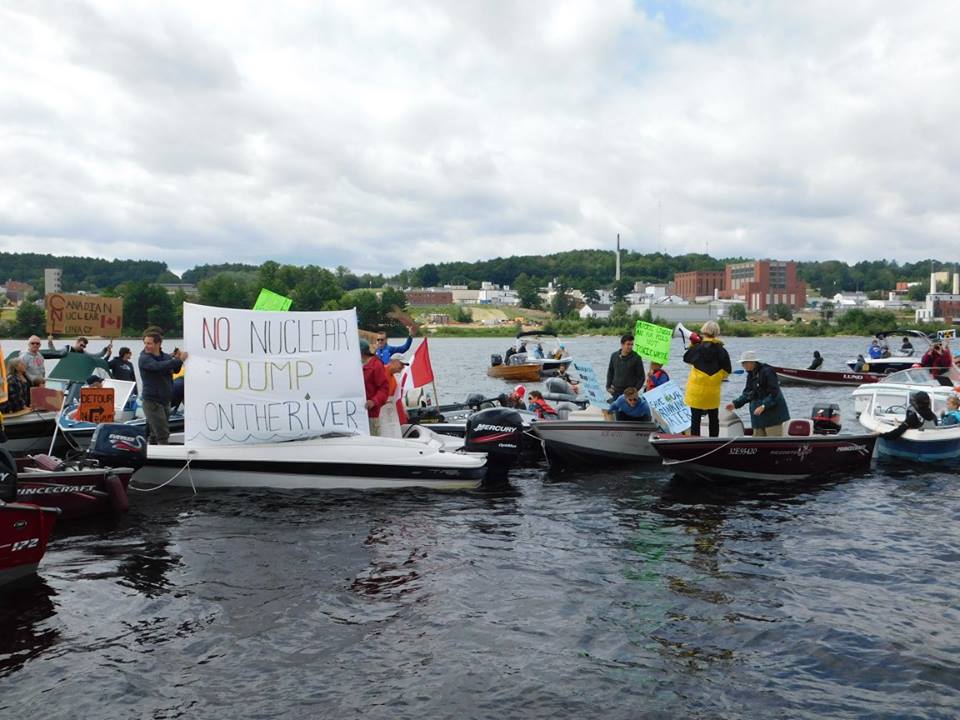
Boat flotilla protest planned for July 27, 2019

Protect the Ottawa River! ~Join us for this peaceful protest in opposition to Canadian Nuclear Laboratories’ proposed radioactive waste dump on the shores of the Ottawa River

This photo is from Chalk River Boat Flotilla Protest V1 in July 2017


Details:

Morning conference: 10:00 – 11:30 am on July 27 at Hotel Pontiac, Fort William (all invited)Several speakers will discuss CNL’s proposals for radioactive waste mound at Chalk River, entombment of NPD reactor at Rolphton, and the transport of nuclear waste to Chalk River from other locations. There will be networking and refreshments.
Media will be invited for conference and flotilla
Following the morning conference, there will be two boating options. Motor boats will leave Fort William Dock at 12:00 noon to arrive in the water in front of Chalk River Laboratories by 1:00 pm

Canoes and kayaks will go for a guided scenic tour of the shoreline and nearby islands.

If you’d like to help promote this event, you can download the poster here.

ACTION ALERT ~ tell the federal government that nuclear energy is not “clean”

ACTION ALERT ~ Tell the federal government that nuclear energy is not clean


The government of Canada is asking for comments on its “sustainable development” strategy. The deadline for comments is Tuesday April 2, 2019.
In its glossary of terms, the strategy includes the following definition:
“Clean energy: Renewable, nuclear, and carbon capture and storage technologies, as well as demand reduction through energy efficiency”

Can you help get the message across to our government that nuclear energy is not clean? It only takes a minute to send a comment using the comment box on this page: http://fsds-sfdd.ca/index.html#/en/detail/all/goal:G05

If you prefer, you can submit your comment by email to this address: ec.bdd-sdo.ec@canada.ca

Nuclear energy produces hazardous radioactive waste that must be isolated from the biosphere for hundreds of thousands of years. This is the main reason, we don’t think it should be called “clean”. See below for further information on why we think it is wrong to include nuclear in the definition of “clean energy”.

If you agree with us, please consider sending a simple message in the comment box (access through the link above). You should first enter “clean energy” the subject line and then add your comment for example, “Please remove “nuclear” from the definition of “clean energy” in your glossary of terms”. or “I object to the inclusion on “nuclear” in the definition of clean energy in your glossary of terms in the sustainable development strategy”. Of course you could say much more if you have time.

See environmental petition 419 to the Auditor General of Canada for background on why nuclear energy is not clean. Here is a link to the petition:https://tinyurl.com/AG-petition-419

Here are some excerpts from the petition:
…Nuclear reactors release a wide variety of air and water pollutants. Nuclear reactors routinely emit radioactive gases to the atmosphere during operation. These include fission and activation products such as tritium (the radioactive form of hydrogen); radioactive carbon-14; radioactive noble gases such as argon, krypton and xenon; radioactive halogens such as iodine-131; and a wide variety of radioactive aerosols. Fuel reprocessing facilities, spent fuel storage facilities and other radioactive waste facilities also release radioactive gases. (7) (8)
…The principal radionuclide in liquid effluents from nuclear reactors is tritium. Other liquid reactor effluents include radioactive isotopes of carbon, sulfur, chromium, manganese, iron, cobalt, zinc, strontium, zirconium, niobium and cesium. Radioactive effluents from fuel reprocessing facilities, spent fuel storage facilities and other radioactive waste facilities can greatly exceed those from nuclear reactors during normal operation.
…Liquid and gaseous effluents from nuclear reactors contain a wide variety of radioactive substances thatpose health risks to people living near reactors. These risks vary according to ingestion and absorption pathways, sites of accumulation in the body, and residence times for different radioactive substances.
…Radioactive wastes (spent fuel, resins, filters, chemical sludges, fuel cladding, contaminated metal and concrete reactor components, etc.) steadily accumulate during reactor operations. Most reactor wastes cannot be reused or recycled. Artificial radioactive substances produced by nuclear reactors can have half-lives of thousands to millions of years. Health risks associated with exposure to these substances may impose serious burdens upon future generations if these risks are not promptly addressed by the present generation that benefits from nuclear power.

Small Modular Nuclear Reactors make no economic sense

Are Thousands of New Nuclear Generators in Canada’s Future?


Ottawa is pushing a new smaller, modular nuclear plant that could only pay off if mass produced.

By M.V. Ramana 7 Nov 2018 | TheTyee.ca
 

Canada’s government is about to embrace a new generation of small nuclear reactors that do not make economic sense. 

Amidst real fears that climate change will wreak devastating effects if we don’t shift away from fossil fuels, the idea that Canada should get deeper into nuclear energy might seem freshly attractive to former skeptics.

For a number of reasons, however, skepticism is still very much warranted.

On Nov. 7, Natural Resources Canada will officially launch something called the Small Modular Reactor Roadmap. The roadmap was previewed in February of this year and is the next step in the process set off by the June 2017 “call for a discussion around Small Modular Reactors in Canada” issued by Canadian Nuclear Laboratories, which is interested in figuring out the role the organization “can play in bringing this technology to market.”

Environmental groups and some politicians have spoken out against this process. A petition signed by nearly two dozen civil society groups has opposed the “development and deployment of SMRs when renewable, safer and less financially, socially and environmentally costly alternatives exist.”

SMRs, as the name suggests, produce relatively small amounts of electricity in comparison with currently common nuclear power reactors. The last set of reactors commissioned in Canada is the four at Darlington. These started operating between 1990 and 1993 and can generate 878 megawatts of electricity (although, on average, they only generate around 75 to 85 per cent of that). In comparison, SMRs are defined as reactors that generate 300 MW or less — as low as 5 MW even. For further comparison, the Site C dam being built in northeastern B.C. is expected to provide 1,100 MW and BC Hydro’s full production capacity is about 11,000 MW.

Various nuclear institutions, such as Canadian Nuclear Laboratories, Canadian Nuclear Association and the CANDU Owners Group are strongly supportive of SMRs. Last October, Mark Lesinski, president and CEO of CNL announced: “Small modular reactors, or SMRs, represent a key area of interest to CNL. As part of our long-term strategy, announced earlier this year, CNL established the ambitious goal of siting a new SMR on a CNL site by 2026.”

Likewise, the CANDU Owners Group announced that it was going to use “their existing nuclear expertise to lead the next wave of nuclear generation — small modular reactors, that offer the potential for new uses of nuclear energy while at the same time offering the benefits of existing nuclear in combating climate change while providing reliable, low-cost electricity.”

A fix for climate change, says Ottawa

Such claims about the benefits of SMRs seems to have influenced the government too. Although NRCan claims to be just “engaging partners and stakeholders, as well as Indigenous representatives, to understand priorities and challenges related to the development and deployment of SMRs in Canada,” its personnel seem to have already decided that SMRs should be developed in Canada.

“The Government of Canada recognizes the potential of SMRs to help us deliver on a number of priorities, including innovation and climate change,” declared Parliamentary Secretary Kim Rudd. Diane Cameron, director of the Nuclear Energy Division at Natural Resources Canada, is confident: “I think we will see the deployment of SMRs in Canada for sure.” Such talk is premature, and unwise.

Canada is a late entrant to this game of talking up SMRs. For the most part it has only been talk, with nothing much to show for all that talk. Except, of course, for millions of dollars in government funding that has flown to private corporations. This has been especially on display in the United States, where the primary agency that has been pumping money into SMRs is the Department of Energy.

In 2001, based on an overview of around 10 SMR designs, DOE’s Office of Nuclear Energy concluded that “the most technically mature small modular reactor designs and concepts have the potential to be economical and could be made available for deployment before the end of the decade, provided that certain technical and licensing issues are addressed.” Nothing of that sort happened by the end of that decade, i.e., 2010. But in 2012 the U.S. government offered money: up to $452 million to cover “the engineering, design, certification and licensing costs for up to two U.S. SMR designs.” The two SMR designs that were selected by the DOE for funding were called mPower and NuScale.

The first pick was mPower and, a few months later, the DOE projected that a major electricity generation utility called the Tennessee Valley Authority “plans to deploy two 180 megawatt small modular reactor units for commercial operation in Roane County, Tennessee, by 2021, with as many as six mPower units at that site.”

The company developing mPower was described by the New York Times as being in the lead in the race to develop SMRs, in part because it had “the Energy Department and the T.V.A. in its camp.”

But by 2017, the project was essentially dead.

Few if any buyers

Why this collapse? In a nutshell, because there is no market for the expensive electricity that SMRs will generate. Many companies presumably enter this business because of the promise of government funding. No company has invested large sums of its own money to commercialize SMRs.

An example is the Westinghouse Electric Co., which worked on two SMR designs and tried to get funding from the DOE. When it failed in that effort, Westinghouse stopped working on SMRs and shifted its focus to decommissioning reactors that are being shut down at an increasing rate, which is seen as a growing business opportunity. Explaining this decision in 2014, Danny Roderick, then president and CEO of Westinghouse, said“The problem I have with SMRs is not the technology, it’s not the deployment — it’s that there’s no customers…. The worst thing to do is get ahead of the market.” 

Many developing countries claim to be interested in SMRs but few seem to be willing to invest in the construction of one. Although many agreements and memoranda of understanding have been signed, there are still no plans for actual construction. Examples are the cases of JordanGhana and Indonesia, all of which have been touted as promising markets for SMRs, but none of which are buying one because there are significant problems with deploying these.

A key problem is poor economics. Nuclear power is already known to be very expensive. But SMRs start with a disadvantage: they are too small. One of the few ways that nuclear power plant operators could reduce the cost of nuclear electricity was to utilize what are called economies of scale, i.e., taking advantage of the fact that many of the expenses associated with constructing and operating a reactor do not change in linear proportion to the power generated. This is lost in SMRs. Most of the early small reactors built in the U.S. shut down early because they couldn’t compete economically.

Reactors by the thousands?

SMR proponents argue that they can make up for the lost economies of scale two ways: by savings through mass manufacture in factories, and by moving from a steep learning curve early on to gaining rich knowledge about how to achieve efficiencies as more and more reactors are designed and built. But, to achieve such savings, these reactors have to be manufactured by the thousands, even under very optimistic assumptions about rates of learning. Rates of learning in nuclear power plant manufacturing have been extremely low. Indeed, in both the United States and France, the two countries with the highest number of nuclear plants, costs went up, not down, with construction experience. 

In the case of Canada, the potential markets that are most often proffered as a reason for developing SMRs are small and remote communities and mines that are not connected to the electric grid. That is not a viable business proposition. There are simply not enough remote communities, with adequate purchasing capacity, to be able to drive the manufacture of the thousands of SMRs needed to make them competitive with large reactors, let alone other sources of power.

There are thus good reasons to expect that small modular reactors, like large nuclear power plants, are just not commercially viable. They will also impose the other well-known problems associated with nuclear energy — the risk of severe accidents, the production of radioactive waste, and the linkage with nuclear weapons — on society. Rather than seeing the writing on the wall, unfortunately, NRCan and other such institutions are regurgitating industry propaganda and wasting money on technologies that will never be economical or contribute to any meaningful mitigation of climate change. There is no justification for such expensive distractions, especially as the climate problem becomes more urgent.