On April 29, twenty-three civil society groups and a First Nations alliance published a joint statement in the Hill Times expressing concerns about the alarming manner in which federally-owned radioactive waste is being handled by a multinational consortium of SNC-Lavalin and two US-based corporations.
It is disturbing that the President of Atomic Energy of Canada Limited (AECL), himself an American and former executive from one of SNC-Lavalin’s original consortium partners, now accuses the authors of spreading “inaccuracies” – “misleading and incorrect” information that “distorts” the truth – without citing a single example. (Letter, Hill Times, May 13)
The endorsing organizations stand behind every point raised in their joint statement. Any one of those concerns provides enough reason for the Prime Minister, Parliament and the Federal Government to change the current approach to the handling of long-lived radioactive wastes in Canada – a toxic liability estimated at $7.9 billion by the Auditor General. Each concern is legitimate, well-founded and echoed by many others: independent scientists, municipalities and concerned citizens, including fifteen former AECL managers and scientists.
AECL has received over $3 billion of taxpayers’ money in the past three federal budgets, handing most of that money over to the private consortium.The 2019-2020 budget alone has $737 million earmarked for radioactive waste management and decommissioning at federally-owned sites, a significant increase since the 2015 Government-owned, Contractor-operated (“GoCo”) private contracting model was brought in by the Harper government.
We call on Parliament to investigate whether this funding has translated into significant reductions in federal radioactive waste liabilities, and whether taxpayers are receiving real long-term value for the money being spent.
The consortium’s plan to erect a gigantic surface mound containing over one million tonnes of mixed radioactive wastes, seven stories high and 11 hectares in area, just one kilometre from the Ottawa River, is shocking. This proposal flouts international guidance and is opposed by 140 downstream municipalities that use the river for drinking water, including Gatineau and the Montreal Metropolitan Community.
Equally troubling is the consortium’s plan to “entomb” two contaminated nuclear reactors in cement right beside the Ottawa and Winnipeg Rivers. Far from being a “modern solution”, as the AECL head claims, the International Atomic Energy Agency states that “entombment is not considered an acceptable strategy” unless exceptional circumstances prevail, such as a core meltdown – and even then alternatives should be explored.
We are concerned by the absence of any adequate federal policy or regulations specifically for reactor decommissioning and radioactive waste management (other than irradiated nuclear fuel). Canada’s sole policy document, a 143-word “Radioactive Waste Policy Framework” lacks substantive content and fails to meet minimal international requirements. Minister of Natural Resources Jim Carr wrote in July 2018, “Canada does not yet have a federal policy for the long-term management of non-fuel radioactive waste.”
These wastes are the sole responsibility of the government of Canada. Roughly half of them were generated during the development of the atomic bomb and the subsequent Cold War buildup of American nuclear weapons. Now is the time for our government to take a serious, direct proprietary interest in these wastes, to ensure the protection of current and future generations of Canadians from the health risks of exposure to dangerous long-lived radioactive materials, risks that include genetic damage, chronic diseases, birth defects and cancer.
Canada’s radioactive waste legacy has been growing for over 70 years; the hazard will last for tens of thousands of years; the problem cannot be dealt with “quickly and cheaply”.
We repeat our call to end the “Go-Co” contract with SNC-Lavalin and its partners, and to consult First Nations and other Canadians with a view to formulating exemplary polices and projects for radioactive waste that meet and exceed our international obligations. We believe these wastes must be safely secured in state-of-the art facilities well away from sources of drinking water, packaged and labeled in such a way as to enable future generations to monitor, retrieve, repair, and repackage such wastes if and when the need arises. We urge that the import, export and transport of radioactive waste not be allowed without full consultation with affected communities and careful consideration of alternatives.
Such actions will begin to re-establish Canadian leadership in the nuclear field by addressing the growing global radioactive waste problem in a responsible manner while creating many long-term, well-paying Canadian jobs.
Ottawa, le 7 mai 2019 – Le gouvernement du Canada veut exclure plusieurs réacteurs nucléaires de la « liste des projets désignés » qui devront subir une évaluation environnementale en vertu du projet de loi C-69, la Loi sur l’évaluation d’impact. Des groupes de la société civile dénoncent cette exemption et exigent que tous les nouveaux réacteurs nucléaires subissent une évaluation environnementale formelle, comme c’est déjà le cas maintenant.
Le document de travail du gouvernement fédéral, publié le 1er mai, propose de soustraire à la Loi sur l’évaluation d’impact tous les réacteurs nucléaires qui produiraient moins de 200 mégawatts de puissance thermique, de même que les réacteurs nucléaires qui produiraient jusqu’à 900 mégawatts de puissance thermique, et qui seraient construits sur des sites nucléaires existants.
« Ces exclusions de l’évaluation d’impact signifient qu’il n’y aurait aucune évaluation préalable crédible, dans une perspective de développement durable, des impacts environnementaux, sanitaires, économiques ou sociaux des projets d’énergie nucléaire, qu’ils soient nouveaux, agrandis ou en réfection », déclare Theresa McClenaghan, directrice exécutive et conseillère pour l’Association canadienne du droit de l’environnement. « À notre avis, donner à l’industrie nucléaire le droit de contourner les dispositions de la Loi sur l’évaluation d’impact est l’antithèse d’une planification environnementale judicieuse et prudente, et le Parlement ne devrait jamais approuver cela. »
« Il est choquant de constater que le gouvernement fédéral prévoit que les projets nucléaires se feront sans évaluation d’impact », déclare Ole Hendrickson, scientifique à la retraite d’Environnement Canada et membre du conseil d’administration de la Fondation Sierra Club Canada. Cela pourrait profiter à l’industrie nucléaire, mais aux dépens de l’environnement, de la santé, de la sécurité publique et des droits des communautés autochtones. »
Dans le cadre d’une conférence de l’industrie nucléaire qui se tenait à Ottawa en novembre dernier, le ministre fédéral des Ressources naturelles, Amarjeet Sohi, a présenté une « feuille de route » qui prévoyait la construction de petits réacteurs modulaires (PRM) dans les communautés autochtones et nordiques ainsi que dans des sites miniers isolés au Canada. Les recommandations de la feuille de route incluaient des commentaires à l’effet que les PRM devraient être exemptés du projet de loi C-69.
Le document de travail sur le règlement d’application du projet de loi C-69 affirme que les effets des PRM sont « bien connus » car ils « partagent certaines des caractéristiques principales de la technologie des réacteurs classiques ». Cependant, tous les PRM proposés utiliseraient de nouvelles conceptions et des technologies non testées, parfois avec des réfrigérants à base de métaux liquides et de sels fondus qui ont provoqué des accidents graves dans les premiers réacteurs prototypes; certains PRM seraient alimentés avec des combustibles controversés jamais autorisés commercialement ou avec du plutonium, du thorium ou de l’uranium enrichi.
« Les personnes qui vivent dans les communautés nordiques et autochtones, où l’industrie nucléaire veut construire ces réacteurs, ont le droit de connaître les risques », déclare Ole Hendrickson. « Il est essentiel d’avoir une évaluation d’impact formelle, avec accès public à l’information, pour identifier ces risques, notamment les émissions radioactives et la contamination à long terme du sol et des eaux souterraines, causées entre autres par un mauvais fonctionnement ou par des accidents ».
L’évaluation d’impact des PRM a attiré l’attention des médias en novembre dernier quand ils ont révélé que la Commission canadienne de la sûreté nucléaire (CCSN), l’organisme de réglementation nucléaire du Canada, faisait secrètement pression pour que le gouvernement exempte les PRM de toute évaluation environnementale. Le Globe and Mail a dévoilé que la CCSN avait incité le gouvernement à exclure les PRM de la liste des projets désignés (voir Federal nuclear regulator urges Liberals to exempt smaller reactors from full panel review, le 6 novembre 2018).
Le document de travail exclut aussi la démolition des réacteurs et des installations nucléaires de la liste des projets désignés en vertu du projet de loi C-69. Cette démolition inclut le nettoyage, le démantèlement et l’enlèvement des installations nucléaires contaminées, le stockage des déchets radioactifs qui en résultent et la restauration des sites nucléaires pour en permettre un usage public. On le fait sans égard aux risques environnementaux de ces activités ni aux demandes des communautés hôtes.
La réhabilitation des sites nucléaires contaminés, les nouvelles installations de stockage de déchets radioactifs sur les sites nucléaires existants et le transport des déchets nucléaires ne sont pas non plus désignés pour une évaluation d’impact dans le document de travail.
Le gouvernement fédéral donne aux Canadiens jusqu’au 31 mai pour soumettre leurs commentaires sur le document de travail concernant la liste des projets désignés dans le projet de loi C-69. Se référer à l’adresse web suivante : https://www.evaluationsimpactsreglements.ca/
À propos de la Fondation Sierra Club Canada
La Fondation Sierra Club Canada est une organisation nationale ouverte à tous, à but non lucratif, qui a pour mission de donner aux gens les moyens de protéger, de restaurer et de profiter d’une planète saine et sûre.
À propos du Ralliement contre la pollution radioactive (RCPR)
Le RCPR a comme mission d’agir bénévolement et collectivement pour favoriser des solutions responsables de gestion des déchets radioactifs qui soient sans risque pour l’environnement et pour la santé de la population.
À propos des Concerned Citizens of Renfrew County and Area (CCRCA)
Le regroupement CCRCA a été fondé en 1978 pour faire des investigations et intervenir concernant les déchets nucléaires et d’autres problèmes de pollution dans l’Est de l’Ontario et dans le bassin versant de la rivière des Outaouais. Le groupe travaille avec d’autres groupes de la société civile pour promouvoir une gestion responsable des déchets radioactifs et la protection de l’environnement.
À propos duRegroupement pour la surveillance du nucléaire (RSN)
Le RSN est un organisme sans but lucratif, incorporé auprès du gouvernement fédéral en 1978. Il est voué à l’éducation et à la recherche concernant toutes les questions qui touchent à l’énergie nucléaire, qu’elles soient civiles ou militaires, et tout particulièrement celles concernant le Canada.
À propos de l’Association canadienne du droit de l’environnement (CELA)
CELA est un groupe de droit d’intérêt public créé en 1970 dans le but d’utiliser et d’améliorer les lois existantes pour préserver l’environnement et protéger la santé humaine. Les avocats de CELA plaident pour les communautés vulnérables à faible revenu devant les cours de justice et les tribunaux pour adresser une grande variété de problèmes liés à l’environnement et à la santé publique.
– 30 –
Contacts pour les médias
Theresa McClenaghan
Directrice exécutive et conseillère pour l’Association canadienne du droit de l’environnement
Ottawa, May 7, 2019 — The Government of Canada is proposing that the “project list” for Bill C-69, the Impact Assessment Act, exempt many nuclear reactors from any environmental assessment. Civil society groups are condemning the exemption from environmental assessment under Bill C-69 and demanding that all new nuclear reactors be subjected to formal environmental assessment, as is now the case.
The federal government’s discussion paper, released on May 1, proposes that all nuclear reactors that produce less than 200 megawatts of thermal power be excluded from the Impact AssessmentAct, as well as nuclear reactors built on existing nuclear sites that produce up to 900 megawatts of thermal power.
“Excluding nuclear energy projects from impact assessment means there will be no credible sustainability-based assessment of the environmental, health, economic or social impacts of new, expanded or refurbished nuclear energy projects before they proceed,” says Theresa McClenaghan, Executive Director and Counsel for the Canadian Environmental Law Association. “In our view, giving the nuclear power industry a free pass under the Impact Assessment Act is the antithesis of sound and precautionary environmental planning, and should not be countenanced by Parliament.”
“It is shocking that the federal government expects nuclear projects to go ahead with no impact assessment,” says Dr. Ole Hendrickson, a retired Environment Canada scientist and board member of Sierra Club Canada Foundation. “This may benefit the nuclear industry, but at the expense of the environment, public health and safety and the rights of Indigenous communities.”
In November, federal Minister of Natural Resources Amarjeet Sohi launched a “roadmap” at a nuclear industry conference in Ottawa that outlines plans to build Small Modular Reactors (SMRs) in Indigenous and northern communities and at remote mining sites across Canada. The Roadmap’s recommendations included comments suggesting that SMRs should be exempted from Bill C-69.
The discussion paper for Bill C-69 regulations says that the effects from SMRs are “well known” and “share core characteristics” with existing conventional reactor technology. However, all proposed SMRs would employ new and untested designs, or technologies, some involving liquid metal and molten salt coolants that caused serious accidents in early prototype reactors, and some using controversial fuels never commercially allowed in Canada before, based on plutonium, thorium, or enriched uranium.
“People in northern and Indigenous communities where the nuclear industry wants to build these reactors have a right to know what the risks are,” says Hendrickson. “A formal impact assessment with public disclosure is essential to identify these risks, including radioactive emissions and long-lasting contamination of soil and groundwater, especially due to malfunctions or accidents.”
Impact assessment of SMRs became a focus of media attention last November when it was revealed that Canada’s nuclear regulator, the Canadian Nuclear Safety Commission (CNSC), had been secretly lobbying the Government for the reactors to be exempted from environmental assessment. The Globe and Mail reported that CNSC encouraged the government to exempt small modular reactors from the list of designated projects (see Federal nuclear regulator urges Liberals to exempt smaller reactors from full panel review – November 6, 2018).
The discussion paper also does not include decommissioning of nuclear reactors and facilities on the project list for Bill C-69. Decommissioning includes cleaning up, dismantling and removing contaminated nuclear facilities; storing the resulting radioactive waste; and returning the nuclear sites back to public use. This is despite the environmental risks of these activities and direct requests from host communities.
Remediation of contaminated nuclear sites, new radioactive waste storage facilities at existing nuclear sites, and nuclear waste transport are also not identified for impact assessment in the discussion paper.
The federal government is giving Canadians until May 31 to submit comments on the discussion paper regarding the Bill C-69 Project List at the following address: impactassessmentregulations.ca
ABOUT CCRCA
The Concerned Citizens of Renfrew County and Area was formed in 1978 to research and advocate about nuclear waste and other pollution issues in Eastern Ontario and the Ottawa River watershed. The group works closely with other civil society groups to promote responsible management of radioactive wastes and protection of the environment.
ABOUT CCNR The Canadian Coalition for Nuclear Responsibility is a not-for-profit organization, federally incorporated since 1978, dedicated to education and research on all issues related to nuclear energy, whether civilian or military, especially those pertaining to Canada.
ABOUT SIERRA CLUB CANADA FOUNDATION
Sierra Club Canada Foundation is a national and grassroots non-profit organization committed to empowering people to protect, restore and enjoy a healthy and safe planet.
ABOUT RALLIEMENT CONTRE LA POLLUTION RADIOACTIVE
The mission of the Ralliement contre la pollution radioactive (RCPR) is to act voluntarily and collectively to promote responsible solutions for the management of radioactive waste that are safe for the environment and for the health of the population.
ABOUT CELA
The Canadian Environmental Law Association is a public interest law group founded in 1970 for the purposes of using and enhancing environmental laws to protect the environment and safeguard human health. CELA lawyers represent low-income and vulnerable communities in the courts and before tribunals on a wide variety of environmental and public health issues.
– 30 –
Media contacts:
Theresa McClenaghan Executive Director and Counsel,
(to arrange an interview with Dr. Ole Hendrickson of SCCF or Dr. Gordon Edwards of CCNR) Concerned Citizens of Renfrew County and Area hendrickson.jones@gmail.com 613-234-0578
This is page 41 of the application for renewal of the Whiteshell Labs license. The CNSC hearing for this license renewal is scheduled for October 2-3, 2019. This page outlines CNL’s plans for transport of low, intermediate and high level radioactive waste from Pinawa, Manitoba to Chalk River, Ontario. The full license application can be viewed at http://www.cnl.ca/en/home/about/WLSiteRelicensing2018.aspx
A total of 2,000 shipments are described in this excerpt, including shipments of liquid waste and irradiated nuclear fuel rods. Shipments are already underway as of March, 2019.
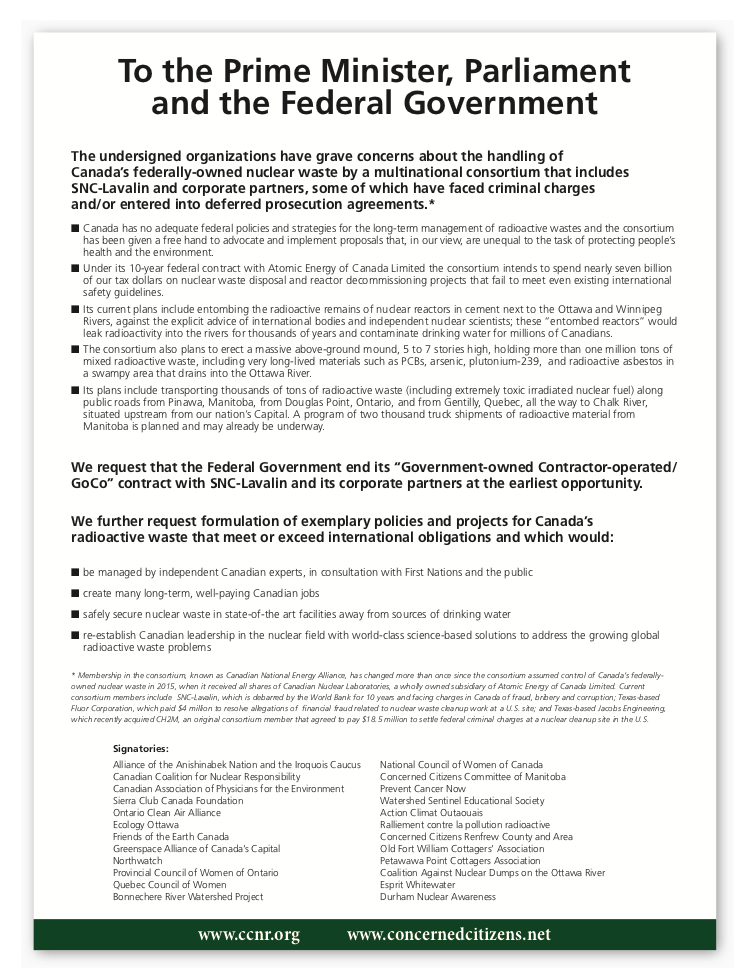
To the Prime Minister, Parliament and the Federal Government
The undersigned organizations have grave concerns about the handling of Canada’s federally-owned nuclear waste by a multinational consortium that includes SNC-Lavalin and corporate partners, some of which have faced criminal charges and/or entered into deferred prosecution agreements.*
● Canada has no adequate federal policies and strategies for the long-term management of radioactive wastes and the consortium has been given a free hand to advocate and implement proposals that, in our view, are unequal to the task of protecting people’s health and the environment.
● Under its 10-year federal contract with Atomic Energy of Canada Limited the consortium intends to spend nearly seven billion of our tax dollars on nuclear waste disposal and reactor decommissioning projects that fail to meet even existing international safety guidelines.
● Its current plans include entombing the radioactive remains of nuclear reactors in cement next to the Ottawa and Winnipeg Rivers, against the explicit advice of international bodies and independent nuclear scientists; these “entombed reactors” would leak radioactivity into the rivers for thousands of years and contaminate drinking water for millions of Canadians.
● The consortium also plans to erect a massive above-ground mound, 5 to 7 stories high, holding more than one million tons of mixed radioactive waste, including very long-lived materials such as PCBs, arsenic, plutonium-239, and radioactive asbestos in a swampy area that drains into the Ottawa River.
● Its plans include transporting thousands of tons of radioactive waste (including extremely toxic irradiated nuclear fuel) along public roads from Pinawa, Manitoba, from Douglas Point, Ontario, and from Gentilly, Quebec, all the way to Chalk River, situated upstream from our nation’s Capital. A program of two thousand truck shipments of radioactive material from Manitoba is planned and may already be underway.
We request that the Federal Government end its “Government-owned Contractor-operated/GoCo” contract with SNC-Lavalin and its corporate partners at the earliest opportunity.
We further request formulation of exemplary policies and projects for Canada’s radioactive waste that meet or exceed international obligations and which would:
● be managed by independent Canadian experts, in consultation with First Nations and the public
● create many long-term, well-paying Canadian jobs
● safely secure nuclear waste in state-of-the art facilities away from sources of drinking water
● re-establish Canadian leadership in the nuclear field with world-class science-based solutions to address the growing global radioactive waste problems
* Membership in the consortium, known as Canadian National Energy Alliance, has changed more than once since the consortium assumed control of Canada’s federally-owned nuclear waste in 2015, when it received all shares of Canadian Nuclear Laboratories, a wholly owned subsidiary of Atomic Energy of Canada Limited. Current consortium members include SNC-Lavalin, which is debarred by the World Bank for 10 years and facing charges in Canada of fraud, bribery and corruption; Texas-based Fluor Corporation, which paid $4 million to resolve allegations of financial fraud related to nuclear waste cleanup work at a U.S. site; and Texas-based Jacobs Engineering, which recently acquired CH2M, an original consortium member that agreed to pay $18.5 million to settle federal criminal charges at a nuclear cleanup site in the U.S.
Signatories:
Alliance of the Anishinabek Nation and the Iroquois Caucus, Canadian Coalition for Nuclear Responsibility, Canadian Association of Physicians for the Environment, Sierra Club Canada Foundation, Ontario Clean Air Alliance, Ecology Ottawa, Friends of the Earth Canada, Greenspace Alliance of Canada’s Capital, Northwatch, Provincial Council of Women of Ontario, Quebec Council of Women, National Council of Women of Canada, Concerned Citizens Committee of Manitoba, Prevent Cancer Now, Watershed Sentinel Educational Society, Action Climat Outaouais, Ralliement contre la pollution radioactive, Concerned Citizens Renfrew County, and Area, Old Fort William Cottagers’ Association, Petawawa Point Cottagers Association, Coalition Against Nuclear Dumps on the Ottawa River, Esprit Whitewater, Durham Nuclear Awareness, Bonnechere River Watershed Project
As it appeared in the Hill Times on April 29, 2019…
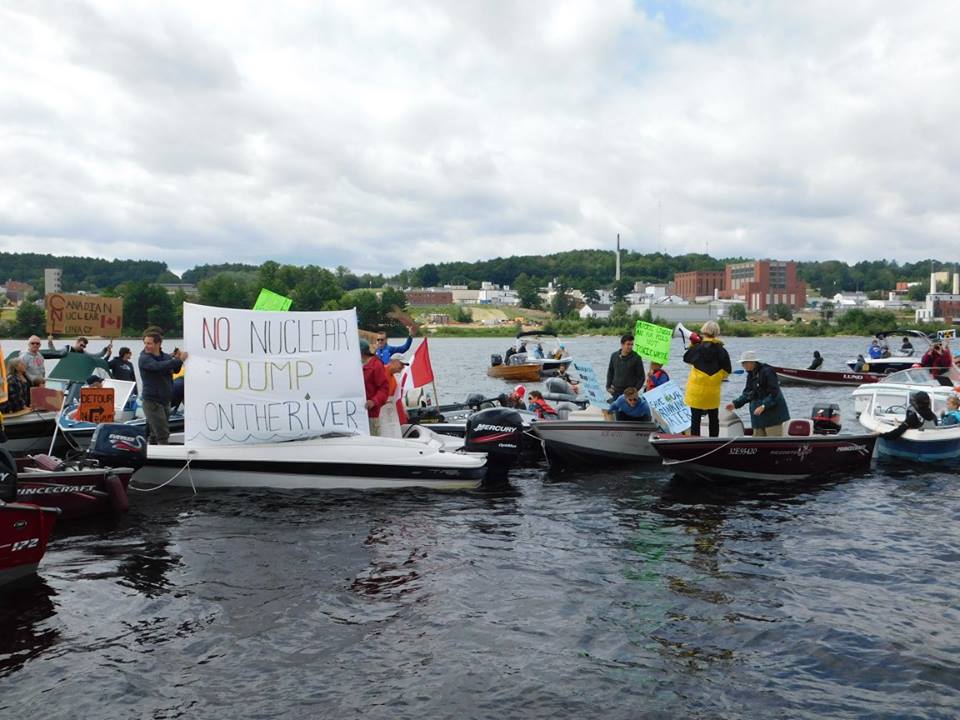
Protect the Ottawa River! ~Join us for this peaceful protest in opposition to Canadian Nuclear Laboratories’ proposed radioactive waste dump on the shores of the Ottawa River
This photo is from Chalk River Boat Flotilla Protest V1 in July 2017
Details:
Morning conference: 10:00 – 11:30 am on July 27 at Hotel Pontiac, Fort William (all invited)Several speakers will discuss CNL’s proposals for radioactive waste mound at Chalk River, entombment of NPD reactor at Rolphton, and the transport of nuclear waste to Chalk River from other locations. There will be networking and refreshments. Media will be invited for conference and flotilla Following the morning conference, there will be two boating options. Motor boats will leave Fort William Dock at 12:00 noon to arrive in the water in front of Chalk River Laboratories by 1:00 pm
Canoes and kayaks will go for a guided scenic tour of the shoreline and nearby islands.
If you’d like to help promote this event, you can download the poster here.
Three recent submissions to the Canadian Nuclear Safety Commission by Dr. J.R. Walker, Canada’s foremost expert on the Government of Canada’s legacy radioactive wastes and how to properly manage them can be accessed here and here. (Backup source in case CNSC website not working)
According to his Linked In, Dr. Walker was the Director of Safety Engineering and Licensing at AECL when he retired before the multinational consortium took over management of Chalk River Laboratories. He was identified as “champion” on behalf of AECL in this CNSC protocol for the Nuclear Legacy Liabilities Program. He states very clearly in his submissions to the CNSC that the wastes proposed for disposal in the NSDF are “intermediate level wastes” that require underground disposal. He says the dump would be hazardous and radioactive for many thousands of years and that radiation doses from the facility would exceed allowable levels.
“No inventory management system is in place to comprehensively verify that waste packages and unpackaged waste accepted for emplacement comply with the radiological parameters of the stated waste acceptance criteria;
“The waste acceptance criteria are insufficiently protective for the material permitted to be emplaced in the proposed Engineered Containment Mound to qualify as low level waste — the radionuclides do not decay to an acceptable level during the time that institutional controls can be relied upon. Consequently, the emplaced material is intermediate level radioactive waste that should not be emplaced in a near surface facility because it requires a greater degree of containment and isolation than that provided by near surface disposal;
“Using the waste acceptance criteria credited in the proponent’s Environmental Impact Statement, it possible to calculate when the constituent radionuclides of the stated inventory would decay sufficiently to meet Canada’s regulatory criteria for disposal. This calculation reveals that many radionuclides would not decay sufficiently to meet Canada’s disposal criteria for many thousands of years and, in some cases, for many millions of years. This means that the safety of humans and nonhuman biota would be dependent upon institutional controls in perpetuity.
“The proposal is non-compliant with International Safety Standards, for example, no verification of the radioactive content of emplaced waste and reliance on institutional controls to ensure long-term safety. Canada is bound by international treaty to have due regard to internationally endorsed criteria and standards concerning radioactive waste management. Consequently, giving approval to the proposed ECM would appear to place Canada in contravention of its international treaty obligations.“
Original post ~ April 2019
Fifteen former AECL officials and scientists have submitted critical comments on the CNL nuclear waste disposal projects. These people point out many serious flaws in the proposals and the environmental impact statements.
These comments were all submitted to CNSC/CEAA. Links are to the CEAA pages for the environmental assessments for the disposal projects Most of these former AECL employees identify themselves as “residents of Deep River” or “residents of Pinawa” and do not refer to their employment at AECL in their submissions (but see Michael Stephens’ second NSDF submission). All are retired, but their former job titles or responsibilities – found through internet searching – are shown in parentheses, below.
A multinational consortium wants to build two nuclear waste dumps alongside the Ottawa River upstream of Ottawa-Gatineau, one at Chalk River, Ontario and the other at Rolphton, Ontario. Both dumps disregard international safety guidelines and would leak radioactive materials into the Ottawa River, endangering drinking water for millions of Canadians living downstream.
Background:
In 1944 Chalk River Laboratories (CRL) were established to produce plutonium for nuclear weapons. Starting in 1952 the Labs were operated by “Atomic Energy of Canada Limited” (AECL). Besides producing plutonium, the labs established a prototype nuclear power reactor (NPD) upstream of Chalk River at Rolphton, and extracted “medical isotopes” from irradiated fuel. These activities and two serious accidents created large quantities of dangerous radioactive wastes. Cleanup costs are estimated at $8 billion.
The Harper government radically restructured AECL in 2015, creating a subsidiary called Canadian Nuclear Laboratories (CNL) and contracting a multinational consortium including SNC Lavalin, to operate the subsidiary and reduce the federal government’s nuclear cleanup liabilities quickly and cheaply. All four consortium members face or have faced criminal charges for fraud and corruption*. Annual costs to taxpayers tripled shortly after restructuring.
In 2016, CNL proposed to construct a giant, above-ground mound of radioactive waste (NSDF) at Chalk River and to entomb in concrete the NPD reactor at Rolphton. Both proposals disregard International Atomic Energy Agency safety standards and would permanently contaminate the Ottawa River with radioactive materials such as plutonium, caesium, strontium and tritium, some of which will be remain hazardous for over 100,000 years. CNL is also moving to bring thousands of shipments of radioactive waste (including highly toxic used fuel rods) to Chalk River from other federal sites in Manitoba, Ontario and Quebec.
Independent experts, retired AECL scientists, Citizens’ groups, NGOs, 140 Quebec municipalities and several First Nations have been sounding alarm bells about the projects via written comments, resolutions, press conferences, and protests including a boat flotilla on the Ottawa River in August 2017 and a Red Canoe March for Nuclear Safety through the streets of downtown Ottawa in January of 2018.
In April 2018, CNL was granted a 10-year license despite widespread concern over license changes that would make it easier for the consortium to get its nuclear waste projects approved. Canada’s nuclear regulator, the Canadian Nuclear Safety Commission (CNSC), granted the new license. The CNSC is also in charge of environmental assessment (EA) and licensing for nuclear waste projects. The CNSC is perceived to be a “captured” regulator that promotes projects it is charged with regulating, according to Canada’s Expert Panel on EA reform. The CNSC’s mishandling of EAs for the consortium’s nuclear waste projects is described in Environmental Petition 413 to the Auditor General of Canada.
* The consortium, known as Canadian National Energy Alliance, includes: SNC-Lavalin,debarred by the World Bank for 10 years and facing charges in Canada of fraud, bribery and corruption; CH2M agreed to pay $18.5 million to settle federal criminal charges at a nuclear cleanup site in the U.S.; Fluor paid $4 million to resolve allegations of financial fraud related to nuclear waste cleanup work at a U.S. site; Rolls-Royce PLC, parent company of consortium member Rolls-Royce Civil Nuclear Canada Ltd., recently agreed to pay more than CAN$1 billion in fines for bribery and corruptionin the U.K., U.S. and Brazil. **NB** since this post was first published, membership in the consortium has changed. Rolls Royce is no longer listed as a consortium member on the CNEA website and Texas based Jacobs Engineering has recently acquired CH2M.
ACTION ALERT ~ Tell the federal government that nuclear energy is not clean
The government of Canada is asking for comments on its “sustainable development” strategy. The deadline for comments is Tuesday April 2, 2019. In its glossary of terms, the strategy includes the following definition: “Clean energy: Renewable, nuclear, and carbon capture and storage technologies, as well as demand reduction through energy efficiency”
Can you help get the message across to our government that nuclear energy is not clean? It only takes a minute to send a comment using the comment box on this page: http://fsds-sfdd.ca/index.html#/en/detail/all/goal:G05
If you prefer, you can submit your comment by email to this address: ec.bdd-sdo.ec@canada.ca
Nuclear energy produces hazardous radioactive waste that must be isolated from the biosphere for hundreds of thousands of years. This is the main reason, we don’t think it should be called “clean”. See below for further information on why we think it is wrong to include nuclear in the definition of “clean energy”.
If you agree with us, please consider sending a simple message in the comment box (access through the link above). You should first enter “clean energy” the subject line and then add your comment for example, “Please remove “nuclear” from the definition of “clean energy” in your glossary of terms”. or “I object to the inclusion on “nuclear” in the definition of clean energy in your glossary of terms in the sustainable development strategy”. Of course you could say much more if you have time.
See environmental petition 419 to the Auditor General of Canada for background on why nuclear energy is not clean. Here is a link to the petition:https://tinyurl.com/AG-petition-419
Here are some excerpts from the petition: …Nuclear reactors release a wide variety of air and water pollutants. Nuclear reactors routinely emit radioactive gases to the atmosphere during operation. These include fission and activation products such as tritium (the radioactive form of hydrogen); radioactive carbon-14; radioactive noble gases such as argon, krypton and xenon; radioactive halogens such as iodine-131; and a wide variety of radioactive aerosols. Fuel reprocessing facilities, spent fuel storage facilities and other radioactive waste facilities also release radioactive gases. (7) (8) …The principal radionuclide in liquid effluents from nuclear reactors is tritium. Other liquid reactor effluents include radioactive isotopes of carbon, sulfur, chromium, manganese, iron, cobalt, zinc, strontium, zirconium, niobium and cesium. Radioactive effluents from fuel reprocessing facilities, spent fuel storage facilities and other radioactive waste facilities can greatly exceed those from nuclear reactors during normal operation. …Liquid and gaseous effluents from nuclear reactors contain a wide variety of radioactive substances thatpose health risks to people living near reactors. These risks vary according to ingestion and absorption pathways, sites of accumulation in the body, and residence times for different radioactive substances. …Radioactive wastes (spent fuel, resins, filters, chemical sludges, fuel cladding, contaminated metal and concrete reactor components, etc.) steadily accumulate during reactor operations. Most reactor wastes cannot be reused or recycled. Artificial radioactive substances produced by nuclear reactors can have half-lives of thousands to millions of years. Health risks associated with exposure to these substances may impose serious burdens upon future generations if these risks are not promptly addressed by the present generation that benefits from nuclear power.
Posted By Alexandra Bly In Biodiversity & Habitat,Canada,Energy Politics,Finance & Investment,Health & Safety,Nuclear,Opinion & Analysis,United States |Full Story: The Energy Mix @theenergymix March 10, 2019Primary Author Paul McKay7 Comments
Jeangagnon/Wikimedia Commons
On the anniversary of the 2011 Fukushima nuclear disaster, investigative journalist Paul McKay reveals that the trade in radioactive waste is becoming a lucrative opportunity for SNC-Lavalin and its U.S. partner.
If it is true that one person’s garbage can be another’s gold, then Montreal-based multinational SNC-Lavalin and its new U.S. partner, Holtec International, plan to be big global players in what promises to be a very lucrative, long-term business: handling highly radioactive nuclear wastes until permanent disposal methods and sites might be found, approved, and built.
That problem is pressing because the volume of spent reactor fuel is cresting in the U.S., Canada, Europe, China, India, Russia, and Japan. There are also hundreds of intensively contaminated reactors which must sooner or later be entombed, dismantled, chopped up by robots, then sent in special, sealed containers to interim storage sites somewhere.
But no country in the world has yet found a proven, permanent solution for the 250 million kilograms of spent fuel now in limbo[2] in storage pools and canisters, let alone the atomic furnaces which created them. There are now[3] about 413 operable civilian reactors in 31 countries, and another 50 under construction.
Physics tells us precisely how “hot” atomic garbage is. Every commercial power reactor—regardless of model, type, country, or owner/operator—contains the radioactive equivalent of many atomic bombs locked within its spent fuel, reactor core, pumps, valves, and extensive cooling circuits.
To illustrate this, consider that only a small fraction of the “fission inventory” at the Fukushima nuclear site escaped during the terrifying March, 2011 accident. All operating civilian reactors eventually create and contain more than 200[4] such “hot” elements and isotopes. Known as transuranic elements, actinides, and activation products, they comply with the laws of physics but defy ordinary definitions of danger, technological assurance, and even human-calibrated time itself.
Some fission products transmute or decay within days, while others (like plutonium-239) can take 24,000 years or more[5] to lose half their deadly mass. As this happens alpha, beta, or gamma radiation is constantly emitted, which in turn can directly damage living cells and organs. Many of these particles can accumulate like silent assassins in the food chain, then strike later.
Worse, they have the ability to invade human bodies by mimicking needed minerals like the calcium, potassium, magnesium, or iron we find in milk, meat, or vegetables. Worse still, they can impair human reproductive organs, causing health damage and intergenerational genetic defects. If exposed, adult women are more vulnerable to radiation than men, because they have one lifetime store of ova while male sperm is replenished over time. Children are most vulnerable of all, because they produce especially defenseless cells at a torrid rate as they grow.
And finally, the “hot” inventory of every reactor contains some irradiated elements which will remain latently lethal for hundreds of centuries or more. Each has its own emission signature and decay rate. The fissile isotope Uranium 235[6], for example, will lose half its mass after 700 million years.
This is not speculative; it is a matter of fundamental physics and biology. Fukushima illustrated why achieving even a 98% containment success rate means catastrophic consequences. The risk of any such failure for millennia to come is an embedded liability for every power reactor operating today, and for its spent fuel legacy.
So it bears examining just who is taking charge of the most dangerous garbage on Earth. Enter SNC-Lavalin and Holtec International.
**********
Canadians might recognize century-old SNC-Lavalin as a venerable engineering giant, but with past decades of technical success and corporate gravitas ruined by 21st century bribery, fraud, and corruption scandals, and by recent convictions of employees and executives for corporate malfeasance.
In 2013, following sordid proof of bribery and kickback schemes from Libya to Bangladesh, the World Bank banned[7] SNC-Lavalin and its 100 global affiliates from bidding on contracts for 10 years. The company is also facing criminal charges[8] for its tactics to win a new hospital construction contract in Montreal, and another criminal probe[9] related to a Montreal bridge contract. A reputation that was once impeccable now may be irredeemable.
SNC-Lavalin also has a well-documented history of manipulating compliant federal and Quebec politicians, and securing endless subsidies, concessions, sweetheart loans, and preferential tax and legal treatments sanctioned by both Liberal and Conservative prime ministers. In 2018, the federal election watchdog reported[10] the company had made more than $117,000 in illegal political donations (the lion’s share of which went to the Liberals) by secretly conscripting employee donations and routing them through obscure pathways. In January 2019, a disgraced company executive pleaded guilty[11] to orchestrating the illegal election finance scheme.
Most recently, the federal minister of justice and attorney general, the top law enforcement official in the country, is alleged to have lost her cabinet post after she rebuffed efforts by Prime Minister Justin Trudeau and his top advisors to have her waive potential criminal penalties (which would preclude SNC-Lavalin bidding on federal contracts for 10 years) in favour of fines and anti-corruption measures. That followed a recent, under-the-radar revision of the federal Criminal Code to allow for such corporate leniency, for which SNC-Lavalin lobbied repeatedly[12].
In 2011, under the former Stephen Harper government, SNC-Lavalin managed to acquire key commercial nuclear contracts, intellectual property, and personnel of the federal Crown corporation Atomic Energy of Canada Ltd. (AECL). The purchase price was C$15 million (plus possible future royalty payments to Ottawa) for an entity into which Canadian taxpayers had sunk[13] more than $17 billion during six previous decades.
Why would the Canadian engineering company pay even that much, when global nuclear growth was barely 1% last year, and capital investment in renewable power generation (nearly US$300 billion[14] in 2016) is more than double that for new nuclear and fossil-based generation (coal, oil, gas) combined? Wasn’t that fatal trend already obvious?
Perhaps it was. But perhaps someone in Montreal also cunningly calculated that there might be much more money to be made during the demise of the global nuclear industry, like a company specializing in dangerous demolitions, or removing asbestos). Because the cumulative volume of atomic garbage is still climbing—and especially since Fukushima, governments and utilities are willing to pay extortionate sums to remove nuclear wastes from densely-populated areas and keep them out of sight for decades or more.
If there are few rivals in that “hot garbage” business, all the better, because that will fetch more contracts at higher prices. Then fortune will favour the brazen.
Such a business model also apparently appeals to U.S.-based Holtec International. It has not designed, financed, or built typical nuclear power plants. Instead, it has created a global contracting business supplying nuclear replacement parts, equipment, and services. For two decades, a core business has been providing concrete casks for spent fuel storage.
During that time, Holtec paid a US$2-million fine[15] related to bribery payments to a convicted federal utility manager, and was the subject of scathing safety reviews by a U.S. quality assurance engineer who was later terminated for suspected whistleblowing. A federal Nuclear Regulatory Commission specialist in nuclear cask safety, Dr. Ross Landsman, contemporaneously concluded[16]: “As far as I am concerned, Holtec has no quality assurance. This is the same kind of thinking that led to the NASA Space Shuttle disaster.”
More recently, Holtec has pursued its plan to buy now-defunct U.S. reactors, cut and gut their radioactive innards, then send the scrap along with the spent fuel to a 1,000-acre property it has acquired in remote New Mexico. But the proposed site is facing stiff public and political opposition[17], because Holtec also plans to store wastes from many retired reactors there.
In 2014, Holtec received promises of US$260 million in New Jersey state subsidies to move its headquarters 12 miles to South Camden, and modernize a vast shipyard building at an estimated cost of US$320 million. The subsidies are contingent on creating 320 permanent jobs, and are to be dispensed over 10 years.
Last September, police formed a protective barricade at the plant entrance after Holtec founder Krishna P. Singh complained[18] to a business journal: “There is no tradition of work in [Camden] families. They don’t show up to work. They can’t stand getting up in the morning and coming to work every single day. They haven’t done it, and they didn’t see their parents do it. Of course, some of them get into drugs and things. So, it’s difficult.”
**********
Back in Canada, SNC-Lavalin is leading a consortium Ottawa belatedly convened to clean up Canada’s first nuclear research and reactor site at Chalk River, Ontario. The “hot garbage” there includes contaminated buildings, instruments, pipes and clothing. Reactors at Chalk River and nearby Rolphton await entombment. An estimated one million cubic meters of atomic wastes are slated to be buried near the upper Ottawa River. Even some former AECL scientists have condemned[19] the planned mega-dump.
The site is 200 kilometres upstream of Parliament Hill, where the $15-million deal to sell key AECL assets was approved. But SNC-Lavalin was indemnified from liabilities in that deal, and the federal government retains ownership of the Chalk River property, buildings, and contaminated materials. So the private consortium is now being paid nearly $1 billion[20] each year by federal taxpayers to manage and bury radioactive[21] wastes at Chalk River, and to operate labs to conduct nuclear research there.
The controversial company has also embedded itself in the Ontario nuclear power sector by way of its Trojan horse purchase of AECL assets. That federal Crown company held key CANDU reactor design patents, decades of crucial calculations and technical drawings, and employed remnants of the irreplaceable cadre of nuclear physicists, chemists, and engineers needed to repair, rebuild, and run Ontario’s nuclear fleet.
Once these assets were bestowed upon SNC-Lavalin by Ottawa, it had the leverage to negotiate lucrative contracts with Bruce Power and Ontario Power Generation (OPG), guaranteeing a major share of work related to $26 billion in combined nuclear power plant reconstruction costs during the next decade. Under the $13-billion Darlington refurbishment contract, up to 93% of any project cost overruns[22] will be borne by the province of Ontario (sole owner of OPG), not SNC-Lavalin or allied private contractors—which gives a big, influential engineering firm with no discernable competition very little incentive to bring the project in on budget.
Those two $13-billion contracts involve removing and replacing major CANDU reactor components. That experience, in turn, will leave the company uniquely positioned to eventually decommission Canada’s fleet of reactors, and handle a projected 5.4 million spent fuel bundles. That work will cost another estimated $23 billion (in 2015 dollars), which reactor operators will be compelled to collect[23] from power consumers and preserve for that use.
In America, Holtec has homed in on similarly alluring pots of “hot” honey, only there they are much, much bigger. That’s because nearly 100 commercial reactors in the U.S. are facing eventual retirement, and federal laws force the utilities that own the reactors to collect a constant stream of payments from consumers to cover plant decommissioning and spent fuel disposal costs. Those multi-billion-dollar pools of money have grown over time, but American utilities cannot draw from them without regulatory approval.
But there is no licenced federal facility in all of America to permanently immobilize and bury the “hot” spent fuel currently being stored at some 80 sites, and only one federal disposal site in South Carolina which will accept both nuclear weapons waste (including military reactors) and a rare few dismantled civilian reactor cores.
Think plugged toilet. Think Fukushima, because Japan has no permanent nuclear waste disposal site. So spent fuel bundles there were stacked in improvised swimming pools—outside the crucial containment shell. Think Pickering, Ontario, where decades of spent fuel is accumulating in swimming pools and concrete canisters because Canada has no approved final disposal site for “hot garbage”.
Everyone in the civilian nuclear business—from reactor operators to their regulators—understands that they might be one extended pump system failure, blackout, earthquake, extreme storm, or cyber-attack away from a public health catastrophe. They are desperate for some saviour to make it all go away.
**********
Re-enter SNC-Lavalin and Holtec. Last summer, instead of competing as rivals, they created a joint venture to collaborate on “hot garbage” contracts across the continent. To the great relief of reactor operators and regulators, their subsidiary CDI is promising to buy defunct nuclear plants, dismantle contaminated components, then ship those and spent fuel bundles in concrete canisters to its isolated New Mexico property. All, CDI claims, at a price and speed individual utilities could not hope to achieve on their own.
For the U.S. utilities, such a deal would get rid of their worst liability nightmare in a hurry and clean up their bottom line, because CDI would get paid from the dedicated funds utilities are forbidden to use for any other purpose. For state utility regulators and the federal Nuclear Regulatory Commission, it would banish the problem to one remote patch of scrubland, far away in the U.S. southwest.
Emphasis on “one”. If the Holtec site in New Mexico does receive final approval, the CDI joint venture will have sole access to the first and only such private facility in North America. Naturally, owning the only toilet in town would confer an effective monopoly, giving the two joint venture partners enough leverage to win most future nuclear disposal contracts, while cashing in as platinum-priced plumbers.
But even if Holtec’s proposed US$2.4-billion project in New Mexico gets licenced and built, and the CDI joint venture does a booming business sending “hot garbage” there from some 80 sites in 35 states, Ernest Hemingway’s curt counsel to “never confuse movement with action” applies here.
The New Mexico facility will not be designed or licenced as a permanent disposal site. Holtec’s sealed canisters will not be designed or licenced to hold nuclear wastes for more than a few decades. And if recent troubles are any indication, some might not last a year—let alone decades.
Holtec and the federal Nuclear Regulatory Commission have now locked horns over the integrity of its newest sealed containers at the San Onofre nuclear complex, 60 miles north of San Diego. It was shut down in 2013, after breakdowns and repair costs made it uneconomic to operate.
Now, the utility owner is prepping the reactors for dismantling at a cost of US$4.4 billion, and some 3.6 million pounds of hot spent fuel waste remains on the site. This year, most of the San Onofre fuel bundles were expected to be transferred from an indoor swimming pool to an outdoor morgue, where new Holtec caskets waited on a ridge overlooking the Pacific Ocean.
However, Holtec made design changes to its casks without notifying the utility or the federal regulator. Only a few had been filled before workers noticed a loose bolt which could jam hot fuel bundles, or puncture the metal cask lining, or prevent future inspections or removal of spent fuel. Work was stopped for 10 days and the NRC was notified. It in turn ordered[24] Holtec to stop supplying casks with the modified design, but many had already been delivered to other nuclear plant sites.
Then fuel transfers were halted again because inexperienced Holtec employees allowed[25] a 50-ton Holtec canister—filled with hot spent fuel bundles—to be dangerously misaligned as it was being lifted by a crane and inserted into a vault at the San Onofre site. The NRC reprimanded Holtec sharply[26] for lax training and oversight related to the incident.
The episodes illustrate the vanishingly small margins of error when dealing with nuclear wastes. Luckily, no leak or accident occurred at San Onofre. But the errant four-inch stainless steel bolt (and the unauthorized cask design change by Holtec) was discovered only by chance, just as 43 identical Holtec casks were waiting to be filled at San Onofre. Others had already been filled at nuclear sites from New England to Alabama.
**********
The shape-shifting lethality of “hot” fission products, and their immutable longevity, tests the limits of not just human technology, but most measures of human conduct.
Once it’s created, such “hot garbage” demands all companies involved be immune to greed, bribery, cutting corners, masking quality control failures, or deceiving safety auditors.
It requires regulators that are relentlessly vigilant, trained to detect flaws and complacency, impervious to bribes or coercion, and who place a far higher priority on public safety than on reactor performance, career promotions, pleasing the boss, or pay raises.
It requires politicians who refuse to dispense favours, subsidies, or serial excuses to preferred players, and who always keep the lethality and longevity of nuclear wastes foremost in their minds when making related policy.
This matrix of perfection, of course, does not exist anywhere on this planet.
So there have been horrific accidents such as Chernobyl and Fukushima. Nuclear plants like San Onofre have been built atop known earthquake faults, a stone’s throw from the Pacific Ocean. In France, massive reactor core containment vessels were belatedly found to be defective—years after startup. In 2016, the French national nuclear safety authority found[27] that a state-owned forging company had falsified quality control reports for four decades while as many as 400 defective parts were supplied.
At the eight-reactor Pickering[28] nuclear complex, located in Canada’s densest population corridor, the plutonium locked inside spent fuel bundles is equal to that embedded in 11,000 nuclear weapons. Even more atomic waste is lurking at the eight-reactor Bruce complex and four-reactor Darlington plant in Ontario, and at the Point Lepreau reactor in New Brunswick.
The Fukushima tragedy, physics, and biology tell us the only tolerable nuclear containment breach rate is zero per cent. For forever. Yet the “hot garbage” keeps piling up, even though it can imperil our biosphere for centuries. This is not just tempting fate. It is giving it the middle finger.
Paul McKay has won Canada’s top awards for investigative, business and feature reporting multiple times, and is the author of two books about nuclear technology and policy. This report was researched and written pro bono. No funding from any source was sought or received.7 Comments (Open | Close)
7 COMMENTS TO “HOT GARBAGE GRIFTERS: SNC-LAVALIN’S PLAN TO TURN NUCLEAR WASTE INTO LONG-TERM GOLD”
#1 Pingback By Hot Garbage Grifters: SNC-Lavalin’s Plan to Turn Nuclear Waste into Long-Term Gold – Enjeux énergies et environnement On March 10, 2019 @ 9:09 PM
[…] The Energy Mix [29]; via […]
#2 Comment By Paul Gervan On March 11, 2019 @ 10:12 AM
Brilliant investigative work. Here’s to independent media. Bravo Paul McKay!
#3 Comment By Mireille LaPointe On March 12, 2019 @ 11:27 AM
Absolutely brilliant! Miigwech, Paul.
#4 Comment By Donna Gilmore On March 15, 2019 @ 8:56 AM
Excellent article! The story is even worse at San Onofre and with Holtec and the NRC. The Holtec system the NRC approved damages the walls of every canister downloaded into the storage holes. The utility, Southern California Edison, and these other players are trying to hide or downplay this issue. The NRC refuses to formally document this issue or hold anyone accountable for a system that immediately shortens the life of these uninspectable and unrepairable thin-wall canisters (only 5/8″ thick). They have no fix other than to recall and replace this system. The root cause is Holtec’s poorly engineered imprecise downloading system that gouges the walls of every canister downloaded. Edison admitted to the NRC that the entire length of the canister wall scrapes against a steel metal guide ring as it is lowered past the ring over 18 feet. More information at SanOnofreSafety.org
#5 Comment By Brennain Lloyd On April 3, 2019 @ 9:06 AM
Excellent. A detailed analysis for the SNC-Lavelin’s sordid past and aspired to future and the connecting point (radioactive wastes) from a reliable investigative journalist. Thank you, Paul McKay.
#6 Comment By Ole Hendrickson On August 2, 2019 @ 11:05 AM
Anyone who has children or who cares about the future should read this article.
#7 Comment By Nira Dookeran On August 2, 2019 @ 1:22 PM
Omg. It’s even worse than I thought. And I thought it was very bad.:-(



 Concerned Citizens of Renfrew County and Area