(Montréal, 23 mars 2020) Trois organisations de la société civile indépendantes – l’Association canadienne des médecins pour l’environnement, le Regroupement pour la surveillance du nucléaire et l’Institut sur la rivière des Outaouais – demandent au directeur général de l’Agence internationale de l’énergie atomique (AIÉA) des Nations Unies de reconsidérer la nomination d’un Canadien en tant que président de sa Commission responsable des normes de sécurité.
Dans une récente lettre au directeur général Rafael M. Grossi, signée par le Dr. Gordon Edwards, le Dr. Éric Notebaert, docteur en médecine, et le Dr. Ole Hendrickson, les auteurs font part de leurs préoccupations concernant la nomination de Rumina Velshi, présidente de la Commission canadienne de sûreté nucléaire (CCSN), en tant que présidente de la Commission responsable des normes de sécurité de l’AIÉA, du fait que l’organisation qu’elle préside (CCSN) a un historique bien documenté de faire fi des normes de sécurité de l’AIÉA et de préconiser l’exemption d’évaluation environnementale pour le petits réacteurs nucléaires au Canada.
«Nous craignons que la nomination de Mme Velshi en vienne à une réduction des normes internationales, et qu’on favorise les avantages pour l’industrie nucléaire et l’appui aux «innovations» au détriment de la protection du public,» mentionne-t-on dans la lettre.
On mentionne également dans la lettre qu’il se pourrait que Mme Velshi ne rencontre pas les normes de l’AIÉA quant à l’indépendance face à l’industrie nucléaire que devraient avoir ses agents de règlementation. Avant sa nomination comme présidente de la CCSN, elle a travaillé pendant huit ans à des postes de haute direction d’Ontario Power Generation (OPG) et elle a dirigé l’équipe commerciale d’OPG qui a proposé d’acheter pour plusieurs milliards de dollars de nouveaux réacteurs nucléaires.
Dans une déclaration publiée de la Commission canadienne de sûreté nucléaire datée du 26 février 2020, on mentionne que sa présidente, Rumina Velshi, «a l’intention d’utiliser sa présidence pour faire reconnaître l’importance d’une plus grande harmonisation des normes pour faire en sorte qu’elles soutiennent l’innovation nucléaire.» Dans une récente allocution devant l’Association nucléaire canadienne, Mme Velshi a réaffirmé ces prises de position.
Les auteurs de la lettre citent le rapport final d’un récent examen de l’AIÉA concernant le cadre sécuritaire du nucléaire au Canada pour prouver l’échec de la CCSN à respecter les normes de sécurité de l’AIÉA. L’examen identifiait plusieurs lacunes et considérait que «de manière générale, la réglementation de la CCSN ne répond pas à toutes les exigences fondamentales de sécurité de l’AIÉA.» L’examen considérait également que le Canada n’était pas conforme aux normes de l’AIÉA en ce qui a trait au démantèlement des réacteurs nucléaires.
«La CCSN propose de permettre l’ensevelissement et l’abandon de carcasses à très longue vie radioactive de vieux réacteurs nucléaires désaffectés comme stratégie acceptable de démantèlement au Canada. Cette approche est explicitement rejetée par les normes de sécurité de l’AIÉA, sauf en cas d’urgence comme un accident nucléaire d’importance (la fonte d’un réacteur),» souligne le Dr Edwards, président du Regroupement pour la surveillance du nucléaire. «Nous sommes préoccupés par cette tentative de la CCSN de permettre au Canada des pratiques contre lesquelles l’AIÉA nous met en garde et nous ne voulons pas que cette façon de faire soit exportée partout ailleurs dans le monde.»
La lettre au directeur général mentionne la façon que la CCSN traite trois projets controversés de disposition de déchets nucléaires comme preuve additionnelle du mépris qu’a l’organisme concernant les normes de sécurité de l’AIÉA. Les installations proposées comprennent : un monticule géant, à proximité de la rivière des Outaouais, devant accueillir un million de tonnes de déchets radioactifs et toxiques tels, entre autres, du plutonium-239, de l’américium-243, du zirconium-93, du nickel-59, du carbone-14; et également l’ensevelissement dans le béton de deux réacteurs fédéraux désaffectés, à proximité des rivières Winnipeg et des Outaouais, qui fournissent l’eau courante à des millions de Canadiens.
Les organisations demandent au directeur de l’AIÉA de maintenir l’intégrité des normes de sécurité de l’AIÉA et de continuer à mettre l’accent sur l’importance vitale de s’assurer de son indépendance et de son objectivité, en déclarant : «Nous accordons une grande importance aux normes de sécurité de l’AIÉA; à l’heure actuelle, c’est tout ce qui est de nature officielle à se mettre entre les CanadienNEs et trois projets de disposition de déchets nucléaires qui porteraient atteinte pour des générations à venir à l’environnement et la santé publique au Canada.»
La lettre soutient que la CCSN est largement perçue comme étant un «régulateur captif», qui met la priorité sur les besoins de l’industrie nucléaire plutôt que sur la protection du public face aux polluants radioactifs provenant des installations nucléaires.
For immediate release (Montreal, March 23, 2020) Three independent civil society organizations — the Canadian Association of Physicians for the Environment, the Canadian Coalition for Nuclear Responsibility and the Ottawa River Institute — are asking the Director General of the UN’s International Atomic Energy Agency (IAEA) to reconsider the recent appointment of a Canadian as chair of its commission on safety standards.
In a recent letter to IAEA Director General Rafael M. Grossi, signed by Dr. Gordon Edwards, Dr. Éric Notebaert, MD, and Dr. Ole Hendrickson, the authors say they are concerned about the appointment of Rumina Velshi, president of the Canadian Nuclear Safety Commission (CNSC), to chair the IAEA’s commission on nuclear safety standards because the organization she heads has a documented record of disregarding IAEA safety standards and advocating for exemption of smaller nuclear reactors from environmental assessment in Canada.
“We fear that Ms. Velshi’s chairmanship could result in the lowering of international standards, with an emphasis on benefits to the nuclear industry and support of ‘innovation’ at the expense of public protection,” says the letter.
According to the letter, Ms. Velshi might not meet the IAEA’s standards for regulatory officials’ independence from the nuclear industry. Before her appointment as CNSC president, she worked for Ontario Power Generation for eight years in senior management positions and led the OPG commercial team involved in a multi-billion dollar proposal to procure new nuclear reactors.
A published statement from the Canadian Nuclear Safety Commission dated February 26, 2020 says its president, Rumina Velshi, “intends to use her chairmanship to champion the importance of greater harmonization of standards and ensure they support nuclear innovation.” In a recent address to the Canadian Nuclear Association Ms. Velshi reiterated these sentiments.
The letter’s authors cite the final report of a recent IAEA review of Canada’s nuclear safety framework as evidence of the CNSC’s failure to meet IAEA safety standards. The review identified numerous deficiencies and found that “CNSC regulations do not comprehensively cover all IAEA Fundamental Safety Requirements.” The review also found Canada to be out of alignment with IAEA standards for nuclear reactor decommissioning.
“The CNSC is proposing to permit entombment and abandonment of very long-lived radioactive entrails of shutdown ‘legacy’ nuclear reactors as an acceptable strategy for decommissioning in Canada. This approach is expressly rejected by IAEA safety standards, except in emergency circumstances such as severe reactor accidents (i.e. meltdowns),” says Dr. Edwards, President of the Canadian Coalition for Nuclear Responsibility. “We are alarmed by this attempt of the CNSC to permit practices in Canada that the IAEA warns against and we don’t want to see this approach exported to the rest of the world.”
The letter to the IAEA Director General cites the CNSC’s handling of three controversial proposals for nuclear waste disposal as further evidence of the regulatory agency’s disregard of IAEA safety standards. The proposed facilities include: a giant, above-ground mound, close to the Ottawa River, for one million tons of mixed radioactive and other toxic wastes including long-lived radionuclides such as plutonium-239, americium-243, zirconium-93, nickel-59, carbon-14 and many more; as well as the planned entombment in concrete of two shutdown federal reactors beside the Winnipeg and Ottawa rivers, which provide drinking water for millions of Canadians.
The groups call on the IAEA director to maintain the integrity of IAEA safety standards and to continue to emphasize the vital importance of ensuring independence and objectivity, stating: “We value IAEA safety standards; at the moment they are all that is of an official nature standing between Canadians and three nuclear waste disposal projects that would adversely affect the environment and public health in Canada for generations.”
The letter notes that the CNSC is widely perceived to be a “captured regulator”, that prioritizes needs of the nuclear industry over protection of the public from radioactive pollutants released from nuclear facilities. -30-
La Commission canadienne de sûreté nucléaire (CCSN) a annoncé le 25 février que sa présidente, Rumina Velshi, avait été nommée à la tête de la Commission des normes de sûreté de l’Agence internationale de l’énergie atomique. Cette nomination nous préoccupe profondément pour les raisons suivantes :
Nous soumettons d’abord que l’AIEA ne devrait pas confier la présidence de sa Commission sur les normes de sécurité à la dirigeante d’un organisme national de réglementation qui a souvent ignoré les normes de sûreté de l’AIEA. Le rapport d’examen par les pairs (1) que vient de publier l’AIEA sur le cadre de sûreté nucléaire du Canada révèle ce qui suit:
La règlementation de la CCSN «ne couvre pas complètement l’ensemble des exigences fondamentales de l’AIEA en matière de sûreté ».
La CCSN « n’a aucune démarche systématique pour identifier les écarts entre les nouvelles exigences de l’AIEA et son cadre de réglementation ».
Le style de rédaction législative du Canada « peut créer des difficultés pour identifier et retrouver le libellé exact des dispositions qui correspondent à chaque exigence des normes de sûreté de l’AIEA ».
Comme exemple concret de l’indifférence de la CCSN envers les normes de sûreté de l’AIEA, citons sa décision de procéder à une évaluation environnementale de trois projets d’élimination des déchets nucléaires qui enfreignent manifestement les normes de sûreté de l’AIEA. Ces projets incluent le stockage permanent, dans un énorme monticule hors-sol, d’un million de tonnes de déchets mixtes, radioactifs et non radioactifs, incluant des radionucléides à vie longue comme le plutonium-239, l’américium-243, le zirconium-93, le nickel-59, le carbone 14 et bien d’autres encore. On prévoit aussi enchâsser deux réacteurs inactifs dans des sarcophages de béton en bordure de rivières majeures qui alimentent des millions de Canadiens en eau potable.
Ces trois installations libéreraient des contaminants radioactifs dans l’environnement pendant des millénaires. La CCSN a rejeté les avertissements d’experts scientifiques relativement aux graves lacunes des trois projets lors de l’étape de la description du projet des évaluations environnementales. Ces projets ont suscité des centaines de protestations de la part des ministères fédéraux et provinciaux, des Premières Nations, de divers groupes de la société civile, de municipalités, de scientifiques à la retraite et de citoyens concernés. Pourtant, ces évaluations environnementales se poursuivent depuis près de quatre ans, bien plus longtemps que l’évaluation d’un an que subissent normalement les projets non-nucléaires. La CCSN a modifié l’échéancier plus d’une fois pour donner plus de temps au promoteur afin de mieux répondre aux craintes du public, et il n’y a toujours pas d’échéance claire pour la conclusion des évaluations. Avec bon nombre de nos collègues, nous avons porté à l’attention de votre prédécesseur nos préoccupations à l’égard de ces projets, en avril 2018. (voir la lettre au Dr Yukiya Amano) (2)
La CCSN s’est également efforcée de rendre acceptable la stratégie du « déclassement in situ » pour les vieux réacteurs nucléaires, malgré les directives claires de l’Agence internationale de l’énergie atomique selon qui cette stratégie ne devrait servir que pour les situations d’urgence, lors d’un accident grave par exemple. Le récent examen par les pairs de l’AIEA a noté ce problème et a suggéré que le Canada « révise ses exigences actuelles et futures en matière de déclassement pour les aligner sur les directives de l’AIEA ». Cependant, la CCSN tente toujours de redéfinir les « circonstances exceptionnelles » et d’inclure le déclassement in situ parmi les stratégies acceptables pour les anciens réacteurs.
La Commission canadienne de sûreté nucléaire est largement perçue au Canada comme victime de capture réglementaire, comme l’a noté le Groupe d’experts sur la réforme de l’évaluation environnementale en avril 2017. * Ce problème de capture réglementaire de la part de la CCSN était aussi souligné dans la pétition 427 en matière d’environnement, « Problèmes de gouvernance nucléaire au Canada » (3), adressée au vérificateur général du Canada en juin 2019. De même, la publication de l’industrie nucléaire, Nuclear Energy Insider, a récemment qualifié le Canada d’excellent endroit pour développer de petits réacteurs modulaires, surtout à cause de son « environnement réglementaire bénin ». (4)
Nous constatons que la CCSN se soucie bien plus des besoins de l’industrie que de protéger le public des effets néfastes du rayonnement ionisant d’origine humaine qu’émettent constamment les installations nucléaires. De l’aveu du personnel de la CCSN en 2017, les commissaires n’avaient jamais refusé d’accorder un permis en 17 ans d’histoire de l’agence (5).
Nous croyons que la dirigeante d’une agence de réglementation « captive » qui ne tient pas compte des directives de l’AIEA sur la gestion des déchets nucléaires et qui travaille activement à affaiblir les normes de sûreté sur le déclassement des réacteurs nucléaires, ne devrait pas être éligible pour diriger la commission de l’AIEA sur les normes de sûreté internationales.
Nous croyons que Mme Velshi pourrait être en situation de conflit d’intérêts à titre de présidente de la Commission canadienne de sûreté nucléaire. Avant sa nomination à la tête de la CCSN, Mme Velshi a travaillé pendant sept ans chez Ontario Power Generation, à des postes de haute direction. Elle ne serait probablement pas qualifiée « d’indépendante » à la lumière du IAEA General Safety Guide No. GSG-12 (Organization, Management and Staffing of the Regulatory Body for Safety) qui explique en détails l’importance de l’indépendance de l’organisme de réglementation pour que lesjugements réglementaires puissent être rendus et appliqués sans pressions indues d’intérêts contraires à la sécurité. Nous soutenons que le manque d’indépendance de Mme Velshi à l’endroit de l’industrie nucléaire la rend inapte à présider la Commission des normes de sûreté de l’AIEA.
Mme Velshi a déclaré qu’elle entend utiliser sa présidence « pour défendre l’importance d’une plus grande harmonisation des normes et pour s’assurer qu’elles favoriseront l’innovation nucléaire sans jamais compromettre la sûreté ». Nous craignons que le leadership de Mme Velshi ne se traduise par un affaiblissement des normes, qui privilégierait l’intérêt de l’industrie et l’aide à « l’innovation » au détriment de la protection du public. Nous notons que la CCSN a plaidé avec succès pour que les petits réacteurs modulaires soient exemptés des évaluations environnementales au Canada (6); nous n’aimerions pas qu’une telle exemption fasse partie de « l’harmonisation » des normes internationales que préconise Mme Velshi.
Nous apprécions les normes de sécurité de l’AIEA; elles sont présentement le seul rempart officiel des Canadiens contre trois projets d’élimination des déchets nucléaires qui pourraient nuire à l’environnement et à la santé publique du Canada pendant des générations. Nous vous exhortons à maintenir l’intégrité des normes de sûreté de l’AIEA et à toujours souligner l’importance vitale de l’indépendance et de l’objectivité. Veuillez reconsidérer la nomination de Rumina Velshi à la présidence de la commission de l’AIEA sur les normes de sécurité.
Cordialement,
Gordon Edwards, Ph.D,Regroupement pour la surveillance du nucléaire Éric Notebaert, MD, M.Sc.Association canadienne des médecins pour l’environnement Ole Hendrickson, Ph.DOttawa River Institute
CC: Le très honorable Justin Trudeau, Premier ministre du Canada
L’Hon. François-Philippe Champagne, Ministre des Affaires étrangères
L’Hon. Seamus O’Regan, Ministre des Ressources Naturelles, Canada
L’Hon. Andrew Scheer, le Parti conservateur du Canada
M. Yves-François Blanchette, Bloc Québécois
M. Jagmeet Singh, NPD
Mme. Elizabeth May, Parti Vert du Canada M. Sylvain Ricard, Vérificateur général du Canada
M. Andrew Hayes, la commissaire à l’Environnement et au Développement durable par intérim
* Extrait du rapport du groupe d’experts : « Une préoccupation souvent répétée était l’absence perçue d’indépendance et de neutralité en raison de la relation étroite que l’ONE et la CCSN entretiennent avec les industries qu’ils réglementent. Ils s’inquiétaient du fait que ces autorités responsables font la promotion de projets qu’elles doivent réglementer. La crainte d’un parti pris ou d’un conflit d’intérêts, réel ou non, était la préoccupation la plus fréquemment soulevée par les participants touchant le rôle de l’ONE et de la CCSN à titre d’autorités responsables. Les participants ont souvent évoqué « l’emprise réglementaire » pour décrire leurs perceptions à l’égard des deux organismes. La crainte de parti-pris de la part de ces deux autorités responsables a miné la confiance dans le processus d’évaluation. » https://www.canada.ca/content/dam/themes/environment/conservation/environmental-reviews/building-common-ground/batir-terrain-entente.pdf
The Canadian Nuclear Safety Commission announced on February 25 that CNSC President Rumina Velshi has been named to Chair the International Atomic Energy Agency’s Commission on Safety Standards. We are deeply concerned about this appointment for the reasons explained below.
Firstly, we submit that the head of a national regulatory body with a documented history of failing to meet IAEA safety standards should not chair the IAEA Commission on safety standards. According to the recently released report (1) from the IAEA peer review of Canada’s nuclear safety framework,
CNSC regulations “do not comprehensively cover all IAEA Fundamental Safety Requirements.”
CNSC “has no systematic approach to conduct a gap analysis between the new IAEA requirements and its regulatory framework.”
Canada’s style of legislative practice “may create difficulties to find exact wording when searching where and by what provision individual requirements of the IAEA Safety Standards are addressed.”
A concrete example of the CNSC’s disregard of IAEA safety standards is its decision to allow three nuclear waste disposal plans to proceed to environmental assessment even though all three projects clearly contravene IAEA safety standards.The proposed facilities include: a giant, above-ground mound for permanent storage of one million tons of mixed radioactive and non-radioactive wastes including long-lived radionuclides such as plutonium-239, americium-243, zirconium-93, nickel-59, carbon-14 and many more as well as the planned entombment in concrete of two shut-down reactors beside major rivers that provide drinking water for millions of Canadians.
All three facilities would leak radioactive contaminants into the environment for millennia. The CNSC dismissed warnings from scientific experts about serious flaws in the three proposals during the project description phase of the environmental assessments. Hundreds of substantive concerns about the projects have been voiced by federal and provincial government departments, First Nations, civil society groups, municipalities, retired scientists, and concerned citizens. Nevertheless, the environmental assessments have been in progress for close to four years, far longer than the normal one-year period allowed for non-nuclear projects. The CNSC has changed the timelines more than once to give the proponent extra time to attempt to address concerns, and there are still no clear final deadlines for completion of the assessments. We and many of our colleagues brought our concerns about these proposed projects to the attention of your predecessor in April, 2018. (see letter to Dr. Yukiya Amano ) (2)
The CNSC has also been working to make “in-situ decommissioning” an acceptable strategy for shut-down nuclear reactors despite clear guidance from the International Atomic Energy Agency that the strategy should only be used in emergency situations such as during a severe accident. The recent IAEA peer review said Canada should “revise its current and planned requirements in the area of decommissioning to align with the IAEA guidance”. However the CNSC continues to work to expand the meaning of “exceptional circumstances” and include in-situ decommissioning as an acceptable strategy for “legacy” reactors.
The Canadian Nuclear Safety Commission is widely perceived in Canada to be subject to regulatory capture, as noted by the Expert Panel on Reform of Environmental Assessment in April 2017.* This problem of regulatory capture on the part of CNSC was highlighted in Environmental Petition 427, “Nuclear Governance Problems in Canada”(3), to the Auditor General of Canada, in June 2019. The nuclear industry publication, Nuclear Energy Insider, recently promoted Canada as an excellent place to develop small modular reactors, partly because of Canada’s “benign regulatory environment”. (4)
In our experience the CNSC prioritizes the needs of industry over protection of the public from the adverse effects of man-made ionizing radiation that is routinely released from all nuclear facilities. According to CNSC staff, the CNSC commissioners did not ever refuse to grant a license in the agency’s 17 year history to 2017. (5)
We believe the leader of a “captured” regulatory agency that fails to meet IAEA guidance on nuclear waste management and works to weaken safety standards for nuclear reactor decommissioning in their domestic application should not be eligible to chair the IAEA commission on international safety standards.
We would like to point out that we believe that Ms. Velshi may be in a conflict of interest situation in her current position as President of the Canadian Nuclear Safety Commission. Prior to her appointment as head of the CNSC, Ms. Velshi worked for seven years at Ontario Power Generation, in senior management positions. Therefore she may not qualify as “independent” according to IAEA General Safety Guide No. GSG-12 (Organization, Management and Staffing of the Regulatory Body for Safety), whichspells out in considerable detail the need for independence of the regulatory body in order to ensure that regulatory judgements can be made, and enforcement actions taken, without any unwarranted pressure from interests that may conflict with safety. We submit that Ms. Velshi’s perceived lack of independence from the nuclear industry makes her unsuitable to serve as the chairperson of the IAEA’s commission on safety standards.
Ms. Velshi has stated that she intends to use her chairmanship “to champion the importance of greater harmonization of standards and ensure they support nuclear innovation while never compromising safety”. We fear that Ms. Velshi’s chairmanship could result in the lowering of international standards, with an emphasis on benefits to the industry and support of “innovation” at the expense of public protection. We note that the CNSC successfully advocated for exemption from environmental assessment for small modular reactors in Canada (6); we would not like to see such an exemption become part of the “harmonization” of international standards envisioned by Ms. Velshi.
We value IAEA safety standards; at the moment they are all that is of an official nature standing between Canadians and three nuclear waste disposal projects that would adversely affect the environment and public health in Canada for generations. We urge you to maintain the integrity of IAEA safety standards and to continue to emphasize the vital importance of ensuring independence and objectivity.
Please reconsider the appointment of Rumina Velshi to the chairmanship of the IAEA commission on safety standards.
Yours sincerely,
Gordon Edwards, Ph.D,
Canadian Coalition for Nuclear Responsibility
Éric Notebaert, MD, M.Sc.
Canadian Association of Physicians for the Environment
Ole Hendrickson, Ph.D
Ottawa River Institute
CC:
The Right Honourable Justin Trudeau, Prime Minister of Canada
The Honourable François-Philippe Champagne, Minister of Foreign Affairs
The Honourable Seamus O’Regan, Minister of Natural Resources
The Hon. Andrew Scheer, Conservative Party of Canada
Yves-François Blanchette, Bloc Québécois
Jagmeet Singh, New Democratic Party
Elizabeth May, Green Party of Canada, Parliamentary Caucus Leader
Sylvain Ricard, Auditor General of Canada
Andrew Hayes, Interim Commissioner of Environment and Sustainable Development
* Excerpt from the Expert Panel Report: “A frequently cited concern was the perceived lack of independence and neutrality because of the close relationship the NEB and CNSC have with the industries they regulate. There were concerns that these Responsible Authorities promote the projects they are tasked with regulating. The apprehension of bias or conflict of interest, whether real or not, was the single most often cited concern by participants with regard to the NEB and CNSC as Responsible Authorities. The term “regulatory capture” was often used when participants described their perceptions of these two entities. The apprehension of bias on the part of these two Responsible Authorities eroded confidence in the assessment process.“ https://www.canada.ca/content/dam/themes/environment/conservation/environmental-reviews/building-common-ground/building-common-ground.pdf
A June 2024 follow-up to an initial 2019 IAEA mission highlighted several problem areas:
Explicit justification of facilities and activities whereby radiation risks must be considered in terms of the overall benefit, in line with IAEA safety standards;
Full alignment of Radiation Protection Regulations with IAEA safety standards;
implementation of constraints on dose or on risk, to be used in the optimization of protection for members of the public for nuclear facilities.
Despite the CNSC’s positive spin on the IAEA missions, their findings are a cause of deep concern for independent observers and experts.
February 2020
The International Atomic Energy Agency (IAEA) has released the final report of its review of Canada’s framework for nuclear safety. The review was conducted in September 2019 by a 24-member team including 20 senior regulatory experts from 17 countries, under the aegis of the IAEA’s “Integrated Regulatory Review Service” (IRRS).
The final report was produced by peer reviewers and hosts together. This report took five months, after completion of the mission to be finalized.
The IRRS team conducting the review provided numerous observations, suggestions and recommendations that require action by the Government of Canada and the Canadian Nuclear Safety Commission (CNSC).
These include the following: (all text is excerpted from the IAEA report and IAEA safety guides except “Comments” which highlight concerns of civil society groups). Red text highlights some key quotes from the IRRS team’s report.
1. The Government of Canada should enhance the existing policy and establish the associated strategy to give effect to the principles stated in its Radioactive Waste Policy Framework.
The IAEA requires “To ensure the effective management and control of radioactive waste, the government shall ensure that a national policy and a strategy for radioactive waste management are established.” Further, it requires that “The national strategy for radioactive waste management has to outline arrangements for ensuring the implementation of the national policy.” The IRRS team found “no evidence”, beyond the principles contained in the Policy Framework, of a “governmental policy or strategy related to radioactive waste management.” It found that the Policy Framework “does not encompass all the needed policy elements nor a detailed strategy or corresponding arrangements… for radioactive waste management in Canada.”
Comment: “The IRRS mission found no evidence… of a government policy or strategy related to radioactive waste management.” This policy and strategy vacuum highlighted by the IAEA has allowed the promotion of substandard radioactive waste facilities that would not isolate radioactive wastes from the biosphere as required by IAEA.This puts Canadians at risk of adverse effects on their drinking water, their health and their property values. If this policy vacuum persists, current and future Canadians will pay for this deficiency with adverse health outcomes and increasing demands on the public purse to remediate poorly designed radioactive waste facilities in the future.
2. The Government of Canada’s decommissioning requirements should align with IAEA guidance that entombment, in which all or part of the facility is encased in a structurally long-lived material, is not an acceptable strategy for planned decommissioning of existing nuclear power plants and future nuclear facilities.
The IRRS team included the following observation in its report: “The CNSC is currently considering two licence applications related to in situ confinement of legacy reactor facilities. This strategy of in-situ confinement is not consistent with SSG-47” (emphasis added)
SSG-47 is the 2018 IAEA Specific Safety Guide, Decommissioning of Nuclear Power Plants, Research Reactors and Other Nuclear Fuel Cycle Facilities. The report suggests that Canada “revise its current and planned requirements in the area of decommissioning to align with the IAEA guidance”.
The IAEA review states that “The national policy on management of radioactive waste should include decommissioning aspects, including the choice of possible decommissioning strategies” and it “encourages Canada to request an international peer review of the proposed strategy related to in situ confinement [entombment] of legacy reactors.”
Comment: Two proposals for entombment of shut-down reactors are currently undergoing environmental assessment in Canada. IAEA guidance explicitly prohibits this approach, which essentially consists of dumping concrete on top of the highly radioactive remains of defunct reactors and leaving them in place. Such an approach would allow radioactive contaminants to leak into groundwater and drinking water sources for millennia.
3. The Government of Canada’s legal framework for nuclear safety should “expressly assign the prime responsibility for safety to the person or organization responsible for a facility or an activity,” and should “explicitly stipulate that compliance with regulations and requirements established or adopted by the regulatory body does not relieve the person or organization responsible for a facility or an activity of its prime responsibility for safety.”
The IRRS team found that “The legal framework does not expressly assign the prime responsibility for safety to the person or organization responsible for a facility or an activity.”
The IAEA requires that “The government shall expressly assign the prime responsibility for safety to the person or organization responsible for a facility or an activity.”
Comment: Lack of clarity on who is primarily responsible for safety can lead to lax safety practices as occurred in Ontario in 1997, when seven Ontario Power Generation reactors had to be shut down and U.S. experts called in to review the situation. (See “Canada pays price for taking nuclear safety for granted”).
4. The Government of Canada’s legal framework for nuclear safety should explicitly address the principle of “Justification of facilities and activities”, namely that “Facilities and activities that give rise to radiation risks must yield an overall benefit.”
The IAEA requires that “For facilities and activities to be considered justified, the benefits that they yield must outweigh the radiation risks to which they give rise.” The IRRS review states that “There is no systematic evaluation of justification for the various practices involving radiation sources in the licensing process.” (emphasis added)
The review suggests that the CNSC should “establish a procedure to ensure the systematic implementation of justification in the authorization of all practices involving radiation sources.”
Comment: Real situations arise where there is a trade-off between the nuclear industry’s desire to expand and the public’s right to be protected from radioactive pollutants, which are routinely released from nuclear facilities. By not explicitly addressing “justification”, Canada’s nuclear safety framework allows industry needs to prevail and man-made radiation exposures to increase without any assessment of whether or not there are benefits to society at large that justify the increased exposures. This deficiency is a problem given the recent exemption from impact assessment of small nuclear reactors and Canada’s intention to invest heavily in this new technology.
5. The CNSC should implement a systematic gap analysis between IAEA requirements and its regulatory framework, and update the regulatory framework as necessary.
The IAEA requires that “regulations and guides shall be reviewed and revised as necessary to keep them up to date, with due consideration of relevant international safety standards” The IRRS team found that CNSC regulations “do not comprehensively cover all IAEA Fundamental Safety Requirements.” The CNSC “has no systematic approach to conduct a gap analysis between the new IAEA requirements and its regulatory framework.” The IRRS team observed that Canada’s style of legislative practice “may create difficulties to find exact wording when searching where and by what provision individual requirements of the IAEA Safety Standards are addressed.” It observed that the CNSC “uses a predominantly non-prescriptive approach in the application of its regulatory framework.”
The IRRS team stated “CNSC has not developed a single document where all elements of safety policy are gathered and approved by the senior management.” (emphasis added)
Comment: Many fundamental IAEA safety standards are not addressed by regulations in Canada and there is no system in place to identify the gaps. IAEA standards that are addressed tend to be addressed in a “non-prescriptive” way. For example, there is no mention of the standards and regulations in actual nuclear facility licenses so essentially there is no legal force behind them. In practical terms, Canada’s regulator relies on its licensees to “self-regulate”; this can lead to problems.
6. The CNSC should establish or approve dose constraints for all Class I type facilities, should consistently implement the concept of dose constraints for all facilities, and should standardise regulatory practice for derived release limits.
The IRRS team found that “dose constraints are not explicitly established for all Class I facilities,” that “there are different approaches used to the regulation of the control and authorization of releases for different types of facilities,” and that “inconsistencies are evident” in the derivation of derived released limits.
Comment: According to the review team there is much inconsistency in Canada’s approach to establishing limits for radioactive pollutants from individual facilities. This puts Canadians at risk. In our experience, CNSC allows licensees to create a separate release limit for each and every one of hundreds of radionuclides it releases, each one based on releasing up to the public dose limit for that radionuclide. This problem is compounded by the fact that members of the public can be exposed to releases from more than one facility. For example, people in the Ottawa Valley are subject to radioactive releases from the defunct NPD reactor at Rolphton, from the Chalk River Laboratories, and from SRB Technologies in Pembroke which releases tritium to the air, groundwater, and the sewer system. Each one of these facilities sets its own release limits that allow it to release up to the public dose limit for each and every radionuclide it releases.
7. The CNSC should ensure that radiation protection requirements are consistent with the IAEA General Safety Requirements, Part 3; specifically, with respect to optimization of radiation protection through dose constraints, dose limits and retention of dose records by licensees.
The IRRS review states that “The current radiation protection regulations and requirements are not in accordance with GSR Part 3 with respect to optimization of radiation protection current radiation protection regulations and requirements are not in accordance with GSR Part 3 with respect to optimization of radiation protection.” (emphasis added)
The IRRS team noted that the CNSC is updating its Radiation Protection Regulations. However, it found that this update “does not foresee a reduction in the dose limit to the pregnant nuclear energy worker from 4 mSv to 1 mSv… nor the establishment of dose limits for apprentices or students of 16 to 18 years of age.” Further, it found that CNSC regulations do not meet the IAEA requirement that “Records of occupational exposure for each worker shall be maintained during and after the worker’s working life, at least until the former worker attains or would have attained the age of 75 years, and for not less than 30 years after cessation of the work.”
Comment: Canada does not adequately protect pregnant nuclear energy workers, allowing a four times higher dose to pregnant nuclear energy workers than IAEA recommends. Canada does not adequately protect student workers from 16 – 18 years of age. Inadequate record retention makes health studies difficult and could interfere with compensation claims in the event of adverse health outcomes potentially caused by radiation exposures.
8. The CNSC should align its transportation regulatory documents with IAEA requirements, including its guidance for package design certification, and guidance regarding management system for transport.
The IAEA Regulations SSR-6 (Regulations for the Safe Transport of Radioactive Materials, 2018 Edition)require that “a management system based on international, national or other standards acceptable to the competent authority shall be established and implemented for all the activities associated to the transport of radioactive material.” The IRRS report states “The CNSC has not explicitly established or adopted guidance regarding management system for transport.” (emphasis added)
Comment: Canada’s inadequate management system for transport of radioactive materials puts Canadians at risk. We have no guarantees that packaging is adequate, and no notification to municipalities and emergency personnel when shipments are passing through their area. Three fiery crashes on Canadian highways in recent years amplify our concerns about potential catastrophic consequences of inadequately regulated transport of radioactive materials.
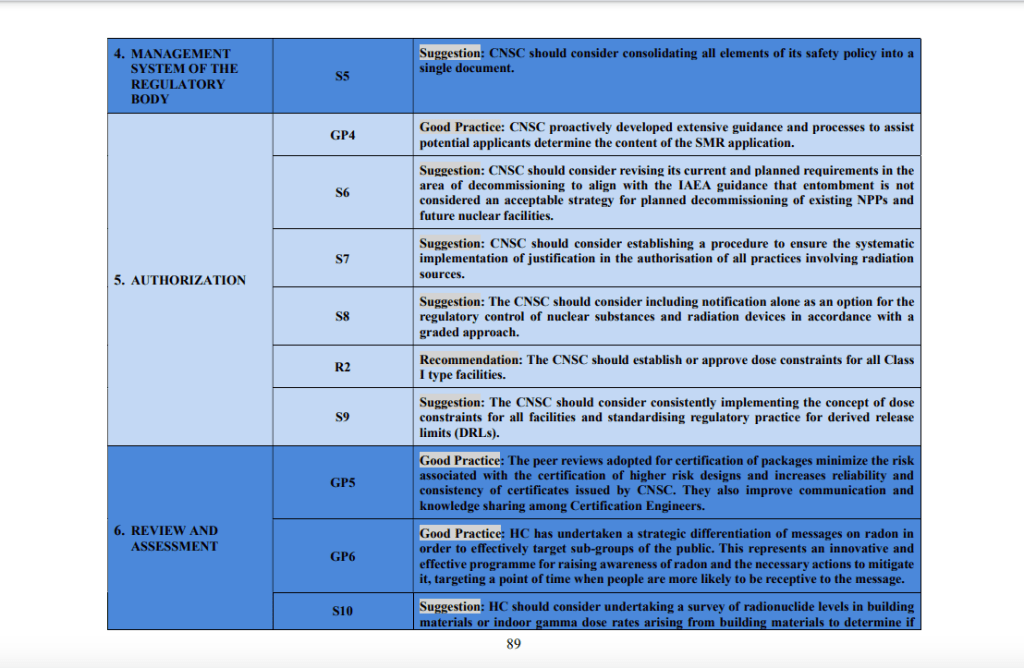
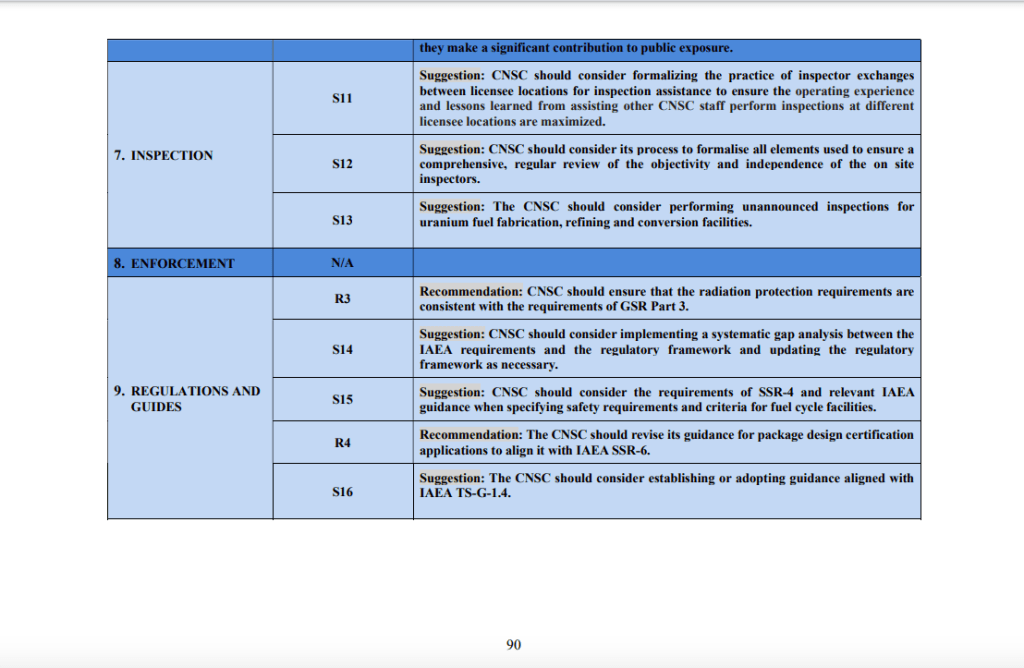
Here are screenshots of Appendix IV from the final report. The IRRS team had suggestions or recommendations in 20 out of the 26 areas they looked at during the review.
Reuters Events Nuclear, formerly Nuclear Energy Insider, is a leading business intelligence provider that serves the global nuclear energy community. Focusing on the entire nuclear lifecycle, we help businesses address complex challenges and opportunities in plant construction, SMRs, O&M, plant digitalization, decommissioning and waste management. Our clients include utilities, operating companies, EPCs, OEMs, suppliers, government bodies, regulatory organizations and financial institutions.
Since 2010, Reuters Events Nuclear has created original content to help our community navigate potential threats and upcoming opportunities. Received by over 30,000 professionals globally…
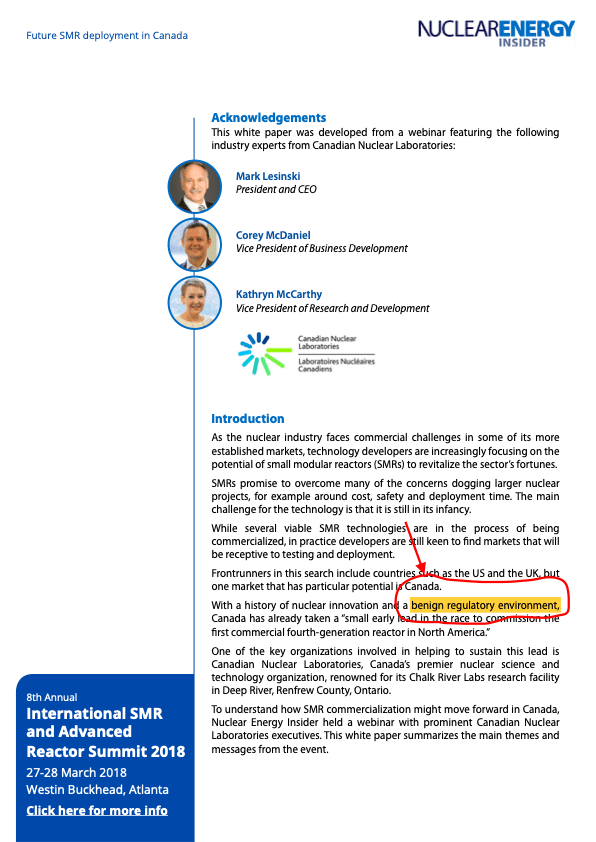
A 2018 White Paper, produced by Nuclear Energy Insider, entitled Future SMR Development in Canada, notes that Canada has a “benign regulatory environment.” (See screen capture below.)
To the Prime Minister, Parliament and the Federal Government The undersigned organizations have grave concerns about the handling of Canada’s federally-owned radioactive waste by a private-sector consortium that includes SNC-Lavalin and two Texas-based multinational corporations. *
● Canada has no adequate federal policies and strategies for the long-term management of radioactive wastes and the consortium has been given a free hand to advocate and implement proposals that, in our view, are unequal to the task of protecting people’s health and the environment. ● Under its federal contract with Atomic Energy of Canada Limited the consortium is receiving billions of our tax dollars to advance radioactive waste disposal and reactor “decommissioning” projects that fail to even meet existing international safety guidelines. ● The consortium’s current plans include entombingthe radioactive remains ofnuclear reactors in cement next to the Ottawa and Winnipeg Rivers, against the explicit advice of international bodies and independent nuclear scientists; these “entombed reactors” would leak radioactivity into the rivers for thousands of years and contaminate drinking water for millions of Canadians. ● The consortium also plans to erect a massive above-ground mound adjacent to a swampy area that drains into the nearby Ottawa River; the mound would hold more than one million tons of mixed radioactive waste including a multitude of long-lived, human-made radioactive materials such as plutonium-239 and hazardous non-radioactive materials such as PCBs, lead, arsenic and asbestos. ● The consortium is already transporting large quantities of radioactive waste along public roadsfrom Pinawa, Manitoba, from Douglas Point, Ontario, and from Gentilly, Quebec, all the way to Chalk River, site of the proposed mound, located upstream from our nation’s Capital.
We request that the Federal Government terminate its contract with the consortium at the end of the first six-year term in 2021 or as soon as possible.
We also request formulation of exemplary policies and projects for Canada’s radioactive waste that meet or exceed international obligations. Such policies and projects would: ● be developed with meaningful consultation with First Nations and the broader Canadian public ● create many long-term, well-paying Canadian jobs while protecting health and property ● safely store radioactive waste in state-of-the-art facilities away from sources of drinking water ● re-establish Canadian leadership in the nuclear field with world-class science-based solutions to address the growing global radioactive waste problems
* Membership in the consortium, known as Canadian National Energy Alliance, has changed more than once since the consortium assumed control of Canada’s federally-owned nuclear waste in 2015, when it received all shares of Canadian Nuclear Laboratories, a wholly owned subsidiary of Atomic Energy of Canada Limited. Current consortium members include SNC-Lavalin, which is debarred by the World Bank for 10 years and faced charges in Canada for fraud, bribery and corruption; Texas-based Fluor Corporation, which paid $4 million to resolve allegations of financial fraud related to nuclear waste cleanup work at a U.S. site; and Texas-based Jacobs Engineering, which recently acquired CH2M, an original consortium member that agreed to pay $18.5 million to settle federal criminal charges at a nuclear cleanup site in the U.S.
Signatories
Alliance of the Anishinabek Nation and the Iroquois Caucus
Canadian Coalition for Nuclear Responsibility
Canadian Association of Physicians for the Environment
Sierra Club Canada Foundation
Friends of the Earth Canada
Ontario Clean Air Alliance
Ecology Ottawa
Ottawa River Institute
Unifor
FTQ – Fédération des travailleurs et travailleuses du Québec
Greenspace Alliance of Canada’s Capital
National Council of Women of Canada
Provincial Council of Women of Quebec
Provincial Council of Women of Ontario
Concerned Citizens of Renfrew County and Area
Northwatch
Les Artistes pour la Paix
Concerned Citizens Committee of Manitoba
Prevent Cancer Now
Action Climat Outaouais
Ralliement contre la pollution radioactive
Bonnechere River Watershed Project
Old Fort William (Quebec) Cottagers’ Association
Pontiac Environmental Protection
Petawawa Point Cottagers Association
Coalition Against Nuclear Dumps on the Ottawa River
Au Premier ministre, au Parlement et au Gouvernement du Canada
Les organisations soussignées s’inquiètent énormément des déchets radioactifs publics dont le gouvernement fédéral a confié la gestion à un consortium privé dont font partie SNC-Lavalin et deux sociétés multinationales du Texas. *
● Le Canada n’a aucune politique nationale ni de stratégie à long terme pour la gestion de ses déchets radioactifs, si bien que le consortium a reçu carte blanche pour élaborer et mettre en œuvre des projets qui nous semblent impuissants à protéger la santé des citoyens et de notre environnement. ● En vertu du contrat fédéral qui le lie à Énergie atomique du Canada Limitée, ce consortium reçoit des milliards de dollars de nos impôts pour faire la promotion de techniques de stockage des déchets radioactifs ou de « déclassement » des réacteurs nucléaires qui ne respectent même pas les règles de sécurité internationales. ● En ce moment même, le consortium veut remplir de béton les restes radioactifs de deux centrales nucléaires en bordure de la rivière des Outaouais et de la rivière Winnipeg, malgré l’avis contraire d’organismes internationaux et de spécialistes indépendants en matière nucléaire. Même ensevelis dans le béton, ces réacteurs laisseraient leur radioactivité fuir vers les rivières pendant des milliers d’années et contamineraient l’eau potable de millions de Canadiens. ● Le consortium veut également entasser plus d’un million de tonnes de déchets radioactifs toxiques juste à côté d’une zone marécageuse qui se draine dans la rivière des Outaouais. Cette colline de déchets contiendrait toutes sortes d’éléments radioactifs à longue durée de vie et créés par l’homme, comme le plutonium-239, ainsi que d’autres produits non radioactifs mais tout aussi dangereux, comme les biphényles polychlorés, le plomb, l’arsenic ou l’amiante. ● Le consortium transporte déjà de grandes quantités de déchets radioactifs sur les routes publiques depuis Pinawa (Manitoba), depuis Douglas Point (Ontario) et depuis Gentilly (Québec), vers Chalk River où se trouvera le monticule proposé, en amont de notre capitale nationale.
Nous demandons que le gouvernement fédéral mette fin à son contrat avec le consortium dès la fin du premier mandat de six ans, en 2021, ou dès que possible.
Nous demandons aussi que le gouvernement se donne des politiques sur les déchets radioactifs et qu’il mette en place des projets exemplaires qui respecteront les normes internationales ou qui les dépasseront. Ces politiques et ces projets devront:
● être élaborés en consultation avec les Premières Nations et le grand public canadien; ● créer de nombreux emplois stables et bien rémunérés tout en protégeant la santé et les biens des Canadiens; ● entreposer les déchets radioactifs dans des installations sécuritaires ultramodernes, loin des sources d’eau potable; ● rétablir le leadership canadien en matière nucléaire avec des solutions de classe mondiale et fondées sur la science pour enrayer le problème croissant des déchets radioactifs à travers le monde.
* Les membres du consortium, connu sous le nom d’Alliance nationale canadienne de l’énergie, ont changé à plusieurs reprises depuis que le consortium a obtenu le contrôle des déchets nucléaires du Canada en 2015, quand il est devenu le seul actionnaire des Laboratoires Nucléaires Canadiens, une filiale à part entière d’Énergie Atomique du Canada Ltée. Les membres actuels du consortium incluent SNC-Lavalin, qui a été bannie par la Banque mondiale depuis 10 ans et qui fait face à des accusations au Canada, la Fluor Corporation du Texas, qui a payé 4 millions$ pour se défaire d’allégations de fraude financière liées aux travaux de décontamination radioactive sur un site de déchets nucléaires américain, de même que Jacobs Engineering du Texas qui a récemment fait l’acquisition de CH2M, un membre original du consortium qui a payé 18,5 millions$ pour mettre fin à des accusations criminelles relatives à un site de nettoyage nucléaire aux États-Unis.
Les Signataires :
Alliance of the Anishinabek Nation and the Iroquois Caucus
Canadian Coalition for Nuclear Responsibility
Canadian Association of Physicians for the Environment
Sierra Club Canada Foundation
Friends of the Earth Canada
Ontario Clean Air Alliance
Ecology Ottawa
Ottawa River Institute
Unifor
FTQ – Fédération des travailleurs et travailleuses du Québec
Greenspace Alliance of Canada’s Capital
National Council of Women of Canada
Provincial Council of Women of Quebec
Provincial Council of Women of Ontario
Concerned Citizens of Renfrew County and Area
Northwatch
Les Artistes pour la Paix
Concerned Citizens Committee of Manitoba
Prevent Cancer Now
Action Climat Outaouais
Ralliement contre la pollution radioactive
Bonnechere River Watershed Project
Old Fort William Cottagers’ Association
Pontiac Environmental Protection
Petawawa Point Cottagers Association
Coalition Against Nuclear Dumps on the Ottawa River
SNC-Lavalin and two Texas-based corporations fail to convince the public that radioactive dumps will be safe
For immediate release (December 17, 2019, Ottawa, Ontario). Civil society groups remain staunchly opposed to two radioactive waste dumps beside the Ottawa River, despite new studies released December 12 by the embattled multinational consortium behind the proposals. Citizens groups and NGOs say no amount of tweaking by Canadian Nuclear Laboratories can make the proposed projects meet international safety standards.
Announced in 2016, the consortium’s plans to build a giant mound for more than one million tonnes of radioactive waste and to entomb a defunct reactor in concrete along side the Ottawa River have raised the ire of citizens and retired nuclear scientists alike. First Nations, NGOs, federal government departments, the Quebec government, and over 140 municipalities have also weighed in with serious concerns about the proposed projects.
“These proposals violate the principle that radioactive waste must be kept out of contact with the biosphere for as long as it remains radioactive,” according to Ole Hendrickson, a scientist and researcher for the group Concerned Citizens of Renfrew County and Area. “The mound and the tomb are the wrong strategies; they simply can’t do the job of keeping radioactive toxins out of our air and drinking water,” Hendrickson said. “In addition to radioactive materials, both facilities would release heavy metals and toxic organic compounds during and after construction.”
Critics are calling on the federal government to cancel these quick-and-dirty radioactive dumps and step up with funding to support world class radioactive waste storage facilities for Canada’s $8 to $10 billion nuclear waste legacy. Ottawa has admitted it has not even formulated a detailed policy on the long-term management of radioactive wastes.
“Radioactive wastes should never be abandoned right beside major water bodies”, says Gordon Edwards, president of the Canadian Coalition for Nuclear Responsibility, “They should be maintained in a monitored and retrievable fashion so that future generations can cope with them. These wastes will be hazardous and radioactive for more than one hundred thousand years, essentially for eternity. They must be carefully packaged and labelled and stored securely, well away from drinking water sources.”
Hendrickson adds that the lack of a careful siting process concerns many citizens groups and NGOs. “It is obvious that the consortium chose the proposed sites based on convenience and low cost, not public safety.”
The proposed facilities do not comply with International Atomic Energy Agency (IAEA) guidelines. The IAEA requires that long-lived radioactive waste be placed in a moderately deep or very deep underground facility. The IAEA also says that flooding a defunct reactor with concrete can only be used in cases of extreme emergency such as a meltdown.
Canadian Nuclear Laboratories misrepresents the amount of long-lived radioactive material that would go in its gigantic five-to-seven story surface mound. The revised environmental impact statement includes a partial inventory of 30 radioactive materials destined for the dump, and 25 of them are very long-lived indeed, each with a half-life of more than four centuries. Of the 30 materials listed, 22 have half-lives over a thousand years, 17 have half-lives over 100,000 years, and 7 have half-lives over a million years. None of these materials would meet the IAEA definition of short-lived waste. Nevertheless, the revised environmental impact statement, released last week by the consortium, asserts only low level waste that “primarily contains short-lived radionuclides” would go into the mound.
“This is a clear example of the ways that CNL misleads the public and decision-makers by playing fast and loose with terms such as “near surface” “low level” and “short-lived”, says Johanna Echlin, of the Old Fort William (Quebec) Cottagers’ Association.
According to Echlin, a federal commitment to create world class facilities for its radioactive waste is urgently needed and would have many benefits. “We have the expertise in Canada to be a world leader in looking after these radioactive wastes,” Echlin said. “Many well-paying jobs and careers will be created when the government of Canada takes this issue seriously and does the right thing. We can do this. We can keep radioactive waste out of our rivers. We’ll all sleep easier knowing that our health, our property values, the beautiful Ottawa River, and future generations are all protected.”
The proponent of the two nuclear waste dumps, Canadian Nuclear Laboratories is owned by the “Canadian National Energy Alliance”, a consortium of SNC-Lavalin and two Texas-based engineering firms. Canadian Nuclear Laboratories is under contract by the federal government to reduce Canada’s $8 billion federal nuclear waste “legacy” liabilities quickly and cheaply.
Environmental assessments of the giant mound and the reactor tomb are in progress. Licensing hearings for the projects are expected in late 2020. -30-


 Concerned Citizens of Renfrew County and Area