International peer review finds deficiencies in Canada’s nuclear safety framework

UPDATE July 2024

A June 2024 follow-up to an initial 2019 IAEA mission highlighted several problem areas:

  • Explicit justification of facilities and activities whereby radiation risks must be considered in terms of the overall benefit, in line with IAEA safety standards;
  • Full alignment of Radiation Protection Regulations with IAEA safety standards;
  • implementation of constraints on dose or on risk, to be used in the optimization of protection for members of the public for nuclear facilities.

Despite the CNSC’s positive spin on the IAEA missions, their findings are a cause of deep concern for independent observers and experts.

February 2020

The International Atomic Energy Agency (IAEA) has released the final report of its review of Canada’s framework for nuclear safety. The review was conducted in September 2019 by a  24-member team including 20 senior regulatory experts from 17 countries, under the aegis of the IAEA’s “Integrated Regulatory Review Service” (IRRS).

The final report was produced by peer reviewers and hosts together. This report took five months, after completion of the mission to be finalized.

The IRRS team conducting the review provided numerous observations, suggestions and recommendations that require action by the Government of Canada and the Canadian Nuclear Safety Commission (CNSC).  

These include the following: (all text is excerpted from the IAEA report and IAEA safety guides except “Comments” which highlight concerns of civil society groups). Red text highlights some key quotes from the IRRS team’s report.

1.  The Government of Canada should enhance the existing policy and establish the associated strategy to give effect to the principles stated in its Radioactive Waste Policy Framework. 

The IAEA requires “To ensure the effective management and control of radioactive waste, the government shall ensure that a national policy and a strategy for radioactive waste management are established.” Further, it requires that “The national strategy for radioactive waste management has to outline arrangements for ensuring the implementation of the national policy.”  The IRRS team found “no evidence”, beyond the principles contained in the Policy Framework, of a “governmental policy or strategy related to radioactive waste management.” It found that the Policy Framework “does not encompass all the needed policy elements nor a detailed strategy or corresponding arrangements… for radioactive waste management in Canada.”

Comment: “The IRRS mission found no evidence… of a government policy or strategy related to radioactive waste management.” This policy and strategy vacuum highlighted by the IAEA has allowed the promotion of substandard radioactive waste facilities that would not isolate radioactive wastes from the biosphere as required by IAEA.This puts Canadians at risk of adverse effects on their drinking water, their health and their property values. If this policy vacuum persists, current and future Canadians will pay for this deficiency with adverse health outcomes and increasing demands on the public purse to remediate poorly designed radioactive waste facilities in the future.

2. The Government of Canada’s decommissioning requirements should align with IAEA guidance that entombment, in which all or part of the facility is encased in a structurally long-lived material, is not an acceptable strategy for planned decommissioning of existing nuclear power plants and future nuclear facilities.

The IRRS team included the following observation in its report: “The CNSC is currently considering two licence applications related to in situ confinement of legacy reactor facilities. This strategy of in-situ confinement is not consistent with SSG-47(emphasis added)

SSG-47 is the 2018 IAEA Specific Safety Guide, Decommissioning of Nuclear Power Plants, Research Reactors and Other Nuclear Fuel Cycle Facilities. The report suggests that Canada “revise its current and planned requirements in the area of decommissioning to align with the IAEA guidance”. 

The IAEA review states that “The national policy on management of radioactive waste should include decommissioning aspects, including the choice of possible decommissioning strategies” and it “encourages Canada to request an international peer review of the proposed strategy related to in situ confinement [entombment] of legacy reactors.”

Comment: Two proposals for entombment of shut-down reactors are currently undergoing environmental assessment in Canada.  IAEA guidance explicitly prohibits this approach, which essentially consists of dumping concrete on top of the highly radioactive remains of defunct reactors and leaving them in place. Such an approach would allow radioactive contaminants to leak into groundwater and drinking water sources for millennia.

3. The Government of Canada’s legal framework for nuclear safety should “expressly assign the prime responsibility for safety to the person or organization responsible for a facility or an activity,” and should “explicitly stipulate that compliance with regulations and requirements established or adopted by the regulatory body does not relieve the person or organization responsible for a facility or an activity of its prime responsibility for safety.”

The IRRS team found that “The legal framework does not expressly assign the prime responsibility for safety to the person or organization responsible for a facility or an activity.”

The IAEA requires that “The government shall expressly assign the prime responsibility for safety to the person or organization responsible for a facility or an activity.” 

Comment: Lack of clarity on who is primarily responsible for safety can lead to lax safety practices as occurred in Ontario in 1997, when seven Ontario Power Generation reactors had to be shut down and U.S. experts called in to review the situation. (See “Canada pays price for taking nuclear safety for granted”).

4. The Government of Canada’s legal framework for nuclear safety should explicitly address the principle of “Justification of facilities and activities”, namely that “Facilities and activities that give rise to radiation risks must yield an overall benefit.”

The IAEA requires that “For facilities and activities to be considered justified, the benefits that they yield must outweigh the radiation risks to which they give rise.” The IRRS review states that “There is no systematic evaluation of justification for the various practices involving radiation sources in the licensing process.” (emphasis added)

The review suggests that the CNSC should “establish a procedure to ensure the systematic implementation of justification in the authorization of all practices involving radiation sources.”

Comment: Real situations arise where there is a trade-off between the nuclear industry’s desire to expand and the public’s right to be protected from radioactive pollutants, which are routinely released from nuclear facilities. By not explicitly addressing “justification”, Canada’s nuclear safety framework allows industry needs to prevail and man-made radiation exposures to increase without any assessment of whether or not there are benefits to society at large that justify the increased exposures. This deficiency is a problem given the recent exemption from impact assessment of small nuclear reactors and Canada’s intention to invest heavily in this new technology.

5.  The CNSC should implement a systematic gap analysis between IAEA requirements and its regulatory framework, and update the regulatory framework as necessary.

The IAEA requires that “regulations and guides shall be reviewed and revised as necessary to keep them up to date, with due consideration of relevant international safety standards” The IRRS team found that CNSC regulations “do not comprehensively cover all IAEA Fundamental Safety Requirements.” The CNSC “has no systematic approach to conduct a gap analysis between the new IAEA requirements and its regulatory framework.”  The IRRS team observed that Canada’s style of legislative practice “may create difficulties to find exact wording when searching where and by what provision individual requirements of the IAEA Safety Standards are addressed.”  It observed that the CNSC “uses a predominantly non-prescriptive approach in the application of its regulatory framework.”

The IRRS team stated CNSC has not developed a single document where all elements of safety policy are gathered and approved by the senior management.” (emphasis added)

Comment:  Many fundamental IAEA safety standards are not addressed by regulations in Canada and there is no system in place to identify the gaps. IAEA standards that are addressed tend to be addressed in a “non-prescriptive” way. For example, there is no mention of the standards and regulations in actual nuclear facility licenses so essentially there is no legal force behind them. In practical terms, Canada’s regulator relies on its licensees to “self-regulate”; this can lead to problems.

6. The CNSC should establish or approve dose constraints for all Class I type facilities, should consistently implement the concept of dose constraints for all facilities, and should standardise regulatory practice for derived release limits.

The IRRS team found that “dose constraints are not explicitly established for all Class I facilities,” that “there are different approaches used to the regulation of the control and authorization of releases for different types of facilities,” and that “inconsistencies are evident” in the derivation of derived released limits.

Comment: According to the review team there is much inconsistency in Canada’s approach to establishing limits for radioactive pollutants from individual facilities. This puts Canadians at risk. In our experience, CNSC allows licensees to create a separate release limit for each and every one of hundreds of radionuclides it releases, each one based on releasing up to the public dose limit for that radionuclide. This problem is compounded by the fact that members of the public can be exposed to releases from more than one facility. For example, people in the Ottawa Valley are subject to radioactive releases from the defunct NPD reactor at Rolphton, from the Chalk River Laboratories, and from SRB Technologies in Pembroke which releases tritium to the air, groundwater, and the sewer system. Each one of these facilities sets its own release limits that allow it to release up to the public dose limit for each and every radionuclide it releases.

7.  The CNSC should ensure that radiation protection requirements are consistent with the IAEA General Safety Requirements, Part 3; specifically, with respect to optimization of radiation protection through dose constraints, dose limits and retention of dose records by licensees.

The IRRS review states that The current radiation protection regulations and requirements are not in accordance with GSR Part 3 with respect to optimization of radiation protection current radiation protection regulations and requirements are not in accordance with GSR Part 3 with respect to optimization of radiation protection.” (emphasis added)

 The IRRS team noted that the CNSC is updating its Radiation Protection Regulations.  However, it found that this update “does not foresee a reduction in the dose limit to the pregnant nuclear energy worker from 4 mSv to 1 mSv… nor the establishment of dose limits for apprentices or students of 16 to 18 years of age.”  Further, it found that CNSC regulations do not meet the IAEA requirement that “Records of occupational exposure for each worker shall be maintained during and after the worker’s working life, at least until the former worker attains or would have attained the age of 75 years, and for not less than 30 years after cessation of the work.”

Comment: Canada does not adequately protect pregnant nuclear energy workers, allowing a four times higher dose to pregnant nuclear energy workers than IAEA recommends. Canada does not adequately protect student workers from 16 – 18 years of age. Inadequate record retention makes health studies difficult and could interfere with compensation claims in the event of adverse health outcomes potentially caused by radiation exposures.

8. The CNSC should align its transportation regulatory documents with IAEA requirements, including its guidance for package design certification, and guidance regarding management system for transport.

The IAEA Regulations SSR-6 (Regulations for the Safe Transport of Radioactive Materials, 2018 Edition)require that “a management system based on international, national or other standards acceptable to the competent authority shall be established and implemented for all the activities associated to the transport of radioactive material.”  The IRRS report states The CNSC has not explicitly established or adopted guidance regarding management system for transport.” (emphasis added)

Comment: Canada’s inadequate management system for transport of radioactive materials puts Canadians at risk. We have no guarantees that packaging is adequate, and no notification to municipalities and emergency personnel when shipments are passing through their area. Three fiery crashes on Canadian highways in recent years amplify our concerns about potential catastrophic consequences of inadequately regulated transport of radioactive materials.

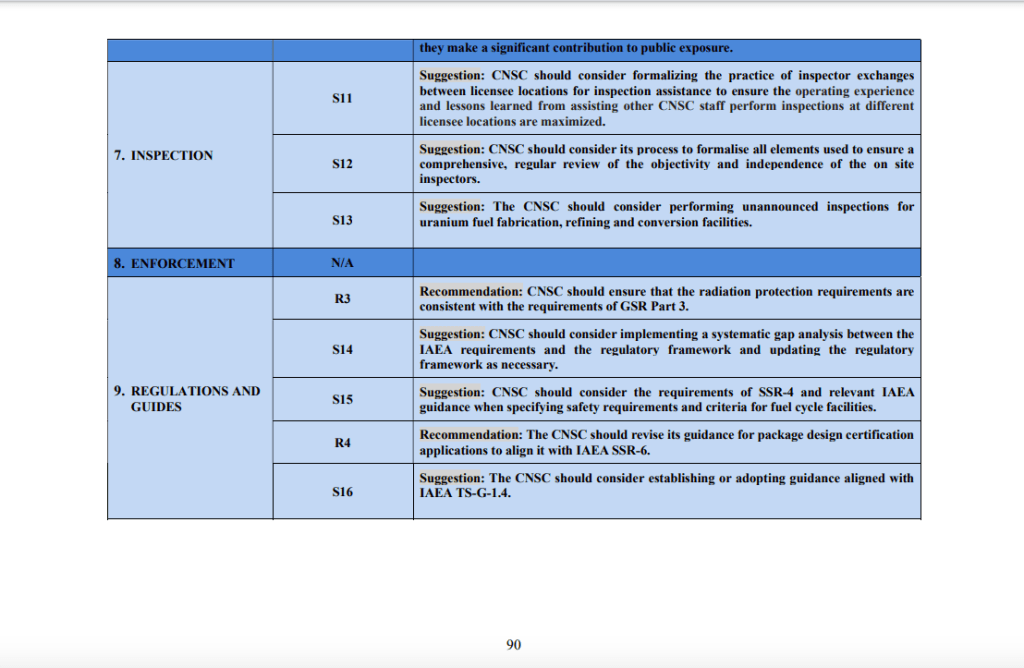
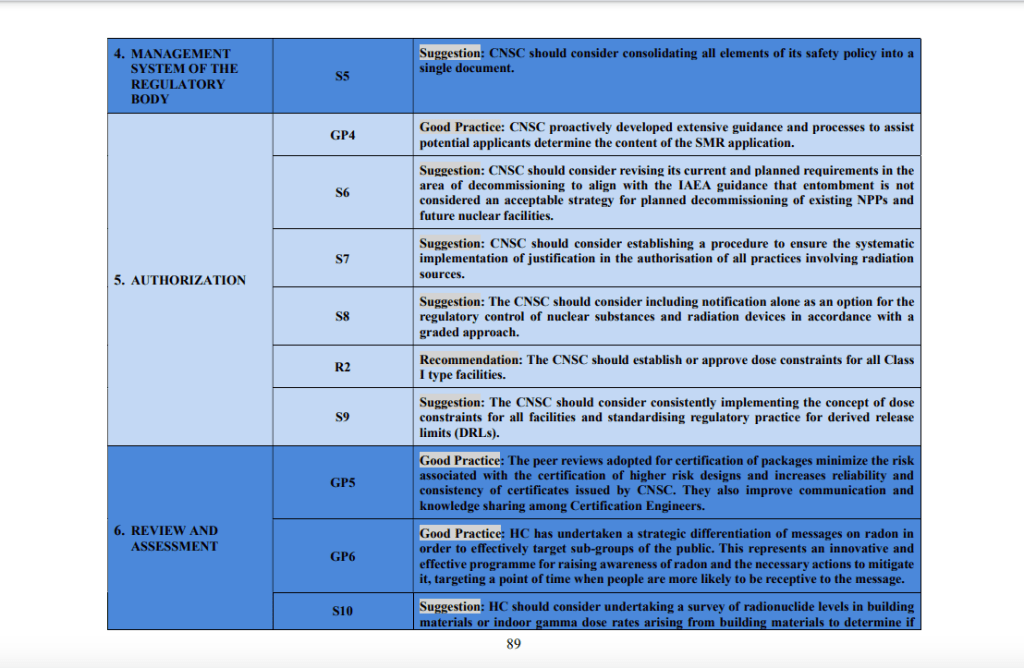
Here are screenshots of Appendix IV from the final report. The IRRS team had suggestions or recommendations in 20 out of the 26 areas they looked at during the review.

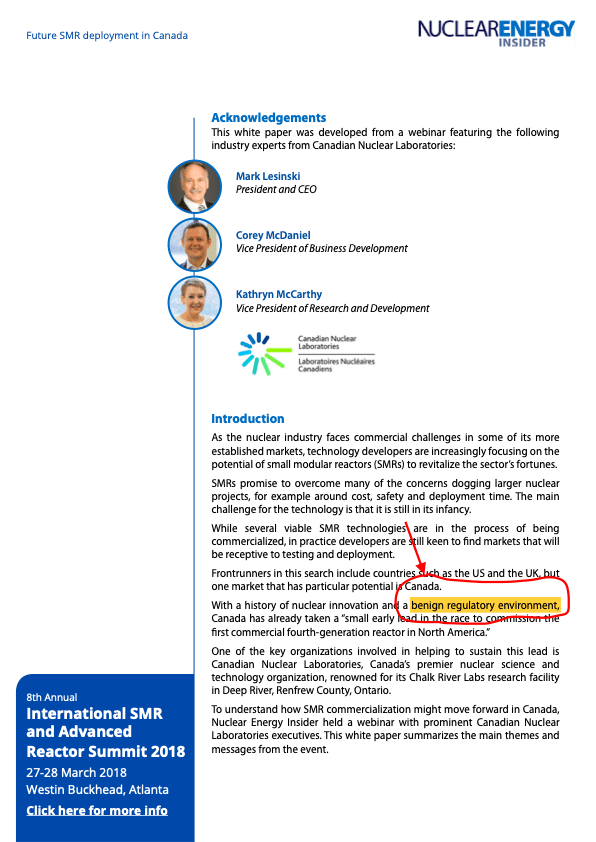
Nuclear Energy Insider says Canada has a “benign regulatory environment”

According to its company listing on LinkedIn:

Reuters Events Nuclear, formerly Nuclear Energy Insider, is a leading business intelligence provider that serves the global nuclear energy community. Focusing on the entire nuclear lifecycle, we help businesses address complex challenges and opportunities in plant construction, SMRs, O&M, plant digitalization, decommissioning and waste management. Our clients include utilities, operating companies, EPCs, OEMs, suppliers, government bodies, regulatory organizations and financial institutions.

Since 2010, Reuters Events Nuclear has created original content to help our community navigate potential threats and upcoming opportunities. Received by over 30,000 professionals globally…

Source: https://www.linkedin.com/company/nuclear-energy-insider/

A 2018 White Paper, produced by Nuclear Energy Insider, entitled Future SMR Development in Canada, notes that Canada has a “benign regulatory environment.” (See screen capture below.)

Serious problems with federally-owned radioactive waste in Canada ~ Full Page Statement in the Hill Times

January 27, 2020

To the Prime Minister, Parliament and the Federal Government
The undersigned organizations have grave concerns about the handling of Canada’s federally-owned radioactive waste by a private-sector consortium that includes SNC-Lavalin and two Texas-based multinational corporations. *


●      Canada has no adequate federal policies and strategies for the long-term management of radioactive wastes and the consortium has been given a free hand to advocate and implement proposals that, in our view, are unequal to the task of protecting people’s health and the environment.
●       Under its federal contract with Atomic Energy of Canada Limited the consortium is receiving billions of our tax dollars to advance radioactive waste disposal and reactor “decommissioning” projects that fail to even meet existing international safety guidelines. 
●      The consortium’s current plans include entombingthe radioactive remains ofnuclear reactors in cement next to the Ottawa and Winnipeg Rivers, against the explicit advice of international bodies and independent nuclear scientists; these “entombed reactors” would leak radioactivity into the rivers for thousands of years and contaminate drinking water for millions of Canadians.
●     The consortium also plans to erect a massive above-ground mound adjacent to a swampy area that drains into the nearby Ottawa River; the mound would hold more than one million tons of mixed radioactive waste including a multitude of long-lived, human-made radioactive materials such as plutonium-239 and hazardous non-radioactive materials such as PCBs, lead, arsenic and asbestos.
●     The consortium is already transporting large quantities of radioactive waste along public roadsfrom Pinawa, Manitoba, from Douglas Point, Ontario, and from Gentilly, Quebec, all the way to Chalk River, site of the proposed mound, located upstream from our nation’s Capital.

We request that the Federal Government terminate its contract with the consortium at the end of the first six-year term in 2021 or as soon as possible.

We also request formulation of exemplary policies and projects for Canada’s radioactive waste that meet or exceed international obligations. Such policies and projects would:
●      be developed with meaningful consultation with First Nations and the broader Canadian public 
●      create many long-term, well-paying Canadian jobs while protecting health and property 
●      safely store radioactive waste in state-of-the-art facilities away from sources of drinking water
●     re-establish Canadian leadership in the nuclear field with world-class science-based solutions to address the growing global radioactive waste problems 

* Membership in the consortium, known as Canadian National Energy Alliance, has changed more than once since the consortium assumed control of Canada’s federally-owned nuclear waste in 2015, when it received all shares of Canadian Nuclear Laboratories, a wholly owned subsidiary of Atomic Energy of Canada Limited.  Current consortium members include  SNC-Lavalin, which is debarred by the World Bank for 10 years and faced charges in Canada for fraud, bribery and corruption; Texas-based Fluor Corporation, which paid $4 million to resolve allegations of  financial fraud related to nuclear waste cleanup work at a U.S. site; and Texas-based Jacobs Engineering, which recently acquired CH2M, an original consortium member that agreed to pay $18.5 million to settle federal criminal charges at a nuclear cleanup site in the U.S.

Signatories  

Alliance of the Anishinabek Nation and the Iroquois Caucus

Canadian Coalition for Nuclear Responsibility

Canadian Association of Physicians for the Environment

Sierra Club Canada Foundation

Friends of the Earth Canada

Ontario Clean Air Alliance

Ecology Ottawa

 Ottawa River Institute

Unifor

FTQ – Fédération des travailleurs et travailleuses du Québec

Greenspace Alliance of Canada’s Capital

National Council of Women of Canada

Provincial Council of Women of Quebec

Provincial Council of Women of Ontario

Concerned Citizens of Renfrew County and Area

Northwatch

Les Artistes pour la Paix

Concerned Citizens Committee of Manitoba

Prevent Cancer Now

Action Climat Outaouais

Ralliement contre la pollution radioactive

Bonnechere River Watershed Project

Old Fort William (Quebec) Cottagers’ Association

Pontiac Environmental Protection

Petawawa Point Cottagers Association

Coalition Against Nuclear Dumps on the Ottawa River

Esprit Whitewater

Durham Nuclear Awareness

First United Church (Ottawa) Water Care Allies

Le grave problème des déchets radioactifs du Gouvernement canadien – annonce pleine-page dans le Hill Times

Version PDF

le 27 janvier 2020

Au Premier ministre, au Parlement et au Gouvernement du Canada

Les organisations soussignées s’inquiètent énormément des déchets radioactifs publics dont le gouvernement fédéral a confié la gestion à un consortium privé dont font partie SNC-Lavalin et deux sociétés multinationales du Texas*


● Le Canada n’a aucune politique nationale ni de stratégie à long terme pour la gestion de ses déchets radioactifs, si bien que le consortium a reçu carte blanche pour élaborer et mettre en œuvre des projets qui nous semblent impuissants à protéger la santé des citoyens et de notre environnement.
● En vertu du contrat fédéral qui le lie à Énergie atomique du Canada Limitée, ce consortium reçoit des milliards de dollars de nos impôts pour faire la promotion de techniques de stockage des déchets radioactifs ou de « déclassement » des réacteurs nucléaires qui ne respectent même pas les règles de sécurité internationales.
● En ce moment même, le consortium veut remplir de béton les restes radioactifs de deux centrales nucléaires en bordure de la rivière des Outaouais et de la rivière Winnipeg, malgré l’avis contraire d’organismes internationaux et de spécialistes indépendants en matière nucléaire.  Même ensevelis dans le béton, ces réacteurs laisseraient leur radioactivité fuir vers les rivières pendant des milliers d’années et contamineraient l’eau potable de millions de Canadiens. 
● Le consortium veut également entasser plus d’un million de tonnes de déchets radioactifs toxiques juste à côté d’une zone marécageuse qui se draine dans la rivière des Outaouais. Cette colline de déchets contiendrait toutes sortes d’éléments radioactifs à longue durée de vie et créés par l’homme, comme le plutonium-239, ainsi que d’autres produits non radioactifs mais tout aussi dangereux, comme les biphényles polychlorés, le plomb, l’arsenic ou l’amiante.
● Le consortium transporte déjà de grandes quantités de déchets radioactifs sur les routes publiques depuis Pinawa (Manitoba), depuis Douglas Point (Ontario) et depuis Gentilly (Québec), vers Chalk River où se trouvera le monticule proposé, en amont de notre capitale nationale.


Nous demandons que le gouvernement fédéral mette fin à son contrat avec le consortium dès la fin du premier mandat de six ans, en 2021, ou dès que possible.


Nous demandons aussi que le gouvernement se donne des politiques sur les déchets radioactifs et qu’il mette en place des projets exemplaires qui respecteront les normes internationales ou qui les dépasseront. Ces politiques et ces projets devront:

● être élaborés en consultation avec les Premières Nations et le grand public canadien;
● créer de nombreux emplois stables et bien rémunérés tout en protégeant la santé et les biens des Canadiens;
● entreposer les déchets radioactifs dans des installations sécuritaires ultramodernes, loin des sources d’eau potable;
● rétablir le leadership canadien en matière nucléaire avec des solutions de classe mondiale et fondées sur la science pour enrayer le problème croissant des déchets radioactifs à travers le monde.

* Les membres du consortium, connu sous le nom d’Alliance nationale canadienne de l’énergie, ont changé à plusieurs reprises depuis que le consortium a obtenu le contrôle des déchets nucléaires du Canada en 2015, quand il est devenu le seul actionnaire des Laboratoires Nucléaires Canadiens, une filiale à part entière d’Énergie Atomique du Canada Ltée.  Les membres actuels du consortium incluent SNC-Lavalin, qui a été bannie par la Banque mondiale depuis 10 ans et qui fait face à des accusations au Canada, la Fluor Corporation du Texas, qui a payé 4 millions$ pour se défaire d’allégations de fraude financière liées aux travaux de décontamination radioactive sur un site de déchets nucléaires américain, de même que Jacobs Engineering du Texas qui a récemment fait l’acquisition de CH2M, un membre original du consortium qui a payé 18,5 millions$ pour mettre fin à des accusations criminelles relatives à un site de nettoyage nucléaire aux États-Unis.

Les Signataires :

Alliance of the Anishinabek Nation and the Iroquois Caucus 

Canadian Coalition for Nuclear Responsibility

Canadian Association of Physicians for the Environment

Sierra Club Canada Foundation

Friends of the Earth Canada

Ontario Clean Air Alliance

Ecology Ottawa 

Ottawa River Institute

Unifor

FTQ – Fédération des travailleurs et travailleuses du Québec

Greenspace Alliance of Canada’s Capital

National Council of Women of Canada

Provincial Council of Women of Quebec

Provincial Council of Women of Ontario

Concerned Citizens of Renfrew County and Area

Northwatch

Les Artistes pour la Paix

Concerned Citizens Committee of Manitoba

Prevent Cancer Now

Action Climat Outaouais

Ralliement contre la pollution radioactive

Bonnechere River Watershed Project

Old Fort William Cottagers’ Association

Pontiac Environmental Protection

Petawawa Point Cottagers Association

Coalition Against Nuclear Dumps on the Ottawa River

Esprit Whitewater

Durham Nuclear Awareness

First United Church (Ottawa) Water Care Allies

Citizens’ groups and multinational consortium still at odds over plans for two nuclear waste dumps beside the Ottawa River

SNC-Lavalin and two Texas-based corporations fail to convince the public that radioactive dumps will be safe

For immediate release
(December 17, 2019, Ottawa, Ontario). Civil society groups remain staunchly opposed to two radioactive waste dumps beside the Ottawa River, despite new studies released December 12 by the embattled multinational consortium behind the proposals. Citizens groups and NGOs say no amount of tweaking by Canadian Nuclear Laboratories can make the proposed projects meet international safety standards.


Announced in 2016, the consortium’s plans to build a giant mound for more than one million tonnes of radioactive waste and to entomb a defunct reactor in concrete along side the Ottawa River have raised the ire of citizens and retired nuclear scientists alike. First Nations, NGOs, federal government departments, the Quebec government, and over 140 municipalities have also weighed in with serious concerns about the proposed projects.


“These proposals violate the principle that radioactive waste must be kept out of contact with the biosphere for as long as it remains radioactive,” according to Ole Hendrickson, a scientist and researcher for the group Concerned Citizens of Renfrew County and Area. “The mound and the tomb are the wrong strategies; they simply can’t do the job of keeping radioactive toxins out of our air and drinking water,” Hendrickson said. “In addition to radioactive materials, both facilities would release heavy metals and toxic organic compounds during and after construction.” 


Critics are calling on the federal government to cancel these quick-and-dirty radioactive dumps and step up with funding to support world class radioactive waste storage facilities for Canada’s $8 to $10 billion nuclear waste legacy. Ottawa has admitted it has not even formulated a detailed policy on the long-term management of radioactive wastes.


“Radioactive wastes should never be abandoned right beside major water bodies”, says Gordon Edwards, president of the Canadian Coalition for Nuclear Responsibility, “They should be maintained in a monitored and retrievable fashion so that future generations can cope with them. These wastes will be hazardous and radioactive for more than one hundred thousand years, essentially for eternity. They must be carefully packaged and labelled and stored securely, well away from drinking water sources.”

Hendrickson adds that the lack of a careful siting process concerns many citizens groups and NGOs. “It is obvious that the consortium chose the proposed sites based on convenience and low cost, not public safety.” 

The proposed facilities do not comply with International Atomic Energy Agency (IAEA) guidelines. The IAEA requires that long-lived radioactive waste be placed in a moderately deep or very deep underground facility.  The IAEA also says that flooding a defunct reactor with concrete can only be used in cases of extreme emergency such as a meltdown.


Canadian Nuclear Laboratories misrepresents the amount of long-lived radioactive material that would go in its gigantic five-to-seven story surface mound. The revised environmental impact statement includes a partial inventory of 30 radioactive materials destined for the dump, and 25 of them are very long-lived indeed, each with a half-life of more than four centuries. Of the 30 materials listed, 22 have half-lives over a thousand years, 17 have half-lives over 100,000 years, and 7 have half-lives over a million years.  None of these materials would meet the IAEA definition of short-lived waste. Nevertheless, the revised environmental impact statement, released last week by the consortium, asserts only low level waste that “primarily contains short-lived radionuclides” would go into the mound.


“This is a clear example of the ways that CNL misleads the public and decision-makers by playing fast and loose with terms such as “near surface” “low level” and “short-lived”, says Johanna Echlin, of the Old Fort William (Quebec) Cottagers’ Association.


According to Echlin, a federal commitment to create world class facilities for its radioactive waste is urgently needed and would have many benefits.
“We have the expertise in Canada to be a world leader in looking after these radioactive wastes,” Echlin said. “Many well-paying jobs and careers will be created when the government of Canada takes this issue seriously and does the right thing. We can do this. We can keep radioactive waste out of our rivers. We’ll all sleep easier knowing that our health, our property values, the beautiful Ottawa River, and future generations are all protected.”

The proponent of the two nuclear waste dumps, Canadian Nuclear Laboratories is owned by the “Canadian National Energy Alliance”, a consortium of SNC-Lavalin and two Texas-based engineering firms. Canadian Nuclear Laboratories is under contract by the federal government to reduce Canada’s $8 billion federal nuclear waste “legacy” liabilities quickly and cheaply.


Environmental assessments of the giant mound and the reactor tomb are in progress. Licensing hearings for the projects are expected in late 2020. 
-30-

More information:
Quick Facts about Low Level Waste
How would the Chalk River Mound leak? Let us count some of the ways
International agency’s findings confirm serious concerns  about Canada’s radioactive waste handling and radiation protection practices
Petition to the Auditor General: Nuclear governance problems in Canada
Scientists decry plan for Ontario nuclear-waste site
Revised Environmental Impact Statement and supporting documents

Environmental Petition: Nuclear governance problems in Canada

June 13, 2019

See also: Who will fix Canada’s nuclear governance gaps?: citizens’ groups (Hill Times) (français)

Petition summary (Office of the Auditor General website)

Environmental Petition: Nuclear governance problems in Canada

This petition is being submitted to the Office of the Auditor General of Canada in accordance with section 22 of the Auditor General Act by Concerned Citizens of Renfrew County and Area (Ontario), Pontiac Environmental Protection (Quebec), and Concerned Citizens of Manitoba. The concerns highlighted in this petition and the answers sought are also matters of importance to our colleagues in other organizations including the Alliance of the Anishinabek Nation and the Iroquois Caucus, the Canadian Coalition for Nuclear Responsibility, Ralliement contre la pollution radioactive (Quebec), Sierra Club Canada Foundation, Friends of the Earth (Canada), the Canadian Environmental Law Association, the Old Fort William (Quebec) Cottagers’ Association, Coalition for a Clean Green Saskatchewan, the Inter-Church Uranium Committee Educational Cooperative (Saskatchewan), the Canadian Association of Physicians for the Environment, Physicians for Global Survival, Mining Watch, Watershed Sentinel Educational Society (British Columbia), Green Coalition Verte (Montreal), and First United Church Water Care Allies (Ottawa).

We request that the Ministers of Natural Resources, Environment and Climate Change, and Justice undertake to address serious governance problems in the management of Canada’s nuclear waste legacy. These problems, highlighted in this petition, must be corrected to support sustainable development, protect the biosphere and avoid undue financial, health and environmental burdens for current and future generations of Canadians. 

Introduction

A consortium of SNC-Lavalin and other multinational corporations has assumed ownership of “Canadian Nuclear Laboratories” (CNL) and now controls all of Canada’s federally-owned nuclear facilities and radioactive wastes. A “Government-owned, Contractor-operated” (GoCo) arrangement was put in place by the former Conservative government in September 2015, just prior to the October 2015 federal election.  Environmental petition 405 and Environmental Petition 405b to the Auditor General raise questions about whether this GoCo arrangement is providing value for Canadian taxpayers (1, 2).  These questions remain relevant.

In May 2016 the consortium put forward three proposals for permanent radioactive waste disposal, the first such proposals ever in Canada. These proposals are currently undergoing environmental assessment (EA) under the Canadian Environmental Assessment Act 2012. They include construction of a giant, above-ground radioactive waste mound at Chalk River, Ontario and “entombment” in concrete of defunct, federal-government-owned nuclear reactors at Rolphton, Ontario and Pinawa, Manitoba (3, 4, 5). 

These project proposals disregard International Atomic Energy Agency (IAEA) safety standards on entombment of reactors and above-ground disposal of waste (6, 7, 8). They would permanently contaminate the Ottawa and Winnipeg Rivers with radioactive materials such as plutonium, caesium, strontium and tritium, some of which will be remain hazardous for over 100,000 years (3, 4, 5). 


Over 140 downstream municipalities that use the Ottawa River for drinking water have passed resolutions against the consortium’s projects (9). First Nations, Ontario, Quebec, civil society groups, independent scientists, municipalities, federal government departments and concerned individuals have submitted hundreds of critical comments on the project descriptions and EAs that are posted on the Canadian Environmental Assessment Registry (10, 11, 12).

Seeking to understand how the consortium’s nuclear waste proposals came to be undergoing EAs despite their lack of alignment with IAEA safety guidelines, the petitioners have researched nuclear governance in Canada and have identified problems in the way nuclear waste is dealt with by the Government of Canada, and in Canada’s system of nuclear governance generally.

Background

Canada’s system of nuclear governance is described in a report  to the Organization for Economic Cooperation and Development (OECD) entitled “Nuclear Legislation in OECD Countries ~ Regulatory and Institutional Framework for Nuclear Activities: Canada” (13). This is part of a series consisting of similar reports from all OECD countries that carry out nuclear activities (14).

Canada’s radioactive waste management program is described in a profile (15) that is part of an OECD series entitled “Radioactive Waste Management Programmes in NEA (Nuclear Energy Agency) Member Countries” (16).

In addition to IAEA and OECD resources we have drawn on Access to Information requests and our own experience for this review.

Problems with Canada’s nuclear governance

1)  Legislation 

Two main acts govern nuclear activities in Canada.  These acts are very “hands off”, providing limited direction and delegating to non-governmental agencies responsibilities that in other countries are managed by government departments and elected representatives.

Weak purposes and value-laden judgments

The primary legislation governing nuclear activities in Canada is the Nuclear Safety and Control Act of 2000 (NSCA). It establishes a regulatory body, the Canadian Nuclear Safety Commission (CNSC), and provides the CNSC with a mandate to limit risks of nuclear energy to health and national security to a “reasonable level” and meet international non-proliferation obligations (17).

The Act’s weak and indirect purpose is “to provide for the limitation to a reasonable level…of the risks…”.  Use of the word “reasonable” implies that there are “reasonable” levels of exposure to man-made ionizing radiation and that it is acceptable for the Commission to make decisions to expose certain members of the public to ionizing radiation without their permission and without any benefit to them. Similarly, the NSCA allows the Commission to decide what constitutes a “reasonable” risk to national security.

Value laden judgments on what risks are “reasonable” or “acceptable” should be made by elected officials who can ultimately be held accountable by the electorate. These are not scientific decisions, but rather value judgments informed by science, economics and social values.  They should not be made by non-elected appointees, especially if they have past associations with the sector being regulated.

Acts in other countries are more direct with clear intentions to protect health and the environment. Two examples are instructive. The purpose of Finland’s Nuclear Energy Act is “To keep the use of nuclear energy in line with the overall good of society, and in particular to ensure that the use of nuclear energy is safe for man and the environment” (18).  The purpose of Germany’s Atomic Energy Act is “to protect life, health and property against the hazards of nuclear energy and the detrimental effects of ionizing radiation” (19).

Canada’s Nuclear Fuel Waste Act of 2002 (NFWA) sets up a private non-profit corporation owned by waste producers to manage nuclear fuel waste and recommend and implement strategies for dealing with it. Its purpose is

“to provide a framework to enable the Governor in Council to make, from the proposals of the waste management organization, a decision on the management of nuclear fuel waste that is based on a comprehensive, integrated and economically sound approach for Canada.” (20)

Nowhere in this Act is there any mention of protecting people or the environment.

“Delegation” (or abdication?) of responsibilities

The organizations created by the NSCA and NFWA are independent of the Canadian government. The NSCA delegates responsibilities for decision making to the CNSC.  The NFWA delegates the development of an approach to manage high level, irradiated nuclear fuel waste to the Nuclear Waste Management Organization (NWMO), a corporation run by nuclear industry waste owners. 

This is in striking contrast to the way most other OECD countries manage their nuclear governance responsibilities. Requirement #1 of the IAEA’s Governmental, Legal and Regulatory Framework for Safety is that “The government shall establish a national policy and strategy for safety,” that “shall express a long term commitment to safety,” and that “shall be promulgated as a statement of the government’s intent.” (21). The Government of Canada has not expressed a long-term commitment to safety in its nuclear policy or legislation.  

No mention of the word “waste” in the NSCA

As the primary act governing nuclear activities and nuclear safety in Canada, it is surprising the word “waste” appears nowhere in the NSCA. This is in contrast to primary acts in other countries such as Finland, Slovakia and the Czech Republic which mention waste 197, 239 and 174 times respectively (14).

The NFWA does not address any type of radioactive waste other than irradiated nuclear fuel.  Thus neither Act addresses the vast majority (by volume) of nuclear reactor wastes, including the shut-down reactors themselves.

2) The Canadian Nuclear Safety Commission

Sole agency responsible for almost all aspects of nuclear governance. 

In contrast to the situation in other OECD countries, the federal government has conferred most of its nuclear governance responsibilities on the CNSC. One ensuing problem is that CNSC has assumed the role of creating policy, even though an IAEA standard explicitly states that policy should be developed and approved by the federal government and not by a regulatory agency (21).

For example, in all OECD member countries other than Canada, decisions about licensing of radioactive waste disposal are made by government bodies – not by a national regulatory agency (22). Canada is unique in giving CNSC sole and final decision-making power in this domain.

Too much independence from Parliament

As noted on the CNSC website: 

“The CNSC … reports to Parliament through the Minister of Natural Resources on the Commission’s activities under the Act. While the Chair and Board of CNSC are appointed by Order in Council, neither the Minister nor the Governor in Council has a role in CNSC’s decision making or the power of appeal. Its decisions are reviewable only by the Federal Court of Canada.” (23) 

In other countries, recommendations made by the regulatory body are generally forwarded to a government minister for a final decision. The CNSC’s “independence” from the elected government of the day arguably limits its responsibility to the Canadian people who are affected by its decisions. 

No independence from industry

The CNSC is widely perceived to be a “captured regulator” that promotes projects it is tasked with regulating.  This was noted by the Expert Panel on Reform of Environmental Assessment in its April 2017 report “Building Common Ground” (24). (Footnote 1) According to Wikipedia, “Regulatory capture is a form of government failure which occurs when a regulatory agency, created to act in the public interest, instead advances the commercial or political concerns of special interest groups that dominate the industry or sector it is charged with regulating… leading to a net loss for society”(25).

Examples of the CNSC’s tendency to promote the projects it is tasked with regulating are presented in Environmental Petition 413 to the Auditor General, which describes the CNSC’s handling of environmental assessments for the consortium’s nuclear waste projects (26).

The international nuclear industry also appears to perceive the CNSC as a captured agency. The CNSC was recently described in an international nuclear industry publication as presiding over a “benign regulatory environment” (27).

Mandate to protect health but no health department

Despite having a mandate to protect health, the CNSC lacks a health department.  A review of CNSC’s organizational chart reveals that the word health does not appear on it (28).

3) Radioactive waste policy vacuum

The IAEA provides detailed guidance on national policy requirements for nuclear decommissioning and radioactive waste management (6, 7, 8, 29). 

On waste management, the IAEA says: “To ensure the effective management and control of radioactive waste, the government shall ensure that a national policy and a strategy for radioactive waste management are established.”  The IAEA adds that “The national policy on radioactive waste management has to set out the preferred options for radioactive waste management.” (4)  

On decommissioning, the IAEA says “the government should establish the overall objectives of decommissioning as part of its obligation to establish and maintain a governmental, legal and regulatory framework for all aspects of decommissioning, including management of the resulting radioactive waste. The policy should be developed by the government in cooperation with relevant organizations, including the licensee, and in consultation with the public.” (29)

Canada has no policy that sets out its objectives and preferred options for decommissioning or radioactive waste management.  The Government of Canada itself has never undertaken public consultations on these matters, but instead delegates consultation to the NWMO and CNSC. 

Non-fuel waste

Environmental Petition 411 to the Auditor General describes in detail the lack of federal policies for management of non-fuel radioactive waste. The petition reviews documents provided by NRCan in response to an Access to Information request for Canada’s radioactive waste policies.  It states that these documents:

 “… do not contain information recommended by IAEA. These documents contain no strategies, and no timeframes. They contain no goals or requirements for safe handling of radioactive wastes. They do not define how and when the goals and requirements will be achieved. They do not set out preferred options for radioactive waste management. They include non-standard, inconsistent and incomplete waste classifications. The policy framework includes the phrase “in accordance with approved waste disposal plans”, implying that such plans exist, but we were unable to find any”. (30)

Canada’s sole radioactive waste policy document is a “Radioactive Waste Policy Framework” (emphasis added) consisting of 143 words in three bullet points (31).  Minister of Natural Resources Jim Carr wrote in July 2018 that “Canada does not yet have a federal policy for the long-term management of non-fuel radioactive waste.” (32)

Reactors

The absence of federal policies for nuclear reactor decommissioning is described in detail in Environmental Petition 418 to the Auditor General, “Need for a national policy on decommissioning of nuclear reactors”. The petitioners note that the lack of federal policy has enabled the consortium that controls federal nuclear sites to propose to entomb reactors in concrete, based solely on cost, with no consideration of international safety guidelines (33).  Government, not private industry, should develop policies and strategies for nuclear decommissioning.

Canada also lacks a policy on the management of irradiated nuclear reactor fuel waste. As noted earlier, the Nuclear Fuel Waste Act delegates the responsibility to develop an approach for high level irradiated nuclear fuel management to an industry-run corporation, the Nuclear Waste Management Organization (20).

4) No checks and balances

A review of OECD documents reveals that Canada has one of the least robust systems of nuclear governance in the world, relying as it does on one agency for nearly all aspects of nuclear governance in the country.  By comparison, most other OECD countries involve high ranking public officials and have multiple government departments involved in nuclear governance. They also have high-level, multi-stakeholder, and interdisciplinary advisory committees and commissions set up to govern nuclear activities. Appendix A provides more details on this. 

As noted earlier, the side-by-side comparison of OECD countries on various aspects of nuclear governance indicates that Canada is the only OECD country that leaves decisions on nuclear waste disposal projects solely in the hands of its nuclear regulatory agency. Canada is also the only OECD country where industry has exclusive responsibility for “cost estimation” (22). Questions have arisen about cost estimates for the project proposals of the multinational consortium that manages federal nuclear sites and wastes under the current GoCo arrangement. Having only a single industry cost estimate creates risks that Canadian taxpayers are not receiving “value for money” from these project proposals. Parliamentary appropriations for nuclear decommissioning and radioactive waste management amounted to $737 million in the 2019-2020 federal budget alone.

The lack of checks and balances in Canada’s nuclear governance system and the absence of a clearly defined purpose to protect health in the environment in the NSCA create an over-riding emphasis on promotion of nuclear energy.  The Minister of Natural Resources, who is responsible for the NSCA, also has powers under the Nuclear Energy Act to “cause… the utilization of nuclear energy” (34), thus creating a conflict of interest in which promotion of nuclear energy tends to be given priority over efforts to limit risks. Recently, Natural Resources Canada, Environment and Climate Change Canada, and Innovation, Science and Economic Development Canada have been promoting nuclear energy as “clean” and “sustainable”, despite the fact that all nuclear reactors produce hazardous radioactive waste that Canada is ill-equipped to deal with as outlined above. Environmental Petition 419 (35)  and Environmental Petition 421 (36) to the Auditor General present the cases against referring to nuclear energy as “clean” and against federal spending on new nuclear technologies. 

Conclusion

Canada’s policies and legislation governing radioactive waste management, and decommissioning of nuclear reactors and other nuclear facilities, have serious deficiencies. This puts Canada in contravention of international safety standards that clearly express a requirement for government leadership in these areas.

Elected representatives, in consultation with Indigenous Peoples and ordinary Canadians, should be directly involved in making decisions about nuclear wastes. These wastes will be hazardous and radioactive for millennia, long after the nuclear industry has ceased to exist.  Decisions should be made in the best interests of current and future generations of Canadians.

Recommended Remedies 

The Government of Canada should formally and publicly review its nuclear governance framework in the context of IAEA standards and guidelines, with a specific focus on policies and legislation for decommissioning and nuclear waste management.  This review is urgently needed to identify gaps, to recommend reforms, and to assure compliance with international standards. 

Two types of reviews would be helpful:

  1. A review by a highly credible, independent and transparent body such as the Commissioner of Environment and Sustainable Development or the Office of the Auditor General of Canada, and
  2. An ARTEMIS  review (Footnote 2) by the International Atomic Energy Agency that would 

review the safety cases for the three radioactive waste disposal projects advanced by the consortium that owns CNL, and broadly examine Canada’s policies and legislation for decommissioning and waste management.

Both review bodies should be provided with this petition as background information. The results of both reviews should be made public, as soon as possible after completion of the reports.

Drawing upon the results of these reviews, Canada should undertake a program of restructuring and reform of the CNSC to eliminate the problem of regulatory capture and ensure that Canada’s nuclear regulator has a clear mandate and adequate capacity to protect health and the environment.  Actions might include transparent, merit-based selection of board members and senior staff, training of board and senior staff, and establishment of a CNSC office of public service ethics.

Canada should establish a high-level, interdisciplinary, multi-stakeholder task force with representation from civil society groups, First Nations and industry to advise on the development of policies and strategies for managing Canada’s post-fission, non-fuel radioactive waste that meet or exceed international safety requirements. 

Canada should strengthen existing legislation (NSCA and NFWA) to reflect international standards, and to better balance long-term human and environmental health considerations with short-term economic interests.

Overall Conclusion

This petition identifies serious weaknesses in Canada’s system of nuclear governance.  This creates risks for Canadians and their environment from nuclear waste, now and in the future. A formal commitment by the Government of Canada to review and remedy these weaknesses will protect current and future generations of Canadians and their environment from the hazards of improperly managed radioactive waste.

Questions

These questions are addressed to the Ministers of Natural Resources, Environment and Climate Change, and Justice.  We ask that this petition also be sent for information to the Ministers of Health, Finance, and Innovation, Science and Economic Development.

1) Will you commit to addressing the problems with nuclear governance identified in this petition? If yes, what steps will you take to do so?

2) Will you commit to strengthening the Nuclear Safety and Control Act and the Nuclear Fuel Waste Act to reflect international standards and to better balance long-term human and environmental health with economic interests?

These questions are addressed to Minister of Natural Resources Canada and the Minister of Environment and Climate Change

3) Given the problems with nuclear governance in Canada outlined in this petition, what immediate steps will you and your cabinet colleagues take to ensure that any nuclear waste disposal project that is licensed in Canada will meet or exceed international safety standards, and will protect drinking water for current and future generations of Canadians?

4) Will you request a review of Canada’s nuclear governance by a highly credible, independent and transparent body such as the Commissioner of Environment and Sustainable Development or the Office of the Auditor General of Canada?

5) Will you request an IAEA ARTEMIS review of the nuclear governance problems identified in this petition and will you provide the IAEA ARTEMIS team with this petition as background for its review?

6) Will you commit to establishing a high-level, interdisciplinary, multi-stakeholder task force with representation from civil society groups, First Nations and industry to advise on the development of policies and strategies for managing Canada’s post-fission, non-fuel radioactive waste that meet or exceed international safety requirements.

Footnotes:

  1. “A frequently cited concern was the perceived lack of independence and neutrality because of the close relationship the NEB and CNSC have with the industries they regulate. There were concerns that these Responsible Authorities promote the projects they are tasked with regulating. The apprehension of bias or conflict of interest, whether real or not, was the single most often cited concern by participants with regard to the NEB and CNSC as Responsible Authorities. The term “regulatory capture” was often used when participants described their perceptions of these two entities. The apprehension of bias on the part of these two Responsible Authorities eroded confidence in the assessment process.“
  2. In 1998 the IAEA instituted an “Integrated Review Service for Radioactive Waste and Spent Fuel Management, Decommissioning and Remediation (ARTEMIS)”, which is available to both government and private sector entities. ARTEMIS reviews can cover national frameworks and regulatory systems as well as specific aspects of national programs. (37). CNSC Executive Vice-President and Chief Regulatory Operations Officer Ramzi Jammal indicated that the CNSC would “request an IAEA review mission for radioactive waste and spent fuel management, decommissioning and remediation programs (ARTEMIS) to review the safety cases for CNL’s proposed major projects” in a May 2018 presentation to the 42nd International Nuclear Regulators Association Meeting in Gyeongju, Republic of Korea (38).

References

1. CCRCA and CELA 2017. Canadian nuclear legacy liabilities: Cleanup costs for Chalk River Laboratories. Environmental Petition No. 405. Concerned Citizens of Renfrew County and Area and Canadian Environmental Law Association. http://www.cela.ca/publications/1123NLLPPetition

2. CCRCA and CELA 2018. Follow-up petition on Canada’s nuclear legacy liabilities. Environmental Petition No. 405b.  Concerned Citizens of Renfrew County and Area and Canadian Environmental Law Association. https://docs.google.com/viewer?a=v&pid=sites&srcid=ZGVmYXVsdGRvbWFpbnxjb25jZXJuZWRjaXRpemVuc3JjYXxneDozM2FmNTM2MTU5OTY3ZDUw

3. CNL 2017.  Near Surface Disposal Facility Environmental Impact Statement.  Canadian Nuclear Laboratories.  Chalk River, Ontario.  http://www.ceaa-acee.gc.ca/050/documents/p80122/118380E.pdf

4. CNL 2017. Environmental Impact Statement – NPD Closure Project. NPD Decommissioning, Revision 0. Canadian Nuclear Laboratories. Chalk River, Ontario. https://www.ceaa-acee.gc.ca/050/documents/p80121/121057E.pdf

5. CNL 2017b. Environmental Impact Statement – In Situ Decommissioning of WR-1 at the Whiteshell Laboratories Site, Revision 1. Canadian Nuclear Laboratories. Pinawa, Manitoba.https://www.ceaa-acee.gc.ca/050/documents/p80124/120753E.pdf

6. IAEA 2011. Policies and Strategies for the Decommissioning of Nuclear and Radiological Facilities. Nuclear Energy Series No. NW-G-2.1. International Atomic Energy Agency, Vienna. https://www-pub.iaea.org/MTCD/Publications/PDF/Pub1525_web.pdf 

7. IAEA 2009. Predisposal Management of Radioactive Waste. General Safety Requirements. Safety Standards Series No. GSR Part 5. International Atomic Energy Agency, Vienna.  https://www-pub.iaea.org/MTCD/Publications/PDF/Pub1368_web.pdf

8. IAEA 2009. Policies and Strategies for Radioactive Waste Management. IAEA Nuclear Energy Series No. NW-G1.1. International Atomic Energy Agency Vienna. https://www-pub.iaea.org/MTCD/Publications/PDF/Pub1396_web.pdf

9. CCRCA. 2019. Updated list of municipal resolutions opposing the Chalk River and Rolphton nuclear waste dumps. Concerned Citizens of Renfrew County and Area.  https://concernedcitizens.net/2019/05/29/updated-list-of-municipal-resolutions-against-the-chalk-river-and-rolphton-nuclear-waste-dumps/

10. CEAA 2019.  Near Surface Disposal Project. Canadian Environmental Assessment Agency. https://www.ceaa-acee.gc.ca/050/evaluations/document/exploration/80122?type=3&culture=en-CA

11. CEAA 2019. Nuclear Power Demonstration Closure Project.Canadian Environmental Assessment Agency. https://www.ceaa-acee.gc.ca/050/evaluations/document/exploration/80121?type=3&culture=en-CA

12. CEAA 2019. In Situ Decommissioning of the WR-1 Reactor. Canadian Environmental Assessment Agency. https://www.ceaa-acee.gc.ca/050/evaluations/document/exploration/80124?type=3&culture=en-CA

13. OECD 2009. Nuclear Legislation in OECD and NEA Countries. Regulatory and Institutional Framework for Nuclear Activities: Canadahttps://www.oecd-nea.org/law/legislation/canada.pdf

14. OECD undated.  Nuclear Energy Agency.  Nuclear Legislation.  OECD and NEA Countrieshttps://www.oecd-nea.org/law/legislation/

15. OECD 2015.  Radioactive Waste Management Programmes in OECD/NEA Member Countries: Canada. https://www.oecd-nea.org/rwm/profiles/Canada_profile_web.pdf

16. OECD 2018a.  Radioactive Waste Management Programmes in NEA Member Countries. https://www.oecd-nea.org/rwm/profiles/

17.  Government of Canada 2019.  Nuclear Safety and Control Act. Justice Laws Website.https://laws-lois.justice.gc.ca/eng/acts/N-28.3/

18.  Finnish Nuclear Energy Act. 2008. https://www.oecd-nea.org/law/legislation/Finnish%20Nuclear%20Energy%20Act%202008.pdf

19.  German Atomic Energy Act.  2002. https://www.nuklearesicherheit.de/en/licensing-and-supervision/the-legal-framework/german-atomic-energy-act-atomgesetz/

20. Government of Canada. 2019.  Nuclear Fuel Waste Act. Justice Laws Website. https://laws-lois.justice.gc.ca/eng/acts/N-27.7/

21.  IAEA. 2016. Governmental, Legal and Regulatory Framework for Safety. General Safety Requirements.  IAEA Safety Standards Series No. GSR Part 1 (Rev. 1).  International Atomic Energy Agency, Vienna. https://www-pub.iaea.org/MTCD/Publications/PDF/Pub1713web-70795870.pdf

22.  OECD 2009.  The Regulatory Infrastructure in NEA Member Countries. http://www.oecd-nea.org/rwm/The-Regulatory-Infrastructure-4Feb10.pdf

23. CNSC. 2018.  The Commission.  Canadian Nuclear Safety Commission.  https://nuclearsafety.gc.ca/eng/the-commission/index.cfm?pedisable=true

24. Government of Canada. 2017. Expert Panel Report. Building Common Ground: A New Vision for Impact Assessment in Canada. https://www.canada.ca/en/services/environment/conservation/assessments/environmental-reviews/environmental-assessment-processes/building-common-ground.html, 

25. Wikipedia. 2019. Regulatory Capture. https://en.wikipedia.org/wiki/Regulatory_capture

26. CCRCA and OFWCA. Environmental Assessment of Nuclear Projects. Environmental Petition No. 413.  Concerned Citizens of Renfrew County and Area and Old Fort William Cottager’s Association.  https://docs.google.com/viewer?a=v&pid=sites&srcid=ZGVmYXVsdGRvbWFpbnxjb25jZXJuZWRjaXRpemVuc3JjYXxneDozNDdmMjI3NzRiYzQwMTRm

27.  Nuclear Energy Insider. 2013. Whitepaper: Understand potential market deployment opportunities in Canada.  December 13, 2013. https://docs.google.com/viewer?a=v&pid=sites&srcid=ZGVmYXVsdGRvbWFpbnxjb25jZXJuZWRjaXRpemVuc3JjYXxneDoyNmVkNDUxOWRkNTkzY2Y5

28. CNSC 2018.  Organization.  Canadian Nuclear Safety Commission., http://nuclearsafety.gc.ca/eng/about-us/organization/index.cfm.

29.  IAEA. 2018. Decommissioning of Nuclear Power Plants, Research Reactors and Other Nuclear Fuel Cycle Facilities.  Specific Safety Guide No. SSG-47.

30. CCRCA and CELA 2018. Policies and strategies for managing non-fuel radioactive wastes. Environmental Petition No. 411. Concerned Citizens of Renfrew County and Area and Canadian Environmental Law Association. https://tinyurl.com/policy-vacuum-petition

31. NRCan. 1996. Radioactive Waste Policy Framework. Natural Resources Canada. http://www.nrcan.gc.ca/energy/uranium-nuclear/7725 

32. Carr, J. 2018. Letter from the Minister of Natural Resources to the Honourable Francis Scarpaleggia, M.P., Member of Parliament for Lac-Saint-Louis (Quebec). July 17, 2018. 

33. CCRCA and CELA 2018. Need for a national policy on decommissioning of nuclear reactors. Environmental Petition No. 418.  Concerned Citizens of Renfrew County and Area and Canadian Environmental Law Association.  https://docs.google.com/viewer?a=v&pid=sites&srcid=ZGVmYXVsdGRvbWFpbnxjb25jZXJuZWRjaXRpemVuc3JjYXxneDo3MzQ5MTMwMWFkNDg5ODk2

34. Government of Canada. 2019.  Nuclear Energy Act. Justice Laws Website. https://laws-lois.justice.gc.ca/PDF/A-16.pdf

35. CCRCA 2018. Concerns about investment in “new” nuclear technologies. Environmental Petition No. 419. Concerned Citizens of Renfrew County and Area https://docs.google.com/viewer?a=v&pid=sites&srcid=ZGVmYXVsdGRvbWFpbnxjb25jZXJuZWRjaXRpemVuc3JjYXxneDo0MTNiOTJlMTgxZTNlOTBl.  

36.  CCRCA 2018.  Questioning nuclear power as clean energy.  Environmental Petition No. 421.  Concerned Citizens of Renfrew County and Area. https://docs.google.com/viewer?a=v&pid=sites&srcid=ZGVmYXVsdGRvbWFpbnxjb25jZXJuZWRjaXRpemVuc3JjYXxneDo0MmM3MTU3OTM4NThmODc0

37. IAEA 2019.  Integrated Review Service for Radioactive Waste and Spent Fuel Management, Decommissioning and Remediation (ARTEMIS). International Atomic Energy Agency, Vienna.  https://www.iaea.org/services/review-missions/integrated-review-service-for-radioactive-waste-and-spent-fuel-management-decommissioning-and-remediation-artemis

38. Jammal, R. 2018.  Canadian Update to the International Nuclear Regulators Association. Canadian Nuclear Safety Commission. http://www.nuclearsafety.gc.ca/eng/pdfs/Presentations/VP/2018/20180517-Ramzi-Jammal-CNSC-Regulatory-Activities-Update-eng.pdf 

Appendix A

What Canada can learn about nuclear governance from other OECD countries

The Organization for Economic Cooperation and Development (OECD) has produced two series of documents that are informative about nuclear governance in Nuclear Energy Association (NEA) member countries. These are: 

  1. “Regulatory and institutional framework for nuclear activities”. http://www.oecd-nea.org/law/legislation/ and 
  2. “Radioactive Waste Management Programmes in NEA Member Countries” https://www.oecd-nea.org/rwm/profiles/

Each OECD country has a report. Review of these documents indicates that Canada’s governance system is less robust than others, lacks checks and balances that exist in other countries, lacks attention to radioactive waste and is overly reliant on the Canadian Nuclear Safety Commission.

Some highlights of nuclear governance in other OECD countries are presented below:

1) Finland 

Finland is advanced in terms of handling its radioactive waste. An examination of its report in the OECD series suggests some reasons for this. Finland has a very comprehensive “Nuclear Energy Act” that deals extensively with radioactive waste. It also has a “Radiation Protection Act” which aims to protect human health from the adverse effects of radiation, an Advisory Committee on Nuclear Safety and a State Nuclear Waste Management Fund that reports to the Ministry of Trade and Industry.

The Finnish Radiation and Nuclear Safety Authority is an independent body that reports to the Ministry of Social Affairs and Health. Its principal functions are to prevent harmful effects of radiation, to regulate the safe use of nuclear energy and radiation, to carry out research on radiation protection and to provide training and information. Its secondary functions are to licence nuclear facilities and for this aspect of its mandate it reports to the Ministry of Trade and Industry.

2) Germany

In Germany there are three advisory committees to the federal government on nuclear issues: a Reactor Safety Commission, a Radiation Protection Commission, and a Disposal Commission which advises the Environment Ministry on all aspects of nuclear waste including transport.

3)  France

France has an elaborate system of nuclear governance, with several high level committees, councils, commissions and directorates.  The Atomic Energy Commission in France was renamed and became the Atomic Energy and Alternative Energy Commission; it now also deals with renewable energy. The National Radioactive Waste Management Agency (ANDRA)  deals with all types of radioactive waste. It is supervised by the Ministries of Ecology and Industry and Research and is independent of waste producers. France has a National Institute for Radiation Protection and Nuclear Safety. The President of France sits on the Council for Nuclear Policy. 

France also has an independent High Committee for Transparency and Information in Nuclear Safety. In France there is a National Plan for the Management of Radioactive Materials and Waste that is updated every three years. There is also an expert assessment committee that evaluates and reviews the various programs carried out for the management of high-level and long-lived intermediate-level radioactive waste; it is neither a regulator nor an operator.

4) The United Kingdom

In the UK, there is a National Radiological Protection Board and a Radiological Protection Act aimed at protecting mankind from radiation hazards; there is no equivalent for these in Canada. The UK also has two important advisory boards relevant to nuclear waste and decommissioning with no equivalent in Canada; these are the Nuclear Safety Advisory Committee and the Radioactive Waste Management Advisory Committee. The UK also has a Nuclear Decommissioning Authority that reports to the government Department for Business, Energy and Industrial Strategy; its role is to implement government policy to “ensure the safe and efficient cleanup of the UK’s nuclear legacy”.

5) The United States

A very large share of nuclear governance responsibilities in the US is vested in The Nuclear Regulatory Commission and Department of Energy. However there is also a major role for the Environmental Protection Agency. The National Research Council in the United States produces regular reports on health risks from exposure to low levels of ionizing radiation. Further there is a National Council on Radiation Protection and Measurement with a mission to support radiation protection by providing independent scientific analysis, information, and recommendations that represent the consensus of leading scientists.

6) Sweden

Sweden has an Act on Nuclear Activities and a Radiation Protection Act that contains provisions for both radioactive waste management and decommissioning. The Nuclear Activities Act requires all holders of nuclear reactor licenses to establish and carry out an R & D program on the safe handling and disposal of nuclear waste including decommissioning and they must submit reports on this every three years to the government.

The National Council for Nuclear Waste is an independent committee attached to the Ministry for the Environment. The Council’s mandate is to study issues relating to nuclear waste and the decommissioning of nuclear installations and to advise the Government and certain authorities on these issues. The Council reports to the Ministry of the Environment. In Sweden, the Ministry for the Environment is responsible for the regulatory policy for nuclear activities, including management and disposal of spent fuel and radioactive waste.

How would the Chalk River Mound leak? Let us count some of the ways

Canadian Nuclear Laboratories (CNL) – run by a consortium of profit-making multinational companies – is proposing to build a giant mound that it misleadingly calls a “Near Surface Disposal Facility” for a million cubic meters of radioactive waste at its Chalk River facility along the Ottawa River.

CNL’s high cost ad campaign (paid for with Canadian tax dollars) says the dump is safe and uses “proven technology”. Ads say the dump will protect the public and the environment.

However, CNL’s draft environmental impact statement (EIS) describes several ways that contents of the proposed “engineered containment mound” of radioactive waste could leak into the Ottawa River. Here are some of the ways:

During operation (while the dump is being filled)…

1. Wastes being added to the mound would be exposed to the elements. 

Rain and melting snow would leach radioactive contents down through the mound. The liquid would be collected and pumped uphill to a water treatment plant. Some but not all radioactive contaminants would be removed prior to releasing the treated leachate into wetlands that drain into the Ottawa River. (Table 3.5.3-1 on page 3-23 of the draft EIS) 

2. Radioactive water (tritium) would leach in very large amounts from the mound. 

Tritium is part of the water molecule and cannot be removed by water treatment. The draft EIS suggests the very high tritium content will be reduced but does not say how. Untreated tritium would be discharged to wetlands that drain into the Ottawa River where it would get incorporated into fish and enter drinking water supplies Large quantities of tritium would also be released from the dump as water vapour. 

3. Other toxic substances such as PCBs leaching from the mound would be only partially removed by water treatment.. 

Table 3.5.3-2 on page 3-25 shows that treatment would only partly remove non-radioactive toxic compounds in the wastes such as lead, PCBs and dioxin. Measurable amounts would be released to the environment. 

4. Heavy storm events would erode the mound’s surface and wash toxic substances into low areas. 

Highly contaminated water washing off active dumping areas would be pumped to the water treatment plant. Less contaminated water would be pumped to three storm-water management ponds around the perimeter of the facility and be discharged to adjacent wetlands. Ponds would provide only “basic” containment of sediments before their contents were released (draft EIS explains this on page 3-57) 

5. The capacity of storm-water ponds would be exceeded during extreme rainfall events or snowmelts. 

The draft EIS (page 9-2) says that pond overflow “would be conveyed by inlet and emergency outlet structures adjacent to the surface water management ponds,” presumably to be released directly into adjacent wetlands. 

6. Other possible ways the facility might leak during operations (not described in detail the EIS) include tornado damage, pump failures during extreme storm events with loss of electrical power, improper installation of the base liners, puncture of the base liners by heavy or sharp materials, melting of liners by radioactively hot materials, and blockage of the leachate collection system. 

After closure…

1. Wastes in the mound would be re-exposed to the elements when the top cover fails. 

After waste dumping ended the leachate collection system and water treatment plant would be shut down, and a top cover placed over the wastes. The draft EIS acknowledges that the top cover would fail with “normal evolution” through forces such as erosion, extreme storms, burrowing animals, root penetration, etc. 

2. Failure of the top cover while the base liners remain intact would initiate the “bathtub scenario”. 

Rain and melting snow would again leach the radioactive wastes, 

but the leachate collection and pumping system would no longer be operational. Contaminated leachate would be trapped by the bottom liner and accumulate in the space between the mound and the surrounding berm. Leachate levels would rise and spill over along the low point of the 

berm. 

Long-lived radioactive elements such as plutonium and uranium, exposed to wind and water erosion, would flow into the river for thousands to millions of years. Eventual failure of the bottom liners would also allow radionuclides to move into groundwater. The Ottawa River would be permanently contaminated by radioactive wastes. Countless generations of people drinking its water would be exposed to increased cancer risks.

Regulatory Challenges in the Age of Nuclear Waste and Decommissioning

by Gordon Edwards, Ph.D.,October 7, 2019.http://ccnr.org/GE_report_7.pdf

Executive Summary
This report was prepared for the Concerned Citizens of Renfrew County and Area (CCRCA) through a grant from the Canadian Nuclear Safety Commission’s Participant Funding Program.


The present report is intended to link two documents, the Integrated Waste Strategy issuing from Canadian Nuclear Laboratories (CNL) in April 2017 and the Regulatory Oversight Report for Canadian Nuclear Laboratories’ Sites: 2018, issuing from the Canadian Nuclear Safety Commission (CNSC) in September 2019.


Under the terms of the funding agreement, the participant is instructed to “review the Regulatory Oversight Report for Canadian Nuclear Laboratories Sites: 2018 and prepare a report on CNL’s Integrated Waste Strategy that examines issues such as the consolidation of high, intermediate, and low-level radioactive waste at Chalk River Laboratories, as well as waste characterization and analysis, packaging, labeling, and transport considerations,” and to “Summarize the findings and recommendations in a written report to be submitted to the Commission.”


CNL’s Integrated Waste Strategy was first expounded in an April 2017 document entitled Canadian Nuclear Laboratories Integrated Waste Strategy, Summary Document, Company Wide, CW-508600-PLA-006, Revision 0, henceforth referred to as the Integrated Waste Strategy. This CNL document, published 19 months after the consortium of private companies that now owns and operates CNL was awarded the contract to manage federal nuclear properties, represents a radical departure from radioactive waste practices and strategies previously espoused by Atomic Energy of Canada (AECL). 


Nevertheless, the CNL strategy document has received little discussion, debate or circulation. Most members of the public, including elected representatives, seem to be ignorant of its existence.


Surprisingly, the recently released CNSC Regulatory Oversight Report does not mention “CNL’s Integrated Waste Strategy” at all. Nor does the Oversight Report discuss the “consolidation of high, intermediate, and low-level waste at Chalk River Laboratories” referred to in the funding agreement, nor does it discuss the extensive transport of radioactive materials of all kinds that has been, is, and will be taking place over public roads and bridges in order to achieve the “consolidation” of radioactive waste at Chalk River Laboratories. 


One is tempted to conclude that any attempt to review the Regulatory Oversight Report in the light of the Integrated Waste Strategy would be futile, since the Oversight Report does not cite the Strategy document; however, CNSC has funded the present report explicitly on those terms. Of necessity, then, this report deals with much content that is completely missing from the Regulatory Oversight Report. 


List of Recommendations
1.  that CNSC not accept or circulate for public comment any draft proposal for a nuclear waste facility or a decommissioning project that is clearly at odds with international guidance;


2.  that in the case of the proposed WR-1 and NPD in-situ decommissioning projects, CNSC require the proponent to demonstrate that the original and already approved decommissioning strategy cannot be carried out, and in the absence of such a demonstration, the original decommissioning strategy be retained;
[Note: WR-1 and NPF are two federally-owned nuclear reactors, the first located beside the Winnipeg River at Pinawa, Manitoba, the second [NPD] located beside the Ottawa River at Rolphton, Ontario, 30 kilometres upriver from Chalk River.]


3.  that CNSC require that a complete list of radionuclides involved in any waste management, transportation or decommissioning scenario, complete with half-lives, activities (total becquerels as well as becquerels per kilogram or per litre), mode of disintegration, radioactive progeny and target organs, be provided by the proponent;


4.  that all information about the radioactive inventory involved in any such scenario be communicated to indigenous peoples and to other members of the Canadian public in plain language stripped of scientific symbols and abbreviations;


5.  that CNSC not accept the emplacement of any intermediate-level waste in any surface  or near-surface radioactive waste facility;


6.  that CNSC not accept the emplacement of any measurable amounts of transuranic waste in any surface or near-surface facility;


7.  that CNSC ensure that the necessary laboratory tests are carried out on each batch of decommissioning waste to detect the presence of transuranic contamination;


8.  that CNSC not accept the emplacement of any measurable quantities of radioactive carbon-14  in any surface or near-surface facility, given its 5700 year half-life and its exceptional environmental mobility as radioactive carbon dioxide or carbonic acid;


9.  that CNSC ensure that no ion-exchange resins be emplaced in any surface or near-surface radioactive waste facility (among other reasons, the fact that carbon-14 contamination is almost always found in such resins);


10.   that CNSC reconsider its opposition to the mandatory environmental assessment of new nuclear reactors and recommend that such assessments be required;


11.  that CNSC require any proponent of a facility for permanent storage of radioactivewaste to propose and prepare a comprehensive strategy for the transmission of RK&M (Records, Knowledge and Memory on Radioactive Waste) to future generations, including a detailed inventory of specific radionuclides included in the proposed facility along with relevant physical, chemical and biological properties ;


12.  that CNSC require any proponent of a facility for permanent storage of radioactive wastes to provide detailed instructions as to how the wastes can be retrieved and repackaged if need be at some future date, and failing the provision of those instructions, approval for the project be withheld;


13.  that CNSC require any proponent of a facility for permanent storage of radioactivewaste to examine the option of Rolling Stewardship as an alternative to abandonment ;


14.  that CNSC request the government of Canada to formulate a socially acceptable  policy on the long-term management of radioactive wastes other than used nuclear fuel, based on extensive public consultations with First Nations and other Canadians.


15.  that CNSC establish a new set of regulations governing the transport of radioactive waste, including requirements for justification and discussion of alternatives ;


16.  that CNSC withhold approval for the transportation of radioactive wastes over public roads unless the proponent of such transport can show a demonstrable improvement in security and environmental protection as a result of such transport;


17.  that CNSC send a correction to the Ontario Office of the Fire Marshal and Emergency Management giving the true radioactive inventory of the Chalk River liquid being transported over Ontario roads and clarifying the danger following a potential spill;


18.  that CNSC staff recalculate and publish the amount of drinking water that could be ruined if accidentally contaminated with various quantities of high-level radioactive liquid waste currently being trucked from Chalk River to South Carolina; 


19.  that CNSC not permit the transport of irradiated fuel from other CNL sites to the Chalk River site unless CNL presents an irrefutable safety case for doing so;


20.  that CNSC initiate a consultation process to develop a new classification scheme for radioactive waste materials based on health and environmental considerations rather than ease of handling;


21.  that CNSC require a thorough manifest of radionuclides, complete with half-lives, activity levels in becquerels, and type of radioactive emission, to accompany every shipment of radioactive waste material, easily accessible for use by first responders;


22.  that CNSC develop an entire suite of regulations focused exclusively on radioactive wastes, concentrating on questions of waste characterization, hazard analysis, packaging, labeling, and transport requirements.

A List of Organizations and Acronyms

CNL = Canadian Nuclear Laboratories, owned and operated by a consortium of multinational corporations (SNC-Lavalin, Fluor and Jacobs), contracted by the Harper government in September 2015 to reduce the federal government’s $7.9 billion radioactive waste liability;

CNL Sites: Since 2015, CNL manages the following federally-owned nuclear sites – CRL (Chalk River Laboratories), WL (Whiteshell Laboratories), DP (Douglas Point Nuclear Reactor), G-1 (Gentilly-1 Nuclear Reactor), NPD (Nuclear Power Demonstration Reactor), PH (Port Hope Legacy Radioactive Wastes), PG (Port Granby Legacy Radioactive Wastes).

AECL = Atomic Energy of Canada Limited, a federal crown corporation to whom CNL reports and from whom CNL is allocated annual federal funding; AECL was previously responsible for all of the sites and radioactive wastes now under the management of CNL;

CNSC = Canadian Nuclear Safety Commission, Canada’s nuclear regulatory agency;

CRL = Chalk River Laboratories, Canada’s main federal nuclear research centre since its construction was first authorized in Washington DC in December 1944.

WL = Whiteshell Research Laboratories, Canada’s second federal nuclear research centre, sited at Pinawa, Manitoba, in operation from 1960 to 1998, now being decommissioned;
Read the Full Report: http://ccnr.org/GE_report_7.pdf

La majorité des candidats fédéraux interrogés s’opposent au monticule de déchets radioactifs à Chalk River

Ottawa, le 9 octobre 2019 – La Coalition contre les décharges nucléaires sur la rivière des Outaouais et les Concerned Citizens of Renfrew County and Area annoncent les résultats d’un sondage sur les politiques et la gestion des déchets nucléaires présenté aux candidats aux élections fédérales.

Les candidats ont été contactés dans 14 circonscriptions d’Ottawa, de l’est de l’Ontario et de l’ouest du Québec.

Les candidats du NPD, du Parti vert et du Parti populaire du Canada qui ont répondu ont été presque unanimes à s’opposer à la construction, à Chalk River, d’un monticule permanent de déchets radioactifs en surface, dans le cadre d’un contrat fédéral de plusieurs milliards de dollars avec SNC-Lavalin et deux sociétés américaines.  Tous les candidats du NPD et les répondants du Parti vert étaient opposés. Cependant, deux candidats au PPC, Mario Belec de Pontiac et Azim Hooda de Nepean, n’étaient pas d’accord.

Aucune réponse n’a été reçue des candidats libéraux ou conservateurs. Le sondage a également été envoyé à tous les membres du Cabinet libéral, avec zéro réponse.

Les circonscriptions sondées étaient Ottawa-Centre, Ottawa-Vanier, Orléans, Ottawa-Ouest, Nepean, Carleton Kanata, Renfrew Nipissing Pembroke, Glengarry Prescott Russell, Carleton, Nepean, Argenteuil-La Petite-Nation, Gatineau, Hull-Aylmer et Pontiac.

 Les candidats du NPD, du Parti Vert et du PPC qui ont répondu ont été unanimes à convenir que :

• Les «petits» réacteurs nucléaires NE DOIVENT PAS être exemptés de l’évaluation d’impact fédérale. Les réacteurs de moins de 200 MW ont été exemptés de l’évaluation d’impact en vertu de la réglementation de la loi C-69 annoncée par le gouvernement libéral à la fin du mois d’août. L’industrie nucléaire, appuyée par Ressources naturelles Canada, propose de construire des «petits réacteurs nucléaires modulaires» dans les communautés nordiques éloignées et les communautés autochtones.

• Le Comité permanent des comptes publics de la Chambre des communes devrait déterminer si le financement fédéral de la gestion des déchets nucléaires dans le cadre du contrat de plusieurs milliards de dollars conclu avec SNC-Lavalin et ses partenaires américains permet d’optimiser l’utilisation des ressources des contribuables.

• Le Canada devrait élaborer des politiques et des stratégies de gestion à long terme des déchets radioactifs avant d’approuver des installations de stockage définitif.

• Le plan de regrouper des déchets radioactifs fédéraux à Chalk River devrait faire l’objet d’une divulgation publique complète, d’une évaluation environnementale et d’une surveillance fédérale.

• Ils travailleraient avec leurs collègues de la Chambre des communes pour lancer une réforme de la Commission canadienne de sûreté nucléaire et de la législation nucléaire canadienne afin de traiter de la gestion à long terme des déchets radioactifs;

• Ils préconiseraient une vaste étude canadienne scientifiquement valide sur les effets sur la santé de l’exposition aux rayonnements ionisants.

En 2015, le gouvernement Harper a privatisé la gestion de ses sites nucléaires et de ses déchets nucléaires à un consortium composé de SNC-Lavalin et de deux sociétés américaines et leur a conféré la propriété de Laboratoires Nucléaires Canadiens (LNC).  Les LNC prévoient de regrouper 1 000 000 mètres cubes de déchets radioactifs dans un monticule en surface situé à Chalk River, près de la rivière des Outaouais. Il prévoit également ensevelir deux anciens réacteurs près de la rivière des Outaouais et de la rivière Winnipeg en les remplissant de ciment et en les abandonnant sur place au lieu de restaurer les sites.

La Commission canadienne de sûreté nucléaire a reçu des centaines de soumissions de groupes et de citoyens s’opposant à ces propositions.

Les déchets radioactifs du gouvernement fédéral, notamment des laboratoires de Chalk River en Ontario, de Gentilly-1 au Québec et de Whiteshell Laboratories au Manitoba, représentent un passif de 8 milliards de dollars pour le gouvernement du Canada. Les décisions à ce sujet auront une incidence sur la santé et la sécurité des Canadiens et sur notre environnement — maintenant et pour des milliers d’années.

                                                   – 30 –

Majority of federal candidates surveyed oppose radioactive waste mound at Chalk River

Ottawa, October 9, 2019 – The Coalition Against Nuclear Dumps on the Ottawa River and Concerned Citizens of Renfrew County and Area announce the results of a federal election candidate survey on nuclear waste policy and management by the federal government.

Candidates were contacted in 14 ridings in Ottawa, Eastern Ontario and West Québec.

The NDP, Green Party and People’s Party of Canada candidates who replied were virtually unanimous in opposing the construction of a permanent aboveground radioactive waste mound at Chalk River by the federal government through its multi-billion-dollar contract with SNC-Lavalin and two American corporations. All NDP candidates and the Green Party respondents were opposed; however, two PPC candidates, Mario Belec of Pontiac and Azim Hooda of Nepean, disagreed.

No responses were received from Liberal or Conservative candidates. The survey was also sent to all members of the Liberal Cabinet, with zero responses.

The ridings surveyed were Ottawa Centre, Ottawa South, Ottawa Vanier, Orleans, Ottawa West Nepean, Carleton Kanata, Renfrew Nipissing Pembroke, Glengarry Prescott Russell, Carleton, Nepean, Argenteuil-La Petite-Nation, Gatineau, Hull-Aylmer, and Pontiac.

The NDP, Green Party and PPC candidates who responded were unanimous in agreeing that:

  • “Small” nuclear reactors should NOT be exempted from federal impact assessment.  Reactors under 200 MW were exempted from impact/environmental assessment under Bill C-69 in regulations announced by the Liberal government at the end of August. The nuclear industry, supported by Natural Resources Canada, proposes to build “small modular” nuclear reactors (SMRs) in Indigenous and remote northern communities.
  • The House of Commons Standing Committee on Public Accounts should examine whether federal funding of nuclear waste management through the multi-billion-dollar contract with SNC-Lavalin and its American partners is providing “value for money” to taxpayers;
  • Canada should develop policies and strategies for long-term radioactive waste management before approving permanent disposal facilities;
  • There should be full public disclosure, environmental assessment, and federal oversight of the plan to consolidate federal radioactive wastes at Chalk River;
  • They would work with their House of Commons colleagues to initiate reform of the Canadian Nuclear Safety Commission and Canada’s nuclear legislation to address long-term management of radioactive wastes;

·    They would advocate for a large, scientifically valid Canadian study into the health effects of exposure to ionizing radiation.

In 2015, the Harper government privatized the management of its contaminated nuclear sites and nuclear wastes to a consortium of SNC-Lavalin and U.S. companies, and gave them ownership of Canadian Nuclear Laboratories (CNL). CNL plans to consolidate 1,000,000 cubic metres of radioactive waste in an aboveground mound at Chalk River near the Ottawa River. It also plans to entomb two defunct reactors near the Ottawa River and the Winnipeg River by filling them with cement and abandoning them in place, instead of restoring the sites.

The Canadian Nuclear Safety Commission has received hundreds of submissions from groups and citizens objecting to the proposals.

The federal government’s radioactive waste, at sites such as Chalk River laboratories in Ontario, Gentilly-1 in Québec, and Whiteshell Laboratories in Manitoba, represents an $8 billion liability for the Government of Canada. Decisions about it will affect the health and safety of Canadians and our environment – now and for thousands of years to come.

– 30 –