Radioactive waste is dangerous, poses risks to all living things and must be kept out of the biosphere for as long as it poses a radioactive hazard (many tens of thousands of years). Article 11 of the Joint Convention states that parties shall “ensure that the generation of radioactive waste is kept to the minimum practicable”.
Small modular nuclear reactors, currently under consideration for taxpayer-funded development in Canada, would produce long-lived hazardous nuclear waste as part of normal operations. These reactors are proposed for Northern, remote and First Nations communities in some of Canada’s most fragile and globally important ecosystems. UNDRIP principles of free prior, and informed consent with indigenous communities have not been respected.
Production of plutonium and other fuels for small modular nuclear reactors would create long-lived hazardous nuclear waste. Small modular nuclear reactors would themselves become hazardous, long-lived nuclear waste; too hot to handle after their short lifespan of a few decades, and too costly to transport, they would likely be abandoned in place leaving permanently contaminated, radioactive exclusion zones, a few hectares in size, everywhere they were deployed.
Low-carbon alternatives to nuclear technology for electricity generation are readily available, faster to deploy, much less expensive and do not generate radioactive waste. They also create more jobs. Small nuclear reactors are therefore not a useful or necessary climate change mitigation strategy.Canada can much more easily, cheaply and quickly get to net zero carbon with a combination of energy conservation and renewables. For details please see Environmental Petition 419 to the Auditor General of Canada.
Small nuclear reactor proponents tout the notion that small reactors will use existing nuclear waste for fuel. This is a dangerous fantasy. In reality, “recycling” radioactive waste creates more radioactive waste, passing the buck to future generations. Worse, reactor technologies that use recycled fuel require extraction of plutonium, creating serious national security risks associated with nuclear weapons proliferation.
We submit that federal support and funding for development of small modular nuclear reactors would constitute an abnegation of Canada’s international commitment to minimize generation of radioactive waste.
We urge you to bring this matter to the attention of your Cabinet colleagues, and cease all government support and taxpayer funding for small modular nuclear reactors.
Yours sincerely,
Anne Lindsey, MA, O.M., Winnipeg, Manitoba
Brennain Lloyd, North Bay, Ontario
Candyce Paul, English River First Nation, Saskatchewan
Dr. Cathy Vakil, MD, Kingston, Ontario
Dr. Dale Dewar, MD, Wynyard, Saskatchewan
Dr. Dorothy Goldin-Rosenberg, PhD, Toronto, Ontario
Eva Schacherl, MA, Ottawa, Ontario
Ginette Charbonneau, Physicist, Oka, Quebec
Gretchen Fitzgerald, BSc, Halifax, Nova Scotia
Johanna Echlin, M.Ed., Montreal, Quebec
Dr. Judith Miller, PhD, Ottawa, Ontario
Dr. Kathryn Lindsay, PhD, Renfrew, Ontario
Kerrie Blaise, MSc, JD, North Bay, Ontario
Lynn Jones, MHSc, Ottawa, Ontario
Dr. Martha Ruben, MD, PhD., Ottawa, Ontario
Pippa Feinstein, JD, LLM, Toronto, Ontario
Dr. Susan O’Donnell, PhD, Fredericton, New Brunswick
Lettre au Comité permanent des comptes publics de la Chambre des communes
Le 29 juin 2020
Cher M. Allison et membres du Comité permanent des comptes publics,
Dans son rapport d’examen spécial, à l’automne 2017, sur Énergie atomique du Canada limitée, le vérificateur général du Canada a fait la recommandation suivante:
La Société [EACL] devrait élaborer un cadre d’information plus détaillé afin d’améliorer les évaluations réalisées et de mieux démontrer à la population canadienne qu’elle renforce son efficacité et efficience tout en maîtrisant et en réduisant les coûts et les risques au fil du temps.
EACL a tenté de donner suite à cette recommandation mais, à notre avis, elle n’a pas réussi. Le document de travail ci-joint “Les déchets radioactifs du gouvernement du Canada : La croissance des coûts et obligations en partenariat public-privé” note que depuis le début d’un partenariat public-privé en 2015, le financement public d’EACL a pratiquement quadruplé pour atteindre 1,3 milliard de dollars en 2020/21. De 2015 à décembre 2019 (données les plus récentes), le passif déclaré d’EACL a augmenté de 332 millions de dollars.
Voici les conclusions du document de travail:
1. Le coût du nettoyage des déchets nucléaires du gouvernement fédéral, estimé à 8 milliards de dollars, est supérieur à l’ensemble des 2 000 autres obligations environnementales du gouvernement. Mesurées en dollars courants, ces obligations sont beaucoup plus élevées et ont récemment été évaluées à 16 milliards de dollars.
2. Le précédent gouvernement conservateur a tenté de réduire les coûts et d’accélérer la réduction des obligations relatives aux déchets nucléaires en mettant en œuvre un partenariat public-privé – un contrat d’organisme gouvernemental exploité par un entrepreneur (OGEE) entre Énergie atomique du Canada limitée (EACL) et un consortium multinational.
3. Le financement public d’EACL destiné à réduire les obligations fédérales en matière de déchets nucléaires a plus que quadruplé depuis le début du contrat OGEE ; les obligations nucléaires augmentent plutôt que de diminuer malgré un déboursé de milliards de dollars de fonds publics.
4. Dans le processus de la mise en oeuvre du contrat OGEE, la surveillance du gouvernement a été considérablement réduite et le contrôle des installations nucléaires et des déchets radioactifs du gouvernement canadien a été largement transféré à des intérêts américains.
5. Le contractant d’OGEE fait avancer des installations de déchets radioactifs de qualité inférieure qui ne sont pas conformes aux normes et obligations internationales ; les évaluations environnementales sont embourbées dans la controverse et accusent plusieurs années de retard.
6. Le Parlement devrait intervenir pour rétablir le contrôle et la surveillance des installations nucléaires fédérales et des déchets radioactifs, et devrait s’assurer que les fonds publics sont sagement investis dans les meilleures stratégies disponibles pour maintenir les déchets radioactifs hors de notre air et de notre eau potable, afin de protéger les générations actuelles et futures de Canadiens.
Nous soutenons qu’EACL n’a pas démontré aux Canadiens qu’elle améliore son efficacité et sa productivité ni qu’elle maîtrise ses coûts. En fait, il semble que ce soit le contraire. Nous vous demandons instamment d’enquêter sur cette question et nous vous demandons instamment d’enquêter sur cette question et nous vous suggérons de lire le document de discussion complet.
Nous sommes impatients de vous entendre et serions heureux de fournir des informations supplémentaires et / ou de répondre à toutes les questions des membres du comité.
Nous regrettons que le document de travail ci-joint ne soit pas encore disponible en français; nous vous ferons parvenir la version française dès qu’elle sera disponible.
Veuillez agréer, Monsieur le Président et membres du comité, l’expression de nos salutations distinguées,
Gordon Edwards, Ph.D, Regroupement pour la surveillance du nucléaire
Éric Notebaert, MD, M.Sc., Association canadienne des médecins pour l’environnement Ole Hendrickson, Ph.D, Concerned Citizens of Renfrew County and Area
Letter to the House of Commons Standing Committee on Public Accounts
June 29, 2020
Dear Mr. Allison and Members of the Standing Committee on Public Accounts,
In his Fall 2017 special examination report on Atomic Energy of Canada Limited, Canada’s Auditor General made the following recommendation:
The Corporation [AECL] should develop a more detailed reporting framework so that it can better measure and demonstrate to Canadians that it is enhancing efficiency and effectiveness, and is containing and reducing costs and risks over time.
AECL has attempted to address this recommendation but in our view it has not succeeded. The attached discussion paper “The Government of Canada’s Radioactive Wastes: Costs and Liabilities Growing under Public-Private Partnership” notes that since the start of a public private partnership in 2015, taxpayer funding to AECL roughly quadrupled to $1.3 billion in 2020/21. Between 2015 and December 2019 (most recently reported data), AECL’s reported liabilities increased by $332 million.
The discussion paper’s conclusions are as follows:
1. The estimated $8 billion remediation cost for the federal government’s nuclear waste liabilities exceeds the total of more than 2,000 other federal environmental liabilities. The un-discounted liability is much higher and was recently reported to be $16 billion.
2. The previous Conservative Government attempted to cut costs and accelerate reduction of federal nuclear waste liabilities by implementing a public-private partnership or GoCo contract between Atomic Energy of Canada Limited (AECL) and a multinational consortium.
3. Taxpayer funding to AECL for reduction of federal nuclear waste liabilities has more than quadrupled since the start of the GoCo contract; nuclear liabilities are increasing rather than decreasing despite expenditure of billions of dollars of public funds.
4. In the process of implementing the GoCo contract, Government oversight was greatly reduced and control over Canada’s federally-owned nuclear facilities and radioactive wastes was largely transferred to American-owned interests.
5. The GoCo contractor is advancing substandard radioactive waste facilities that do not comply with international standards and obligations; environmental assessments are mired in controversy and several years behind schedule;
6. Parliament should intervene to restore control of and oversight over federal nuclear facilities and radioactive wastes, and should ensure that public funds are spent wisely on the best available strategies to keep radioactive waste out of our air and drinking water in order to protect current and future generations of Canadians.
We submit that AECL has not demonstrated to Canadians that it is enhancing efficiency and effectiveness and containing costs. In fact the opposite appears to be true. We urge you to investigate this matter and to read the full discussion paper.
We look forward to hearing from you and would be pleased to provide additional information and/or answer any questions that committee members may have.
Yours truly,
Gordon Edwards, Ph.D, Canadian Coalition for Nuclear Responsibility
Éric Notebaert, MD, M.Sc. Canadian Association of Physicians for the Environment
Ole Hendrickson, Ph.D, Concerned Citizens of Renfrew County and Area
Office of/Bureau du Richard Cannings MP South Okanagan – West Kootenay
June 17, 2020
Don’t approve Nuclear Waste regulations which put Canadians at risk, says NDP Natural Resources Critic Richard Cannings
The Canadian Nuclear Safety Commission (CNSC) should not approve a suite of regulatory documents on radioactive waste at its meeting June 18, 2020 and instead live up to the Liberal government’s commitment to openness and transparency for regulatory development. Some of these regulations developed by commission staff are at best vague guidelines that leave nuclear waste policy decisions in the hands of private industry, instead of actually prescribing actions that are in the public interest.
These regulatory changes would pave the way for several controversial nuclear waste disposal projects, including a giant mound at Chalk River, Ontario, two entombments of shut- down reactors, and a proposed deep geological repository for the burial of high-level nuclear fuel waste.
This proposal does not meet Canada’s commitment to meeting or surpassing international standards for the handling of nuclear waste. For example, the entombment of nuclear reactors is designated as “in-situ decommissioning”, a practice that the International Atomic Energy Agency says should only be used as a last option for facilities damaged in accidents.
Of further concern is the lack of clarity in the proposed regulations. In many cases the licensee is directed to develop safety requirements with no explicit directions as to what those safety requirements are. The giant mound at Chalk River is meant to contain up to 1 million cubic metres of low- to intermediate-activity nuclear waste but these activity levels are not defined and the private owner of the facility would get to decide what materials are stored in that mound of nuclear waste.
The Minister of Natural Resources has committed to consulting Canadians on a policy framework and strategy for radioactive waste. Instead we have this backdoor process with limited public input and no parliamentary oversight. The minister should be conducting a public process to develop a Canadian framework for radioactive waste management that meets or exceeds international best practices, a framework that does not allow the nuclear industry to police itself.
Par Gilles Provost, journaliste scientifique à la retraite
Pendant que les médias parlent de coronavirus et d’émeutes raciales, le Canada s’affaire à tromper le public en détournant la définition de ses déchets radioactifs.
Les déchets de faible activité, par exemple, sont depuis toujours des produits radioactifs assez inoffensifs pour qu’on puisse les manipuler à main nue, sans blindage de protection. Or, dans quelques jours à peine, ces mêmes mots « déchets de faible activité » vont désigner des produits radioactifs mille fois plus dangereux, souvent mortels au toucher.
Ce détournement linguistique est caché dans un règlement-fleuve que la Commission canadienne de sureté nucléaire (CCSN) prévoit adopter le 18 juin prochain. Le règlement prévoit qu’un produit radioactif sera « de faible activité » dès qu’il sera possible de l’éliminer sécuritairement à moins de 30 mètres de profondeur (« près de la surface »), quitte à l’envelopper d’une chape de plomb ou de béton!
Un seul critère à respecter : ces déchets devront contenir surtout des produits radioactifs à vie courte, dont le danger aura disparu en « quelques siècles ». La logique ici, c’est qu’un dépotoir près de la surface est vulnérable à l’érosion et aux intrusions humaines. Comme ses systèmes d’isolement et de protection ont une espérance de vie limitée, on ne devrait y mettre que des déchets qui vont se désintégrer rapidement. Leur danger doit disparaître plus vite que le dépotoir.
L’illogisme, ce n’est pas de créer cette nouvelle classe de déchets; c’est plutôt de conserver l’ancienne appellation qui devient alors trompeuse. On ne peut pas parler de déchets de faible activité si on ne tient même plus compte de leur niveau d’activité!
Pire, on se heurte alors à une absurdité scientifique : L’activité d’un produit radioactif, en physique, c’est sa vitesse de désintégration. Plus il se désintègre rapidement, plus son activité est forte. Cela veut dire qu’un produit radioactif de forte activité selon la physique serait maintenant un déchet de faible activité, selon la nouvelle définition décrétée par la Commission canadienne de sûreté nucléaire!
L’erreur est si grossière qu’elle en devient incroyable, compte tenu de l’expertise de la Commission. Je m’attendais donc à ce que tout soit vite corrigé si je signalais le problème à ses experts et à sa présidente.
Pas du tout! La dernière version du règlement, vieille de quelques jours, définit pour la première fois que les déchets de faible activité « sont appropriés pour évacuation dans des installations de gestion près de la surface » mais elle ne change pas leur nom pour autant. On persiste à les dire « de faible activité » même quand leur activité réelle est astronomique et mortelle. L’erreur est délibérée!
L’erreur a aussi des effets pratiques puisque la Commission se prépare à approuver une « installation de gestion de déchets près de la surface » à Chalk River, à côté de la rivière des Outaouais dont l’eau potable alimente Gatineau, Laval et Montréal. Ce dépôt recevra plus d’un million de tonnes de déchets radioactifs civils et militaires qui appartiennent au gouvernement fédéral. Celui-ci nous promet que l’installation durera 500 ans même s’il s’agit d’un monticule de déchets entassés sur une colline. (C’est aussi cela, « près de la surface »!)
Depuis octobre 2017, le promoteur de ce monticule radioactif répète sur toutes les tribunes qu’il va y stocker « uniquement des déchets de faible activité ». C’était chaque fois un mensonge. Ses communications secrètes avec la Commission, obtenues grâce à la loi sur l’accès à l’information, révèlent au contraire qu’il n’a jamais eu l’intention d’exclure de son projet les déchets trop radioactifs pour qu’on puisse les toucher sans blindage. Parmi les 134 000 mètres cubes de barils et de conteneurs radioactifs qu’il prévoit entasser dans son monticule, aucun ne contient des déchets que vous pourriez toucher sans blindage.
Désormais, par la magie du nouveau règlement qui change le sens des mots, tout déchet radioactif placé dans ce dépôt deviendra par définition « de faible activité ». Toutes les promesses mensongères des trois dernières années deviendront vraies.
Heureusement que la Commission de sûreté nucléaire veille à notre sécurité!
It’s Only Low Level Radioactive Waste!
By Gilles Provost, retired science journalist
While the media are talking about coronaviruses and racial riots, Canada is trying to deceive the public by hijacking the definition of its radioactive waste.
Low-level radioactive waste, for example, has always been harmless enough to be handled with bare hands without protective shielding. However, just a few days from now, these very same words “low level waste” will refer to radioactive products a thousand times more dangerous, often deadly to the touch.
This semantic perversion is hidden in a mega-regulation the Canadian Nuclear Safety Commission (CNSC) plans to adopt on June 18. This new regulation stipulate that any radioactive waste will be “Low Level” (faible activité/weak activity in French) as soon as it can be disposed of safely at less than 30 meters underground (“near-surface”), even if it also needs to be wrapped in a lead or concrete screed!
Only one constraint: this waste must mostly made of short-lived radioactive elements, the danger of which will have disappeared “a few hundred years” from now. The rational here is that any near-surface dumping site will be vulnerable to erosion and human intrusion. Since its isolation and containment systems have such a limited life expectancy, it should only contain waste that decay quickly. The hazard must disappear faster than the dump.
The absurdity here is not to create this new waste classification; it is rather to keep the old name which then becomes misleading. We cannot talk about low-level/weak activity waste if we don’t even take its activity level into account!
Worse, this is also a scientific nonsense: The activity of a radionuclide, in physics, is its decay rate. The faster it decays, the stronger the activity. This means that any radioactive waste which has a high activity level according to physics would now be a Low Level/weak activity waste, according to the new CNSC definition!
The mistake is gross enough to be unbelievable, given the Commission expertise. So much so that I expected everything to be fixed quickly if I reported the problem to its experts and its president.
Not at all! The latest version of the regulation, a few days old, now defines Low-Level waste as “suitable for disposal in near surface facilities” but has not changed the name accordingly. They persist in calling it Low Level/weak activity” waste even when its real activity level is astronomical and deadly. The misunderstanding is intentional!
The confusion also has practical effects since the Commission is preparing to approve a “Near Surface Disposal Facility” at Chalk River, next to the Ottawa River which serve as the drinking water source for Ottawa, Laval and Montreal. This facility will receive at least a million tons of civilian and military radioactive waste belonging to the federal government. We are also being told that this dumping ground will last for 500 years even if it is a mound of waste piled up on a hill. (Yes, “near surface” may also mean that!)
Since October 2017, the promoter of this radioactive mound has been repeating again and again that it will only contain ” Low Level Waste”. It was a lie each and every time. His secret communications with the Commission, obtained thanks to the Access to Information Act, reveal on the contrary that he never intended to exclude any waste that we should not touch without shielding. Among the 134,000 cubic meters of barrels and radioactive containers he plans to pile up in his mound, none contains waste that could be touched without shielding.
From now on, by the magic of this new regulation which redefines word’s meaning, any radioactive waste placed in this repository will by definition become “Low Level/Weak Activity Waste”. All the false promises of the past three years will become true.
Thankfully, the Nuclear Safety Commission is keeping us safe!
The Canadian Nuclear Safety Commission is on the cusp of approving new rules for the disposal of nuclear waste in Canada.
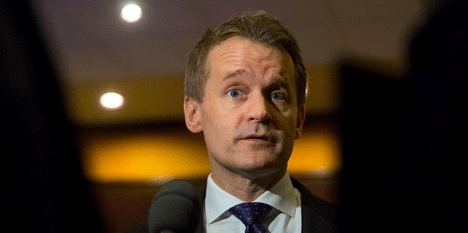
Minister of Natural Resources Seamus O’Regan, pictured delivering the opening keynote at the Canadian Nuclear Association’s annual conference in Ottawa on Feb. 27, 2020. The Canadian Nuclear Safety Commission reports to Parliament through Mr. O’Regan. The Hill Times photograph by Andrew Meade
On June 18th, Canada’s industry-friendly regulator, the Canadian Nuclear Safety Commission (CNSC), will formalize new guidance and requirements for disposal of radioactive waste. The CNSC’s new rules are tailored to allow the nuclear industry to “solve” its waste problem as easily and cheaply as possible.
While the CNSC claims to have consulted the public in preparing five new regulatory documents (“REGDOCs”) for radioactive waste storage and disposal, the documents largely reflect the agency’s separate interactions with industry giants such as Cameco, Ontario Power Generation, Bruce Power, and Canadian Nuclear Laboratories (a privately-owned corporation controlled by U.S. interests).
With Canadian nuclear reactors approaching the end of their useful life, or already shut down, the CNSC’s proposal to allow permanent, on-site disposal (and eventual abandonment) of radioactive waste at existing nuclear facilities is attracting criticism.
This strategy, known as “in-situ decommissioning”, is expressly supported in a new CNSC decommissioning REGDOC, even though its use is specifically proscribed by the International Atomic Energy Agency (IAEA).
Plans to use existing nuclear facilities for permanent waste disposal were initially set out in a 2014 Canadian Standards Association document prepared by industry and government nuclear officials. This document identifies “in situ confinement—to place the facility in a safe and secure condition with the intention to abandon in-place” as a decommissioning strategy option.
In 2015, the consortium of multinational companies that owns Canadian Nuclear Laboratories and operates the federal government’s nuclear sites (including six shut-down reactors) proposed to use this option for federal reactors in Ontario and Manitoba—to entomb them in concrete and grout. These proposals triggered federal environmental assessments that are being led by the CNSC.
In February 2020 the IAEA released a review of Canada’s nuclear safety framework, and observed that “The CNSC is currently considering two licence applications related to in situ confinement of legacy reactor facilities. This strategy of in-situ confinement is not consistent with SSG-47.”
SSG-47 is the 2018 IAEA Specific Safety Guide, Decommissioning of Nuclear Power Plants, Research Reactors and Other Nuclear Fuel Cycle Facilities. The IAEA suggested that CNSC “consider revising its current and planned requirements in the area of decommissioning to align with the IAEA guidance.”
But tather than following IAEA guidance that “entombment is not considered an acceptable strategy for planned decommissioning,” the CNSC decommissioning REGDOC to be approved on June 18th says “In situ decommissioning may be considered a solution… for legacy sites.”
The REGDOC then goes further, opening the door for abandonment of future nuclear facilities such as small modular reactors if their removal is not “practicable”.
Approval of this REGDOC and four others dealing with radioactive waste is being rushed by the CNSC behind closed doors during the coronavirus pandemic. The CNSC dismissed a written request from civil society groups to speak at, or even make written submissions for, its so-called “public meeting” on June 18th.
Civil society groups have long noted that Canada lacks policies and strategies for managing radioactive waste. Federal policy is limited to a 143-word Radioactive Waste Policy Framework that does not mention the fundamental principle of dealing with radioactive waste in a manner that protects human health—now and in the future—without imposing undue burdens on future generations.
In February, the IAEA recommended that “The Government of Canada should enhance the existing policy and establish the associated strategy to give effect to the principles stated in its Radioactive Waste Policy Framework.” The government responded that “Natural Resources Canada will review its existing policy for radioactive waste, and consider how it may be enhanced.”
NRCan officials say this review will include consultation with Indigenous groups and the public, but its start has been delayed by the pandemic.
It appears that the CNSC has decided to move quickly to pre-empt this government review, so as to allow maximum flexibility for the nuclear industry to use quick and cheap options to deal with its vexing challenge of radioactive waste disposal. When it comes to protecting people from exposure to harmful radiation, the fox is guarding the chicken house.
Ole Hendrickson is a retired environmental scientist, and a member of the Concerned Citizens of Renfrew County and Area.
Micro Modular Reactor Project at Chalk River: Comments on the proposed scope of factors to be considered in the conduct of an EA (Impact Assessment Agency Reference #80182)
Concerned Citizens of Renfrew County and Area
June 1, 2020
Concerned Citizens of Renfrew County and Area wishes to comment on factors to be considered in the environmental assessment of a “small modular reactor” (SMR) proposed to be built at the Chalk River Laboratories, located in Renfrew County on the Ottawa River. We are a non-governmental, volunteer organization that has been working for the clean-up and prevention of radioactive pollution from the nuclear industry in the Ottawa Valley for over 40 years.
Global First Power – a partnership between Ultra Safe Nuclear Corporation and Ontario Power Generation Inc. (OPG) – is proposing to build a “Micro Modular Reactor” (MMR) at the federally owned Chalk River Laboratories. The MMR project description says OPG would “provide licensing and operations capability for the MMR facility during the construction, operation, and decommissioning phases of the project.” Project funding sources are unclear, but Global First Power said in a May 20th “SMR Telephone Town Hall” that the MMR would cost in the range of $100 to $200 million dollars.
The Canadian Environmental Assessment Act, 2012 (CEAA 2012) was bundled into an omnibus budget bill and passed in great haste and secrecy, without an opportunity for careful consideration by Parliamentarians. In contrast, Canada’s House of Commons and Senate had prolonged and sometimes contentious debates in 2019 before passing the Impact Assessment Act– which supersedes CEAA 2012. However, the MMR project was launched just prior to the coming into force of the Impact Assessment Act. Its project assessment under CEAA 2012 may not benefit from the new Act’s measures pertaining to sustainability and Indigenous rights, to name a few, that are now legal requirements.
In Section 22 (1) of the new Act, the list of “factors to be considered” in a project assessment differs from the equivalent section 19 (1) of the old Act. Parliament added the following factors, all of which are relevant to the MMR project and should be included in the scope of the project assessment:
the “need for” the project;
the extent to which the designated project contributes to sustainability;
alternative means of carrying out the project that include use of “best available technologies”;
the impact that the designated project may have on any Indigenous group and any adverse impact that the designated project may have on the rights of the Indigenous peoples of Canada;
“community knowledge provided with respect to the designated project”; and
“the extent to which the effects of the designated project hinder or contribute to the Government of Canada’s ability to meet its environmental obligations and its commitments in respect of climate change.”
The project’s ability to contribute to Canada’s climate change commitments must include the project’s carbon dioxide and GHG emissions. The CNSC’s Interim Strategy for Environmental Assessments (https://nuclearsafety.gc.ca/eng/resources/fact-sheets/greenhouse-gas-emission-assessments-canadian-nuclear-fuel-cycle.cfm, proposes “that proponents assess the total GHG production as part of CNSC-led environmental assessments,” using “a lifecycle analysis approach that includes estimation of upstream and downstream GHG emissions,” that “may include the following stages:
mining and milling
refining
fuel fabrication
nuclear power plant
waste disposal (low-, intermediate-, and high-level radioactive waste disposal).”
All five stages are relevant to the MMR project. The CNSC should require the proponent to carefully evaluate the emissions from each of these stages, including all the uncertainties involved. In particular, GHG emissions associated with the MMR fuel fabrication stage (involving production of enriched U-235 fuel not currently used in Canadian nuclear power reactors) should be thoroughly assessed.
The MMR project would represent “the first commercial deployment of a private sector funded Small Modular Reactor (SMR) technology in Canada,” intended to “demonstrate the commercial viability of the MMR technology to prospective customers.” This is not intended to be a “one-off” project. It has implications for future deployment of SMRs, and should be assessed with this in mind.
The MMR project description refers to remote communities “with no access to grid power for their heating and electricity needs” as prospective customers for MMR deployment. Many of these remote communities are Indigenous; however, the increased protections provided to Indigenous rights in the new Impact Assessment Act are not requirements within CEAA 2012. To quote from the new Act, “the impact that the designated project may have on any Indigenous group and any adverse impact that the designated project may have on the rights of the Indigenous peoples of Canada” must be considered as a factor in the project assessment. We further note that the Chalk River Laboratories were established without consultation or accommodation with Algonquin peoples who never ceded their rights to the 3,700 hectare site. At a minimum, the MMR project will be located on this site for several decades, potentially with impacts lasting thousands of years. The proponent should consider in detail the MMR project’s impact on the exercise of their traditional rights.
Our group made a previous submission on the project description with details on a number of technical issues (waste management, description of physical works related to the project, accident probabilities, nuclear weapons proliferation risks). We requested these be addressed in the EA. We repeat our request that our previous submission be addressed in the consideration of the scope of the EA.
In that submission we noted that the project description does not describe “Financial support that federal authorities are, or may be, providing to the project,” which is a requirement of the Prescribed Information for the Description of a Designated Project Regulations under CEAA 2012. We questioned the proponent’s assertion that “Federal authorities are not providing financial support to the Project,” and noted that this side-stepped the issue of support that may be provided to the project in the future.
Atomic Energy of Canada Limited (AECL), the federal crown corporation that owns the Chalk River site, provides the privately-owned Canadian Nuclear Laboratories (CNL) with roughly a billion dollars annually in federal funding. CNL has created a Canadian Nuclear Research Initiative “to make CNL’s technical capabilities and expert knowledge available and accessible to the SMR community in order to equip them with the technical support required to progress towards SMR deployment in Canada,” and is negotiating terms of a cost sharing arrangementwithUltra Safe Nuclear Corporation “to resolve a broad array of technical questions in support of its Micro Modular Reactor (MMR).”
Noting the MMR project objective of demonstrating commercial viability of SMRs, we ask that the following additional factor be included in the scope of the EA: Financial support from government authorities, including the crown corporations AECL and OPG, for the project. The assessment should also detail any in-kind support that AECL and OPG have given or expect to be offering in the future.
Finally, we wish to raise an issue regarding the process through which the CNSC’s Commission will make its determination on the scope of the MMR EA. The scope of three previous EAs currently being conducted under CEAA 2012 was approved by a panel composed solely of the CEO and President of the CNSC, who also serves as Commission Chair. A Commission Decision on the Scope of Environmental Assessments for three proposed projects at existing Canadian Nuclear Laboratories’ facilities wasmade at a Commission Hearing on March 8, 2017 with the only Member present being the past CNSC President, Michael Binder. While this is shown on the CNSC website as a “Hearing in writing,” no Notice of Meeting was issued prior to this “public” hearing, and no documentation was available for consideration other than a written submission from CNSC staff (CMD 17-H100).
In the current matter, CMD 20-H102 refers to a “Hearing in writing based solely on written submissions scheduled for June 2020,” with no further details as to the date of the hearing, which Commissioners may be present, whether the public would be allowed to listen to any discussions that might take place, or whether submissions such as the present one will be included as CMDs for the hearing.
Based on the limited information currently available, the decision-making process for the hearing on the scope of the MMR EA could be similar, if not identical, to that followed for the March 8, 2017 hearing.
Given that the current CNSC President and CEO, who is also Chair of the Commission, is a former senior manager responsible for new nuclear reactor projects at OPG – and given that OPG would “provide licensing and operations capability for the MMR facility during the construction, operation, and decommissioning phases of the project” – using a “Hearing in writing” with only the current Commission Chair present creates the appearance of a conflict of interest.
We recommend that the CNSC use an alternative decision-making process for the scoping decision that provides transparency and that does not affect public trust in the independence and credibility of the regulator. In light of the COVID-19 pandemic, we also recommend an extension in the submission deadline for comments, so that all interested parties have ample time to consider this important matter.
from Kerrie Blaise, Legal Counsel, Canadian Environmental Law Association
For both NPD and Whiteshell, the revised EIS has been found to be incomplete and the CNSC has sent it back to the proponent. The CNSC is currently undertaking their completeness review for NSDF.
April 30, 2020 – On March 27, 2020, Canadian Nuclear Laboratories (CNL) submitted a revised draft environmental impact statement (EIS) for the proposed In Situ Decommissioning Of the Whiteshell Reactor #1 Project to the Canadian Nuclear Safety Commission (CNSC), which included an updated EIS, updated technical supporting documents, and consolidated responses to all federal and provincial information requests. CNSC staff conducted a completeness check and determined that insufficient information was provided to enable the federal and provincial review team to proceed with the EIS technical review. CNL is expected to provide additional information and resubmit the revised EIS and supporting documents at a later date.
April 9, 2020 – The Federal and Provincial Review Team (FPRT) has completed their technical review of Canadian Nuclear Laboratories’ (CNL) revised draft environmental impact statement (EIS) for the proposed Near Surface Disposal Facility, including updated supporting documents, and responses to all federal and provincial comments and information requests (IRs) (step 26 in Appendix A of the CNL–CNSC Administrative Protocol for the Proposed Near Surface Disposal Facility), available here.
Led by the Canadian Nuclear Safety Commission (CNSC), the federal and provincial authorities that participated in the technical review included Environment and Climate Change Canada, Health Canada, Natural Resources Canada, Ontario Ministry of the Environment and Climate Change, and the Quebec Ministère de l’Environnement et de la Lutte contre les changement climatiques. The FPRT technical review resulted in 37 IRs in total, several of these follow-up comments on existing IRs as well as several new IRs resulting from the review of new information. The CNSC submitted the consolidated table of federal and provincial comments from the FPRT technical review to CNL on April 3, 2020. CNL must now respond to these additional federal and provincial comments. The CNSC, in collaboration with the FPRT, will then make a determination on whether the information provided in CNL’s submissions is complete.
May 05, 2020 – On March 31, 2020, Canadian Nuclear Laboratories (CNL) submitted a revised draft environmental impact statement (EIS) for the proposed Nuclear Power Demonstration (NPD) Closure Project to the Canadian Nuclear Safety Commission (CNSC), which included an updated EIS, updated technical supporting documents, and responses to all federal and provincial comments and information requests. CNSC staff conducted a completeness check and determined that insufficient information was provided to enable the federal and provincial review team to proceed with the EIS technical review. CNL is expected to provide additional information and resubmit the revised EIS and supporting documents at a later date.


 Concerned Citizens of Renfrew County and Area