The Ottawa River flows through an ancient rift valley that extends from near North Bay through Ottawa toward Montreal. The area is seismically active, and experiences dozens of minor earthquakes each year. Stronger earthquakes also occur such as the magnitude 5 quake in June 2010 that caused shaking, evacuations and damage in Ottawa including shattered windows in Ottawa City Hall and power outages in the downtown area.
Experts say Ottawa is at risk for a big earthquake.The Government of Canada is currently in the process of shoring up and earthquake-proofing the buildings on Parliament Hill. The project will take 13 years and cost billions of dollars.
Incredibly, at the same time as billions are being spent to earthquake-proof Canada’s Parliament Buildings, the Government of Canada is paying billions of dollars to a US-based consortium that is importing large quantities of radioactive waste to the Ottawa Valley.
Soon after it took control of Canada’s nuclear laboratories and radioactive waste in 2015, the consortium, through its wholly-owned subsidiary, Canadian Nuclear Laboratories (CNL), announced its intention to consolidate all federally-owned radioactive waste at Chalk River Laboratories, alongside the Ottawa River, 180 km upstream of the Nation’s Capital. There was no consultation or approval from the Algonquin Nation in whose unceded territory the Chalk River Laboratories is located, nor any consultation with residents of the Ottawa Valley about the plan.
CNL is importing nuclear waste from federal nuclear facilities in Manitoba, southern Ontario and Quebec. The imports comprise thousands of shipments and thousands of tonnes of radioactive debris from reactor decommissioning, and dozens of tonnes of high level waste nuclear fuel, the most deadly kind of radioactive waste that can deliver a lethal dose of radiation to an unprotected bystander within seconds of exposure.
High level waste shipments from Becancour, Quebec have already been completed. They involved “dozens of trucks” and convoys operating secretly over several months, from December 2024 through July 2025, under police escort, to move 60 tons of used fuel bundles to Chalk River. Tons of high level waste from Manitoba will follow soon.
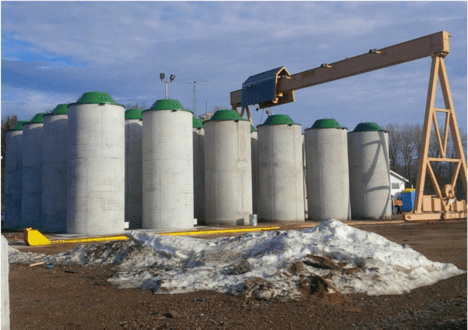
Since there is no long-term facility for high level waste at Chalk River, nor is there any such facility anywhere in Canada at present, CNL built silos (shown in the photo below) to hold the waste at a cost of 15 million dollars. This high level radioactive waste is ostensibly in storage at Chalk River, but there is no guarantee it will ever be moved.
CNL plans to put the less deadly waste into a giant, above-ground radioactive waste mound called the Near Surface Disposal Facility, a controversial project currently mired in legal challenges. The dump would hold one million tons of radioactive waste in a facility designed to last about 500 years. Many of the materials destined for disposal in the dump, such as plutonium, will remain radioactive for far longer than that. According to CNL’s own studies, the facility would leak during operation and disintegrate after a few hundred years, releasing its contents to the surrounding environment and Ottawa River less than a kilometer away.
Shipping containers filled with radioactive waste are piling up at Waste Management Area H on the Chalk River Laboratories property, awaiting a time when they can be driven or emptied into the NSDF. At last count there were 1500 shipping containers there, shown in the photo below.
It would be hard to choose a less suitable place to consolidate all federal radioactive waste than in a seismically-active zone beside the Ottawa River that provides drinking water for millions of Canadians in communities downstream including Ottawa, Gatineau and Montreal.
Concerns about imports of radioactive waste to the Ottawa Valley are widespread and growing.
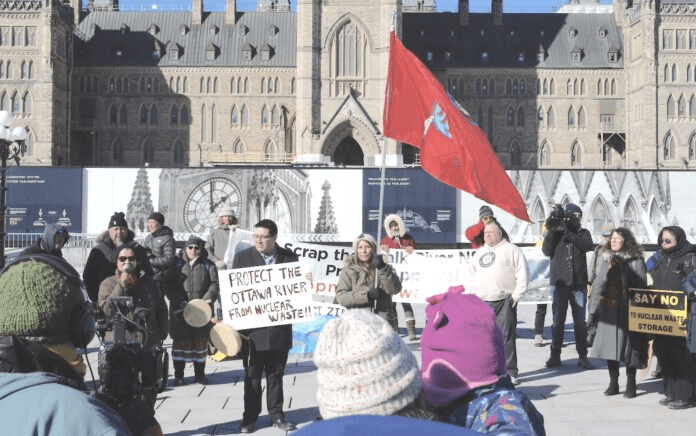
In 2021, Ottawa City Council unanimously passed a resolution calling for radioactive waste imports to the Ottawa Valley to stop. Ottawa Riverkeeper recently called for transportation of radioactive waste to the Chalk River Laboratories to stop until a clear, long-term plan for the waste is available. A December 2025 letter to Prime Minister Mark Carney from Bloc Québécois and Green Party MPs along with First Nations and many civil society groups requested a moratorium on shipments of Canadian radioactive waste to Chalk River.
Action is urgently needed to halt the imports of radioactive waste to the earthquake-prone Ottawa Valley.
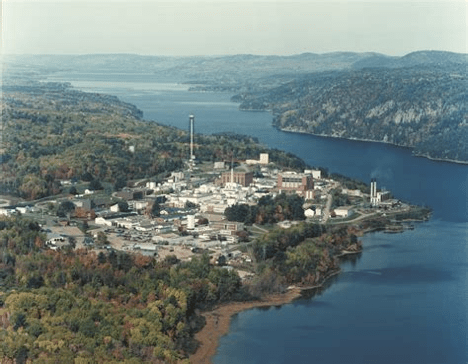
Photo above shows Chalk River Laboratories, beside the Ottawa River upstream of the Nation’s Capital, in the ancient, seismically-active rift valley.
Towards a transparent and responsible management of radioactive waste
December 2 2025
Several political parties and civil society organizations are dismayed to learn thatCanadian Nuclear Laboratories (CNL) has decided to consolidate radioactive waste (forwhich the federal government is responsible) at the Chalk River Laboratories site. This decision was made without consultation with First Nations or the public, and without parliamentary debate. Canadian Nuclear Laboratories (CNL) is only a private contractor,not a government agency.
For the population, there is no public accountability and concern is growing. Why concentrate everything at Chalk River? CNL is not intending to permanently store high- or intermediate-level waste at Chalk River. Those wastes will likely be moved again. Chalk River is an unsuitable location for radioactive waste consolidation because it islocated on the Ottawa River and the area is prone to seismic tremors.
Used nuclear fuel has the highest level of radioactivity; it is being transported to ChalkRiver from nuclear reactors in Manitoba, Ontario and Quebec for interim storage pending the construction of a proposed deep geological repository (DGR). CNL intendsto have the same used fuel eventually transported to the DGR. But such a repositorystill does not exist and may never be licensed or approved. Whether the DGR isultimately built or not, issues surrounding the transportation of radioactive waste have to be addressed.
There are increased risks and costs of transporting used fuel twice: first from thenuclear power plants to Chalk River, and then from Chalk River to a second destination.This leads to extra safety risks and a waste of public money. The government is justmoving the waste around at great expense and added risk without solving the problempermanently, as there is still no proven safe solution despite 45 years of effort.
The proposed transportation of intermediate-level waste to Chalk River from thedecommissioning of nuclear reactors is similarly ill-advised.
Public concern was heightened by the news of the secretive transport of tonnes of usednuclear fuel from Bécancour, Quebec, to Chalk River during the summer of 2025, alongpublic roads and bridges, without any explicit authorization or opportunity for publicconsultation or even proper notification.
• We call on the federal government for a moratorium on the shipment of Canadianradioactive waste to Chalk River because of the increasing risk of radioactivecontamination and the lack of an acceptable due process.
• We call on the federal government to ban all imports of radioactive waste from othercountries, including disused medical sources, discarded tritium light sources, or usednuclear fuel.
• We call on the Minister of Environment and Climate Change to conduct a strategicassessment of the transportation of high- and intermediate-level radioactive waste onpublic highways, in accordance with section 95 of the Impact Assessment Act. Theresults of this assessment would contribute to future impact assessments of nuclearfacilities. The goal would be to examine, for example, the cumulative impact at ChalkRiver and to provide a framework for upcoming environmental assessments of nuclearpower plants and reactor decommissioning projects.
Patrick Bonin, M.P.Bloc Québécois critic for the Environment and Climate Change
Elizabeth May, M.P.Green Party of Canada
André BélangerFondation Rivières
Alain BranchaudSNAP Québec
Ginette Charbonneau Physicist and spokesperson for le Ralliement contre la pollution radioactive
A hearing this Wednesday November 12 in the Federal Court of Appeal, before a panel of three judges, will be a test of Canada’s commitment to protect threatened and endangered species and may determine whether the giant Ottawa River nuclear waste dump can be built or not.You can watch the hearing on Zoom by registering at this link, and you are also invited to a rally, “Stand up for Wildlife,” from noon to 2 pm outside the courtroom on Sparks St. in Ottawa.
Background:
Earlier this year we celebrated the successful legal challenge to the granting of a Species-at-Risk permit to Canadian Nuclear Laboratories (CNL) for the construction of the nuclear waste dump known as the “NSDF.” The legal challenge was brought by Kebaowek First Nation, Concerned Citizens of Renfrew County and Area, the Canadian Coalition for Nuclear Responsibility, and Sierra Club Canada Foundation.
You may recall that CNL is owned by a multinational private-sector consortium that operates Canada’s federal nuclear labs under a $1.6 billion per year contract with the Government of Canada. CNL needed a Species-at-risk permit in order to construct its controversial, giant, above-ground nuclear waste dump beside the Ottawa River because the site they chose for the dump is on federal land smack dab in the middle of irreplaceable wildlife habitat that is home to many species at risk. A permit would allow CNL to destroy habitat and residences for threatened and endangered species in order to construct its giant dump.
In order to get a permit, a proponent must prove that it carefully considered all possible alternatives and chose the one with the least impact on endangered species. CNL did not do this. In fact, it is on record as saying it chose the location because it would reduce transportation costs. In his ruling issued on March 14, 2025, Justice Russel Zinn said the environment minister’s issuing of the species-at-risk permit was “unreasonable due to fatal flaws” in interpreting and applying the federal Species at Risk Act, adding that the issuing of the permit must be reconsidered.
Unfortunately for threatened wildlife and for Canadian taxpayers, who foot the bill for everything the multinational consortium does under its contract with the government, the case was appealed by CNL. Hence, the evidence will be reviewed again on November 12, this time in the federal court of appeal, by a panel of three judges.
The legal case here is fairly cut and dried; it will be interesting to see how it plays out. But behind the straightforward legal arguments lies a shocking story of disregard for wildlife that we discovered when we applied for the initial judicial review and received 4,000 pages of material connected with the permit application. Among other things, we learned that CNL knew that the site was very rich in biodiversity, but chose it anyway. The site is located on a south facing densely forested hillside that rises 140 feet above five named wetlands at its base, critical habitat for endangered Blanding’s turtles. The forest stands have old growth characteristics and provide prime habitat for endangered bats and songbirds such as the Canada Warbler, Golden-winged Warbler and Eastern Whip-poor-will. To create a flat surface for the NSDF, clear cutting and extensive blasting would convert 28 hectares of forested hillside into 170,000 cubic metres of rock, with unknown but likely adverse effects on the surrounding wetlands. More than 10,000 mature trees would be cut down, including provincially-endangered Black Ash trees. Kebaowek First Nation found three active bear dens on the site, and evidence of extensive use of the site by threatened Eastern Wolves. Both bears and wolves are species of great cultural importance to Algonquin peoples.
Seethis post on the Concerned Citizens website, for more detail on CNL’s disregard for wildlife in its choice of a site for the NSDF.
The beautiful artwork below is by Destiny Cote of Kitigan Zibi Anishinabeg. Eastern Wolves are one of the threatened species that would be adversely affected by the NSDF.
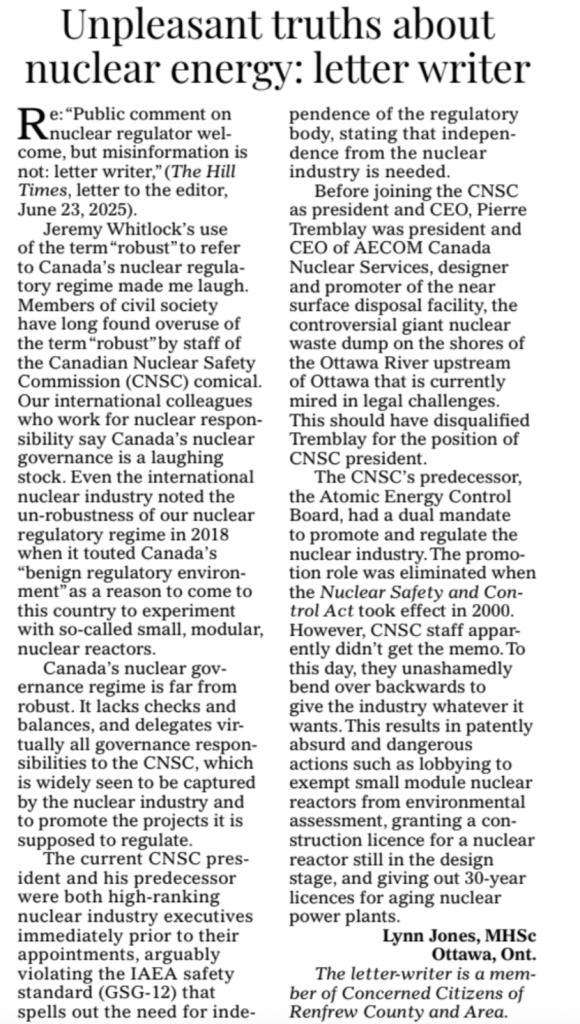
This letter appeared in the July 7 edition of the Hill Times. (subscribe here)
It was in response to a letter by Jeremy Whitlock, indefatigable cheerleader for all things nuclear. His letter, published on June 23, 2025 is here.
Jeremy Whitlock was responding to this letter, published in the Hill Times on June 16, 2025:
Canada is failing to meet a fundamental principle of nuclear safety according to international experts
A March 2025 report by the International Atomic Energy Agency (IAEA) flagged a serious problem in Canada’s nuclear governance regime. Canada has not incorporated the fundamental safety principle of justification into its legal framework, despite being urged to do so by an international peer review team in 2019.
The IAEA principle of justification in nuclear safety requires that any practice involving human exposures to ionizing radiation be justified during the licensing process for a facility. It must be demonstrated that the overall benefits of the project to individuals and society, outweigh the potential health detriments of the radiation exposures it will cause.
Justification is necessary because there is no safe level of exposure to ionizing radiation from nuclear reactors and radioactive waste. Ionizing radiation causes cancers of all kinds, many other chronic diseases and damage to the human gene pool. Human-made nuclear waste will remain hazardous and radioactive for millions of years.
Canada’s failure to justify nuclear projects is a serious deficiency that urgently needs to be addressed given the Government of Canada’s professed interest in funding and expanding nuclear electricity generation in Canada. We need to ask: can we justify creating more and more radioactive waste that future generations will have to deal with even though they will receive zero benefit from the activities that created it.
Other serious deficiencies were flagged by the IAEA experts in 2019. For example, Canada allows pregnant nuclear workers to be exposed to a radiation dose four times larger than is tolerated by IAEA standards. This issue remains unaddressed five years later.
The giant Chalk River radioactive waste megadump, known as the NSDF, was approved by the Canadian Nuclear Safety Commission on January 8, 2024 after a protracted and badly flawed environmental assessment. For background on problems with the NSDF see this post. Two months after the CNSC approval of the license, a permit was issued by the Minister of Environment and Climate Change Canada to allow destruction of endangered species and their habitats and residences in construction of the NSDF.
Two legal challenges to the CNSC decision to license the NSDF were initiated in February 2024. A challenge to the species at risk permit was initiated in March 2024.
Legal Challenge 1 ~ Kebaowek FN vs Canadian Nuclear Laboratories
Kebaowek First Nation applied for a judicial review of the CNSC decision to license the NSDF on grounds that the Canadian Nuclear Safety Commission’s failed to secure Algonquin First Nations’ free, prior and informed consent for disposal of hazardous waste in their territory as mandated by the United Nations Declaration on the Rights of Indigenous Peoples Act. The case was heard by Justice Julie Blackhawk in a two-day hearing July 10 and 11 in Ottawa. The lead lawyer for Kebaowek, Robert Janes KC, was brilliant in arguing the case. He has represented First Nations many times in the Supreme Court. Justice Blackhawk’s decision is pending and may take several more months. Donations to the GoFundMe campaign to help cover Kebaowek FN’s legal costs are greatly appreciated. The campaign page is here.
Legal Challenge 2 ~ Concerned Citizens et al vs Canadian Nuclear Laboratories
Concerned Citizens of Renfrew County and Area, Ralliement contre la pollution radioactive, and the Canadian Coalition for Nuclear Responsibility applied for a judicial review of the CNSC decision to license the NSDF. The three groups are challenging the decision on a number of grounds including excessive radiation doses, failure to adequately describe or control what would be put in the dump and failure to consider cumulative effects . (More details about the grounds and a link to the factum here.)
The case was heard in federal court by Justice Whyte Nowak in Ottawa on November 19 and 20, 2024. The judge is expected to render her decision sometime in the next several months.
Legal Challenge 3 ~ Kebaowek First Nation et al vs Canadian Nuclear Laboratories
This challenge is an application for review of the decision by the Minister of Environment and Climate Change Canada to issue a permit to destroy several species at risk and their habitats and residences during construction of the NSDF. Kebaowek First Nation is joined in this application by Concerned Citizens of Renfrew County and Area, the Canadian Coalition for Nuclear Responsibility and Sierra Club Canada Foundation. The applicants argue that the NSDF proponent did not examine all possible options, and did not choose the one least likely to affect species at risk, as required by the Species at Risk Act and therefore should not have been granted a permit. They present evidence that the proponent in fact chose an option that it knew to be richer in biodiversity and potentially more damaging to species at risk because it would reduce its costs for transporting waste.
The hearing is scheduled for February 5th and 6th, 2025. The factum was filed on September 27, and is appended to the end of this post. Members of the public can attend the hearing in person, or register to watch it on Zoom. To register for the Zoom go to:https://www.fct-cf.gc.ca/en/court-files-and-decisions/hearing-lists and scroll down the page to the beige Advanced Search bar. Just below that bar on the right hand side is a search box. Type “Kebaowek” in the search box. Then click on the green pencil in the square box icon, to register to watch on Zoom.
Why is so little Chalk River waste suitable for near surface disposal?
Extensive research work at the Chalk River Laboratories on nuclear reactor fuels, and in the early days, on materials for nuclear weapons, produced waste with large quantities of long-lived alpha emitters. This waste is difficult to manage and can even become increasingly radioactive over time.
According to the International Atomic Energy Agency, because of the presence of long-lived alpha emitters, waste from nuclear research facilities is generally classified as intermediate level, and even in some cases, as high level. This waste cannot be put in a near surface disposal facility because its radioactivity will not decay to harmless levels during the period that the facility remains under institutional control.
Alpha emitters decay by throwing off an alpha particle, the equivalent of a helium nucleus, with two protons and two neutrons. The external penetrating power of an alpha particle is low, but alpha emitters have extremely serious health effects if ingested or inhaled. They can lodge in your lungs and cause cancer.
Research at Chalk River and all other nuclear laboratories is ultimately based on three long-lived alpha emitters — thorium-232, uranium-235, and uranium-238. These are the “naturally occurring” or “primordial” radionuclides. They were created by large stars and then incorporated into the Earth and the solar system when they formed some 4.5 billion years ago. The waste inventory proposed by Canadian Nuclear Laboratories for the Near Surface Disposal Facility (NSDF) includes over six tons each of thorium-232 and uranium-238.
Each “natural” alpha emitter initiates a decay chain with roughly a dozen radioactive isotopes of other elements such as radium, radon, and polonium. These elements also occur naturally, but in much smaller amounts because of their more rapid decay.
When a radioactive element releases an alpha particle, the atomic weight of the product goes down by four. Uranium-238 decays to uranium-234, with a 245,000-year half-life. Uranium-234 decays to thorium-230, with a 75,000-year half-life. Thorium-230 decays to radium-226, with a 1,600-year half-life. Shorter half-lives mean greater initial radioactivity. Radium-226 decays to radon-222, with a 4-day half-life. Radon-222, a gas, builds up in the basements of houses built over uranium-rich rocks. When it is inhaled it decays into polonium-218, a highly toxic, cancer-causing substance with a 3-day half-life. “Naturally occurring” alpha emitters are clearly harmful.
Hazards increase when uranium and thorium are mined and concentrated from ores and used in their pure form. Marie Curie, who spent much of her career isolating radium and polonium from uranium, died of radiation-induced leukemia at age 66. She was buried in a lead-lined tomb because her corpse emitted so much radiation.
When thorium-232, uranium-235, and uranium-238 are irradiated in a reactor, as at Chalk River, they absorb neutrons and produce significant quantities of new, man-made, long-lived alpha-emitters. Irradiated uranium-238 absorbs a neutron and temporarily forms uranium-239. Uranium-239 transmutes to neptunium-239, which quickly transmutes to long-lived plutonium-239, with a half-life of 24,000 years.
Plutonium-239 is “fissile” – it can readily support a chain reaction. It is what the early Chalk River researchers produced for the manufacture of U.S. nuclear weapons, by separating the plutonium from irradiated reactor fuel. They also used the separated plutonium to make “mixed oxide” (MOX) reactor fuel, mixing it with fresh uranium.
Thorium-232, when put in a nuclear reactor, will absorb a neutron and transmute to uranium-233, with a half-life of 160,000 years. Uranium-233 also can support a chain reaction, so it can be used in atomic bombs and reactor fuels as well. Chalk River researchers did a lot of work to separate uranium-233 from irradiated thorium-232.
All reactor fuel contains uranium-235. It is the only naturally occurring isotope that readily undergoes fission and can sustain a chain reaction. But not all uranium-235 atoms undergo fission in a nuclear reactor. Instead they can absorb either one or two neutrons and form yet two more very long-lived, man-made alpha-emitters, uranium-236 (half-life of 23.4 million years) and neptunium-237 (half-life of 2.14 million years).
Nuclear engineers don’t like uranium-236 because it acts as a “neutron poison”, absorbing neutrons instead of undergoing fission. The longer that uranium-235 fuel remains in a reactor, the more uranium-236 and neptunium-237 are produced.
Uranium-236 is certainly a part of the Chalk River waste. It is the longest-lived of all the man-made alpha emitters, but for some reason it was omitted from the NSDF inventory.
As noted above, thorium-232, uranium-235, and uranium-238 are the start of three naturally occurring decay chains. A fourth decay chain starts with man-made neptunium-237 and ends with thallium-205 (the element before lead in the periodic table). Neptunium and its “progeny” have all decayed away during Earth’s 4.5-billion-year history, but production of neptunium-237 in nuclear reactors (and uranium-233 by thorium-232 irradiation) has “resurrected” this hitherto extinct fourth decay chain.
Americium-241, found in significant quantities in Chalk River waste, is another starting point for the man-made nepturium-237 decay chain. Nuclear reactors have also greatly augmented the amounts of radionuclides in the uranium-235 decay chain by producing plutonium-239, and in the thorium-232 decay chain by producing uranium-236.
Early research done at Chalk River to extract (or “reprocess”) plutonium-239 and uranium-233 from irradiated fuel and irradiated thorium targets has created a legacy of buildings (e.g., the Plutonium Recovery Laboratory) and soils (e.g., the Thorium Pit) that are contaminated with long-lived alpha emitters. Reprocessing was dangerous and caused several accidents. The resulting contamination has never been cleaned up.
Until 2018, highly enriched uranium-235 targets were irradiated in the NRU reactor at Chalk River, followed by dissolving the targets in nitric acid and extracting the fission product molybdenum-99, a “medical isotope”. After extraction of “moly-99”, the other fission products, and the long-lived alpha emitters uranium-236 and neptunium-237 (produced when uranium-235 atoms absorb neutrons instead of undergoing fission), remain in the medical isotope waste. This waste resembles high-level spent fuel waste and represents one of Chalk River’s most dangerous legacies.
Fuel reprocessing, medical isotope production, and other research activities at Chalk River have produced very significant amounts of waste containing long-lived alpha emitters. This waste is unsuitable for near-surface disposal. Much of it is mixed with shorter-lived fission products and cannot be separated from them. This mixed waste should not be put in the NSDF.
Detecting alpha emitters in mixed waste is expensive and challenging. Putting inadequately characterized waste in the NSDF would invalidate its safety case.
Unfortunately, the NSDF Project lacks adequate waste characterization procedures. If the project is allowed to proceed, workers and future Ottawa valley residents could be exposed to unknown quantities of long-lived alpha emitters and suffer the serious health effects associated with them.
Will CNL put nuclear reactor components in the NSDF?
The lack of clarity about the nature of the waste intended for disposal in the NSDF has been a concern since the NSDF project description was published in March 2016. In our group’s comments on the project description, submitted in June 2016, we stated
For the public to have adequate information about the nature of the radioactive waste proposed for inclusion in the NSDF, the environmental assessment must provide much more detail than simply stating that the waste “will be required to meet waste acceptance criteria.”
CNL has prepared a document, NSDF Waste Acceptance Criteria (WAC) that CNL says “will ensure the short- and long-term protection of the public, the environment and workers.” But is this true? And do the NSDF Waste Acceptance Criteriaallow CNL to place reactor components in the NSDF?
The calandria from the NRX reactor accident in December 1952 and two calandria from the NRU reactor are buried at shallow depths in the waste management areas of Chalk River Laboratories. This is stated in the Overview Decommissioning and Cleanup Plan for Chalk River Laboratories:
“Several special burials (NRU and NRX calandrias) were also made in concrete containers or directly in the trenches.”
“Oversized debris, including waste that does not fall within the definition of waste types 1 to 5, primarily due to its size or shape. The process applicable to infrequently performed activities (section 6.4) is used to approve the placement of type 6 waste.”
The Infrequently Performed Operations override clause in section 6.4 states:
“The eligibility of wastes that do not meet all the requirements set forth in the WAC (including Type 6, Oversized Waste) may be evaluated on a case-by-case basis.”
Reactor calandrias would almost certainly exceed the “Dose Rate Limits and Means of Handling and Transferring ” in Table 7 of the WAC. However, the Waste Acceptance Criteria allow these dose limits to be exceeded if waste packages are shielded:
“Shielded Waste Packages could be used to ensure waste complies with the dose rate limit in Table 7.”
CNL has made a presentation to the Chalk River Laboratories Environmental Stewardship Council about its work to uncover the NRX calandria, currently buried at shallow depth in Waste Management Area A. The notes from Council meeting number 53 on Thursday, March 21, 2024, state that a council member asked for an update on this work:
Has anything else been happening with the NRX Calandra [sic] with the Calandra [sic] in Waste Area A?
The first emplacement of radioactive waste at the CRL site took place in 1946 into what is now referred to as Waste Management Area A. These emplacements took the form of direct disposal of solids and liquids into excavated sand trenches. The scale of operations was modest and unrecorded until 1952, when the cleanup from the NRX accident generated large quantities of radioactive waste (which included the reactor’s calandria) that had to be managed quickly and safely. At that time, approximately 4,500 m3 of aqueous waste, containing 330 TBq (9,000 Ci) of mixed fission products, was poured into excavated trenches. This action was followed by smaller dispersals (6.3 TBq and 34 TBq of mixed fission products) in 1954 and 1955, respectively. Waste is no longer accepted for emplacement in Waste Management Area A.
The 2023 Overview Decommissioning and Cleanup Plan for Chalk River Laboratories indicates CNL’s intention to transfer all the contents of WMA A to the NSDF: “the preliminary scenario presented is the removal of wastes from WMA A and its disposal in the NSDF.”
CNL’s lack of transparency regarding the waste destined for the NSDF, despite the requirements of the General Nuclear Safety and Control Regulations (GNSCR), is one of the main points of one of the legal challenges to the CNSC’s decision to authorize construction of the facility.
The Memorandum of Fact and Law for the federal court case (Court File No. T-226-24) between Concerned Citizens of Renfrew County and Area, the Canadian Coalition for Nuclear Responsibility and le Ralliement contre la pollution radioactive (Applicants) and Canadian Nuclear Laboratories (Respondent) says the following:
The Commission’s failure to require the specific and comprehensive information set out in GNSCR s. 3(1)(c) and (j) has an enormous impact on the integrity of the Decision as a whole. This failure undermines the Decision’s main conclusion that the NSDF will not produce significant adverse environmental and health effects. All CNL’s calculations estimating the amount of radioactive material that the NSDF would release into the environment and would expose a member of the public to were based on the Waste Acceptance Criteria being followed. Since materials can be placed in the NSDF even if they do not meet the Waste Acceptance Criteria, all the calculations and estimations are a fiction. There is no guarantee that the amount and type of substances that end up in the NSDF will be the same amount and type as that upon which the calculations for the safety assessments were made.
~~~~~~~~
Photos from Globe and Mail article (19 March 2023) “Jimmy Carter, Chalk River and the dawn of Canada’s nuclear age”
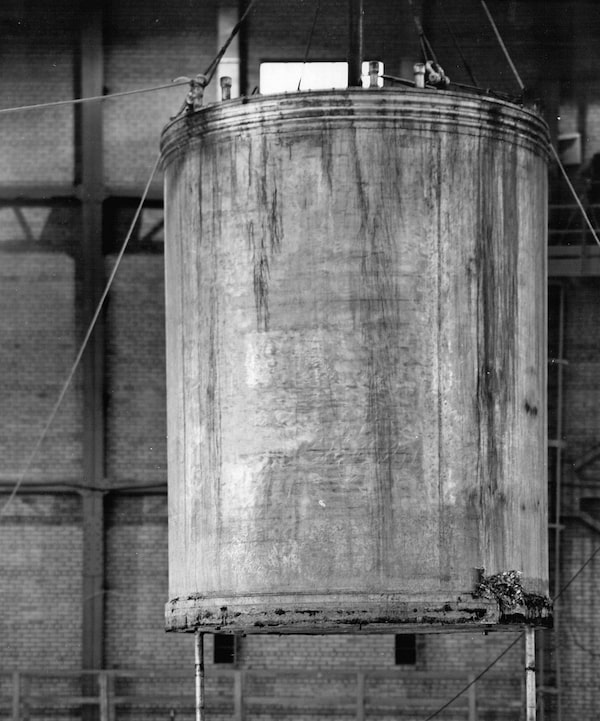
The NRX calandria is lowered into a protective bag and driven away to a disposal site in May 1953.CANADIAN NUCLEAR LABORATORIES
Now, 70 years after the cleanup, the largest artefact from the accident is about to see the light of day once again.
The burial mound of the NRX calandria, as seen earlier this month. Later this spring, a project team will resume work on excavating and then cutting up the calandria for longer term storage.CANADIAN NUCLEAR LABORATORIES/SUPPLIED
The “NSDF,” a giant, above-ground landfill beside the Ottawa River, for one million tonnes of radioactive waste, approved by the Canadian Nuclear Safety Commission on January 9, is a debacle-in-the-making.
The NSDF fails to meet International safety standards according to experts who for years were in charge of the waste at Chalk River. Industry veterans say much of the waste is too long-lived for permanent emplacement in an above-ground mound.
The facility is expected to leak during operation and break down and release its contents to the environment after 550 years, while many of the dangerous, post-fission, man-made radioactive toxins in the mound will remain hazardous for many millennia. Plutonium and other radioactive pollutants will leak into the Ottawa River that drains into the St. Lawrence River at Montreal. This leakage will contaminate drinking water for millions of Canadians. All radioactive contaminants increase risks of cancer, birth defects and genetic mutations in exposed populations. The larger the population exposed, the greater the incidence of maladies.
Ten out of 11 Algonquin First Nations that have lived in the Ottawa River watershed for millennia say they do not consent to the NSDF on their unceded territory. The Assembly of First Nations and more than 140 municipalities including Ottawa, Gatineau and Montreal have passed resolutions of concern and/or opposition to the facility.
We wonder who the beneficiaries of the NSDF would be, besides shareholders of the three multinationals involved: SNC-Lavalin (now called Atkins Réalis), and two Texas-based multinationals, Fluor and Jacobs. The three multinationals comprise the “Canadian National Energy Alliance,” contracted by the Harper government in 2015 to quickly and cheaply reduce Canada’s multibillion dollar federal nuclear waste cleanup liability.
Two legal challenges to the CNSC’s decision have been launched in Federal Court. More may follow if a species-at-risk permit to clearcut the NSDF site is approved .
There is a positive way forward for the Liberal government. The Federal Cabinet could request an ARTEMIS review by the International Atomic Energy Agency. ARTEMIS reviews are expert peer reviews, available to all member states of IAEA.
An ARTEMIS review could provide the Government of Canada with valuable advice about how to manage its legacy radioactive waste. Responsibility for managing this waste was handed over to profit-seeking multinationals in 2015 by the Harper government. Costs to taxpayers have ballooned since then. An ARTEMIS review could advise the Government of Canada on how to get value for money in its radioactive waste management projects while ensuring that safety is the top priority.
House of Commons e-petition 4676 calling for an ARTEMIS review garnered 3000 signatures in 30 days over the recent Christmas and New Years holiday period. The petition also called on the Government of Canada to uphold the principle, from the UN Declaration on the Rights of Indigenous Peoples, that “free, prior and informed consent” must be obtained before hazardous waste is stored in the territory of Indigenous people.
We and others have written to the Prime Minister and several Cabinet Ministers urging Cabinet to request an IAEA ARTEMIS review as soon as possible for the benefit of all Canadians and future generations.
Please subscribe to the National Observer using this link, to support the excellent investigative journalism of Natasha Bulowski on the Chalk River nuclear waste.
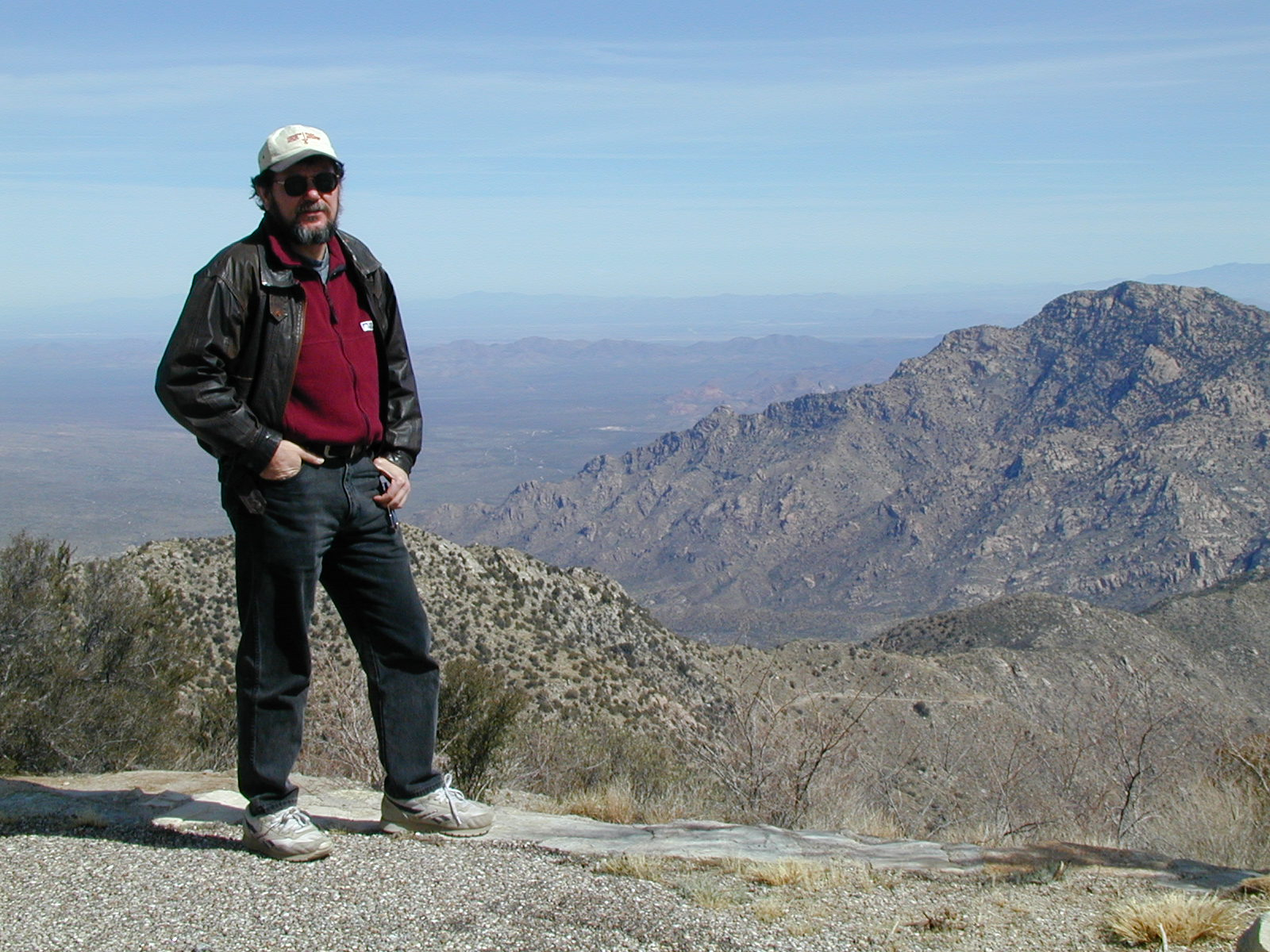
Former employee at Atomic Energy of Canada Limited Kerry Burns (centre right, with a beard and spectacles) at AECL’s Whiteshell Laboratories in Manitoba in 1979. Photo submitted by Kerry Burns
Approval of a nuclear waste disposal site near the Ottawa River hinged on a promise that only low-level radioactive waste would be accepted. But former nuclear industry employees and experts warn some waste slated for disposal contains unacceptably high levels of long-lived radioactive material.
The “near-surface disposal facility” at Chalk River Laboratories (CRL) will store up to one million cubic metres of current and future low-level radioactive waste inside a shallow mound about one kilometre from the river, which provides drinking water to millions of people in the region. But former employees who spent decades working at the labs in waste management and analysis say previous waste-handling practices were inadequate, imprecise and not up to modern standards. Different levels of radioactive material were mixed together, making it unacceptable to bury in the mound.
“Anything pre-2000 is anybody’s guess what the hell they have on their hands,” said Gregory Csullog, a retired waste inventory specialist and former longtime employee of Atomic Energy of Canada Limited (AECL), the Crown corporation that ran the federal government’s nuclear facilities before the Harper government privatized it in 2015.
Gregory Csullog pictured at the Yucca Mountain nuclear waste repository in 2001 while employed with the International Atomic Energy Agency. Photo submitted by Gregory Csullog
Csullog described the waste during this earlier time as an unidentifiable “mishmash” of intermediate- and low-level radioactivity because there were inadequate systems to properly label, characterize, store and track what was produced at Chalk River or shipped there from other labs. “Literally, there were no rules,” said Csullog, who was hired in 1982 to develop waste identification and tracking systems.
International safety standards state low-level radioactive waste is suitable for disposal in various facilities, ranging from near the surface to 30 metres underground, depending primarily on how long it remains radioactive. High-level waste, like used fuel rods, must be buried hundreds to thousands of metres underground in stable rock formations and remain there, effectively forever. Intermediate-level waste is somewhere in the middle and should be buried tens to hundreds of metres underground, not in near-surface disposal facilities, according to the International Atomic Energy Agency (IAEA).
Radioactive waste is recognized by many health authorities as cancer-causing and its longevity makes disposal a thorny issue. Even short-lived radioactive waste typically takes hundreds of years to decay to extremely low levels and some radioactive isotopes like tritium found in the waste — a byproduct of nuclear reactors — are especially hard to remove from water.
What people are reading
Canadian Nuclear Laboratories (CNL) originally wanted its near-surface disposal facility to take intermediate- and low-level waste when it first proposed the project in 2016. Backlash was swift and concerned groups, including Deep River town council and multiple experts, argued it would transgress international standards to put intermediate-level waste in that type of facility. In 2017, CNL changed its proposal and promised to only accept low-level waste. The announcement quelled the Deep River town council’s concern, but some citizen groups, scientists, former employees and many Algonquin Nations aren’t buying it.
CNL says its waste acceptance criteria will ensure all the waste will be low-level and comply with international and Canadian standards. Eighty seven per cent of the waste will be loose soil and debris from environmental remediation and decommissioned buildings. The other 13 per cent “will have sufficiently high radionuclide content to require use of packaging” in containers, drums or steel boxes in the disposal facility, according to CNL.
Approval of a nuclear waste disposal site near the Ottawa River hinged on a promise that only low-level radioactive waste would be accepted. #ChalkRiverLabs
However, project opponents note that between 2016 and 2019, about 90 per cent of the intermediate-level waste inventory at federal sites was reclassified as low-level, according to data from AECL and a statement from CNL. The timing of the reclassification raised the alarm for critics, who took it to mean intermediate-level waste was inappropriately categorized as low-level so it could be stored in the Chalk River disposal facility. CNL said the 2016 estimate was based on overly “conservative assumptions” and the waste was reclassified after some legacy waste was retrieved, examined and found to be low-level.
The disposal facility will also accept waste generated over the next two decades and some shipments from hospitals and universities.
The history of Chalk River Laboratories
To fully understand the nuclear waste problem, you first have to know the history of Chalk River Lab’s operations and accidents, according to Mahdi Khelfaoui, professor of the history of energy, science and technology at the University of Quebec at Trois-Rivières and author of multiple articles on the nuclear industry and its history in Canada.
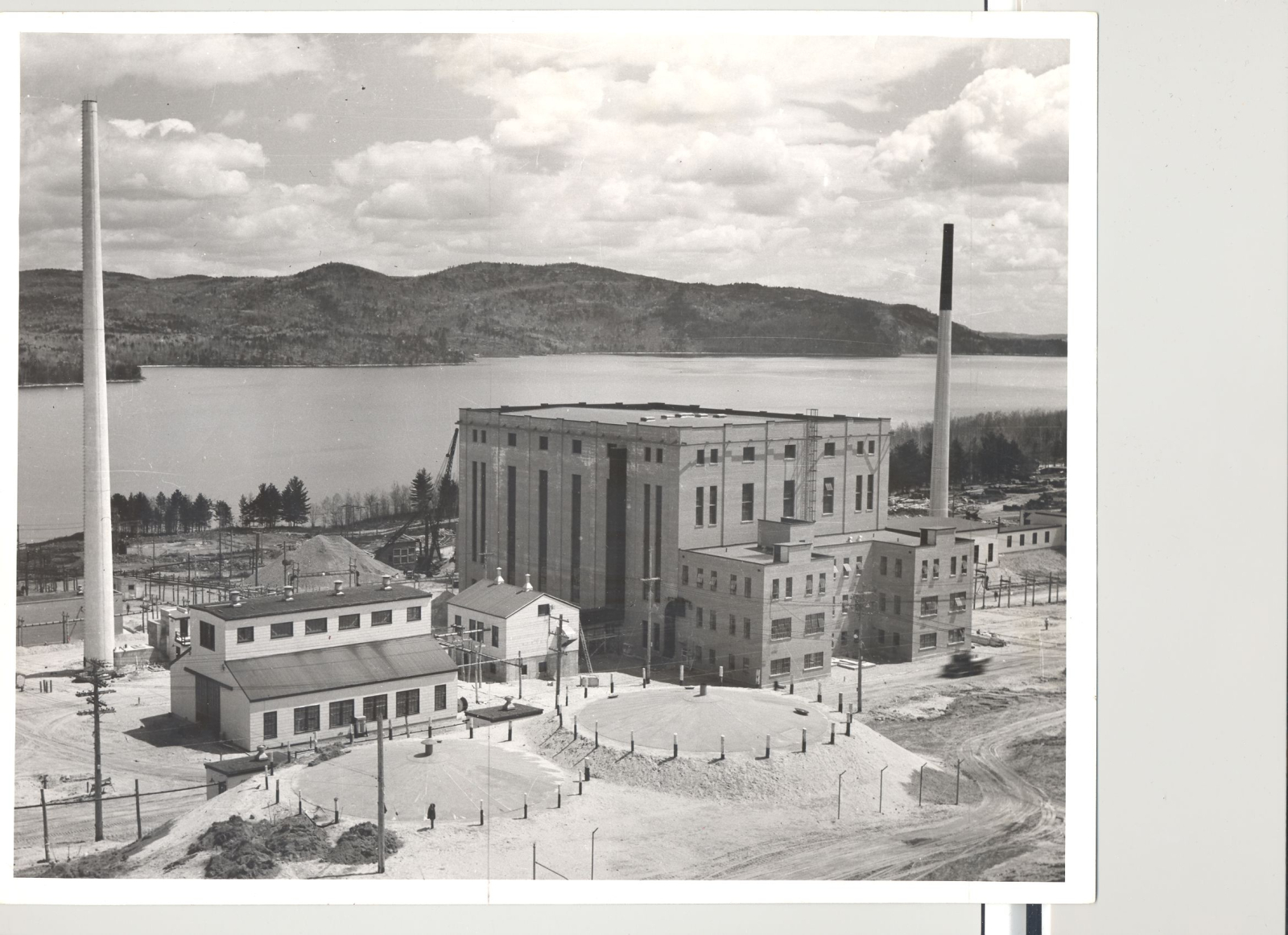
Chalk River Laboratories photographed in 1945. Photo from the National Research Council Canada archives
Chalk River is Canada’s biggest research facility. Built in 1944, it became home to the world’s first recorded nuclear reactor core meltdown in December 1952, followed by another incident in 1958. The 1952 accident was ranked a five on the International Atomic Energy Agency’s scale of one to seven; Chernobyl was a seven.
The partial reactor meltdown spewed radioactive material into the air and environment. During the year-long cleanup, highly radioactive debris and fuel rods were buried in a sandy area near the Ottawa River and millions of litres of contaminated water were dumped into ditches less than two kilometres from the river.
In this day and age, burying wooden boxes of fuel rods in shallow holes would be unthinkable, said Khelfaoui.
“At the time, the radioactive waste issue was almost synonymous with protecting the [commercial] interests of the nuclear industry,” said Khelfaoui. Public involvement in waste management policy was “nonexistent” before the end of the 1990s, he said.
Keeping accurate information on waste over time is a challenge and there have been inventory discrepancies at Chalk River, he added.
For example, the fuel rods buried in a “rudimentary” fashion after the 1952 meltdown were dug up and moved to safer storage in 2007, said Khelfaoui. AECL expected to find 19 fuel rods and cans in the boxes, but there were actually 32.
Over 75 years, Chalk River Laboratories developed CANDU reactors, did nuclear weapons research, supplied the United States’ nuclear weapons program with plutonium and uranium, and at one time was the world’s largest supplier of medical isotopes used to diagnose and treat cancers.
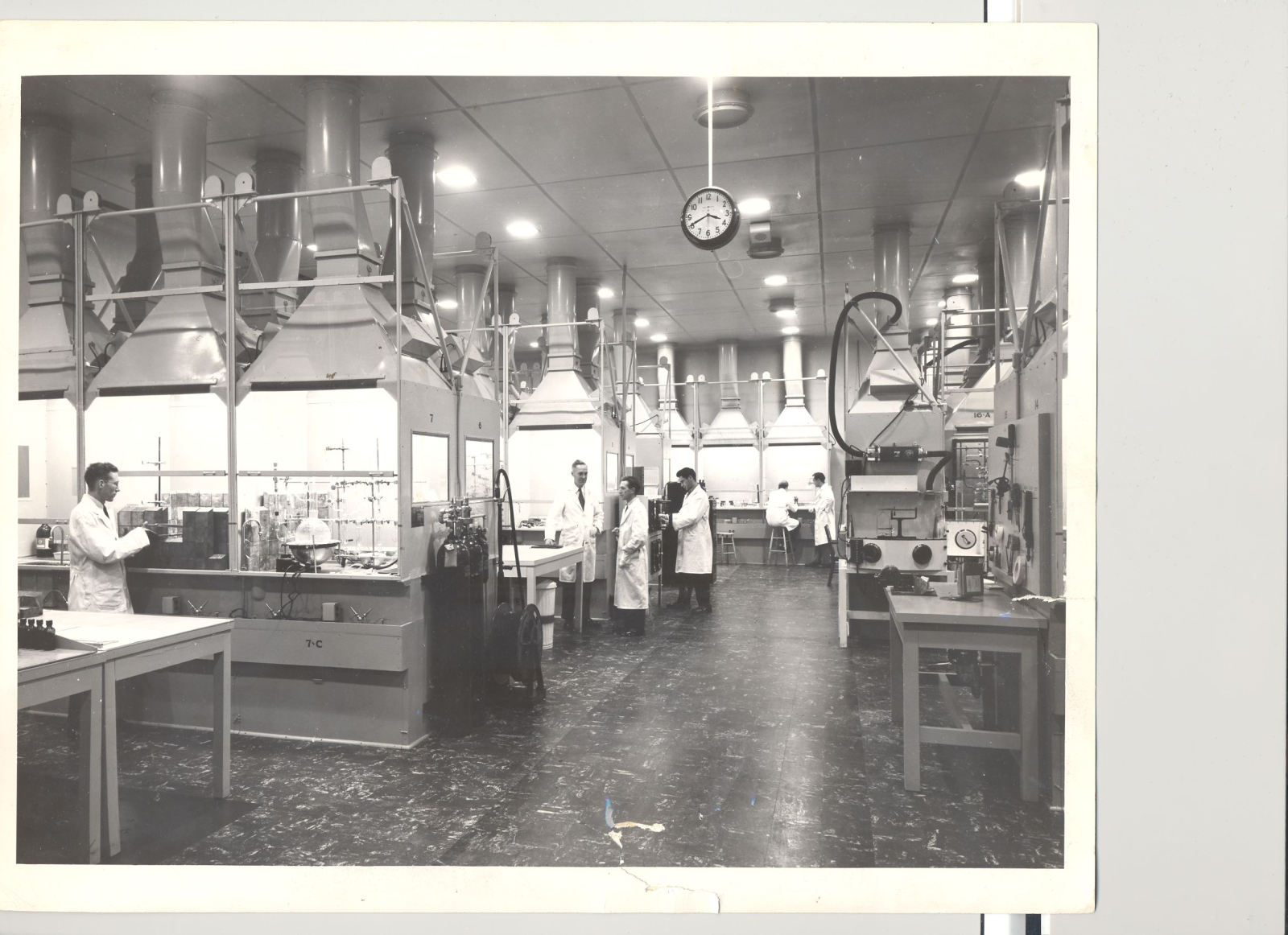
Chalk River Labs’ isotope separation laboratory in 1948. For 60 years, Chalk River Labs produced medical isotopes used to treat and diagnose diseases like cancer. Photo from the National Research Council Canada archives
Inherent inventory issues
Until the mid-1990s, waste wasn’t even categorized as intermediate, low or high-level, said Csullog, who worked at AECL back when the Crown corporation still ran day-to-day operations at Chalk River Laboratories. Much of it was stored together in what he described as a “mishmash of unsegregated, unmarked, uncharacterized mixture of low- and intermediate-level waste.”
“This mixing and lack of identification would make all these wastes unsuitable for the near-surface disposal facility,” said Csullog.
His main concern is the packaged legacy waste, which includes contaminated protective gear, old mops, rags, tools and lab equipment from former operations. For example, some of this equipment was used to clean up highly radioactive water that leaked out of the site’s two nuclear reactors, said Csullog.
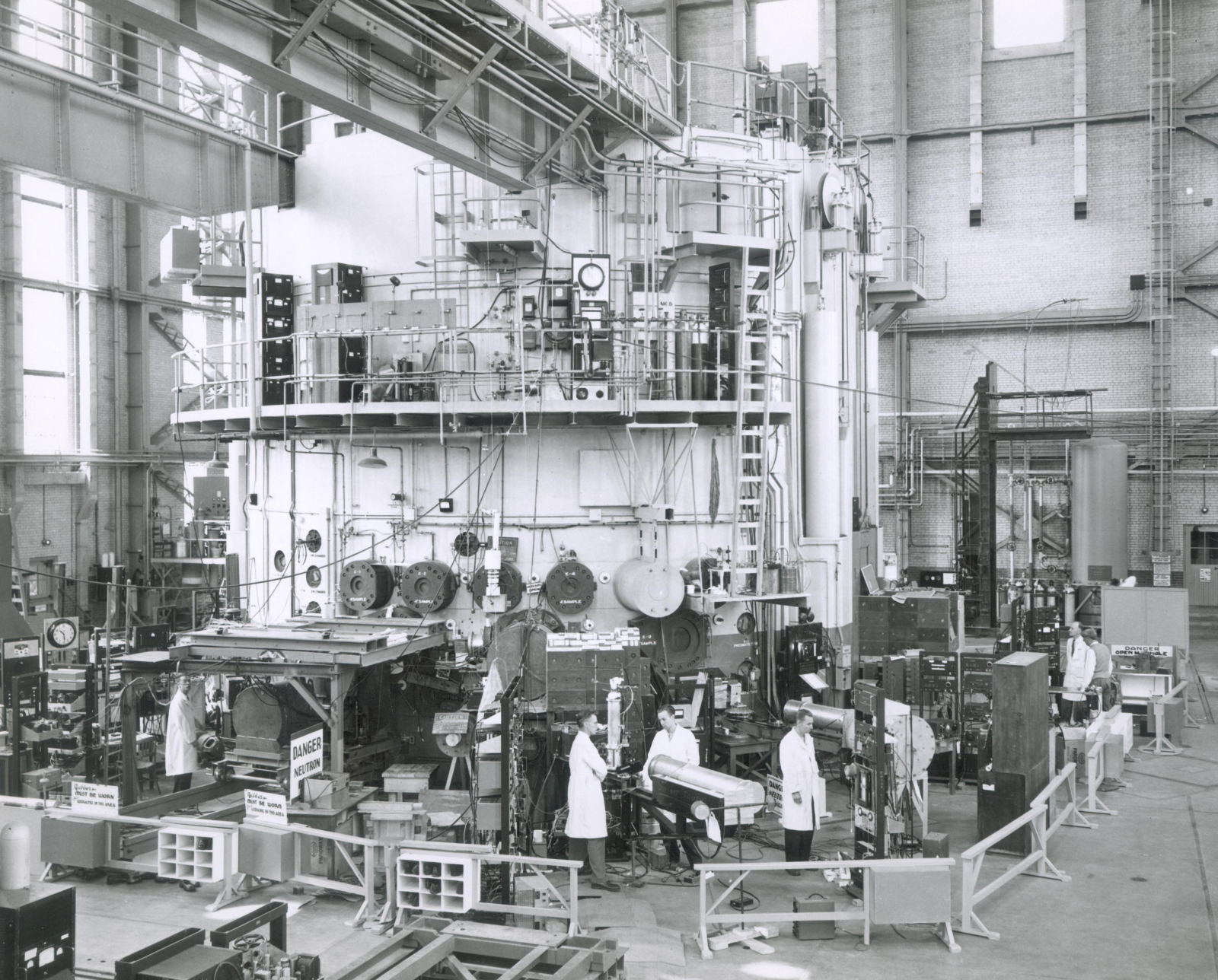
A historic photo of the National Research Experimental Reactor (NRX). NRX began operation in 1947 as Canada’s first large-scale research reactor and played a major role in developing the CANDU reactor. It was used to test fuels and materials and for nuclear physics research in support of the Canadian nuclear power program, according to the Canadian Nuclear Safety Commission. NRX was shut down on Jan. 29, 1992. Photo courtesy of Canadian Nuclear Laboratories
During his 21 years at AECL’s Chalk River Laboratories, Csullog developed programs to label and track all the radioactive waste created or shipped to the site. He later wrote the International Atomic Energy Agency’s guidelines on waste inventory record-keeping systems.
Developing these programs for AECL posed a challenge because many of the logbooks he was given to transcribe at the outset of his work in 1982 had precious little information on where the waste came from, how it was created or its radionuclide content. Csullog described the information in these historical records as “meaningless.” Until the mid-’90s, there weren’t even waste package labels to link waste to the correct paperwork, which also hindered his work, said Csullog.
“We didn’t track it. You can’t throw it all together and say, ‘We’ll use historical information.’ It’s irrelevant,” said Csullog.
In an email statement to Canada’s National Observer, CNL said the radioactivity of the legacy waste packages is based on records from its waste database. “CNL recognizes there are gaps” in this data and said no waste will be placed in the facility based only on historic information. Data on older legacy waste data will be reassessed and “modern analysis techniques” used to ensure there is “enough information on the waste” to make certain it meets the acceptance criteria.
The majority of packaged waste now in storage was generated pre-1995 and there is enough information to classify it as low-level waste “within a reasonable certainty,” a CNL representative told the Canadian Nuclear Safety Commission (CNSC) during the licensing process. All waste generators have to submit documents detailing the properties of the waste and then it’s up to CNL to verify the waste matches the documentation before it goes into the disposal facility.
Even after Csullog’s waste identification and tracking program was implemented in the mid-’90s, some waste with higher radioactivity was still compacted with really low-level material when it should have been kept separate, said Csullog.This was done so the radiation emitted by each bale was limited enough for people to handle and move them but in hindsight, was a mistake, he said. At this period in time, the industry was on a learning curve when it came to waste management, said Csullog.
It takes a “very, very small amount of a contaminant that’s long-lived” to make low-level waste transition to intermediate, Csullog emphasized.
By the time Csullog left the Crown corporation in 1999, his final iteration of a waste inventory database was being used for package labelling, validation, inspection and compliance monitoring. While it was a vast improvement on past practices, the program still relied on estimates of waste characteristics and only helped keep tabs on newly created wastes — not the pre-2000’s waste Csullog says is unacceptable for the facility. Estimates are not a substitute for the more involved process of characterization,a process to verify the specific type and concentrations of radionuclides,said Csullog, but it helps identify which waste should be a priority and make a plan to verify its characteristics. Radionuclides are radioactive atoms.
To safely manage, dispose and store waste, it must first be characterized so you know how long the radionuclides take to decay and can then accurately classify waste as low or intermediate level based on their disposal requirements, said Kerry Burns, an expert on radioactive waste characterization methods who worked at AECL for 25 years and the IAEA for eight years.
In either case, Csullog said when he returned to AECL in 2006 after a stint working for the IAEA, his program that estimated waste characteristics and tracked them had been “abandoned.” The outstanding question in Csullog’s mind is what has been done to take its place.
In a detailed submission to the CNSC, Csullog outlined the many problems with waste identification and inventory systems during his time at AECL and the persistent lack of data to verify the radionuclide content of this older waste.
Csullog emphasized he is not against the disposal facility as a whole. He is against CNL putting this particular legacy waste into it. Instead, CNL should put this legacy waste into a deeper facility designed for intermediate-level waste since it will have to dispose of other intermediate-level waste anyway, he said.
A majority of the waste planned for disposal in the near-surface facility is soil and debris from decommissioned buildings. Most of the buildings decommissioned so far were administrative and likely had little contamination and CNL could feasibly have enough information on the radioactive properties, said Csullog. But the site’s wide range of research and development activities exposed lab equipment and some buildings to many different radioactive materials. For example, some labs separated plutonium for the U.S. weapons program, said Burns.
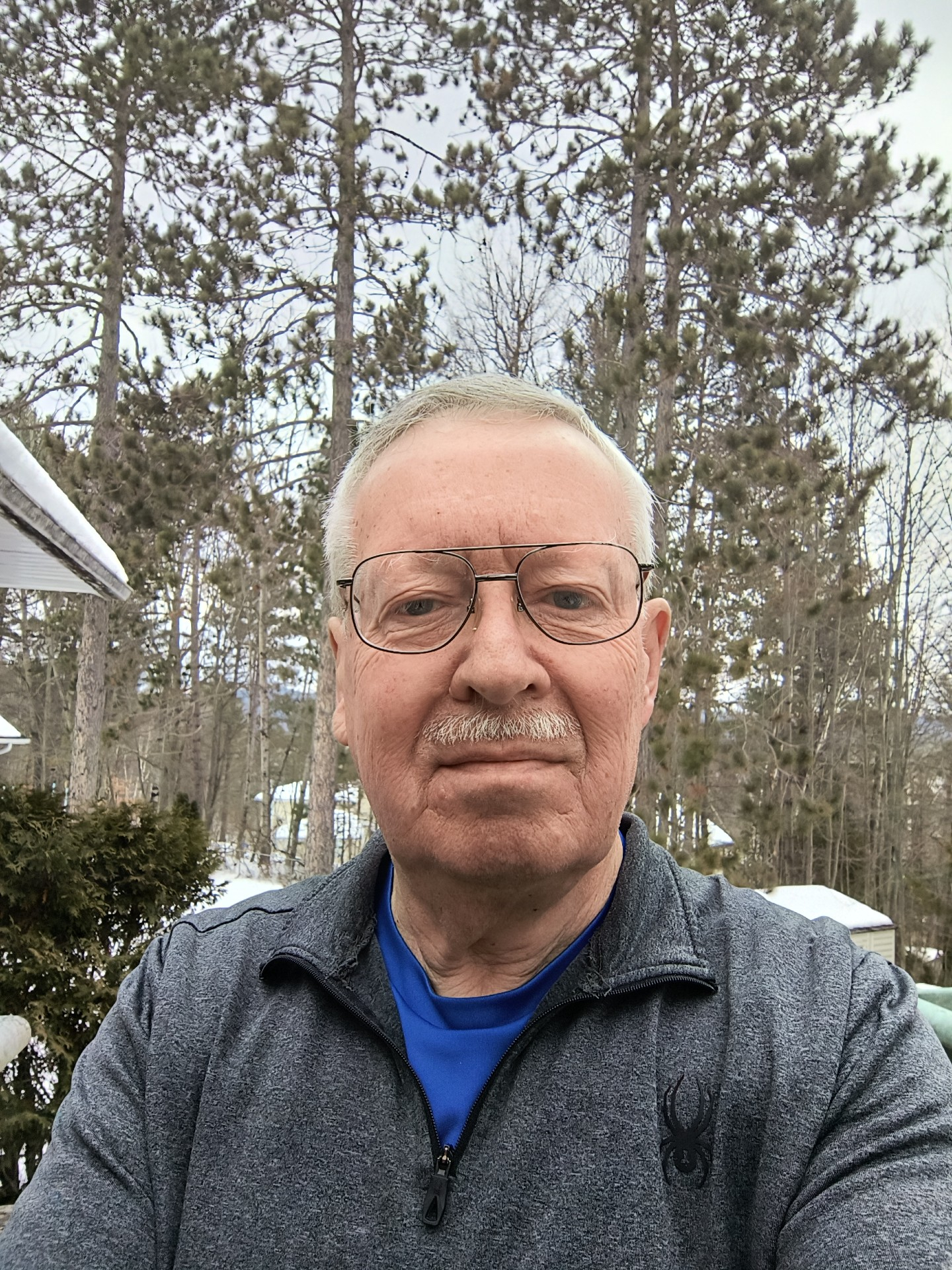
Kerry Burns, longtime AECL employee and radioactive waste characterization expert, outside his home in 2024. Photo submitted by Kerry Burns
Because of the site’s wide-ranging activities, it is unknown exactly what concentrations of radionuclides are in the legacy waste, said Burns.
The radionuclides typically encountered at Chalk River Labs have half-lives ranging from seconds to tens of thousands of years and can give off three different types of radiation. Low-level waste should decay to extremely low levels within roughly 300 years. As radionuclides decay, some of them turn into other radionuclides with different properties, which is vital to know when you’re planning how to store waste, said Burns.
Some controlled activities — like operating a nuclear power plant — produce waste with fairly predictable types and amounts of radionuclides. As long as these predictable waste streams are kept separate, you can often measure, sample and analyze it, said Burns, who spent years at AECL developing radiochemical analysis methods to determine exact properties of waste, and authored multiple articles on these methods.
But these methods only work if the waste is consistent, monitored carefully over time and kept separate from other waste streams, said Burns.
“I am afraid that the legacy and decommissioning wastes at CNL fall into the category of a dog’s breakfast,” said Burns. To know exactly how dangerous and long-lived the materials going into the facility truly are, a detailed analysis of each package and container would be required, said Burns.
According to CNL’s waste acceptance criteria, radiochemical analysis is not part of its minimum verification requirements, though it may be done as an additional verification measure.
Canada’s National Observer asked CNL which waste streams, if any, have had their radionuclide content confirmed using radiochemical analysis.
CNL said radiochemical analysis and background information are used to create “fingerprints” for waste streams based on what background information and past data exist on the waste.
“Some fingerprints have been established, while others are still in development,” said CNL. The company gave no specifics on which waste streams were examined using radiochemical analysis.
All waste will have “sufficient characterization data” to confirm it can be placed in the near-surface disposal facility, according to CNL.
Radiochemical analysis is “prohibitively expensive” and “extremely time-consuming” but is the only way to determine the inventory of long-lived, hard-to-detect radionuclides in thiswaste, said Burns. This chemical analysis becomes even more challenging when waste from different operations is mixed together, as Csullog and Burns said was the case for a great deal of waste pre-2000. If a sample isn’t representative of the whole waste stream, the results won’t reflect everything in it, said Burns.
Canada’s National Observer asked CNL if it has a budget or cost estimate for radiochemical analysis and which wastes will require this analysis. CNL declined to answer.
CNL is responsible for ensuring waste meets its acceptance criteria.CNL is owned by a consortium of private companies (including AtkinsRealis, formerly SNC-Lavalin). AECL receives federal funding and contracts CNL to manage and run the federal sites, including Chalk River.
Minimum requirements for verification include inspecting waste package labels and providing documents on the waste profile and management plan. CNL’s waste acceptance criteria doesn’t specify how often verification takes place. CNL declined to explain how frequently it would verify waste.
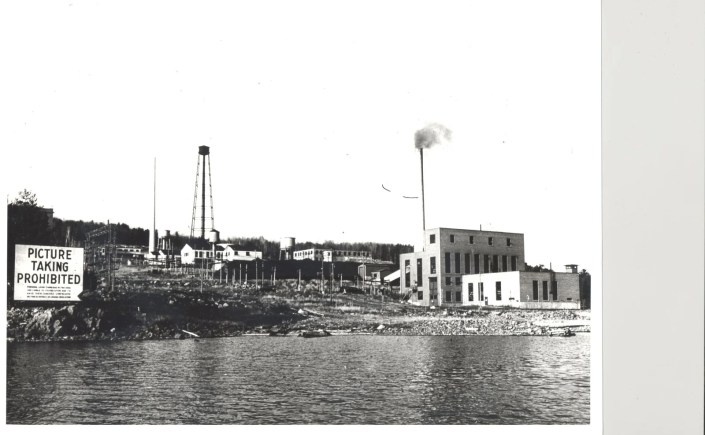
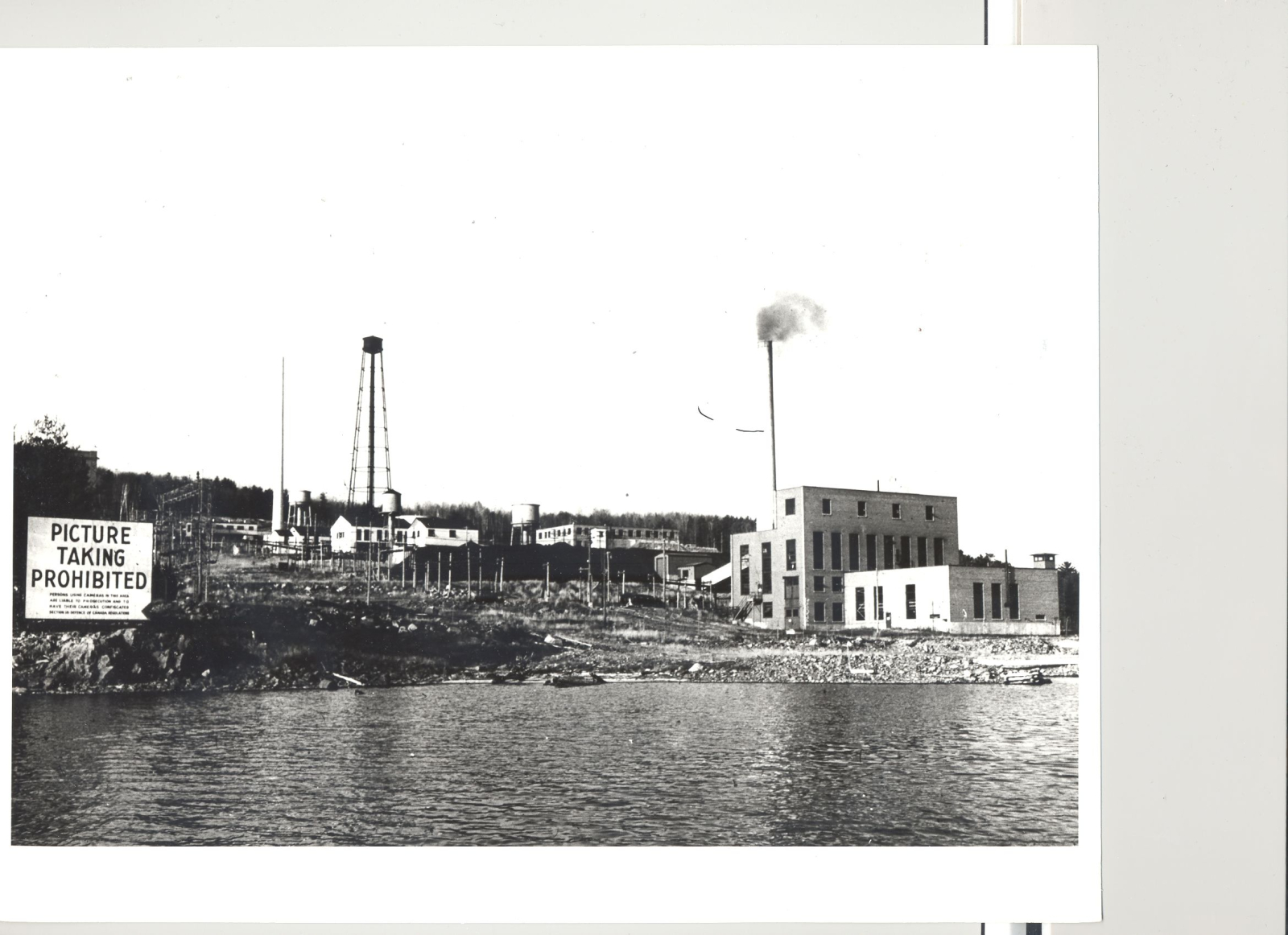
Chalk River Laboratories photographed from the Ottawa River in 1945. It was constructed in 1944. Photo from the National Research Council Canada archives
Csullog and Burns can only speak to the waste management practices from their time at Chalk River. Burns’ team at AECL used radiochemical analysis paired with another group’s measurements to characterize the mixed waste that was compacted into bales. These bales are on the lower end of radioactivity compared to other operations waste and the characterization data showed even those are unsuitable for the disposal facility, said Csullog.
CNL could have adequate systems and practices in place to characterize and track waste being generated today, they say, though neither is convinced based on the company’s submissions to the CNSC. But proper waste management today doesn’t change the fact that the Chalk River site is dealing with waste from an era when far less was known about the importance of handling radioactive waste, said Csullog.
“It was a good place to work … but when it came to waste management, it was always sort of the lowest priority,” said Burns, referring to AECL back in his day. “You’re dealing with a research site where people get rewarded for publishing papers, for doing innovative research, not for handling wastes and putting it in storage.”
Natasha Bulowski / Local Journalism Initiative / Canada’s National Observer
Update November 7, 2024: The factum for this case is available here.
le français suit
For immediate release
(Ottawa, February 8, 2024) – Concerned Citizens of Renfrew County and Area, Ralliement contre la pollution radioactive and the Canadian Coalition for Nuclear Responsibility have launched a legal challenge to the recent decision by the Canadian Nuclear Safety Commission (CNSC) to license the construction of a giant radioactive waste mound beside the Ottawa River, 180 km north-west of Ottawa. The giant mound is known as the “Near Surface Disposal Facility” or “NSDF.”
The three groups are asking the Federal Court to review the Commission’s failure to adequately consider the following evidence:
Radiation doses from the NSDF (as estimated by the proponent) would exceed some limits prescribed by Canadian regulations and international standards;
The proponent, Canadian Nuclear Laboratories (CNL), did not provide sufficient information about the waste that would go into the NSDF thereby rendering its Safety Case unreliable;
A key document submitted by CNL, the “Waste Acceptance Criteria,” includes an override section that would allow CNL to dispose of waste in the NSDF that does not meet the acceptance criteria. The override section nullifies any guarantees that only acceptable waste would be put in the mound and it makes the Safety Case a fiction;
Waste verification processes are inadequate to ensure that waste going into the NSDF meets Waste Acceptance Criteria;
CNL failed to provide information about many other projects it is undertaking on the same property that are likely to contribute to cumulative environmental impacts of the radioactive waste mound;
CNL proposed as a mitigation measure* to run a pipeline into Perch Lake, which would actually increase the flow of radioactive tritium into the Ottawa River, rather than decreasing it; and
Habitat and residences of protected species would be destroyed by site preparation and construction of the NSDF.
The application for judicial review submitted to Federal Court on Wednesday, February 7, also submits that the CNSC decision is unreasonable because the Commission did not issue a licence to prepare a site, or conduct the necessary assessment in relation to site preparation.
“In our view, the Commission’s decision to license the giant radioactive waste mound, one kilometer from the Ottawa River, is a serious mistake,” said Lynn Jones of the Concerned Citizens of Renfrew County and Area. “The mound is designed to last only 550 years, while much of the waste that would go into it will remain hazardous and radioactive for thousands of years.”
Represented by Nicholas Pope of Hameed Law, the applicants are seeking an order quashing the decision to amend the license to allow for construction of the NSDF.
– 30 –
* Mitigation measures are supposed to eliminate, reduce or control an adverse effect that the project would cause.
Concerned Citizens of Renfrew County and Area is a citizens’ group that advocates for prevention and clean-up of radioactive pollution from nuclear facilities in the Ottawa Valley.
The Canadian Coalition for Nuclear Responsibility is a non-profit organization that conducts education and research on issues related to nuclear energy.
Ralliement contre la pollution radioactive is an association that promotes responsible solutions for managing radioactive waste to reduce risks to the environment and to public health.
~~~~~~~~~~~~~~~~~~
Des groupes de citoyens demandent à la Cour fédérale de réviser la décision d’autoriser un dépôt de déchets radioactifs en surface près de la rivière des Outaouais.
(Ottawa, le 8 février 2024) – Concerned Citizens of Renfrew County and Area, le Ralliement contre la pollution radioactive et le Regroupement pour la surveillance du nucléaire ont demandé hier la révision judiciaire d’une décision de la Commission canadienne de sûreté nucléaire (CCSN). Celle-ci a récemment autorisé la construction d’une installation géante de gestion des déchets radioactifs près de la surface (IGDPS), tout près de la rivière des Outaouais à 180 km d’Ottawa.
Les trois groupes reprochent à la Commission de sûreté nucléaire d’avoir autorisé cette décharge radioactive sans considérer plusieurs éléments essentiels :
• Les doses de rayonnement annoncées par le promoteur de cette installation dépasseront certaines limites prescrites par la réglementation canadienne et les normes internationales ;
• Le promoteur, les Laboratoires Nucléaires Canadiens (LNC), n’a pas fourni suffisamment de renseignements sur les déchets qui seront placés dans cette installation, si bien que son dossier de sûreté n’est pas fiable ;
• Un document-clé soumis par les LNC, intitulé Les critères d’acceptation des déchets, inclut une section de dérogation qui permettra de placer dans cette IGDPS des déchets plus dangereux que ne le permettent les critères d’acceptation officiels. Cette possibilité de dérogation rend illusoire toute garantie de sécurité;
• Les processus prévus ne permettront pas de garantir que les déchets placés dans l’IGDPS sont conformes aux critères d’acceptation;
• Les LNC ont omis de fournir des informations sur plusieurs autres projets voisins dont les impacts environnementaux s’ajoutent à ceux des déchets placés dans l’IGDPS;
• Les LNC ont proposé comme mesure d’atténuation* d’installer un pipeline de déversement vers le lac Perch voisin, ce qui augmentera les rejets de tritium radioactif dans la rivière des Outaouais plutôt que de les diminuer ;
• L’habitat et les abris de plusieurs espèces protégées seront détruits par la préparation du site et la construction de l’IGDPS.
Selon cette demande de contestation judiciaire présentée à la Cour fédérale le 7 février, la décision de la CCSN est aussi déraisonnable parce que la Commission n’a pas émis de permis pour préparer l’emplacement et n’a pas procédé à l’évaluation nécessaire avant cette préparation de l’emplacement.
« À notre avis, la Commission commet une grave erreur en autorisant cette installation géante de gestion des déchets radioactifs à un kilomètre de la rivière des Outaouais», a déclaré Lynn Jones, de Concerned Citizens of Renfrew County and Area. « L’IGDPS durera à peine 550 ans alors qu’une grande partie des déchets qui y seront placés resteront dangereux et radioactifs pendant des milliers d’années. »
Les demandeurs sont représentés par Nicholas Pope de Hameed Law. Ils demandent une ordonnance qui obligera la CCSN à réévaluer sa décision de modifier le permis pour permettre la construction de l’IGDPS.
-30-
*Les mesures d’atténuation ont pour but d’éliminer, réduire ou contrôler un effet négatif du projet.
Concerned Citizens of Renfrew County and Area est un groupe de citoyens qui prône la prévention et l’assainissement de la pollution radioactive provenant des installations nucléaires de la vallée de l’Outaouais.
Le Regroupement pour la surveillance du nucléaire est une organisation à but non lucratif qui mène des activités d’éducation et de recherche sur les questions liées à l’énergie nucléaire.
Le Ralliement contre la pollution radioactive est une association qui promeut des solutions responsables pour la gestion des déchets radioactifs, afin de réduire les risques pour l’environnement et la santé publique.







 Concerned Citizens of Renfrew County and Area