The Chalk River Mound or “near surface disposal facility” is a proposed giant above ground landfill for one million tons of radioactive waste on the property of Canadian Nuclear Labs, less than one kilometre from the Ottawa River upstream of Ottawa-Gatineau and Montreal. We debunk below two of the most misleading myths about the proposed facility. Please contact us if you need more references for the material presented below, or browse our list of all posts for more information.
Myth # 1: It’s only “low level waste”
“Low level” in the context of radioactive waste does not mean “low hazard” This is a really big mistake that almost everyone makes. “Low level” simply means the wastes can be handled by nuclear industry workers without the use of lead shielding because the wastes give off relatively low levels of gamma radiation. But they can and do contain high levels of other types of radiation such as “alpha” and “beta.” “Low level” radioactive waste can remain hazardous for hundreds of thousands of years and includes some of the most toxic radioactive poisons known such as plutonium.
No “Intermediate waste” in the NSDF is a red herring. Neither “Low level” OR “Intermediate level” radioactive wastes are supposed to be disposed of in above-ground engineered mounds (landfills) according to the International Atomic Energy Agency. That is because both categories are dangerous and pose risks to all life on earth for the duration of their radiological hazard, which is hundreds of thousands of years for BOTH CATEGORIES of waste. The main thing that distinguishes “Low level” from “intermediate level” radioactive waste is that “low level” can be handled without shielding or robots because its risks come from inhalation or ingestion. “Intermediate level” waste on the other hand gives off strong gamma radiation and therefore requires lead shielding and/or remote handling.
Much of the legacy waste at the Chalk River site is a poorly characterized or uncharacterized MIXTURE of “low” and “intermediate” level wastes. The dividing lines between the categories are blurry. There are many different definitions around the world. Canada’s definitions are inferior to those in other countries. The wastes are not all sitting around in nice neat packages labelled “low level” and “intermediate level”. It would be the work of decades to properly categorize, package and label all the legacy wastes, and arguably, this should be done before choosing technologies for managing the wastes. We are in touch with a former engineer at AECL who was in charge of waste characterization for decades and worked as a consultant for the IAEA. He says the knowledge level of legacy wastes at Chalk River was and likely still is “abysmal”.
The proponent is playing games with Waste Acceptance Criteria to enable maximum disposal of legacy wastes in the NSDF Definitions are being finagled to enable claims that “only” low-level wastes would go in the facility. Canada’s nuclear regulator, the Canadian Nuclear Safety Commission, allows proponents to make up their own definitions of waste classes. The NSDF proponent defines wastes with long-lived beta/gamma activity as high as ten thousand radioactive disintegrations per second per gram of waste (Bq/g) as “low level”. Finland puts any waste with activity greater than one hundred Bq/g in an underground facility, 65-90 meters deep in crystalline rock.5.
The proponent’s contract with Atomic Energy of Canada states that it will dispose of ALL wastes quickly and cheaply. The main objective of the GoCo contract was to reduce Canada’s legacy radioactive waste liabilities. The ONLY strategies being advanced by the consortium are the above ground engineered mound (landfill) and in-situ burial of reactors on the Ottawa and Winnipeg rivers. Thus, the contract provides a strong incentive for the consortium to dispose of uncharacterized legacy wastes in the NSDF since it’s the only project on the table.
Myth #2: It’s a “sound project from an engineering point of view.”
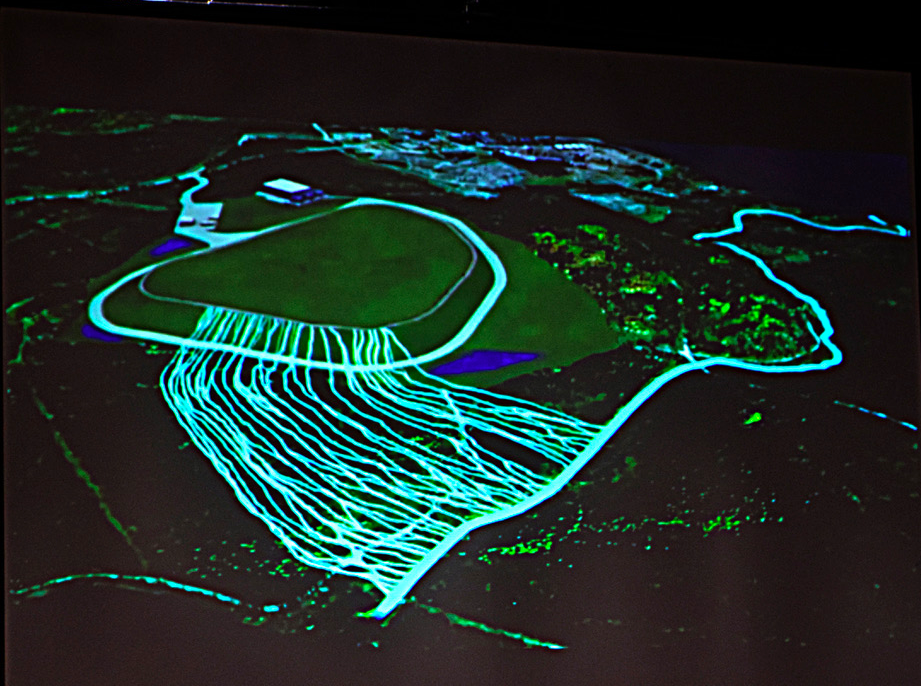
The engineered containment mound is expected to disintegrate within a few hundred years and the contents flow out of the mound into the surrounding wetlands that drain into the Ottawa River. The NSDF draft environmental impact statement includes 25 occurrences of the phrase “liner and cover failure as a result of normal evolution” and three occurrences of the phrase “inevitable failure of the cover.” The “bathtub scenario” is mentioned 30 times in the draft EIS. It is projected to occur in the year 2400 when the cover fails, water enters the mound and overflows, and takes contaminants into Perch Creek and the Ottawa River. The Performance Assessment for the NSDF includes a graphic illustration of the bathtub scenario, a table listing quantities of radionuclides flowing out of the mound into the Ottawa River, and a pie chart showing estimated doses of various radionuclides to an infant downstream in Pembroke. Given the expected eventual disintegration of the mound and migration of its contents into the Ottawa River, it would seem to be inappropriate to refer to the project as “a sound proposal from an engineering point of view.”
The image below is a simulation of the “bathtub effect” from the Radio Canada Decouverte documentary “Chalk River Heritage.”
Canadian Nuclear Laboratories (CNL) – run by a consortium of profit-making multinational companies – is proposing to build a“Near Surface Disposal Facility” for a million cubic meters of radioactive waste at its Chalk River facility along the Ottawa River. CNL’s final environmental impact statement (EIS) describes several ways that contents of the proposed “engineered containment mound” of radioactive waste could leak into the Ottawa River.
During operation…
1. Wastes being added to the mound would be exposed to the elements.
Rain and melting snow would leach radioactive contents down through the mound. Different radioactive elements would leach at different rates depending on how strongly they were bound to the wastes. Radioactively contaminated leachate would be collected in a system of pipes and pumped uphill to a water treatment plant. Some but not all radioactive contaminants would be removed prior to releasing the treated leachate into adjacent wetlands (for part of the year) or directly into Perch Lake, which drains into the Ottawa River via Perch Creek. Table 3.4.2-2 on page 3-58 of the final EIS shows levels of different radionuclides in leachate that would be discharged from the water treatment plant.
2. Tritium as radioactive water would leach in very large amounts from the mound.
Tritium – a radioactive form of hydrogen with a half-life of 12.3 years – is readily taken up by living organisms and incorporated in body tissues. When tritium decays it emits “beta radiation” damaging to DNA and other cell constituents. Tritium is part of the water molecule and cannot be removed by water treatment. The EIS estimates that the tritium in a liter of leachate would emit 140 thousand beta particles per second. After passing through Perch Lake and Perch Creek, water containing roughly 7 thousand beta particles per liter per second (the current Ontario drinking water standard) would be released into the Ottawa River, be incorporated in fish and other aquatic life, and enter downstream drinking water supplies. Large amounts of tritium would also be released from the mound and Perch Lake as water vapour.
3. Other toxic substances such as PCBs leaching from the mound would be only partially removed by water treatment.
Table 3.4.2-3 on pages 3-59 and 3-6 of the EIS indicate that leachate from the mound would include a very wide range of non-radioactive toxic compounds such as arsenic, mercury, lead, chloroform, ethylene dibromide, PCBs and dioxin. Measurable amounts would be released to the environment.
4. Heavy storm events could erode the mound’s surface and wash toxic substances into low areas.
The EIS proposes an elaborate system of contact water ponds, non-contact water ponds, surface water management ponds, drainage ditches, and culverts. Highly contaminated water washing off active dumping areas would flow into a contact pond and be pumped to the water treatment plant. Water washing off “inactive” areas (but contaminated by dust from active dumping areas) would flow into non-contact water ponds, be pumped to a perimeter ditch and three storm-water management ponds. These ponds would discharge to adjacent wetlands that are already contaminated by existing nearby leaking radioactive waste areas.
5. The capacity of storm-water ponds would be exceeded during extreme rainfall events or snowmelts.
The EIS (page 3-76) says that “when the probable maximum precipitation flow will exceed the surface water management ponds attenuation capacity,” adjacent emergency outlet structures “will be able to convey this flow.”
6. Clearing 34 hectares of mature forest and discharging waste water would impact wetlands.
The existing forest recharges adjacent wetlands. Loss of the forest’s infiltration and recharge capacity would tend to dry out these wetlands and expose their radioactive contents (such as tritium, strontium-90 and carbon-14) to erosion. The EIS notes (page 5-278) that waste water discharge to adjacent wetlands and Perch Lake “may cause changes to water levels, flows, and channel and bank stability, and scouring of the wetland, affecting water quality at downstream locations.”
7. Other possible ways the facility might leak during operations
(not described in detail in the EIS) include pump failures during extreme storm events with loss of electrical power, improper installation of the base liners, puncture of the base liners by heavy or sharp materials, melting of liners by radioactively hot materials, and blockage of the leachate collection system.
After closure…
1. Wastes in the mound would be re-exposed to the elements when the top cover fails.
After waste dumping ended the leachate collection system and water treatment plant would be shut down, and a top cover placed over the wastes. The EIS acknowledges that the top cover would inevitably fail with “normal evolution” through forces such as erosion, extreme storms, burrowing animals, root penetration, etc. It proposes the “conversion of a largely undisturbed, mature forested area to a permanently fenced, turf-grass habitat that is highly modified (i.e., mown, fertilized and maintained as tree-free to avoid the disruption of roots to the cover structure)” (p, 5-509).
2. Failure of the top cover while the more protected base liners remain intact would initiate a “bathtub scenario”.
Rain and melting snow would again leach the radioactive wastes, but the leachate collection and pumping system would no longer be operational. Contaminated leachate would be trapped by the bottom liner and accumulate in the space between the mound and the surrounding berm. Leachate levels would rise and spill over along the low point of the berm. A different scenario involves failure of the bottom liner, releasing leachate into groundwater.
3. Radioactive wastes would flow directly into Perch Creek and the Ottawa River less than 1 kilometer away, essentially forever.
Long-lived radioactive elements such as plutonium and uranium, exposed to wind and water erosion, would flow into the river for thousands to millions of years. Table 5.2.3-8 on page 5-155 of the draft EIS estimated that, under the bathtub scenario, plutonium (Pu) isotopes (Pu-239 and Pu-240) would exit the dump at 21.4 million and 32.4 million Becquerels per year. Eventual failure of the bottom liners would also allow radionuclides to move through groundwater,. These details were removed from the final EIS, but it is clear that the Ottawa River would be permanently contaminated by radioactive waste, and countless generations of people drinking its water would be exposed to increased cancer risks.
Canadian taxpayers are paying a consortium (Canadian National Energy Alliance) contracted by the federal government in 2015, billions of dollars to reduce Canada’s $16 billion nuclear liabilities quickly and cheaply. The consortium is proposing to construct a giant mound for one million tons of radioactive waste beside the Ottawa River upstream of Ottawa-Gatineau. The proposed dumpsite is partially surrounded by wetlands that drain into the Ottawa River less than one kilometre away.
There is considerable secrecy about what would go into the mound; the information that follows has been derived from the proponent’s final environmental impact statement (EIS) (December 2020) which lists a partial inventory of radionuclides that would go into the gigantic five-to-seven story radioactive mound (aka the “NSDF”). The EIS and supporting documents also contain inventories of non-radioactive hazardous materials that would go into the dump.
Here is what the consortium says it is planning to put into the Chalk River mound according to the final EIS and supporting documents:
1) Long-lived radioactive materials
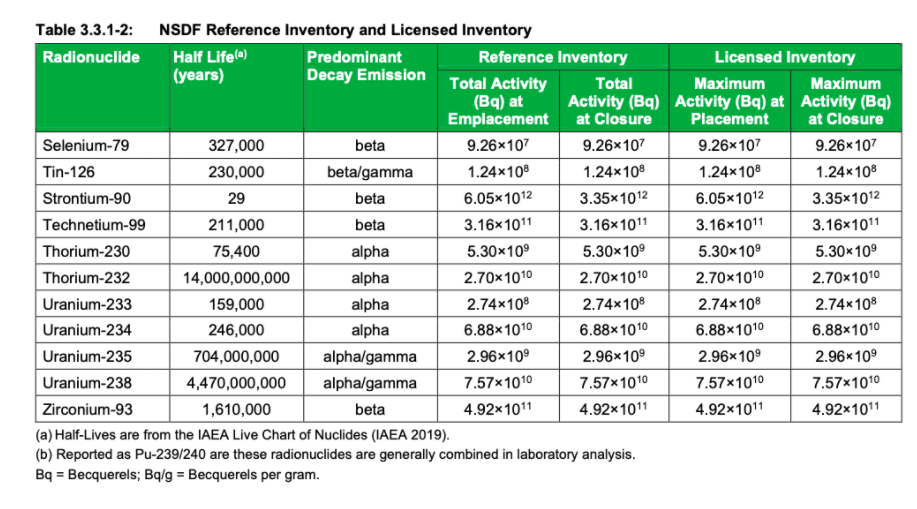
Twenty-five out of the 30 radionuclides listed in Table 3.3.1-2: NSDF Reference Inventory and Licensed Inventory are long-lived, with half-lives ranging from four centuries to more than four billion years.
To take just one example, the man-made radionuclide, Neptunium-237, has a half-life of 2 million years such that, after 2 million years have elapsed, half of this radioactive substance will be present, together with its radioactive decay products such as Uranium-233. At the time of closure of the mound, the neptunium-237 will be giving off 17 million radioactive disintegrations each second, second after second.
The mound would contain up to 6 tonnes of Uranium and 6.6 tonnes of thorium-232.
2) Four isotopes of plutonium, one of the most deadly radioactive materials known, if inhaled or ingested.
John Gofman MD, PhD, a Manhattan Project scientist and former director of biomedical research at the DOE’s Lawrence Livermore Laboratory, stated that even one-millionth of a gram of plutonium inhaled into the lung, will cause lung cancer within 20 years. Sir Brian Flowers, author of the UK Royal Commission Report on Nuclear Energy and the Environment, wrote that a few thousands of a gram, inhaled into the lungs, will cause death within a few years because of massive fibrosis of the lungs, and that a few millionths of a gram will cause lung cancer with almost 100% certainty.
The four isotopes of plutonium listed in the NSDF reference inventory are Plutonium-239, Plutonium-240, Plutonium-241 and Plutonium-242. According to Table 3.3.1-2 NSDF Reference Inventory and Licensed Inventory from the EIS, The two isotopes 239 and 240 combined will have an activity of 51 billion Bq when they are emplaced in the dump. This means that they will be giving off 51 billion radioactive disintegrations each second, second after second. These plutonium isotopes could constitute a significant hazard to workers during emplacement of plutonium wastes and plutonium contaminated debris in the mound.
3) Fissionable materials
Fissionable materials can be used to make nuclear weapons.
The mound would contain “special fissionable materials” listed in this table extracted from an EIS supporting document, Waste Acceptance Criteria, Version 4, (November 2020)
The CNL inventory includes a very large quantity of cobalt-60 (91 quadrillion Becquerels), contained in waste cobalt-60 irradiating devices. Cobalt-60 when concentrated in irradiators gives off so much strong gamma radiation that lead shielding must be used by workers who handle them in order to avoid dangerous radiation exposures. The International Atomic Energy Agency considers high-activity cobalt-60 irradiators to be “intermediate-level waste” and specifies that they must be stored underground. Addition of high-activity cobalt-60 irradiators means that hundreds of tons of lead shielding would be disposed of in the mound.
5) Very Large quantities of tritium
The mound would contain 890 trillion becquerels of tritium, a radioactive form of hydrogen. Tritium readily combines with oxygen to form radioactive water. It moves readily through the environment and easily enters all cells of the human body where it can cause damage to cell structures including genetic material such as DNA and RNA. For more on the hazards of tritium see the Tritium Primer on the TAP website: http://tapcanada.org/wordpress/?page_id=403
Because it is part of the water molecule, removal of tritium from water is very difficult and expensive. There are no plans to remove tritium from the mound leachate. Instead the consortium plans to pipe the contaminated water directly into Perch Lake which drains into the Ottawa River.
6) Carbon-14
The mound would contain close to two trillion becquerels of Carbon-14, an internal emitter that is hazardous in similar ways to tritium. Carbon is a key element in all organic molecules. When it is inhaled or ingested it can become incorporated into organic molecules and cellular components including genetic material.
Hazardous materials destined for the dump include asbestos, PCBs, dioxins, mercury, up to 13 tonnes of arsenic and hundreds of tonnes of lead. (Reference)(Reference for the arsenic quantity is the CPDP)
9) Large quantities of valuable metals that could attract scavengers
According the the final EIS, the mound would contain 33 tonnes of aluminum, 3,520 tonnes of copper, and 10,000 tonnes of iron. It is well known that scavenging of materials occurs after closure of facilities such as the Chalk River mound. Scavengers would be exposed to high radiation doses as they sought to extract these valuable materials from the dump.
10) Organic Materials
80,339 tonnes of wood and other organic material are destined for the mound. These materials would decompose and cause slumping in the mound, therefore potentially compromising the integrity of the cap.
~~~~~~
Most of the radioactive and hazardous material would get into the air and water, some sooner, some later.
Some would get into ground and surface water during creation of the mound, such as tritium which is very mobile and cannot be removed by the proposed water treatment plant. Others would get into the air, during construction and could be breathed by workers. Some materials would leach slowly into groundwater. Still others would be released when the mounds deteriorates over time and eventually disintegrates several hundreds of years into the future. For details on the expected disintegration of the mound in a process described as “normal evolution” see this post: https://concernedcitizens.net/2020/11/04/the-proponents-own-study-shows-that-the-chalk-river-mound-will-disintegrate/
~~~~~~~~
The mound would actually get more radioactive over time
See the submission entitled “A Heap of Trouble” by Dr. Gordon Edwards, president of the Canadian Coalition for Nuclear Responsibility for a chilling description of this process. http://www.ccnr.org/Heap_of_Trouble.pdf. Here is a quote from the submission:
The Near Surface Disposal Facility (NSDF) project is presented not as a temporary, interim storage facility but as a permanent repository that will ultimately be abandoned. We are dealing with a potentially infinite time horizon. The proponent seeks approval not just for a few decades, but forever. Such permission has never before been granted for post-fission radioactive wastes in Canada, nor should it be granted. Long-lived radioactive waste should not be abandoned, especially not on the surface beside a major body of water.
“The facility will remain a significant hazard for in excess of 100,000 years.“
“There is no safe level of exposure to any man-made radioactive material.“
“There is no safe level of exposure to any man-made radioactive material. All discharges, no matter how small, into our air and water can cause cancer and many other diseases as well as genetic damage and birth defects.”
~ Dr. Eric Notebaert, Canadian Association of Physicians for the Environment.
This dump would not not meet international safety standardsfor radioactive waste management. Details
The Canadian Nuclear Safety Commission (CNSC) has just given a green light to the preferred industry solution for disposal of nuclear reactors — entomb and abandon them in place, also known as “in-situ decommissioning.” This paves the way for the introduction of a new generation of “small modular” nuclear reactors or SMRs.
SMRs bring many challenges, including safety of untested designs, nuclear weapons proliferation risks, high costs, disposal of radioactive waste, and public acceptance. Groups concerned about nuclear safety are objecting to plans in the works to abandon these nuclear reactors and the radioactive waste they produce once they are shut down.
Over 100 Indigenous and civil society groups have signed a public statement opposing SMR funding, noting that the federal government currently has no detailed policy or strategy for what to do with radioactive waste. Many of these groups are also participating in a federal radioactive waste policy review launched in November 2020.
The Assembly of First Nations passed resolution 62/2018 demanding that the nuclear industry abandon plans for SMRs and that the federal government cease funding them. It calls for free, prior and informed consent “to ensure that no storage or disposal of hazardous materials shall take place in First Nations lands and territories.”
SMR waste includes not only reactor fuel but also the reactors themselves.
An SMR emits no radiation before start-up (other than from uranium fuel) and could easily be transported at that stage. But during reactor operation, metal and concrete components absorb neutrons from the splitting of uranium atoms — and in the process, transform into radioactive waste. Removing an SMR after shut-down would be difficult and costly, and comes with the need to shield workers and the public from its radioactivity.
Abandoning nuclear reactors on site has been in the works for some time. CNSC helped draft a 2014 nuclear industry standard with in-situ decommissioning as an option and then included it in a July 2019 draft regulatory document.
However, when the International Atomic Energy Agency (IAEA) released a peer-reviewed report on Canada’s nuclear safety framework last February, it said in-situ decommissioning is “not consistent” with IAEA safety standards.
The IAEA suggested that CNSC “consider revising its current and planned requirements in the area of decommissioning to align with the IAEA guidance that entombment is not considered an acceptable strategy for planned decommissioning of existing [nuclear power plants] and future nuclear facilities.” It also noted that CNSC is reviewing license applications for in-situ decommissioning of shut-down federal reactors in Ontario and Manitoba, and encouraged Canada “to request an international peer review of the proposed strategy” for legacy reactors.
But CNSC continued to pursue this strategy. Clever language in a June 2020 document appeared to rule out on-site reactor disposal, but left the door open where removal is not “practicable”:
“In-situ decommissioning shall not be considered a reasonable decommissioning option for planned decommissioning of existing nuclear power plants or for future nuclear facilities in situations where removal is possible and practicable.”
At public meeting last June, CNSC Commissioner Sandor Demeter asked: “why are future facilities in this sentence when in fact we should be designing them so that in-situ decommissioning is not the option?” Former CNSC staff member Karine Glenn replied that “leaving some small parts of a structure behind…especially if you are in a very, very remote area, may be something that could be considered.”
Commissioners decided to approve the regulatory document, but with added text to clarify where in-situ decommissioning would be acceptable. They asked for additional text on “legacy sites” and “research reactors,” stating that “[t]he Commission need not see this added text if it aligns with the oral submissions staff made in the public meeting.”
But no new clarifying text was added to the final version of the document published on January 29, 2021. It enables abandonment of SMRs — by retaining the reference to future nuclear facilities — and of “research and demonstration facilities, locations or sites dating back to the birth of nuclear technologies in Canada for which decommissioning was not planned as part of the design.”
The CNSC seems willing to ignore international safety standards — and a decision of its own commission — to accommodate nuclear industry proponents of SMRs and allow radioactive waste to be abandoned in place.
Meanwhile, the federal government has assigned the nuclear industry itself — via the Nuclear Waste Management Organization — the task of developing a radioactive waste strategy for Canada. Barring public outcry, that strategy will be abandonment.
Ole Hendrickson is a retired forest ecologist and a founding member of the Ottawa River Institute, a non-profit charitable organization based in the Ottawa Valley.
Note that the table includes four isotopes of plutonium.
Note also that Twenty-five out of the 30 radionuclides listed are long-lived, with half-lives ranging from four centuries to more than four billion years. Materials such as these are not supposed to be disposed of in above-ground landfills according to the International Atomic Energy Agency.
Honorable Jean-Yves Duclos, président du Conseil du Trésor
Honorable Joyce Murray, vice-présidente du Conseil du Trésor
Honorable Bardish Chagger, membre du Conseil du Trésor
Honorable Catherine McKenna, membre du Conseil du Trésor
Honorable Chrystia Freeland, membre du Conseil du Trésor
Honorable Jonathan Wilkinson, membre du Conseil du Trésor
Distingués Monsieur Duclos et membres du Conseil du Trésor,
Le 21 septembre 2020, nous vous avons écrit en tant que femmes dirigeantes dans des milieux communautaires et autochtones, en sciences, médecine, droit et protection de l’environnement afin de vous demander de cesser de financer le développement de nouveaux petits réacteurs nucléaires modulaires (appelés PRM). Le Canada est membre d’un traité international sur les déchets radioactifs et il doit s’acquitter de ses obligations légales de minimiser la production des déchets radioactifs. Le financement fédéral des PRM serait une abnégation de ses obligations en vertu de ce traité.
Aujourd’hui, d’autres femmes dirigeantes de toutes les provinces et territoires du Canada et de plusieurs sites des Premières Nations se joignent à nous. Nous vous exhortons fortement à rejeter les nouveaux PRM. Le gouvernement fédéral fait la promotion des PRM comme une solution miracle pour faire face à l’urgence climatique. C’est complètement faux!
En fait, les PRM ne constituent certainement pas une action rapide et efficace pour faire face à l’urgence climatique. Ils ne pourront atteindre la phase de production avant 10 ou 15 ans. C’est trop tard pour réduire les gaz à effet de serre. C’est engloutir de l’argent inutilement qui serait mieux dépensé dans des technologies à faible émission de carbone peu coûteuses et prêtes à utiliser.
Les énergies solaire et éolienne sont devenues les sources d’électricité les moins coûteuses et les plus répandues dans le monde. En 2018, le rapport de Deloitte, Global Renewable Energy Trends: Solar and Wind Move from Mainstream to Preferred a conclu que « les sources d’énergie traditionnelles solaires et éoliennes ont franchi un nouveau seuil, car elles sont devenues les sources d’énergie préférées dans une grande partie du monde ». Selon le rapport, les énergies solaire et éolienne alimentent davantage les réseaux électriques. Elles comptent parmi les sources d’énergie les moins chères au monde et elles sont très prometteuses. Le rapport souligne que l’intermittence des énergies solaire et éolienne n’est plus un problème étant donné les progrès rapides des technologies de stockage. Le Canada devrait financer un plus vaste déploiement des sources d’énergie solaire et éolienne.
Le financement pour améliorer l’efficacité et la conservation de l’énergie constituerait une meilleure utilisation des deniers publics que les subventions à l’industrie nucléaire. Un rapport présenté en juin 2018 par le Conseil Génération Énergie au ministre des Ressources naturelles Canada a révélé que : « Les meilleures possibilités qui se présentent au Canada pour économiser, diminuer les émissions de gaz à effet de serre et créer des emplois sont liées à une réduction radicale du gaspillage d’énergie. L’amélioration de l’efficacité énergétique nous permettrait d’atteindre un tiers de notre engagement en matière d’émissions en vertu de l’Accord de Paris sur le climat. »
Nous vous exhortons à dire «non» à l’industrie nucléaire qui demande des milliards de dollars de fonds publics pour subventionner une technologie dangereuse, excessivement polluante et coûteuse, et dont nous n’avons pas besoin. Investissez plutôt dans les énergies renouvelables, et dans l’efficacité et la conservation de l’énergie. Cela créera des milliers d’emplois et réduira rapidement les émissions de gaz à effet de serre.
Il ne faut jamais oublier que le principal produit des réacteurs nucléaires – en termes de répercussions planétaires – sont les déchets radioactifs dangereux et même mortels pour toute vie sur terre, et ce pendant des centaines de milliers d’années.
Il ne faut jamais oublier que le principal produit des réacteurs nucléaires – en termes de répercussions planétaires – sont les déchets radioactifs dangereux et même mortels pour toute vie sur terre, et ce pendant des centaines de milliers d’années. Il n’existe pas de moyen sûr éprouvé pour empêcher les déchets radioactifs de pénétrer dans l’environnement des êtres vivants.
Veuillez consulter la pétition environnementale 419, soumise au vérificateur général du Canada en novembre 2018, pour plus de détails sur les raisons pour lesquelles le Canada devrait refuser d’octroyer des subventions de plusieurs milliards à l’industrie nucléaire.
Nous vous exhortons à porter cette question à l’attention de vos collègues du Cabinet et à mettre fin à tout soutien gouvernemental aux petits réacteurs nucléaires modulaires avec l’argent des contribuables.
Veuillez recevoir l’expression de nos sentiments les plus sincères,
Alexandra Hayward, B. Sc., candidate au diplôme Juris Doctor, St. John’s, Terre-Neuve-et-Labrador.
Alma H. Brooks, Wolastoqew and Eastern Wabanaki (Nouveau-Brunswick)
Angela Bischoff, Toronto, Ontario
Ann Coxworth, M. Sc., Saskatoon, Saskatchewan
Anne Lindsey, O.M., M.A., Winnipeg, Manitoba
Ann Pohl, MEd, Killaloe, Ontario
Anna Tilman, B. Sc. Physique, M.A. Biophysique médicale, Aurora, Ontario
Chef April Adams-Phillips, Conseil Mohawk d’Akwesasne (Québec)