This is an excerpt from the NSDF proponent’s draft Environmental Impact Statement (March 2017)


This is an excerpt from the NSDF proponent’s draft Environmental Impact Statement (March 2017)
March 2022 , updated January 2025
A 2016 Access to Information request revealed the following information about the salaries of senior executives under the GoCo scheme for operating Canada’s Chalk River Laboratories (and other federal nuclear sites). Scroll down to the end of this post for the updated information from the 2024 ATIP request.
Nine senior executives were paid an average of $722,000 per person per year (including travel)
Most were non-Canadian.
Twenty-eight senior contractors were paid an average of $377,275 per year per person.
27 of the 28 senior contractors were non-Canadian.
The documents obtained trough the ATIP program are as follows:
File 1: Executive and senior contractor files (9 executive salaries + travel) = $722, 000 / yr per person. Senior contractor costs (28 persons) at $377, 275 / yr per person. (For comparison purposes, consider that the salary of the Prime Minister of Canada is $347,400 per year)
File 2. Confirmation that 27 out of 28 senior contractors were non-Canadian. It is not known if any Canadian tax is paid by the non Canadians.
Files 3. CNEA fees ~ CNEA fees are all redacted despite being taxpayer funded and Science Advisory Board, SAB, costs. Typically the CNEA fees would likely be 15-20% of overall contract value per year but there is no way to confirm what these CNEA fees are. Also on p4 of 7 is the Science Advisory Board cost for one year. ($183,254) where 4 out of 5 members were non-Canadian (advising Canadians on science policy).
~~~~~~~~~~~~~~
The following updated information was obtained in an ATIP request in 2024:
“In 2023, via contract money funneled through AECL, Canadian taxpayers paid average salaries of $510,301 to each of 44 CNL executives and non-executive contract staff, mostly non-Canadians — well above the Prime Minister’s $406,200 salary. ” Ole Hendrickson, Rabble.ca
GoCo contract costs – Total labour and total non-labour costs
| Number | Total cost ($)4,5,6 | Average cost ($) | ||||
| 2023 | 2016 | 2023 | 2016 | 2023 | 2016 | |
| CNL executives1 | 14 | 9 | 7,969,646 | 6,498,000 | 569,260 | 722,000 |
| CNL non-executive contract staff2 | 30 | 28 | 14,483,594 | 10,563,700 | 482,786 | 377,275 |
| CNL total or average | 44 | 37 | 22,453,240 | 17,061,700 | 510,301 | 461,127 |
| AECL executives3 | 11 | 5,710,125 | 519,102 | |||
| CNL + AECL total or average | 55 | 28,163,365 | 512,061 | |||
1Total Canadian National Energy Alliance executive management labour and non-labour costs included in expenses (not necessarily paid) of all CNL managers working on management type functions relating to the GoCo. Labour costs include salaries, bonuses, performance-related fees and other compensation. Non-labour costs include all other costs (e.g., relocation costs).
2Total labour and total non-labour costs included in expenses (not necessarily paid) of GoCo contract staff working on management type functions related to the GoCo: (30 staff including 20 non-Canadians in 2023; 28 staff including 27 non-Canadians in 2016). Labour costs include salaries, bonuses, performance-related fees and other compensation paid by CNL for contractors. Non-labour costs include all other costs paid by CNL for contractors (e.g., relocation costs).
3Total labour and total non-labour costs included in expenses for AECL’s 11 executive staff for the most recent fiscal year, 2023-24.
4Total travel costs (non-labour) for CNL executives in 2016 were $200,732.
5Total labour costs for non-executive contract staff in 2016 were $6,207,952; total non-labour costs for non-executive contract staff in 2016 were $4,355,748.
6Total cost of CNL executives increased by 22.6% between 2016 and 2023; total cost of CNL non-executive contract staff increased by 37.1% between 2016 and 2023.
*** Cliquez sur l’hyperlien bleu pour lire dans votre navigateur sans téléchargement
February 21, 2022
February 25 (revised version with footnotes, submitted to the House of Commons standing committee on Environment and Sustainable Development)
*Click on the blue file name, just above to read in your browser without downloading.
This Original version was sent to the CNSC president Rumina Velshi on February 21, 2021
*** Click on the blue hyperlink to read in your browser without downloading
February 21, 2022
The Canadian Nuclear Safety Commission (CNSC) has made a massive error in a document it prepared for a February 22 hearing to license a giant mound of radioactive waste near the Ottawa River, 180 km upstream from Canada’s capital.
The CNSC’s presentation deck for the hearing (slide 23) shows the radioactivity of the mound falling below the radioactivity of local rocks between 10 and 100 years after closure of the federal waste facility.
But the gray band showing the radioactivity of nearby rocks is wrong – roughly 1,000 times too high.
“This is very worrying because the Commission is the only body in Canada overseeing the nuclear industry and monitoring its activities for safety,” said Ole Hendrickson, PhD, a scientist and researcher for Concerned Citizens of Renfrew County and Area. “Packages in the waste mound will be more radioactive than the vast majority of ore samples, even 10,000 years from now.”
The CNSC uses the erroneous “range of radioactivity in rocks” to conclude that the proposed radioactive waste dump would not pose a significant long-term health hazard to the public, and recommends licensing its construction.
Canada’s nuclear regulator spent four years assessing the “Near Surface Disposal Facility (NSDF)” proposal from Canadian Nuclear Laboratories (CNL), but failed to pick up the error of several orders of magnitude.
The mound will include long-lived packaged wastes with up to 10,000,000 Becquerels per kilogram of radioactivity. That means 10 million atoms decaying – giving off a burst of radiation – every second per kilo. The facility would hold over a million tonnes of waste.
In its proposal, the CNL also calculated an “ingestion dose” and concluded it would be safer to eat waste in the mound than to eat local uranium ore, approximately ten years after closure of the radioactive waste facility.
The CNSC’s slide refers to a 1981 Ontario Geological Survey Report. Even the most radioactive sample in the report would be far less radioactive than the gray band claiming to show a “range of radioactivity in rocks” in the Pembroke-Renfrew area. That one outlier sample (with 1100 ppm uranium) was found near Merchands Lake, 100 km away from Chalk River.
The report analyzed 74 samples and found 67 with low levels, from 1 to 100 parts per million, of uranium.
The error first appears in the Safety Case prepared by the mound’s proponent. Canadian Nuclear Laboratories (CNL) is a privately-owned company contracted by the federal government in 2015 to operate nuclear facilities owned by the federal crown corporation Atomic Energy of Canada Limited (AECL). The Safety Case is the key document used by CNSC in making a licensing decision.
Hendrickson added, “Repetition of CNL’s massive error raises major doubts about the credibility of CNSC’s assessment of the risks of the project.”

Requirements for “waste characterization,” a key step in ensuring safety, are essentially non-existent in the proposed license.
At three places the EA report says “Under CNSC licence, CNL would also have to comply with the CNSC waste characterization requirements as outlined in CNSC Regulatory Document, REGDOC-2.1.1.1, volume 1.”
Three problems with that statement:
1) There is no such REGDOC, although there IS a REGDOC-2.11.1, Volume I
2) However, REGDOC-2.11.1, Volume I is NOT included in the CNSC licence, so CNL would not have to comply with it.
3) And even if REGDOC-2.11.1, Volume I WERE included in the CNSC licence, it contains no substantial requirements for waste characterization:
7.2 Waste characterization The licensee shall perform waste characterization at appropriate steps in the management of radioactive waste. The characterization of radioactive waste shall include the principal radionuclides relevant to safety and assurance that the waste or waste package will meet the acceptance criteria for the appropriate steps in the management of radioactive waste. Waste characterization shall include assessing the physical, mechanical, chemical, biological, thermal and/or radiological properties of the waste, including dominant radionuclide content, as applicable. The licensee shall maintain records of the relevant characteristics of the waste based on the characterization performed.
Assessing only “principal” or “dominant” radionuclides is subjective. This means that the licensee can choose to ignore most of the radionuclides in the waste, making it impossible to track them and adhere to limits in the Waste Acceptance Criteria. The phrase “as applicable” means that even tracking “dominant” radionuclides is optional.
OTTAWA, le 16 février 2022 – Des députées et 50 groupes environnementaux et citoyens s’opposent aux prochaines audiences de la Commission canadienne de sûreté nucléaire (CCSN) pour autoriser la première installation permanente de « gestion » de déchets radioactifs au Canada.
Trois députées ont signé une déclaration appelant à la suspension des audiences : Laurel Collins, porte-parole du NPD en matière d’environnement; Elizabeth May, Chef parlementaire du Parti vert du Canada; et Monique Pauzé, porte-parole de l’environnement pour le Bloc Québécois.
Les signataires syndicaux de la déclaration incluent le Syndicat canadien de la fonction publique (SCFP) – Québec, la Fédération des travailleurs et travailleuses du Québec (FTQ) et le Comité de santé, de sécurité et environnement d’Unifor Québec.
On retrouve, parmi les autres signataires, les Amis de la Terre, le Ralliement contre la pollution radioactive, l’Association canadienne des médecins pour l’environnement, le Conseil national des femmes du Canada, l’Ontario Clean Air Alliance et le Front commun pour la transition énergétique du Québec. Des regroupements de la vallée de l’Outaouais l’ont également signée, dont Concerned Citizens of Renfrew County and Area, Old Fort William Cottagers’ Association, Action Climat Outaouais, et Protection environnementale de Pontiac, entre autres.
Le 31 janvier, la Première Nation de Kebaowek a demandé que les audiences soient suspendues jusqu’à ce qu’un cadre de consultation entre elle et la CCSN soit mis en place. Les audiences portent sur l’autorisation de construire une « installation de gestion des déchets près de la surface (IGDPS) » pour les déchets nucléaires à Chalk River, en Ontario, sur les terres algonquines Anishinaabeg non cédées le long de la rivière des Outaouais.
Le rapport du personnel de la CCSN recommande d’autoriser la construction du monticule pour 1 million de mètres cubes de déchets radioactifs et toxiques accumulés par le gouvernement fédéral depuis 1945. La CCSN a prévu des audiences d’autorisation les 22 février et 31 mai. Aucune audience d’évaluation environnementale distincte n’est prévue.
L’installation proposée serait un monticule hors sol situé à un kilomètre de la rivière des Outaouais, en amont d’Ottawa et de Montréal. 140 municipalités se sont opposées au projet, craignant une contamination de l’eau potable et du bassin versant.
En 2017, la CCSN a reçu 400 soumissions en réponse à son étude d’impact environnemental : la grande majorité d’entre elles s’opposent au plan.
– 30 –
February 2022
This is Table 11, excerpted from CNL’s “Waste Acceptance Criteria” document for the Chalk River Mound (“NSDF”)
These quantities of waste metals ( 300+ tonnes of aluminum, 3,500 tonnes of Copper, close to 2,000 tonnes of iron and 200 tonnes of lead) create serious risks of scavenging after the institutional control period for the mound ends; however the CNSC’s EA report is silent on this risk.
The source document, Waste Acceptance Criteria, version 4, can be accessed here: Waste Acceptance Criteria, Version 4

February 2022
This is an excerpt from page 17 of CNL’s “Waste Acceptance Criteria” document for the “NSDF”. It is a list of chemicals that would go in the above ground giant radioactive and hazardous waste mound beside the Ottawa River. The source document is here.

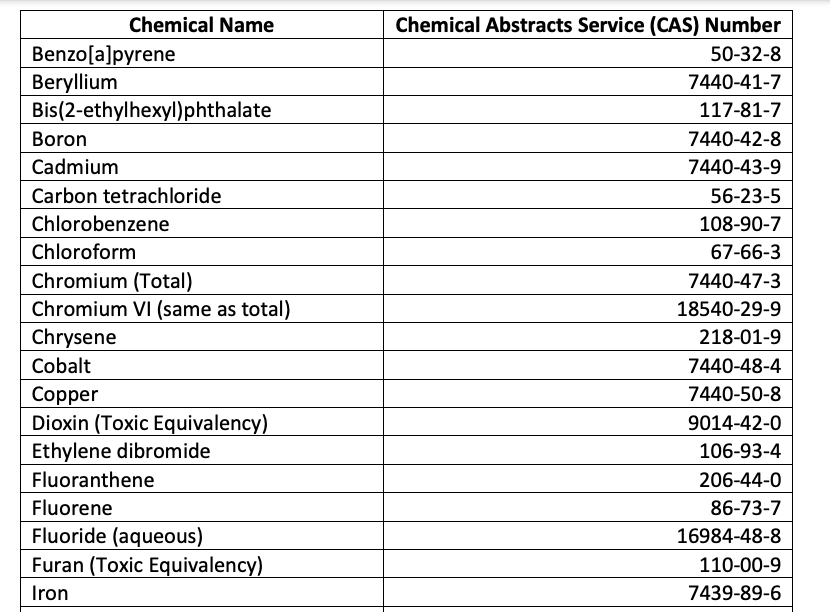
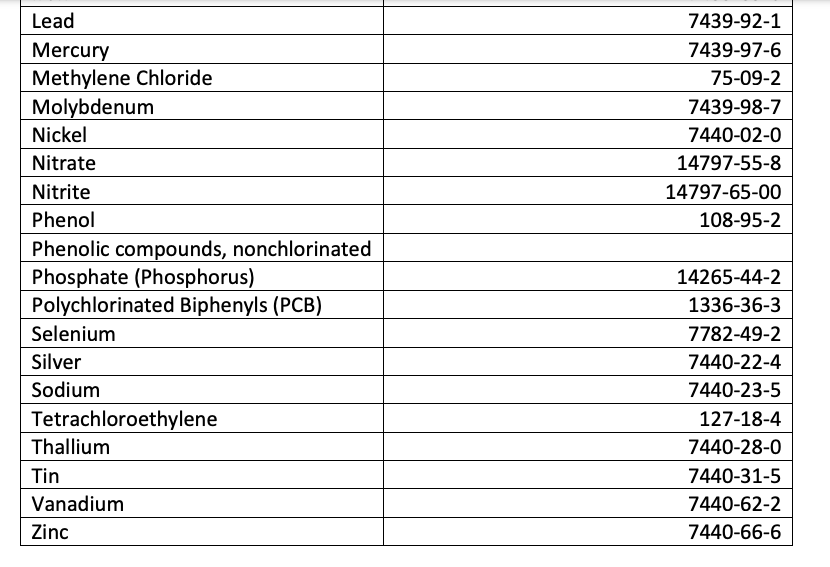
By comparing the unconditional clearance levels in Schedule 2 of the Nuclear Substances and Radiation Devices Regulations to the Radionuclide Concentration Limits in Table 4 of the NSDF Waste Acceptance Criteria (WAC), one can conclude that long-lived radionuclides proposed for disposal – if present in packaged wastes at maximum permitted limits – would not decay to clearance levels for thousands to millions of years.
Summing the radioactivity quantities in Table 11 of the WAC, at 1600 years post-closure, the entire contents of the mound would exceed unconditional clearance levels by more than 5-fold, even if all radionuclides were evenly distributed throughout. Hence removal from regulatory control would not be possible for millennia.
CNSC’s environmental assessment report makes confusing/contradictory statements about removal from regulatory control:
The Post-Institutional Control Period will occur after the IC period and continues indefinitely, subject to either federal or provincial regulatory control.
At a given time in the future and/or after year 2400, and taking into consideration the regulatory requirements in effect at that time, CNL will seek Commission approval for the removal of the NSDF from CNSC regulatory control.
CNL’s licence specifically allows “Release from Regulatory Control — The licensee shall only release the decommissioned property, or any part thereof, for reuse upon the acceptance of the final end-state report by the CNSC.”
CNSC’s environmental assessment report is supposed to cover all licensing stages, including decommissioning and abandonment (removal from regulatory control). But it contains absolutely no mention of an end-state report, and only the following passing reference to end state:
CNL indicated that although it is outside the scope of the NSDF project, CNL is establishing the Land Use Program to determine next land uses and end state objectives for all CNL managed sites in Canada.
End state objectives for the NSDF are definitely NOT outside the scope of the project. End state is absolutely central to the whole concept of a disposal facility. This is a fatal omission in the environmental assessment.
***The real end state would be a degrading mound that would expose the public to nuclear substances in excess of clearance levels for millennia.***
 Concerned Citizens of Renfrew County and Area