Published in the Hill-Times on Mar 4, 2024
Dear Editor
The “NSDF,” a giant, above-ground landfill beside the Ottawa River, for one million tonnes of radioactive waste, approved by the Canadian Nuclear Safety Commission on January 9, is a debacle-in-the-making.
The NSDF fails to meet International safety standards according to experts who for years were in charge of the waste at Chalk River. Industry veterans say much of the waste is too long-lived for permanent emplacement in an above-ground mound.
The facility is expected to leak during operation and break down and release its contents to the environment after 550 years, while many of the dangerous, post-fission, man-made radioactive toxins in the mound will remain hazardous for many millennia. Plutonium and other radioactive pollutants will leak into the Ottawa River that drains into the St. Lawrence River at Montreal. This leakage will contaminate drinking water for millions of Canadians. All radioactive contaminants increase risks of cancer, birth defects and genetic mutations in exposed populations. The larger the population exposed, the greater the incidence of maladies.
Ten out of 11 Algonquin First Nations that have lived in the Ottawa River watershed for millennia say they do not consent to the NSDF on their unceded territory. The Assembly of First Nations and more than 140 municipalities including Ottawa, Gatineau and Montreal have passed resolutions of concern and/or opposition to the facility.
We wonder who the beneficiaries of the NSDF would be, besides shareholders of the three multinationals involved: SNC-Lavalin (now called Atkins Réalis), and two Texas-based multinationals, Fluor and Jacobs. The three multinationals comprise the “Canadian National Energy Alliance,” contracted by the Harper government in 2015 to quickly and cheaply reduce Canada’s multibillion dollar federal nuclear waste cleanup liability.
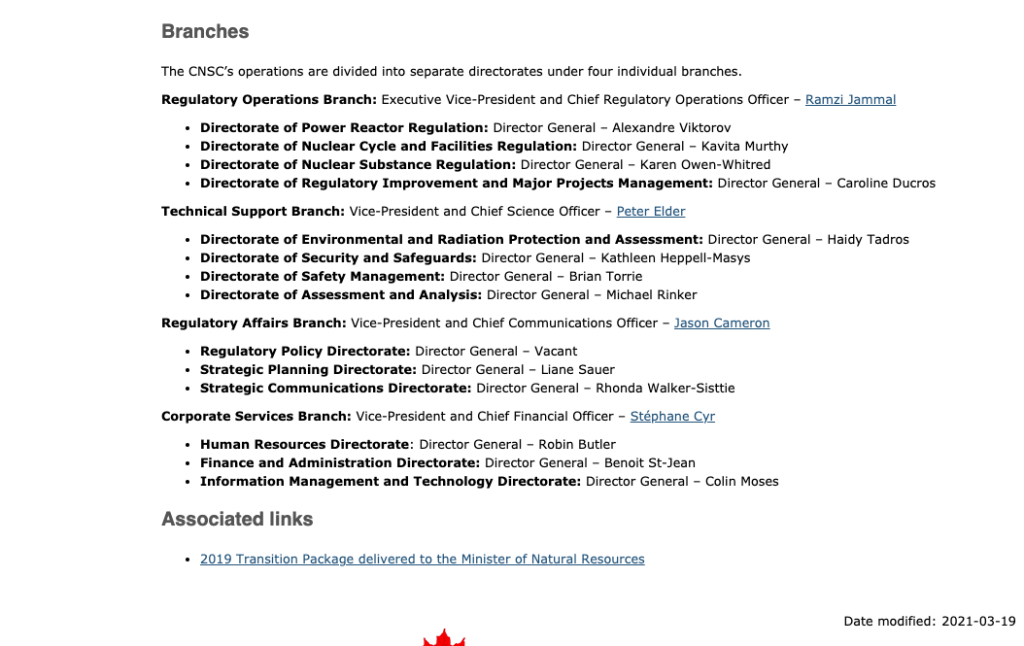
Canada’s deficient nuclear governance regime and its “nuclear-industry-captured” regulator, the Canadian Nuclear Safety Commission, have enabled this debacle-in-the-making to be taken seriously and to receive a license for construction.
Two legal challenges to the CNSC’s decision have been launched in Federal Court. More may follow if a species-at-risk permit to clearcut the NSDF site is approved .
There is a positive way forward for the Liberal government. The Federal Cabinet could request an ARTEMIS review by the International Atomic Energy Agency. ARTEMIS reviews are expert peer reviews, available to all member states of IAEA.
An ARTEMIS review could provide the Government of Canada with valuable advice about how to manage its legacy radioactive waste. Responsibility for managing this waste was handed over to profit-seeking multinationals in 2015 by the Harper government. Costs to taxpayers have ballooned since then. An ARTEMIS review could advise the Government of Canada on how to get value for money in its radioactive waste management projects while ensuring that safety is the top priority.
House of Commons e-petition 4676 calling for an ARTEMIS review garnered 3000 signatures in 30 days over the recent Christmas and New Years holiday period. The petition also called on the Government of Canada to uphold the principle, from the UN Declaration on the Rights of Indigenous Peoples, that “free, prior and informed consent” must be obtained before hazardous waste is stored in the territory of Indigenous people.
We and others have written to the Prime Minister and several Cabinet Ministers urging Cabinet to request an IAEA ARTEMIS review as soon as possible for the benefit of all Canadians and future generations.
Gordon Edwards, PhD, Montreal
Canadian Coalition for Nuclear Responsibility
Lynn Jones, MHSc, Ottawa
Concerned Citizens of Renfrew County and Area



 Concerned Citizens of Renfrew County and Area