Author: hendricksonjones
LETTRE OUVERTE ~ Le financement fédéral pour de nouveaux réacteurs nucléaires est une grave erreur qui détourne d’une action rapide contre le changement climatique
Le 6 décembre 2020
Honorable Jean-Yves Duclos, président du Conseil du Trésor
Honorable Joyce Murray, vice-présidente du Conseil du Trésor
Honorable Bardish Chagger, membre du Conseil du Trésor
Honorable Catherine McKenna, membre du Conseil du Trésor
Honorable Chrystia Freeland, membre du Conseil du Trésor
Honorable Jonathan Wilkinson, membre du Conseil du Trésor
Distingués Monsieur Duclos et membres du Conseil du Trésor,
Le 21 septembre 2020, nous vous avons écrit en tant que femmes dirigeantes dans des milieux communautaires et autochtones, en sciences, médecine, droit et protection de l’environnement afin de vous demander de cesser de financer le développement de nouveaux petits réacteurs nucléaires modulaires (appelés PRM). Le Canada est membre d’un traité international sur les déchets radioactifs et il doit s’acquitter de ses obligations légales de minimiser la production des déchets radioactifs. Le financement fédéral des PRM serait une abnégation de ses obligations en vertu de ce traité.
Aujourd’hui, d’autres femmes dirigeantes de toutes les provinces et territoires du Canada et de plusieurs sites des Premières Nations se joignent à nous. Nous vous exhortons fortement à rejeter les nouveaux PRM. Le gouvernement fédéral fait la promotion des PRM comme une solution miracle pour faire face à l’urgence climatique. C’est complètement faux!
En fait, les PRM ne constituent certainement pas une action rapide et efficace pour faire face à l’urgence climatique. Ils ne pourront atteindre la phase de production avant 10 ou 15 ans. C’est trop tard pour réduire les gaz à effet de serre. C’est engloutir de l’argent inutilement qui serait mieux dépensé dans des technologies à faible émission de carbone peu coûteuses et prêtes à utiliser.
Les énergies solaire et éolienne sont devenues les sources d’électricité les moins coûteuses et les plus répandues dans le monde. En 2018, le rapport de Deloitte, Global Renewable Energy Trends: Solar and Wind Move from Mainstream to Preferred a conclu que « les sources d’énergie traditionnelles solaires et éoliennes ont franchi un nouveau seuil, car elles sont devenues les sources d’énergie préférées dans une grande partie du monde ». Selon le rapport, les énergies solaire et éolienne alimentent davantage les réseaux électriques. Elles comptent parmi les sources d’énergie les moins chères au monde et elles sont très prometteuses. Le rapport souligne que l’intermittence des énergies solaire et éolienne n’est plus un problème étant donné les progrès rapides des technologies de stockage. Le Canada devrait financer un plus vaste déploiement des sources d’énergie solaire et éolienne.
Le financement pour améliorer l’efficacité et la conservation de l’énergie constituerait une meilleure utilisation des deniers publics que les subventions à l’industrie nucléaire. Un rapport présenté en juin 2018 par le Conseil Génération Énergie au ministre des Ressources naturelles Canada a révélé que : « Les meilleures possibilités qui se présentent au Canada pour économiser, diminuer les émissions de gaz à effet de serre et créer des emplois sont liées à une réduction radicale du gaspillage d’énergie. L’amélioration de l’efficacité énergétique nous permettrait d’atteindre un tiers de notre engagement en matière d’émissions en vertu de l’Accord de Paris sur le climat. »
Nous vous exhortons à dire «non» à l’industrie nucléaire qui demande des milliards de dollars de fonds publics pour subventionner une technologie dangereuse, excessivement polluante et coûteuse, et dont nous n’avons pas besoin. Investissez plutôt dans les énergies renouvelables, et dans l’efficacité et la conservation de l’énergie. Cela créera des milliers d’emplois et réduira rapidement les émissions de gaz à effet de serre.
Il ne faut jamais oublier que le principal produit des réacteurs nucléaires – en termes de répercussions planétaires – sont les déchets radioactifs dangereux et même mortels pour toute vie sur terre, et ce pendant des centaines de milliers d’années.
Il ne faut jamais oublier que le principal produit des réacteurs nucléaires – en termes de répercussions planétaires – sont les déchets radioactifs dangereux et même mortels pour toute vie sur terre, et ce pendant des centaines de milliers d’années. Il n’existe pas de moyen sûr éprouvé pour empêcher les déchets radioactifs de pénétrer dans l’environnement des êtres vivants.
Veuillez consulter la pétition environnementale 419, soumise au vérificateur général du Canada en novembre 2018, pour plus de détails sur les raisons pour lesquelles le Canada devrait refuser d’octroyer des subventions de plusieurs milliards à l’industrie nucléaire.
Nous vous exhortons à porter cette question à l’attention de vos collègues du Cabinet et à mettre fin à tout soutien gouvernemental aux petits réacteurs nucléaires modulaires avec l’argent des contribuables.
Veuillez recevoir l’expression de nos sentiments les plus sincères,
Alexandra Hayward, B. Sc., candidate au diplôme Juris Doctor, St. John’s, Terre-Neuve-et-Labrador.
Alma H. Brooks, Wolastoqew and Eastern Wabanaki (Nouveau-Brunswick)
Angela Bischoff, Toronto, Ontario
Ann Coxworth, M. Sc., Saskatoon, Saskatchewan
Anne Lindsey, O.M., M.A., Winnipeg, Manitoba
Ann Pohl, MEd, Killaloe, Ontario
Anna Tilman, B. Sc. Physique, M.A. Biophysique médicale, Aurora, Ontario
Chef April Adams-Phillips, Conseil Mohawk d’Akwesasne (Québec)
Auréa Cormier, M.D., C.M., Moncton, Nouveau-Brunswick
Bea Olivastri, Ottawa, Ontario
Betty L. E. Wilcox, B.A., B. Éd., Stanhope, Île-du-Prince-Édouard
Brenda Brochu, B.A., B. Éd., Peace River, Alberta
Brennain Lloyd, North Bay, Ontario
Candyce Paul, English River First Nation, Saskatchewan
Carole Dupuis, Saint-Antoine-de-Tilly, Québec
Carolyn Wagner, M. Éd., Fredericton, Nouveau-Brunswick
Catherine Cameron, B. Sc., MBA, Perth Ontario
Cathy Vakil, M.D., Kingston, Ontario
Cecily Mills,M.D., Ph. D. Microbiologie, Edmonton, Alberta
Chantal Levert, Montréal, Québec
Charlotte Rigby, M.D., Ph. D., Gatineau, Québec
Chris Cavan, B. Éd., Almonte, Ontario
Dale Dewar, M.D., Wynyard, Saskatchewan
Deborah Powell, Hon. B.A., Bristol, Québec
Diane Beckett, BES, M.A., Churchill, Manitoba
Diane Fortin, Gatineau, Québec
Dorothy Goldin Rosenberg, Ph. D., Toronto, Ontario
Elizabeth Logue, Wakefield, Québec
Ellen Gabriel, Mohawks of Kanehsatà:ke (Quebec)
Emma March, M.A., candidate au diplôme Juris Doctor, Kingston, Ontario
Elssa Martinez, M.S.S., Montréal, Québec
Eriel Deranger, membre de l’Athabasca Chipewyan First Nation, Treaty 8 (Alberta)
Eva Schacherl, M.A., Ottawa, Ontario
Evelyn Gigantes, B.A., ancienne députée provinciale, Ottawa, Ontario
Gail Wylie, Fredericton, Nouveau-Brunswick
Ginette Charbonneau, physicienne, Oka, Québec
Gini Dickie, B.A., Toronto, Ontario
Gracia Janes, OMC, Niagara-on-the-Lake, Ontario
Gretchen Fitzgerald, B. Sc., Halifax, Nouvelle-Écosse
Hilu Tagoona, B.A., Qairnimiut Inuk, Nunavut
Imelda Perley Opolahsomuwehs, M.D., Neqotkuk First Nation, Nouveau-Brunswick
Janet Graham, M.A., Ottawa, Ontario
Janice Harvey, Ph. D., Fredericton, Nouveau-Brunswick
Jean Brereton, Golden Lake, Ontario
Jean Swanson, membre de l’Ordre du Canada (C.M.), B.A., Vancouver, Colombie-Britannique
Jessica Spencer, Moncton, Nouveau-Brunswick
Jocelyne Lachapelle, Framton, Québec
Joan Scottie, Inuk, Nunavut Makitagunarngningit, Baker Lake, Nunavut
Joann McCann-Magill, M.A., Sheenboro, Québec
Joanne Mantha, M.A., Gatineau, Québec
Johanna Echlin, M. Éd., Montréal, Québec
Julie Reimer, MMM, Kingston, Ontario
Judith Miller, Ph. D., Ottawa, Ontario
Kathrin Winkler, B.A., Halifax, Nouvelle-Écosse
Kathyn Lindsay, Ph. D., Renfrew, Ontario
Kay Rogers, B.A., M.A., M. Sc., Perth Ontario
Kerrie Blaise, M. Sc., J.D., North Bay, Ontario
Kim Reeder, MEM (gestion environnement), Saint Andrews, Nouveau-Brunswick
Kringen Henein, Ph. D., Ottawa, Ontario
Larissa Holman, B. Sc., MREM, Gatineau, Québec
Laure Waridel, écosociologue, Ph. D, CM, Montréal, Québec
Lenore Morris, B.A., MBA, J.D., Whitehorse, Yukon
Liette Parent-Leduc, B.A.A., D. Fisc, Saint-Robert, Québec
Lisa Aitken, M. Éd., gestion des ressources humaines, Winnipeg, Manitoba
Lorraine Hewlett, B.A., M.A., B. Éd, Yellowknife, Territoires du Nord-Ouest
Lorraine Rekmans, Osgoode, Ontario
Louise Comeau, Ph. D., Keswick Ridge, Nouveau-Brunswick
Louise Morand, l’Assomption, Québec
Louise Vandelac, Ph. D., professeure titulaire, UQAM, Montréal, Québec
Lucie Massé, Oka, Québec
Lucie Sauvé, Ph. D., Montréal, Québec
Dr. Lynn Gehl, PhD, Algonquin – Pikwakanagan First Nation (Ontario)
Lynn Jones, maîtrise en sciences de la santé, Ottawa, Ontario
Margo Sheppard, BES (études environnementales), Fredericton, Nouveau-Brunswick
Maria Varvarikos, B.A., maîtrise en études juridiques, Westmount, Québec
Martha Ruben, M. D., Ph. D., Ottawa, Ontario
Martine Chatelain, Montréal, Québec
Marion Copleston, BA, B. Éd., ancienne mairesse de Bonshaw, Île-du-Prince-Édouard
Mary Alice Smith, BA, Metis Cree, Robinson-Superior Treaty area, Longbow Lake (Ontario)
Mary Lou Smoke, Anishinawbe Kwe, Bear Clan
Mary-Wynne Ashford, M.D., Ph. D., Victoria, Colombie-Britannique
Meg Sears, Ph. D., Dunrobin, Ontario
Megan McCann, RMT, Fredericton, Nouveau-Brunswick
Megan Mitton, députée, Sackville, Nouveau-Brunswick
Melissa Lem, M.D., Vancouver, Colombie-Britannique
Meredith Brown, B. Sc. (Ingénierie) MRM, Wakefield, Québec
Michele Kaulbach, Westmount, Québec
Nadia Alexan, Montréal, Québec
Neecha Dupuis, Ojibway Nation of SAUGEEN Indian Tribe No. 258 Savant Lake (Ontario)
Nira Dookeran, MA, Ottawa, Ontario
Odette Sarrazin, St-Gabriel-de-Brandon, Québec
Paula Tippett B. Sc., M.D., M. Sc. (santé publique), Saint John, Nouveau-Brunswick
Pippa Feinstein, J.D., LL.M., Toronto, Ontario
Renee Abram, Oneida First Nation of the Thames (Ontario)
Roberta Frampton Benefiel, Happy Valley-Goose Bay, Terre-Neuve-et-Labrador
Roma De Robertis, MA, Saint John, Nouveau-Brunswick
Sarah Colwell, B. Sc., M.D., associé du Collège royal des médecins et chirurgiens du Canada, Moncton, Nouveau-Brunswick
Serena Kenny, Lac Seul First Nation (Ontario)
Stefanie Bryant, BA, Lac Seul First Nation (Ontario)
Susan O’Donnell, Ph. D., Fredericton, Nouveau-Brunswick
Sylvia Hale, Ph. D., Fredericton, Nouveau-Brunswick
Sylvia Oljemark, Montréal, Québec
Theresa McClenaghan, B. Sc., LL.B., LL.M., Paris, Ontario
Serena Kenny, Lac Seul First Nation (Ontario)
Valerie Needham, MA, Ottawa, Ontario
Venetia Crawford, BA, Shawville, Québec
Willi Nolan-Campbell, Nouveau-Brunswick
CC:
Hon. Erin O’Toole, Chef de l’opposition
Yves-François Blanchet, chef du Bloc québécois
Jagmeet Singh, Chef du Nouveau Parti démocratique
Annamie Paul, Chef du Parti vert du Canada
Greg Fergus, secrétaire parlementaire du président du Conseil du Trésor

Open letter to Treasury Board from women leaders on SMRs published in the Hill Times

Hill Times Op Ed: If we’re going to spend a billion dollars a year managing our nuclear waste, let’s do it right
December 7, 2020
by Lynn Jones
https://www.hilltimes.com/2020/12/07/270469/270469
OTTAWA—A contract quietly signed during the 2015 federal election campaign between Atomic Energy of Canada Limited (AECL) and a multinational consortium is costing Canadians billions of dollars and increasing risks to health from deadly radioactive pollutants.
The multi-billion dollar contract was an attempt by the former federal Conservative government to reduce Canada’s $7.9-billion nuclear waste liability quickly and cheaply by creating a public-private partnership or GoCo (government-owned, contractor-operated) contract.
The GoCo contractor is called the “Canadian National Energy Alliance” (CNEA) even though the majority of its members are foreign corporations. It currently consists of Fluor and Jacobs, two Texas-based multinationals involved in nuclear weapons production, and SNC-Lavalin. Under the contract, the consortium assumed control over all Canada’s federal nuclear facilities and radioactive wastes.
Since the GoCo contract was signed, costs to Canadian taxpayers appear to have almost quadrupled. According to AECL financial reports, its parliamentary appropriations rose from $327-million in 2015 to $1.3-billion (approved) for the year ending March 31, 2021. AECL’s nuclear waste liabilities have not gone down, but rather appear to have increased by about $200-million.
The Crown corporation, Atomic Energy of Canada Limited, was supposed to oversee the contract on behalf of the Government of Canada but may not have been in a position to do so. Serious problems at AECL were identified by the Auditor General in a 2017 report. Problems included lack of a board chair, lack of a CEO, no board directors at all for 2016 and most of 2017, failure to hold public meetings and lack of experience with the GoCo model.
Since 2015, it appears that the GoCo contractor has spent hundreds of millions of our tax dollars promoting three radioactive waste facilities that we believe to be quick, cheap, and substandard. They are: a giant, above-ground mound beside the Ottawa River at Chalk River, Ontario, for one million tonnes of mixed radioactive and non-radioactive wastes including plutonium, and entombment in concrete of two old nuclear reactors beside the Ottawa and Winnipeg rivers which provide drinking water to millions of Canadians.
More than two dozen submissions to the Impact Assessment Agency from ex-AECL nuclear waste experts including senior scientists and senior managers highlight serious concerns about the three projects and point out that they fail to meet international safety standards.
The consortium’s own studies show that all three facilities would leak radioactive contaminants into the environment and drinking water sources for millennia.
The consortium’s own studies show that all three facilities would leak radioactive contaminants into the environment and drinking water sources for millennia.
According to the consortium’s draft environmental impact statement, it appears that the giant Chalk River mound is expected to eventually disintegrate, in a process referred to as “normal evolution”. At that time, its radioactive and hazardous contents would flow out of the mound into surrounding wetlands that drain into the Ottawa River less than a kilometre away.
Hundreds of concerns about the three projects have been voiced by federal and provincial government departments, First Nations, civil society groups, 140 Quebec municipalities, nuclear waste experts, and concerned citizens. And yet the projects continue to lumber forward and the consortium continues to receive almost a billion dollars a year from Canadian taxpayers.
Does anyone in government have their eyes on this ball? Did they notice when AECL renewed the GoCo contract early in the pandemic lockdown, 18 months before expiry, despite the recent conviction of consortium partner SNC-Lavalin on a charge of fraud? Are they concerned by the rapidly rising costs and substandard proposals?
…the giant Chalk River mound is expected to eventually disintegrate, in a process referred to as “normal evolution”. At that time, its radioactive and hazardous contents would flow out of the mound into surrounding wetlands that drain into the Ottawa River less than a kilometre away.
Are they aware that the consortium is bringing thousands of truckloads of radioactive waste to Chalk River from other federal facilities in Manitoba, Ontario, and Quebec? The Chalk River Laboratories site is not a good place to consolidate federal nuclear waste either for temporary or for long-term storage. It is seismically active and adjacent to the Ottawa River, source of drinking water for Ottawa-Gatineau, Montreal, and many other communities.
With all of the problems currently facing the world, one might ask, “Why should Canadians care about this nuclear waste problem?”
Radioactive waste is the deadliest waste on the planet. Nuclear reactors create hundreds of dangerous radioactive substances that remain toxic to all life for hundreds of thousands of years. Exposure can cause serious chronic diseases, birth defects, and genetic damage that is passed on to future generations. According to the U.S. National Research Council, there is no safe level of exposure to ionizing radiationreleased from nuclear reactors and nuclear waste facilities. And yet Canada is pouring billions of dollars into projects that will not keep these poisons out of our environment and drinking water.
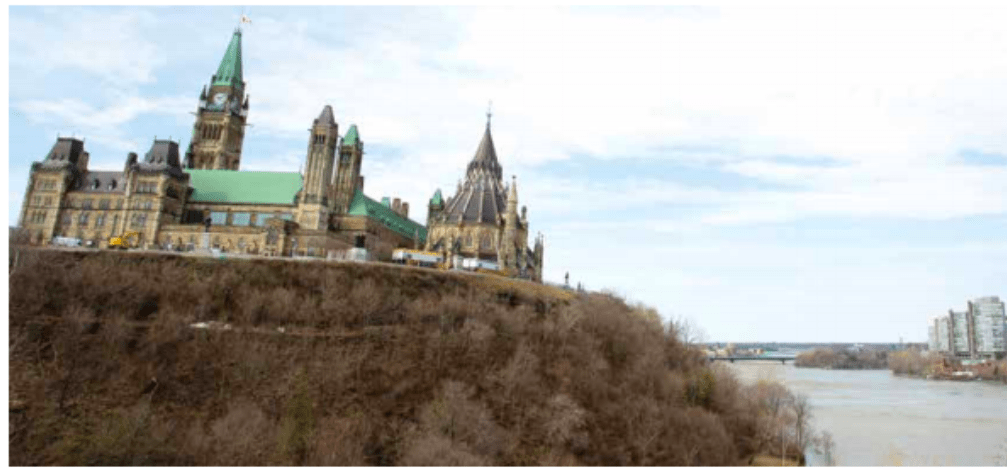
The Ottawa River is a Canadian Heritage River that flows past Parliament Hill—surely we don’t want to be the generation responsible for permanently contaminating it with radioactive waste.
Surely we can and must do better. The Ottawa River is a Canadian Heritage River that flows past Parliament Hill—surely we don’t want to be the generation responsible for permanently contaminating it with radioactive waste.
If we are going to spend a billion dollars a year managing our nuclear waste, let’s do it right. Let’s meet or exceed international standards and build secure storage facilities, well away from drinking water sources. Let’s make sure the wastes are carefully packaged and labelled and stored in monitored and retrievable conditions. This approach will create thousands of good, long-lasting careers in the nuclear waste and decommissioning field and show the world what top tier radioactive waste storage facilities look like.
OPEN LETTER ~ Federal funding for new nuclear reactors is a serious mistake that blocks swift action on climate change
La version française ici
Note: this letter was also published in English as a full page ad in the Hill Times on December 7, 2020.
December 6, 2020
The Hon. Jean-Yves Duclos, President
The Hon. Joyce Murray, Vice-Chair
The Hon. Bardish Chagger, Member
The Hon. Catherine McKenna, Member
The Hon. Chrystia Freeland, Member
The Hon. Jonathan Wilkinson, Member
Treasury Board of Canada
Dear Mr. Duclos and Members of the Treasury Board:
On September 21, 2020 we wrote to you as women who are Indigenous and non-Indigenous community leaders in science, medicine, law and environmental protection to ask you to stop funding new nuclear reactors. Canada is a member of an international nuclear waste treaty and has a legal obligation to minimize generation of radioactive waste. Federal funding for new nuclear reactors would be an abnegation of this treaty obligation.
Today we are joined by women colleagues from all provinces and territories in Canada and several Indigenous communities. We strongly urge you to reject new nuclear reactors, called “SMRs.” They are being promoted to your government as a silver bullet to address the climate emergency. This is a false notion.
We strongly urge you to reject new nuclear reactors, called “SMRs.” They are being promoted to your government as a silver bullet to address the climate emergency. This is a false notion.
In fact, SMRs prevent swift, effective action to address the climate emergency. SMRs are many years away from production. They would take far too long to reduce greenhouse gas emissions. They suck money and attention away from inexpensive low-carbon technologies that are ready to deploy now.
Solar and wind power are already the cheapest and fastest-growing electricity sources in the world. A 2018 Deloitte report, “Global Renewable Energy Trends: Solar and Wind Move from Mainstream to Preferred” concluded: “Solar and wind power recently crossed a new threshold, moving from mainstream to preferred energy sourcesacross much of the globe”. The report noted that solar and wind power enhance electrical grids. It also pointed out that intermittency is no longer a concern owing to rapid advances in storage technology. Canada should fund much wider deployment of solar and wind power.
More funding for energy efficiency and energy conservation would also be a much better use of tax dollars than handouts to the nuclear industry. The 2018 report presented by the Generation Energy Council to Canada’s Minister of Natural Resources found that: “Canada’s greatest opportunities to save money, cut greenhouse gas emissions and create jobs can be found in slashing energy waste. Fully one-third of our Paris emissions commitment could be achieved by improving energy efficiency.”
We urge you to say “no” to the nuclear industry that is asking for billions of dollars in taxpayer funds to subsidize a dangerous, highly-polluting and expensive technology that we don’t need. Instead, put more money into renewables, energy efficiency and energy conservation. This will create many thousands of jobs and quickly reduce greenhouse gas emissions.
We must never forget that the main product of nuclear reactors — in terms of planetary impact — is deadly radioactive poisons that remain hazardous to all life on earth for hundreds of thousands of years. The electricity they produce for a few short decades is but a minor by-product.
We must never forget that the main product of nuclear reactors — in terms of planetary impact — is deadly radioactive poisons that remain hazardous to all life on earth for hundreds of thousands of years. The electricity they produce for a few short decades is but a minor by-product. There is no proven safe method for keeping radioactive waste out of the environment of living things for hundreds of thousands of years.
Please see Environmental Petition 419, submitted to the Auditor General of Canada in November 2018, for more detail on why Canada should refuse multibillion dollar handouts to subsidize the nuclear industry.
We urge you to bring this matter to the attention of your Cabinet colleagues, and stop all government support and taxpayer funding for so-called small modular nuclear reactors.
Yours sincerely,
Alma H. Brooks, Wolastoqew and Eastern Wabanaki (New Brunswick)
Chief April Adams-Phillips, Mohawk Council of Akwesasne (Quebec)
Candyce Paul, English River First Nation (Saskatchewan)
Ellen Gabriel, Mohawks of Kanehsatà:ke (Quebec)
Eriel Deranger, Member of the Athabasca Chipewyan First Nation, Treaty 8 (Alberta)
Hilu Tagoona, BA, Qairnimiut Inuk, (Nunavut)
Dr. Imelda Perley Opolahsomuwehs, Neqotkuk First Nation (New Brunswick)
Joan Scottie, Inuk, Nunavut Makitagunarngningit, Baker Lake, Nunavut
Lorraine Rekmans, member of the Serpent River First Nation (Ontario)
Dr. Lynn Gehl, PhD, Algonquin – Pikwakanagan First Nation (Ontario)
Mary Alice Smith, BA, Metis Cree, Robinson-Superior Treaty area, Longbow Lake (Ontario)
Mary Lou Smoke, Anishinawbe Kwe, Bear Clan
Neecha Dupuis, Ojibway Nation of SAUGEEN Indian Tribe No. 258 Savant Lake (Ontario)
Renee Abram, Oneida First Nation of the Thames (Ontario)
Serena Kenny, Lac Seul First Nation (Ontario)
Stefanie Bryant, BA, Lac Seul First Nation (Ontario)
Alexandra Hayward, BSc, JD Candidate, St. John’s, Newfoundland and Labrador
Angela Bischoff, Toronto, Ontario
Anna Tilman, BA Physics, MA Medical Biophysics, Aurora, Ontario
Ann Coxworth, MSc, Saskatoon, Saskatchewan
Ann Pohl, MEd, Killaloe, Ontario
Anne Lindsey, Order of Manitoba, MA, Winnipeg, Manitoba
Dr. Auréa Cormier, PhD, Order of Canada, Moncton, New Brunswick
Dr. Barbara Birkett, MDCM, FRCPC, Oakville, Ontario
Beatrice Olivastri, Ottawa, Ontario
Betty L. E. Wilcox, BA, BEd, Stanhope, Prince Edward Island
Brenda Brochu, BA, BEd, Peace River, Alberta
Brennain Lloyd, North Bay, Ontario
Carole Dupuis, Saint-Antoine-de-Tilly, Québec
Carolyn Wagner, MEd, Fredericton, New Brunswick
Catherine Cameron, BSc., MBA, Perth Ontario
Dr. Cathy Vakil, MD, Kingston, Ontario
Dr. Cecily Mills, PhD Microbiology, Edmonton, Alberta
Chantal Levert, Montréal, Québec
Dr. Charlotte Rigby, PhD, Gatineau, Quebec
Chris Cavan, BEd, Almonte, Ontario
Dr. Dale Dewar, MD, Wynyard, Saskatchewan
Dr. Darlene Hammell, MD, Victoria, British Columbia
Deborah Powell, BA, BEd, Bristol, Quebec
Diane Beckett, BES, MA, Churchill, Manitoba
Diane Fortin, Gatineau, Québec
Dr. Dorothy Goldin Rosenberg, PhD, Toronto, Ontario
Elizabeth Logue, Wakefield, Quebec
Elssa Martinez, MSW, Montreal, Quebec
Emma March, MA, JD candidate, Kingston, Ontario
Dr. Erica Frank, MD, MPH, FACPM; Nanoose Bay, British Columbia
Eva Schacherl, MA, Ottawa, Ontario
Evelyn Gigantes, BA, former MPP, Ottawa, Ontario
Gail Wylie, Fredericton, New Brunswick
Gini Dickie, BA, Toronto, Ontario
Ginette Charbonneau, Physicist, Oka, Quebec
Gracia Janes, Ontario Medal for Citizenship, Niagara-on-the-Lake Ontario
Gretchen Fitzgerald, BSc, Halifax, Nova Scotia
Janet Graham, MA, Ottawa, Ontario
Dr. Janet Ray MD, Victoria, British Columbia
Dr. Janice Harvey, PhD, Fredericton, New Brunswick
Jean Brereton, Golden Lake, Ontario
Jean Swanson, Order of Canada, BA, City Councillor, Vancouver, British Columbia
Dr. Jeannie Rosenberg, MD, Huntingdon, Quebec
Jessica Spencer, Moncton, New Brunswick
Joann McCann-Magill, MA, Sheenboro, Quebec
Joanne Mantha, MA, Gatineau, Quebec
Jocelyne Lachapelle, Framton, Québec
Johanna Echlin, MEd, Westmount, Quebec
Julie Reimer, MMM, Kingston, Ontario
Dr. Judith Miller, PhD, Ottawa, Ontario
Kathrin Winkler, BA, Halifax, Nova Scotia
Dr. Kathryn Lindsay, PhD, Renfrew, Ontario
Kay Rogers, BA, MA, MSc, Perth Ontario
Kerrie Blaise, MSc, JD, North Bay, Ontario
Kim Reeder, MEM (Environmental Management), Saint Andrews, New Brunswick
Dr. Kringen Henein, PhD, Ottawa Ontario
Larissa Holman, BSc, MREM, Gatineau, Quebec
Dr. Laure Waridel, PhD, Order of Canada, Montréal, Québec
Lenore Morris, BA, MBA, JD, Whitehorse, Yukon
Liette Parent-Leduc, B.A.A., D. Fisc, Saint-Robert, Québec
Lisa Aitken, MEd, HRM, Winnipeg, Manitoba
Dr. Louise Comeau, PhD, Keswick Ridge, New Brunswick
Louise Morand, l’Assomption, Québec
Dr. Louise Vandelac, PhD, Montreal, Quebec
Lorraine Hewlett, BA, MA, BEd, Yellowknife, Northwest Territories
Lucie Massé, Oka, Québec
Dr. Lucie Sauvé, PhD, Montréal, Québec
Lynn Jones, MHSc, Ottawa, Ontario
Margo Sheppard, BES (Environmental Studies), Fredericton, New Brunswick
Maria Varvarikos, BA, MLS, NDG, Montreal, Quebec
Dr. Marianne Rev, MD, Vancouver, British Columbia
Marion Copleston, BA, BEd, Past Mayor of Bonshaw, Prince Edward Island
Dr. Martha Ruben, MD, PhD, Ottawa, Ontario
Martine Chatelain, Montréal, Québec
Dr. Mary-Wynne Ashford, MD, PhD, Victoria, British Columbia
Dr. Meg Sears, PhD, Dunrobin, Ontario
Megan McCann, RMT, Fredericton, New Brunswick
Megan Mitton, MLA, Sackville, New Brunswick
Dr. Melissa Lem, MD, Vancouver, British Columbia
Meredith Brown, BSc (Engineering) MRM, Wakefield, Quebec
Michele Kaulbach, Westmount, Quebec
Nadia Alexan, Montréal, Québec
Dr. Nancy Covington, MD, Halifax, Nova Scotia
Nira Dookeran, MA, Ottawa, Ontario
Odette Sarrazin, St-Gabriel-de-Brandon, Québec
Dr. Paula Tippett, BSc, MD, MPH, Saint John, New Brunswick
Pippa Feinstein, JD, LLM, Toronto, Ontario
Dr. Rashmi Chadha MBChB, MScCH, Vancouver, British Columbia
Roberta Frampton Benefiel, Happy Valley-Goose Bay, Newfoundland and Labrador
Roma De Robertis, MA, Saint John, New Brunswick
Dr. Sarah Colwell BSc, MD, FRCPC, Moncton, New Brunswick
Dr. Silvia Schriever, MD, Victoria, British Columbia
Dr. Susan O’Donnell, PhD, Fredericton, New Brunswick
Dr. Sylvia Hale, PhD, Fredericton, New Brunswick
Sylvia Oljemark, Montréal , Québec
Theresa McClenaghan, BSc, LL.B., LL.M., Paris, Ontario
Valerie Needham, MA, Ottawa, Ontario
Venetia Crawford, BA, Shawville, Quebec
Willi Nolan-Campbell, New Brunswick
CC
Hon. Erin O’Toole, Leader of the Official Opposition
Yves-François Blanchet, Leader of the Bloc Québécois
Jagmeet Singh, Leader of the New Democratic Party of Canada
Annamie Paul, Leader of the Green Party of Canada
Greg Fergus, Parliamentary Secretary to the President of the Treasury Board
~~~~~~~

Does the CNSC president meet IAEA requirements for “independence”?
The International Atomic Energy Agency provides explicit guidance on the necessary independence of the nuclear regulatory agency in order to ensure safety and public confidence. The guidance is provided in the IAEA “General Safety Guide No. GSG-12, Organization, Management and Staffing of the Regulatory Body for Safety”. Here is a screen capture from page 22 of that publication (emphasis added).
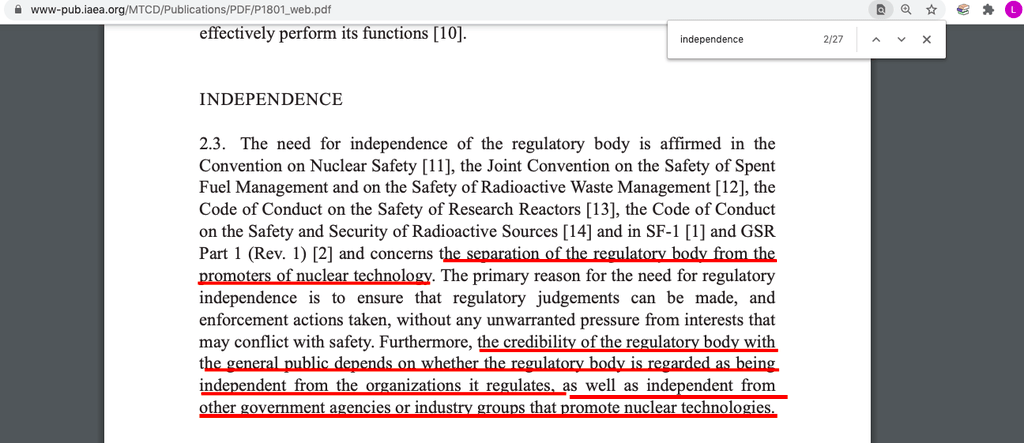
The guidance is quite clear that the regulatory body must be separate from the “promoters of nuclear technology”. The guidance also suggests that CNSC should be independent from NRCan; more detail on this is provided in this post.
The CNSC’s current president, Rumina Velshi, prior to her appointment at CNSC, worked for Ontario Power Generation for eight years in senior management positions and led the OPG commercial team involved in a multi-billion dollar proposal to procure new nuclear reactors as noted below in the announcement of Ms. Velshi’s appointment on the US Nuclear Regulatory Commission website.
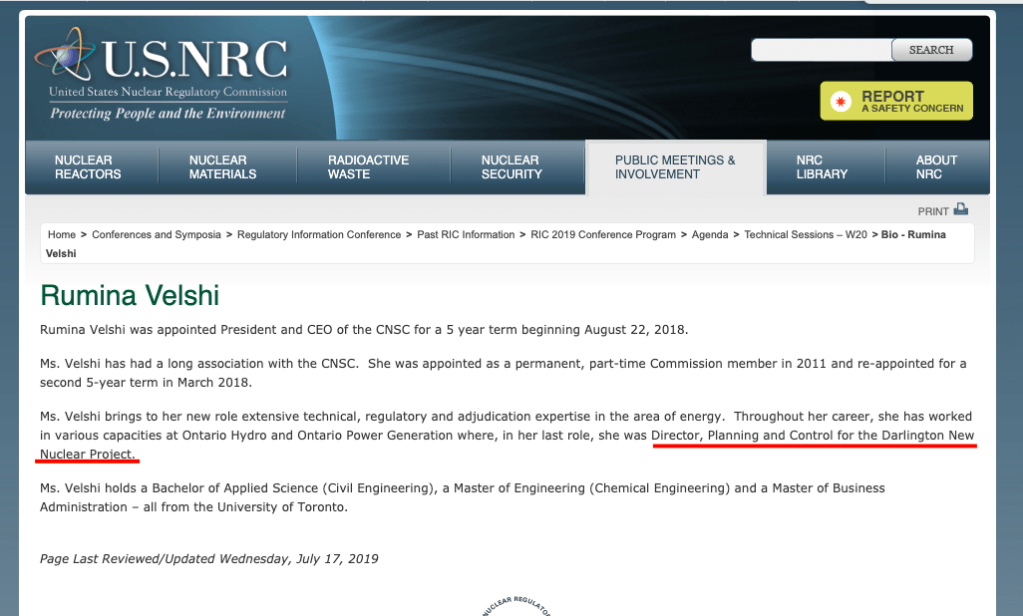
It would seem that Rumina Velshi fails to meet the IAEA’s guidance that staff of the regulatory body must be separate from “promoters of nuclear technology”. As the leader of a multi-billion dollar project to procure new nuclear reactors, Ms. Velshi was quite clearly a “promoter of nuclear energy” before her appointment at the Canadian Nuclear Safety Commission.
CNSC president should not report to the Minister of Natural Resources, according to IAEA guidance
Having the CNSC report through the Minister of Natural Resources who is charged with producing (and promoting) nuclear energy under the Nuclear Energy Act is not consistent with the IAEA’s guidance on “independence”.
IAEA General Safety Guide No. GSG-12, Organization, Management and Staffing of the Regulatory Body for Safety says:
2.3 …the credibility of the regulatory body with the general public depends on whether the regulatory body is regarded as being independent from the organizations it regulates, as well as independent from other government agencies or industry groups that promote nuclear technologies.
The IAEA recommends that the CNSC’s independence from Parliament and government not be absolute:
2.6. Paragraph 2.8 of GSR Part 1 (Rev. 1) [2] states that:“To be effectively independent from undue influences on its decision making, the regulatory body: …Shall be free from any pressures associated with political circumstances or economic conditions, or pressures from government departments, authorized parties or other organizations”.
2.7. The regulatory body should, however, be accountable to the government and to the general public with regard to effectively and efficiently fulfilling its mission to protect workers, the public and the environment…
More specifically, it is unacceptable that the CNSC’s funding requests come through the Minister of Natural Resources:
2.14. …Review and approval of the regulatory body’s budget should be performed only by governmental agencies that are effectively neutral in respect of the development, promotion or operation of facilities and conduct of activities. Such an approach provides additional assurance of the independence of the regulatory body
Under the Nuclear Energy Act, the Minister of Natural Resources is Canada’s promoter of nuclear technologies:
Powers of Minister 10(1) The Minister may
(a) undertake or cause to be undertaken research and investigations with respect to nuclear energy;
(b) with the approval of the Governor in Council, utilize, cause to be utilized and prepare for the utilization of nuclear energy;
(c) with the approval of the Governor in Council, lease or, by purchase, requisition or expropriation, acquire or cause to be acquired nuclear substances and any mines, deposits or claims of nuclear substances and patent rights or certificates of supplementary protection issued under the Patent Act relating to nuclear energy and any works or property for production or preparation for production of, or for research or investigations with respect to, nuclear energy
The President of Canada’s nuclear regulatory body (CNSC) reports to the Minister of Natural Resources. The Nuclear Safety and Control Act says
12(4) …the President shall make such reports to the Minister as the Minister may require concerning the general administration and management of the affairs of the Commission…
Hence, the Minister in charge of nuclear energy, including federal (AECL) properties for production and research of nuclear energy, is also in charge of the regulatory body that is supposed to protect workers, the public and the environment.
This creates a lack of independence of the regulatory body.
The Nuclear Safety and Control Act does allow for the President of the CNSC to report to a minister other than the Minister of Natural Resources. From section 2, Definitions:
Minister means the Minister of Natural Resources or such member of the Queen’s Privy Council for Canada as the Governor in Council may designate as the Minister for the purposes of this Act.
A quick and cheap fix to CNSC’s lack of independence would be to designate the Minister of Environment and Climate Change as the “the Minister for the purposes of this Act”.
That being said, both the Nuclear Safety and Control Act and the Nuclear Energy Act are more than 23 years old and have never been reviewed by Parliament. Such a review is long overdue.
Canada re-engages in the Nuclear Weapons Business with SMRs
December 3, 2020
Published as an Op Ed by the Hill Times at this link: WWW.HILLTIMES.COM/2020/12/03/CANADA-RE-ENTERS-NUCLEAR-WEAPONS-BUSINESS-WITH-SMALL-MODULAR-REACTORS/274591
Canada Re-enters the Nuclear Weapons Business with SMRs
Natural Resources Minister Seamus O’Regan is expected to announce within weeks his government’s action plan for development of “small modular” nuclear reactors (SMRs).

SMR developers already control the federally-subsidized Chalk River Laboratories and other facilities owned by the crown corporation, Atomic Energy of Canada Limited (AECL). Canada is now poised to play a supporting role in the global nuclear weapons business, much as it did during World War II.
Canada was part of the Manhattan project with the U.S. and U.K. to produce atomic bombs. In 1943 the three countries agreed to build a facility in Canada to produce plutonium for nuclear weapons. Researchers who trained at the Chalk River Laboratories went on to launch weapons programs in the U.K. and France. Chalk River provided plutonium for U.S. weapons until the 1960s.
Canada’s Nuclear Schizophrenia describes a long tradition of nuclear cooperation with the United States: “For example, in the early 1950s, the U.S. Navy used Canadian technology to design a small reactor for powering its nuclear submarines.” C.D. Howe, after creating AECL in 1952 to develop nuclear reactors and sell weapons plutonium, remarked that “we in Canada are not engaged in military development, but the work that we are doing at Chalk River is of importance to military developments.”
The uranium used in the 1945 Hiroshima bomb may have been mined and refined in Canada. According to Jim Harding’s book Canada’s Deadly Secret: Saskatchewan Uranium and the Global Nuclear System, from 1953 to 1969, all the uranium mined in Saskatchewan went to make U.S. nuclear weapons. Canada remains the world’s second-largest producer of uranium. North America’s only currently operating uranium processing facility is owned by Cameco in Port Hope, Ontario.
Canada built India’s CIRUS reactor, which started up in 1960 and produced the plutonium for India’s first nuclear explosion in 1974. Canada also built Pakistan’s first nuclear reactor, which started up in 1972. Although this reactor was not used to make weapons plutonium, it helped train the engineers who eventually exploded Pakistan’s first nuclear weapons in 1998.
In 2015 the Harper Government contracted a multi-national consortium called Canadian National Energy Alliance – now comprised of two U.S. companies, Fluor and Jacobs, along with Canada’s SNC-Lavalin – to operate AECL’s nuclear sites, the main one being at Chalk River. Fluor operates the Savannah River Site, a South Carolina nuclear weapons facility, under contract to the U.S. Department of Energy (DOE). Jacobs also has contracts at DOE weapons facilities and is part of a consortium that operates the U.K. Atomic Weapons Establishment.
Joe McBrearty, the president of the consortium’s subsidiary that operates Chalk River and other federal nuclear sites, was a U.S. Navy nuclear submarine commander and then chief operating officer for the DOE’s nuclear laboratories between 2010 and 2019.
All three consortium partners have investments in SMRs and are ramping up research and development at AECL’s Chalk River facility. Some SMR designs would use uranium enriched to levels well beyond those in current reactors; others would use plutonium fuel; others would use fuel dissolved in molten salt. All of these pose new and problematic weapons proliferation risks.
Rolls Royce, an original consortium partner that makes reactors for the U.K.’s nuclear submarines, is lead partner in a U.K. consortium (including SNC-Lavalin) that was recently funded by the U.K. government to advance that country’s SMR program.
A military bromance: SMRs to support and cross-subsidize the UK nuclear weapons program, says “Industry and government in the UK openly promote SMRs on the grounds that an SMR industry would support the nuclear weapons program (in particular the submarine program) by providing a pool of trained nuclear experts, and that in so doing an SMR industry will cross-subsidize the weapons program.”
The article quotes a 2017 Rolls Royce study as follows: “expansion of a nuclear-capable skilled workforce through a civil nuclear UK SMR programme would relieve the Ministry of Defence of the burden of developing and retaining skills and capability.”
The SMR connection to weapons and submarines could hardly be clearer – without SMRs, the U.S. and U.K. will experience a shortage of trained engineers to maintain their nuclear weapons programs.
With the takeover of AECL’s Chalk River Laboratories by SMR developers, and growing federal government support for SMRs, Canada has become part of a global regime linking nuclear power and nuclear weapons.
Several ex-AECL scientists have pointed out that all three of CNL’s proposed nuclear waste projects fail to meet international safety standards
November 2020 (updated April 2022)
See also: Critical comments from former AECL officials and scientists on CNL Disposal projects
The most recent critical comments from ex-AECL experts are interventions submitted for the final licensing hearing that starts on May 30.
Dr. JR Walker’s intervention is here: https://api.cnsc-ccsn.gc.ca/dms/digital-medias/CMD22-H7-63B.pdf/object?subscription-key=3ff0910c6c54489abc34bc5b7d773be0
He says: “On the face of the documents provided, there is no justification for approval of the proposed Engineered Containment Mound until the deficiencies are corrected.”
~~~~~~~
Several ex-AECL scientists have pointed out, in comments on the environmental assessments, that all three of CNL’s proposed nuclear waste projects fail to meet international safety standards for radioactive waste facilities. The comments are publicly available on the website of the Impact Assessment Agency. Links to the submissions are compiled in this post. Below we highlight some that are especially pertinent to lack of compliance with international safety guidelines. See also the Globe and Mail article from June 2017 “Scientists decry plan for Ontario nuclear-waste site”
Concerns about the Near Surface Disposal Facility (Chalk River Mound)
Dr. Michael Michael Stephens, former Manager for Strategic Planning for the Canadian Nuclear Legacy Liabilities Program at AECL
I am commenting as a resident of Deep River, as a Canadian taxpayer, and from my 25 years’ working experience in radioactive waste management and decommissioning of nuclear facilities, including as
source: https://www.ceaa.gc.ca/050/documents/p80122/119775E.pdf page 2
former Manager for Strategic Planning for the Canadian Nuclear Legacy Liabilities Program.
The concept of the NSDF project deviates significantly from internationally-accepted waste management principles and practices. Before consideration is given to allowing it to be implemented, it should be,subjected to a comprehensive technical review by an international group of experts arranged through the International Atomic Energy Agency, and the results should be made public.
source: https://www.ceaa.gc.ca/050/documents/p80122/119775E.pdf page 5
DR. J.R. Walker, former Director of Safety Engineering and Licensing at AECL
A must-read submission on the NSDF (Chalk River Mound)
This quote is about non-compliance with international guidlines:
The proposed project does not meet Canadian and international guidance and would require members
source: https://www.ceaa.gc.ca/050/documents/p80122/119034E.pdf page 7
of the public to be subject to unacceptable radiological risks into the far future.
This quote is about eventual failure of the mound:
The institutional control period ends 300 years post-closure, and the design life of the facility is 500 years post-closure. Subsequently, the facility will fail and the radionuclide inventory will be released
source: https://www.ceaa.gc.ca/050/documents/p80122/119034E.pdf page 8
into the environment. As noted previously, the predicted doses exceed the public dose limit specified in Canadian Regulations [10] for more than 100,000 years.
These are Dr. Walker’s concluding remarks about the NSDF environmental impact statement:
5.0 Concluding Remarks
The Draft EIS [1] and the associated project proposal contain numerous deficiencies. For example,
• The proposal employs inadequate technology and is problematically located;
• The proposal does not meet regulatory requirements with respect to the health and safety of
persons and the protection of the environment; and
• The authors have failed to meet the requirements of the Canadian Environmental AssessmentAct 2012.The extent and gravity of these deficiencies preclude a conclusion that the project is unlikely to cause significant adverse environmental effects, taking into consideration the implementation of mitigation measures.
Source: https://www.ceaa.gc.ca/050/documents/p80122/119034E.pdf page 10
Concerns about the proposed Whiteshell reactor entombment
Dr. J.R. Walker, former Director of Safety Engineering and Licensing at AECL, explains that the Whiteshell Reactor Entombment would not meet IAEA guidelines.
The proposed facility [1] is in noncompliance with international requirements and guidance, for
Source: https://www.ceaa-acee.gc.ca/050/documents/p80124/121207E.pdf page 9
example:
• Entombment is not acceptable as a decommissioning strategy [2];
• Near surface disposal is not acceptable for intermediate level waste [8]; and
• Perpetual institutional control is not acceptable [6 – 10, 13].
Peter Baumgartner and six colleagues, former AECL scientists and engineers, outline many serious concerns and note that IAEA doesn’t consider entombment to be a decommissioning strategy except in emergencies. Read their submission on the IAA website: https://www.ceaa-acee.gc.ca/050/documents/p80124/114856E.pdf page 9
Dr. Michael Stephens, former Manager, Business Operations, Liability Management Unit; and former Manager, Strategic Planning, Nuclear Legacy Liabilities Program at AECL states:
It is surprising that the proponent is proposing to entomb the WR-1 reactor, which was successfully operated throughout its operating lifetime and underwent a planned permanent shutdown in 1985. Entombment is not an accepted practice in the world’s nuclear community in such a situation.
Source: https://www.ceaa-acee.gc.ca/050/documents/p80124/114855E.pdf page 1
Concerns about the Rolphton Entombment
Dr. Michael Stevens and Dr. J.R. Walker both also commented on the proposed entombment of the NPD reactor at Rolphton, noting the lack of compliance with IAEA guidance.
Here are the links to two of their submissions on the Rolphton project:
Here are the links to two of their submissions on the Rolphton project:
Dr. Michael Stephens (former Manager, Business Operations, Liability Management Unit; Manager, Strategic Planning, Nuclear Legacy Liabilities Program, AECL)
“It is surprising that the proponent is proposing to entomb the NPD reactor, which was successfully
operated for 25 years and underwent a planned permanent shutdown in 1987. The proponent must
surely be aware that entombment is not an accepted practice in the world’s nuclear community in such
a situation.”
J.R. Walker (former Director, Safety Engineering & Licensing; Champion, NLLP Protocol, AECL)
“The proposal described in the Draft EIS [1] would cause Canada to be in violation of its obligations
under the Joint Convention [17], since:
• Internationally endorsed criteria and standards have been ignored, e.g., General Safety
Requirements Part 6: Decommissioning of Facilities [4] and Specific Safety Requirements:
Disposal of Radioactive Waste [7];
• Reasonably predictable impacts on future generations are greater than those permitted for the
current generation; and
• Undue burdens are imposed on future generations.”
“4.6 Summary
NPD will remain a radiological hazard for tens of thousands of years (see, for example, Figure G-75 of
[20]). It is absurd to conclude that cement grout, a reinforced concrete cap above the reactor vessel, and
an engineered barrier (fill, geomembrane, soil, and vegetation) over the building footprint will protect
the public for that period of time”
“The Draft EIS [1] and the associated project proposal contain numerous deficiencies.
These deficiencies include:
a) The proposal does not discharge Canada’s liabilities concerning the NPD Reactor, since it
neither safely disposes of the radiological hazard nor does it get the liability off the books;
b) The proposal fails to address Canada’s international obligations, since it fails to meet the
requirements of the Joint Convention on the Safety of Spent Fuel Management and on the
Safety of Radioactive Waste Management [17]; and
c) The proposal and its assessment lack credibility, since it employs inadequate technology that
would result in radiological doses to future residents that exceed those that are permissible in
Canada today.”
Bill Turner also commented on the Rophton project. Mr. Turner is a retired AECL Quality Assurance Specialist and Environmental Assessment Coordinator/Strategic Planner. He points out that according to the IAEA, entombment is not considered a decommissioning strategy and is not an option in the case of planned permanent shutdown. He quotes from IAEA guidance document Decommissioning of Facilities, General Safety Requirements Part 6, IAEA, Vienna, 2014 on page 1 of his 10 page submission. Here is a link to his full submission: https://www.ceaa-acee.gc.ca/050/documents/p80121/114830E.pdf
Since the GoCo contract was signed, costs to Canadian taxpayers appear to have almost quadrupled
(This post was originally created in November 2020. Updated April 2022.)
Since the GoCo contract was signed, costs to Canadian taxpayers appear to have almost quadrupled. According to AECL financial reports, its parliamentary appropriations rose from $327-million in 2015 to $1.3-billion (approved) for the year ending March 31, 2021. AECL’s nuclear waste liabilities have not gone down, but appear to have increased by about $200-million.
Parliamentary Appropriations
Here are the figures and references for parliamentary appropriations to AECL:
$327 million in 2015
$491 million in 2016
$784 million in 2017
$826 million in 2018
Reference is the Five Year Consolidated Financial Summary in AECL’s annual report 2018, page 390
Parliamentary appropriations to AECL:
$829 million in 2019
$868 million in 2020
Reference is the Five-Year Financial Summary table on page 35 of AECL’s annual report 2019-20, page 35
Approved parliamentary appropriations for the year ending March 31, 2021 are $1.3 billion. The reference is Page 30 in this document: https://www.aecl.ca/wp-content/uploads/2020/08/AECL-2020-2021-Q1-Financial-Report.pdf The quote reads as follows:
The appropriations approved for operating and capital expenditures for the year ending March 31, 2021 total $1,254 million.
$1.254 billion rounded to two figures is $1.3 billion. So the parliamentary appropriations for AECL have risen from $327 million in 2015 to $1.3 billion in 2020-21, which is roughly quadrupled.
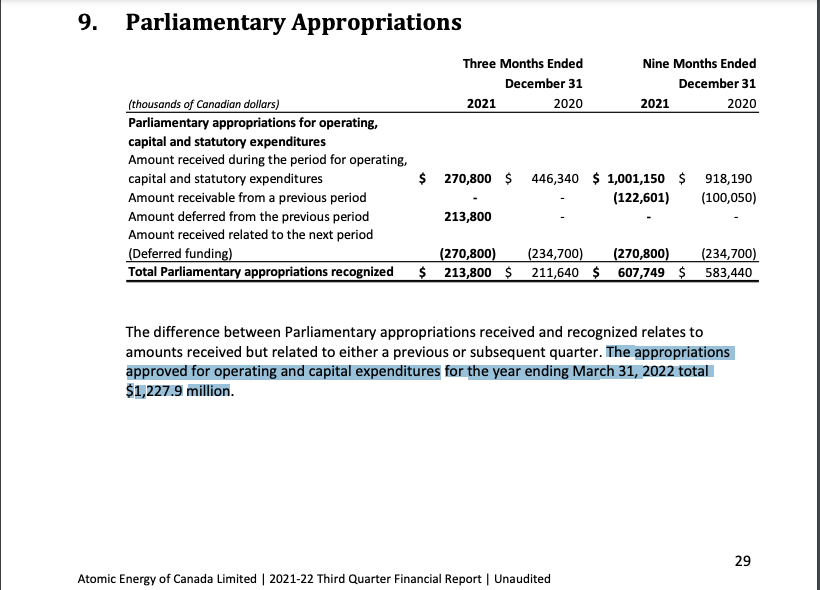
Update April 2022 ~ appropriations approved for year ending March 31, 2022 were $1.23 billion (see blue highlight below).
This table is from the Atomic Energy of Canada Limited 2021-22 Third Quarter Financial Report page 29
Nuclear Waste Liabilities
The figures for the nuclear waste liabilities are in the second last line in the table entitled Five-year financial summary, on page 36 of AECL’s annual report 2019-20 The report refers to the liabilities as “Decommissioning and waste management provision and contaminated sites liabilities”
In the farthest right column, the figure for 2106 is 7.87 billion which matches what the Auditor General reported in his special report in 2017 which said:
“One element of the Corporation’s mandate concerns decommissioning and waste management to deal with the results of decades of nuclear activities at the Corporation’s sites and with the cleanup of waste at orphan sites for which the federal government has assumed responsibility. The cost of this work is estimated at over $7.9 billion as of 31 March 2016.”
Report of the Auditor General of Canada to the Board of Directors of Atomic Energy of Canada Limited—Special Examination—2017 https://www.oag-bvg.gc.ca/internet/English/parl_oag_201711_07_e_42672.html
The figure on the farthest left is the amount of the liabilities for 2020. It is $8.06 billion or 8.1 billion, rounded to two figures.
The difference between the liabilities in 2016 at $7.9 billion and 2020 at $8.1 billion is a small increase of $200 million.
 Concerned Citizens of Renfrew County and Area