Three legal challenges to the NSDF

The giant Chalk River radioactive waste megadump, known as the NSDF, was approved by the Canadian Nuclear Safety Commission on January 8, 2024 after a protracted and badly flawed environmental assessment. For background on problems with the NSDF see this post. Two months after the CNSC approval of the license, a permit was issued by the Minister of Environment and Climate Change Canada to allow destruction of endangered species and their habitats and residences in construction of the NSDF.

Two legal challenges to the CNSC decision to license the NSDF were initiated in February 2024. A challenge to the species at risk permit was initiated in March 2024.

Legal Challenge 1 ~ Kebaowek FN vs Canadian Nuclear Laboratories

Kebaowek First Nation applied for a judicial review of the CNSC decision to license the NSDF on grounds that the Canadian Nuclear Safety Commission’s failed to secure Algonquin First Nations’ free, prior and informed consent for disposal of hazardous waste in their territory as mandated by the United Nations Declaration on the Rights of Indigenous Peoples Act.  The case was heard by Justice Julie Blackhawk in a two-day hearing July 10 and 11 in Ottawa. The lead lawyer for Kebaowek, Robert Janes KC, was brilliant in arguing the case. He has represented First Nations many times in the Supreme Court. Justice Blackhawk’s decision is pending and may take several more months. Donations to the GoFundMe campaign to help cover Kebaowek FN’s legal costs are greatly appreciated. The campaign page is here.

Legal Challenge 2 ~ Concerned Citizens et al vs Canadian Nuclear Laboratories

Concerned Citizens of Renfrew County and Area, Ralliement contre la pollution radioactive, and the Canadian Coalition for Nuclear Responsibility applied for a judicial review of the CNSC decision to license the NSDF. The three groups are challenging the decision on a number of grounds including excessive radiation doses, failure to adequately describe or control what would be put in the dump and failure to consider cumulative effects . (More details about the grounds and a link to the factum here.)

The case was heard in federal court by Justice Whyte Nowak in Ottawa on November 19 and 20, 2024. The judge is expected to render her decision sometime in the next several months.

Legal Challenge 3 ~ Kebaowek First Nation et al vs Canadian Nuclear Laboratories

This challenge is an application for review of the decision by the Minister of Environment and Climate Change Canada to issue a permit to destroy several species at risk and their habitats and residences during construction of the NSDF. Kebaowek First Nation is joined in this application by Concerned Citizens of Renfrew County and Area, the Canadian Coalition for Nuclear Responsibility and Sierra Club Canada Foundation. The applicants argue that the NSDF proponent did not examine all possible options, and did not choose the one least likely to affect species at risk, as required by the Species at Risk Act and therefore should not have been granted a permit. They present evidence that the proponent in fact chose an option that it knew to be richer in biodiversity and potentially more damaging to species at risk because it would reduce its costs for transporting waste.

The hearing is scheduled for February 5th and 6th, 2025. The factum was filed on September 27, and is appended to the end of this post.  Members of the public can attend the hearing in person, or register to watch it on Zoom. To register for the Zoom go to:https://www.fct-cf.gc.ca/en/court-files-and-decisions/hearing-lists and scroll down the page to the beige Advanced Search bar. Just below that bar on the right hand side is a search box. Type “Kebaowek” in the search box. Then click on the green pencil in the square box icon, to register to watch on Zoom.

See also: Permit to allow destruction of endangered species on site of giant Ottawa River radioactive waste dump challenged in Federal Court 27,Mar 2024

~~~~~~

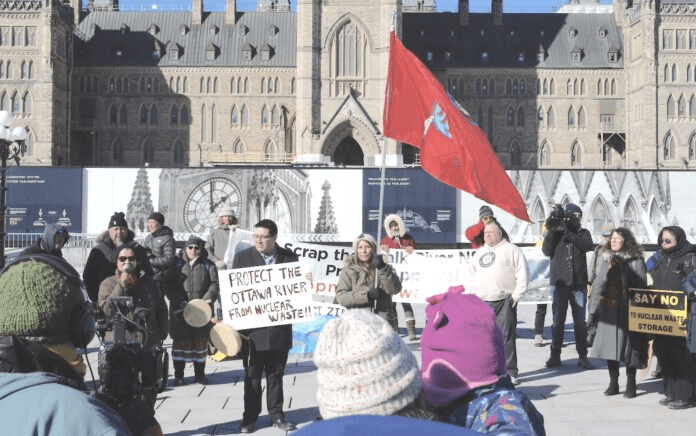
Photo below of Algonquin First Nations members and allies protesting the NSDF on Parliament HIll in February 2024. (photo, North Renfrew Times)
La Presse: Lettre ouverte ~ Le Québec doit prendre position contre le projet d’entreposage de déchets radioactifs à Chalk River

https://www.lapresse.ca/dialogue/opinions/2024-11-26/dechets-nucleaires-a-chalk-river/le-quebec-doit-prendre-position-contre-le-projet.php

PHOTO ALAIN ROBERGE, ARCHIVES LA PRESSELa ville de Chalk River, en Ontario

Dans cette lettre au ministre Benoit Charette, neuf chefs autochtones ainsi que neuf représentants d’organisations pressent Québec de s’opposer au projet d’entreposage de déchets radioactifs à Chalk River, en Ontario, près de la rivière des Outaouais, un affluent du Saint-Laurent.

Publié hier à 11 h 30

Chef Lance Haymond

CHEF LANCE HAYMOND Première Nation de Kebaowek*

Monsieur le Ministre Charette,

Il est temps d’agir. Le projet d’Installation de gestion de déchets près de la surface (IGDPS) à Chalk River, en Ontario, représente des risques environnementaux, sanitaires et culturels graves et immédiats pour les communautés situées à l’est de la rivière des Outaouais, notamment les Premières Nations et les Québécois. Pourtant, le gouvernement du Québec est resté silencieux face à cet enjeu crucial. En tant que chef de la Première Nation de Kebaowek, je vous exhorte à prendre une position ferme et publique sur cette question qui menace une source vitale d’eau potable pour des millions de personnes, tant québécoises que membres des Premières Nations.

PHOTO ALAIN ROBERGE, ARCHIVES LA PRESSE« Chaque jour sans action nous rapproche d’un dommage irréversible pour la rivière des Outaouais », écrit l’auteur.

La Nation Anishinabe, avec les municipalités, les organisations environnementales et les citoyens préoccupés, est à l’avant-garde de l’opposition à ce projet. Plus de 140 municipalités au Québec, ainsi que des partis politiques fédéraux, comme le Bloc québécois et le Parti vert, et provinciaux, comme Québec solidaire, ont publiquement manifesté leur opposition au projet d’IGDPS à Chalk River.

Le 9 septembre 2024, lors d’une conférence de presse avec le Bloc québécois, nous avons souligné la gravité de cette situation.

Le message collectif était clair : le Québec doit protéger ses citoyens et son environnement contre les dangers à long terme du monticule de déchets nucléaires près de la rivière des Outaouais.

Votre silence continu sur ce dossier est profondément préoccupant et de plus en plus intenable. À mesure que le projet avance, vous persistez à ignorer les préoccupations légitimes des communautés autochtones, des experts en environnement, des municipalités et des citoyens québécois. Chaque jour sans action nous rapproche d’un dommage irréversible pour la rivière des Outaouais, rivière sacrée pour le peuple anishinabe et cruciale pour la santé et le bien-être de millions de Québécois.

Pourquoi le leadership du Québec est essentiel

  • Protection environnementale : Le projet d’IGDPS à Chalk River représente un risque majeur pour la rivière des Outaouais, qui approvisionne en eau potable des millions de Québécois. La protection de cette ressource inestimable doit être une priorité pour tout gouvernement engagé envers la durabilité et la gestion responsable de l’environnement.
  • Sentiment public : L’opposition de plus de 140 municipalités témoigne de l’inquiétude généralisée des Québécois. En restant silencieux, le gouvernement ignore les voix de ses propres citoyens.
  • Droits des Autochtones : Le projet d’IGDPS à Chalk River a été lancé sans consultation adéquate avec les communautés autochtones, en violation des principes de réconciliation énoncés dans la Déclaration des Nations unies sur les droits des peuples autochtones (DNUDPA). Une position ferme du Québec permettrait de protéger l’environnement tout en respectant les droits des Autochtones.
  • Leadership politique : Un engagement public du Québec s’alignerait avec les objectifs climatiques de la province et démontrerait une gestion responsable des ressources naturelles. Le Québec a l’occasion de créer un précédent fort quant à la prise en compte des préoccupations environnementales et autochtones dans les projets futurs.

Monsieur le Ministre, les Québécois attendent que vous fassiez preuve de leadership, tout comme ma communauté attend de ses dirigeants qu’ils prennent une position ferme face à de telles menaces environnementales. La rivière des Outaouais ne peut plus attendre, les communautés et nos peuples qui en dépendent non plus.

Le moment d’agir, c’est maintenant.

*Cosignataires : chef Jean-Guy Whiteduck, Kitigan Zibi Anishinabeg ; chef Casey Ratt, Algonquins de Barriere Lake ; chef Regis Penosway, Conseil Anicinapek de Kitcisakik ; chef Lucien Wabanonik, Conseil de la Nation Anishnabe du Lac Simon ; cheffe Chantal Kistabish, Conseil de la Première Nation Abitibiwinni ; chef Henry Rodgers, Première Nation de Long Point ; cheffe Lisa Robinson, Première Nation de Wolf Lake ; cheffe Vicky Chief, Première Nation de Timiskaming ; Ole Hendrickson, Concerned Citizens of Renfrew County and Area ; Ginette Charbonneau, Ralliement contre la pollution radioactive ; Gordon Edwards, Regroupement pour la surveillance du nucléaire ; Jean-Pierre Finet, Regroupement des organismes environnementaux en énergie ; Rebecca Pétrin, Eau secours ; André Bélanger, Fondation Rivières ; Lucie Sauvé, Collectif scientifique sur les enjeux énergétiques au Québec ; Eric Notebaert, Association canadienne des médecins pour l’environnement ; Marie-Claude Beaulieu, Mères au front rivière des Mille Îles ; Geneviève Carrisse, Mères au Front Rivières de l’Outaouais

Judicial review hearing November 19/20, 2024 of the CNSC decision to license the NSDF

Update March 15, 2025

The application for a redetermination of the decision was rejected. Justice Whyte-Noak’s decision is here:

Update: December 3, 2024

The court challenge was heard in federal court on November 19-20, 2024. The lawyer for the applicant groups (Concerned Citizens of Renfrew County and Area, Ralliement contre la pollution radioactive, and Canadian Coalition for Nuclear Responsibility) argued that the Commission used the wrong limit for allowable public radiation exposures following closure of the NSDF, and did not meaningfully grapple with the project’s cumulative effects.  He also argued that Canadian Nuclear Laboratories – a private company owned by a consortium of two Texas-based companies and SNC-Lavalin that was contracted in 2015 by the federal crown corporation Atomic Energy of Canada Limited to deal with the waste — did not provide legally required information on waste origins, did not describe how it would characterize the waste, and has plans to dump waste packages and “oversized debris” that would exceed safe radiation limits. 

Another issue raised at the November 2024 court challenge was that the Commission failed to address impacts of the NSDF project on one particular species at risk, the Eastern Wolf.  Based on evidence that it is a separate species from the Grey Wolf, the Eastern Wolf was uplisted from “Special Concern” to “Threatened” status in August 2024 under the federal Species at Risk Act (SARA).  Only after Kebaowek First Nation insisted on going on site to conduct their own research did evidence emerge that Eastern Wolves are raising pups near the NSDF footprint and using the Perch Lake area.  The groups’ lawyer noted that no mitigation measures have been proposed to address harm to this species.

November 4. 2024

On February 8, 2024 Concerned Citizens of Renfrew County and Area, Ralliement contre la pollution radioactive and the Canadian Coalition for Nuclear Responsibility applied for a judicial review in Federal Court of the CNSD decision to license the Near Surface Diposal Facility at Chalk River.

A press release outlining the grounds for the application is available here. The factum is available here. https://judicialreviewlaw.ca/docs/T-226-24%20-%20Factum.pdf

The application will be heard by Justice Whyte Nowak on November 19th and 20th, 2024, beginning at 9:30 both days.

It is possible to register to view the hearing on Zoom. Here are the steps to follow to register:

  1. Go to this link: https://www.fct-cf.gc.ca/en/court-files-and-decisions/hearing-lists
  2. Scroll down the page until you get to the gold bar that says “Advanced Search”; on the right hand side, directly under that gold bar is a small search box
  3. Enter “Concerned Citizens” in the search box
  4. Click the green pencil and paper icon that is on the entry that comes up
  5. Enter your name and email address

There will also be limited seating to view the hearing in person. The location of the hearing will be determined closer to the date. It will either be the Federal Court building on Sparks St. or the Supreme Court building on Wellington.

The challenge of long-lived alpha emitters in the Chalk River legacy wastes

January 22, 2024 (revised September 17, 2024)

Why is so little Chalk River waste suitable for near surface disposal? 

Extensive research work at the Chalk River Laboratories on nuclear reactor fuels, and in the early days, on materials for nuclear weapons, produced waste with large quantities of long-lived alpha emitters.  This waste is difficult to manage and can even become increasingly radioactive over time.  

According to the International Atomic Energy Agency, because of the presence of long-lived alpha emitters, waste from nuclear research facilities is generally classified as intermediate level, and even in some cases, as high level. This waste cannot be put in a near surface disposal facility because its radioactivity will not decay to harmless levels during the period that the facility remains under institutional control.   

Alpha emitters decay by throwing off an alpha particle, the equivalent of a helium nucleus, with two protons and two neutrons.  The external penetrating power of an alpha particle is low, but alpha emitters have extremely serious health effects if ingested or inhaled. They can lodge in your lungs and cause cancer.

Research at Chalk River and all other nuclear laboratories is ultimately based on three long-lived alpha emitters — thorium-232, uranium-235, and uranium-238. These are the “naturally occurring” or “primordial” radionuclides.  They were created by large stars and then incorporated into the Earth and the solar system when they formed some 4.5 billion years ago.  The waste inventory proposed by Canadian Nuclear Laboratories for the Near Surface Disposal Facility (NSDF) includes over six tons each of thorium-232 and uranium-238.

Each “natural” alpha emitter initiates a decay chain with roughly a dozen radioactive isotopes of other elements such as radium, radon, and polonium.  These elements also occur naturally, but in much smaller amounts because of their more rapid decay. 

When a radioactive element releases an alpha particle, the atomic weight of the product goes down by four.  Uranium-238 decays to uranium-234, with a 245,000-year half-life. Uranium-234 decays to thorium-230, with a 75,000-year half-life. Thorium-230 decays to radium-226, with a 1,600-year half-life.  Shorter half-lives mean greater initial radioactivity. Radium-226 decays to radon-222, with a 4-day half-life.  Radon-222, a gas, builds up in the basements of houses built over uranium-rich rocks.  When it is inhaled it decays into polonium-218, a highly toxic, cancer-causing substance with a 3-day half-life. “Naturally occurring” alpha emitters are clearly harmful.

Hazards increase when uranium and thorium are mined and concentrated from ores and used in their pure form.  Marie Curie, who spent much of her career isolating radium and polonium from uranium, died of radiation-induced leukemia at age 66. She was buried in a lead-lined tomb because her corpse emitted so much radiation.

When thorium-232, uranium-235, and uranium-238 are irradiated in a reactor, as at Chalk River, they absorb neutrons and produce significant quantities of new, man-made, long-lived alpha-emitters.  Irradiated uranium-238 absorbs a neutron and temporarily forms uranium-239.  Uranium-239 transmutes to neptunium-239, which quickly transmutes to long-lived plutonium-239, with a half-life of 24,000 years. 

Plutonium-239 is “fissile” – it can readily support a chain reaction.  It is what the early Chalk River researchers produced for the manufacture of U.S. nuclear weapons, by separating the plutonium from irradiated reactor fuel.  They also used the separated plutonium to make “mixed oxide” (MOX) reactor fuel, mixing it with fresh uranium.

Thorium-232, when put in a nuclear reactor, will absorb a neutron and transmute to uranium-233, with a half-life of 160,000 years.  Uranium-233 also can support a chain reaction, so it can be used in atomic bombs and reactor fuels as well. Chalk River researchers did a lot of work to separate uranium-233 from irradiated thorium-232.

All reactor fuel contains uranium-235.  It is the only naturally occurring isotope that readily undergoes fission and can sustain a chain reaction.  But not all uranium-235 atoms undergo fission in a nuclear reactor.  Instead they can absorb either one or two neutrons and form yet two more very long-lived, man-made alpha-emitters, uranium-236 (half-life of 23.4 million years) and neptunium-237 (half-life of 2.14 million years). 

Nuclear engineers don’t like uranium-236 because it acts as a “neutron poison”, absorbing neutrons instead of undergoing fission.  The longer that uranium-235 fuel remains in a reactor, the more uranium-236 and neptunium-237 are produced. 

Uranium-236 is certainly a part of the Chalk River waste. It is the longest-lived of all the man-made alpha emitters, but for some reason it was omitted from the NSDF inventory.

As noted above, thorium-232, uranium-235, and uranium-238 are the start of three naturally occurring decay chains.  A fourth decay chain starts with man-made neptunium-237 and ends with thallium-205 (the element before lead in the periodic table).  Neptunium and its “progeny” have all decayed away during Earth’s 4.5-billion-year history, but production of neptunium-237 in nuclear reactors (and uranium-233 by thorium-232 irradiation) has “resurrected” this hitherto extinct fourth decay chain.  

Americium-241, found in significant quantities in Chalk River waste, is another starting point for the man-made nepturium-237 decay chain.  Nuclear reactors have also greatly augmented the amounts of radionuclides in the uranium-235 decay chain by producing plutonium-239, and in the thorium-232 decay chain by producing uranium-236.

Early research done at Chalk River to extract (or “reprocess”) plutonium-239 and uranium-233 from irradiated fuel and irradiated thorium targets has created a legacy of buildings (e.g., the Plutonium Recovery Laboratory) and soils (e.g., the Thorium Pit) that are contaminated with long-lived alpha emitters.  Reprocessing was dangerous and caused several accidents. The resulting contamination has never been cleaned up.

Until 2018, highly enriched uranium-235 targets were irradiated in the NRU reactor at Chalk River, followed by dissolving the targets in nitric acid and extracting the fission product molybdenum-99, a “medical isotope”. After extraction of “moly-99”, the other fission products, and the long-lived alpha emitters uranium-236 and neptunium-237 (produced when uranium-235 atoms absorb neutrons instead of undergoing fission), remain in the medical isotope waste.  This waste resembles high-level spent fuel waste and represents one of Chalk River’s most dangerous legacies.

Fuel reprocessing, medical isotope production, and other research activities at Chalk River have produced very significant amounts of waste containing ­­long-lived alpha emitters.  This waste is unsuitable for near-surface disposal.  Much of it is mixed with shorter-lived fission products and cannot be separated from them.  This mixed waste should not be put in the NSDF. 

Detecting alpha emitters in mixed waste is expensive and challenging. Putting inadequately characterized waste in the NSDF would invalidate its safety case.

Unfortunately, the NSDF Project lacks adequate waste characterization procedures.  If the project is allowed to proceed, workers and future Ottawa valley residents could be exposed to unknown quantities of long-lived alpha emitters and suffer the serious health effects associated with them.

~~~~~~~~~~

NSDF project description February 2016

Five months after signing its contract and assuming control of Canada’s federal nuclear sites, CNL issued a project description for the NSDF that indicated a preferred location for the NSDF. The reasons given for the site being more suitable did not include minimizing the effect on biodiversity. It’s also important to note that the third reason is incorrect as the chosen NSDF site is a virgin forested hillside extraordinarily rich in biodiversity.

Excerpt:

The EMR Site is currently considered to be more suitable for the NSDF. The advantages of the
EMR Site include:
 Environmental: Shorter travel distance for trucks delivering waste to the NSDF from the CRL
campus where the vast majority of new waste will be generated. By road, the EMR Site is
approximately 4 km closer to the campus than the Alternate Site. Similarly, the EMR Site is
2-3 km closer to interim waste stores that will be moved to the NSDF. As such fuel
consumption and exhaust emissions associated with transport vehicles will be significantly
less for the EMR Site.
 Safety and Security: Shorter travel distance and therefore shorter response times for CRL
emergency crews responding to calls for assistance (e.g. fire, security). Emergency vehicles
are situated at the edge of the main CRL campus.
 Stewardship: Minimizes use of virgin (undeveloped) property at CRL by establishing NSDF in
the same vicinity as most of the existing WMAs and reduces the area of the CRL site that
will require long-term management and institutional control.

NSDF site selection studies

Near Surface Disposal Facility Site Selection Report Revision 2 (October 2016)

Very Low Level Waste Site Selection Report Revision 1 (January 2016 )

Biodiversity review for the Near Surface Disposal Facility Revision 0 (2016 November 29)

Project Description for the NSDF (February 2016)

LNC mettra-t-elle des composants de réacteurs nucléaires dans l’IGDPS?

le 12 août, 2024

LNC mettra-t-elle des composants de réacteurs nucléaires dans l’IGDPS?

Le manque de clarté quant à la nature des déchets destinés à être éliminés dans l’IGDPS est un sujet de préoccupation depuis la publication de la description du projet IGDPS en mars 2016.  Dans les commentaires de notre groupe sur la description du projet, soumis en juin 2016, nous avons déclaré

Pour que le public dispose d’informations adéquates sur la nature des déchets radioactifs qu’il est proposé d’inclure dans l’IGDPS, l’évaluation environnementale doit fournir beaucoup plus de détails que le simple fait d’indiquer que les déchets “devront satisfaire aux critères d’acceptation des déchets.”

LNC a préparé un document, Critères d’acceptation des déchets (CAD), qui, selon LNC, “assurera la protection à court et à long terme du public, de l’environnement et des travailleurs”.  Mais est-ce vrai ?  Et les Critères d’acceptation des déchets  permettent-ils à CNL de placer des composants de réacteurs dans l’IGDPS?

La calandre provenant de l’accident du réacteur NRX en décembre 1952 et deux calandres du réacteur NRU sont enfouies à faible profondeur dans les zones de gestion des déchets des Laboratoires de Chalk River.  Ceci est indiqué dans le Plan général de déclassement et de nettoyage des Laboratoires de Chalk River

“Plusieurs enfouissements spéciaux (calandres des NRU et NRX) ont également été effectués dans des conteneurs en béton ou directement dans les tranchées.”

Les CAD permet l’élimination des déchets classés comme Type 6 – Déchets surdimensionnés:

“Débris surdimensionnés, notamment les déchets qui n’entrent pas dans la définition des déchets des types 1 à 5, principalement en raison de leur taille ou de leur forme. On a recours au processus applicable aux activités effectuées peu fréquemment (section 6.4) pour approuver la mise en place des déchets de type 6.”

Section 6.4, Activités effectuées peu fréquemment, fait office de clause dérogatoire. Il stipule que: 

“L’admissibilité des déchets qui ne répondent pas à toutes les exigences énoncées dans les CAD (y compris les déchets de type 6, Déchets surdimensionnés) peut être évaluée au cas par cas.”

Les calandres des réacteurs dépasseraient presque certainement les “Limites de débit de dose et moyens pour manipuler et transférer” du tableau 7 des CAD.  Toutefois, les critères d’acceptation des déchets autorisent le dépassement de ces limites de dose si les colis de déchets sont blindés:

“Les colis de déchets blindés pourraient être utilisés pour s’assurer que les déchets respectent la limite de débit de dose indiquée dans le tableau 7.”

CNL a fait une présentation au Conseil de gérance de l’environnement des Laboratoires de Chalk River sur ses travaux de mise au jour de la calandre NRX, actuellement enfouie à faible profondeur dans la zone de gestion des déchets A (ZGD A).  Les notes de la réunion du Conseil numéro 53 du jeudi 21 mars 2024 indiquent qu’un membre du Conseil a demandé une mise à jour de ces travaux :

Que se passe-t-il d’autre avec le NRX Calandra [sic] dans la zone A de déchets ? 

Le Septième Rapport national du Canada pour la Convention commune fournit plus de détails sur la zone de gestion des déchets A :

C’est en 1946 qu’a commencé l’entreposage des déchets radioactifs sur le site des LCR, dans une zone maintenant appelée ZGD A. Cet entreposage a pris la forme d’un stockage définitif direct de solides et de liquides dans des tranchées de sable. Il s’agissait d’opérations modestes qui n’ont pas été consignées avant 1952, année où l’assainissement de l’accident du NRX a généré de grandes quantités de déchets radioactifs (incluant la calandre du réacteur) qui devaient être gérées rapidement, en toute sûreté. À cette occasion, environ 4 500 m³ de déchets aqueux contenant 330 TBq (9 000 Ci) de produits de fission mixtes ont été déversés dans les tranchées. Des dispersions plus modestes ont suivi (6,3 TBq et 34 TBq de produits de fission mixtes) en 1954 et 1955, respectivement. Aujourd’hui, la ZGD A n’accepte plus de déchets.

Le plan préliminaire global de déclassement de 2014 fait état de registres limités pour les liquides en fûts et en bouteilles enfouis avant 1956 et pour les déchets solides enfouis avant 1955.

Le Plan général de déclassement et de nettoyage des Laboratoires de Chalk River de 2023 indique l’intention de LNC de transférer tout le contenu de la ZGD A dans l’IGDPS : “le scénario préliminaire présenté est l’enlèvement des déchets de la ZGD A et leur élimination dans l’IGDPS.”   

Le manque de transparence de LNC concernant les déchets destinés au l’IGDPS, malgré les exigences du Règlement général sur la sûreté et la réglementation nucléaires (RGSRN), est l’un des principaux points de l’une des contestations juridiques de la décision de la CCSN d’autoriser la construction de l’installation.

L’exposé des faits et du droit dans l’affaire de la cour fédérale (dossier de la cour n° T-226-24) entre Concerned Citizens of Renfrew County and Area, le Regroupement pour la surveillance du nucléaire et le Ralliement contre la pollution radioactive (requérants) et les Laboratoires nucléaires canadiens (défendeurs) dit ceci : 

Le fait que la Commission n’ait pas exigé les informations spécifiques et complètes prévues par l’article 3(1)(c) et (j) du RGSRN a un impact énorme sur l’intégrité de la décision dans son ensemble. Ce manquement compromet la principale conclusion de la décision, à savoir que l’IGDPS n’aura pas d’effets négatifs importants sur l’environnement et la santé. Tous les calculs de LNC estimant la quantité de matières radioactives que l’IGDPS rejetterait dans l’environnement et à laquelle un membre du public serait exposé étaient basés sur le respect des critères d’acceptation des déchets.  Étant donné que des matériaux peuvent être placés dans l’IGDPS même s’ils ne répondent pas aux critères d’acceptation des déchets, tous les calculs et toutes les estimations sont fictifs. Il n’y a aucune garantie que la quantité et le type de substances qui aboutissent dans l’IGDPS seront les mêmes que ceux qui ont servi de base aux calculs des évaluations de sécurité.

~~~~~~~~~

Photos from Globe and Mail article (19 March 2023) “Jimmy Carter, Chalk River and the dawn of Canada’s nuclear age”

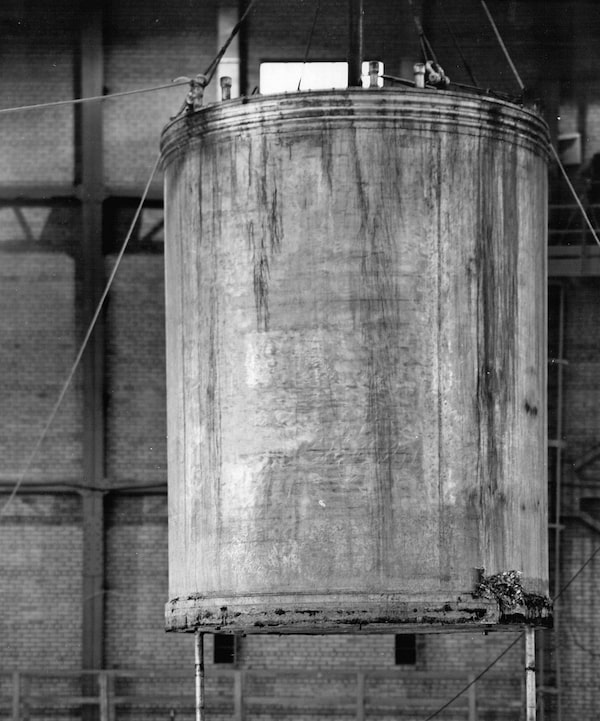
Chalk River NRX-Reactor leak, 1953 -- calandria removed from reactor being lowered into calandria bag. Photograph shows south-east sid
The NRX calandria is lowered into a protective bag and driven away to a disposal site in May 1953.CANADIAN NUCLEAR LABORATORIES

Now, 70 years after the cleanup, the largest artefact from the accident is about to see the light of day once again.

The burial mound of the NRX calandria, as seen earlier this month. Later this spring, a project team will resume work on excavating and then cutting up the calandria for longer term storage.CANADIAN NUCLEAR LABORATORIES/SUPPLIED

Will CNL put nuclear reactor components in the NSDF?

August 12, 2024 (en français ici)

Will CNL put nuclear reactor components in the NSDF?

The lack of clarity about the nature of the waste intended for disposal in the NSDF has been a concern since the NSDF project description was published in March 2016.  In our group’s comments on the project description, submitted in June 2016, we stated

For the public to have adequate information about the nature of the radioactive waste proposed for inclusion in the NSDF, the environmental assessment must provide much more detail than simply stating that the waste “will be required to meet waste acceptance criteria.”

CNL has prepared a document, NSDF Waste Acceptance Criteria (WAC) that CNL says “will ensure the short- and long-term protection of the public, the environment and workers.”  But is this true?  And do the NSDF Waste Acceptance Criteria allow CNL to place reactor components in the NSDF?

The calandria from the NRX reactor accident in December 1952 and two calandria from the NRU reactor are buried at shallow depths in the waste management areas of Chalk River Laboratories.  This is stated in the Overview Decommissioning and Cleanup Plan for Chalk River Laboratories: 

“Several special burials (NRU and NRX calandrias) were also made in concrete containers or directly in the trenches.”

The Waste Acceptance Criteria allow the disposal of waste classified as Type 6 – Oversized waste:

“Oversized debris, including waste that does not fall within the definition of waste types 1 to 5, primarily due to its size or shape. The process applicable to infrequently performed activities (section 6.4) is used to approve the placement of type 6 waste.”

The Infrequently Performed Operations override clause in section 6.4 states: 

“The eligibility of wastes that do not meet all the requirements set forth in the WAC (including Type 6, Oversized Waste) may be evaluated on a case-by-case basis.”

Reactor calandrias would almost certainly exceed the “Dose Rate Limits and Means of Handling and Transferring ” in Table 7 of the WAC.  However, the Waste Acceptance Criteria allow these dose limits to be exceeded if waste packages are shielded: 

“Shielded Waste Packages could be used to ensure waste complies with the dose rate limit in Table 7.”

CNL has made a presentation to the Chalk River Laboratories Environmental Stewardship Council about its work to uncover the NRX calandria, currently buried at shallow depth in Waste Management Area A.  The notes from Council meeting number 53 on Thursday, March 21, 2024, state that a council member asked for an update on this work:

Has anything else been happening with the NRX Calandra [sic] with the Calandra [sic] in Waste Area A?

The Seventh Canadian National Report for the Joint Convention provides more details about Waste Management Area A:

The first emplacement of radioactive waste at the CRL site took place in 1946 into what is now referred to as Waste Management Area A. These emplacements took the form of direct disposal of solids and liquids into excavated sand trenches. The scale of operations was modest and unrecorded until 1952, when the cleanup from the NRX accident generated large quantities of radioactive waste (which included the reactor’s calandria) that had to be managed quickly and safely. At that time, approximately 4,500 m3 of aqueous waste, containing 330 TBq (9,000 Ci) of mixed fission products, was poured into excavated trenches. This action was followed by smaller dispersals (6.3 TBq and 34 TBq of mixed fission products) in 1954 and 1955, respectively. Waste is no longer accepted for emplacement in Waste Management Area A.

The 2014 Comprehensive Preliminary Decommissioning Plan notes the limited records for drummed and bottled liquids buried prior to 1956 and for solid wastes buried prior to 1955. 

The 2023 Overview Decommissioning and Cleanup Plan for Chalk River Laboratories indicates CNL’s intention to transfer all the contents of WMA A to the NSDF: “the preliminary scenario presented is the removal of wastes from WMA A and its disposal in the NSDF.”

CNL’s lack of transparency regarding the waste destined for the NSDF, despite the requirements of the General Nuclear Safety and Control Regulations (GNSCR), is one of the main points of one of the legal challenges to the CNSC’s decision to authorize construction of the facility.  

The Memorandum of Fact and Law for the federal court case (Court File No. T-226-24) between Concerned Citizens of Renfrew County and Area, the Canadian Coalition for Nuclear Responsibility and le Ralliement contre la pollution radioactive (Applicants) and Canadian Nuclear Laboratories (Respondent) says the following:

The Commission’s failure to require the specific and comprehensive information set out in GNSCR s. 3(1)(c) and (j) has an enormous impact on the integrity of the Decision as a whole. This failure undermines the Decision’s main conclusion that the NSDF will not produce significant adverse environmental and health effects. All CNL’s calculations estimating the amount of radioactive material that the NSDF would release into the environment and would expose a member of the public to were based on the Waste Acceptance Criteria being followed. Since materials can be placed in the NSDF even if they do not meet the Waste Acceptance Criteria, all the calculations and estimations are a fiction. There is no guarantee that the amount and type of substances that end up in the NSDF will be the same amount and type as that upon which the calculations for the safety assessments were made.

~~~~~~~~

Photos from Globe and Mail article (19 March 2023) “Jimmy Carter, Chalk River and the dawn of Canada’s nuclear age”

Chalk River NRX-Reactor leak, 1953 -- calandria removed from reactor being lowered into calandria bag. Photograph shows south-east sid
The NRX calandria is lowered into a protective bag and driven away to a disposal site in May 1953.CANADIAN NUCLEAR LABORATORIES

Now, 70 years after the cleanup, the largest artefact from the accident is about to see the light of day once again.

The burial mound of the NRX calandria, as seen earlier this month. Later this spring, a project team will resume work on excavating and then cutting up the calandria for longer term storage.CANADIAN NUCLEAR LABORATORIES/SUPPLIED

Lettre du Hill Times : Crise de la mauvaise gestion des déchets radioactifs dans le bassin versant de la rivière des Outaouais, Chef Lance Haymond et Dr. Gordon Edwards

le 20 mai, 2024

https://www.hilltimes.com/story/2024/05/20/crisis-of-radioactive-waste-management-in-the-ottawa-river-watershed-advocates/421802/

Nous écrivons pour alerter les lecteurs du Hill Times sur ce que nous considérons comme une crise de mauvaise gestion des déchets radioactifs dans le bassin versant de la rivière des Outaouais. Les éléments de cette crise sont les suivants:

·         Une gigantesque décharge en surface d’un million de tonnes de déchets radioactifs aux Laboratoires de Chalk River, à moins d’un kilomètre de la rivière des Outaouais. Selon l’inventaire autorisé pour l’installation, plus de la moitié des radionucléides ont une longue durée de vie, leurs demi-vies dépassant de plusieurs milliers d’années la durée de vie nominale de l’installation.  Les experts affirment que les déchets sont de “niveau intermédiaire” et qu’ils devraient être stockés sous terre. L’installation devrait laisser échapper des contaminants radioactifs pendant son fonctionnement et se décomposer en raison de l’érosion après quelques centaines d’années.

·         Une proposition visant à enterrer « in situ » un réacteur nucléaire défunt à moins de 400 mètres de la rivière des Outaouais, à Rolphton, en Ontario. La proposition bafoue les normes de sécurité internationales qui stipulent que l’enfouissement ne devrait être utilisé qu’en cas d’urgence.

·         Un consortium multinational du secteur privé transporte tous les déchets radioactifs fédéraux, y compris les déchets de combustible irradié de haute activité, vers Chalk River. Ces importations ont lieu malgré la demande explicite de la ville d’Ottawa, en 2021, de cesser les importations de déchets radioactifs dans la vallée de l’Outaouais, qui est sismiquement active et constitue un mauvais emplacement pour le stockage à long terme des déchets radioactifs.

·         Tout ce qui précède se produit malgré l’opposition du peuple algonquin, sur le territoire non cédé duquel se trouvent les laboratoires de Chalk River et le défunt réacteur de Rolphton. Cela contrevient à la Loi sur la Déclaration des Nations Unies sur les droits des peuples autochtones du Canada.

À notre avis, cette crise est le résultat direct du régime inadéquat de gouvernance nucléaire du Canada, dans lequel presque tous les aspects de la gouvernance nucléaire sont confiés à une seule agence, la Commission canadienne de sûreté nucléaire, qui est largement perçue comme étant capturée par l’industrie nucléaire et comme favorisant les projets qu’elle est censée réglementer. Parmi les autres problèmes, on peut citer les conflits d’intérêts, le manque de freins et contrepoids et une politique inadéquate en matière de déchets nucléaires.

Malgré les résolutions répétées de l’Assemblée des Premières Nations et de plus de 140 municipalités situées en aval, dont Ottawa, Gatineau et Montréal, le gouvernement actuel ne semble pas vouloir ou pouvoir prendre des mesures significatives pour résoudre cette crise. Nous faisons donc appel à l’Agence internationale de l’énergie atomique et demandons une réunion avec son équipe d’examen par les pairs qui doit se rendre au Canada le mois prochain.

Chef Lance Haymond, Première Nation Kebaowek

Gordon Edwards, Ph.D., Regroupement pour la surveillance du nucléaire