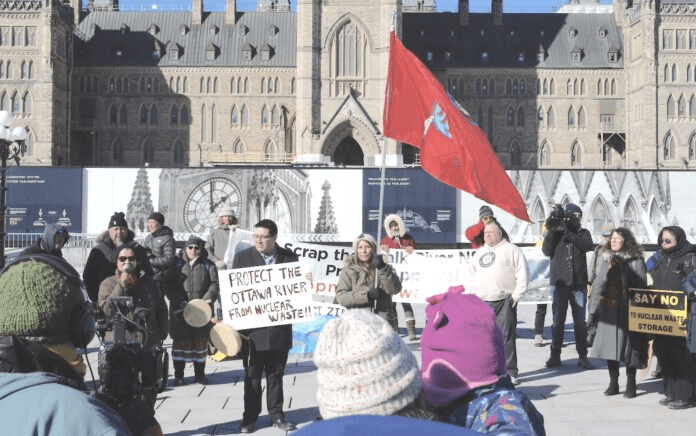
A hearing this Wednesday November 12 in the Federal Court of Appeal, before a panel of three judges, will be a test of Canada’s commitment to protect threatened and endangered species and may determine whether the giant Ottawa River nuclear waste dump can be built or not.You can watch the hearing on Zoom by registering at this link, and you are also invited to a rally, “Stand up for Wildlife,” from noon to 2 pm outside the courtroom on Sparks St. in Ottawa.
Background:
Earlier this year we celebrated the successful legal challenge to the granting of a Species-at-Risk permit to Canadian Nuclear Laboratories (CNL) for the construction of the nuclear waste dump known as the “NSDF.” The legal challenge was brought by Kebaowek First Nation, Concerned Citizens of Renfrew County and Area, the Canadian Coalition for Nuclear Responsibility, and Sierra Club Canada Foundation.
You may recall that CNL is owned by a multinational private-sector consortium that operates Canada’s federal nuclear labs under a $1.6 billion per year contract with the Government of Canada. CNL needed a Species-at-risk permit in order to construct its controversial, giant, above-ground nuclear waste dump beside the Ottawa River because the site they chose for the dump is on federal land smack dab in the middle of irreplaceable wildlife habitat that is home to many species at risk. A permit would allow CNL to destroy habitat and residences for threatened and endangered species in order to construct its giant dump.
In order to get a permit, a proponent must prove that it carefully considered all possible alternatives and chose the one with the least impact on endangered species. CNL did not do this. In fact, it is on record as saying it chose the location because it would reduce transportation costs. In his ruling issued on March 14, 2025, Justice Russel Zinn said the environment minister’s issuing of the species-at-risk permit was “unreasonable due to fatal flaws” in interpreting and applying the federal Species at Risk Act, adding that the issuing of the permit must be reconsidered.
Unfortunately for threatened wildlife and for Canadian taxpayers, who foot the bill for everything the multinational consortium does under its contract with the government, the case was appealed by CNL. Hence, the evidence will be reviewed again on November 12, this time in the federal court of appeal, by a panel of three judges.
The legal case here is fairly cut and dried; it will be interesting to see how it plays out. But behind the straightforward legal arguments lies a shocking story of disregard for wildlife that we discovered when we applied for the initial judicial review and received 4,000 pages of material connected with the permit application. Among other things, we learned that CNL knew that the site was very rich in biodiversity, but chose it anyway. The site is located on a south facing densely forested hillside that rises 140 feet above five named wetlands at its base, critical habitat for endangered Blanding’s turtles. The forest stands have old growth characteristics and provide prime habitat for endangered bats and songbirds such as the Canada Warbler, Golden-winged Warbler and Eastern Whip-poor-will. To create a flat surface for the NSDF, clear cutting and extensive blasting would convert 28 hectares of forested hillside into 170,000 cubic metres of rock, with unknown but likely adverse effects on the surrounding wetlands. More than 10,000 mature trees would be cut down, including provincially-endangered Black Ash trees. Kebaowek First Nation found three active bear dens on the site, and evidence of extensive use of the site by threatened Eastern Wolves. Both bears and wolves are species of great cultural importance to Algonquin peoples.
Seethis post on the Concerned Citizens website, for more detail on CNL’s disregard for wildlife in its choice of a site for the NSDF.
The beautiful artwork below is by Destiny Cote of Kitigan Zibi Anishinabeg. Eastern Wolves are one of the threatened species that would be adversely affected by the NSDF.
In March 2024, Canadian Nuclear Laboratories (CNL) was granted a Species at Risk permit by Environment and Climate Change Canada. The permit would allow CNL to harm, harass and kill destroy endangered species and destroy their residences during construction of the “NSDF,” a giant radioactive waste dump alongside the Ottawa River, upstream of Ottawa and Montreal.
Kebaowek First Nation, Concerned Citizens of Renfrew County and Area, the Canadian Coalition for Nuclear Responsibility and Sierra Club Canada Foundation applied for a judicial review of the decision to award the permit. During the judicial review, we reviewed evidence produced during the environmental assessment and 4,000 pages provided to us as applicants for judicial review. We concluded that there is considerable evidence that CNL did not meet the requirements of the Species at Risk Act and should not have been given a permit.
In his ruling issued on March 14, 2025, Justice Russel Zinn said the environment minister’s issuing of the species-at-risk permit was “unreasonable due to fatal flaws” in interpreting and applying the federal Species at Risk Act, adding that the issuing of the permit must be reconsidered.
The ruling by Justice Zinn was appealed by Canadian Nuclear Laboratories. A hearing in the Federal Court of Appeal took place on November 12, 2025.
We feel strongly that the mature ecosystem and rich biodiversity present on the NSDF site are highly valuable and irreplaceable. Much as we may wish to be able to do so, humans cannot recreate a rich, biodiverse mature forest on the side of a southwest-facing slope surrounded by wetlands. Only Nature can create such an ecosystem that supports hundreds to thousands of species in a thriving matrix of interrelated life.
Background and context:
The federally owned Chalk River Laboratories site is heavily contaminated with radioactive and other hazardous waste accumulated over eight decades of operation including three decades of plutonium production for US nuclear weapons. The contamination was described by Ottawa Citizen journalist Ian McLeod in 2011: Chalk River’s toxic legacy. The legacy wastes at Chalk River are “poorly documented and misunderstood” according to NRCan (Ottawa Citizen) and are likely to require underground disposal according to the International Atomic Energy Agency. The cost to clean up the site has been estimated at $16 billion, more than the combined total cost of cleaning up all other federal environmental liabilities across Canada.
The federal government initiated the Nuclear Legacy Liabilities Program (NLLP) in 2006, a long-term strategy to clean up Chalk River Laboratories and other federal nuclear sites in Ontario, Quebec and Manitoba. As part of the program, a Comprehensive Preliminary Decommissioning Plan was produced. The cleanup was to take place over eighty-five years. One of the first steps was a “Very LowLevel” (VLLW) waste facility to dispose of 160,000 cubic meters of waste. A “Low Level” waste facility was not planned until later because waste characterization was in progress and would take considerable time. It is important to note that the “Low Level” radioactive waste at Chalk River is much more dangerous than the “Very Low Level” waste and will remain hazardous and radioactive for many thousands of years.
However, the federal government’s long-term NLLP strategy was abandoned prematurely in September 2015 when Atomic Energy of Canada Ltd. was re-structured and privatized. The contract to manage the nuclear laboratories was awarded to a multinational consortium, the “Canadian National Energy Alliance”, of which SNC-Lavalin was a key player. The contract between the Government of Canada and the new contractor-operated entity, Canadian Nuclear Laboratories (CNL), required CNL to seek the “fastest, most cost-effective ways” of disposing of all waste and required that a “Low Level” Waste facility be built within six years of commencement of the contract (by September 2021).
Only a few months later, in February 2016, CNL issued a project description for the NSDF (Near Surface Disposal Facility), a giant above-ground mound for one million tons/cubic metres of radioactive and hazardous waste that experts say clearly contravenes international safety standards. The proposed NSDF would be six times larger than the proposed VLLW facility and would use the same basic design, similar to a municipal landfill. Studies show the mound would leak during operation and break down due to erosion after a few hundred years, releasing its contents to the environment, even though much of the inventory will remain radioactive for many millennia.
The NSDF project was supposed to be completed in September 2021 but met with strong opposition from Indigenous communities, more than 140 downstream municipalities, civil society groups and many individual Canadians. It became caught up for almost eight years in protracted closed-door negotiations between the consortium and the regulator, the Canadian Nuclear Safety Commission (CNSC), as a deeply-flawed environmental assessment was carried out. The project was approved in January 2024 by the CNSC, a body widely viewed to be a captured regulator that promotes the projects it is supposed to regulate.
Inadequate siting process for the NSDF
A proper siting process for “all” the legacy federal radioactive waste would have taken several years and would have seriously considered federal lands farther away from the Ottawa River, such as the extensive sand barrens at Garrison Petawawa adjacent to Chalk River Laboratories. That was not to be the case. Within five months of assuming responsibility for federal nuclear wastes, CNL was defending a site for its NSDF on CRL property, less than one kilometer from the Ottawa River. CNL’s February 2016 project description described two prospective sites but declared that one, the “EMR site”, was preferred. Reasons for the preference did not mention biodiversity or species at risk. Instead they emphasized proximity to the wastes slated for disposal in the facility.
A site selection report for the NSDF was released in February 2016 at about the same time as the hastily prepared project description. It relied heavily on the previous study to find a site for the Very Low Level Waste Facility. The report ruled out locations off the CRL site on economic (not biodiversity) grounds. The study also relaxed the exclusion criteria to allow steep slopes, rock outcrops and proximity to critical habitat for endangered species. This enabled CNL to insert its new “preferred” site (the East Mattawa Road or “EMR site”) into the process even though it consisted of a densely forested hillside rising 140 feet above five named wetlands at its base. To create a flat surface area for the facility, clear cutting and extensive blasting would convert 28 hectares of mature forest into 170,000 cubic metres of rock, with unknown but likely adverse effects on the surrounding wetlands that drain into the nearby Ottawa River.
Later in 2016, CNL issued a report entitled “Biodiversity review for the NSDF project” (attached). This study was not provided to ECCC during the SARA permit application process. The report concluded that the preferred “EMR site” would have the least impact on biodiversity even though data presented in the report showed the opposite – greater biodiversity at the chosen EMR site than at the Alternate site. For example, 11 species at risk were documented at the EMR site versus 8 at the Alternate site. One hundred and twelve species of animals and plants were present at the EMR site versus 46 species at the Alternate site. The study failed to document the presence of species such as Black Bears and Eastern Wolves in the EMR/NSDF local study area. This flawed study was used to support selection of the EMR site for the NSDF, a clearly unsupportable choice if lesser impact on biodiversity was truly the objective.
Exceptionally rich biodiversity at the NSDF site
The Chalk River Laboratories site is uniquely rich in biodiversity. As a restricted area for 80 years, there has been very little human access to most of the 3,700-hectare site. Some forests, such as those at the EMR site, have acquired old growth characteristics from lack of disturbance. The site is dotted with lakes and wetlands that, combined with proximity to the Ottawa River, provide habitats and feeding grounds for many species at risk and large mammals. According to the Biodiversity review for the NSDF project, fifty species at risk have the potential to be present on the CRL site and 26 have been confirmed to be present. According to the Environmental Impact Statement for the NSDF, 123 migratory bird species are present or likely to be present on the CRL property.
The NSDF/EMR site is even richer in biodiversity than the CRL site as a whole. As depicted on the map below of the CRL site, the NSDF/EMR site and vicinity include key components that combine to support exceptionally rich biodiversity: a densely forested south-west facing slope, surrounded at the base by wetlands. Riparian zones abound in this area, including as it does five named wetlands in addition to Perch Creek, Perch Lake and the Ottawa River shoreline less than one kilometer away. It is not surprising that the Biodiversity Review noted 112 plant and animal species present here compared to only 46 at the Alternate site.
Compared to all other forest stands within the Chalk River Laboratories property, the NSDF site’s forested hillside, proposed for blasting and leveling, has relatively old stands of mature trees, which provide important habitat for species at risk (Appendix 5.6-4 in the final EIS). The forest stands in the NSDF/EMR site have by far the greatest number of bat roost trees of any forest stands on the entire Chalk River Laboratories property. The EIS reports 6,485 bat roost trees in the NSDF/EMR site, compared to approximately 1,567 in the Alternate site. This is shown graphically in the appended bat habitat suitability maps that show the great concentration of suitable bat nesting habitat in the local study area for the NSDF site, which is closer to ideal foraging habitat above Perch Lake and surrounding wetlands. The bat habitat suitability maps were were produced by Trent University and provided to ECCC by Annie Morin of CNL in a memo dated October 24, 2023.
The EMR site’s southwest-facing hillside with sandy soil provides preferred conditions for bear dens, of which three active ones have been observed recently. Bears are very important to the Algonquin Anishinaabe people on whose unceded territory the CRL property is located. It is surprising therefore that Black Bears were not considered as a valued component, or even listed as a mammal species observed in the local study area for the NSDF. It was Indigenous-led research by Kebaowek First Nation that documented the three active bear dens in winter 2023. KFN also documented the presence of Eastern Wolves, another species of great cultural and spiritual importance to Algonquin Anishinaabe people, in the NSDF local study area.
The southwest-facing slope of old growth forest stands – in close proximity to abundant insect breeding grounds in adjacent wetlands – also provides preferred nesting conditions for many migratory songbirds. According to Appendix 5.6-3 of the Environmental Impact Statement, 111 migratory bird species are likely or confirmed in the local study area for the NSDF site, a high density of species in a relatively small area.
The Biodiversity Review noted that Perch Lake contains 17 fish species, all of which were under consideration as valued components but ruled out on the basis that the lake water would be unaffected by the project. However, a pipeline to Perch Lake from the NSDF, added to the plan in 2020, is expected to discharge very high levels of radioactive tritium and smaller quantities of many other radioactive and hazardous substances directly into Perch Lake. CNL would allow the concentration of tritium in Perch Lake to rise as high as 360,000 Bq/l, fifty times higher than the very permissive Canadian drinking water standard for tritium. This would have adverse effects on the 17 fish species mentioned above and many other aquatic species. Tritium is readily incorporated into genetic material and causes genetic damage, cancer and birth defects. It readily bioaccumulates in the food chain and has the potential to affect all animals feeding in the Perch Lake basin. It is our understanding that the Department of Fisheries and Oceans should review this plan, but we have not seen any evidence that they have yet done so.
It cannot be said that CNL chose the location and site expected to have the least impact on species at risk
CNL chose the EMR site for the NDSF even though it contains more habitat for species at risk and is richer in biodiversity than the Alternate site. It cannot be reasonably said that CNL chose the location and site expected to have the least impact on species at risk or chose the best solution to reduce the impact on species at risk. Given that the entire CRL property is rich in biodiversity, failing to seriously consider off-site alternatives is another way in which CNL did not choose the site and location expected to have the least impact on species at risk.
CNL’s actions with respect to the Eastern Wolf suggest that biodiversity conservation was considered an impediment rather than a goal
According to the Canada Gazette (page 25), CNL raised concerns about uplisting of the Eastern Wolf in 2017 stating they could incur costs of up to $160 million from uplifting. CNL did not mention Eastern Wolves in its application for a SARA permit in 2017 despite the fact that, according to a letter from George Dolinar of CNL to ECCC in March 2024, Eastern Wolf pups had been observed within the CRL boundary in 2012. The Eastern Wolf was also not mentioned in George Dolinar’s letter to ECCC in April 2020 providing additional information in support of the SARA permit application. These actions suggest that CNL considered protection of Eastern Wolves to be something to be avoided. In George Dolinar’s letter of March 2024, “Protecting the Eastern Wolf in Preparation to the Near Surface Disposal Facility Construction,” Mr Dolinar does not mention Indigenous-led research by Kebaowek First Nation in 2023 that documented the presence of Eastern wolves and pups on the CRL site with extensive use of trail cameras and “ground truthing.” The failure to mention the role of Kebaowek First Nation and its findings is deeply concerning. Kebaowek First Nation presented detailed results of its research to the Canadian Nuclear Safety Commission in a submission dated May 1, 2023.
The giant Chalk River radioactive waste megadump, known as the NSDF, was approved by the Canadian Nuclear Safety Commission on January 8, 2024 after a protracted and badly flawed environmental assessment. For background on problems with the NSDF see this post. Two months after the CNSC approval of the license, a permit was issued by the Minister of Environment and Climate Change Canada to allow destruction of endangered species and their habitats and residences in construction of the NSDF.
Two legal challenges to the CNSC decision to license the NSDF were initiated in February 2024. A challenge to the species at risk permit was initiated in March 2024.
Legal Challenge 1 ~ Kebaowek FN vs Canadian Nuclear Laboratories
Kebaowek First Nation applied for a judicial review of the CNSC decision to license the NSDF on grounds that the Canadian Nuclear Safety Commission’s failed to secure Algonquin First Nations’ free, prior and informed consent for disposal of hazardous waste in their territory as mandated by the United Nations Declaration on the Rights of Indigenous Peoples Act. The case was heard by Justice Julie Blackhawk in a two-day hearing July 10 and 11 in Ottawa. The lead lawyer for Kebaowek, Robert Janes KC, was brilliant in arguing the case. He has represented First Nations many times in the Supreme Court. Justice Blackhawk’s decision is pending and may take several more months. Donations to the GoFundMe campaign to help cover Kebaowek FN’s legal costs are greatly appreciated. The campaign page is here.
Legal Challenge 2 ~ Concerned Citizens et al vs Canadian Nuclear Laboratories
Concerned Citizens of Renfrew County and Area, Ralliement contre la pollution radioactive, and the Canadian Coalition for Nuclear Responsibility applied for a judicial review of the CNSC decision to license the NSDF. The three groups are challenging the decision on a number of grounds including excessive radiation doses, failure to adequately describe or control what would be put in the dump and failure to consider cumulative effects . (More details about the grounds and a link to the factum here.)
The case was heard in federal court by Justice Whyte Nowak in Ottawa on November 19 and 20, 2024. The judge is expected to render her decision sometime in the next several months.
Legal Challenge 3 ~ Kebaowek First Nation et al vs Canadian Nuclear Laboratories
This challenge is an application for review of the decision by the Minister of Environment and Climate Change Canada to issue a permit to destroy several species at risk and their habitats and residences during construction of the NSDF. Kebaowek First Nation is joined in this application by Concerned Citizens of Renfrew County and Area, the Canadian Coalition for Nuclear Responsibility and Sierra Club Canada Foundation. The applicants argue that the NSDF proponent did not examine all possible options, and did not choose the one least likely to affect species at risk, as required by the Species at Risk Act and therefore should not have been granted a permit. They present evidence that the proponent in fact chose an option that it knew to be richer in biodiversity and potentially more damaging to species at risk because it would reduce its costs for transporting waste.
The hearing is scheduled for February 5th and 6th, 2025. The factum was filed on September 27, and is appended to the end of this post. Members of the public can attend the hearing in person, or register to watch it on Zoom. To register for the Zoom go to:https://www.fct-cf.gc.ca/en/court-files-and-decisions/hearing-lists and scroll down the page to the beige Advanced Search bar. Just below that bar on the right hand side is a search box. Type “Kebaowek” in the search box. Then click on the green pencil in the square box icon, to register to watch on Zoom.


 Concerned Citizens of Renfrew County and Area