


A multinational consortium wants to build two nuclear waste dumps alongside the Ottawa River upstream of Ottawa-Gatineau, one at Chalk River, Ontario and the other at Rolphton, Ontario. Both dumps disregard international safety guidelines and would leak radioactive materials into the Ottawa River, endangering drinking water for millions of Canadians living downstream.
Background:
In 1944 Chalk River Laboratories (CRL) were established to produce plutonium for nuclear weapons. Starting in 1952 the Labs were operated by “Atomic Energy of Canada Limited” (AECL). Besides producing plutonium, the labs established a prototype nuclear power reactor (NPD) upstream of Chalk River at Rolphton, and extracted “medical isotopes” from irradiated fuel. These activities and two serious accidents created large quantities of dangerous radioactive wastes. Cleanup costs are estimated at $8 billion.
The Harper government radically restructured AECL in 2015, creating a subsidiary called Canadian Nuclear Laboratories (CNL) and contracting a multinational consortium including SNC Lavalin, to operate the subsidiary and reduce the federal government’s nuclear cleanup liabilities quickly and cheaply. All four consortium members face or have faced criminal charges for fraud and corruption*. Annual costs to taxpayers tripled shortly after restructuring.
In 2016, CNL proposed to construct a giant, above-ground mound of radioactive waste (NSDF) at Chalk River and to entomb in concrete the NPD reactor at Rolphton. Both proposals disregard International Atomic Energy Agency safety standards and would permanently contaminate the Ottawa River with radioactive materials such as plutonium, caesium, strontium and tritium, some of which will be remain hazardous for over 100,000 years. CNL is also moving to bring thousands of shipments of radioactive waste (including highly toxic used fuel rods) to Chalk River from other federal sites in Manitoba, Ontario and Quebec.
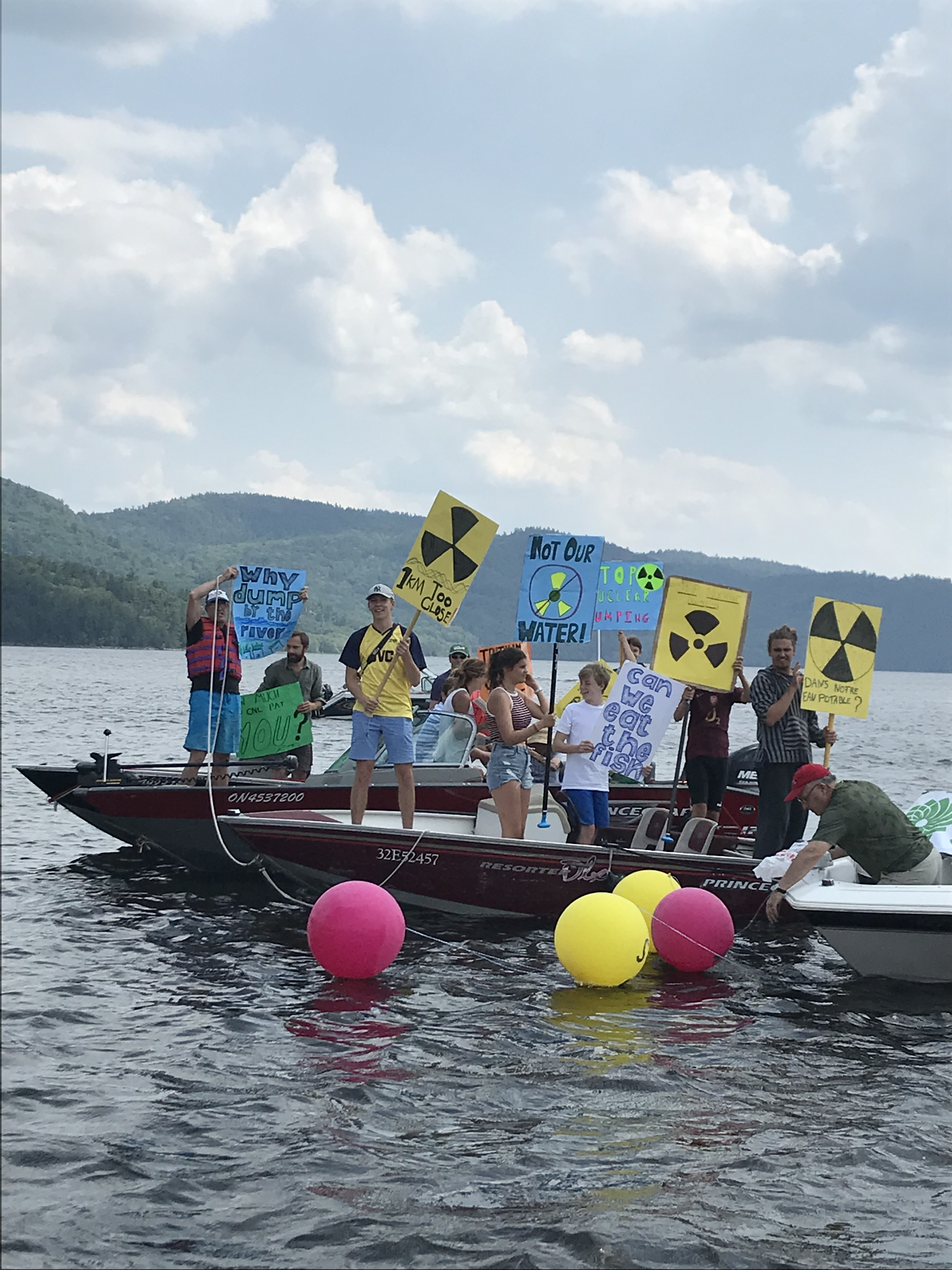
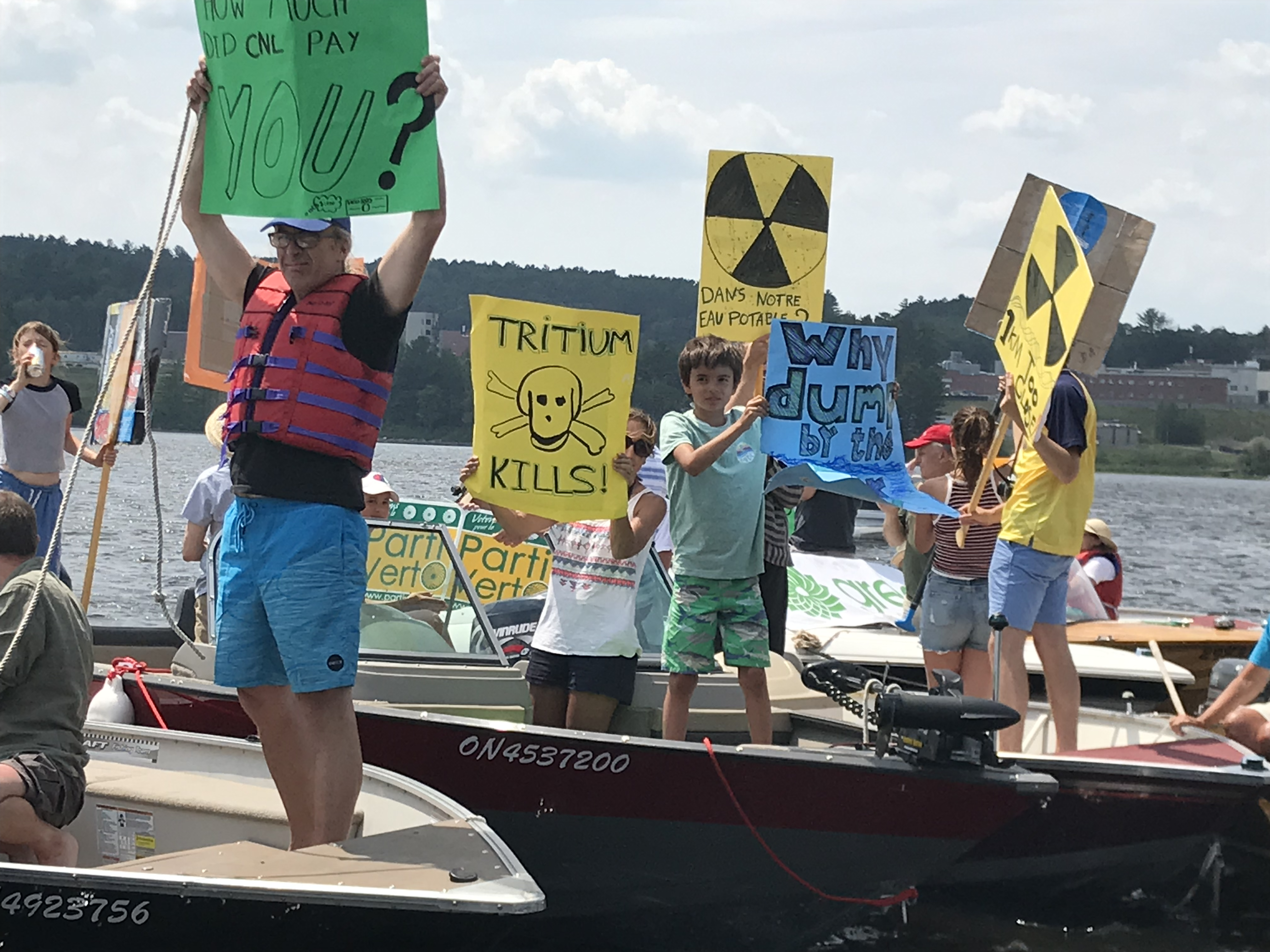
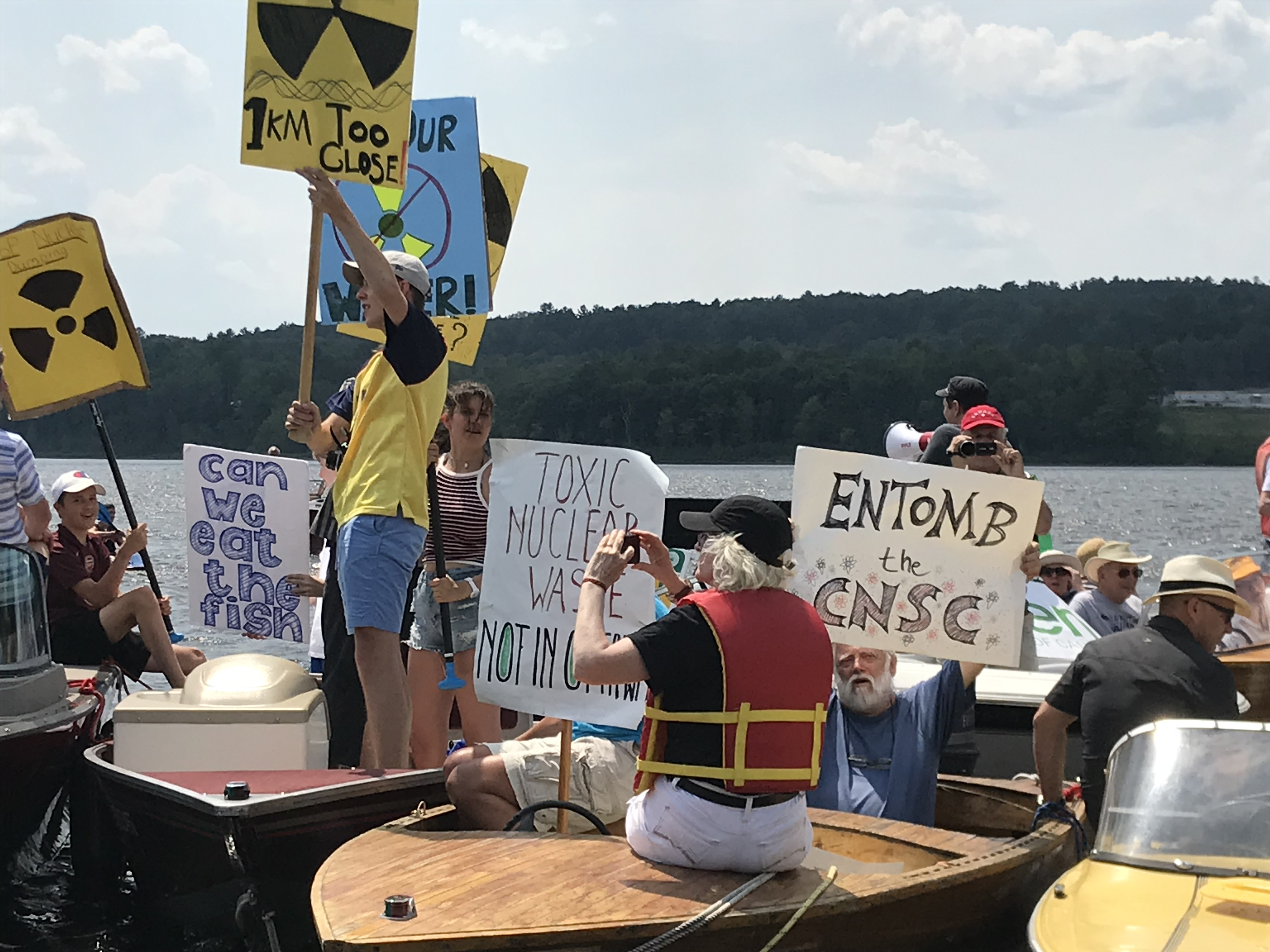
Independent experts, retired AECL scientists, Citizens’ groups, NGOs, 140 Quebec municipalities and several First Nations have been sounding alarm bells about the projects via written comments, resolutions, press conferences, and protests including a boat flotilla on the Ottawa River in August 2017 and a Red Canoe March for Nuclear Safety through the streets of downtown Ottawa in January of 2018.
In April 2018, CNL was granted a 10-year license despite widespread concern over license changes that would make it easier for the consortium to get its nuclear waste projects approved. Canada’s nuclear regulator, the Canadian Nuclear Safety Commission (CNSC), granted the new license. The CNSC is also in charge of environmental assessment (EA) and licensing for nuclear waste projects. The CNSC is perceived to be a “captured” regulator that promotes projects it is charged with regulating, according to Canada’s Expert Panel on EA reform. The CNSC’s mishandling of EAs for the consortium’s nuclear waste projects is described in Environmental Petition 413 to the Auditor General of Canada.
* The consortium, known as Canadian National Energy Alliance, includes: SNC-Lavalin,debarred by the World Bank for 10 years and facing charges in Canada of fraud, bribery and corruption; CH2M agreed to pay $18.5 million to settle federal criminal charges at a nuclear cleanup site in the U.S.; Fluor paid $4 million to resolve allegations of financial fraud related to nuclear waste cleanup work at a U.S. site; Rolls-Royce PLC, parent company of consortium member Rolls-Royce Civil Nuclear Canada Ltd., recently agreed to pay more than CAN$1 billion in fines for bribery and corruptionin the U.K., U.S. and Brazil. **NB** since this post was first published, membership in the consortium has changed. Rolls Royce is no longer listed as a consortium member on the CNEA website and Texas based Jacobs Engineering has recently acquired CH2M.
(Ottawa, Ontario, April 3, 2017) The draft environmental impact statement (EIS) for a proposed giant nuclear waste dump along the Ottawa River is ringing alarm bells for citizens’ groups. It reveals that the dump would contain plutonium and dozens of other waste products created by nuclear reactors, many of which will be radioactive for hundreds of thousands of years.
The proposed “Near Surface Disposal Facility” (NSDF) would be built on a 34-hectare site about one km from the Ottawa River at Canadian Nuclear Laboratories in Chalk River, Ontario. The site is about 150 kilometres northwest of Ottawa, across the river from the Municipality of Sheenboro in the Province of Quebec. The dump would be similar in design to a municipal landfill. It would be used for permanent disposal of up to one million cubic meters of “low-level” and “intermediate-level” radioactive wastes in a mound up to 25 meters high.
The draft environmental impact statement (EIS) was released on March 17th. A CNSC (Canadian Nuclear Safety Commission) decision on approval of the facility is expected in January 2018 and construction could begin soon after.
Johanna Echlin of the Old Fort William Cottagers’ Association was shocked to learn that the dump would contain very long-lived radionuclides. “How can it possibly be ethical and environmentally-responsible to put plutonium and other very long-lived radioactive wastes in a landfill beside the Ottawa River?” she asks. “I have talked to many people on both sides of the river, all the way to Montreal, and everyone I have spoken to thinks this is a terrible idea.”
Plutonium is one of many radioactive byproducts of nuclear fission that would be present in significant quantities in wastes disposed of in the NSDF. Inhaling or ingesting plutonium or other radionuclides (e.g., in dust from the waste dump or runoff into the river) would increase risks of cancers of the lung, bones, blood and liver.
Dr. Ole Hendrickson is reviewing the draft EIS for the Concerned Citizens of Renfrew County and Area. He says that the landfill-type design would expose radioactive wastes to wind, rain and snow. Long-lived radioactive wastes would be hazardous long after plastic liners had deteriorated and leachate collection and treatment had ceased, and would spread into surrounding wetlands, lakes and waterways.
“By failing to provide adequate waste containment, this proposal flagrantly disregards the International Atomic Energy Agency’s safety standard for disposal of radioactive waste,” warns Hendrickson.
The public has 60 days to respond to the EIS (until May 17, 2017). It is posted on the Canadian Environmental Assessment Agency website at: http://www.ceaa-acee.gc.ca/050/document-eng.cfm?document=118381
– 30 –
(Ottawa, Ontario, March 12, 2017) A proposal for a giant disposal facility for radioactive waste on the Ottawa River near Chalk River, Ontario is raising the ire of local residents and citizens’ groups.
A consortium of multinational companies is behind the proposal, currently under review by the Canadian Nuclear Safety Commission. If approved, the 30–hectare “Near Surface Disposal Facility” would dispose of up to one million cubic metres of low- and medium-level radioactive waste in a huge mound up to 25 metres high, about 1 km from Ottawa River at the Canadian Nuclear Laboratories.
The project description, posted on the Canadian Environmental Assessment Agency website, notes that the facility would include wastes from “commercial activities”. In addition to being radioactive, some “mixed” wastes could contain PCBs, arsenic and mercury. Construction of the facility could begin as early as 2018.
Local citizens’ groups say that the proposed site is unsuitable for a dump of any kind given its proximity to the Ottawa River, a source of drinking water for millions of Canadians. They also point out that the site is near a major fault line, and on top of fractured and porous bedrock through which groundwater flows rapidly into the Ottawa River. These and other points are covered in a fact sheet prepared by concerned citizens entitled “Ten things Canadians need to know about the Chalk River Near Surface Disposal Facility”.
According to Johanna Echlin of the Old Fort William Cottagers’ Association, the proposal has shocked and angered local residents as well as people downstream in Ottawa and Montreal. “Folks I talk to are outraged at the idea of dumping a million cubic metres of radioactive waste beside the Ottawa River”, said Echlin.
Citizens are concerned that the consortium of multinational corporations has no stake in the long-term health of the Ottawa River. Echlin and her fellow cottagers worry that “after making a tidy profit on creation of the dump, they could walk away in 10 years when their contract ends and leave a leaking mess for others to live with”. Echlin’s group is encouraging downstream municipalities to pass resolutions opposing the facility, and they are tracking opposition on their website.
Dr. Ole Hendrickson, researcher for Concerned Citizens of Renfrew County and Area, hopes that questions raised by local citizens will be addressed in the draft Environmental Impact Statement scheduled for release on March 17, 2017. “We don’t yet have adequate information about the purpose of the proposed facility, such as what commercial activities the proponents have in mind,” said Hendrickson. “A key question” he added, “is whether wastes from Canada’s nuclear power reactors could be sent to this facility for disposal.”
The public will have 60 days to respond to the Environmental Impact Statement after it is posted on the Canadian Environmental Assessment Agency website at:
www.ceaa-acee.gc.ca/050/details-eng.cfm?evaluation=80122
The fact sheet and other materials produced by the citizens’ groups are available at:
http://ofwca.org/SheenOFWCA/OFWCACNL.html and https://sites.google.com/site/concernedcitizensrca/
– 30 –

