Presentation – Update on Chalk River radioactive waste disposal -BCI Jan. 2021

This presentation was given at the AGM of Biodiversity Conservancy International, January 14, 2021


This slide from the presentation shows Chalk River Labs in 1948.  The original 10 megawatt version of the NRX reactor had been completed a year earlier, in July 1947.   Plutonium was extracted from uranium irradiated in the NRX and shipped to the U.S. to make nuclear weapons.  Later, irradiated targets containing plutonium were shipped to the U.S, for processing there.  This continued until the mid-1960s.  


Natural Resources Canada estimates that over half the nuclear wastes at Chalk River – including contaminated buildings, buried wastes, and contaminated lands – came from Cold War weapons-related activities.

Hill Times Letter to the Editor ~ We need parliamentarians to stop project, prevent Ottawa River from being permanently contaminated by gigantic radioactive landfill

January 18, 2021

Re “CNL working to accomplish responsible action in managing Canada’s nuclear research and development legacy” (The Hill Times, Letters to the Editor, December 14, 2020).

https://www.hilltimes.com/2021/01/18/278089/278089

This letter from Joe McBrearty, President and CEO of Canadian Nuclear Laboratories (CNL) deepens my concern about the handling of Canada’s $8 billion nuclear waste liability. 

Mr. McBrearty claims that the Chalk River Mound beside the Ottawa River, 150 km north of Ottawa-Gatineau, “will contain only low-level radioactive waste which contains radionuclides that require isolation and containment for only a few hundred years.”

Unfortunately this claim does not stand up to scrutiny.

Last month CNL published its final environmental impact statement listing a partial inventory of radionuclides that would go into the gigantic five-to-seven story radioactive mound (aka the “NSDF”).

Twenty-five out of the 30 radionuclides listed in the inventory are long-lived, with half-lives ranging from four centuries to more than four billion years. To take just one example, the man-made radionuclide, Neptunium-237, has a half-life of 2 million years such that, after 2 million years have elapsed, half of the material will still be radioactive. 

The inventory includes four isotopes of plutonium, one of the most deadly radioactive materials known, if inhaled or ingested.

It is incorrect to say that these materials “require isolation and containment for only a few hundred years.” Many of them will be dangerously radioactive for more than one hundred thousand years. The International Atomic Energy Agency states that materials like this must be stored tens of meters or more underground, not in an above-ground mound.

The CNL inventory also includes a very large quantity of cobalt-60, a material that gives off so much strong gamma radiation that lead shielding must be used by workers who handle it in order to avoid dangerous radiation exposures. The International Atomic Energy Agency considers high-activity cobalt-60 sources to be “intermediate-level waste” and specifies that they must be stored underground. Addition of high-activity cobalt-60 sources means that hundreds of tons of lead shielding would be disposed of in the mound along with other hazardous materials such as arsenic, asbestos, PCBs, dioxins and mercury.


CNL’s environmental impact statement describes several ways that radioactive materials would leak into surrounding wetlands that drain into the Ottawa River during filling of the mound and after completion. It also describes CNL’s intent to pipe water polluted with tritium and other radioactive and hazardous substances from the waste treatment facility directly into Perch Lake which drains into the Ottawa River.

I stand by my original conclusion: We need parliamentarians to step up now to stop this deeply flawed project and prevent the Ottawa River from being permanently contaminated by a gigantic, leaking radioactive landfill that would do little to reduce Canada’s $8 billion nuclear waste liability.

Letter to the editor published in the Hill Times Monday January 18, 2021

Health and environmental groups appeal to International Atomic Energy Agency to nix Canadian appointment


For immediate release 
(Montreal, March 23, 2020) Three independent civil society organizations — the Canadian Association of Physicians for the Environment, the Canadian Coalition for Nuclear Responsibility and the Ottawa River Institute —  are asking the Director General of the UN’s International Atomic Energy Agency (IAEA) to reconsider the recent appointment of a Canadian as chair of its commission on safety standards.

In a recent letter to IAEA Director General Rafael M. Grossi, signed by Dr. Gordon Edwards, Dr. Éric Notebaert, MD, and Dr. Ole Hendrickson, the authors say they are concerned about the appointment of Rumina Velshi, president of the Canadian Nuclear Safety Commission (CNSC), to chair the IAEA’s commission on nuclear safety standards because the organization she heads has a documented record of disregarding IAEA safety standards and advocating for exemption of smaller nuclear reactors from environmental assessment in Canada. 

“We fear that Ms. Velshi’s chairmanship could result in the lowering of international standards, with an emphasis on benefits to the nuclear industry and support of ‘innovation’ at the expense of public protection,” says the letter.

According to the letter, Ms. Velshi might not meet the IAEA’s standards for regulatory officials’ independence from the nuclear industry. Before her appointment as CNSC president, she worked for Ontario Power Generation for eight years in senior management positions and led the OPG commercial team involved in a multi-billion dollar proposal to procure new nuclear reactors. 

published statement from the Canadian Nuclear Safety Commission dated February 26, 2020 says its president, Rumina Velshi, “intends to use her chairmanship to champion the importance of greater harmonization of standards and ensure they support nuclear innovation.”  In a recent address to the Canadian Nuclear Association Ms. Velshi reiterated these sentiments.

The letter’s authors cite the final report of a recent IAEA review of Canada’s nuclear safety framework as evidence of the CNSC’s failure to meet IAEA safety standards. The review identified numerous deficiencies and found that “CNSC regulations do not comprehensively cover all IAEA Fundamental Safety Requirements.” The review also found Canada to be out of alignment with IAEA standards for nuclear reactor decommissioning.

“The CNSC is proposing to permit entombment and abandonment of very long-lived radioactive entrails of shutdown ‘legacy’ nuclear reactors as an acceptable strategy for decommissioning in Canada. This approach is expressly rejected by IAEA safety standards, except in emergency circumstances such as severe reactor accidents (i.e. meltdowns),” says Dr. Edwards, President of the Canadian Coalition for Nuclear Responsibility.  “We are alarmed by this attempt of the CNSC to permit practices in Canada that the IAEA warns against and we don’t want to see this approach exported to the rest of the world.”

The letter to the IAEA Director General cites the CNSC’s handling of three controversial proposals for nuclear waste disposal as further evidence of the regulatory agency’s disregard of IAEA safety standards. The proposed facilities include: a giant, above-ground mound, close to the Ottawa River, for one million tons of mixed radioactive and other toxic wastes including long-lived radionuclides such as plutonium-239, americium-243, zirconium-93, nickel-59, carbon-14 and many more; as well as the planned entombment in concrete of two shutdown federal reactors beside the Winnipeg and Ottawa rivers, which provide drinking water for millions of Canadians.

The groups call on the IAEA director to maintain the integrity of IAEA safety standards and to continue to emphasize the vital importance of ensuring independence and objectivity, stating:  “We value IAEA safety standards; at the moment they are all that is of an official nature standing between Canadians and three nuclear waste disposal projects that would adversely affect the environment and public health in Canada for generations.”

The letter notes that the CNSC is widely perceived to be a “captured regulator”, that prioritizes needs of the nuclear industry over protection of the public from radioactive pollutants released from nuclear facilities.
-30-

Links:

  1. Letter to IAEA Director General March 12, 2020. https://concernedcitizens.net/2020/03/20/letter-to-iaea-director-general-march-12-2020/ 
  2. Federal nuclear regulator urges Liberals to exempt smaller reactors from full panel review. Globe and Mail, November 6, 2018.  https://www.theglobeandmail.com/business/article-federal-nuclear-regulator-urges-liberals-to-exempt-smaller-reactors/ 
  3. CNSC president wants to harmonize international nuclear safety standards, Email message from CNSC February 26, 2020. https://concernedcitizens.net/2020/03/20/cnsc-president-wants-to-harmonize-international-nuclear-safety-standards/
  4. Remarks by President Rumina Velshi at the Canadian Nuclear Association 2020 Conference. CNSC February 27, 2020. https://www.nuclearsafety.gc.ca/eng/resources/presentations/president-velshi-remarks-canadian-nuclear-association-2020-conference.cfm
  5. REPORT OF THE INTEGRATED REGULATORY REVIEW SERVICE MISSION TO CANADA, International Atomic Energy Agency. https://www.iaea.org/sites/default/files/documents/review-missions/irrs_canada_2019_final_report.pdf
  6. International peer review finds deficiencies in Canada’s nuclear safety framework. Blog post. March 7, 2020. https://concernedcitizens.net/2020/03/07/international-peer-review-finds-deficiencies-in-canadas-nuclear-safety-framework/

Serious problems with federally-owned radioactive waste in Canada ~ Full Page Statement in the Hill Times

January 27, 2020

To the Prime Minister, Parliament and the Federal Government
The undersigned organizations have grave concerns about the handling of Canada’s federally-owned radioactive waste by a private-sector consortium that includes SNC-Lavalin and two Texas-based multinational corporations. *


●      Canada has no adequate federal policies and strategies for the long-term management of radioactive wastes and the consortium has been given a free hand to advocate and implement proposals that, in our view, are unequal to the task of protecting people’s health and the environment.
●       Under its federal contract with Atomic Energy of Canada Limited the consortium is receiving billions of our tax dollars to advance radioactive waste disposal and reactor “decommissioning” projects that fail to even meet existing international safety guidelines. 
●      The consortium’s current plans include entombingthe radioactive remains ofnuclear reactors in cement next to the Ottawa and Winnipeg Rivers, against the explicit advice of international bodies and independent nuclear scientists; these “entombed reactors” would leak radioactivity into the rivers for thousands of years and contaminate drinking water for millions of Canadians.
●     The consortium also plans to erect a massive above-ground mound adjacent to a swampy area that drains into the nearby Ottawa River; the mound would hold more than one million tons of mixed radioactive waste including a multitude of long-lived, human-made radioactive materials such as plutonium-239 and hazardous non-radioactive materials such as PCBs, lead, arsenic and asbestos.
●     The consortium is already transporting large quantities of radioactive waste along public roadsfrom Pinawa, Manitoba, from Douglas Point, Ontario, and from Gentilly, Quebec, all the way to Chalk River, site of the proposed mound, located upstream from our nation’s Capital.

We request that the Federal Government terminate its contract with the consortium at the end of the first six-year term in 2021 or as soon as possible.

We also request formulation of exemplary policies and projects for Canada’s radioactive waste that meet or exceed international obligations. Such policies and projects would:
●      be developed with meaningful consultation with First Nations and the broader Canadian public 
●      create many long-term, well-paying Canadian jobs while protecting health and property 
●      safely store radioactive waste in state-of-the-art facilities away from sources of drinking water
●     re-establish Canadian leadership in the nuclear field with world-class science-based solutions to address the growing global radioactive waste problems 

* Membership in the consortium, known as Canadian National Energy Alliance, has changed more than once since the consortium assumed control of Canada’s federally-owned nuclear waste in 2015, when it received all shares of Canadian Nuclear Laboratories, a wholly owned subsidiary of Atomic Energy of Canada Limited.  Current consortium members include  SNC-Lavalin, which is debarred by the World Bank for 10 years and faced charges in Canada for fraud, bribery and corruption; Texas-based Fluor Corporation, which paid $4 million to resolve allegations of  financial fraud related to nuclear waste cleanup work at a U.S. site; and Texas-based Jacobs Engineering, which recently acquired CH2M, an original consortium member that agreed to pay $18.5 million to settle federal criminal charges at a nuclear cleanup site in the U.S.

Signatories  

Alliance of the Anishinabek Nation and the Iroquois Caucus

Canadian Coalition for Nuclear Responsibility

Canadian Association of Physicians for the Environment

Sierra Club Canada Foundation

Friends of the Earth Canada

Ontario Clean Air Alliance

Ecology Ottawa

 Ottawa River Institute

Unifor

FTQ – Fédération des travailleurs et travailleuses du Québec

Greenspace Alliance of Canada’s Capital

National Council of Women of Canada

Provincial Council of Women of Quebec

Provincial Council of Women of Ontario

Concerned Citizens of Renfrew County and Area

Northwatch

Les Artistes pour la Paix

Concerned Citizens Committee of Manitoba

Prevent Cancer Now

Action Climat Outaouais

Ralliement contre la pollution radioactive

Bonnechere River Watershed Project

Old Fort William (Quebec) Cottagers’ Association

Pontiac Environmental Protection

Petawawa Point Cottagers Association

Coalition Against Nuclear Dumps on the Ottawa River

Esprit Whitewater

Durham Nuclear Awareness

First United Church (Ottawa) Water Care Allies

How would the Chalk River Mound leak? Let us count some of the ways

Canadian Nuclear Laboratories (CNL) – run by a consortium of profit-making multinational companies – is proposing to build a giant mound that it misleadingly calls a “Near Surface Disposal Facility” for a million cubic meters of radioactive waste at its Chalk River facility along the Ottawa River.

CNL’s high cost ad campaign (paid for with Canadian tax dollars) says the dump is safe and uses “proven technology”. Ads say the dump will protect the public and the environment.

However, CNL’s draft environmental impact statement (EIS) describes several ways that contents of the proposed “engineered containment mound” of radioactive waste could leak into the Ottawa River. Here are some of the ways:

During operation (while the dump is being filled)…

1. Wastes being added to the mound would be exposed to the elements. 

Rain and melting snow would leach radioactive contents down through the mound. The liquid would be collected and pumped uphill to a water treatment plant. Some but not all radioactive contaminants would be removed prior to releasing the treated leachate into wetlands that drain into the Ottawa River. (Table 3.5.3-1 on page 3-23 of the draft EIS) 

2. Radioactive water (tritium) would leach in very large amounts from the mound. 

Tritium is part of the water molecule and cannot be removed by water treatment. The draft EIS suggests the very high tritium content will be reduced but does not say how. Untreated tritium would be discharged to wetlands that drain into the Ottawa River where it would get incorporated into fish and enter drinking water supplies Large quantities of tritium would also be released from the dump as water vapour. 

3. Other toxic substances such as PCBs leaching from the mound would be only partially removed by water treatment.. 

Table 3.5.3-2 on page 3-25 shows that treatment would only partly remove non-radioactive toxic compounds in the wastes such as lead, PCBs and dioxin. Measurable amounts would be released to the environment. 

4. Heavy storm events would erode the mound’s surface and wash toxic substances into low areas. 

Highly contaminated water washing off active dumping areas would be pumped to the water treatment plant. Less contaminated water would be pumped to three storm-water management ponds around the perimeter of the facility and be discharged to adjacent wetlands. Ponds would provide only “basic” containment of sediments before their contents were released (draft EIS explains this on page 3-57) 

5. The capacity of storm-water ponds would be exceeded during extreme rainfall events or snowmelts. 

The draft EIS (page 9-2) says that pond overflow “would be conveyed by inlet and emergency outlet structures adjacent to the surface water management ponds,” presumably to be released directly into adjacent wetlands. 

6. Other possible ways the facility might leak during operations (not described in detail the EIS) include tornado damage, pump failures during extreme storm events with loss of electrical power, improper installation of the base liners, puncture of the base liners by heavy or sharp materials, melting of liners by radioactively hot materials, and blockage of the leachate collection system. 

After closure…

1. Wastes in the mound would be re-exposed to the elements when the top cover fails. 

After waste dumping ended the leachate collection system and water treatment plant would be shut down, and a top cover placed over the wastes. The draft EIS acknowledges that the top cover would fail with “normal evolution” through forces such as erosion, extreme storms, burrowing animals, root penetration, etc. 

2. Failure of the top cover while the base liners remain intact would initiate the “bathtub scenario”. 

Rain and melting snow would again leach the radioactive wastes, 

but the leachate collection and pumping system would no longer be operational. Contaminated leachate would be trapped by the bottom liner and accumulate in the space between the mound and the surrounding berm. Leachate levels would rise and spill over along the low point of the 

berm. 

Long-lived radioactive elements such as plutonium and uranium, exposed to wind and water erosion, would flow into the river for thousands to millions of years. Eventual failure of the bottom liners would also allow radionuclides to move into groundwater. The Ottawa River would be permanently contaminated by radioactive wastes. Countless generations of people drinking its water would be exposed to increased cancer risks.

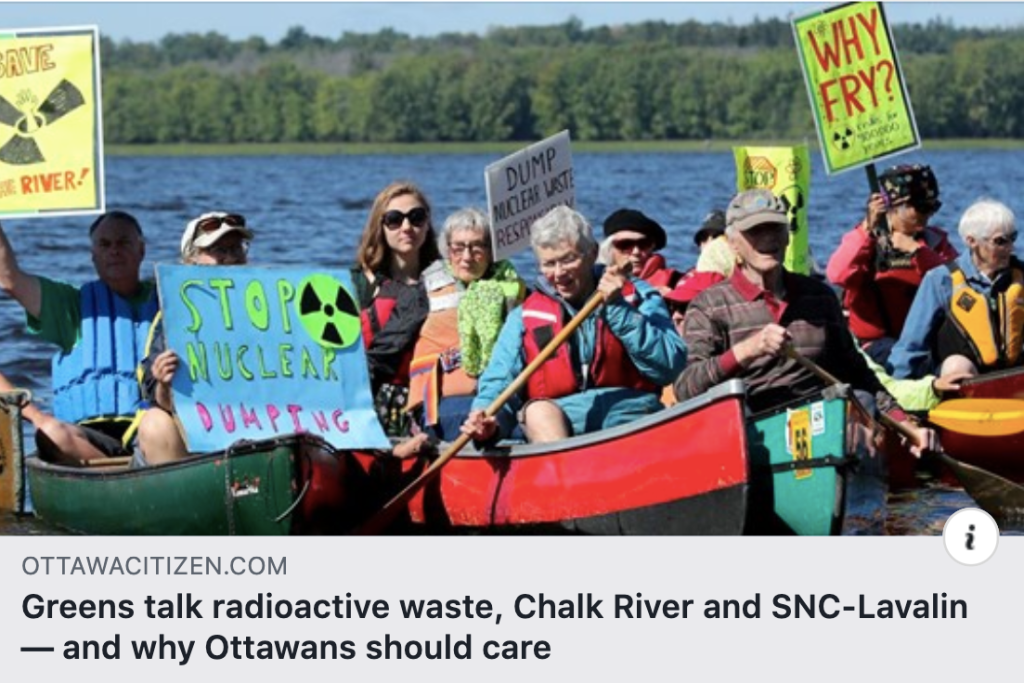
Greens talk radioactive waste, Chalk River and SNC-Lavalin

September 5, 2019, Ottawa Citizen, TAYLOR BLEWETT

Leveraging one of the year’s top political controversies, federal Green party candidates staged an event Thursday to highlight their concerns about potential contamination of the Ottawa River and a government they describe as too cosy with SNC-Lavalin to care.

Standing in the sand on Westboro Beach, Ottawa Centre Green party candidate Angela Keller-Herzog gave the assembled crowd a quick refresher on the nuclear situation at Chalk River, 200 kilometres northwest of Ottawa.

On the eve of the 2015 federal election, former prime minister Stephen Harper’s government selected a consortium of companies, including engineering firm SNC-Lavalin, as its preferred proponent to manage and operate Canadian Nuclear Laboratories — the organization proposing a “near surface disposal facility” for radioactive waste at Chalk River.

It’s a plan, now under review, that’s been in the works for several years, and CNL is adamant about its safety. “It will actually take waste out of areas with very little containment, and put it into an area that is engineered and contained away from the environment,” said Sandra Faught, manager of regulatory approvals for the facility at CNL.

Despite such assurances, the proposed facility has generated fierce criticism from community, Indigenous and environmental advocates for as long as it’s been in the public eye.

At Thursday’s press conference, the Greens breathed fresh life into these concerns by emphasizing the involvement of one of the most controversial names in politics right now: SNC-Lavalin.

“Poor nuclear waste decisions have fallout for millennia — this is too important a job to be handed to SNC and corner-cutting, profit-seeking foreign corporations with dubious ethical background,” said Keller-Herzog.

As an MP, she said, she would champion the creation of a federal policy guiding the management of non-fuel radioactive waste (the kind the Chalk River disposal facility would deal with.)

She also raised a new concern — that the Liberal government, including Environment Minister and Ottawa Centre MP Catherine McKenna, have created an exemption that would allow small modular nuclear reactors to skip the new environmental review process they introduced in Bill C-69.

Both CNL and the federal government are focused on the opportunities presented by these portable, less powerful reactors.

“Canada is well positioned to become a global leader in the development and deployment of SMR technology,” reads a Natural Resources Canada webpage, while CNL envisions itself as a “global hub” for small modular reactor innovation.

In the spring of 2018, CNL invited SMR proposals to develop a “demonstration project” at one of its sites. This would be the first small modular reactor in Canada.

“I ask you: If experimental, unproven nuclear reactors don’t have to undergo impact assessment, then what’s the point?” said Keller-Herzog. “In other words, the Liberal government, Minister McKenna and senior public servants are lining up their ducks to pave the way for the plans of SNC-Lavalin and its American partners. Does that sound familiar?”

This newspaper contacted McKenna’s ministerial office about the decision to exempt small nuclear reactors — under 200 thermal megawatts —  from the list of projects that would require environmental assessment under Bill C-69.

“Previously all nuclear reactors would have been designated projects, regardless of size and location,” according to the Canada Gazette entry regarding the exemption.

In response, spokesperson Caroline Thériault sent a statement: 

“A robust project list ensures good projects can move forward in a timely and transparent way that protects the environment, rebuilds public trust and strengthens our economy. This list covers all major projects within federal jurisdiction those pose significant environmental risk.”

Even without a spot on the Bill C-69 project list, small modular reactor would still be subject to scrutiny.

According to a statement from the Impact Assessment Agency of Canada, “New nuclear projects below the 200 MW thermal‎ threshold are subject to licensing and assessment processes by the Canadian Nuclear Safety Commission.”

Alexandre Deslongchamps, spokesperson for the minster of natural resources, noted that the CNSC “is peer-reviewed and world-renowned” and “will only approve projects if it concludes that they are safe for people and the environment, both now and in the future.”

With files from the Financial Post

Comment from Mark Mackenzie: I am flabbergasted as to how a facility can get away with calling a 7 storey high dump a ‘Near Surface Disposal Facility’. At 7 stories high, I invite any Chalk River executive to jump off and tell us how close they were to the surface…. There is no reason to jeopardize the incredible value of the Ottawa River for a nuclear dump within 1 kilometre. The CNSC is hardly an effective regulatory body as they merely rubber stamp whatever the profit oriented nuclear industry wants. SNC Lavelin ‘anything for a buck’ is the Canadian partner. Great group today bringing awareness to the importance of this issue. Three Green Party candidates – Angela Keller-Herzog, Lorraine Rekmans and Claude Bertrand were highly articulate about how the Ottawa River needs to be protected.

Comment from Lynn Jones: Someone should tell the NRCan spokesperson that CNSC was outed long ago as a “captured regulator” that is world renowned for nothing other than promoting the industry and the projects it is supposed to regulate. Even the international nuclear industry refers to Canada’s “benign regulatory environment” when touting Canada as the place to come and tap into the public purse to develop small nuclear reactors.

RED ALERT ~ CNL tells CNSC it has current plans to put “intermediate level waste” in above ground mounds

July 2019

In October 2017, Canadian Nuclear Laboratories (CNL) announced that it would not put Intermediate Level Waste (ILW) in a proposed above-ground mound.

CNL incorrectly calls this mound a “Near Surface Disposal Facility” (NSDF). International Atomic Energy Agency (IAEA) safety requirements state that a near surface facility should consist of in-ground vaults or trenches, and is suitable only for Low Level Waste.

In March 2019, the Canadian Nuclear Safety Commission (CNSC), Canada’s captured nuclear regulator, released a draft “Regulatory Document” on waste management for comment. The CNSC’s proposed language on ILW was that it “generally requires” greater isolation than would be provided by near surface disposal.

Putting ILW above-ground would go against common sense. Because of its long-lived radionuclides, the IAEA requires that ILW be disposed of “at least a few tens of metres below ground level.”

In June 2019 CNL submitted its comments on the draft RegDoc. CNL asked CNSC to further weaken its wording on ILW, saying “There are current plans to place ILW in aboveground mounds.”  CNL wanted the language on ILW changed from “generally requires” to “may require” greater isolation.

CNSC’s final version of the Regulatory Document, published February 2021, retains the original language of “generally requires”.

This could allow CNL to dispose of long-lived, intermediate-level radioactive waste in its proposed above-ground mound, the so-called NSDF.

Why did CNL say in October 2017 that it would not put ILW in the NSDF, but tell CNSC in June 2019 that there are “current plans to place ILW in aboveground mounds”?

From the IAEA Specific Safety Requirements No. SSR-5, Disposal of Radioactive Waste, page 4:

(b) Near surface disposal: Disposal in a facility consisting of engineered trenches or vaults constructed on the ground surface or up to a few tens of metres below ground level. Such a facility may be designated as a disposal facility for low level radioactive waste (LLW)

(c) Disposal of intermediate level waste: Depending on its characteristics, intermediate level radioactive waste (ILW) can be disposed of in different types of facility. Disposal could be by emplacement in a facility constructed in caverns, vaults or silos at least a few tens of metres below ground level and up to a few hundred metres below ground level. It could include purpose built facilities and facilities developed in or from existing mines. It could also include facilities developed by drift mining into mountainsides or hillsides, in which case the overlying cover could be more than 100 m deep. 

From the IAEA Specific Safety Requirements No. SSR-5, Disposal of Radioactive Waste, page 55:

Intermediate level waste (ILW): Waste that, because of its content, particularly of long lived radionuclides, requires a greater degree of containment and isolation than that provided by near surface disposal.  

From CNL updates NSDF Waste Inventorydated October 26, 2017:

Canadian Nuclear Laboratories (CNL) announced today that it has re-evaluated its proposal for the Near Surface Disposal Facility (NSDF) at Chalk River Laboratories, and has made the decision to only include low-level radioactive waste in the NSDF…. Intermediate level waste will continue to be managed in interim storage at Chalk River Laboratories until a long-term disposal solution for this category of radioactive waste has been developed and approved. 

From CNSC REGDOC-2.11.1, Volume I, Management of Radioactive Waste, March 2019 draft, section 6.1, Waste Classification, bullet 4, page 4:

Due to its long-lived radionuclides, ILW generally requires a higher level of containment and isolation than can be provided in near surface repositories.

From Canadian Nuclear Laboratories Comments on Draft Regdoc-2.11.1, Volume 1: Management Of Radioactive Waste, page 11 of 25, comment #13 on section 6.1, dated June 27, 2019: 

The 4th bullet is a potentially misleading or biasing statement. There are current plans to place ILW in aboveground mounds. 

Amend 4th bullet to read, “Due to its long‐lived radionuclides, ILW generally may require a higher level of containment and isolation than can be provided in near surface repositories.

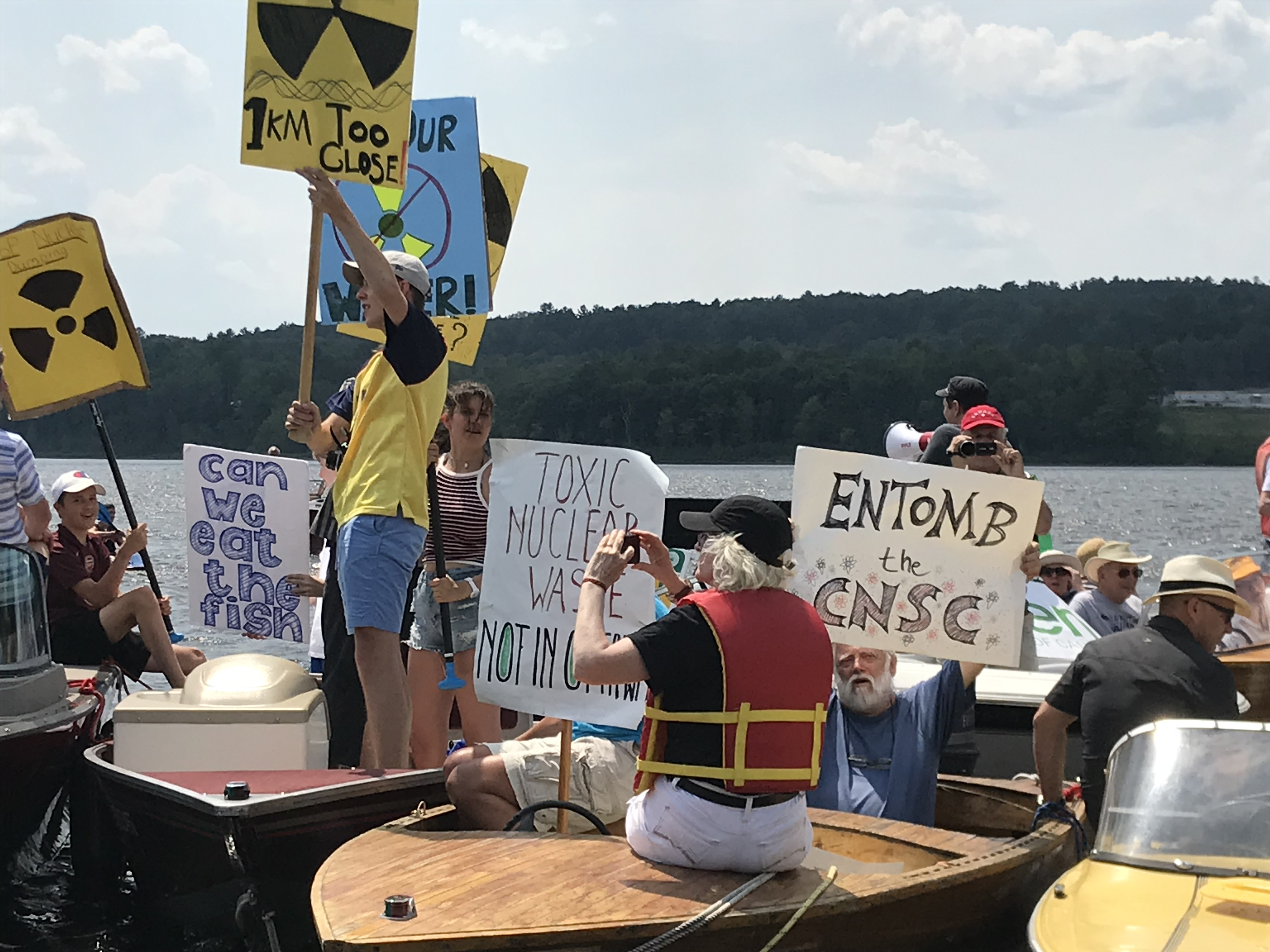
Photos from the protest flotilla on July 27th

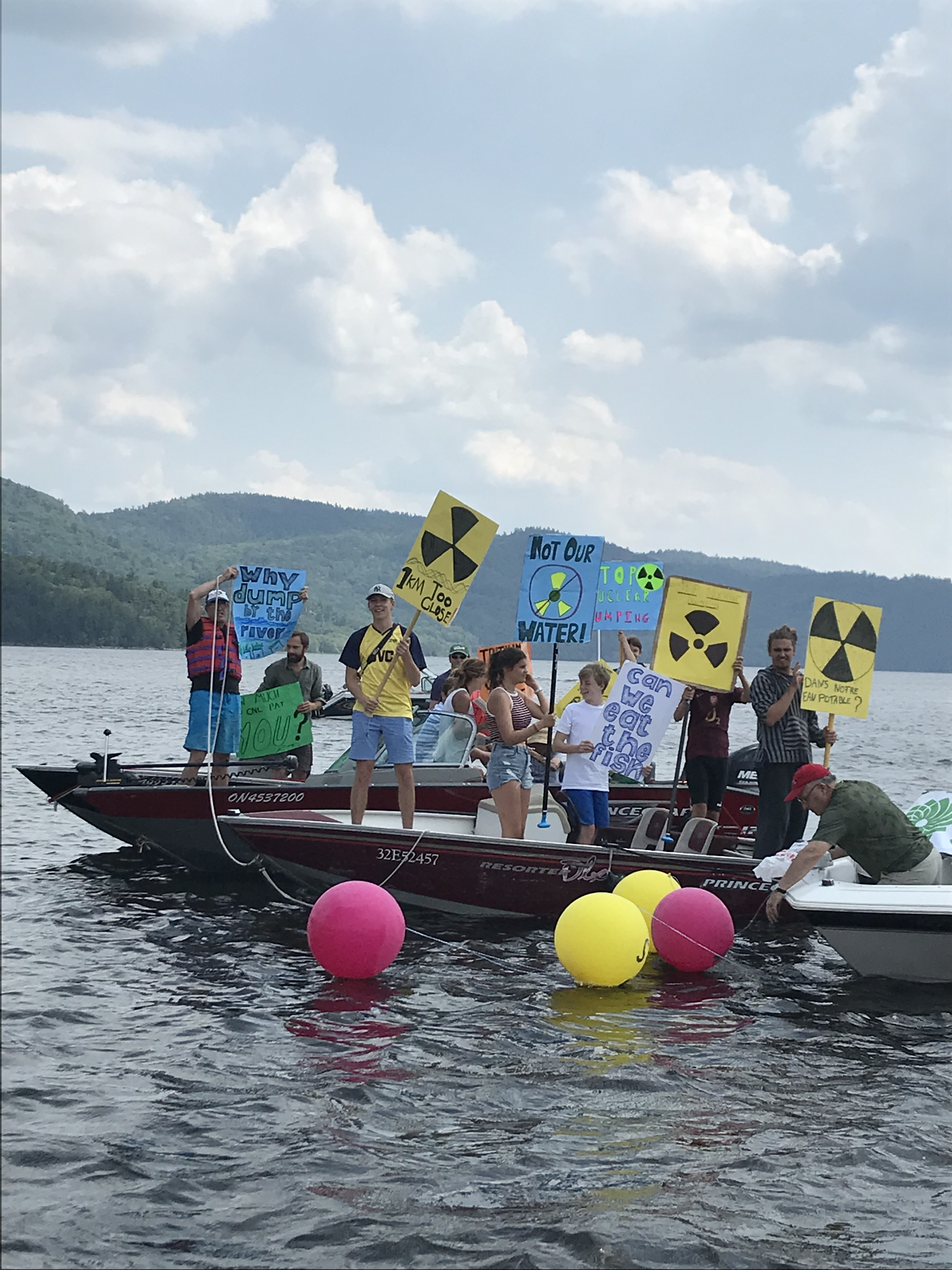
IN THIS PHOTO GREEN PARTY CANDIDATE IN PONTIAC (CLAUDE BERTRAND) IS RELEASING MOCK RADIOACTIVE ISOTOPES INTO THE RIVER – A SYMBOLIC GESTURE (THESE BALLS WERE REMOVED FROM THE WATER A LITTLE LATER)


Morning meeting: (room was full – approximately 80 people coming from Pontiac, Gatineau, Ottawa and Montreal)  From left to right: Jason Phelps, MC (OFWCA), Elssa Martinez (OFWCA), Ole Hendrickson (Concerned Citizens of Renfrew County and Area), Patrick Nadeau (Executive Director, Ottawa Riverkeeper)Photo taken by: Eva Schacherl, Coalition Against Nuclear Dumps on the Ottawa River (CANDOR)

Two nuclear waste dumps threaten the Ottawa River

A multinational consortium wants to build two nuclear waste dumps alongside the Ottawa River upstream of Ottawa-Gatineau, one at Chalk River, Ontario and the other at Rolphton, Ontario. Both dumps disregard international safety guidelines and would leak radioactive materials into the Ottawa River, endangering drinking water for millions of Canadians living downstream.

Background:

In 1944 Chalk River Laboratories (CRL) were established to produce plutonium for nuclear weapons. Starting in 1952 the Labs were operated by “Atomic Energy of Canada Limited” (AECL).  Besides producing plutonium, the labs established a prototype nuclear power reactor (NPD) upstream of Chalk River at Rolphton, and extracted “medical isotopes” from irradiated fuel. These activities and two serious accidents created large quantities of dangerous radioactive wastes. Cleanup costs are estimated at $8 billion.

The Harper government radically restructured AECL in 2015, creating a subsidiary called Canadian Nuclear Laboratories (CNL) and contracting a multinational consortium including SNC Lavalin, to operate the subsidiary and reduce the federal government’s nuclear cleanup liabilities quickly and cheaply. All four consortium members face or have faced criminal charges for fraud and corruption*. Annual costs to taxpayers tripled shortly after restructuring.

In 2016, CNL proposed to construct a giant, above-ground mound of radioactive waste (NSDF) at Chalk River and to entomb in concrete the NPD reactor at Rolphton. Both proposals disregard International Atomic Energy Agency safety standards and would permanently contaminate the Ottawa River with radioactive materials such as plutonium, caesium, strontium and tritium, some of which will be remain hazardous for over 100,000 years.  CNL is also moving to bring thousands of shipments of radioactive waste (including highly toxic used fuel rods) to Chalk River from other federal sites in Manitoba, Ontario and Quebec.


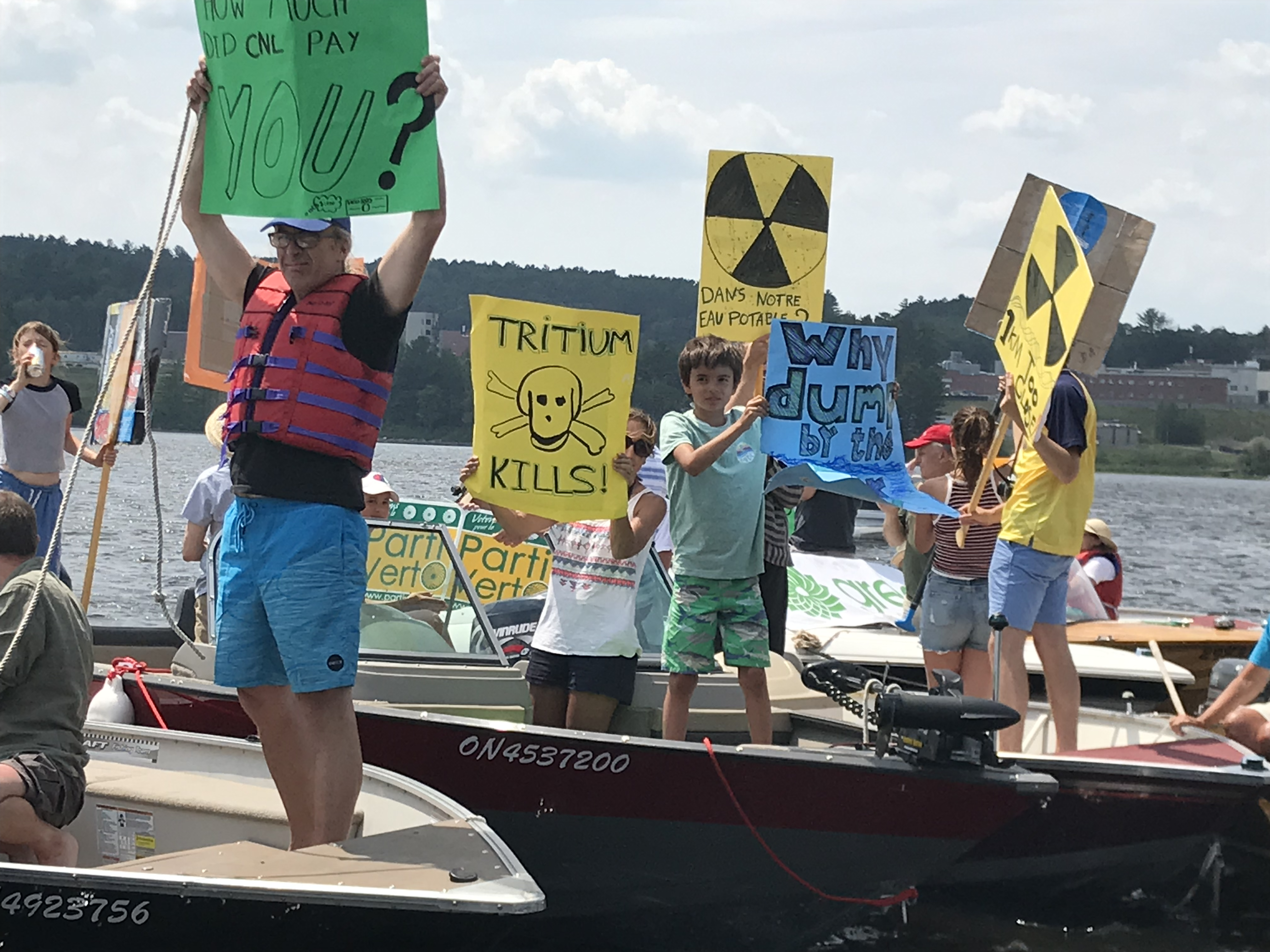
Independent experts, retired AECL scientists, Citizens’ groups, NGOs, 140 Quebec municipalities and several First Nations have been sounding alarm bells about the projects via written comments, resolutions, press conferences, and protests including a boat flotilla on the Ottawa River in August 2017 and a Red Canoe March for Nuclear Safety through the streets of downtown Ottawa in January of 2018.


In April 2018, CNL was granted a 10-year license despite widespread concern over license changes that would make it easier for the consortium to get its nuclear waste projects approved. Canada’s nuclear regulator, the Canadian Nuclear Safety Commission (CNSC), granted the new license.  The CNSC is also in charge of environmental assessment (EA) and licensing for nuclear waste projects. The CNSC is perceived to be a “captured” regulator that promotes projects it is charged with regulating, according to Canada’s Expert Panel on EA reform. The CNSC’s mishandling of EAs for the consortium’s nuclear waste projects is described in Environmental Petition 413 to the Auditor General of Canada.

* The consortium, known as Canadian National Energy Alliance, includes: SNC-Lavalin,debarred by the World Bank for 10 years and facing charges in Canada of fraud, bribery and corruption; CH2M agreed to pay $18.5 million to settle federal criminal charges at a nuclear cleanup site in the U.S.; Fluor paid $4 million to resolve allegations of  financial fraud related to nuclear waste cleanup work at a U.S. site; Rolls-Royce PLC,  parent company of consortium member Rolls-Royce Civil Nuclear Canada Ltd., recently agreed to pay more than CAN$1 billion in fines for bribery and corruptionin the U.K., U.S. and Brazil. **NB** since this post was first published, membership in the consortium has changed. Rolls Royce is no longer listed as a consortium member on the CNEA website and Texas based Jacobs Engineering has recently acquired CH2M.

Giant Radioactive Waste Dump on the Ottawa River: New revelations alarm citizens’ groups

(Ottawa, Ontario, April 3, 2017)  The draft environmental impact statement (EIS) for a proposed giant nuclear waste dump along the Ottawa River is ringing alarm bells for citizens’ groups.   It reveals that the dump would contain plutonium and dozens of other waste products created by nuclear reactors,  many of which will be radioactive for hundreds of thousands of years.

The proposed “Near Surface Disposal Facility” (NSDF) would be built on a 34-hectare site about one km from the Ottawa River at Canadian Nuclear Laboratories in Chalk River, Ontario.  The site is about 150 kilometres northwest of Ottawa, across the river from the Municipality of Sheenboro in the Province of Quebec.  The dump would be similar in design to a municipal landfill.  It would be used for permanent disposal of up to one million cubic meters of “low-level” and “intermediate-level” radioactive wastes in a mound up to 25 meters high.

The draft environmental impact statement (EIS) was released on March 17th.  A CNSC (Canadian Nuclear Safety Commission) decision on approval of the facility is expected in January 2018 and construction could begin soon after.

Johanna Echlin of the Old Fort William Cottagers’ Association was shocked to learn that the dump would contain very long-lived radionuclides. “How can it possibly be ethical and environmentally-responsible to put plutonium and other very long-lived radioactive wastes in a landfill beside the Ottawa River?” she asks. “I have talked to many people on both sides of the river, all the way to Montreal, and everyone I have spoken to thinks this is a terrible idea.”

Plutonium is one of many radioactive byproducts of nuclear fission that would be present in significant quantities in wastes disposed of in the NSDF.  Inhaling or ingesting plutonium or other radionuclides (e.g., in dust from the waste dump or runoff into the river) would increase risks of cancers of the lung, bones, blood and liver.

Dr. Ole Hendrickson is reviewing the draft EIS for the Concerned Citizens of Renfrew County and Area.  He says that the landfill-type design would expose radioactive wastes to wind, rain and snow.  Long-lived radioactive wastes would be hazardous long after plastic liners had deteriorated and leachate collection and treatment had ceased, and would spread into surrounding wetlands, lakes and waterways.   

“By failing to provide adequate waste containment, this proposal flagrantly disregards the International Atomic Energy Agency’s safety standard for disposal of radioactive waste,” warns Hendrickson.

The public has 60 days to respond to the EIS (until May 17, 2017).  It is posted on the Canadian Environmental Assessment Agency website at: http://www.ceaa-acee.gc.ca/050/document-eng.cfm?document=118381

– 30 –