Hill Times Op-Ed ~ A beautiful hillside

This op-ed was published in the Hill Times on April 29, 2026. On May 28, 2026 the Federal Court of Appeal ruled in favour of Kebaowek First Nation, allies and endangered species. The decision is here.

Can Canada’s Species-at-risk Act protect endangered wildlife on federal land? A pending Federal Court of Appeal ruling might hold the answer.

There’s a beautiful, wild, south-facing hillside, close to the Ottawa River, not too far upstream from Parliament Hill. It is densely forested with mature stands of deciduous and coniferous trees and partly surrounded by five named wetlands that drain through Perch Creek and Perch Lake into the Ottawa River. 

In summer the forest is full of birdsong. Many migrating songbirds pass through the area. Rare songbirds nest in the woods on the hillside. You might hear a Wood Thrush singing, or Whip-poor-wills, or Canada Warblers, or Golden-winged Warblers, all of which are listed as threatened under the Species at Risk Act. The old trees provide ideal roosting habitat for three species of endangered bats, the Little Brown Bat, Northern Myotis and Tri-coloured Bat.
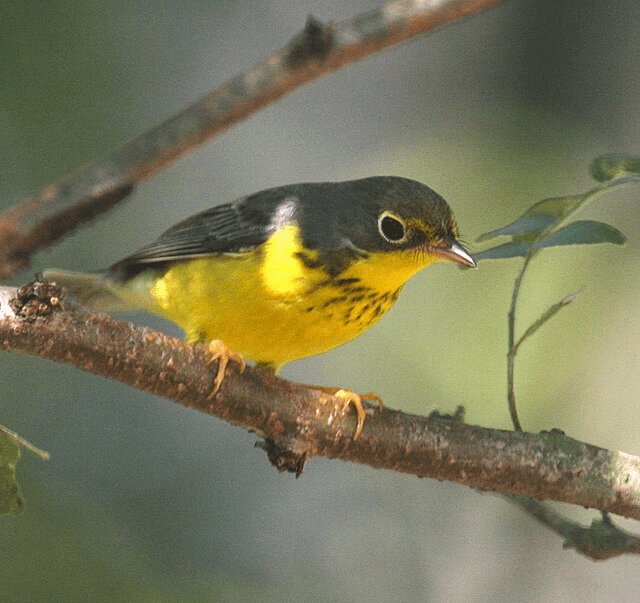
The iconic Canada Warbler is one of several endangered species living in the area proposed for the Near Surface Disposal Facility, Photo, Emmett Hume, Creative Commons Attribution 3.0, https://commons.wikimedia.org/wiki/File:Canada_Warbler_on_Bough.jpg

After a summer rainfall, little streams and rivulets flow down the hillside into the wetlands at its base. These wetlands and nearby Perch Lake provide abundant food for birds and bats and for many small mammals, which in turn attract larger mammals. They also support many aquatic animals such as fish, frogs, waterfowl and turtles, including endangered Blanding’s Turtles. 

The hillside forest is vibrant and green, blanketed with mosses and lichens and full of diverse species of trees including endangered Black Ash. The sandy warm soil on the southwest-facing slope supports three active Black Bear dens. A deer yard provides an ideal winter feeding ground for endangered Eastern Wolves that have dens nearby. 

This rich web of diverse animal and plant life is unique and rare. It likely evolved here because of the hill’s southern exposure, abundant water and extensive riparian zones where land and water meet. Lack of human interference was key. Humans have not been permitted to wander here for 80 years because it is located on the Chalk River Laboratories property, a fenced off, no-go zone since the first nuclear reactor was built there in 1945.

Incredibly, this is the very spot Canadian Nuclear Laboratories (CNL) has chosen to build its controversial, giant, above-ground nuclear waste dump called the Near Surface Disposal Facility (NSDF). CNL chose the site mainly to reduce hauling costs for one million tons of radioactive waste it plans to put in the dump. After clearcutting the forest, they would blast the hillside with explosives to flatten it, turning 37 hectares of forest into half a million tons of rock rubble.

CNL is owned by a multinational private-sector consortium that operates Canada’s federal nuclear laboratory under a $1.2 billion per year contract with the Government of Canada.

Environment and Climate Change Canada (ECCC) granted CNL a permit to destroy endangered species and their residences in order to build the NSDF. According to the Species at Risk Act, such permits should only be granted if the applicant considered all reasonable alternatives and adopted the best solution to reduce impacts on endangered species. 

The ECCC permit decision was successfully challenged in Federal Court by Kebaowek First Nation and allies who believe that ECCC did not receive complete information about how the site was chosen and made errors in granting the permit. CNL appealed the lower court decision and the appeal hearing was held on November 12, 2025 in Ottawa.  A ruling from the Federal Court of Appeal is expected soon; it will determine whether the permit gets sent back for redetermination by ECCC or not. The fate of a unique and irreplaceable wildlife habitat hangs in the balance.

Lynn Jones is a member of Concerned Citizens of Renfrew County and Area. She is based in Ottawa

Ottawa River Nuclear Waste Dump ~ Species-at-Risk Appeal hearing and rally November 12, 2025

A hearing this Wednesday November 12 in the Federal Court of Appeal, before a panel of three judges, will be a test of Canada’s commitment to protect threatened and endangered species and may determine whether the giant Ottawa River nuclear waste dump can be built or not. You can watch the hearing on Zoom by registering at this link, and you are also invited to a rally, “Stand up for Wildlife,” from noon to 2 pm outside the courtroom on Sparks St. in Ottawa.

Background:

Earlier this year we celebrated the successful legal challenge to the granting of a Species-at-Risk permit to Canadian Nuclear Laboratories (CNL) for the construction of the nuclear waste dump known as the “NSDF.” The legal challenge was brought by Kebaowek First Nation, Concerned Citizens of Renfrew County and Area, the Canadian Coalition for Nuclear Responsibility, and Sierra Club Canada Foundation.

You may recall that CNL is owned by a multinational private-sector consortium that operates Canada’s federal nuclear labs under a $1.6 billion per year contract with the Government of Canada. CNL needed a Species-at-risk permit in order to construct its controversial, giant, above-ground nuclear waste dump beside the Ottawa River because the site they chose for the dump is on federal land smack dab in the middle of irreplaceable wildlife habitat that is home to many species at risk. A permit would allow CNL to destroy habitat and residences for threatened and endangered species in order to construct its giant dump.

In order to get a permit, a proponent must prove that it carefully considered all possible alternatives and chose the one with the least impact on endangered species. CNL did not do this. In fact, it is on record as saying it chose the location because it would reduce transportation costs. In his ruling issued on March 14, 2025, Justice Russel Zinn said the environment minister’s issuing of the species-at-risk permit was “unreasonable due to fatal flaws” in interpreting and applying the federal Species at Risk Act, adding that the issuing of the permit must be reconsidered. 

Unfortunately for threatened wildlife and for Canadian taxpayers, who foot the bill for everything the multinational consortium does under its contract with the government, the case was appealed by CNL. Hence, the evidence will be reviewed again on November 12, this time in the federal court of appeal, by a panel of three judges.

The legal case here is fairly cut and dried; it will be interesting to see how it plays out. But behind the straightforward legal arguments lies a shocking story of disregard for wildlife that we discovered when we applied for the initial judicial review and received 4,000 pages of material connected with the permit application. Among other things, we learned that CNL knew that the site was very rich in biodiversity, but chose it anyway. The site is located on a south facing densely forested hillside that rises 140 feet above five named wetlands at its base, critical habitat for endangered Blanding’s turtles. The forest stands have old growth characteristics and provide prime habitat for endangered bats and songbirds such as the Canada Warbler, Golden-winged Warbler and Eastern Whip-poor-will. To create a flat surface for the NSDF, clear cutting and extensive blasting would convert 28 hectares of forested hillside into 170,000 cubic metres of rock, with unknown but likely adverse effects on the surrounding wetlands. More than 10,000 mature trees would be cut down, including provincially-endangered Black Ash trees. Kebaowek First Nation found three active bear dens on the site, and evidence of extensive use of the site by threatened Eastern Wolves. Both bears and wolves are species of great cultural importance to Algonquin peoples. 

Seethis post on the Concerned Citizens website, for more detail on CNL’s disregard for wildlife in its choice of a site for the NSDF.

The beautiful artwork below is by Destiny Cote of Kitigan Zibi Anishinabeg. Eastern Wolves are one of the threatened species that would be adversely affected by the NSDF.