


See also:
Update ~ July 5, 2023
Three recent submissions to the Canadian Nuclear Safety Commission by Dr. J.R. Walker, Canada’s foremost expert on the Government of Canada’s legacy radioactive wastes and how to properly manage them can be accessed here and here. (Backup source in case CNSC website not working)
According to his Linked In, Dr. Walker was the Director of Safety Engineering and Licensing at AECL when he retired before the multinational consortium took over management of Chalk River Laboratories. He was identified as “champion” on behalf of AECL in this CNSC protocol for the Nuclear Legacy Liabilities Program. He states very clearly in his submissions to the CNSC that the wastes proposed for disposal in the NSDF are “intermediate level wastes” that require underground disposal. He says the dump would be hazardous and radioactive for many thousands of years and that radiation doses from the facility would exceed allowable levels.
Here are some excerpts from Dr. Walker’s final submission to the CNSC dated May 30, 2023: (emphases added)
“No inventory management system is in place to comprehensively verify that waste packages and unpackaged waste accepted for emplacement comply with the radiological parameters of the stated waste acceptance criteria;
“The waste acceptance criteria are insufficiently protective for the material permitted to be emplaced in the proposed Engineered Containment Mound to qualify as low level waste — the radionuclides do not decay to an acceptable level during the time that institutional controls can be relied upon. Consequently, the emplaced material is intermediate level radioactive waste that should not be emplaced in a near surface facility because it requires a greater degree of containment and isolation than that provided by near surface disposal;
“Using the waste acceptance criteria credited in the proponent’s Environmental Impact Statement, it possible to calculate when the constituent radionuclides of the stated inventory would decay sufficiently to meet Canada’s regulatory criteria for disposal. This calculation reveals that many radionuclides would not decay sufficiently to meet Canada’s disposal criteria for many thousands of years and, in some cases, for many millions of years. This means that the safety of humans and nonhuman biota would be dependent upon institutional controls in perpetuity.
“The proposal is non-compliant with International Safety Standards, for example, no verification of the radioactive content of emplaced waste and reliance on institutional controls to ensure long-term safety. Canada is bound by international treaty to have due regard to internationally endorsed criteria and standards concerning radioactive waste management. Consequently, giving approval to the proposed ECM would appear to place Canada in contravention of its international treaty obligations.“
Fifteen former AECL officials and scientists have submitted critical comments on the CNL nuclear waste disposal projects. These people point out many serious flaws in the proposals and the environmental impact statements.
These comments were all submitted to CNSC/CEAA. Links are to the CEAA pages for the environmental assessments for the disposal projects
Most of these former AECL employees identify themselves as “residents of Deep River” or “residents of Pinawa” and do not refer to their employment at AECL in their submissions (but see Michael Stephens’ second NSDF submission). All are retired, but their former job titles or responsibilities – found through internet searching – are shown in parentheses, below.
Comments from AECL officials and scientists on the Near Surface Disposal Facility Project:
Michael Stephens (Manager, Business Operations, Liability Management Unit; Manager, Strategic Planning, Nuclear Legacy Liabilities Program, AECL)
Michael Stephens (2nd submission)
William Turner (Quality Assurance Specialist and Environmental Assessment Coordinator/Strategic Planner, AECL)
William Turner (2nd submission)
William Turner (3rd submission)
William Turner (4th submission)
William Turner (5th submission)
John Hilborn (Nuclear physicist, AECL)
J.R. Walker (Director, Safety Engineering & Licensing; Champion, NLLP Protocol, AECL)
J.R. Walker (2nd submission)
J.R. Walker (3rd submission)
Peter Baumgartner, Dennis Bilinsky, Edward T. Kozak, Tjalle T. Vandergraaf, Grant Koroll, Jude McMurry, Alfred G. Wikjord (all retired AECL Whiteshell Laboratories employees)
Pravin Shah (Manager, Site Landlord Services, AECL)
Greg Csullog (Manager, Waste Identification Program, AECL)
Greg Csullog (2nd submission)
David J. Winfield (30 years’ experience, research reactors and nuclear facilities, AECL)
Comments from AECL officials and scientists on the Nuclear Power Demonstration Closure Project:
William Turner (Quality Assurance Specialist and Environmental Assessment Coordinator/Strategic Planner, AECL)
William Turner (2nd submission)
William Turner (3rd submission)
Michael Stephens (Manager, Business Operations, Liability Management Unit; Manager, Strategic Planning, Nuclear Legacy Liabilities Program, AECL)
J.R. Walker (Director, Safety Engineering & Licensing; Champion, NLLP Protocol, AECL)
Comments from AECL officials and scientists on the In Situ Decommissioning of the Whiteshell Reactor #1 Project
William Turner (Quality Assurance Specialist and Environmental Assessment Coordinator/Strategic Planner, AECL)
William Turner (2nd submission)
William Turner (3rd submission)
Michael Stephens (Manager, Business Operations, Liability Management Unit; Manager, Strategic Planning, Nuclear Legacy Liabilities Program, AECL)
Michael Stephens (2nd submission)
Peter Baumgartner (AECL Whiteshell Laboratories employee)
Peter Baumgartner (2nd submission)
Peter Baumgartner, Dennis Bilinsky, Edward T. Kozak, Tjalle T. Vandergraaf, Grant Koroll, Jude McMurry, Alfred G. Wikjord (all retired AECL Whiteshell Laboratories employees)
Peter Baumgartner, Dennis Bilinsky, Edward T. Kozak, Tjalle T. Vandergraaf, Grant Koroll, Jude McMurry, Alfred G. Wikjord (2ndsubmission)
Leonard Simpson (Director of Reactor Safety Research, AECL)
J.R. Walker (Director, Safety Engineering & Licensing; Champion, NLLP Protocol, AECL)
A multinational consortium wants to build two nuclear waste dumps alongside the Ottawa River upstream of Ottawa-Gatineau, one at Chalk River, Ontario and the other at Rolphton, Ontario. Both dumps disregard international safety guidelines and would leak radioactive materials into the Ottawa River, endangering drinking water for millions of Canadians living downstream.
Background:
In 1944 Chalk River Laboratories (CRL) were established to produce plutonium for nuclear weapons. Starting in 1952 the Labs were operated by “Atomic Energy of Canada Limited” (AECL). Besides producing plutonium, the labs established a prototype nuclear power reactor (NPD) upstream of Chalk River at Rolphton, and extracted “medical isotopes” from irradiated fuel. These activities and two serious accidents created large quantities of dangerous radioactive wastes. Cleanup costs are estimated at $8 billion.
The Harper government radically restructured AECL in 2015, creating a subsidiary called Canadian Nuclear Laboratories (CNL) and contracting a multinational consortium including SNC Lavalin, to operate the subsidiary and reduce the federal government’s nuclear cleanup liabilities quickly and cheaply. All four consortium members face or have faced criminal charges for fraud and corruption*. Annual costs to taxpayers tripled shortly after restructuring.
In 2016, CNL proposed to construct a giant, above-ground mound of radioactive waste (NSDF) at Chalk River and to entomb in concrete the NPD reactor at Rolphton. Both proposals disregard International Atomic Energy Agency safety standards and would permanently contaminate the Ottawa River with radioactive materials such as plutonium, caesium, strontium and tritium, some of which will be remain hazardous for over 100,000 years. CNL is also moving to bring thousands of shipments of radioactive waste (including highly toxic used fuel rods) to Chalk River from other federal sites in Manitoba, Ontario and Quebec.
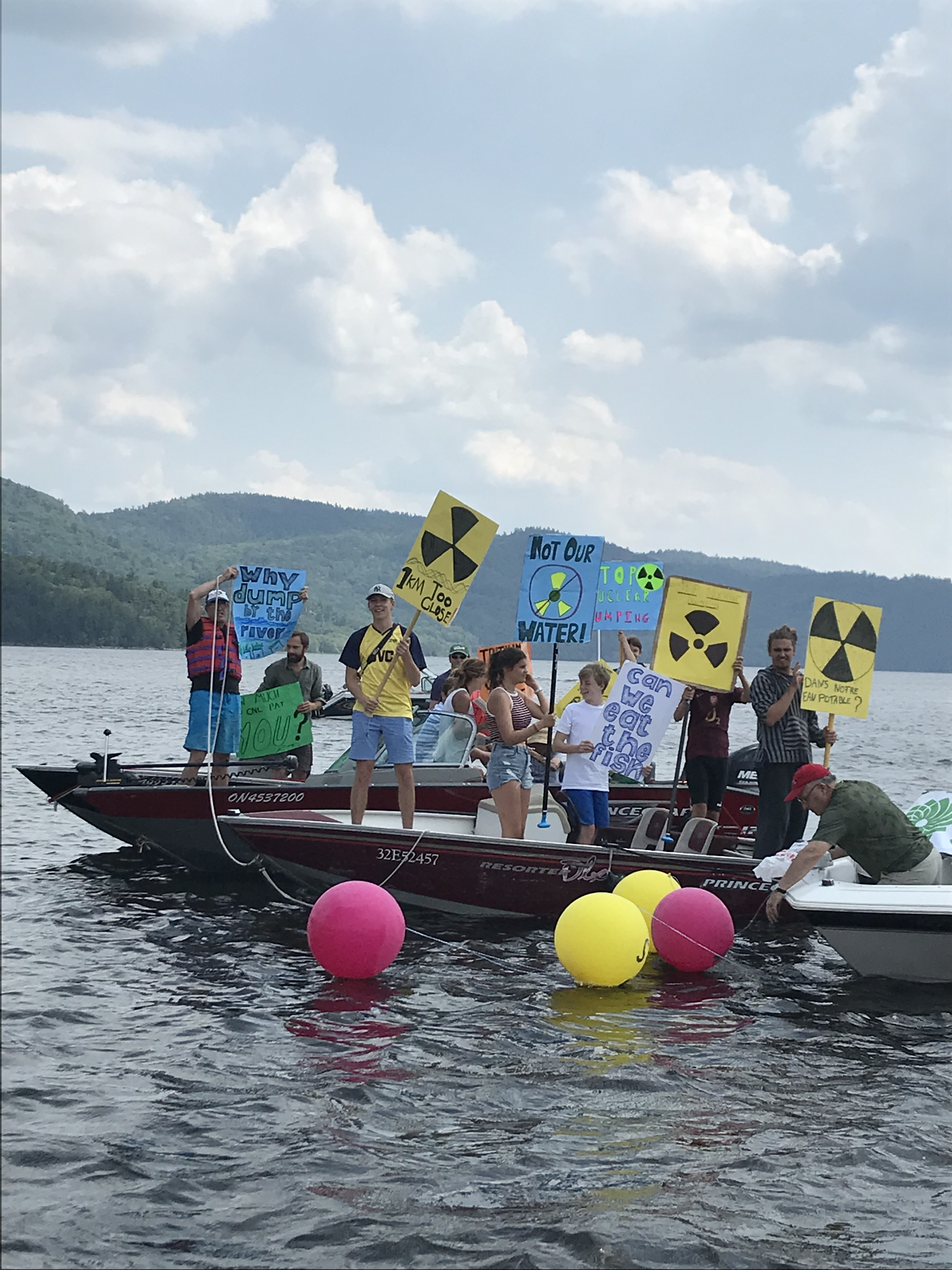
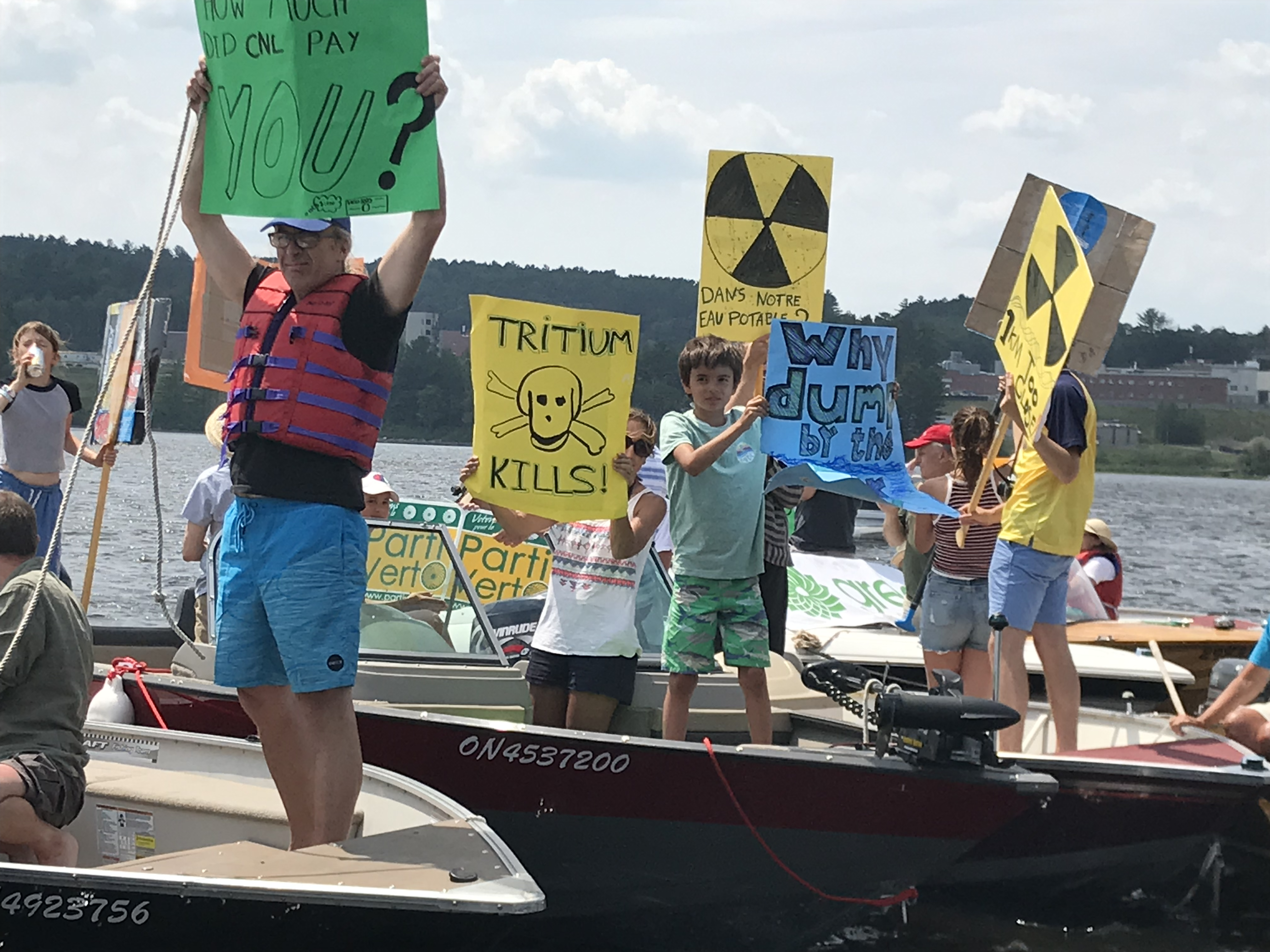
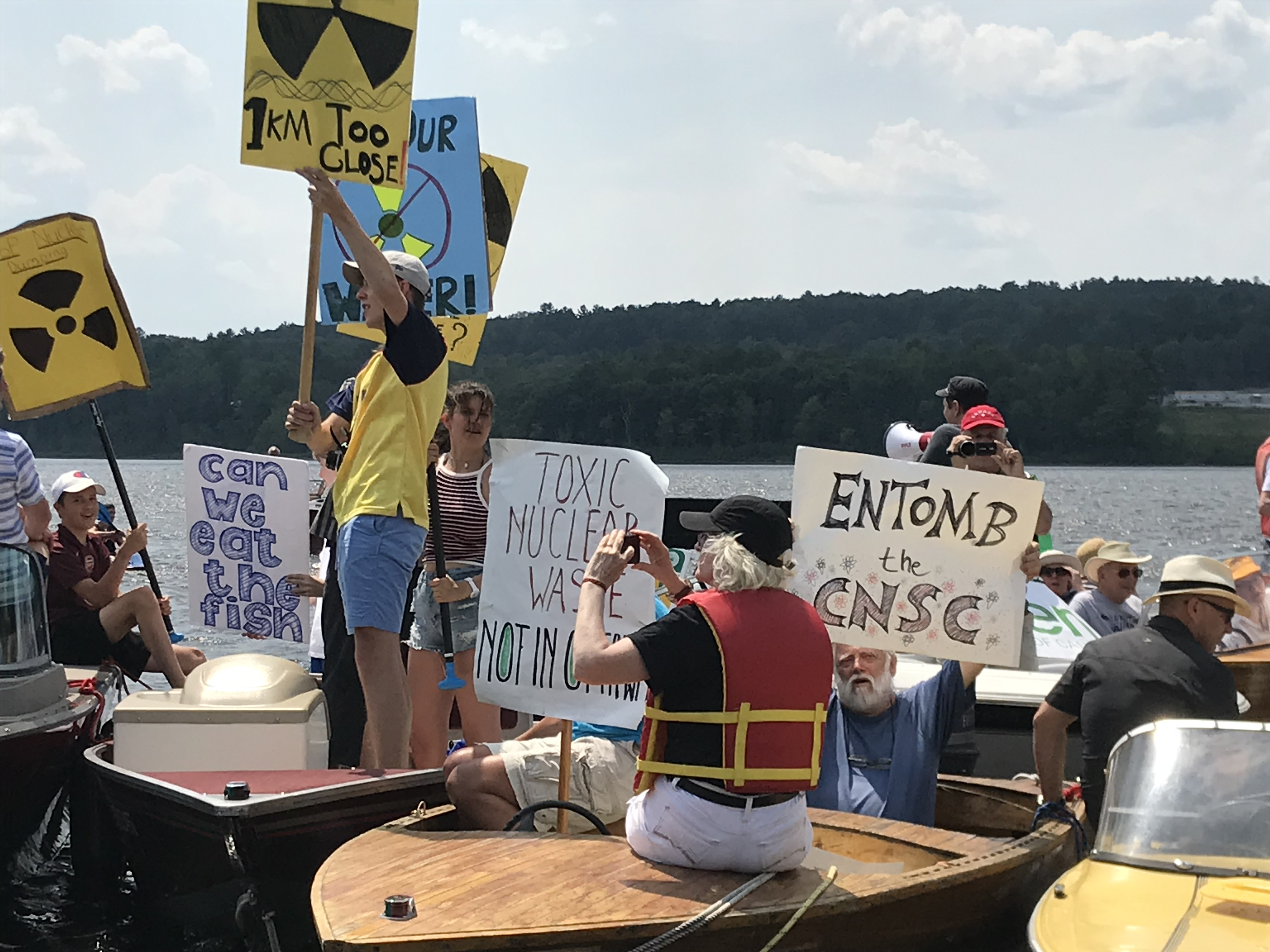
Independent experts, retired AECL scientists, Citizens’ groups, NGOs, 140 Quebec municipalities and several First Nations have been sounding alarm bells about the projects via written comments, resolutions, press conferences, and protests including a boat flotilla on the Ottawa River in August 2017 and a Red Canoe March for Nuclear Safety through the streets of downtown Ottawa in January of 2018.
In April 2018, CNL was granted a 10-year license despite widespread concern over license changes that would make it easier for the consortium to get its nuclear waste projects approved. Canada’s nuclear regulator, the Canadian Nuclear Safety Commission (CNSC), granted the new license. The CNSC is also in charge of environmental assessment (EA) and licensing for nuclear waste projects. The CNSC is perceived to be a “captured” regulator that promotes projects it is charged with regulating, according to Canada’s Expert Panel on EA reform. The CNSC’s mishandling of EAs for the consortium’s nuclear waste projects is described in Environmental Petition 413 to the Auditor General of Canada.
* The consortium, known as Canadian National Energy Alliance, includes: SNC-Lavalin,debarred by the World Bank for 10 years and facing charges in Canada of fraud, bribery and corruption; CH2M agreed to pay $18.5 million to settle federal criminal charges at a nuclear cleanup site in the U.S.; Fluor paid $4 million to resolve allegations of financial fraud related to nuclear waste cleanup work at a U.S. site; Rolls-Royce PLC, parent company of consortium member Rolls-Royce Civil Nuclear Canada Ltd., recently agreed to pay more than CAN$1 billion in fines for bribery and corruptionin the U.K., U.S. and Brazil. **NB** since this post was first published, membership in the consortium has changed. Rolls Royce is no longer listed as a consortium member on the CNEA website and Texas based Jacobs Engineering has recently acquired CH2M.
English version follows
(Fiche d’information préparée par les associations Old Fort William Cottager’s Association, Concerned Citizens of Renfrew County and area, le Ralliement contre la pollution radioactive et la Coalition contre le dépotoir nucléaire sur la rivière des Outaouais.)
Trois projets pour gérer l’héritage radioactif du Canada menacent de contaminer de matières radioactives l’eau potable de millions de Canadiens :
Actions proposées:
Fiche d’information préparée par les associations Old Fort William Cottager’s Association, Concerned Citizens of Renfrew County and area, le Ralliement contre la pollution radioactive et la Coalition contre le dépotoir nucléaire sur la rivière des Outaouais.
 Concerned Citizens of Renfrew County and Area