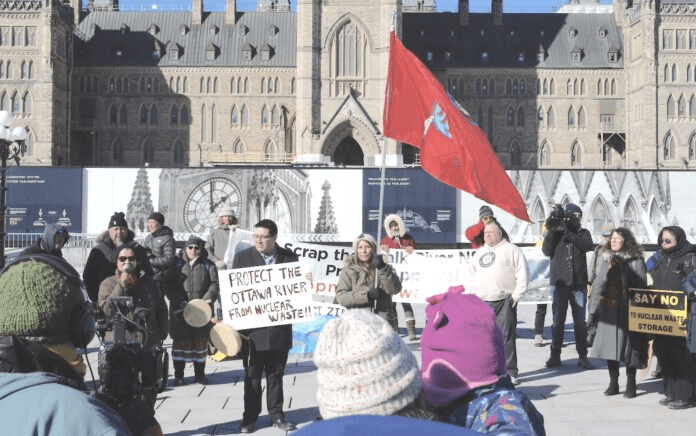
Kebaowek, May 29, 2026 – Kebaowek First Nation, Concerned Citizens of Renfrew County and Area, the Canadian Coalition for Nuclear Responsibility, and Sierra Club Canada Foundation welcome a significant victory following the decision of the Federal Court of Appeal to dismiss Canadian Nuclear Laboratories’ (CNL) appeal regarding the Species at Risk Act permit issued for the proposed Near Surface Disposal Facility (NSDF) at Chalk River. The Court upheld the Federal Court’s earlier ruling and ordered Environment and Climate Change Canada (ECCC) to reconsider its decision to grant the permit.
The permit would have authorized CNL to destroy endangered species and their habitats in order to construct a massive radioactive waste disposal facility less than 1.1 kilometres from the Ottawa River (Kichi Sibi), a watershed that provides drinking water to millions of Canadians.
In its decision, the Federal Court of Appeal concluded that ECCC failed to adequately explain how it determined that all reasonable alternatives had been considered and that the best solution had been selected, as required under the Species at Risk Act. The Court emphasized that the Minister’s reasons lacked sufficient transparency, intelligibility, and justification, and directed ECCC to conduct a new determination. The Court also confirmed that the Federal Court’s interpretation of section 73 of the Species at Risk Act is not binding on ECCC and that the Minister must independently provide a clear and reasonable analysis when reconsidering the permit application. Furthermore, the Court found that the public notice issued by ECCC failed to provide a meaningful explanation to Canadians about why endangered species would be harmed in support of the project.
The ruling represents another important legal milestone in the ongoing efforts to protect species at risk, uphold environmental laws, and ensure accountability in decision-making surrounding the proposed NSDF.
“The Federal Court of Appeal has confirmed that Environment Canada must go back and do its job properly. This decision reinforces what we have been saying from the beginning: decisions that threaten endangered species, sensitive ecosystems, and our sacred river must be based on a transparent, rigorous, and lawful process. Kebaowek remains committed to protecting the Kichi Sibi, defending our responsibilities to future generations, the drinking water of millions of citizens of Quebec and Ontario, and ensuring that Indigenous rights and environmental protections are respected every step of the way,” said Chief Lance Haymond of Kebaowek First Nation.
The area selected by CNL for the NSDF is home to numerous species protected under the Species at Risk Act, including the Blanding’s Turtle, Little Brown Bat, Northern Myotis, Tri-coloured Bat, Canada Warbler, Golden-winged Warbler, Whip-poor-will, Eastern Wolf, and Black Ash. The proposed site consists of mature forests, wetlands, streams, and critical habitat that have remained largely undisturbed for decades.

The Eastern Wolf is one of several endangered species living in the area proposed for the Near Surface Disposal Facility at Chalk River Laboratories. Photo, Michael Runtz,
The organizations argue that CNL’s site selection process failed to adequately assess alternative locations that may have posed fewer risks to endangered species and their habitats. The Court’s decision now provides an opportunity for ECCC to conduct a more rigorous and transparent review of the evidence before making a new determination.
“This decision is an important victory for science, transparency, and common sense. The Court recognized that the public deserves meaningful explanations when decisions are made that could result in the destruction of endangered species and their habitats. The ecological value of this site is extraordinary, and it deserves careful consideration before irreversible damage is permitted,” said Ole Hendrickson, spokesperson for Concerned Citizens of Renfrew County and Area.
“This ruling confirms that environmental protections under the Species at Risk Act cannot simply be treated as a procedural box to check. We will continue working to ensure that all reasonable alternatives are fully examined and that the protection of species at risk remains a central consideration. More generally, we will work to ensure that the principle of “justification” is enshrined in Canadian law, as recommended twice by the International Atomic Energy Agency,” said Dr. Gordon Edwards, President of the Canadian Coalition for Nuclear Responsibility.
“The Court’s decision reinforces a fundamental principle: Canadians have the right to understand why environmental harm is being authorized and whether less damaging alternatives exist. This case is about accountability, transparency, and ensuring that environmental laws are applied as Parliament intended. Sierra Club Canada Foundation remains committed to supporting efforts that protect biodiversity and uphold the public interest,” said Gretchen Fitzgerald, Executive Director, Sierra Club Canada Foundation.
This decision builds upon two important Federal Court rulings related to the proposed NSDF project. In March 2025, the Federal Court ruled that the Species at Risk Act permit issued for the project must be reconsidered because reasonable alternative locations were not properly assessed. In a parallel case, the Federal Court also ruled in favour of Kebaowek First Nation regarding the implementation of the United Nations Declaration on the Rights of Indigenous Peoples (UNDRIP) and the duty to consult in the NSDF licensing process. That landmark decision is currently before the Federal Court of Appeal and is expected to help clarify how Free, Prior and Informed Consent (FPIC) and UNDRIP should be applied in federal regulatory decision-making across Canada.
While the Court has returned the matter to ECCC for redetermination rather than permanently rejecting the permit, the organizations intend to actively participate in the reconsideration process. They will continue to present evidence demonstrating that alternative locations exist and that the proposed Chalk River site is not the best option for protecting species at risk and their habitats.
The organizations also note that CNL may seek leave to appeal to the Supreme Court of Canada, although leave applications are granted only in a small number of cases involving issues of national importance.
Kebaowek First Nation, Concerned Citizens of Renfrew County and Area, the Canadian Coalition for Nuclear Responsibility, and Sierra Club Canada Foundation remain united in their commitment to protecting the Ottawa River watershed, safeguarding endangered species, and ensuring that environmental decision making respects both ecological integrity and Indigenous rights.
For more information on Kebaowek First Nation’s efforts to halt the NSDF project, visit Stop Nuclear Waste website.
For more information on how to support Kebaowek First Nation’s legal efforts, visit Kebaowek First Nation – Raven Trust
-30-
Source: Kebaowek First Nation Kebaowek First Nation, Concerned Citizens of Renfrew County and Area, Canadian Coalition for Nuclear Responsibility and Sierra Club Canada Foundation
For media inquiries or interview requests:
Mathilde Robitaille-Lefebvre
Media Relations
m.robitaille-lefebvre@seize03.ca
819-852-4762