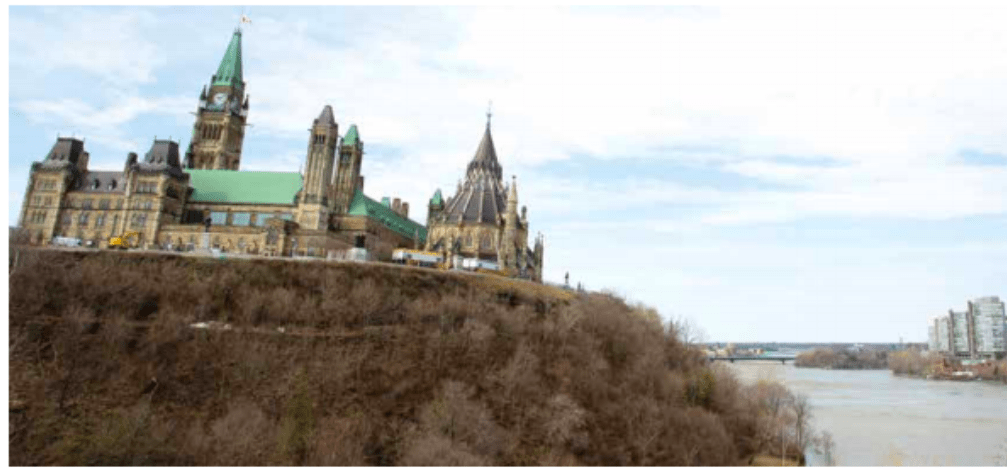
Hill Times ~ Le déluge souligne l’importance de l’audience finale pour le dépôt de déchets nucléaires – Audience finale des délégations de trois premières nations

THE HILL TIMES | LUNDI 21 AOÛT 2023

Il est grand temps que le gouvernement s’occupe de cette catastrophe environnementale en devenir, un problème grave qui s’aggravera si on l’ignore.

OTTAWA – Le 10 août, la Commission canadienne de sûreté nucléaire a tenu une audience finale sur l’autorisation d’un gigantesque dépôt de déchets radioactifs en surface près de la rivière des Outaouais, en amont d’Ottawa-Gatineau et de Montréal, à Chalk River (Ontario), qui a créé un précédent.

Des délégations de trois Premières Nations algonquines – Kebaowek, Kitigan Zibi et Barriere Lake – se sont réunies au 50 Sussex Dr. à Ottawa pour faire leurs présentations finales en personne aux membres de la communauté, aux alliés non autochtones et à une poignée de représentants élus, au mépris d’un décret de la Commission canadienne de sûreté nucléaire (CCSN) stipulant que l’audience ne serait que virtuelle. La CCSN a présidé l’audience via Zoom.

Pendant l’audience, une tempête sans précédent s’est abattue sur le site, avec d’énormes quantités de pluie, de tonnerre, de grêle et de vent qui ont soufflé sur les chaises de la terrasse extérieure couverte où la foule en surnombre regardait les débats. Malgré la férocité de l’orage, les aînés algonquins ont entretenu un feu sacré cérémoniel tout au long de la cérémonie.

Si le projet est approuvé, la décharge géante, appelée “installation de stockage en surface” (IGDPS) par le promoteur, contiendrait un million de tonnes de déchets radioactifs et dangereux dans un monticule en surface sur la propriété des laboratoires de Chalk River, une installation nucléaire fédérale fortement contaminée établie sur des terres algonquines volées en 1944 afin de produire du plutonium pour les armes nucléaires américaines. Les laboratoires de Chalk River représentent un énorme passif environnemental pour le gouvernement du Canada, avec un coût de dépollution estimé à plusieurs milliards de dollars.

Le promoteur de la décharge est un consortium multinational composé de SNC-Lavalin et de deux multinationales basées au Texas : Fluor et Jacobs. Le consortium a été engagé par le gouvernement conservateur en 2015 pour réduire rapidement et à moindre coût l’énorme responsabilité fédérale en matière de déchets nucléaires hérités. Paradoxalement, les coûts pour les contribuables de la gestion des déchets radioactifs hérités du gouvernement fédéral canadien ont grimpé à plus d’un milliard de dollars par an après la privatisation.

L’audition du 10 août a créé un précédent à deux égards. Si elle est approuvée, l’IGDPS sera la toute première installation de stockage permanent des déchets de réacteurs nucléaires au Canada. Deuxièmement, la décision d’autoriser ou non l’installation est un test important de l’engagement du Canada envers la Déclaration des Nations unies sur les droits des peuples autochtones, qui interdit le stockage de déchets radioactifs sur les terres des peuples autochtones sans leur consentement libre, préalable et éclairé. Dix des onze Premières nations algonquines, dont les membres vivent dans la vallée de l’Outaouais depuis des temps immémoriaux, ont déclaré qu’elles ne consentaient pas à ce que l’ IGDPS soit implanté sur leur territoire non cédé.

Bon nombre des déchets qu’il est proposé d’éliminer dans le NSDF resteront dangereux et radioactifs pendant des milliers, voire des millions d’années, selon le Dr. J.R. Walker, le plus grand expert canadien en matière de déchets radioactifs hérités du gouvernement fédéral et de la meilleure façon de les gérer. M. Walker a clairement indiqué que les déchets proposés pour l’IGDPS ne sont pas des déchets de faible activité, mais des déchets radioactifs de “niveau intermédiaire” qui devraient être éliminés à des dizaines, voire des centaines de mètres sous la surface du sol. Il a également affirmé que la proposition n’était pas conforme aux normes de sécurité internationales.

Le site proposé pour l’IGDPS se trouve sur le flanc d’une colline entourée de zones humides qui se jettent dans la rivière des Outaouais, à moins d’un kilomètre de là.

La déclaration d’impact sur l’environnement du promoteur documente les nombreuses façons dont la décharge pourrait fuir pendant son exploitation et après sa fermeture. Trois isotopes du plutonium figurent sur la longue liste des radionucléides qui seraient rejetés dans la rivière des Outaouais dans les “effluents traités” de la décharge. Le monticule devrait se dégrader, s’éroder et finalement se désintégrer en raison de “l’évolution naturelle”.

La plupart des gens pensent qu’il est répréhensible de déverser délibérément des matières radioactives dans une importante source d’eau potable telle que la rivière des Outaouais, car il n’existe pas de niveau d’exposition sûr à ces poisons fabriqués par l’homme. Chaque rejet accidentel ou délibéré augmente les risques de cancer, de malformations congénitales et de dommages génétiques chez les populations exposées.

L’Assemblée des Premières Nations et plus de 140 municipalités situées en aval, dont Ottawa, Gatineau et Montréal, ont adopté des résolutions exprimant leur inquiétude à l’égard de la proposition du IGDPS.

Malgré les nombreuses lacunes et la forte opposition, le personnel de la Commission canadienne de sûreté nucléaire n’a jamais hésité à soutenir le projet de décharge. Il semble qu’il n’ait jamais reçu le mémo en 2000 lorsque le mandat de l’organisation a été modifié par une nouvelle législation, passant d’un rôle de promotion de l’industrie nucléaire à un mandat strictement axé sur la protection des Canadiens et de l’environnement.

L’audience du 10 août a été présidée par un seul commissaire, ainsi que par la présidente de la CCSN. Leurs curriculum vitae respectifs font état de longs états de service et d’allégeance à l’industrie nucléaire. Les deux fonctionnaires n’ont pas posé une seule question aux équipes d’intervenants des Premières nations, qui étaient manifestement choquées par le manque d’intérêt pour les informations qu’elles s’étaient donné tant de mal à rassembler et à partager. Un membre de l’équipe a demandé : “Pouvons-nous vous poser des questions ?”, ce à quoi le président a sèchement répondu : “Ce n’est pas notre façon de procéder.”

Le régime de gouvernance nucléaire gravement déficient du Canada a été décrit précédemment dans le Hill Times. La gouvernance nucléaire au Canada s’appuie fortement sur la CCSN pour presque tous les aspects de la surveillance de l’industrie nucléaire. La CCSN est largement perçue comme un “régulateur capturé” qui promeut les projets qu’elle est censée réglementer.

Il est clair que notre régime de gouvernance nucléaire gravement déficient a permis à l’IGDPS – un simulacre grotesque d’installation de gestion responsable des déchets radioactifs – d’être proposée et prise au sérieux au Canada. La décision de la CCSN d’approuver le permis pour l’IGDPS est attendue prochainement.

La puissante tempête qui s’est abattue sur le 50 Sussex Dr. pendant que l’on entendait des témoignages en langue algonquine sur la cupidité et la destruction inconsidérée de l’environnement a souligné la gravité de la décision envisagée. Il ne fait aucun doute qu’une tempête record comme celle qui a frappé l’IGDPS au cours de sa phase de remplissage de 50 ans – alors que les déchets sont exposés aux éléments – pourrait facilement provoquer d’importants déversements de poisons radioactifs et d’autres matières dangereuses dans la rivière des Outaouais.

Il est grand temps que le gouvernement se réveille et s’attaque à cette catastrophe environnementale en cours, un problème grave qui ne fera que s’aggraver au fur et à mesure qu’il sera ignoré.

————————————————————————–

Lynn Jones est une gestionnaire de programme de santé publique à la retraite qui travaille maintenant pour Concerned Citizens of Renfrew County and Area, une organisation non gouvernementale qui œuvre depuis plus de 40 ans à l’assainissement et à la prévention de la pollution radioactive provenant de l’industrie nucléaire dans la vallée de l’Outaouais. Elle est basée à Ottawa.

L’image ci-dessous est une simulation de l’effet baignoire tirée du documentaire de Découverte “Chalk River Heritage”.

Hill Times ~ Deluge underlines the importance of final hearing for nuclear waste dump beside the Ottawa River

Published in the Hill Times Monday August 21, 2023

On August 10, 2023, the Canadian Nuclear Safety Commission held a precedent-setting final licensing hearing for a giant above-ground radioactive waste dump beside the Ottawa River upstream of Ottawa-Gatineau and Montreal at Chalk River, Ontario.

Delegations from three Algonquin First Nations – Kebaowek, Kitigan Zibi and Barriere Lake – gathered at 50 Sussex Drive to make their final presentations in-person to community members, non-Indigenous allies and a handful of elected officials, in defiance of a Canadian Nuclear Safety Commission (CNSC) decree that the hearing would be virtual only. The CNSC presided over the hearing by Zoom.

While the hearing was taking place, an unprecedented storm hit the venue with huge amounts of rain, thunder, hail and wind that blew over the chairs on the outdoor covered terrace where the overflow crowd was watching the proceedings. Despite the ferocious storm, Algonquin Elders kept a ceremonial sacred fire burning throughout.

If approved, the giant dump, called a “near-surface disposal facility” (NSDF) by the proponent, would hold one million tonnes of radioactive and hazardous waste in an above-ground mound on the property of Chalk River Laboratories, a heavily contaminated federal nuclear facility established on stolen Algonquin land in 1944 to produce plutonium  for US nuclear weapons. Chalk River Laboratories is a huge environmental liability for the Government of Canada, with an estimated cleanup cost in the billions of dollars.

The dump proponent is a multinational consortium comprised of SNC-Lavalin, and two Texas-based multinationals, Fluor and Jacobs. The consortium was contracted by the Harper government in 2015 to quickly and cheaply reduce the enormous federal legacy nuclear waste liability. Perversely, costs to Canadian taxpayers for managing Canada’s federal legacy radioactive wastes ballooned to more than 1 billion dollars per year after privatization.

The August 10 hearing was precedent-setting in two ways.  If approved, the NSDF would be the first ever facility for permanent disposal of nuclear reactor waste in Canada. Secondly, the decision whether or not to license the facility is an important test of Canada’s commitment to the United Nations Declaration on the Rights of Indigenous Peoples, which forbids storage of radioactive waste on the land of Indigenous Peoples without their free, prior and informed consent. Ten of the eleven Algonquin First Nations whose people have lived in the Ottawa Valley since time immemorial say they  do not consent to the NSDF on their unceded territory.

Many of the wastes proposed for disposal in the NSDF will be hazardous and radioactive for thousands to millions of years, according to Canada’s foremost expert on the federal legacy radioactive wastes and how best to manage them, Dr. JR Walker.  Dr. Walker has clearly stated that wastes proposed for the NSDF do not qualify as low level waste but are in fact “intermediate level” radioactive waste that should be disposed of tens to hundreds of meters below the ground surface. He also notes that the proposal is non-compliant with International Safety Standards.

The site for the proposed “NSDF” is on the side of a hill surrounded by wetlands that drain into the Ottawa River – less than one kilometre away. The proponent’s environmental impact statement documents many ways the dump could leak during operation and after closure. Three isotopes of plutonium are included in the long list of radionuclides that would be discharged into the Ottawa River in “treated effluent” from the dump. The mound is expected to degrade and erode and eventually disintegrate due to “natural evolution.”  

Most people believe it is wrong to deliberately discharge radioactive materials into a major drinking water source such as the Ottawa River, since there is no safe level of exposure to these man-made poisons. Every accidental and deliberate discharge increases risks of cancer, birth defects and genetic damage in the populations exposed.

The Assembly of First Nations and more than 140 downstream municipalities – including Ottawa, Gatineau and Montreal – have passed resolutions of concern about the NSDF proposal. 

Despite the many serious shortcomings and strong opposition, the Canadian Nuclear Safety Commission staff have never wavered in their support for the dump. It appears they never “got the memo” back in 2000, when the organization’s mandate changed under new legislation from a role that included promotion of the nuclear industry, to a mandate strictly focused on protecting Canadians and the environment.

The August 10 hearing was presided over by only one Commissioner – along with the CNSC President. Both of their CVs tout long service and allegiance to the nuclear industry. The two officials askednot one single question of the First Nation intervenor teams, who were clearly shocked by the lack of interest in the information they had gone to such great lengths to gather and share. A member of the team asked, “Well, can we ask you some questions?” to which the President curtly replied, “That’s not our process.”

Canada’s seriously deficient nuclear governance regime has been described previously in the Hill Times here and here.  Nuclear governance in Canada relies heavily on the Canadian Nuclear Safety Commission for almost all aspects of nuclear industry oversight. The CNSC is widely perceived to be a “captured regulator”  that promotes the projects it is supposed to regulate.

It is clear that our seriously deficient nuclear governance regime has enabled the NSDF — a grotesque mockery of a responsible radioactive waste management facility—  to be proposed and taken seriously in Canada. A CNSC decision to approve the license for the NSDF is expected soon.

The powerful storm that pounded 50 Sussex Drive while testimony was being heard in the Algonquin language about greed and heedless destruction of the environment, underlined the serious decision being contemplated. There is no question that a record-breaking storm like that one, hitting the NSDF during its 50-year long filling stage – while wastes are exposed to the elements, could readily cause large spills of radioactive poisons and other hazardous materials into the Ottawa River.

It’s long past time that the government woke up and dealt with this environmental catastrophe in the making, a serious problem that will only grow steadily worse the longer it is ignored.

Lynn Jones is a retired public health program manager now with Concerned Citizens of Renfrew County and Area, a non-governmental organization that has been working for the clean-up and prevention of radioactive pollution from the nuclear industry in the Ottawa Valley for over 40 years. She is based in Ottawa.

Image below is a simulation of the bathtub effect from the Decouverte documentary “Chalk River Heritage.”

Trudeau’s got to walk the talk on nuclear waste (Hill Times op-ed by Michael Harris)

https://www.hilltimes.com/2021/04/26/294820/294820

The Hill Times
By MICHAEL HARRIS       APRIL 26, 2021

If the Trudeau government is doing more than virtue signalling in its most recent budget, if it is truly committed to making environmental issues top of agenda goals, there are two things that it should be leading on. 
Photo: Prime Minister Justin Trudeau, pictured March 3, 2021, walking down Wellington Street in Ottawa to the Sir John A. Macdonald Building for that day’s press conference. The government should have condemned Japan’s nuclear dump into the Pacific Ocean—as both bad practice, and dangerous precedent, writes Michael Harris.


HALIFAX—Holding the Tokyo Olympics during a pandemic was always a bad idea.

Sending a national team to compete in Japan, which has just declared a third state of emergency for the Tokyo, Osaka region, is simply insanity.

With more than three million people dead worldwide, vaccine shortages, and several countries like India, Pakistan, and Brazil struggling with a third wave of this constantly mutating killer-virus, why would you?  In COVID Times, travelling and congregating are the new Russian Roulette.

With Earth Day fresh in everyone’s mind, there is another reason not to attend the Olympic Games in Japan. As I have recently reported in The Hill Times, after seven years of handwringing, Japan’s government has decided to dump radioactive waste water from the doomed Fukushima nuclear plant into the Pacific Ocean. The toilet of last resort. The shit-show is set to begin in 2023, and go on for decades.

Three neighbours are glow-in-the-dark furious about Japan’s decision. Taiwan is livid. China called the announced nuclear dump into fishing grounds “unilateral” and “extremely irresponsible.” South Korea, a huge fish-consuming nation, said the move was “totally unacceptable.”

Don’t be surprised if these countries take counter-measures, including reconsidering their attendance at the Olympics. (North Korea has already opted out because of COVID).

There is another group profoundly impacted by this crime against the planet.

Japanese fishermen devastated by the March 11, 2011, nuclear disaster at Fukushima, remain adamantly opposed to their government’s plan. They have struggled for eight years to rebuild their fishery.

That appears to have been the death march of futility. The market for Fukushima fish will be about as brisk as the demand for Chernobyl potatoes, or vacation packages to Montserrat, after the volcano erupted on the Caribbean Island.

What country that is truly committed to rescuing the environment from damage inflicted by humans, hopefully before Earth morphs into Mars, could attend an athletic contest hosted by a government that is deliberately poisoning the ocean with nuclear waste?

And not just a little radioactive water—a million tonnes worth. The now contaminated water was once used to cool the Daiichi nuclear facility at Fukushima. That was before an earthquake and 15-metre tsunami triggered a triple meltdown at the installation. This caused hydrogen explosions, widespread contamination of land in and around the reactor site, and a huge public evacuation.

Now that contaminated water sits in a thousand storage tanks on the wrecked site. Every day, 170 tonnes of freshly contaminated ground water flowing into the installation is added to this dread inventory of nuclear sewage.

The Japanese government argues that it is not just dumping nuclear waste into the Pacific, but treated radioactive waste. It will only be somewhat contaminated.

And even though it won’t be able to remove any of the tritium in the treated toxic stew from Fukushima, tritium is the least harmful of all the radioactive elements. That’s because it’s only a mildly radioactive isotope of hydrogen, you see, trivial really. And besides it will be diluted, and it will meet global standards of practice, blah, blah, blah.

And who will be in charge of this operation? The Tokyo Electric Power Company, the same company that built and operated the Fukushima Daiichi nuclear power plant, and is now in charge of the 40-year recovery plan for this catastrophic property.

Feel comforted? Who will ever know if they “treat” and remove all the radioactive iodine and strontium 90 from the ocean-bound contaminated water? The fish I guess.

The International Atomic Energy Agency clearly doesn’t seem concerned. Rafael Grossi, the agency’s Director-General, tweeted this endorsement: “I welcome Japan’s announcement on how it will dispose of the treated water stored at Fukushima nuclear power plant. @IAEA will work with Japan before, during, and after the discharge of the water to help ensure this is carried out without an adverse impact on health and environment.”

A further statement from the IAEA reinforced the director general’s glad-handing.

“Today’s decision by the government of Japan is a milestone that will help pave the way for continued progress in the decommissioning of the Fukushima Daiichi nuclear power plant.”

The United States gave its own PR pat on the back to Japan’s mind-numbing decision, claiming that the approach being taken appeared to be in line with global standards, “without an adverse impact on human health and the environment.”

Not a thing to worry about. Whenever something truly awful happens involving the nuclear industry, or a terrible decision is made by government, the watch words of the day are “downplay,” “minimize,” and “deny.”

The plain fact is that energy produced from nuclear plants has a fundamental flaw that no one in the nuclear industry has been able to solve: there is still no safe, long-term way to dispose of the nuclear waste that these plants produce.

The U.S., for example, still doesn’t have a deep depository dump for all the radioactive waste from 70 years of being in the nuclear weapons business.

They tried for decades to sell Nevada on making Yucca Mountain the permanent storage site for America’s nuclear waste. They failed because no rational population wants a product that retains its chemical toxicity for millennia to be stored in their backyard.

That might have something to do with what happened at the Waste Isolation Pilot Plant in New Mexico in 2014. A drum containing radioactive plutonium and americium waste blew up deep in the mine.  Plumes of radioactive foam contaminated 35 per cent of the installation.

The radioactive waste had been packaged at the Los Alamos National Laboratory. Not the boys in shipping and receiving. The best in the business. And it still ended in catastrophe.

If the Trudeau government is doing more than virtue signalling in its most recent budget, if it is truly committed to making environmental issues top of agenda goals, there are two things that it should be leading on.

First, the government should have condemned Japan’s nuclear dump into the Pacific Ocean—as both bad practice, and dangerous precedent.

Second, before investing any more public money in the nuclear route to achieve net zero carbon emissions by 2050, including small modular reactors, they have to have a safe, long-term option for handling Canada’s growing heap of nuclear waste.

Having that contaminated waste stored at nuclear reactor sites in Ontario, Quebec, and New Brunswick is merely an “interim” solution. Those sites are rapidly running out of space. Besides, the dry containers that hold the nuclear waste are designed to work for fifty years. The contamination persists for 250,000 years.

Japan wants the world to come to the Tokyo Olympics in the middle of a deadly pandemic, despite its dreadful decision to dump nuclear waste into the ocean, and a COVID emergency in that country. For both of these reasons, Canada should not attend.

Who wants to spread a plague to watch someone win a hundred-yard dash? And who wants a Radioactive Earth Day somewhere down the road?

Michael Harris is an award-winning author and journalist. 

Hendrickson: Council can do more to protect the Ottawa River from radioactive leaks (Ottawa Citizen)

Canadian Nuclear Laboratories’ plan for a radioactive waste landfill and a nuclear reactor disposal facility upstream from Ottawa must be rethought. Our local politicians should insist on it.Author of the article:Ole HendricksonPublishing date:Apr 13, 2021  •  

An aerial view of Chalk River laboratories on the shores of the Ottawa River.
An aerial view of Chalk River laboratories on the shores of the Ottawa River. SunMedia

Canadian Nuclear Laboratories (CNL) is planning a radioactive waste landfill and a nuclear reactor disposal facility near the Ottawa River, upstream from Ottawa and many other communities.

CNL claims these plans would be an improvement over the status quo. How credible is that claim? While a landfill might help in the short term, exposing wastes to extreme weather events is risky. In the longer term, CNL’s own reports suggest that our descendants could be living downstream from a leaking and disintegrating pile.

CNL says 10 per cent of the landfill’s radioactive waste would be imported. That would mean 100,000 tonnes of a total of one million tonnes: 50,000 tonnes from other contaminated federal nuclear sites in Manitoba, southern Ontario and Quebec; and another 50,000 tonnes of commercial wastes from across Canada.

Ottawa’s environmental protection committee recently heard from dozens of groups and individuals opposed to CNL’s plans. The committee passed a motion urging CNL to stop transferring radioactive waste from other provinces to the Chalk River federal site.

The remaining waste would be buildings and soil contaminated by nuclear operations at Chalk River since 1945, and waste containers already stored there. Once in the giant landfill, the containers would rust and disintegrate. The concentrated radioactive wastes in them would mingle with the soil and other materials. The result: a radioactive mess where it’s impossible to tell what’s what or to ever separate or extract the more toxic elements if things go wrong.

Meanwhile, the landfill would release large amounts of tritium which, when swallowed or breathed in, increases the risk of cancer and other diseases.

One way it could go wrong, described in CNL’s own report, is called the bathtub scenario. The top cover of the landfill is breached, the base fills up with water from rain and snow, and the now-contaminated precipitation overflows downhill to the Ottawa River a kilometre away.

CNL claims the landfill’s liner is good for 550 years. Many are skeptical of this claim. But eventually it is certain to fail.

Even after hundreds of years, the landfill would contain radioactive forms of plutonium, radium, polonium, uranium, thorium, chlorine, iodine and more. These radioactive substances take thousands to billions of years to decay. The landfill would also hold dioxins, PCBs, asbestos, mercury, arsenic and lead.

Nearby, CNL plans to “entomb” the Nuclear Power Demonstration (NPD) reactor that was shut down in 1987. Instead of removing the reactor, it would fill it with cement and grout. Like the landfill idea, this would leave no option for removing wastes once they start to leak into groundwater and the Ottawa River.

Both the proposed landfill and the NPD reactor site are on fractured bedrock with high rates of groundwater movement into the river.

In my presentation to Ottawa‘s environment committee I outlined a better approach:

• Stop transferring wastes from other federal nuclear sites to Chalk River;

• Dismantle (do not entomb) the NPD reactor;

• Upgrade the existing Chalk River groundwater treatment facilities to fully capture plumes of pollution coming from areas where wastes (even reactor cores) were dumped in the past;

• Remove the wastes that are the sources of these plumes, analyze them, repackage them, record the results, and put the packages in above-ground storage units as an interim measure; and

• Find a site well away from the river with stable, solid rock for an underground repository that can isolate long-lived radioactive wastes from the biosphere.

Ottawa’s environment committee has recognized this potential threat to our drinking water by requesting a regional impact assessment of radioactive disposal projects in the Ottawa Valley. This would fall under the federal minister of environment and the 2019 Impact Assessment Act.

Let’s hope city council agrees and claims a place at the table as decisions are made that will affect countless future generations of Ottawa residents.

Ole Hendrickson, PhD., is an environmental scientist living in Ottawa.

Hill Times Op-Ed: Political opposition growing to new nuclear reactors

By EVA SCHACHERL      DECEMBER 9, 2020

The nuclear industry and Liberals have not only been laying the groundwork for government funding. It appears they have been ensuring that the framework for nuclear energy in Canada gets even more accommodating.

Natural Resources Minister Seamus O’Regan has been hyping so-called next-generation reactors for months, portraying the industry as a future utopia. The Hill Times photograph by Andrew Mead.

Many Canadians are anxious to see what our energy future will be. Politically, it’s a question that stirs passions from Alberta’s oil patch to Ontario’s cancelled wind farms.

But political debate is picking up around our nuclear energy future. And with good reason. Government-funded expansion of the nuclear industry, and a simultaneous watering-down of regulations, could be the Liberal government’s toxic legacy.

Natural Resources Minister Seamus O’Regan has been hyping so-called next-generation reactors for months. A recent nuclear industry summit—hosted with federal funding—portrayed nuclear energy expansion in Canada as a future utopia.

The Green Party caucus, the NDP’s natural resources critic Richard Cannings, and the Bloc Québécois’s environment critic Monique Pauzé have all slammed O’Regan’s expected small modular reactor (SMR) “action plan.” They say it does not belong in a plan to reduce greenhouse gas emissions. Energy efficiency, wind, solar, and storage technologies are ready to build, and much cheaper, according to Lazard, a financial advisory and asset management firm. The prototype reactors will take years, if not decades, to develop, and could absorb hundreds of millions, even billions, in taxpayer subsidies, according to Greenpeace Canada.

That would mean opportunities lost for those dollars to build many times the amount of zero-emission energy with renewables and energy-efficiency projects. The latter would not create toxic radioactive waste for future generations to contend with.

Independent research says that a nuclear solution for remote communities (as proposed by the government) is likely to cost 10 times more to build and operate than the alternatives.

It seems inevitable that the Liberal action plan will soon be launched with generous handouts for the nuclear industry, whose aspiring players in Canada today include SNC-Lavalin and U.S. corporations like Westinghouse and GE-Hitachi Nuclear Energy. Few Canadians are aware that “Canadian” Nuclear Laboratories (CNL) is owned by a consortium of SNC-Lavalin and two U.S. firms, Fluor and Jacobs.

In recent years, the nuclear industry and Liberals have not only been laying the groundwork for government funding. It appears they’ve also been ensuring that the framework for nuclear energy in Canada gets even more accommodating.

The biggest step was exempting most new reactors from the Impact Assessment Act, which, in 2019, replaced the Canadian Environmental Assessment Act. This was deemed so important to the nuclear industry’s future that the Canadian Nuclear Safety Commission (CNSC) lobbied the Liberal government to exempt small reactors—and won. So much for the CNSC, the regulator that’s supposed to oversee the industry, being seen as objective and “world class.”

The Impact Assessment Act was intended to create “greater public trust in impact assessment and decision-making.”  But there will be no federal assessment of nuclear reactors up to 200 thermal MW in size, nor of new reactors built at existing nuclear plants (up to 900 MWth). Yet new tidal power projects, as well as offshore wind farms with 10 or more turbines, need an assessment under the regulations, as do many new fossil fuel projects. 

Also exempted from federal assessment is the “on-site storage of irradiated nuclear fuel or nuclear waste” associated with small modular reactors. This will make it easier for SMRs’ radioactive waste to be potentially left in the northern, remote, and First Nations communities, where they are proposed to be built.

The nuclear regulator has also been responsible for introducing a suite of “regulatory documents” on reactor decommissioning and radioactive waste that environmental groups have called “sham regulation.”

Meanwhile, the bureaucrats at the CNSC have been busy signing a memorandum of cooperation with the U.S. Nuclear Regulatory Commission on Small Modular Reactors. This agreement means that Canada can recognize U.S. reviews of reactor designs in order to “streamline the review process.”

CNSC has also outlined its plan in a document called Strategy for Readiness to Regulate Advanced Reactor Technologies. In a nutshell, the document says that regulations for new reactor designs will have to be flexible. It notes that CNSC regulated the earlier generation of water-cooled reactors (such as CANDUs) at first based on “objectives” in the 1950s and ‘60s. Then, as experience with these reactors evolved, regulations became more detailed and prescriptive. It says the same may have to happen with the new next-gen reactor designs. 

In the 1950s, there were indeed few “prescriptive requirements” for the newfangled reactors. In 1952, the NRX reactor at Chalk River, Ont., had a meltdown. It was the first large-scale nuclear reactor accident in the world and took two years to clean up—which, by 1950s standards, included pumping 10,000 curies of long-lived fission products into a nearby sandy area. Then in 1958, the NRU reactor at Chalk River—a test bed for developing fuels and materials for the CANDU reactor—had a major accident, a fuel-rod fire that contaminated the building and areas downwind. It took 600 workers and military personnel to do the top-secret clean-up.

Let’s hope today’s regulators and lawmakers can learn from history. Does Canada really need or want to be the “leading-edge” testing ground for new experimental nuclear reactors? Canadians should have their say in a referendum—or at the ballot box.

Eva Schacherl is an Ottawa-based environmentalist. 

Hill Times Op Ed: If we’re going to spend a billion dollars a year managing our nuclear waste, let’s do it right

December 7, 2020

by Lynn Jones

https://www.hilltimes.com/2020/12/07/270469/270469

OTTAWA—A contract quietly signed during the 2015 federal election campaign between Atomic Energy of Canada Limited (AECL) and a multinational consortium is costing Canadians billions of dollars and increasing risks to health from deadly radioactive pollutants. 

The multi-billion dollar contract was an attempt by the former federal Conservative government to reduce Canada’s $7.9-billion nuclear waste liability quickly and cheaply by creating a public-private partnership or GoCo (government-owned, contractor-operated) contract.

The GoCo contractor is called the “Canadian National Energy Alliance” (CNEA) even though the majority of its members are foreign corporations. It currently consists of Fluor and Jacobs, two Texas-based multinationals involved in nuclear weapons production, and SNC-Lavalin. Under the contract, the consortium assumed control over all Canada’s federal nuclear facilities and radioactive wastes.

Since the GoCo contract was signed, costs to Canadian taxpayers appear to have almost quadrupled. According to AECL financial reports, its parliamentary appropriations rose from $327-million in 2015 to $1.3-billion (approved) for the year ending March 31, 2021. AECL’s nuclear waste liabilities have not gone down, but rather appear to have increased by about $200-million.  

The Crown corporation, Atomic Energy of Canada Limited, was supposed to oversee the contract on behalf of the Government of Canada but may not have been in a position to do so. Serious problems at AECL were identified by the Auditor General in a 2017 report. Problems included lack of a board chair, lack of a CEO, no board directors at all for 2016 and most of 2017, failure to hold public meetings and lack of experience with the GoCo model.

Since 2015, it appears that the GoCo contractor has spent hundreds of millions of our tax dollars promoting three radioactive waste facilities that we believe to be quick, cheap, and substandard. They are: a giant, above-ground mound beside the Ottawa River at Chalk River, Ontario, for one million tonnes of mixed radioactive and non-radioactive wastes including plutonium, and entombment in concrete of two old nuclear reactors beside the Ottawa and Winnipeg rivers which provide drinking water to millions of Canadians. 

More than two dozen submissions to the Impact Assessment Agency from ex-AECL nuclear waste experts including senior scientists and senior managers highlight serious concerns about the three projects and point out that they fail to meet international safety standards. 

The consortium’s own studies show that all three facilities would leak radioactive contaminants into the environment and drinking water sources for millennia.

The consortium’s own studies show that all three facilities would leak radioactive contaminants into the environment and drinking water sources for millennia.

According to the consortium’s draft environmental impact statement, it appears that the giant Chalk River mound is expected to eventually disintegrate, in a process referred to as “normal evolution”. At that time, its radioactive and hazardous contents would flow out of the mound into surrounding wetlands that drain into the Ottawa River less than a kilometre away. 

Hundreds of concerns about the three projects have been voiced by federal and provincial government departments, First Nations, civil society groups, 140 Quebec municipalities, nuclear waste experts, and concerned citizens. And yet the projects continue to lumber forward and the consortium continues to receive almost a billion dollars a year from Canadian taxpayers. 

Does anyone in government have their eyes on this ball? Did they notice when AECL renewed the GoCo contract early in the pandemic lockdown, 18 months before expiry, despite the recent conviction of consortium partner SNC-Lavalin on a charge of fraud? Are they concerned by the rapidly rising costs and substandard proposals?

…the giant Chalk River mound is expected to eventually disintegrate, in a process referred to as “normal evolution”. At that time, its radioactive and hazardous contents would flow out of the mound into surrounding wetlands that drain into the Ottawa River less than a kilometre away. 

Are they aware that the consortium is bringing thousands of truckloads of radioactive waste to Chalk River from other federal facilities in Manitoba, Ontario, and Quebec? The Chalk River Laboratories site is not a good place to consolidate federal nuclear waste either for temporary or for long-term storage. It is seismically active and adjacent to the Ottawa River, source of drinking water for Ottawa-Gatineau, Montreal, and many other communities.

With all of the problems currently facing the world, one might ask, “Why should Canadians care about this nuclear waste problem?”

Radioactive waste is the deadliest waste on the planet. Nuclear reactors create hundreds of dangerous radioactive substances that remain toxic to all life for hundreds of thousands of years. Exposure can cause serious chronic diseases, birth defects, and genetic damage that is passed on to future generations. According to the U.S. National Research Council, there is no safe level of exposure to ionizing radiationreleased from nuclear reactors and nuclear waste facilities. And yet Canada is pouring billions of dollars into projects that will not keep these poisons out of our environment and drinking water.

The Ottawa River is a Canadian Heritage River that flows past Parliament Hill—surely we don’t want to be the generation responsible for permanently contaminating it with radioactive waste.

Surely we can and must do better. The Ottawa River is a Canadian Heritage River that flows past Parliament Hill—surely we don’t want to be the generation responsible for permanently contaminating it with radioactive waste.

If we are going to spend a billion dollars a year managing our nuclear waste, let’s do it right. Let’s meet or exceed international standards and build secure storage facilities, well away from drinking water sources. Let’s make sure the wastes are carefully packaged and labelled and stored in monitored and retrievable conditions. This approach will create thousands of good, long-lasting careers in the nuclear waste and decommissioning field and show the world what top tier radioactive waste storage facilities look like.

Hill Times photo by Andrew Meade

Canada re-engages in the Nuclear Weapons Business with SMRs

December 3, 2020

Published as an Op Ed by the Hill Times at this link: WWW.HILLTIMES.COM/2020/12/03/CANADA-RE-ENTERS-NUCLEAR-WEAPONS-BUSINESS-WITH-SMALL-MODULAR-REACTORS/274591

Canada Re-enters the Nuclear Weapons Business with SMRs

Natural Resources Minister Seamus O’Regan is expected to announce within weeks his government’s action plan for development of “small modular” nuclear reactors (SMRs).

O'Regan putting nuclear 'front and centre' raises eyebrows, industry hopes  - The Hill Times
 Minister of Natural Resources delivering a keynote speech to the Canadian Nuclear Association. The Hill Times photograph by Andrew Meade

SMR developers already control the federally-subsidized Chalk River Laboratories and other facilities owned by the crown corporation, Atomic Energy of Canada Limited (AECL).  Canada is now poised to play a supporting role in the global nuclear weapons business, much as it did during World War II.

Canada was part of the Manhattan project with the U.S. and U.K. to produce atomic bombs.  In 1943 the three countries agreed to build a facility in Canada to produce plutonium for nuclear weapons.  Researchers who trained at the Chalk River Laboratories went on to launch weapons programs in the U.K. and France.  Chalk River provided plutonium for U.S. weapons until the 1960s.

Canada’s Nuclear Schizophrenia describes a long tradition of nuclear cooperation with the United States:  “For example, in the early 1950s, the U.S. Navy used Canadian technology to design a small reactor for powering its nuclear submarines.”  C.D. Howe, after creating AECL in 1952 to develop nuclear reactors and sell weapons plutonium, remarked that “we in Canada are not engaged in military development, but the work that we are doing at Chalk River is of importance to military developments.”

The uranium used in the 1945 Hiroshima bomb may have been mined and refined in Canada. According to Jim Harding’s book Canada’s Deadly Secret: Saskatchewan Uranium and the Global Nuclear System, from 1953 to 1969, all the uranium mined in Saskatchewan went to make U.S. nuclear weapons. Canada remains the world’s second-largest producer of uranium.  North America’s only currently operating uranium processing facility is owned by Cameco in Port Hope, Ontario.

Canada built India’s CIRUS reactor, which started up in 1960 and produced the plutonium for India’s first nuclear explosion in 1974. Canada also built Pakistan’s first nuclear reactor, which started up in 1972.  Although this reactor was not used to make weapons plutonium, it helped train the engineers who eventually exploded Pakistan’s first nuclear weapons in 1998.

In 2015 the Harper Government contracted a multi-national consortium called Canadian National Energy Alliance – now comprised of two U.S. companies, Fluor and Jacobs, along with Canada’s SNC-Lavalin – to operate AECL’s nuclear sites, the main one being at Chalk River.  Fluor operates the Savannah River Site, a South Carolina nuclear weapons facility, under contract to the U.S. Department of Energy (DOE).  Jacobs also has contracts at DOE weapons facilities and is part of a consortium that operates the U.K. Atomic Weapons Establishment.

Joe McBrearty, the president of the consortium’s subsidiary that operates Chalk River and other federal nuclear sites, was a U.S. Navy nuclear submarine commander and then chief operating officer for the DOE’s nuclear laboratories between 2010 and 2019.

All three consortium partners have investments in SMRs and are ramping up research and development at AECL’s Chalk River facility. Some SMR designs would use uranium enriched to levels well beyond those in current reactors; others would use plutonium fuel; others would use fuel dissolved in molten salt.   All of these pose new and problematic weapons proliferation risks.

Rolls Royce, an original consortium partner that makes reactors for the U.K.’s nuclear submarines, is lead partner in a U.K. consortium (including SNC-Lavalin) that was recently funded by the U.K. government to advance that country’s SMR program. 

A military bromance: SMRs to support and cross-subsidize the UK nuclear weapons program, says “Industry and government in the UK openly promote SMRs on the grounds that an SMR industry would support the nuclear weapons program (in particular the submarine program) by providing a pool of trained nuclear experts, and that in so doing an SMR industry will cross-subsidize the weapons program.” 

The article quotes a 2017 Rolls Royce study as follows: “expansion of a nuclear-capable skilled workforce through a civil nuclear UK SMR programme would relieve the Ministry of Defence of the burden of developing and retaining skills and capability.”

The SMR connection to weapons and submarines could hardly be clearer – without SMRs, the U.S. and U.K. will experience a shortage of trained engineers to maintain their nuclear weapons programs.

With the takeover of AECL’s Chalk River Laboratories by SMR developers, and growing federal government support for SMRs, Canada has become part of a global regime linking nuclear power and nuclear weapons.

Opinion: A new global treaty bans nuclear weapons. But why didn't Canada  sign? - The Globe and Mail