This slide from the presentation shows Chalk River Labs in 1948. The original 10 megawatt version of the NRX reactor had been completed a year earlier, in July 1947. Plutonium was extracted from uranium irradiated in the NRX and shipped to the U.S. to make nuclear weapons. Later, irradiated targets containing plutonium were shipped to the U.S, for processing there. This continued until the mid-1960s.
Natural Resources Canada estimates that over half the nuclear wastes at Chalk River – including contaminated buildings, buried wastes, and contaminated lands – came from Cold War weapons-related activities.
Re “CNL working to accomplish responsible action in managing Canada’s nuclear research and development legacy” (The Hill Times, Letters to the Editor, December 14, 2020).
This letter from Joe McBrearty, President and CEO of Canadian Nuclear Laboratories (CNL) deepens my concern about the handling of Canada’s $8 billion nuclear waste liability.
Mr. McBrearty claims that the Chalk River Mound beside the Ottawa River, 150 km north of Ottawa-Gatineau, “will contain only low-level radioactive waste which contains radionuclides that require isolation and containment for only a few hundred years.”
Unfortunately this claim does not stand up to scrutiny.
Last month CNL published its final environmental impact statement listing a partial inventory of radionuclides that would go into the gigantic five-to-seven story radioactive mound (aka the “NSDF”).
Twenty-five out of the 30 radionuclides listed in the inventory are long-lived, with half-lives ranging from four centuries to more than four billion years. To take just one example, the man-made radionuclide, Neptunium-237, has a half-life of 2 million years such that, after 2 million years have elapsed, half of the material will still be radioactive.
It is incorrect to say that these materials “require isolation and containment for only a few hundred years.” Many of them will be dangerously radioactive for more than one hundred thousand years. The International Atomic Energy Agency states that materials like this must be stored tens of meters or more underground, not in an above-ground mound.
The CNL inventory also includes a very large quantity of cobalt-60, a material that gives off so much strong gamma radiation that lead shielding must be used by workers who handle it in order to avoid dangerous radiation exposures. The International Atomic Energy Agency considers high-activity cobalt-60 sources to be “intermediate-level waste” and specifies that they must be stored underground. Addition of high-activity cobalt-60 sources means that hundreds of tons of lead shielding would be disposed of in the mound along with other hazardous materials such as arsenic, asbestos, PCBs, dioxins and mercury.
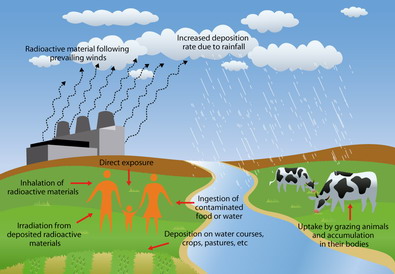
CNL’s environmental impact statement describes several ways that radioactive materials would leak into surrounding wetlands that drain into the Ottawa River during filling of the mound and after completion. It also describes CNL’s intent to pipe water polluted with tritium and other radioactive and hazardous substances from the waste treatment facility directly into Perch Lake which drains into the Ottawa River.
I stand by my original conclusion: We need parliamentarians to step up now to stop this deeply flawed project and prevent the Ottawa River from being permanently contaminated by a gigantic, leaking radioactive landfill that would do little to reduce Canada’s $8 billion nuclear waste liability.
Letter to the editor published in the Hill Times Monday January 18, 2021
Uranium enrichment is indeed a proliferation-sensitive technology as is clearly demonstrated by the Iranian situation. Even though, under the terms of the NPT and all other international accords, Iran has the right to enrich uranium to any degree that might be desired, for civilian purposes only, in practical terms the western powers do not at all trust Iran to exercise that right. So they are prohibited from doing so, even to the 20% (minus epsilon) level, which is what many of the proposed SMNR designs require.
Right up until the final shutdown of the NRU reactor at Chalk River, Canada was using weapons-grade uranium (>93%) targets for the production of technetium-99m generators for use in hospitals around the world, and I was told by an Iranian scientist in Salzburg that Iran wanted weapons-grade uranium for exactly the same reason – medical isotopes. All of this ignoring the fact that weapons-grade uranium is NOT needed for this purpose, whether in Canada or anywhere else, and in actual fact technetium-99m generators can be produced in a cost-effective manner without the use of a nuclear reactor of any kind, or even using uranium of any kind.
But – in the interests of a nuclear weapons free world – Canada should indeed be encouraging the international / multinational control (or oversight) of ALL enrichment facilities.
But that is small potatoes. Canada claims the NPT is the backbone of its non-proliferation commitment, but India has not signed the NPT and has already developed a nuclear weapons capability beginning in 1974 with plutonium produced in a Canadian reactor (the CIRUS, a clone of the NRX). Whereupon Canada insisted there would be no more nuclear cooperation between Canada and India – but all the time, India remained a member of COG (the CANDU Owners Group) and went on to build more than a dozen CANDU “clones” without direct Canadian help (other than the fact that we sold them under very generous terms the original CANDUS that were the cookie-cutter models for all the others. And then, under Stephen Harper, we resumed sales of uranium to India without any requirement that they get rid of their nuclear arsenal or even stop expanding it, and without signing the NPT. Which makes all the other countries who signed the NPT to have access to Canadian uranium and/or technology look like fools, because India got all the goodies without accepting the NPT responsibilities. Canada should stop selling uranium to India if the NPT is really so important.
But even that is small potatoes. Article VI of the NPT says that the “ official nuclear weapons states USA, UK, France, Russia and China, must negotiate in good faith not only to eliminate nuclear weapons but to achieve general and complete disarmament (i.e. elimination of armies and an end to war). Clearly, none of these nuclear superpowers are embarked on such a path, and until they do, Canada should refuse to sell uranium to any of them. Or at least should put constant pressure on the, to comply with Article VI. The fact that these things are not done indicates that Canada is only paying lip-service when it says that NPT is the basis for its non-proliferation policies.
PET told the UN General Assembly that if we want a world free of nuclear weapons, we must end the arms race – and we must begin with a strategy of suffocation, to choke off the vital oxygen on which it feeds, meaning the production of the two “strategic nuclear materials” which serve as primary nuclear explosives, i.e. weapons-grade uranium and weapons-grade plutonium.
These same considerations should apply when it comes to the extraction of plutonium from irradiated nuclear fuel. At the very least, there should be a requirement for such facilities (reprocessing plants) to be under international control just as enrichment plants should be under international control. Of course, better yet would be the abolition of reprocessing and uranium enrichment altogether, taking Pierre Elliott Trudeau’s 1978 “strategy of suffocation” to its ultimate limit. PET told the UN General Assembly that if we want a world free of nuclear weapons, we must end the arms race – and we must begin with a strategy of suffocation, to choke off the vital oxygen on which it feeds, meaning the production of the two “strategic nuclear materials” which serve as primary nuclear explosives, i.e. weapons-grade uranium and weapons-grade plutonium. However we now know that, for weapons purposes, ALL plutonium is “good” plutonium, so the division of plutonium into weapons-grade and non-weapons-grade is illusory. Ultimately, then, the strategy of suffocation means no nuclear reactors whatsoever.
The Hill Times, Monday, Jan. 11, 2021 Letters / opinions No, not all nuclear materials and by-products are safely stored in a highly regulated environment, says letter writer (https://www.hilltimes.com/2021/01/11/276503/276503)
Re: “We cannot afford to be naive about climate change—renewables and nuclear must work together,” by John Gorman, The Hill Times, Dec. 14, 2020.
Mr. Gorman states “the nuclear industry is the only energy industry that can account for all its by-products. While fossil-fuel emissions go into the atmosphere and other industrial waste goes to landfill, all nuclear materials and by-products are safely stored, managed, and monitored in a highly regulated environment.”
There are numerous leaking radioactive waste areas on the Chalk River Laboratories site north-west of Ottawa-Gatineau on the Ottawa River. These leaking waste sites were described in detail in an Ottawa Citizen article in 2011 by Ian McLeod, entitled “Chalk River’s Toxic Legacy.”
The multinational consortium running Chalk River Laboratories is planning to build a gigantic above-ground landfill for one million tonnes of radioactive waste including plutonium and other materials that would remain radioactive for more than 100,000 years. This way of dealing with radioactive waste contravenes international safety standards and best practices.
The consortium’s own studies show that the mound would leak during operation and after closure. The mound is expected to eventually disintegrate in a process referred to as “normal evolution” described in a study called the “Performance Assessment,” produced by the proponent as part of a protracted and controversial environmental assessment that is ongoing.
So much for Mr. Gorman’s assertion that “all nuclear materials and by-products are safely stored, managed, and monitored in a highly regulated environment.”
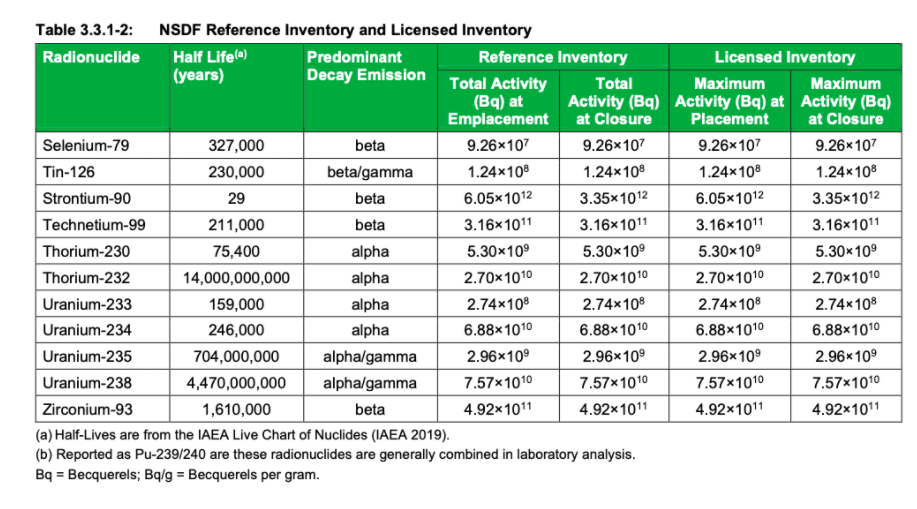
The NSDF “Licensed Inventory” (Table 13 in the NSDF Waste Acceptance Criteria), if followed by the proponent, would only allow disposal of a tiny fraction of the Government of Canada’s legacy nuclear waste. The NSDF would yield virtually no reduction in the federal nuclear legacy liability despite the expenditure of hundreds of millions of tax dollars.
Liabilities could also increase, because a giant pile of leaking radioactive waste would be difficult to remediate, and remediation costs could exceed those of managing the wastes had they not been put in the mound.
by Dr. Gordon Edwards, President of the Canadian Coalition for Nuclear Responsibility
December 19, 2020
Civilian nuclear and military nuclear have always been friendly room-mates, members of a “mutual admiration” society. In today’s announcement of an SMR Action Plan, Natural Resources Minister Seamus O’Regan said that nuclear power in Canada is a “home-grown” technology and referred to C. D. Howe’s role in this connection. In fact C.D. Howe arranged for all Canadian uranium extracted from Canadian mines to be sold to the US military for use in tens of thousands of nuclear weapons from 1945 to 1965. C D Howe was also on the Committee that met in Washington DC in 1944 to approve the first nuclear reactors to be built in Canada (at Chalk River) as part of the ongoing effort to produce plutonium for use as a nuclear explosive. Mr. Howe approved of the policy of selling plutonium produced at Chalk River to the US military for weapons use, a practice that continued until 1975 and beyond. Plutonium from Chalk River was sent to Britain (it was the first sample of plutonium that Britain had ever obtained) just a few months before Britain detonated its first A-Bomb in the Monte Bello Islands off Australia.
To the best of my knowledge, no civilian nuclear power agency – not the Canadian Nuclear Association, nor the Canadian Nuclear Society, nor the Canadian Nuclear Safety Commission, nor Atomic Energy of Canada Limited, nor Canadian Nuclear Laboratories, NOBODY – has ever issued a clear statement denouncing nuclear weapons or even calling for a nuclear weapons free world. Most nuclear scientists and engineers feel a strong kinship and camaraderie with those who are in the nuclear weapons business. The same goes for those in the nuclear division of Natural Resources Canada. I remember on one occasion (prior to the exchange of nuclear tests between India and Pakistan) I expressed alarm at the fact that both neighbours are developing a nuclear war-fighting capability and a couple of senior civil servants said “Would that be so bad? Maybe that’s just what the world needs. More deterrence. Creates stability”
Despite regular denials from our puppet masters that civilian nuclear has nothing to do with military nuclear, it is clear that civilian nuclear (including the frankly discriminatory provisions of the NPT) has adopted an appeasement policy that will never succeed in bringing about a nuclear weapons free world. Why does Canada continue to sell uranium to countries that are in the process of investing hundreds of billions to improve and modernize the nuclear arsenals in utter defiance of the NPT, knowing that the vast bulk of Canadian uranium that is rejected from enrichment plants as DU end up as the raw material for producing plutonium for Bombs, and that the lion’s share of the explosive power – and the overwhelming share of the radioactive fallout – of every H-bomb comes from the fissioning of DU atoms that are freely accessed by the military even if they are the leftovers of “peaceful” fuel production for nuclear power plants?
“The indigenous UK supply chain that supports defence nuclear programmes requires significant ongoing support to retain talent and develop and maintain capability between major programmes. Opportunities for the supply chain to invest in new capability are restricted by the limited size and scope of the defence nuclear programme. A UK SMR programme would increase the security, size and scope of opportunities for the UK supply chain significantly, enabling long-term sustainable investment in people, technology and capability.
“Expanding the talent pool from which defence nuclear programmes can draw from would bring a double benefit. First, additional talent means more competition for senior technical and managerial positions, driving excellence and performance. Second, the expansion of a nuclear-capable skilled workforce through a civil nuclear UK SMR programme would relieve the Ministry of Defence of the burden of developing and retaining skills and capability. This would free up valuable resources for other investments.”
Note that the table includes four isotopes of plutonium.
Note also that Twenty-five out of the 30 radionuclides listed are long-lived, with half-lives ranging from four centuries to more than four billion years. Materials such as these are not supposed to be disposed of in above-ground landfills according to the International Atomic Energy Agency.
As noted in the recent Hill Times op-ed by Eva Schacherl, Political Opposition Growing to New Reactors, both small modular nuclear reactors AND the high-level fuel waste they produce are EXEMPT from environmental assessment in Canada
From the op-ed:
“The Impact Assessment Act was intended to create “greater public trust in impact assessment and decision-making.” But there will be no federal assessment of nuclear reactors up to 200 thermal MW in size, nor of new reactors built at existing nuclear plants (up to 900 MWth). Yet new tidal power projects, as well as offshore wind farms with 10 or more turbines, need an assessment under the regulations, as do many new fossil fuel projects.”
“Also exempted from federal assessment is the “on-site storage of irradiated nuclear fuel or nuclear waste” associated with small modular reactors. This will make it easier for SMRs’ radioactive waste to be potentially left in the northern, remote, and First Nations communities, where they are proposed to be built.”
This SMR fuel waste exemption was a last-minute insertion in the Impact Assessment Act regulations. It is found in section 28 of the Physical Activities Regulations (the so-called ‘project list’ for the new Impact Assessment Act and reads as follows:
28 The construction and operation of either of the following:(a) a new facility for the storage of irradiated nuclear fuel or nuclear waste, outside the licensed boundaries of an existing nuclear facility, as defined in section 2 of the Nuclear Safety and Control Act, other than a facility for the on-site storage of irradiated nuclear fuel or nuclear waste associated with one or more new fission or fusion reactors that have a combined thermal capacity of less than 200 MWth;
As far the fuel waste from the proposed SMR (the “MMR Project“) at Chalk River is concerned, there is another exemption in section 28 – the phrase “outside the licensed boundaries of an existing nuclear facility” allows it to be kept on site at Chalk River, a licensed nuclear facility.
Artist’s rendering of a prototype small nuclear reactor plant. Under Canadian legislation, the whole plant along with the irradiated nuclear fuel it produced could become a radioactive exclusion zone, permanently off limits to humans
The nuclear industry and Liberals have not only been laying the groundwork for government funding. It appears they have been ensuring that the framework for nuclear energy in Canada gets even more accommodating.
Natural Resources Minister Seamus O’Regan has been hyping so-called next-generation reactors for months, portraying the industry as a future utopia. The Hill Times photograph by Andrew Mead.
Many Canadians are anxious to see what our energy future will be. Politically, it’s a question that stirs passions from Alberta’s oil patch to Ontario’s cancelled wind farms.
But political debate is picking up around our nuclear energy future. And with good reason. Government-funded expansion of the nuclear industry, and a simultaneous watering-down of regulations, could be the Liberal government’s toxic legacy.
The Green Party caucus, the NDP’s natural resources critic Richard Cannings, and the Bloc Québécois’s environment critic Monique Pauzé have all slammed O’Regan’s expected small modular reactor (SMR) “action plan.” They say it does not belong in a plan to reduce greenhouse gas emissions. Energy efficiency, wind, solar, and storage technologies are ready to build, and much cheaper, according to Lazard, a financial advisory and asset management firm. The prototype reactors will take years, if not decades, to develop, and could absorb hundreds of millions, even billions, in taxpayer subsidies, according to Greenpeace Canada.
That would mean opportunities lost for those dollars to build many times the amount of zero-emission energy with renewables and energy-efficiency projects. The latter would not create toxic radioactive waste for future generations to contend with.
Independent research says that a nuclear solution for remote communities (as proposed by the government) is likely to cost 10 times more to build and operate than the alternatives.
It seems inevitable that the Liberal action plan will soon be launched with generous handouts for the nuclear industry, whose aspiring players in Canada today include SNC-Lavalin and U.S. corporations like Westinghouse and GE-Hitachi Nuclear Energy. Few Canadians are aware that “Canadian” Nuclear Laboratories (CNL) is owned by a consortium of SNC-Lavalin and two U.S. firms, Fluor and Jacobs.
In recent years, the nuclear industry and Liberals have not only been laying the groundwork for government funding. It appears they’ve also been ensuring that the framework for nuclear energy in Canada gets even more accommodating.
The biggest step was exempting most new reactors from the Impact Assessment Act, which, in 2019, replaced the Canadian Environmental Assessment Act. This was deemed so important to the nuclear industry’s future that the Canadian Nuclear Safety Commission (CNSC) lobbied the Liberal government to exempt small reactors—and won. So much for the CNSC, the regulator that’s supposed to oversee the industry, being seen as objective and “world class.”
The Impact Assessment Act was intended to create “greater public trust in impact assessment and decision-making.” But there will be no federal assessment of nuclear reactors up to 200 thermal MW in size, nor of new reactors built at existing nuclear plants (up to 900 MWth). Yet new tidal power projects, as well as offshore wind farms with 10 or more turbines, need an assessment under the regulations, as do many new fossil fuel projects.
Also exempted from federal assessment is the “on-site storage of irradiated nuclear fuel or nuclear waste” associated with small modular reactors. This will make it easier for SMRs’ radioactive waste to be potentially left in the northern, remote, and First Nations communities, where they are proposed to be built.
The nuclear regulator has also been responsible for introducing a suite of “regulatory documents” on reactor decommissioning and radioactive waste that environmental groups have called “sham regulation.”
Meanwhile, the bureaucrats at the CNSC have been busy signing a memorandum of cooperation with the U.S. Nuclear Regulatory Commission on Small Modular Reactors. This agreement means that Canada can recognize U.S. reviews of reactor designs in order to “streamline the review process.”
CNSC has also outlined its plan in a document called Strategy for Readiness to Regulate Advanced Reactor Technologies. In a nutshell, the document says that regulations for new reactor designs will have to be flexible. It notes that CNSC regulated the earlier generation of water-cooled reactors (such as CANDUs) at first based on “objectives” in the 1950s and ‘60s. Then, as experience with these reactors evolved, regulations became more detailed and prescriptive. It says the same may have to happen with the new next-gen reactor designs.
In the 1950s, there were indeed few “prescriptive requirements” for the newfangled reactors. In 1952, the NRX reactor at Chalk River, Ont., had a meltdown. It was the first large-scale nuclear reactor accident in the world and took two years to clean up—which, by 1950s standards, included pumping 10,000 curies of long-lived fission products into a nearby sandy area. Then in 1958, the NRU reactor at Chalk River—a test bed for developing fuels and materials for the CANDU reactor—had a major accident, a fuel-rod fire that contaminated the building and areas downwind. It took 600 workers and military personnel to do the top-secret clean-up.
Let’s hope today’s regulators and lawmakers can learn from history. Does Canada really need or want to be the “leading-edge” testing ground for new experimental nuclear reactors? Canadians should have their say in a referendum—or at the ballot box.
Eva Schacherl is an Ottawa-based environmentalist.





 Concerned Citizens of Renfrew County and Area