As noted in CCRCA’s May 2021 letter to the then-Minister of Natural Resources, Seamus O-Reagan: (see full letter below)
Canadian companies such as Nordion, Best Theratronics, and SRB Technologies are doing a brisk trade in waste imports in the form of disused sealed sources and expired self-luminous tritium devices.. These companies do not necessarily limit their imports to devices of their own manufacture. Imported radioactive wastes are being sent to CRL, where they become the property of the Government of Canada.
This begs the question: Are Canadian taxpayers on the hook to cover the full costs of looking after this waste in perpetuity? There is no easy answer to this question.
Canada’s national reports to the Joint Convention on the Safety of Spent Fuel Management and on the Safety of Radioactive Waste Management have information on disused radioactive sources. The nuclear substances found in these radiation-emitting devices undergo decay. At some point the devices are no longer sufficiently radioactive for their original purpose, such as sterilizing equipment. But they still emit highly dangerous amounts of radiation and must be managed carefully as radioactive waste.
Best Theratronics, a company based in Kanata, Ontario, has a growing inventory of disused radioactive sources. Canada’s Eighth National Report to the Joint Convention shows that as of December 31, 2023, the activity of disused cobalt-60 and cesium-137 sources was 191 Terabecquerels (TBq). The Seventh National Report showed an activity value of 71 TBq as of December 31, 2019.
A Terabecquerel is the quantity of a radioactive substance that gives off a trillion radioactive disintegrations each second—a very large amount.
Best Theratronics periodically sends its highly radioactive waste to Chalk River Laboratories. Chalk River is Canada’s largest publicly-owned energy research facility, and Canada’s major licensed commercial radioactive waste storage facility. A private company called Canadian Nuclear Laboratories (CNL) manages Chalk River, under a $24 billion government contract with the three U.S. corporations that own CNL.
At a 2019 hearing before the Canadian Nuclear Safety Commission (CNSC), Canada’s nuclear regulator, the owner of Best Theratronics reported that “In 2014, we had a resident inventory of disused sources at Nordion. All of that has now been disposed of at CNL… So I can report that all those legacy sources, which is over 500 sources, cobalt and cesium, have been successfully removed from our license.”
Nordion is another private company that manufactures and exports radioactive sources, and that imports disused sources from around the world. Located in Kanata next to Best Theratronics, Nordion has also been increasing its inventory of radioactive waste disused sources. Its December 2023 inventory of 5,468 Terabecquerels of cobalt-60 was up from 4,126 Terabecquerels in 2019.
Canada’s Policy for Radioactive Waste Management and Decommissioning says that “radioactive sources that were not from Canada may be brought to Canada.” Under this policy, Nordion and Best Theratronics engage in a brisk trade in radioactive waste.
This radioactive waste, much of it imported from other countries, is sent to Chalk River. CNL plans to dispose of all the commercial waste at Chalk River in a million-cubic-metre landfill called the NSDF. The maximum activity of cobalt-60 that the NSDF could safely accommodate (according to Waste Acceptance Criteria developed jointly by CNL and CNSC) is 9,060 Terabecquerels. This is roughly twice the combined cobalt-60 inventory of Nordion and Best Theratronics. The NSDF would provide them with a “solution” for their imported radioactive waste cobalt-60 devices, at public expense.
CNL has stated its intent to put all the commercial waste that is sent to Chalk River into the NSDF. But the waste acceptance criteria for the landfill, which supposedly represent protective limits, could be exceeded by a very large amount. Results of a 2019 ATIP request illustrate this risk (View and download the ATIP response HERE)
Nordion was sold to an American company in 2014. It is now owned by Sotera Health, headquartered in Broadview Heights, Ohio. The 2019 ATIP results show that Nordion sent a waste shipment to Chalk River in 2018 with 34 Terabecquerels of niobium-94. With a half-life of of 20,300 years, niobium-94 poses a major long-term radioactive hazard. This single shipment contained over 1400 times the maximum activity of niobium-94 that would be allowed in the NSDF. The NSDF Waste Acceptance Criteria allow only 23.4 Gigabecquerels, or 0.0234 Terabecquerels.
Other American-owned companies shipped radioactive waste to Chalk River during the 2014-2018 period, including Permafix NW, headquartered in Richland, Washington, which made seven waste shipments totalling 8.3 tonnes; BWXT Nuclear Energy, owned by BWX Technologies in Lynchburg, Virginia; and Energy Solutions, owned by TriArtisan Partners in New York City.
Results of the ATIP request show that Energy Solutions shipped 68 Gigabecquerels of radium-226 (half-life of 1600 years) to Chalk River. This is nearly twice the maximum activity of 37 Gigabecquerels that would be allowed in the NSDF.
Americium-241 is another highly dangerous radioactive substance, with a half life of 432 years. The maximum activity that would be allowed in the NSDF is 60.4 Gigabecquerels. The ATIP results show that two Canadian-owned companies alone shipped nearly 70 times this maximum amount that would be allowed in the NSDF: 1063 Gigabecquerels from Noremtech, and 3114 Gigabecquerels from Stuart Hunt.
SRB Technologies, another Canadian company, imports expired glow-in-the-dark exit signs and other self-luminous devices from the U.S. After removing the tritium-filled tubes, SRB Technologies puts them in drums and sends them to Chalk River as waste.
The total activity of tritium contained in waste sent by SRB to Chalk River was 38,857 Terabecquerels. The maximum activity of tritium that could be put in the NSDF during its 50-year operating period is 891 Terabecquerels, a 44-fold lower amount.
SRB, Nordion, and Best Theratronics import waste radioactive devices from foreign countries that they did not manufacture. Large quantities of foreign-origin radioactive waste, much of it highly radioactive, is shipped to Canada for storage and eventual disposal at Chalk River, where it becomes the responsibility of Canadian taxpayers.
The Ottawa River flows through an ancient rift valley that extends from near North Bay through Ottawa toward Montreal. The area is seismically active, and experiences dozens of minor earthquakes each year. Stronger earthquakes also occur such as the magnitude 5 quake in June 2010 that caused shaking, evacuations and damage in Ottawa including shattered windows in Ottawa City Hall and power outages in the downtown area.
Experts say Ottawa is at risk for a big earthquake.The Government of Canada is currently in the process of shoring up and earthquake-proofing the buildings on Parliament Hill. The project will take 13 years and cost billions of dollars.
Incredibly, at the same time as billions are being spent to earthquake-proof Canada’s Parliament Buildings, the Government of Canada is paying billions of dollars to a US-based consortium that is importing large quantities of radioactive waste to the Ottawa Valley.
Soon after it took control of Canada’s nuclear laboratories and radioactive waste in 2015, the consortium, through its wholly-owned subsidiary, Canadian Nuclear Laboratories (CNL), announced its intention to consolidate all federally-owned radioactive waste at Chalk River Laboratories, alongside the Ottawa River, 180 km upstream of the Nation’s Capital. There was no consultation or approval from the Algonquin Nation in whose unceded territory the Chalk River Laboratories is located, nor any consultation with residents of the Ottawa Valley about the plan.
CNL is importing nuclear waste from federal nuclear facilities in Manitoba, southern Ontario and Quebec. The imports comprise thousands of shipments and thousands of tonnes of radioactive debris from reactor decommissioning, and dozens of tonnes of high level waste nuclear fuel, the most deadly kind of radioactive waste that can deliver a lethal dose of radiation to an unprotected bystander within seconds of exposure.
High level waste shipments from Becancour, Quebec have already been completed. They involved “dozens of trucks” and convoys operating secretly over several months, from December 2024 through July 2025, under police escort, to move 60 tons of used fuel bundles to Chalk River. Tons of high level waste from Manitoba will follow soon.
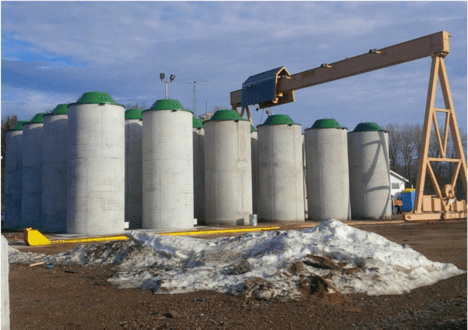
Since there is no long-term facility for high level waste at Chalk River, nor is there any such facility anywhere in Canada at present, CNL built silos (shown in the photo below) to hold the waste at a cost of 15 million dollars. This high level radioactive waste is ostensibly in storage at Chalk River, but there is no guarantee it will ever be moved.
CNL plans to put the less deadly waste into a giant, above-ground radioactive waste mound called the Near Surface Disposal Facility, a controversial project currently mired in legal challenges. The dump would hold one million tons of radioactive waste in a facility designed to last about 500 years. Many of the materials destined for disposal in the dump, such as plutonium, will remain radioactive for far longer than that. According to CNL’s own studies, the facility would leak during operation and disintegrate after a few hundred years, releasing its contents to the surrounding environment and Ottawa River less than a kilometer away.
Shipping containers filled with radioactive waste are piling up at Waste Management Area H on the Chalk River Laboratories property, awaiting a time when they can be driven or emptied into the NSDF. At last count there were 1500 shipping containers there, shown in the photo below.
It would be hard to choose a less suitable place to consolidate all federal radioactive waste than in a seismically-active zone beside the Ottawa River that provides drinking water for millions of Canadians in communities downstream including Ottawa, Gatineau and Montreal.
Concerns about imports of radioactive waste to the Ottawa Valley are widespread and growing.
In 2021, Ottawa City Council unanimously passed a resolution calling for radioactive waste imports to the Ottawa Valley to stop. Ottawa Riverkeeper recently called for transportation of radioactive waste to the Chalk River Laboratories to stop until a clear, long-term plan for the waste is available. A December 2025 letter to Prime Minister Mark Carney from Bloc Québécois and Green Party MPs along with First Nations and many civil society groups requested a moratorium on shipments of Canadian radioactive waste to Chalk River.
Action is urgently needed to halt the imports of radioactive waste to the earthquake-prone Ottawa Valley.
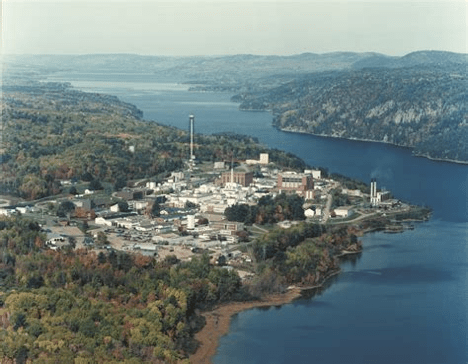
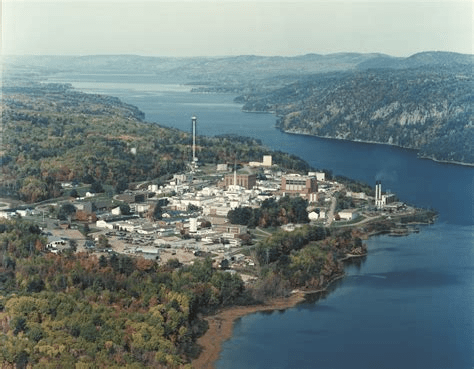
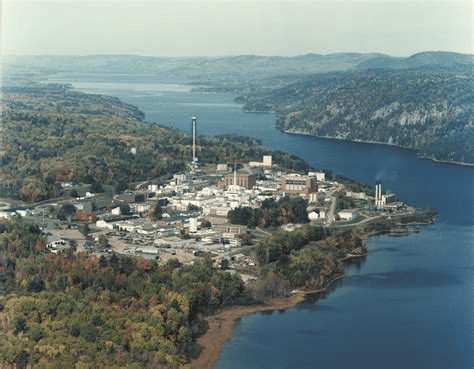
Photo above shows Chalk River Laboratories, beside the Ottawa River upstream of the Nation’s Capital, in the ancient, seismically-active rift valley.
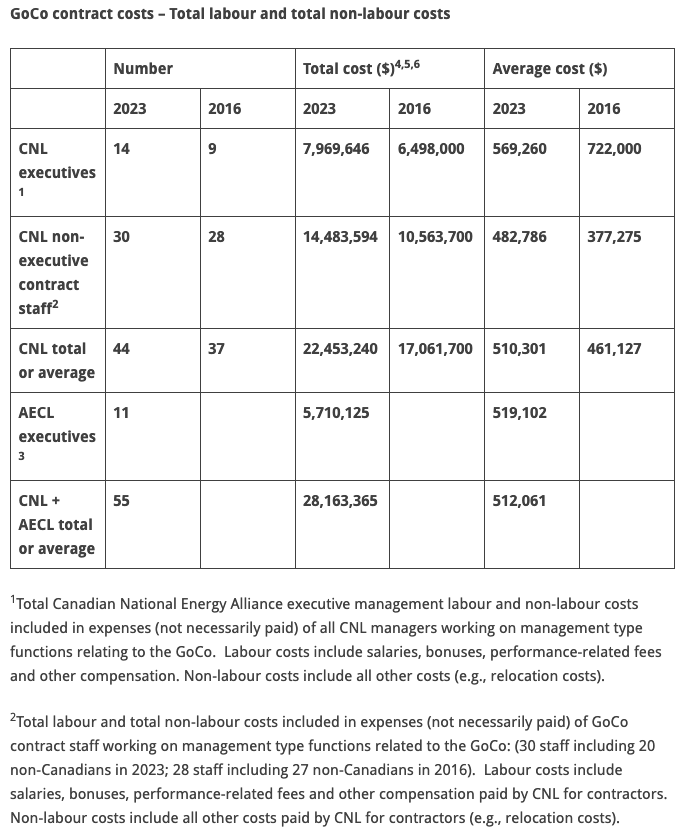
Nine senior executives of CNL were paid an average of $722,000 per person per year (including travel) and most were non-Canadian.
Twenty-eight senior contractors were paid an average of $377,275 per year per person. 27 of the 28 senior contractors were non-Canadian.
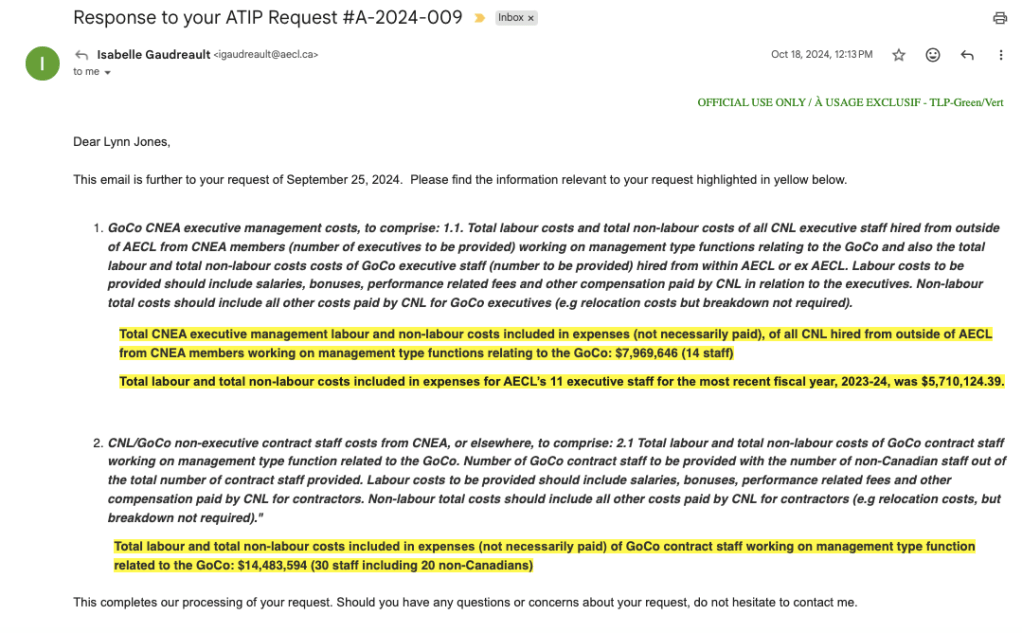
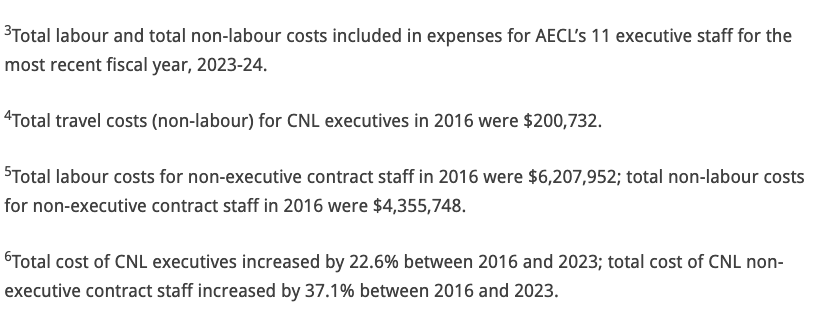
An October 2024 follow-up ATIP request (see screen cap below) revealed that the average salary for 14 senior executives was $569,260 per person per year and the average salary for 30 non-executive senior contractors (20 non-Canadians) was $482,786 per person per year.
Nuclear weapons are an existential threat to life on Earth and need to be abolished.
Concerned Citizens and other civil society groups are concerned about the nuclear weapons connections of US-based multinational corporations contracted to operate Canadian Nuclear Laboratories. Some new facilities being built or proposed at Chalk River Laboratories are aimed at handling tritium and plutonium, both of which are key ingredients in nuclear warheads.
The current owner/operator of Canadian Nuclear Laboratories, “Nuclear Laboratory Partners of Canada,” assumed ownership in December 2025 under a 6-year, multibillion dollar contract with the Government of Canada. It consists of three US-based corporations: BWXT, Amentum, and Battelle. A fourth corporation, Kinectrics, was recently acquired by BWXT.
Here is what Perplexity Pro told us about nuclear weapons connections of BWXT, Amentum and Batelle.
BWXT
BWXT has significant connections to U.S. nuclear weapons programs through its work with government agencies and defense contracts.bwxt+1
Key Contracts
BWXT manages high-consequence nuclear operations for the U.S. Department of Energy (DOE) and National Nuclear Security Administration (NNSA), which oversees the U.S. nuclear weapons stockpile. In 2025, it secured a $1.5 billion contract from NNSA to build a uranium enrichment facility for defense applications, including tritium production—a key component in nuclear weapons.reuters+2
Naval and Defense Roles
The company manufactures nuclear reactor components for U.S. Navy submarines and aircraft carriers, including Virginia-class and Columbia-class vessels, under multi-billion-dollar contracts like a $2.6 billion award in 2025. BWXT holds licenses for depleted uranium fabrication for defense and has handled highly enriched uranium from down-blended nuclear weapon cores.reddit+3
Historical Context
BWXT was previously involved in tritium production for the U.S. nuclear arsenal. Subsidiaries like Nuclear Fuel Services support these government programs.dontbankonthebomb+1
Amentum
Amentum has substantial nuclear weapons connections through U.S. and UK defense contracts for weapons facilities, plutonium processing, tritium operations, and national security sites.amentum+2
U.S. Weapons Complex
Amentum manages the Pantex Plant (nuclear weapons assembly/disassembly) and Y-12 National Security Complex (uranium components for weapons) under a $28 billion NNSA contract via NPOne JV. It supports Los Alamos plutonium facilities, Savannah River pit production, and naval nuclear propulsion for ballistic missile submarines.amentum+3
Plutonium and Remediation
The company decommissions plutonium-contaminated facilities at U.S. sites like Hanford’s Plutonium Finishing Plant and UK’s Low Level Waste Repository, plus Portsmouth uranium enrichment for weapons.amentum+2
UK AWE (Atomic Weapons Establishment)Involvement
Amentum serves as Delivery Partner for AWE’s Enriched Uranium Components Programme at Aldermaston, handling enriched uranium for UK nuclear warheads, decommissioning gloveboxes, and program management.amentum+2
Battelle
Battelle Memorial Institute has deep historical and ongoing connections to nuclear weapons programs, including direct contributions to the Manhattan Project and management of key NNSA national laboratories involved in weapons research.battelle+2
Manhattan Project Role
During World War II, 400 Battelle researchers fabricated plutonium from uranium for atomic bomb cores. This work positioned Battelle as a leader in nuclear research, including extruding uranium fuel for early reactors at Oak Ridge.wikipedia+2
National Labs Management
Battelle manages or co-manages eight DOE national labs central to nuclear security, such as Los Alamos National Laboratory (plutonium pits for weapons via Triad National Security, LLC), Pacific Northwest National Laboratory, and Savannah River National Laboratory (nuclear materials management). These labs support stockpile stewardship, pit production, and nuclear deterrence under NNSA.battelle+4
Additional Ties
Battelle developed nuclear fuel rods for naval reactors like the USS Nautilus and provided Environment, Health and Safety support at Pantex Plant, the primary site for weapons assembly/disassembly. It oversees chemical weapons demilitarization and biodefense tied to nuclear security missions.battelle+3
The photo above shows Canadian Nuclear Laboratories, 180 km upstream of Ottawa Gatineau on the Ottawa River. It is now wholly owned by US based corporations with extensive ties to nuclear weapons production.
The two page document below is excerpted from an environmental remediation report that was presented to members of the CNL Environmental Stewardship Council on June 26, 2025.
The photo below from the report shows the growing collection of shipping containers full of radioactive wastes being amassed at Waste Management Area H on the Chalk River Laboratories property. As reported verbally at the meeting, the number of containers was approximately 1500 in June 2025 with more arriving regularly.
Towards a transparent and responsible management of radioactive waste
December 2 2025
Several political parties and civil society organizations are dismayed to learn thatCanadian Nuclear Laboratories (CNL) has decided to consolidate radioactive waste (forwhich the federal government is responsible) at the Chalk River Laboratories site. This decision was made without consultation with First Nations or the public, and without parliamentary debate. Canadian Nuclear Laboratories (CNL) is only a private contractor,not a government agency.
For the population, there is no public accountability and concern is growing. Why concentrate everything at Chalk River? CNL is not intending to permanently store high- or intermediate-level waste at Chalk River. Those wastes will likely be moved again. Chalk River is an unsuitable location for radioactive waste consolidation because it islocated on the Ottawa River and the area is prone to seismic tremors.
Used nuclear fuel has the highest level of radioactivity; it is being transported to ChalkRiver from nuclear reactors in Manitoba, Ontario and Quebec for interim storage pending the construction of a proposed deep geological repository (DGR). CNL intendsto have the same used fuel eventually transported to the DGR. But such a repositorystill does not exist and may never be licensed or approved. Whether the DGR isultimately built or not, issues surrounding the transportation of radioactive waste have to be addressed.
There are increased risks and costs of transporting used fuel twice: first from thenuclear power plants to Chalk River, and then from Chalk River to a second destination.This leads to extra safety risks and a waste of public money. The government is justmoving the waste around at great expense and added risk without solving the problempermanently, as there is still no proven safe solution despite 45 years of effort.
The proposed transportation of intermediate-level waste to Chalk River from thedecommissioning of nuclear reactors is similarly ill-advised.
Public concern was heightened by the news of the secretive transport of tonnes of usednuclear fuel from Bécancour, Quebec, to Chalk River during the summer of 2025, alongpublic roads and bridges, without any explicit authorization or opportunity for publicconsultation or even proper notification.
• We call on the federal government for a moratorium on the shipment of Canadianradioactive waste to Chalk River because of the increasing risk of radioactivecontamination and the lack of an acceptable due process.
• We call on the federal government to ban all imports of radioactive waste from othercountries, including disused medical sources, discarded tritium light sources, or usednuclear fuel.
• We call on the Minister of Environment and Climate Change to conduct a strategicassessment of the transportation of high- and intermediate-level radioactive waste onpublic highways, in accordance with section 95 of the Impact Assessment Act. Theresults of this assessment would contribute to future impact assessments of nuclearfacilities. The goal would be to examine, for example, the cumulative impact at ChalkRiver and to provide a framework for upcoming environmental assessments of nuclearpower plants and reactor decommissioning projects.
Patrick Bonin, M.P.Bloc Québécois critic for the Environment and Climate Change
Elizabeth May, M.P.Green Party of Canada
André BélangerFondation Rivières
Alain BranchaudSNAP Québec
Ginette Charbonneau Physicist and spokesperson for le Ralliement contre la pollution radioactive
A hearing this Wednesday November 12 in the Federal Court of Appeal, before a panel of three judges, will be a test of Canada’s commitment to protect threatened and endangered species and may determine whether the giant Ottawa River nuclear waste dump can be built or not.You can watch the hearing on Zoom by registering at this link, and you are also invited to a rally, “Stand up for Wildlife,” from noon to 2 pm outside the courtroom on Sparks St. in Ottawa.
Background:
Earlier this year we celebrated the successful legal challenge to the granting of a Species-at-Risk permit to Canadian Nuclear Laboratories (CNL) for the construction of the nuclear waste dump known as the “NSDF.” The legal challenge was brought by Kebaowek First Nation, Concerned Citizens of Renfrew County and Area, the Canadian Coalition for Nuclear Responsibility, and Sierra Club Canada Foundation.
You may recall that CNL is owned by a multinational private-sector consortium that operates Canada’s federal nuclear labs under a $1.6 billion per year contract with the Government of Canada. CNL needed a Species-at-risk permit in order to construct its controversial, giant, above-ground nuclear waste dump beside the Ottawa River because the site they chose for the dump is on federal land smack dab in the middle of irreplaceable wildlife habitat that is home to many species at risk. A permit would allow CNL to destroy habitat and residences for threatened and endangered species in order to construct its giant dump.
In order to get a permit, a proponent must prove that it carefully considered all possible alternatives and chose the one with the least impact on endangered species. CNL did not do this. In fact, it is on record as saying it chose the location because it would reduce transportation costs. In his ruling issued on March 14, 2025, Justice Russel Zinn said the environment minister’s issuing of the species-at-risk permit was “unreasonable due to fatal flaws” in interpreting and applying the federal Species at Risk Act, adding that the issuing of the permit must be reconsidered.
Unfortunately for threatened wildlife and for Canadian taxpayers, who foot the bill for everything the multinational consortium does under its contract with the government, the case was appealed by CNL. Hence, the evidence will be reviewed again on November 12, this time in the federal court of appeal, by a panel of three judges.
The legal case here is fairly cut and dried; it will be interesting to see how it plays out. But behind the straightforward legal arguments lies a shocking story of disregard for wildlife that we discovered when we applied for the initial judicial review and received 4,000 pages of material connected with the permit application. Among other things, we learned that CNL knew that the site was very rich in biodiversity, but chose it anyway. The site is located on a south facing densely forested hillside that rises 140 feet above five named wetlands at its base, critical habitat for endangered Blanding’s turtles. The forest stands have old growth characteristics and provide prime habitat for endangered bats and songbirds such as the Canada Warbler, Golden-winged Warbler and Eastern Whip-poor-will. To create a flat surface for the NSDF, clear cutting and extensive blasting would convert 28 hectares of forested hillside into 170,000 cubic metres of rock, with unknown but likely adverse effects on the surrounding wetlands. More than 10,000 mature trees would be cut down, including provincially-endangered Black Ash trees. Kebaowek First Nation found three active bear dens on the site, and evidence of extensive use of the site by threatened Eastern Wolves. Both bears and wolves are species of great cultural importance to Algonquin peoples.
Seethis post on the Concerned Citizens website, for more detail on CNL’s disregard for wildlife in its choice of a site for the NSDF.
The beautiful artwork below is by Destiny Cote of Kitigan Zibi Anishinabeg. Eastern Wolves are one of the threatened species that would be adversely affected by the NSDF.
In March 2024, Canadian Nuclear Laboratories (CNL) was granted a Species at Risk permit by Environment and Climate Change Canada. The permit would allow CNL to harm, harass and kill destroy endangered species and destroy their residences during construction of the “NSDF,” a giant radioactive waste dump alongside the Ottawa River, upstream of Ottawa and Montreal.
Kebaowek First Nation, Concerned Citizens of Renfrew County and Area, the Canadian Coalition for Nuclear Responsibility and Sierra Club Canada Foundation applied for a judicial review of the decision to award the permit. During the judicial review, we reviewed evidence produced during the environmental assessment and 4,000 pages provided to us as applicants for judicial review. We concluded that there is considerable evidence that CNL did not meet the requirements of the Species at Risk Act and should not have been given a permit.
In his ruling issued on March 14, 2025, Justice Russel Zinn said the environment minister’s issuing of the species-at-risk permit was “unreasonable due to fatal flaws” in interpreting and applying the federal Species at Risk Act, adding that the issuing of the permit must be reconsidered.
The ruling by Justice Zinn was appealed by Canadian Nuclear Laboratories. A hearing in the Federal Court of Appeal took place on November 12, 2025.
We feel strongly that the mature ecosystem and rich biodiversity present on the NSDF site are highly valuable and irreplaceable. Much as we may wish to be able to do so, humans cannot recreate a rich, biodiverse mature forest on the side of a southwest-facing slope surrounded by wetlands. Only Nature can create such an ecosystem that supports hundreds to thousands of species in a thriving matrix of interrelated life.
Background and context:
The federally owned Chalk River Laboratories site is heavily contaminated with radioactive and other hazardous waste accumulated over eight decades of operation including three decades of plutonium production for US nuclear weapons. The contamination was described by Ottawa Citizen journalist Ian McLeod in 2011: Chalk River’s toxic legacy. The legacy wastes at Chalk River are “poorly documented and misunderstood” according to NRCan (Ottawa Citizen) and are likely to require underground disposal according to the International Atomic Energy Agency. The cost to clean up the site has been estimated at $16 billion, more than the combined total cost of cleaning up all other federal environmental liabilities across Canada.
The federal government initiated the Nuclear Legacy Liabilities Program (NLLP) in 2006, a long-term strategy to clean up Chalk River Laboratories and other federal nuclear sites in Ontario, Quebec and Manitoba. As part of the program, a Comprehensive Preliminary Decommissioning Plan was produced. The cleanup was to take place over eighty-five years. One of the first steps was a “Very LowLevel” (VLLW) waste facility to dispose of 160,000 cubic meters of waste. A “Low Level” waste facility was not planned until later because waste characterization was in progress and would take considerable time. It is important to note that the “Low Level” radioactive waste at Chalk River is much more dangerous than the “Very Low Level” waste and will remain hazardous and radioactive for many thousands of years.
However, the federal government’s long-term NLLP strategy was abandoned prematurely in September 2015 when Atomic Energy of Canada Ltd. was re-structured and privatized. The contract to manage the nuclear laboratories was awarded to a multinational consortium, the “Canadian National Energy Alliance”, of which SNC-Lavalin was a key player. The contract between the Government of Canada and the new contractor-operated entity, Canadian Nuclear Laboratories (CNL), required CNL to seek the “fastest, most cost-effective ways” of disposing of all waste and required that a “Low Level” Waste facility be built within six years of commencement of the contract (by September 2021).
Only a few months later, in February 2016, CNL issued a project description for the NSDF (Near Surface Disposal Facility), a giant above-ground mound for one million tons/cubic metres of radioactive and hazardous waste that experts say clearly contravenes international safety standards. The proposed NSDF would be six times larger than the proposed VLLW facility and would use the same basic design, similar to a municipal landfill. Studies show the mound would leak during operation and break down due to erosion after a few hundred years, releasing its contents to the environment, even though much of the inventory will remain radioactive for many millennia.
The NSDF project was supposed to be completed in September 2021 but met with strong opposition from Indigenous communities, more than 140 downstream municipalities, civil society groups and many individual Canadians. It became caught up for almost eight years in protracted closed-door negotiations between the consortium and the regulator, the Canadian Nuclear Safety Commission (CNSC), as a deeply-flawed environmental assessment was carried out. The project was approved in January 2024 by the CNSC, a body widely viewed to be a captured regulator that promotes the projects it is supposed to regulate.
Inadequate siting process for the NSDF
A proper siting process for “all” the legacy federal radioactive waste would have taken several years and would have seriously considered federal lands farther away from the Ottawa River, such as the extensive sand barrens at Garrison Petawawa adjacent to Chalk River Laboratories. That was not to be the case. Within five months of assuming responsibility for federal nuclear wastes, CNL was defending a site for its NSDF on CRL property, less than one kilometer from the Ottawa River. CNL’s February 2016 project description described two prospective sites but declared that one, the “EMR site”, was preferred. Reasons for the preference did not mention biodiversity or species at risk. Instead they emphasized proximity to the wastes slated for disposal in the facility.
A site selection report for the NSDF was released in February 2016 at about the same time as the hastily prepared project description. It relied heavily on the previous study to find a site for the Very Low Level Waste Facility. The report ruled out locations off the CRL site on economic (not biodiversity) grounds. The study also relaxed the exclusion criteria to allow steep slopes, rock outcrops and proximity to critical habitat for endangered species. This enabled CNL to insert its new “preferred” site (the East Mattawa Road or “EMR site”) into the process even though it consisted of a densely forested hillside rising 140 feet above five named wetlands at its base. To create a flat surface area for the facility, clear cutting and extensive blasting would convert 28 hectares of mature forest into 170,000 cubic metres of rock, with unknown but likely adverse effects on the surrounding wetlands that drain into the nearby Ottawa River.
Later in 2016, CNL issued a report entitled “Biodiversity review for the NSDF project” (attached). This study was not provided to ECCC during the SARA permit application process. The report concluded that the preferred “EMR site” would have the least impact on biodiversity even though data presented in the report showed the opposite – greater biodiversity at the chosen EMR site than at the Alternate site. For example, 11 species at risk were documented at the EMR site versus 8 at the Alternate site. One hundred and twelve species of animals and plants were present at the EMR site versus 46 species at the Alternate site. The study failed to document the presence of species such as Black Bears and Eastern Wolves in the EMR/NSDF local study area. This flawed study was used to support selection of the EMR site for the NSDF, a clearly unsupportable choice if lesser impact on biodiversity was truly the objective.
Exceptionally rich biodiversity at the NSDF site
The Chalk River Laboratories site is uniquely rich in biodiversity. As a restricted area for 80 years, there has been very little human access to most of the 3,700-hectare site. Some forests, such as those at the EMR site, have acquired old growth characteristics from lack of disturbance. The site is dotted with lakes and wetlands that, combined with proximity to the Ottawa River, provide habitats and feeding grounds for many species at risk and large mammals. According to the Biodiversity review for the NSDF project, fifty species at risk have the potential to be present on the CRL site and 26 have been confirmed to be present. According to the Environmental Impact Statement for the NSDF, 123 migratory bird species are present or likely to be present on the CRL property.
The NSDF/EMR site is even richer in biodiversity than the CRL site as a whole. As depicted on the map below of the CRL site, the NSDF/EMR site and vicinity include key components that combine to support exceptionally rich biodiversity: a densely forested south-west facing slope, surrounded at the base by wetlands. Riparian zones abound in this area, including as it does five named wetlands in addition to Perch Creek, Perch Lake and the Ottawa River shoreline less than one kilometer away. It is not surprising that the Biodiversity Review noted 112 plant and animal species present here compared to only 46 at the Alternate site.
Compared to all other forest stands within the Chalk River Laboratories property, the NSDF site’s forested hillside, proposed for blasting and leveling, has relatively old stands of mature trees, which provide important habitat for species at risk (Appendix 5.6-4 in the final EIS). The forest stands in the NSDF/EMR site have by far the greatest number of bat roost trees of any forest stands on the entire Chalk River Laboratories property. The EIS reports 6,485 bat roost trees in the NSDF/EMR site, compared to approximately 1,567 in the Alternate site. This is shown graphically in the appended bat habitat suitability maps that show the great concentration of suitable bat nesting habitat in the local study area for the NSDF site, which is closer to ideal foraging habitat above Perch Lake and surrounding wetlands. The bat habitat suitability maps were were produced by Trent University and provided to ECCC by Annie Morin of CNL in a memo dated October 24, 2023.
The EMR site’s southwest-facing hillside with sandy soil provides preferred conditions for bear dens, of which three active ones have been observed recently. Bears are very important to the Algonquin Anishinaabe people on whose unceded territory the CRL property is located. It is surprising therefore that Black Bears were not considered as a valued component, or even listed as a mammal species observed in the local study area for the NSDF. It was Indigenous-led research by Kebaowek First Nation that documented the three active bear dens in winter 2023. KFN also documented the presence of Eastern Wolves, another species of great cultural and spiritual importance to Algonquin Anishinaabe people, in the NSDF local study area.
The southwest-facing slope of old growth forest stands – in close proximity to abundant insect breeding grounds in adjacent wetlands – also provides preferred nesting conditions for many migratory songbirds. According to Appendix 5.6-3 of the Environmental Impact Statement, 111 migratory bird species are likely or confirmed in the local study area for the NSDF site, a high density of species in a relatively small area.
The Biodiversity Review noted that Perch Lake contains 17 fish species, all of which were under consideration as valued components but ruled out on the basis that the lake water would be unaffected by the project. However, a pipeline to Perch Lake from the NSDF, added to the plan in 2020, is expected to discharge very high levels of radioactive tritium and smaller quantities of many other radioactive and hazardous substances directly into Perch Lake. CNL would allow the concentration of tritium in Perch Lake to rise as high as 360,000 Bq/l, fifty times higher than the very permissive Canadian drinking water standard for tritium. This would have adverse effects on the 17 fish species mentioned above and many other aquatic species. Tritium is readily incorporated into genetic material and causes genetic damage, cancer and birth defects. It readily bioaccumulates in the food chain and has the potential to affect all animals feeding in the Perch Lake basin. It is our understanding that the Department of Fisheries and Oceans should review this plan, but we have not seen any evidence that they have yet done so.
It cannot be said that CNL chose the location and site expected to have the least impact on species at risk
CNL chose the EMR site for the NDSF even though it contains more habitat for species at risk and is richer in biodiversity than the Alternate site. It cannot be reasonably said that CNL chose the location and site expected to have the least impact on species at risk or chose the best solution to reduce the impact on species at risk. Given that the entire CRL property is rich in biodiversity, failing to seriously consider off-site alternatives is another way in which CNL did not choose the site and location expected to have the least impact on species at risk.
CNL’s actions with respect to the Eastern Wolf suggest that biodiversity conservation was considered an impediment rather than a goal
According to the Canada Gazette (page 25), CNL raised concerns about uplisting of the Eastern Wolf in 2017 stating they could incur costs of up to $160 million from uplifting. CNL did not mention Eastern Wolves in its application for a SARA permit in 2017 despite the fact that, according to a letter from George Dolinar of CNL to ECCC in March 2024, Eastern Wolf pups had been observed within the CRL boundary in 2012. The Eastern Wolf was also not mentioned in George Dolinar’s letter to ECCC in April 2020 providing additional information in support of the SARA permit application. These actions suggest that CNL considered protection of Eastern Wolves to be something to be avoided. In George Dolinar’s letter of March 2024, “Protecting the Eastern Wolf in Preparation to the Near Surface Disposal Facility Construction,” Mr Dolinar does not mention Indigenous-led research by Kebaowek First Nation in 2023 that documented the presence of Eastern wolves and pups on the CRL site with extensive use of trail cameras and “ground truthing.” The failure to mention the role of Kebaowek First Nation and its findings is deeply concerning. Kebaowek First Nation presented detailed results of its research to the Canadian Nuclear Safety Commission in a submission dated May 1, 2023.
A March 2025 report by the International Atomic Energy Agency (IAEA) flagged a serious problem in Canada’s nuclear governance regime. Canada has not incorporated the fundamental safety principle of justification into its legal framework, despite being urged to do so by an international peer review team in 2019.
The IAEA principle of justification in nuclear safety requires that any practice involving human exposures to ionizing radiation be justified during the licensing process for a facility. It must be demonstrated that the overall benefits of the project to individuals and society, outweigh the potential health detriments of the radiation exposures it will cause.
Justification is necessary because there is no safe level of exposure to ionizing radiation from nuclear reactors and radioactive waste. Ionizing radiation causes cancers of all kinds, many other chronic diseases and damage to the human gene pool. Human-made nuclear waste will remain hazardous and radioactive for millions of years.
Canada’s failure to justify nuclear projects is a serious deficiency that urgently needs to be addressed given the Government of Canada’s professed interest in funding and expanding nuclear electricity generation in Canada. We need to ask: can we justify creating more and more radioactive waste that future generations will have to deal with even though they will receive zero benefit from the activities that created it.
Other serious deficiencies were flagged by the IAEA experts in 2019. For example, Canada allows pregnant nuclear workers to be exposed to a radiation dose four times larger than is tolerated by IAEA standards. This issue remains unaddressed five years later.
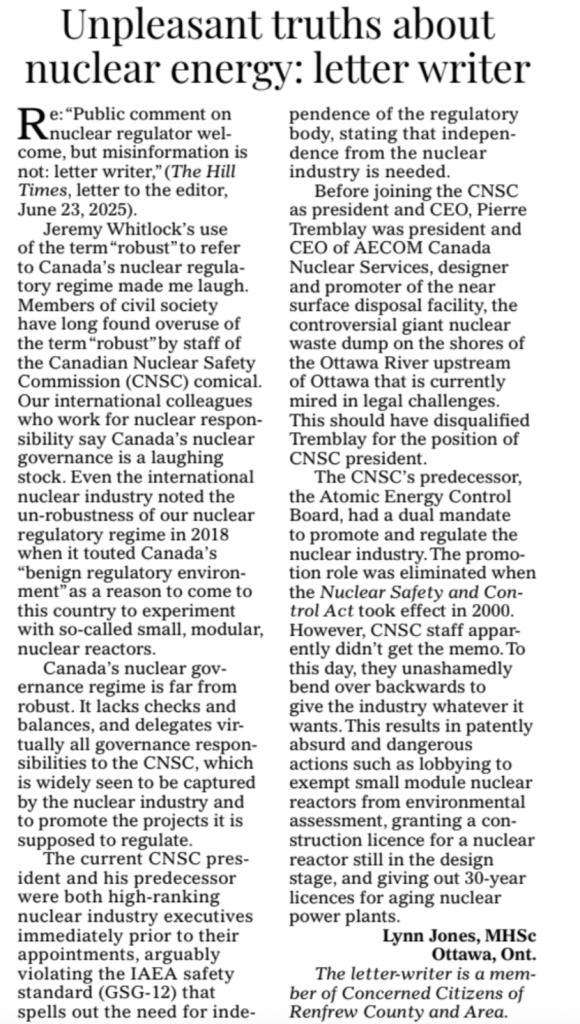
This letter appeared in the July 7 edition of the Hill Times. (subscribe here)
It was in response to a letter by Jeremy Whitlock, indefatigable cheerleader for all things nuclear. His letter, published on June 23, 2025 is here.
Jeremy Whitlock was responding to this letter, published in the Hill Times on June 16, 2025:
Canada is failing to meet a fundamental principle of nuclear safety according to international experts
A March 2025 report by the International Atomic Energy Agency (IAEA) flagged a serious problem in Canada’s nuclear governance regime. Canada has not incorporated the fundamental safety principle of justification into its legal framework, despite being urged to do so by an international peer review team in 2019.
The IAEA principle of justification in nuclear safety requires that any practice involving human exposures to ionizing radiation be justified during the licensing process for a facility. It must be demonstrated that the overall benefits of the project to individuals and society, outweigh the potential health detriments of the radiation exposures it will cause.
Justification is necessary because there is no safe level of exposure to ionizing radiation from nuclear reactors and radioactive waste. Ionizing radiation causes cancers of all kinds, many other chronic diseases and damage to the human gene pool. Human-made nuclear waste will remain hazardous and radioactive for millions of years.
Canada’s failure to justify nuclear projects is a serious deficiency that urgently needs to be addressed given the Government of Canada’s professed interest in funding and expanding nuclear electricity generation in Canada. We need to ask: can we justify creating more and more radioactive waste that future generations will have to deal with even though they will receive zero benefit from the activities that created it.
Other serious deficiencies were flagged by the IAEA experts in 2019. For example, Canada allows pregnant nuclear workers to be exposed to a radiation dose four times larger than is tolerated by IAEA standards. This issue remains unaddressed five years later.




 Concerned Citizens of Renfrew County and Area