New owners of Canadian Nuclear Laboratories have extensive nuclear weapons connections

Nuclear weapons are an existential threat to life on Earth and need to be abolished.

Concerned Citizens and other civil society groups are concerned about the nuclear weapons connections of US-based multinational corporations contracted to operate Canadian Nuclear Laboratories. Some new facilities being built or proposed at Chalk River Laboratories are aimed at handling tritium and plutonium, both of which are key ingredients in nuclear warheads.

The current owner/operator of Canadian Nuclear Laboratories, “Nuclear Laboratory Partners of Canada,” assumed ownership in December 2025 under a 6-year, multibillion dollar contract with the Government of Canada. It consists of three US-based corporations: BWXT, Amentum, and Battelle. A fourth corporation, Kinectrics, was recently acquired by BWXT.

Here is what Perplexity Pro told us about nuclear weapons connections of BWXT, Amentum and Batelle.

BWXT

BWXT has significant connections to U.S. nuclear weapons programs through its work with government agencies and defense contracts.bwxt+1​

Key Contracts

BWXT manages high-consequence nuclear operations for the U.S. Department of Energy (DOE) and National Nuclear Security Administration (NNSA), which oversees the U.S. nuclear weapons stockpile. In 2025, it secured a $1.5 billion contract from NNSA to build a uranium enrichment facility for defense applications, including tritium production—a key component in nuclear weapons.reuters+2​

The company manufactures nuclear reactor components for U.S. Navy submarines and aircraft carriers, including Virginia-class and Columbia-class vessels, under multi-billion-dollar contracts like a $2.6 billion award in 2025. BWXT holds licenses for depleted uranium fabrication for defense and has handled highly enriched uranium from down-blended nuclear weapon cores.reddit+3​

Historical Context

BWXT was previously involved in tritium production for the U.S. nuclear arsenal. Subsidiaries like Nuclear Fuel Services support these government programs.dontbankonthebomb+1​

Amentum

Amentum has substantial nuclear weapons connections through U.S. and UK defense contracts for weapons facilities, plutonium processing, tritium operations, and national security sites.amentum+2​

U.S. Weapons Complex

Amentum manages the Pantex Plant (nuclear weapons assembly/disassembly) and Y-12 National Security Complex (uranium components for weapons) under a $28 billion NNSA contract via NPOne JV. It supports Los Alamos plutonium facilities, Savannah River pit production, and naval nuclear propulsion for ballistic missile submarines.amentum+3​

Plutonium and Remediation

The company decommissions plutonium-contaminated facilities at U.S. sites like Hanford’s Plutonium Finishing Plant and UK’s Low Level Waste Repository, plus Portsmouth uranium enrichment for weapons.amentum+2​

UK AWE (Atomic Weapons Establishment)Involvement

Amentum serves as Delivery Partner for AWE’s Enriched Uranium Components Programme at Aldermaston, handling enriched uranium for UK nuclear warheads, decommissioning gloveboxes, and program management.amentum+2​

Battelle

Battelle Memorial Institute has deep historical and ongoing connections to nuclear weapons programs, including direct contributions to the Manhattan Project and management of key NNSA national laboratories involved in weapons research.battelle+2​

Manhattan Project Role

During World War II, 400 Battelle researchers fabricated plutonium from uranium for atomic bomb cores. This work positioned Battelle as a leader in nuclear research, including extruding uranium fuel for early reactors at Oak Ridge.wikipedia+2​

National Labs Management

Battelle manages or co-manages eight DOE national labs central to nuclear security, such as Los Alamos National Laboratory (plutonium pits for weapons via Triad National Security, LLC), Pacific Northwest National Laboratory, and Savannah River National Laboratory (nuclear materials management). These labs support stockpile stewardship, pit production, and nuclear deterrence under NNSA.battelle+4​

Additional Ties

Battelle developed nuclear fuel rods for naval reactors like the USS Nautilus and provided Environment, Health and Safety support at Pantex Plant, the primary site for weapons assembly/disassembly. It oversees chemical weapons demilitarization and biodefense tied to nuclear security missions.battelle+3​

References:

BWXT

  1. https://www.bwxt.com/sectors/complex-site-operations/nuclear-operations/
  2. https://en.wikipedia.org/wiki/BWX_Technologies
  3. https://www.reuters.com/business/energy/bwx-technologies-secures-15-billion-contract-us-nuclear-weapons-agency-2025-09-16/
  4. https://www.ans.org/news/2025-09-17/article-7374/nnsa-awards-bwxt-15b-defense-fuels-contract/
  5. https://www.reddit.com/r/UraniumSqueeze/comments/1nz1a3c/is_bwxt_the_overlooked_sleeping_nuclear_tech/
  6. https://www.bwxt.com/bwxt-announces-2-6-billion-in-contracts-for-naval-nuclear-reactor-components/
  7. https://www.dontbankonthebomb.com/bwxt/
  8. https://cardinalnews.org/2024/07/05/lynchburg-firm-aims-to-advance-nuclear-technology-in-space/
  9. https://www.world-nuclear-news.org/articles/bwxt-launches-advanced-nuclear-fuel-subsidiary
  10. https://www.purdue.edu/newsroom/2025/Q4/purdue-bwxt-forge-strategic-collaboration-to-advance-nuclear-innovation

Amentum

  1. https://www.amentum.com/our-capabilities/mission-modernization-sustainment/nuclear-security-and-deterrence/
  2. https://en.wikipedia.org/wiki/Amentum_(company)
  3. https://www.amentum.com/news/amentum-team-awarded-28-billion-y-12-national-security-complex-and-pantex-plant-management-contract/
  4. https://www.reuters.com/business/energy/bwx-technologies-secures-15-billion-contract-us-nuclear-weapons-agency-2025-09-16/
  5. https://www.amentum.com/project/supporting-our-nations-weapons-defense-system-with-advanced-conduct-of-operations-and-best-in-class-operational-readiness-at-los-alamos-national-laboratory-lanl/
  6. https://www.amentum.com/news/amentum-team-awarded-21-billion-integrated-mission-completion-contract-at-the-savannah-river-site/
  7. https://www.amentum.com/project/decommissioning-plutonium-contaminated-material-facilities-at-the-llwr-uk/
  8. https://www.amentum.com/news/amentum-led-jv-helps-treat-and-dispose-of-nuclear-waste-in-hanford/
  9. https://virginiabusiness.com/amentum-led-team-receives-5-87b-nuke-cleanup-contract/
  10. https://www.amentum.com/project/enriched-uranium-components-programme/
  11. https://www.bwxt.com/sectors/complex-site-operations/nuclear-operations/
  12. https://www.onr.org.uk/publications/regulatory-reports/site-specific-reports/inspection-records/2024/08/atomic-weapons-establishment-aldermaston-inspection-id-53309

Battelle

  1. https://www.battelle.org/history/space-age
  2. https://www.battelle.org/laboratory-management
  3. https://www.bwxt.com/sectors/complex-site-operations/nuclear-operations/
  4. https://en.wikipedia.org/wiki/Battelle_Memorial_Institute
  5. https://www.energy.gov/sites/default/files/2021-07/DEC%20-%20Battelle%20%20Memorial%20Institute%20signed%201-23-1983.pdf
  6. https://matternews.org/voices/anduril-teach-in-highlights-ohio-states-long-developed-military-connections/
  7. https://www.latinousa.org/2025/10/28/armsracelosalamos/
  8. https://www.reuters.com/business/energy/bwx-technologies-secures-15-billion-contract-us-nuclear-weapons-agency-2025-09-16/
  9. https://www.battelle.org/markets/national-security/cbrne-defense/threat-awareness
  10. https://www.ornl.gov/content/who-we-are-and-who-we-arent
  11. https://news.tamus.edu/texas-am-system-part-of-bwxt-led-team-awarded-30-billion-management-and-operating-contract-for-national-nuclear-security-administrations-pantex-plant/
  12. https://inside.battelle.org/blog-details/operating-large-research-infrastructure-requires-a-wide-variety-of-skilled-professionals
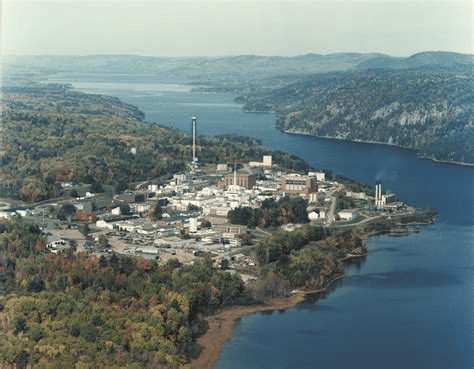
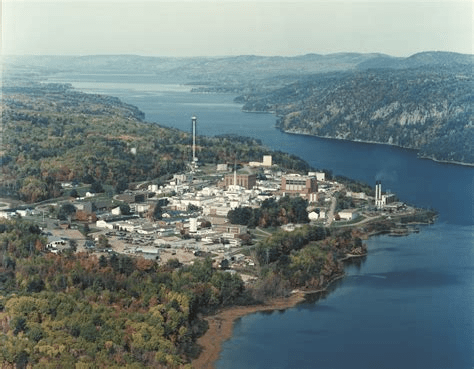
The photo above shows Canadian Nuclear Laboratories, 180 km upstream of Ottawa Gatineau on the Ottawa River. It is now wholly owned by US based corporations with extensive ties to nuclear weapons production.

The challenge of long-lived alpha emitters in the Chalk River legacy wastes

January 22, 2024 (revised September 17, 2024)

Why is so little Chalk River waste suitable for near surface disposal? 

Extensive research work at the Chalk River Laboratories on nuclear reactor fuels, and in the early days, on materials for nuclear weapons, produced waste with large quantities of long-lived alpha emitters.  This waste is difficult to manage and can even become increasingly radioactive over time.  

According to the International Atomic Energy Agency, because of the presence of long-lived alpha emitters, waste from nuclear research facilities is generally classified as intermediate level, and even in some cases, as high level. This waste cannot be put in a near surface disposal facility because its radioactivity will not decay to harmless levels during the period that the facility remains under institutional control.   

Alpha emitters decay by throwing off an alpha particle, the equivalent of a helium nucleus, with two protons and two neutrons.  The external penetrating power of an alpha particle is low, but alpha emitters have extremely serious health effects if ingested or inhaled. They can lodge in your lungs and cause cancer.

Research at Chalk River and all other nuclear laboratories is ultimately based on three long-lived alpha emitters — thorium-232, uranium-235, and uranium-238. These are the “naturally occurring” or “primordial” radionuclides.  They were created by large stars and then incorporated into the Earth and the solar system when they formed some 4.5 billion years ago.  The waste inventory proposed by Canadian Nuclear Laboratories for the Near Surface Disposal Facility (NSDF) includes over six tons each of thorium-232 and uranium-238.

Each “natural” alpha emitter initiates a decay chain with roughly a dozen radioactive isotopes of other elements such as radium, radon, and polonium.  These elements also occur naturally, but in much smaller amounts because of their more rapid decay. 

When a radioactive element releases an alpha particle, the atomic weight of the product goes down by four.  Uranium-238 decays to uranium-234, with a 245,000-year half-life. Uranium-234 decays to thorium-230, with a 75,000-year half-life. Thorium-230 decays to radium-226, with a 1,600-year half-life.  Shorter half-lives mean greater initial radioactivity. Radium-226 decays to radon-222, with a 4-day half-life.  Radon-222, a gas, builds up in the basements of houses built over uranium-rich rocks.  When it is inhaled it decays into polonium-218, a highly toxic, cancer-causing substance with a 3-day half-life. “Naturally occurring” alpha emitters are clearly harmful.

Hazards increase when uranium and thorium are mined and concentrated from ores and used in their pure form.  Marie Curie, who spent much of her career isolating radium and polonium from uranium, died of radiation-induced leukemia at age 66. She was buried in a lead-lined tomb because her corpse emitted so much radiation.

When thorium-232, uranium-235, and uranium-238 are irradiated in a reactor, as at Chalk River, they absorb neutrons and produce significant quantities of new, man-made, long-lived alpha-emitters.  Irradiated uranium-238 absorbs a neutron and temporarily forms uranium-239.  Uranium-239 transmutes to neptunium-239, which quickly transmutes to long-lived plutonium-239, with a half-life of 24,000 years. 

Plutonium-239 is “fissile” – it can readily support a chain reaction.  It is what the early Chalk River researchers produced for the manufacture of U.S. nuclear weapons, by separating the plutonium from irradiated reactor fuel.  They also used the separated plutonium to make “mixed oxide” (MOX) reactor fuel, mixing it with fresh uranium.

Thorium-232, when put in a nuclear reactor, will absorb a neutron and transmute to uranium-233, with a half-life of 160,000 years.  Uranium-233 also can support a chain reaction, so it can be used in atomic bombs and reactor fuels as well. Chalk River researchers did a lot of work to separate uranium-233 from irradiated thorium-232.

All reactor fuel contains uranium-235.  It is the only naturally occurring isotope that readily undergoes fission and can sustain a chain reaction.  But not all uranium-235 atoms undergo fission in a nuclear reactor.  Instead they can absorb either one or two neutrons and form yet two more very long-lived, man-made alpha-emitters, uranium-236 (half-life of 23.4 million years) and neptunium-237 (half-life of 2.14 million years). 

Nuclear engineers don’t like uranium-236 because it acts as a “neutron poison”, absorbing neutrons instead of undergoing fission.  The longer that uranium-235 fuel remains in a reactor, the more uranium-236 and neptunium-237 are produced. 

Uranium-236 is certainly a part of the Chalk River waste. It is the longest-lived of all the man-made alpha emitters, but for some reason it was omitted from the NSDF inventory.

As noted above, thorium-232, uranium-235, and uranium-238 are the start of three naturally occurring decay chains.  A fourth decay chain starts with man-made neptunium-237 and ends with thallium-205 (the element before lead in the periodic table).  Neptunium and its “progeny” have all decayed away during Earth’s 4.5-billion-year history, but production of neptunium-237 in nuclear reactors (and uranium-233 by thorium-232 irradiation) has “resurrected” this hitherto extinct fourth decay chain.  

Americium-241, found in significant quantities in Chalk River waste, is another starting point for the man-made nepturium-237 decay chain.  Nuclear reactors have also greatly augmented the amounts of radionuclides in the uranium-235 decay chain by producing plutonium-239, and in the thorium-232 decay chain by producing uranium-236.

Early research done at Chalk River to extract (or “reprocess”) plutonium-239 and uranium-233 from irradiated fuel and irradiated thorium targets has created a legacy of buildings (e.g., the Plutonium Recovery Laboratory) and soils (e.g., the Thorium Pit) that are contaminated with long-lived alpha emitters.  Reprocessing was dangerous and caused several accidents. The resulting contamination has never been cleaned up.

Until 2018, highly enriched uranium-235 targets were irradiated in the NRU reactor at Chalk River, followed by dissolving the targets in nitric acid and extracting the fission product molybdenum-99, a “medical isotope”. After extraction of “moly-99”, the other fission products, and the long-lived alpha emitters uranium-236 and neptunium-237 (produced when uranium-235 atoms absorb neutrons instead of undergoing fission), remain in the medical isotope waste.  This waste resembles high-level spent fuel waste and represents one of Chalk River’s most dangerous legacies.

Fuel reprocessing, medical isotope production, and other research activities at Chalk River have produced very significant amounts of waste containing ­­long-lived alpha emitters.  This waste is unsuitable for near-surface disposal.  Much of it is mixed with shorter-lived fission products and cannot be separated from them.  This mixed waste should not be put in the NSDF. 

Detecting alpha emitters in mixed waste is expensive and challenging. Putting inadequately characterized waste in the NSDF would invalidate its safety case.

Unfortunately, the NSDF Project lacks adequate waste characterization procedures.  If the project is allowed to proceed, workers and future Ottawa valley residents could be exposed to unknown quantities of long-lived alpha emitters and suffer the serious health effects associated with them.

~~~~~~~~~~

Small Modular Reactors and Proliferation /Tolerance of Nuclear Weapons

Gordon Edwards, January 12, 2021

Uranium enrichment is indeed a proliferation-sensitive technology as is clearly demonstrated by the Iranian situation. Even though, under the terms of the NPT and all other international accords, Iran has the right to enrich uranium to any degree that might be desired, for civilian purposes only, in practical terms the western powers do not at all trust Iran to exercise that right. So they are prohibited from doing so, even to the 20% (minus epsilon) level, which is what many of the proposed SMNR designs require.


Right up until the final shutdown of the NRU reactor at Chalk River, Canada was using weapons-grade uranium (>93%) targets for the production of technetium-99m generators for use in hospitals around the world, and I was told by an Iranian scientist in Salzburg that Iran wanted weapons-grade uranium for exactly the same reason – medical isotopes. All of this ignoring the fact that weapons-grade uranium is NOT needed for this purpose, whether in Canada or anywhere else, and in actual fact technetium-99m generators can be produced in a cost-effective manner without the use of a nuclear reactor of any kind, or even using uranium of any kind.


But – in the interests of a nuclear weapons free world – Canada should indeed be encouraging the international / multinational control (or oversight) of ALL enrichment facilities.

But that is small potatoes. Canada claims the NPT is the backbone of its non-proliferation commitment, but India has not signed the NPT and has already developed a nuclear weapons capability beginning in 1974 with plutonium produced in a Canadian reactor (the CIRUS, a clone of the NRX). Whereupon Canada insisted there would be no more nuclear cooperation between Canada and India – but all the time, India remained a member of COG (the CANDU Owners Group) and went on to build more than a dozen CANDU “clones” without direct Canadian help (other than the fact that we sold them under very generous terms the original CANDUS that were the cookie-cutter models for all the others.  And then, under Stephen Harper, we resumed sales of uranium to India without any requirement that they get rid of their nuclear arsenal or even stop expanding it, and without signing the NPT. Which makes all the other countries who signed the NPT to have access to Canadian uranium and/or technology look like fools, because India got all the goodies without accepting the NPT responsibilities. Canada should stop selling uranium to India if the NPT is really so important.

But even that is small potatoes. Article VI of the NPT says that the “ official  nuclear weapons states USA, UK, France, Russia and China, must negotiate in good faith not only to eliminate nuclear weapons but to achieve general and complete disarmament (i.e. elimination of armies and an end to war).  Clearly, none of these nuclear superpowers are embarked on such a path, and until they do, Canada should refuse to sell uranium to any of them. Or at least should put constant pressure on the, to comply with Article VI. The fact that these things are not done indicates that Canada is only paying lip-service when it says that NPT is the basis for its non-proliferation policies.

PET told the UN General Assembly that if we want a world free of nuclear weapons, we must end the arms race – and we must begin with a strategy of suffocation, to choke off the vital oxygen on which it feeds, meaning the production of the two “strategic nuclear materials” which serve as primary nuclear explosives, i.e. weapons-grade uranium and weapons-grade plutonium.

These same considerations should apply when it comes to the extraction of plutonium from irradiated nuclear fuel.  At the very least, there should be a requirement for such facilities (reprocessing plants) to be under international control just as enrichment plants should be under international control. Of course, better yet would be the abolition of reprocessing and uranium enrichment altogether, taking Pierre Elliott Trudeau’s 1978 “strategy of suffocation” to its ultimate limit. PET told the UN General Assembly that if we want a world free of nuclear weapons, we must end the arms race – and we must begin with a strategy of suffocation, to choke off the vital oxygen on which it feeds, meaning the production of the two “strategic nuclear materials” which serve as primary nuclear explosives, i.e. weapons-grade uranium and weapons-grade plutonium. However we now know that, for weapons purposes, ALL plutonium is “good” plutonium, so the division of plutonium into weapons-grade and non-weapons-grade is illusory. Ultimately, then, the strategy of suffocation means no nuclear reactors whatsoever.

See www.ccnr.org/plute_sandia.html

Trinity (nuclear test) - Wikipedia
Trinity test of a plutonium bomb (Wikipedia)

Why is there so much plutonium at Chalk River?

October 25, 2020

~~

Update April 29, 2022) five isotopes of plutonium are included in the inventory of radioactive materials destined for the NSDF if it is approved. Details here: https://concernedcitizens.net/2020/12/17/cnls-partial-inventory-of-radionuclides-that-would-go-into-the-chalk-river-mound/

~~~

A consortium of private multinational corporations is proposing to create a giant mound of radioactive wastes at Chalk River, Ontario, less than a kilometer from the Ottawa River.  According to the draft Environmental Impact Statement (EIS) the proposed mega-dump will house a rather large quantity of plutonium.

What is plutonium and why should we worry about it?

Plutonium is a human-made radioactive element that is created as a byproduct in nuclear reactors. The first reactors were built to produce plutonium for use as a nuclear explosive in atomic weapons. Plutonium can also be fabricated into fuel elements for nuclear reactors.

Plutonium remains radioactive for tens of thousands of years after it is created.  It comes in several different varieties or “isotopes”.  The most abundant varieties are plutonium-239, with a half-life of 24,000 years; and plutonium-240, with a half-life of 6,600 years.  The half-life is the time required for half of the atoms to undergo radioactive disintegration. When a plutonium atom disintegrates it is transformed into another radioactive material, sometimes one with a much longer half-life.

All isotopes of plutonium are highly toxic. Even very small doses can lead to radiation-induced illnesses such as cancer, often resulting in death.

Why is there plutonium at Chalk River?

The decision to build the Chalk River Laboratories (CRL) was taken in Washington, D.C. in 1944.  Canada, Great Britain and the United States agreed to build the facility as part of an effort to produce plutonium for bombs.  In fact, plutonium produced at CRL played a role in both the US and UK nuclear weapons programs.

During the late 1940s, British scientists carried out all necessary pilot plant work at Chalk River to design their own large plutonium production plant at Windscale, England.  Plutonium produced at CRL arrived in England just months before the first British nuclear explosion took place in Australia in 1952.

For three decades, plutonium produced in Canadian research reactors was sold to the U.S. military to help finance the Chalk River Laboratories.  A reprocessing plant at Chalk River was built to extract plutonium from irradiated nuclear fuel dissolved in nitric acid. It was shut down in 1954, but irradiated fuel containing Canadian plutonium was shipped to the U.S. until the mid-1970s.  In all, at least 250 kg of plutonium was sold to the U.S. for nuclear weapons and warheads.

Three buildings central to plutonium production are slated for demolition

Various facilities at CRL were used in the 1940s and 1950s to extract plutonium from fuels irradiated in the NRX reactor.  In 2004, environmental assessments were initiated governing the radioactive demolition of three such structures:

•       The Plutonium Tower, used in the late 1940s to extract plutonium from fuel   rods irradiated in the NRX reactor.

•       The Plutonium Recovery Laboratory, used between 1949 and 1957 to extract plutonium isotopes from enriched fuels irradiated in the NRX reactor.

•       The Waste Water Evaporator, used between 1952 and 1958 to process radioactive liquid wastes left behind from the plutonium extraction work. Decommissioning of this facility would include: removal, treatment and storage of plutonium-bearing liquid wastes and sludge in tanks, plutonium-contaminated process lines and equipment; decontamination and removal of process equipment and processing cells for handling plutonium; removal of building structures containing plutonium residues; segregation of solid wastes and transfer of these plutonium-contaminated materials to waste management facilities at CRL.

In December 2011 the Canadian Nuclear Safety Commission gave the go-ahead for dismantling the first of these structures, the Plutonium Tower.  In 2012, changes to the Canadian Environmental Assessment Act introduced by Stephen Harper’s government made it permissible to demolish radioactively contaminated buildings without any environmental assessment (EA).

To date, only the auxiliary buildings associated with the Plutonium Tower have been decommissioned, but the Tower itself is still standing.  And as far as the Plutonium Recovery Lab and Waste Water Evaporator go, neither has been decommissioned. All these decommissioning projects will be difficult, and will generate lots of long-lived, intermediate-level waste.

These buildings are just three examples of demolition projects that would produce plutonium-contaminated rubble likely destined for the proposed megadump. Chalk River scientists were keenly interested in testing plutonium as a reactor fuel.  Some three tonnes of plutonium-based fuel elements were fabricated at Chalk River using remote handling devices called gloveboxes. Such facilities would also result in plutonium-contaminated wastes when demolished.

The draft EIS estimates that total quantities of plutonium to be placed in the planned landfill-type facility would be measured in the trillions of Becquerels. A Becquerel is a unit of radioactivity, indicating that one radioactive disintegration is taking place every second. (Every radioactive atom eventually disintegrates, or explodes, giving off one or two subatomic projectiles called “atomic radiation”. All forms of atomic radiation — alpha particles, beta particles, gamma rays, and neutrons–are damaging to living cells.)

Plutonium will inevitably leak into the Ottawa River (EIS)

The draft EIS indicates that after failure of the landfill cover, which is bound to occur at some point after abandonment, millions of Becquerels of each plutonium isotope would enter Perch Creek every year.  Perch Creek flows into the Ottawa River about 1 km away.

Canadian Coalition for Nuclear Responsibility and Concerned Citizens of Renfrew County and Area

May 2017