Letter to Mark Carney ~ Pour une gestion transparente et responsable des déchets radioactifs

December 12, 2025

English version follows below.

Towards a transparent and responsible management of radioactive waste

December 2 2025

Several political parties and civil society organizations are dismayed to learn thatCanadian Nuclear Laboratories (CNL) has decided to consolidate radioactive waste (forwhich the federal government is responsible) at the Chalk River Laboratories site. This decision was made without consultation with First Nations or the public, and without parliamentary debate. Canadian Nuclear Laboratories (CNL) is only a private contractor,not a government agency.

For the population, there is no public accountability and concern is growing. Why concentrate everything at Chalk River? CNL is not intending to permanently store high- or intermediate-level waste at Chalk River. Those wastes will likely be moved again. Chalk River is an unsuitable location for radioactive waste consolidation because it islocated on the Ottawa River and the area is prone to seismic tremors.

Used nuclear fuel has the highest level of radioactivity; it is being transported to ChalkRiver from nuclear reactors in Manitoba, Ontario and Quebec for interim storage pending the construction of a proposed deep geological repository (DGR). CNL intendsto have the same used fuel eventually transported to the DGR. But such a repositorystill does not exist and may never be licensed or approved. Whether the DGR isultimately built or not, issues surrounding the transportation of radioactive waste have to be addressed.

There are increased risks and costs of transporting used fuel twice: first from thenuclear power plants to Chalk River, and then from Chalk River to a second destination.This leads to extra safety risks and a waste of public money. The government is justmoving the waste around at great expense and added risk without solving the problempermanently, as there is still no proven safe solution despite 45 years of effort.

The proposed transportation of intermediate-level waste to Chalk River from thedecommissioning of nuclear reactors is similarly ill-advised.

Public concern was heightened by the news of the secretive transport of tonnes of usednuclear fuel from Bécancour, Quebec, to Chalk River during the summer of 2025, alongpublic roads and bridges, without any explicit authorization or opportunity for publicconsultation or even proper notification.

• We call on the federal government for a moratorium on the shipment of Canadianradioactive waste to Chalk River because of the increasing risk of radioactivecontamination and the lack of an acceptable due process.

• We call on the federal government to ban all imports of radioactive waste from othercountries, including disused medical sources, discarded tritium light sources, or usednuclear fuel.

• We call on the Minister of Environment and Climate Change to conduct a strategicassessment of the transportation of high- and intermediate-level radioactive waste onpublic highways, in accordance with section 95 of the Impact Assessment Act. Theresults of this assessment would contribute to future impact assessments of nuclearfacilities. The goal would be to examine, for example, the cumulative impact at ChalkRiver and to provide a framework for upcoming environmental assessments of nuclearpower plants and reactor decommissioning projects.

Patrick Bonin, M.P.Bloc Québécois critic for the Environment and Climate Change

Elizabeth May, M.P.Green Party of Canada

André BélangerFondation Rivières

Alain BranchaudSNAP Québec

Ginette Charbonneau Physicist and spokesperson for le Ralliement contre la pollution radioactive

Et al….
Transport of radioactive waste on Canadian roads ~ a growing public risk

See also High level radioactive waste imports to Chalk River from Manitoba and Quebec will likely begin in 2025

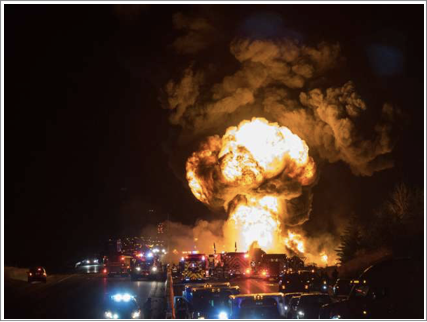
On  November 1, 2017 Canadians were horrified by news of a fiery crash involving tanker trucks and several cars on a highway north of Toronto, Ontario, that shocked first responders by its absolute devastation. 

Now consider this…

The Government of Canada has hired a multinational consortium of SNC Lavalin and two US based corporations to deal with several million tons of radioactive waste ultimately owned by the taxpayers of Canada. These wastes were created during seven decades of Canadian involvement in the production of nuclear weapons materials for the US, production of medical isotopes, and nuclear power research and development. The radioactive wastes are currently located in three provinces: Ontario, Quebec and Manitoba. 

The consortium plans to “consolidate” these wastes at Chalk River, Ontario, next to the Ottawa river which supplies drinking water to millions of people. 

This will require thousands of shipments of radioactive waste along Canadian roads from Pinawa, Manitoba, Douglas Point, Ontario and Gentilly, Quebec to Chalk River.  (See possible transport routes below)  

Radioactive waste is among the most toxic waste on earth…

Much of the federally owned radioactive waste is a result of “fissioning” of uranium in nuclear reactors. Hundreds of radioactive substances are produced by fissioning, almost none of which existed in nature prior to the creation of nuclear reactors. Individual radioactive substances vary greatly in the types of damaging radiation they give off and the length of time they remain hazardous, with some of them remaining lethal and carcinogenic for millions of years.  

All man-made radioactive substances can cause damage to human genetic material. They can cause birth defects, cancers, genetic damage and many diseases and disorders in humans, including their unborn children and their descendants, and in all other living things.  It is important to keep radioactive waste away from living things.

These radioactive waste shipments are already being transported through many Canadian cities and towns including Kenora, Thunder Bay, North Bay, Ottawa, Montreal and Trois Rivières, in simple ship-standard containers.

Municipalities and first responders have not been consulted or briefed about these shipments, putting them at risk should an accident occur in their territory.

A serious accident on any of these routes could result in widespread radioactive contamination of land, air, water bodies and communities.  A person in a car, sitting in trafficnext to a truck carrying a container full of radioactive waste could be receiving a dose of gamma radiation, which penetrates the walls of these containers.

Chalk River, Ontario, the final destination of these shipments, is a poor location for permanent storage of radioactive waste. It is located on a major earthquake fault line; the underlying bedrock is porous and fractured, and groundwater moves rapidly though the rock into the Ottawa River which is a source of drinking water for millions of Canadians downstream in Ottawa, Gatineau, Montreal and many other communities. 

Current facilities for waste storage at Chalk River are inadequate in the long-term, and a highly controversial planned new “radioactive waste mound” has been criticized extensively by independent scientists and does not comply with international safety standards. This raises the question of why these shipments of wastes are being allowed. The Crown Agency responsible for the nuclear waste, Atomic Energy Canada Limited (AECL), has given much freedom to the SNC-Lavalin consortium contractors to decide how they want to handle the waste.Risky in and of themselves, these shipments are contributing to making an already-existing problem of radioactive waste at Chalk River even worse.

Despite all of these concerns, shipments are already underway.

The photo below shows containers full of radioactive waste being piled up at “Waste Management Area H” at the Chalk River Labs site in Chalk River, Ontario. The lifespan of these containers is unknown. They are exposed to weather and therefore are likely to eventually corrode and deteriorate. Tornadoes also are known to affect the region and are occurring with increasing frequency and strength. The consortium says it can pile the containers five high and store close to 7,000 containers in this location. Each container contains roughly 10 tons of radioactive waste.  The photo below was part of a presentation to the Chalk River Labs Environmental Stewardship Council in March 2019.