Will CNL put nuclear reactor components in the NSDF?

August 12, 2024 (en français ici)

Will CNL put nuclear reactor components in the NSDF?

The lack of clarity about the nature of the waste intended for disposal in the NSDF has been a concern since the NSDF project description was published in March 2016.  In our group’s comments on the project description, submitted in June 2016, we stated

For the public to have adequate information about the nature of the radioactive waste proposed for inclusion in the NSDF, the environmental assessment must provide much more detail than simply stating that the waste “will be required to meet waste acceptance criteria.”

CNL has prepared a document, NSDF Waste Acceptance Criteria (WAC) that CNL says “will ensure the short- and long-term protection of the public, the environment and workers.”  But is this true?  And do the NSDF Waste Acceptance Criteria allow CNL to place reactor components in the NSDF?

The calandria from the NRX reactor accident in December 1952 and two calandria from the NRU reactor are buried at shallow depths in the waste management areas of Chalk River Laboratories.  This is stated in the Overview Decommissioning and Cleanup Plan for Chalk River Laboratories: 

“Several special burials (NRU and NRX calandrias) were also made in concrete containers or directly in the trenches.”

The Waste Acceptance Criteria allow the disposal of waste classified as Type 6 – Oversized waste:

“Oversized debris, including waste that does not fall within the definition of waste types 1 to 5, primarily due to its size or shape. The process applicable to infrequently performed activities (section 6.4) is used to approve the placement of type 6 waste.”

The Infrequently Performed Operations override clause in section 6.4 states: 

“The eligibility of wastes that do not meet all the requirements set forth in the WAC (including Type 6, Oversized Waste) may be evaluated on a case-by-case basis.”

Reactor calandrias would almost certainly exceed the “Dose Rate Limits and Means of Handling and Transferring ” in Table 7 of the WAC.  However, the Waste Acceptance Criteria allow these dose limits to be exceeded if waste packages are shielded: 

“Shielded Waste Packages could be used to ensure waste complies with the dose rate limit in Table 7.”

CNL has made a presentation to the Chalk River Laboratories Environmental Stewardship Council about its work to uncover the NRX calandria, currently buried at shallow depth in Waste Management Area A.  The notes from Council meeting number 53 on Thursday, March 21, 2024, state that a council member asked for an update on this work:

Has anything else been happening with the NRX Calandra [sic] with the Calandra [sic] in Waste Area A?

The Seventh Canadian National Report for the Joint Convention provides more details about Waste Management Area A:

The first emplacement of radioactive waste at the CRL site took place in 1946 into what is now referred to as Waste Management Area A. These emplacements took the form of direct disposal of solids and liquids into excavated sand trenches. The scale of operations was modest and unrecorded until 1952, when the cleanup from the NRX accident generated large quantities of radioactive waste (which included the reactor’s calandria) that had to be managed quickly and safely. At that time, approximately 4,500 m3 of aqueous waste, containing 330 TBq (9,000 Ci) of mixed fission products, was poured into excavated trenches. This action was followed by smaller dispersals (6.3 TBq and 34 TBq of mixed fission products) in 1954 and 1955, respectively. Waste is no longer accepted for emplacement in Waste Management Area A.

The 2014 Comprehensive Preliminary Decommissioning Plan notes the limited records for drummed and bottled liquids buried prior to 1956 and for solid wastes buried prior to 1955. 

The 2023 Overview Decommissioning and Cleanup Plan for Chalk River Laboratories indicates CNL’s intention to transfer all the contents of WMA A to the NSDF: “the preliminary scenario presented is the removal of wastes from WMA A and its disposal in the NSDF.”

CNL’s lack of transparency regarding the waste destined for the NSDF, despite the requirements of the General Nuclear Safety and Control Regulations (GNSCR), is one of the main points of one of the legal challenges to the CNSC’s decision to authorize construction of the facility.  

The Memorandum of Fact and Law for the federal court case (Court File No. T-226-24) between Concerned Citizens of Renfrew County and Area, the Canadian Coalition for Nuclear Responsibility and le Ralliement contre la pollution radioactive (Applicants) and Canadian Nuclear Laboratories (Respondent) says the following:

The Commission’s failure to require the specific and comprehensive information set out in GNSCR s. 3(1)(c) and (j) has an enormous impact on the integrity of the Decision as a whole. This failure undermines the Decision’s main conclusion that the NSDF will not produce significant adverse environmental and health effects. All CNL’s calculations estimating the amount of radioactive material that the NSDF would release into the environment and would expose a member of the public to were based on the Waste Acceptance Criteria being followed. Since materials can be placed in the NSDF even if they do not meet the Waste Acceptance Criteria, all the calculations and estimations are a fiction. There is no guarantee that the amount and type of substances that end up in the NSDF will be the same amount and type as that upon which the calculations for the safety assessments were made.

~~~~~~~~

Photos from Globe and Mail article (19 March 2023) “Jimmy Carter, Chalk River and the dawn of Canada’s nuclear age”
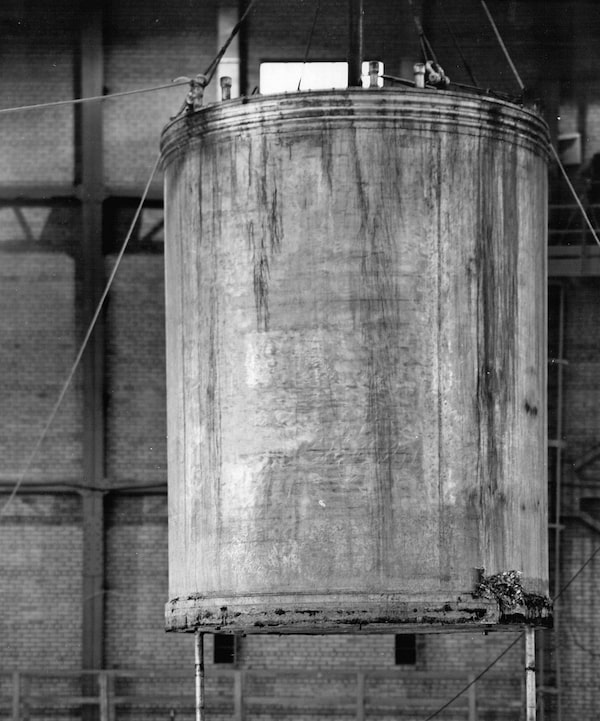
Chalk River NRX-Reactor leak, 1953 -- calandria removed from reactor being lowered into calandria bag. Photograph shows south-east sid
The NRX calandria is lowered into a protective bag and driven away to a disposal site in May 1953.CANADIAN NUCLEAR LABORATORIES

Now, 70 years after the cleanup, the largest artefact from the accident is about to see the light of day once again.

The burial mound of the NRX calandria, as seen earlier this month. Later this spring, a project team will resume work on excavating and then cutting up the calandria for longer term storage.CANADIAN NUCLEAR LABORATORIES/SUPPLIED

Petitions to the Auditor General of Canada on radioactive waste

8 January 2022

Back several years ago when we were beginning to mobilize to oppose the giant Ottawa River radioactive waste mound (NSDF), a colleague suggested submitting an environmental petition to the Auditor General. The Environmental Petitions process is a formal means (covered in the Auditor General Act), whereby citizens can submit questions to government officials about environmentally important issues. The OAG mediates the process and the officials are required to answer the questions within a 120 day time frame.

The NSDF proposal was (and is) so substandard and irresponsible, that it prompted a series of petitions to the AG from Concerned Citizens and various colleagues and NGOs.

Here are links to the petitions on various aspects of radioactive waste since 2017. Petition summaries can be found on the website of OAG here: https://www.oag-bvg.gc.ca/internet/English/pet_lp_e_938.html


405 – Canada’s Nuclear Legacy Liabilities: Clean-up Costs for the Chalk River Laboratories

405 B – Follow-up petition on Canada’s nuclear legacy liabilities

411 – Policies and strategies for managing non-fuel radioactive wastes

413 – Environmental Assessment of Nuclear Projects

418 – Need for a national policy on decommissioning of nuclear reactors

419 – Concerns about investment in “new” nuclear technologies

421 – Questioning nuclear power as clean energy

427 – Nuclear governance problems in Canada

443 – Reporting relationship of the Canadian Nuclear Safety Commission

According to the Office of the Auditor General of Canada, one of the environment and sustainable development audits currently in progress is “Nuclear Waste Management”. The report is expected to be published in 2022.

City of Ottawa requests a regional assessment of radioactive waste disposal projects in the Ottawa Valley

The City of Ottawa is requesting a regional assessment of radioactive waste disposal projects in the Ottawa Valley under Canada’s new Impact Assessment Act. This review, if undertaken as requested, would address cumulative impacts of radioactive waste projects planned for the Ottawa Valley. It would be conducted by a committee appointed for the task by the Minister of Environment and Climate Change or by the Impact Assessment Agency.

Hill Times Letter to the Editor ~ We need parliamentarians to stop project, prevent Ottawa River from being permanently contaminated by gigantic radioactive landfill

January 18, 2021

Re “CNL working to accomplish responsible action in managing Canada’s nuclear research and development legacy” (The Hill Times, Letters to the Editor, December 14, 2020).

https://www.hilltimes.com/2021/01/18/278089/278089

This letter from Joe McBrearty, President and CEO of Canadian Nuclear Laboratories (CNL) deepens my concern about the handling of Canada’s $8 billion nuclear waste liability. 

Mr. McBrearty claims that the Chalk River Mound beside the Ottawa River, 150 km north of Ottawa-Gatineau, “will contain only low-level radioactive waste which contains radionuclides that require isolation and containment for only a few hundred years.”

Unfortunately this claim does not stand up to scrutiny.

Last month CNL published its final environmental impact statement listing a partial inventory of radionuclides that would go into the gigantic five-to-seven story radioactive mound (aka the “NSDF”).

Twenty-five out of the 30 radionuclides listed in the inventory are long-lived, with half-lives ranging from four centuries to more than four billion years. To take just one example, the man-made radionuclide, Neptunium-237, has a half-life of 2 million years such that, after 2 million years have elapsed, half of the material will still be radioactive. 

The inventory includes four isotopes of plutonium, one of the most deadly radioactive materials known, if inhaled or ingested.

It is incorrect to say that these materials “require isolation and containment for only a few hundred years.” Many of them will be dangerously radioactive for more than one hundred thousand years. The International Atomic Energy Agency states that materials like this must be stored tens of meters or more underground, not in an above-ground mound.

The CNL inventory also includes a very large quantity of cobalt-60, a material that gives off so much strong gamma radiation that lead shielding must be used by workers who handle it in order to avoid dangerous radiation exposures. The International Atomic Energy Agency considers high-activity cobalt-60 sources to be “intermediate-level waste” and specifies that they must be stored underground. Addition of high-activity cobalt-60 sources means that hundreds of tons of lead shielding would be disposed of in the mound along with other hazardous materials such as arsenic, asbestos, PCBs, dioxins and mercury.


CNL’s environmental impact statement describes several ways that radioactive materials would leak into surrounding wetlands that drain into the Ottawa River during filling of the mound and after completion. It also describes CNL’s intent to pipe water polluted with tritium and other radioactive and hazardous substances from the waste treatment facility directly into Perch Lake which drains into the Ottawa River.

I stand by my original conclusion: We need parliamentarians to step up now to stop this deeply flawed project and prevent the Ottawa River from being permanently contaminated by a gigantic, leaking radioactive landfill that would do little to reduce Canada’s $8 billion nuclear waste liability.

Letter to the editor published in the Hill Times Monday January 18, 2021

The gigantic Chalk River Mound (the so-called ‘NSDF’) would not reduce Canada’s radioactive waste liabilities and could in fact increase them

The NSDF “Licensed Inventory” (Table 13 in the NSDF Waste Acceptance Criteria), if followed by the proponent, would only allow disposal of a tiny fraction of the Government of Canada’s legacy nuclear waste.  The NSDF would yield virtually no reduction in the federal nuclear legacy liability despite the expenditure of hundreds of millions of tax dollars. 


Liabilities could also increase, because a giant pile of leaking radioactive waste would be difficult to remediate, and remediation costs could exceed those of managing the wastes had they not been put in the mound.

For a detailed analysis see this post: https://concernedcitizens.net/2020/10/06/the-government-of-canadas-radioactive-wastes-costs-and-liabilities-growing-under-public-private-partnership/

How would the Chalk River Mound leak? Let us count some of the ways

Canadian Nuclear Laboratories (CNL) – run by a consortium of profit-making multinational companies – is proposing to build a giant mound that it misleadingly calls a “Near Surface Disposal Facility” for a million cubic meters of radioactive waste at its Chalk River facility along the Ottawa River.

CNL’s high cost ad campaign (paid for with Canadian tax dollars) says the dump is safe and uses “proven technology”. Ads say the dump will protect the public and the environment.

However, CNL’s draft environmental impact statement (EIS) describes several ways that contents of the proposed “engineered containment mound” of radioactive waste could leak into the Ottawa River. Here are some of the ways:

During operation (while the dump is being filled)…

1. Wastes being added to the mound would be exposed to the elements. 

Rain and melting snow would leach radioactive contents down through the mound. The liquid would be collected and pumped uphill to a water treatment plant. Some but not all radioactive contaminants would be removed prior to releasing the treated leachate into wetlands that drain into the Ottawa River. (Table 3.5.3-1 on page 3-23 of the draft EIS) 

2. Radioactive water (tritium) would leach in very large amounts from the mound. 

Tritium is part of the water molecule and cannot be removed by water treatment. The draft EIS suggests the very high tritium content will be reduced but does not say how. Untreated tritium would be discharged to wetlands that drain into the Ottawa River where it would get incorporated into fish and enter drinking water supplies Large quantities of tritium would also be released from the dump as water vapour. 

3. Other toxic substances such as PCBs leaching from the mound would be only partially removed by water treatment.. 

Table 3.5.3-2 on page 3-25 shows that treatment would only partly remove non-radioactive toxic compounds in the wastes such as lead, PCBs and dioxin. Measurable amounts would be released to the environment. 

4. Heavy storm events would erode the mound’s surface and wash toxic substances into low areas. 

Highly contaminated water washing off active dumping areas would be pumped to the water treatment plant. Less contaminated water would be pumped to three storm-water management ponds around the perimeter of the facility and be discharged to adjacent wetlands. Ponds would provide only “basic” containment of sediments before their contents were released (draft EIS explains this on page 3-57) 

5. The capacity of storm-water ponds would be exceeded during extreme rainfall events or snowmelts. 

The draft EIS (page 9-2) says that pond overflow “would be conveyed by inlet and emergency outlet structures adjacent to the surface water management ponds,” presumably to be released directly into adjacent wetlands. 

6. Other possible ways the facility might leak during operations (not described in detail the EIS) include tornado damage, pump failures during extreme storm events with loss of electrical power, improper installation of the base liners, puncture of the base liners by heavy or sharp materials, melting of liners by radioactively hot materials, and blockage of the leachate collection system. 

After closure…

1. Wastes in the mound would be re-exposed to the elements when the top cover fails. 

After waste dumping ended the leachate collection system and water treatment plant would be shut down, and a top cover placed over the wastes. The draft EIS acknowledges that the top cover would fail with “normal evolution” through forces such as erosion, extreme storms, burrowing animals, root penetration, etc. 

2. Failure of the top cover while the base liners remain intact would initiate the “bathtub scenario”. 

Rain and melting snow would again leach the radioactive wastes, 

but the leachate collection and pumping system would no longer be operational. Contaminated leachate would be trapped by the bottom liner and accumulate in the space between the mound and the surrounding berm. Leachate levels would rise and spill over along the low point of the 

berm. 

Long-lived radioactive elements such as plutonium and uranium, exposed to wind and water erosion, would flow into the river for thousands to millions of years. Eventual failure of the bottom liners would also allow radionuclides to move into groundwater. The Ottawa River would be permanently contaminated by radioactive wastes. Countless generations of people drinking its water would be exposed to increased cancer risks.

Ontario town slams proposal for nuclear-waste facility, citing safety issues

A sign marks the entrance to the Chalk River Laboratories in Chalk River, Ont., in 2012. The nearby town of Deep River has opposed a proposal to build a nuclear-waste facility at the location.SEAN KILPATRICK/THE CANADIAN PRESS

SHAWN MCCARTHYGLOBAL ENERGY REPORTERPUBLISHED AUGUST 23, 2017UPDATED AUGUST 23, 2017FOR SUBSCRIBERS 5 COMMENTS

https://www.theglobeandmail.com/report-on-business/industry-news/energy-and-resources/ontario-town-slams-proposal-for-nuclear-waste-facility-citing-safety-issues/article36071242/

The Town of Deep River, Ont. – home to Canada’s nuclear pioneers for 60 years – has slammed a proposal to build a near-surface nuclear-waste facility at the nearby Chalk River laboratories, saying the company appears to put its scheduling issues ahead of safety.

Government-owned, private-sector-managed Canadian Nuclear Laboratories (CNL) proposes to build a $325-million facility to dispose of a large quantity of low- and intermediate-level radioactive waste generated at the historic research centre, and to bring some waste material from other sites that it manages.

CNL is responding to widespread criticism of the project among local, pro-nuclear residents by revisiting its plan to include a small amount of intermediate-level waste at the site, Kurt Kehler, vice-president for decommissioning and waste management, said in an interview on Wednesday.

In a submission to the Canadian Nuclear Safety Commission, the Town of Deep River argued the company’s plan is flawed and that the draft environmental-impact statement that was submitted to the regulator is missing key information.

However, in an accompanying letter, Mayor Joan Lougheed said the town supports CNL’s effort to provide for the safe storage and disposal of nuclear waste. Deep River is home for many of the lab’s current and retired employees; it has a population of roughly 4,000 people, situated on the Ottawa River some 200 kilometres northwest of the national capital.

“We’re doing our due diligence and responsibility as representatives of the Town of Deep River,” Ms. Lougheed said in an interview on Wednesday. “We all have a responsibility to deal with waste and waste management.”

She said town supports the storage of low-level radioactive waste at such a near-surface site, but has concerns about the intermediate-level radioactive material that requires isolation and containment for more than several hundred years.

In 2015, the Canadian National Energy Alliance consortium won a contract from the former Conservative government to manage the former Atomic Energy of Canada Ltd. research facilities, now known as Canadian Nuclear Laboratories. The group – which includes SNC-Lavalin Group Inc., and American engineering giant CH2M Hill Inc. and Fluor Corp. – was tasked with bringing private-sector efficiency to AECL operations.

In its submission, Deep River says CNL failed to engage the municipality and its residents, offering a presentation rather than meaningful consultation. It suggests the consortium appears to be more focused on timely and profitable execution of the project than on safety and long-term management of the waste.

Particularly in the consideration of alternative options, “at times it appears the project schedule and costs were the driving forces influencing the assessment rather than public health, safety and the environment,” it said.STORY CONTINUES BELOW ADVERTISEMENT

The town and CNL are in negotiations over what compensation will be paid to the municipality as the host community, and Mr. Kehler described Deep River’s demands as “pretty lofty.”

As well, several First Nations groups either oppose the proposal outright, or say that they have not been properly consulted even though the research facilities are located on unceded traditional territory that is subject to land-claim negotiations.

CNL’s proposal – which aims to have the waste facility operational in 2021 – is running into fierce opposition from some AECL retirees. Several scientists who worked at facility say the CNL plan fails to meet international standards for safely dealing with intermediate-level waste (ILW).

“We’ve heard those comments and we’re taking that under serious advisement,” Mr. Kehler said. “And so we’ll be coming out with a recommendations shortly to the commission. … We are taking ILW issue seriously and I think we’ll come up with an appropriate resolution that will make just about everybody happy.”

The plan currently calls for 1 per cent of the total volume to be intermediate-level waste, and the company says that material would be on the lower end of the intermediate range. CNL is separately developing plans for the more dangerous intermediate-level waste that exists on the site.

Mr. Kehler also rejected the suggestion that CNL is compromising safety for financial reasons, saying the company is proceeding according to a schedule laid out by the Canadian Environmental Assessment Act and the nuclear-safety commission.