Letter to Mark Carney ~ Pour une gestion transparente et responsable des déchets radioactifs

December 12, 2025

English version follows below.

Towards a transparent and responsible management of radioactive waste

December 2 2025

Several political parties and civil society organizations are dismayed to learn thatCanadian Nuclear Laboratories (CNL) has decided to consolidate radioactive waste (forwhich the federal government is responsible) at the Chalk River Laboratories site. This decision was made without consultation with First Nations or the public, and without parliamentary debate. Canadian Nuclear Laboratories (CNL) is only a private contractor,not a government agency.

For the population, there is no public accountability and concern is growing. Why concentrate everything at Chalk River? CNL is not intending to permanently store high- or intermediate-level waste at Chalk River. Those wastes will likely be moved again. Chalk River is an unsuitable location for radioactive waste consolidation because it islocated on the Ottawa River and the area is prone to seismic tremors.

Used nuclear fuel has the highest level of radioactivity; it is being transported to ChalkRiver from nuclear reactors in Manitoba, Ontario and Quebec for interim storage pending the construction of a proposed deep geological repository (DGR). CNL intendsto have the same used fuel eventually transported to the DGR. But such a repositorystill does not exist and may never be licensed or approved. Whether the DGR isultimately built or not, issues surrounding the transportation of radioactive waste have to be addressed.

There are increased risks and costs of transporting used fuel twice: first from thenuclear power plants to Chalk River, and then from Chalk River to a second destination.This leads to extra safety risks and a waste of public money. The government is justmoving the waste around at great expense and added risk without solving the problempermanently, as there is still no proven safe solution despite 45 years of effort.

The proposed transportation of intermediate-level waste to Chalk River from thedecommissioning of nuclear reactors is similarly ill-advised.

Public concern was heightened by the news of the secretive transport of tonnes of usednuclear fuel from Bécancour, Quebec, to Chalk River during the summer of 2025, alongpublic roads and bridges, without any explicit authorization or opportunity for publicconsultation or even proper notification.

• We call on the federal government for a moratorium on the shipment of Canadianradioactive waste to Chalk River because of the increasing risk of radioactivecontamination and the lack of an acceptable due process.

• We call on the federal government to ban all imports of radioactive waste from othercountries, including disused medical sources, discarded tritium light sources, or usednuclear fuel.

• We call on the Minister of Environment and Climate Change to conduct a strategicassessment of the transportation of high- and intermediate-level radioactive waste onpublic highways, in accordance with section 95 of the Impact Assessment Act. Theresults of this assessment would contribute to future impact assessments of nuclearfacilities. The goal would be to examine, for example, the cumulative impact at ChalkRiver and to provide a framework for upcoming environmental assessments of nuclearpower plants and reactor decommissioning projects.

Patrick Bonin, M.P.Bloc Québécois critic for the Environment and Climate Change

Elizabeth May, M.P.Green Party of Canada

André BélangerFondation Rivières

Alain BranchaudSNAP Québec

Ginette Charbonneau Physicist and spokesperson for le Ralliement contre la pollution radioactive

Et al….
Canada is failing to meet a fundamental principle of nuclear safety according to international experts

This letter to the editor was published in the Hill Times on June 16, 2025 (Subscribe to the Hill Times)

~~~~~

March 2025 report  by the International Atomic Energy Agency (IAEA) flagged a serious problem in Canada’s nuclear governance regime. Canada has not incorporated the fundamental safety principle of justification into its legal framework, despite being urged to do so by an international peer review team in 2019.

The IAEA principle of justification in nuclear safety requires that any practice involving human exposures to ionizing radiation be justified during the licensing process for a facility. It must be demonstrated that the overall benefits of the project to individuals and society, outweigh the potential health detriments of the radiation exposures it will cause.

Justification is necessary because there is no safe level of exposure to ionizing radiation from nuclear reactors and radioactive waste. Ionizing radiation causes cancers of all kinds, many other chronic diseases and damage to the human gene pool. Human-made nuclear waste will remain hazardous and radioactive for millions of years.

Canada’s failure to justify nuclear projects is a serious deficiency that urgently needs to be addressed given the Government of Canada’s professed interest in funding and expanding nuclear electricity generation in Canada. We need to ask: can we justify creating more and more radioactive waste that future generations will have to deal with even though they will receive zero benefit from the activities that created it.

Other serious deficiencies were flagged by the IAEA experts in 2019. For example, Canada allows pregnant nuclear workers to be exposed to a radiation dose four times larger than is tolerated by IAEA standards. This issue remains unaddressed five years later.

These problems are just the tip of the iceberg. An environmental petition to the Auditor General of Canada in 2019 described many problems with Canada’s nuclear governance regime suggesting it compares unfavourably with more robust regimes in other OECD countries.  See Hill Times letters to the editor: “Who will fix Canada’s nuclear governance gaps?” and “Reforms needed at the Canadian Nuclear Safety Commission,” for more details.

Lynn Jones, Ottawa (Concerned Citizens of Renfrew County and Area)

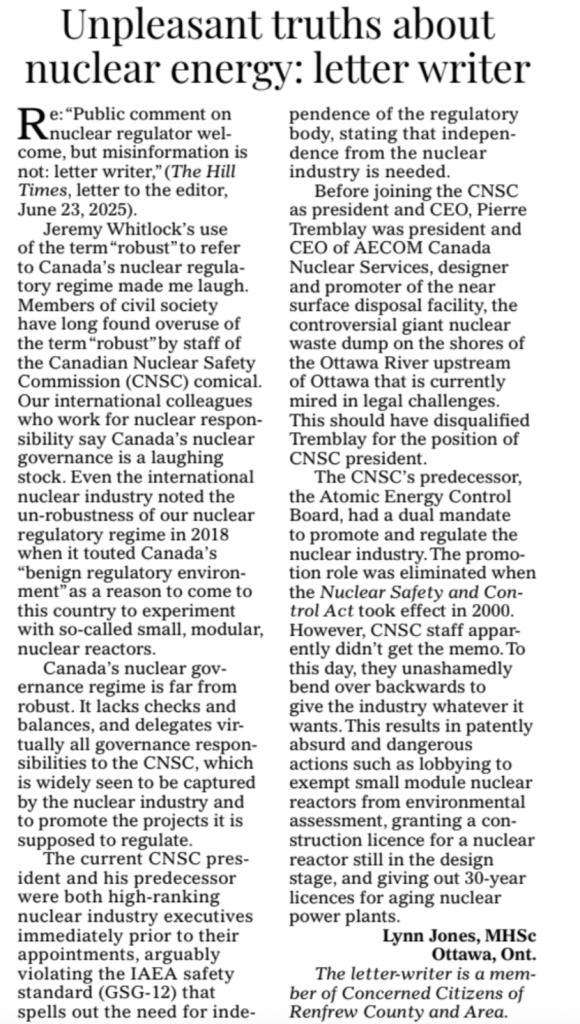
Canada’s inadequate nuclear regulatory regime highlighted in Hill Times letters to the editor

This letter appeared in the July 7 edition of the Hill Times. (subscribe here)

It was in response to a letter by Jeremy Whitlock, indefatigable cheerleader for all things nuclear. His letter, published on June 23, 2025 is here.

Jeremy Whitlock was responding to this letter, published in the Hill Times on June 16, 2025:

Canada is failing to meet a fundamental principle of nuclear safety according to international experts

March 2025 report  by the International Atomic Energy Agency (IAEA) flagged a serious problem in Canada’s nuclear governance regime. Canada has not incorporated the fundamental safety principle of justification into its legal framework, despite being urged to do so by an international peer review team in 2019.

The IAEA principle of justification in nuclear safety requires that any practice involving human exposures to ionizing radiation be justified during the licensing process for a facility. It must be demonstrated that the overall benefits of the project to individuals and society, outweigh the potential health detriments of the radiation exposures it will cause.

Justification is necessary because there is no safe level of exposure to ionizing radiation from nuclear reactors and radioactive waste. Ionizing radiation causes cancers of all kinds, many other chronic diseases and damage to the human gene pool. Human-made nuclear waste will remain hazardous and radioactive for millions of years.

Canada’s failure to justify nuclear projects is a serious deficiency that urgently needs to be addressed given the Government of Canada’s professed interest in funding and expanding nuclear electricity generation in Canada. We need to ask: can we justify creating more and more radioactive waste that future generations will have to deal with even though they will receive zero benefit from the activities that created it.

Other serious deficiencies were flagged by the IAEA experts in 2019. For example, Canada allows pregnant nuclear workers to be exposed to a radiation dose four times larger than is tolerated by IAEA standards. This issue remains unaddressed five years later.

These problems are just the tip of the iceberg. An environmental petition to the Auditor General of Canada in 2019 described many problems with Canada’s nuclear governance regime suggesting it compares unfavourably with more robust regimes in other OECD countries.  See Hill Times letters to the editor: “Who will fix Canada’s nuclear governance gaps?” and “Reforms needed at the Canadian Nuclear Safety Commission,” for more details.

Lynn Jones, Ottawa (Concerned Citizens of Renfrew County and Area)

Kebaowek First Nation condemns CNSC decision to license the Chalk River nuclear waste dump and calls on the federal government to intervene

PRESS RELEASE

FOR IMMEDIATE RELEASE

NUCLEAR WASTE AT CHALK RIVER: KEBAOWEK FIRST NATION CONDEMNS CNSC DECISION AND CALLS ON THE CANADIAN GOVERNMENT

KEBAOWEK, January 9, 2024 – Despite concerns expressed by First Nations and increased support from over 140 municipalities across Canada, the Canadian Nuclear Safety Commission (CNSC) has granted the license for the Near Surface Disposal Facility (NSDF) project at Chalk River. In response, the Kebaowek First Nation strongly condemns this decision and calls on the federal government to intervene to stop this environmentally high-risk project.

“The Commission’s decision is unacceptable, notably because it goes against the rights of Indigenous peoples and environmental protection. The Canadian government must act promptly and immediately assert the suspension of the project. The Commission’s final decision is totally wrong when it states that the NSDF project will not cause significant environmental effects. While the decision states that CNL will take appropriate measures to safeguard the environment, the health, safety of individuals, and national security and to comply with national obligations, it is undeniable that the safety and health of people and the environment will be profoundly impacted for generations to come through this project, ” reacted Chief Lance Haymond of Kebaowek.

It is worth noting that the NSDF would release radioactive and hazardous materials into a nearby wetland and the Ottawa River during its operation and after its closure. The mound is expected to degrade through a process of “normal evolution”. The NSDF could also contaminate the river following earthquakes, wildfires, floods, and other extreme weather events. Not only is the Kichi Sibi sacred to the Algonquin Peoples, but the Chalk River site is also close to the sacred Algonquin sites of Oiseau Rock and Baptism Point.

In 2017, the Assembly of First Nations adopted a resolution stating that the CNSC and the Canadian government had not fulfilled their constitutional obligation to consult and accommodate First Nations regarding the NSDF. The Anishinabek Nation and the Iroquois caucus issued a joint statement on radioactive waste, asserting that “we must protect the land, water, and all living beings for future generations” and calling for no abandonment of radioactive waste, moving it away from major waterways, and eliminating the practice of importing or exporting radioactive waste.

In addition to the opposition of Algonquin First Nations to the project, over 140 municipalities in Quebec and Ontario, including Gatineau and Montreal, as well as several civil society organizations, have expressed their opposition to the NSDF plan. In 2021, the City of Ottawa adopted a resolution expressing its concern.

The Kebaowek First Nation, committed to defending the rights of Indigenous peoples and environmental preservation, expresses its eagerness to collaborate with the government and other stakeholders to ensure a careful consideration of Indigenous concerns and compliance with the obligations of the United Nations Declaration on the Rights of Indigenous Peoples (UNDRIP) in the context of this project. The First Nation maintains its categorical opposition to the establishment of a permanent NSDF on unceded Anishinabe territory, emphasizing the crucial importance of protecting Indigenous rights, the environment, and cultural heritage. Faced with a lack of trust in the CNSC and its persistent failure to uphold UNDRIP, the First Nation calls on the federal government, including the Minister of Environment and Natural Resources, to intervene and end the project.

“I want to be very clear: the Algonquin Peoples did not consent to the construction of this radioactive waste dump on our unceded territory. We believe the consultation was inadequate, to say the least, and that our Indigenous rights are threatened by this proposal. We demand the cancellation of the NSDF project. The focus should instead be on a real and successful cleanup of the site to permanently eliminate old radioactive waste,” explains Chief Haymond.

Kebaowek First Nation Chief Lance Haymond speaking at a press conference in Ottawa in June 2023

For more information: https://www.stopnuclearwaste.com/ 

To obtain the Board’s decision: https://www.cnsc-ccsn.gc.ca/eng/resources/news-room/nsdf-media-kit.cfm  

-30-

Source: 

Kebaowek First Nation

For information and interview requests: 

Mathilde Robitaille-Lefebvre 

Media Relations 

m.robitaille-lefebvre@seize03.ca 

819-852-4762

Justin Roy

Advisor 

Kebaowek First Nation 

Jroy@kebaowek.ca 

819-627-3309