Canada is failing to meet a fundamental principle of nuclear safety according to international experts

This letter to the editor was published in the Hill Times on June 16, 2025 (Subscribe to the Hill Times)

~~~~~

March 2025 report  by the International Atomic Energy Agency (IAEA) flagged a serious problem in Canada’s nuclear governance regime. Canada has not incorporated the fundamental safety principle of justification into its legal framework, despite being urged to do so by an international peer review team in 2019.

The IAEA principle of justification in nuclear safety requires that any practice involving human exposures to ionizing radiation be justified during the licensing process for a facility. It must be demonstrated that the overall benefits of the project to individuals and society, outweigh the potential health detriments of the radiation exposures it will cause.

Justification is necessary because there is no safe level of exposure to ionizing radiation from nuclear reactors and radioactive waste. Ionizing radiation causes cancers of all kinds, many other chronic diseases and damage to the human gene pool. Human-made nuclear waste will remain hazardous and radioactive for millions of years.

Canada’s failure to justify nuclear projects is a serious deficiency that urgently needs to be addressed given the Government of Canada’s professed interest in funding and expanding nuclear electricity generation in Canada. We need to ask: can we justify creating more and more radioactive waste that future generations will have to deal with even though they will receive zero benefit from the activities that created it.

Other serious deficiencies were flagged by the IAEA experts in 2019. For example, Canada allows pregnant nuclear workers to be exposed to a radiation dose four times larger than is tolerated by IAEA standards. This issue remains unaddressed five years later.

These problems are just the tip of the iceberg. An environmental petition to the Auditor General of Canada in 2019 described many problems with Canada’s nuclear governance regime suggesting it compares unfavourably with more robust regimes in other OECD countries.  See Hill Times letters to the editor: “Who will fix Canada’s nuclear governance gaps?” and “Reforms needed at the Canadian Nuclear Safety Commission,” for more details.

Lynn Jones, Ottawa (Concerned Citizens of Renfrew County and Area)
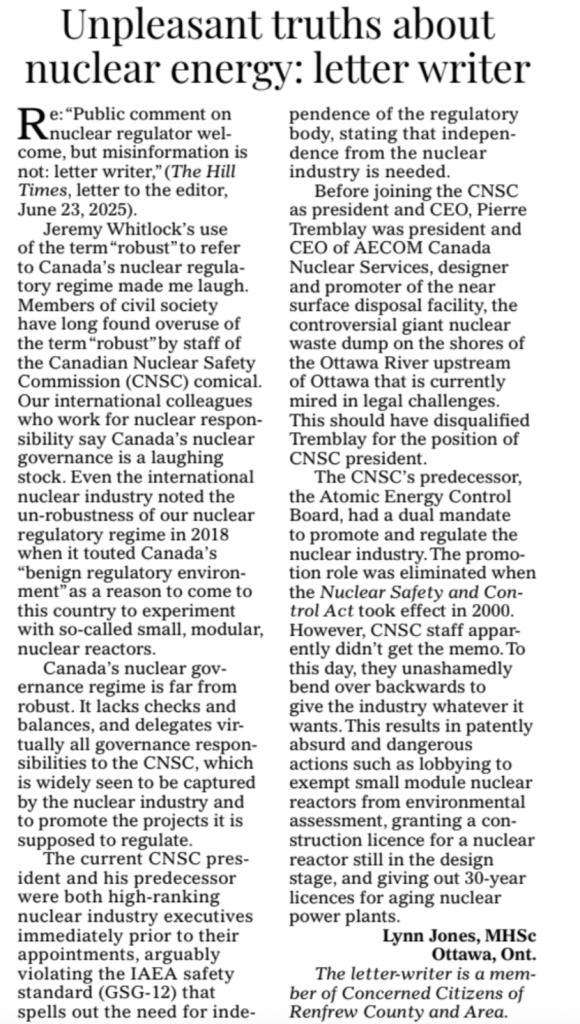
Canada’s inadequate nuclear regulatory regime highlighted in Hill Times letters to the editor

This letter appeared in the July 7 edition of the Hill Times. (subscribe here)

It was in response to a letter by Jeremy Whitlock, indefatigable cheerleader for all things nuclear. His letter, published on June 23, 2025 is here.

Jeremy Whitlock was responding to this letter, published in the Hill Times on June 16, 2025:

Canada is failing to meet a fundamental principle of nuclear safety according to international experts

March 2025 report  by the International Atomic Energy Agency (IAEA) flagged a serious problem in Canada’s nuclear governance regime. Canada has not incorporated the fundamental safety principle of justification into its legal framework, despite being urged to do so by an international peer review team in 2019.

The IAEA principle of justification in nuclear safety requires that any practice involving human exposures to ionizing radiation be justified during the licensing process for a facility. It must be demonstrated that the overall benefits of the project to individuals and society, outweigh the potential health detriments of the radiation exposures it will cause.

Justification is necessary because there is no safe level of exposure to ionizing radiation from nuclear reactors and radioactive waste. Ionizing radiation causes cancers of all kinds, many other chronic diseases and damage to the human gene pool. Human-made nuclear waste will remain hazardous and radioactive for millions of years.

Canada’s failure to justify nuclear projects is a serious deficiency that urgently needs to be addressed given the Government of Canada’s professed interest in funding and expanding nuclear electricity generation in Canada. We need to ask: can we justify creating more and more radioactive waste that future generations will have to deal with even though they will receive zero benefit from the activities that created it.

Other serious deficiencies were flagged by the IAEA experts in 2019. For example, Canada allows pregnant nuclear workers to be exposed to a radiation dose four times larger than is tolerated by IAEA standards. This issue remains unaddressed five years later.

These problems are just the tip of the iceberg. An environmental petition to the Auditor General of Canada in 2019 described many problems with Canada’s nuclear governance regime suggesting it compares unfavourably with more robust regimes in other OECD countries.  See Hill Times letters to the editor: “Who will fix Canada’s nuclear governance gaps?” and “Reforms needed at the Canadian Nuclear Safety Commission,” for more details.

Lynn Jones, Ottawa (Concerned Citizens of Renfrew County and Area)

New evidence that radiation risks are greater than currently acknowledged, from the International Nuclear Workers Study

January 29, 2024

This is an excerpt from the final submission by the Canadian Environmental Law Association to the Canadian Nuclear Safety Commission on the application to construct the Near Surface Disposal Facility at Chalk River, Ontario

Another issue not discussed in the EIS is the new evidence that radiation risks are greater than
currently acknowledged. This new evidence is from the International Nuclear Workers’ Study
(INWORKS) which comprises a number of meta studies of nuclear workers in the US, UK and
France. These meta studies are very large (>300,000 participants) which lends considerable
authority to their findings.

In more detail, in late 2015 and in subsequent years, the INWORKS studies examined associations
between low dose-rate radiation and leukemia/lymphoma76, solid cancers77, and circulatory disease.

Their radiation risk estimates were higher than current risk estimates. For example, in
the solid cancer study, the observed increase was 0.47/0.32 = 1.47, ie a 47% increase – a significant
amount. But for leukemia the increase was much greater. The more recent study on leukemia risks
(Leurad et al, 2021) found the increase in point estimates was 5.8 fold or 580%. This large increase
was driven mainly by the 11-fold increase in chronic myelogenous leukemia80 (“CML”) in older
workers81. The study on cardiovascular risks somewhat surprisingly reported brand new risks of
heart disease and strokes. These new risks and increased risks are not taken into account in official
risk estimates by regulatory agencies including the CNSC but they should be.


The INWORKS radiation studies remain pertinent as to whether a license should be given to CNL
for a number of other reasons, as follows. They:


a. provide strong evidence of a dose-response relationship between cumulative, chronic,
low-dose, exposures to radiation and leukemia.
b. confirm that radiation risks exist even at very low dose rates (average = 1·1 mGy per
year).
c. observe risks at low dose rates rather than extrapolating them from high dose rates. (eg as
in the LSS study of Japanese bomb survivors)
d. found that risks do not depend on dose rate thus contradicting the ICRP’s use of a Dose
and Dose Rate Effectiveness Factor (DDREF) (which acts to reduce by half its published
radiation risks).
e. found radiogenic leukemia risks decline linearly with dose, contradicting earlier studies
suggesting a lower, linear-quadratic relationship for leukemia.
f. strengthen the Linear No-Threshold (LNT) model of radiogenic risks, as it now applies to
leukemias as well as to solid cancers.
g. found no evidence of a threshold below which no effects are seen, and
h. found a trend of increasing risk of solid cancer by attained age.

Because the INWORK findings are far-reaching in their implications, it is necessary to doublecheck their findings. This was carried out by recent exhaustive review (Hauptmann et al, 2020) of the INWORKS studies which examined possible sources of bias82 and confounding83. It concluded
that these epidemiological studies directly support the conclusion of increased cancer risks from
low doses of ionising radiation, with little evidence of bias and confounding. This is similar to the
findings of yet another study84 which also reviewed the INWORKS studies using specialist
statistical and epidemiological methods to look for evidence of bias. It found none.

References are available in the original CELA submission:

https://api.cnsc-ccsn.gc.ca/dms/digital-medias/cmd22-h7-104.pdf/object?subscription-key=3ff0910c6c54489abc34bc5b7d773be0