Letter to Mark Carney ~ Pour une gestion transparente et responsable des déchets radioactifs

December 12, 2025

English version follows below.

Towards a transparent and responsible management of radioactive waste

December 2 2025

Several political parties and civil society organizations are dismayed to learn thatCanadian Nuclear Laboratories (CNL) has decided to consolidate radioactive waste (forwhich the federal government is responsible) at the Chalk River Laboratories site. This decision was made without consultation with First Nations or the public, and without parliamentary debate. Canadian Nuclear Laboratories (CNL) is only a private contractor,not a government agency.

For the population, there is no public accountability and concern is growing. Why concentrate everything at Chalk River? CNL is not intending to permanently store high- or intermediate-level waste at Chalk River. Those wastes will likely be moved again. Chalk River is an unsuitable location for radioactive waste consolidation because it islocated on the Ottawa River and the area is prone to seismic tremors.

Used nuclear fuel has the highest level of radioactivity; it is being transported to ChalkRiver from nuclear reactors in Manitoba, Ontario and Quebec for interim storage pending the construction of a proposed deep geological repository (DGR). CNL intendsto have the same used fuel eventually transported to the DGR. But such a repositorystill does not exist and may never be licensed or approved. Whether the DGR isultimately built or not, issues surrounding the transportation of radioactive waste have to be addressed.

There are increased risks and costs of transporting used fuel twice: first from thenuclear power plants to Chalk River, and then from Chalk River to a second destination.This leads to extra safety risks and a waste of public money. The government is justmoving the waste around at great expense and added risk without solving the problempermanently, as there is still no proven safe solution despite 45 years of effort.

The proposed transportation of intermediate-level waste to Chalk River from thedecommissioning of nuclear reactors is similarly ill-advised.

Public concern was heightened by the news of the secretive transport of tonnes of usednuclear fuel from Bécancour, Quebec, to Chalk River during the summer of 2025, alongpublic roads and bridges, without any explicit authorization or opportunity for publicconsultation or even proper notification.

• We call on the federal government for a moratorium on the shipment of Canadianradioactive waste to Chalk River because of the increasing risk of radioactivecontamination and the lack of an acceptable due process.

• We call on the federal government to ban all imports of radioactive waste from othercountries, including disused medical sources, discarded tritium light sources, or usednuclear fuel.

• We call on the Minister of Environment and Climate Change to conduct a strategicassessment of the transportation of high- and intermediate-level radioactive waste onpublic highways, in accordance with section 95 of the Impact Assessment Act. Theresults of this assessment would contribute to future impact assessments of nuclearfacilities. The goal would be to examine, for example, the cumulative impact at ChalkRiver and to provide a framework for upcoming environmental assessments of nuclearpower plants and reactor decommissioning projects.

Patrick Bonin, M.P.Bloc Québécois critic for the Environment and Climate Change

Elizabeth May, M.P.Green Party of Canada

André BélangerFondation Rivières

Alain BranchaudSNAP Québec

Ginette Charbonneau Physicist and spokesperson for le Ralliement contre la pollution radioactive

Et al….
Will CNL put nuclear reactor components in the NSDF?

August 12, 2024 (en français ici)

Will CNL put nuclear reactor components in the NSDF?

The lack of clarity about the nature of the waste intended for disposal in the NSDF has been a concern since the NSDF project description was published in March 2016.  In our group’s comments on the project description, submitted in June 2016, we stated

For the public to have adequate information about the nature of the radioactive waste proposed for inclusion in the NSDF, the environmental assessment must provide much more detail than simply stating that the waste “will be required to meet waste acceptance criteria.”

CNL has prepared a document, NSDF Waste Acceptance Criteria (WAC) that CNL says “will ensure the short- and long-term protection of the public, the environment and workers.”  But is this true?  And do the NSDF Waste Acceptance Criteria allow CNL to place reactor components in the NSDF?

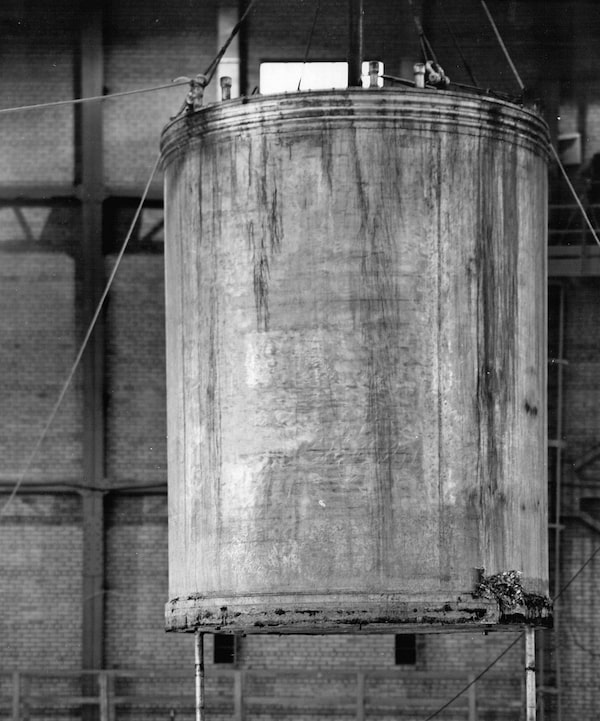
The calandria from the NRX reactor accident in December 1952 and two calandria from the NRU reactor are buried at shallow depths in the waste management areas of Chalk River Laboratories.  This is stated in the Overview Decommissioning and Cleanup Plan for Chalk River Laboratories: 

“Several special burials (NRU and NRX calandrias) were also made in concrete containers or directly in the trenches.”

The Waste Acceptance Criteria allow the disposal of waste classified as Type 6 – Oversized waste:

“Oversized debris, including waste that does not fall within the definition of waste types 1 to 5, primarily due to its size or shape. The process applicable to infrequently performed activities (section 6.4) is used to approve the placement of type 6 waste.”

The Infrequently Performed Operations override clause in section 6.4 states: 

“The eligibility of wastes that do not meet all the requirements set forth in the WAC (including Type 6, Oversized Waste) may be evaluated on a case-by-case basis.”

Reactor calandrias would almost certainly exceed the “Dose Rate Limits and Means of Handling and Transferring ” in Table 7 of the WAC.  However, the Waste Acceptance Criteria allow these dose limits to be exceeded if waste packages are shielded: 

“Shielded Waste Packages could be used to ensure waste complies with the dose rate limit in Table 7.”

CNL has made a presentation to the Chalk River Laboratories Environmental Stewardship Council about its work to uncover the NRX calandria, currently buried at shallow depth in Waste Management Area A.  The notes from Council meeting number 53 on Thursday, March 21, 2024, state that a council member asked for an update on this work:

Has anything else been happening with the NRX Calandra [sic] with the Calandra [sic] in Waste Area A?

The Seventh Canadian National Report for the Joint Convention provides more details about Waste Management Area A:

The first emplacement of radioactive waste at the CRL site took place in 1946 into what is now referred to as Waste Management Area A. These emplacements took the form of direct disposal of solids and liquids into excavated sand trenches. The scale of operations was modest and unrecorded until 1952, when the cleanup from the NRX accident generated large quantities of radioactive waste (which included the reactor’s calandria) that had to be managed quickly and safely. At that time, approximately 4,500 m3 of aqueous waste, containing 330 TBq (9,000 Ci) of mixed fission products, was poured into excavated trenches. This action was followed by smaller dispersals (6.3 TBq and 34 TBq of mixed fission products) in 1954 and 1955, respectively. Waste is no longer accepted for emplacement in Waste Management Area A.

The 2014 Comprehensive Preliminary Decommissioning Plan notes the limited records for drummed and bottled liquids buried prior to 1956 and for solid wastes buried prior to 1955. 

The 2023 Overview Decommissioning and Cleanup Plan for Chalk River Laboratories indicates CNL’s intention to transfer all the contents of WMA A to the NSDF: “the preliminary scenario presented is the removal of wastes from WMA A and its disposal in the NSDF.”

CNL’s lack of transparency regarding the waste destined for the NSDF, despite the requirements of the General Nuclear Safety and Control Regulations (GNSCR), is one of the main points of one of the legal challenges to the CNSC’s decision to authorize construction of the facility.  

The Memorandum of Fact and Law for the federal court case (Court File No. T-226-24) between Concerned Citizens of Renfrew County and Area, the Canadian Coalition for Nuclear Responsibility and le Ralliement contre la pollution radioactive (Applicants) and Canadian Nuclear Laboratories (Respondent) says the following:

The Commission’s failure to require the specific and comprehensive information set out in GNSCR s. 3(1)(c) and (j) has an enormous impact on the integrity of the Decision as a whole. This failure undermines the Decision’s main conclusion that the NSDF will not produce significant adverse environmental and health effects. All CNL’s calculations estimating the amount of radioactive material that the NSDF would release into the environment and would expose a member of the public to were based on the Waste Acceptance Criteria being followed. Since materials can be placed in the NSDF even if they do not meet the Waste Acceptance Criteria, all the calculations and estimations are a fiction. There is no guarantee that the amount and type of substances that end up in the NSDF will be the same amount and type as that upon which the calculations for the safety assessments were made.

~~~~~~~~

Photos from Globe and Mail article (19 March 2023) “Jimmy Carter, Chalk River and the dawn of Canada’s nuclear age”

Chalk River NRX-Reactor leak, 1953 -- calandria removed from reactor being lowered into calandria bag. Photograph shows south-east sid
The NRX calandria is lowered into a protective bag and driven away to a disposal site in May 1953.CANADIAN NUCLEAR LABORATORIES

Now, 70 years after the cleanup, the largest artefact from the accident is about to see the light of day once again.

The burial mound of the NRX calandria, as seen earlier this month. Later this spring, a project team will resume work on excavating and then cutting up the calandria for longer term storage.CANADIAN NUCLEAR LABORATORIES/SUPPLIED

Multinational consortium yields to public pressure on nuclear dump plan

(Ottawa, October 30, 2017) The multinational consortium running Canadian Nuclear Laboratories (CNL) and managing Canada’s federally-owned radioactive waste announced on Thursday (October 26th) that it will remove intermediate-level waste, which requires remote handling, from its plans for a giant radioactive mound beside the Ottawa River at Chalk River, Ontario.

Citizens’ groups who have been working for months to sound the alarm about the CNL proposal hailed the announcement as a partial victory. Over 200 submissions, most highly critical, were sent to the Canadian Nuclear Safety Commission during the public comment period for the project’s environmental impact study that ended in August.

CNL said in a press release October 26th that it was responding to comments from the public and the Canadian Nuclear Safety Commission, and that wastes intended for disposal in the proposed facility will meet guidelines for low level radioactive waste set out by the International Atomic Energy Agency (IAEA).

“We are pleased that our concerns are being heard,” said Johanna Echlin of the Old Fort William Cottagers’ Association, based in Sheenboro Quebec. “We said from the start that the facility should not contain “intermediate level” waste which is supposed to be disposed of in underground caverns according to the IAEA.”

There is still a long way to go before the proposal could be considered acceptable, according to Echlin. She notes that even “low level” radioactive waste is not supposed to be disposed of on top of the ground in a mound according to the IAEA. “It’s only common sense”, says Echlin. “You don’t have to be a rocket scientist or nuclear engineer to understand that radioactive waste should not be placed on plastic liners that will deteriorate long before the waste becomes harmless.”

“Low-level” waste is a misnomer that causes a lot of confusion, according to Dr. Ole Hendrickson of Concerned Citizens of Renfrew County and Area. “Low-level” waste is so named because it can be handled without using robots or special shielding, unlike used nuclear fuel rods which can provide a fatal dose of radiation within seconds to a person standing a few feet away.

“Low-level” radioactive waste can contain very hazardous materials, says Hendrickson. “Man-made isotopes such as plutonium, neptunium, and americium have extremely long half lives. They are highly toxic and will be around for thousands of years. Yet significant quantities are destined for this facility if it gets approved.”

Citizens groups say the proposed technology, an “engineered mound” similar to a municipal landfill, is not acceptable. They would like to see a “state-of-the-art” facility that would keep the radioactive materials out of the air and water for as long as they remain harmful, which could be longer than 100,000 years.  Facilities currently under construction in Finland and France which utilize engineered caverns in stable rock, tens of metres below the surface, would be much safer and could serve as an example for a new Canadian facility.

Dump opponents are also concerned about the site for the facility. “You couldn’t choose a worse site for this dump if you tried,” according to Echlin, “on the side of a hill, that would have to be deforested, and smack in the middle of a wetland that drains into the Ottawa River only a kilometre away”.

Proximity to the river is causing worry about possible contamination of drinking water since the Ottawa River is a drinking water source for millions of Canadians downstream of Chalk River in cities such as Ottawa-Gatineau and Montreal.

Ole Hendrickson of the CCRCA notes that siting was not done according to IAEA guidance that calls for a site that can ensure the environment will be adequately protected during the entire lifetime of the facility. “CNL should explore the 70,000 acres of federal land adjacent to the Chalk River Labs property to find a more suitable location,” Hendrickson said. “With a better location, away from the river and in stable rock, we could all get behind this project and build a facility that Canada can be proud of,” he added.

-30-

Scientists decry plan for Ontario nuclear-waste site

A warning sign outside of the nuclear reactor at the Atomic Energy Canada Limited plant in Chalk River, Ontario, on December 19, 2007.FRED CHARTRAND/THE CANADIAN PRESS

SHAWN MCCARTHYGLOBAL ENERGY REPORTEROTTAWAINCLUDES CORRECTIONPUBLISHED JUNE 27, 2017UPDATED JUNE 28, 2017 32 COMMENTS

Former AECL scientists are condemning a plan to build a nuclear waste facility at the Chalk River site on the Ottawa River, saying it would be ill-equipped to handle the level of radioactive material planned for it.

The government-owned, private sector-operated Canadian Nuclear Laboratories (CNL) is proposing to build a $325-million facility to dispose of a large quantity of low- and intermediate-level waste generated from the demolition of aging buildings and other contaminated material generated over the past 65 years.

But several former senior scientists who worked there say the CNL proposal is seriously flawed and represents a threat to human health and the environment.

In 2015, the Canadian National Energy Alliance consortium won a contract to manage the Chalk River laboratories. The group includes SNC-Lavalin Group Inc. and U.S. engineering giants, CH2M Hill Inc. and Fluor Corp.

The former Conservative government split up the country’s nuclear flagship, Atomic Energy of Canada Ltd., selling its commercial business to SNC-Lavalin and retaining its research operations, including Chalk River, in CNL.

Ottawa is financing a $1.2-billion, 10-year effort to transform the aging Chalk River site, where the Candu reactor was developed. CNL is constructing some new facilities and demolishing older buildings. The company is also managing the site’s longer-term decommissioning.

The Canadian Nuclear Safety Commission (CNSC) is currently reviewing CNL’s plan for the nuclear waste disposal facility that would be a five-storey-high, dome-like structure and would hold one million cubic metres of low- and intermediate-level radioactive waste. The material is generated and stored on site, and the new facility is meant to provide permanent disposal.

David Winfield, a former senior scientist in safety management at AECL, said international standards suggest permanent disposal of intermediate-level radioactive waste should be done in vaults built deep underground in impermeable rock.

“The proposed design seems not to be appropriate to handle that level of waste,” Mr. Winfield said in an interview Tuesday. In addition to his role at AECL, Mr. Winfield has done consulting work on safety issues for the International Atomic Energy Agency.

He also worries CNL is locating the disposal facility in a swampy area of the sprawling Chalk River site, which could cause material to leach from it.

STORY CONTINUES BELOW ADVERTISEMENT

Another former AECL senior scientist, William Turner, said the new management appears to be rushing the plan in order to have it operational by 2020, and worries they are driven by financial considerations, including performance bonuses. “If this isn’t done right, they will walk away with pockets full of money and Canadians will be left with an enormous bill,” Mr. Turner said in an interview.

In a submission to the regulator last month, a former AECL director of safety engineering and licensing said CNL’s proposal “employs inadequate technology and is problematically located.”

“The proposal does not meet regulatory requirements with respect to the health and safety of persons and the protection of the environment,” Dr. J.R. Walker said in a lengthy critique of the plan.

CNL president Mark Lesinski defended the company’s proposal, saying the near-surface facility will provide “safe and permanent disposal” of radioactive materials.

In a statement provided to The Globe and Mail, Mr. Lesinski said the company carried out extensive geotechnical and hydro-geological tests to ensure the location was the best place to put it.

The site will primarily contain low-level radioactive waste – which requires no shielding for exposure – while more dangerous intermediate-level waste will represent no more than 1 per cent of the total material, he said.

“As proponent/licensee, CNL must demonstrate to the regulator (CNSC) that inclusion of these limited quantities of [intermediate level waste] is safe,” Mr. Lesinski said.Editor’s note: An early version of this article incorrectly identified Dr. J.R. Walker as Dr. Robert Walker.

Giant Radioactive Waste Dump on the Ottawa River: New revelations alarm citizens’ groups

(Ottawa, Ontario, April 3, 2017)  The draft environmental impact statement (EIS) for a proposed giant nuclear waste dump along the Ottawa River is ringing alarm bells for citizens’ groups.   It reveals that the dump would contain plutonium and dozens of other waste products created by nuclear reactors,  many of which will be radioactive for hundreds of thousands of years.

The proposed “Near Surface Disposal Facility” (NSDF) would be built on a 34-hectare site about one km from the Ottawa River at Canadian Nuclear Laboratories in Chalk River, Ontario.  The site is about 150 kilometres northwest of Ottawa, across the river from the Municipality of Sheenboro in the Province of Quebec.  The dump would be similar in design to a municipal landfill.  It would be used for permanent disposal of up to one million cubic meters of “low-level” and “intermediate-level” radioactive wastes in a mound up to 25 meters high.

The draft environmental impact statement (EIS) was released on March 17th.  A CNSC (Canadian Nuclear Safety Commission) decision on approval of the facility is expected in January 2018 and construction could begin soon after.

Johanna Echlin of the Old Fort William Cottagers’ Association was shocked to learn that the dump would contain very long-lived radionuclides. “How can it possibly be ethical and environmentally-responsible to put plutonium and other very long-lived radioactive wastes in a landfill beside the Ottawa River?” she asks. “I have talked to many people on both sides of the river, all the way to Montreal, and everyone I have spoken to thinks this is a terrible idea.”

Plutonium is one of many radioactive byproducts of nuclear fission that would be present in significant quantities in wastes disposed of in the NSDF.  Inhaling or ingesting plutonium or other radionuclides (e.g., in dust from the waste dump or runoff into the river) would increase risks of cancers of the lung, bones, blood and liver.

Dr. Ole Hendrickson is reviewing the draft EIS for the Concerned Citizens of Renfrew County and Area.  He says that the landfill-type design would expose radioactive wastes to wind, rain and snow.  Long-lived radioactive wastes would be hazardous long after plastic liners had deteriorated and leachate collection and treatment had ceased, and would spread into surrounding wetlands, lakes and waterways.   

“By failing to provide adequate waste containment, this proposal flagrantly disregards the International Atomic Energy Agency’s safety standard for disposal of radioactive waste,” warns Hendrickson.

The public has 60 days to respond to the EIS (until May 17, 2017).  It is posted on the Canadian Environmental Assessment Agency website at: http://www.ceaa-acee.gc.ca/050/document-eng.cfm?document=118381

– 30 –