Three legal challenges to the NSDF

The giant Chalk River radioactive waste megadump, known as the NSDF, was approved by the Canadian Nuclear Safety Commission on January 8, 2024 after a protracted and badly flawed environmental assessment. For background on problems with the NSDF see this post. Two months after the CNSC approval of the license, a permit was issued by the Minister of Environment and Climate Change Canada to allow destruction of endangered species and their habitats and residences in construction of the NSDF.

Two legal challenges to the CNSC decision to license the NSDF were initiated in February 2024. A challenge to the species at risk permit was initiated in March 2024.

Legal Challenge 1 ~ Kebaowek FN vs Canadian Nuclear Laboratories

Kebaowek First Nation applied for a judicial review of the CNSC decision to license the NSDF on grounds that the Canadian Nuclear Safety Commission’s failed to secure Algonquin First Nations’ free, prior and informed consent for disposal of hazardous waste in their territory as mandated by the United Nations Declaration on the Rights of Indigenous Peoples Act.  The case was heard by Justice Julie Blackhawk in a two-day hearing July 10 and 11 in Ottawa. The lead lawyer for Kebaowek, Robert Janes KC, was brilliant in arguing the case. He has represented First Nations many times in the Supreme Court. Justice Blackhawk’s decision is pending and may take several more months. Donations to the GoFundMe campaign to help cover Kebaowek FN’s legal costs are greatly appreciated. The campaign page is here.

Legal Challenge 2 ~ Concerned Citizens et al vs Canadian Nuclear Laboratories

Concerned Citizens of Renfrew County and Area, Ralliement contre la pollution radioactive, and the Canadian Coalition for Nuclear Responsibility applied for a judicial review of the CNSC decision to license the NSDF. The three groups are challenging the decision on a number of grounds including excessive radiation doses, failure to adequately describe or control what would be put in the dump and failure to consider cumulative effects . (More details about the grounds and a link to the factum here.)

The case was heard in federal court by Justice Whyte Nowak in Ottawa on November 19 and 20, 2024. The judge is expected to render her decision sometime in the next several months.

Legal Challenge 3 ~ Kebaowek First Nation et al vs Canadian Nuclear Laboratories

This challenge is an application for review of the decision by the Minister of Environment and Climate Change Canada to issue a permit to destroy several species at risk and their habitats and residences during construction of the NSDF. Kebaowek First Nation is joined in this application by Concerned Citizens of Renfrew County and Area, the Canadian Coalition for Nuclear Responsibility and Sierra Club Canada Foundation. The applicants argue that the NSDF proponent did not examine all possible options, and did not choose the one least likely to affect species at risk, as required by the Species at Risk Act and therefore should not have been granted a permit. They present evidence that the proponent in fact chose an option that it knew to be richer in biodiversity and potentially more damaging to species at risk because it would reduce its costs for transporting waste.

The hearing is scheduled for February 5th and 6th, 2025. The factum was filed on September 27, and is appended to the end of this post.  Members of the public can attend the hearing in person, or register to watch it on Zoom. To register for the Zoom go to:https://www.fct-cf.gc.ca/en/court-files-and-decisions/hearing-lists and scroll down the page to the beige Advanced Search bar. Just below that bar on the right hand side is a search box. Type “Kebaowek” in the search box. Then click on the green pencil in the square box icon, to register to watch on Zoom.

See also: Permit to allow destruction of endangered species on site of giant Ottawa River radioactive waste dump challenged in Federal Court 27,Mar 2024

~~~~~~

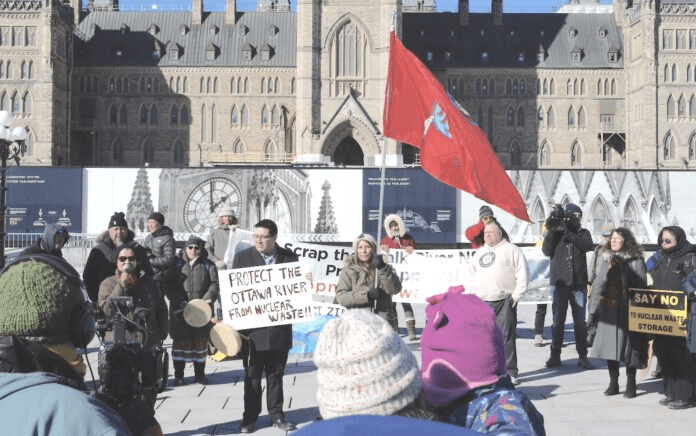
Photo below of Algonquin First Nations members and allies protesting the NSDF on Parliament HIll in February 2024. (photo, North Renfrew Times)
Debunking myths about the Chalk River Mound (aka “NSDF”)

The Chalk River Mound or “near surface disposal facility” is a proposed giant above ground landfill for one million tons of radioactive waste on the property of Canadian Nuclear Labs, less than one kilometre from the Ottawa River upstream of Ottawa-Gatineau and Montreal. We debunk below two of the most misleading myths about the proposed facility. Please contact us if you need more references for the material presented below, or browse our list of all posts for more information.

Myth # 1: It’s only “low level waste”


“Low level” in the context of radioactive waste does not mean “low hazard”

This is a really big mistake that almost everyone makes. “Low level” simply means the wastes can be handled by nuclear industry workers without the use of lead shielding because the wastes give off relatively low levels of gamma radiation. But they can and do contain high levels of other types of radiation such as “alpha” and “beta.”  “Low level” radioactive waste can remain hazardous for hundreds of thousands of years and includes some of the most toxic radioactive poisons known such as plutonium.

No “Intermediate waste” in the NSDF is a red herring.
Neither “Low level” OR “Intermediate level” radioactive wastes are supposed to be disposed of in above-ground engineered mounds (landfills) according to the International Atomic Energy Agency. That is because both categories are dangerous and pose risks to all life on earth for the duration of their radiological hazard, which is hundreds of thousands of years for BOTH CATEGORIES of waste.  The main thing that distinguishes “Low level” from “intermediate level” radioactive waste is that “low level” can be handled without shielding or robots because its risks come from inhalation or ingestion. “Intermediate level” waste on the other hand gives off strong gamma radiation and therefore requires lead shielding and/or remote handling.

Much of the legacy waste at the Chalk River site is a poorly characterized or uncharacterized MIXTURE of “low” and “intermediate” level wastes.
The dividing lines between the categories are blurry. There are many different definitions around the world. Canada’s definitions are inferior to those in other countries. The wastes are not all sitting around in nice neat packages labelled “low level” and “intermediate level”. It would be the work of decades to properly categorize, package and label all the legacy wastes, and arguably, this should be done before choosing technologies for managing the wastes. We are in touch with a former engineer at AECL who was in charge of waste characterization for decades and worked as a consultant for the IAEA. He says the knowledge level of legacy wastes at Chalk River was and likely still is “abysmal”.

The proponent is playing games with Waste Acceptance Criteria to enable maximum disposal of legacy wastes in the NSDF
Definitions are being finagled to enable claims that “only” low-level wastes would go in the facility.  Canada’s nuclear regulator, the Canadian Nuclear Safety Commission, allows proponents to make up their own definitions of waste classes.  The NSDF proponent defines wastes with long-lived beta/gamma activity as high as ten thousand radioactive disintegrations per second per gram of waste (Bq/g) as “low level”.  Finland puts any waste with activity greater than one hundred Bq/g in an underground facility, 65-90 meters deep in crystalline rock.5.

The proponent’s contract with Atomic Energy of Canada states that it will dispose of ALL wastes quickly and cheaply.
The main objective of the GoCo contract was to reduce Canada’s legacy radioactive waste liabilities. The ONLY strategies being advanced by the consortium are the above ground engineered mound (landfill) and in-situ burial of reactors on the Ottawa and Winnipeg rivers.  Thus, the contract provides a strong incentive for the consortium to dispose of uncharacterized legacy wastes in the NSDF since it’s the only project on the table.

Myth #2: It’s a “sound project from an engineering point of view.”

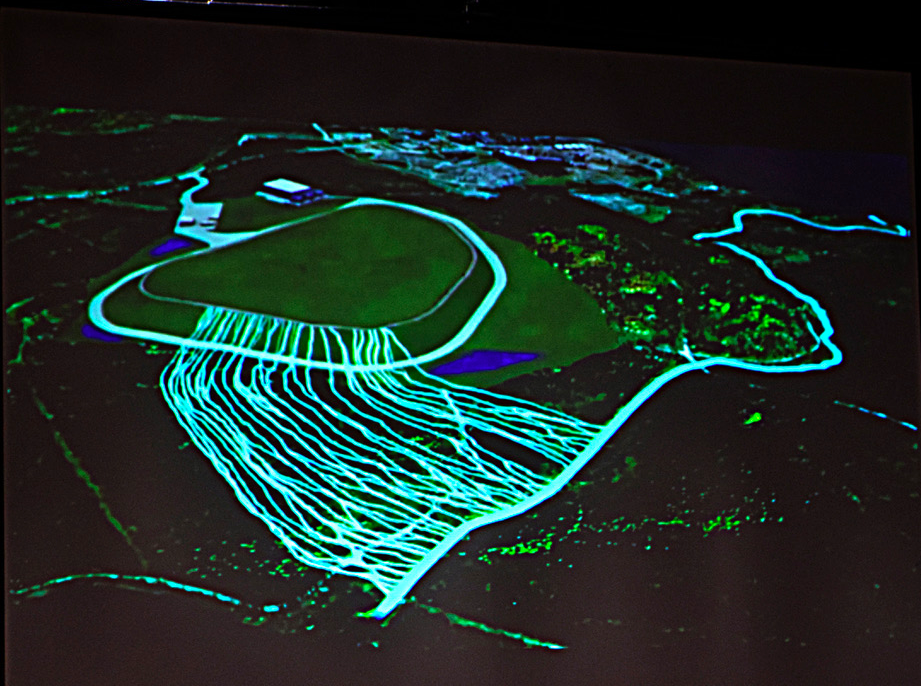
The engineered containment mound is expected to disintegrate within a few hundred years and the contents flow out of the mound into the surrounding wetlands that drain into the Ottawa River. The NSDF draft environmental impact statement includes 25 occurrences of the phrase “liner and cover failure as a result of normal evolution” and three occurrences of the phrase “inevitable failure of the cover.”  The “bathtub scenario” is mentioned 30 times in the draft EIS. It is projected to occur in the year 2400 when the cover fails, water enters the mound and overflows, and takes contaminants into Perch Creek and the Ottawa River. The Performance Assessment for the NSDF includes a graphic illustration of the bathtub scenario, a table listing quantities of radionuclides flowing out of the mound into the Ottawa River, and a pie chart showing estimated doses of various radionuclides to an infant downstream in Pembroke. Given the expected eventual disintegration of the mound and migration of its contents into the Ottawa River, it would seem to be inappropriate to refer to the project as “a sound proposal from an engineering point of view.” 

The image below is a simulation of the “bathtub effect” from the Radio Canada Decouverte documentary “Chalk River Heritage.”

Scientists decry plan for Ontario nuclear-waste site

A warning sign outside of the nuclear reactor at the Atomic Energy Canada Limited plant in Chalk River, Ontario, on December 19, 2007.FRED CHARTRAND/THE CANADIAN PRESS

SHAWN MCCARTHYGLOBAL ENERGY REPORTEROTTAWAINCLUDES CORRECTIONPUBLISHED JUNE 27, 2017UPDATED JUNE 28, 2017 32 COMMENTS

Former AECL scientists are condemning a plan to build a nuclear waste facility at the Chalk River site on the Ottawa River, saying it would be ill-equipped to handle the level of radioactive material planned for it.

The government-owned, private sector-operated Canadian Nuclear Laboratories (CNL) is proposing to build a $325-million facility to dispose of a large quantity of low- and intermediate-level waste generated from the demolition of aging buildings and other contaminated material generated over the past 65 years.

But several former senior scientists who worked there say the CNL proposal is seriously flawed and represents a threat to human health and the environment.

In 2015, the Canadian National Energy Alliance consortium won a contract to manage the Chalk River laboratories. The group includes SNC-Lavalin Group Inc. and U.S. engineering giants, CH2M Hill Inc. and Fluor Corp.

The former Conservative government split up the country’s nuclear flagship, Atomic Energy of Canada Ltd., selling its commercial business to SNC-Lavalin and retaining its research operations, including Chalk River, in CNL.

Ottawa is financing a $1.2-billion, 10-year effort to transform the aging Chalk River site, where the Candu reactor was developed. CNL is constructing some new facilities and demolishing older buildings. The company is also managing the site’s longer-term decommissioning.

The Canadian Nuclear Safety Commission (CNSC) is currently reviewing CNL’s plan for the nuclear waste disposal facility that would be a five-storey-high, dome-like structure and would hold one million cubic metres of low- and intermediate-level radioactive waste. The material is generated and stored on site, and the new facility is meant to provide permanent disposal.

David Winfield, a former senior scientist in safety management at AECL, said international standards suggest permanent disposal of intermediate-level radioactive waste should be done in vaults built deep underground in impermeable rock.

“The proposed design seems not to be appropriate to handle that level of waste,” Mr. Winfield said in an interview Tuesday. In addition to his role at AECL, Mr. Winfield has done consulting work on safety issues for the International Atomic Energy Agency.

He also worries CNL is locating the disposal facility in a swampy area of the sprawling Chalk River site, which could cause material to leach from it.

STORY CONTINUES BELOW ADVERTISEMENT

Another former AECL senior scientist, William Turner, said the new management appears to be rushing the plan in order to have it operational by 2020, and worries they are driven by financial considerations, including performance bonuses. “If this isn’t done right, they will walk away with pockets full of money and Canadians will be left with an enormous bill,” Mr. Turner said in an interview.

In a submission to the regulator last month, a former AECL director of safety engineering and licensing said CNL’s proposal “employs inadequate technology and is problematically located.”

“The proposal does not meet regulatory requirements with respect to the health and safety of persons and the protection of the environment,” Dr. J.R. Walker said in a lengthy critique of the plan.

CNL president Mark Lesinski defended the company’s proposal, saying the near-surface facility will provide “safe and permanent disposal” of radioactive materials.

In a statement provided to The Globe and Mail, Mr. Lesinski said the company carried out extensive geotechnical and hydro-geological tests to ensure the location was the best place to put it.

The site will primarily contain low-level radioactive waste – which requires no shielding for exposure – while more dangerous intermediate-level waste will represent no more than 1 per cent of the total material, he said.

“As proponent/licensee, CNL must demonstrate to the regulator (CNSC) that inclusion of these limited quantities of [intermediate level waste] is safe,” Mr. Lesinski said.Editor’s note: An early version of this article incorrectly identified Dr. J.R. Walker as Dr. Robert Walker.