Author: hendricksonjones
Six reasons to STOP the Ottawa River radioactive waste dump
March 22, 2021

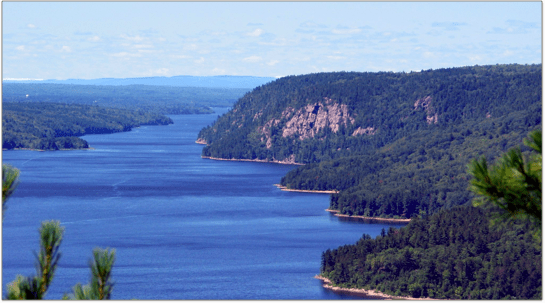
The Ottawa River is a Canadian Heritage River that flows past Parliament Hill. It has untold value as a beautiful natural and historical treasure. The river is sacred for the Algonquin People whose traditional territory it defines.
The Ottawa River is threatened by a giant landfill for one million tonnes of radioactive and other hazardous waste. A multinational consortium (SNC-Lavalin, Fluor and Jacobs) plans to build the seven-story mound on the grounds of the Chalk River Laboratories, northwest of Ottawa, directly across the Ottawa River from the province of Quebec.
Independent scientists and the public have not had a formal opportunity to comment on this project since August 2017 when hundreds of critical comments were submitted to the Canadian Nuclear Safety Commission. CNSC is the sole decision maker about wether or not to license the dump. An Expert Panel recommended in 2017 that the CNSC not be in charge of environmental assessment for nuclear projects. The panel also noted that the CNSC is widely perceived to be a captured regulator.
The Assembly of First Nations and more than 140 Quebec and Ontario municipalities have passed resolutions opposing the Ottawa River nuclear waste dump.
Here are six reasons to STOP this project:
1. The proposed site is unsuitable for a dump of any kind. The site is less than one kilometre from the Ottawa River which forms the border between Ontario and Quebec. The river is a drinking water source for millions of Canadians. After passing the Chalk River Laboratories, it flows downstream through Ottawa-Gatineau, past Parliament Hill, and on to Montreal. The site is tornado and earthquake prone; the Ottawa River itself is a major fault line. The site is partly surrounded by wetlands and the underlying bedrock is porous and fractured.
2. The mound would contain hundreds of radioactive materials, dozens of hazardous chemicals and tonnes of heavy metals. Radioactive materials destined for the dump include tritium, carbon-14, strontium-90, four types of plutonium (one of the most dangerous radioactive materials if inhaled or ingested), and up to 6.3 tonnes of uranium. Twenty-five out of the 30 radionuclides listed in the reference inventory for the mound are long-lived. This suggests the dump would remain dangerously radioactive for 100,000 years.
The cobalt-60 in the dump would give off so much intense gamma radiation that workers must use lead shielding to avoid dangerous radiation exposures. The International Atomic Energy Agency says high-activity cobalt-60 is “intermediate-level waste” and must be stored underground.
Dioxin, PCBs, asbestos, mercury, up to 13 tonnes of arsenic and hundreds of tonnes of lead would go into the dump. It would also contain thousands of tonnes of copper and iron and 33 tonnes of aluminum, tempting scavengers to dig into the mound after closure.
3. The mound would leak radioactive and hazardous contaminants into the Ottawa River during operation and after closure. Many ways the mound would leak are described in the environmental impact statement. The mound is expected to eventually disintegrate in a process referred to as “normal evolution.”
4. There is no safe level of exposure to the radiation that would leak into the Ottawa River from the Chalk River mound. All of the escaping radioactive materials would increase risks of birth defects, genetic damage, cancer and other chronic diseases. The International Atomic Energy Agency says radioactive wastes must be carefully stored out of the biosphere, not in an above-ground mound.
5. International safety standards do not allow landfills to be used for disposal of “low level” radioactive waste. The International Atomic Energy Agency says that only Very Low Level Radioactive Waste (VLLW) can be put in an above-ground landfill-type facility. Canada would be shirking its international obligations as a member state of the IAEA and a signatory to an international nuclear waste treaty if it allowed this dump to be licensed.
6. The giant Chalk River mound would not reduce Canada’s $8 billion federal radioactive waste liabilities and could in fact increase them. The giant pile of leaking radioactive waste would be difficult to remediate. Remediation costs could exceed those of managing the wastes had they not been put in the mound.
Who will fix Canada’s nuclear governance gaps?: citizens’ groups (Hill Times)
The following letter to the editor was published in the Hill Times, March 3, 2021 (en français ici)
See also “Reforms needed at the Canadian Nuclear Safety Commission” – Hill Times letter to the Editor
Our respective public interest citizens’ groups from Manitoba and Ontario along with colleagues in Quebec submitted Petition 427 to the federal auditor general in June 2019 to flag serious problems in Canada’s nuclear governance regime and recommend solutions. The concerns raised in our petition are shared by many other groups from across Canada.
Our research into nuclear governance was sparked by a desire to understand why and how substandard radioactive waste projects have come to be planned for sites on the Winnipeg and Ottawa Rivers. OECD documents allowed for comparisons between Canada and other OECD countries on many aspects of nuclear governance.
Canada came up short on many metrics. For example, Canada has:
- Weak and outdated primary legislation with purposes that do not explicitly aim to protect the public from the detrimental effects of ionizing radiation;
- No legislation dealing with the vast majority (by volume) of nuclear reactor wastes in Canada;
- Delegated almost all nuclear oversight to one agency, the Canadian Nuclear Safety Commission, resulting in a lack of checks and balances found in other OECD countries;
- A serious and ongoing perception of regulatory capture of the Canadian Nuclear Safety Commission, reported by the Expert Panel on environmental assessment reform. The CNSC promotes the projects it is tasked with regulating;
- A serious conflict of interest in the reporting relationship of CNSC to the minister of natural resources, who has a mandate to promote nuclear energy under the Nuclear Energy Act;
- Delegated to a nuclear industry group, the Nuclear Waste Management Organization (NWMO), the job of developing strategies for radioactive waste, counter to guidance from the International Atomic Energy Agency (IAEA);
- A serious policy vacuum on radioactive waste and nuclear reactor decommissioning, currently being addressed but with problems that include leadership by the minister of natural resources who has a conflict of interest as noted above, and delegation to the NWMO, counter to IAEA guidance.
Why does it matter that Canada has one of the least robust systems of nuclear governance in the world? The nuclear business comes with risks of catastrophic accidents and produces dangerous and potentially deadly wastes. There is no safe level of exposure to the radioactive substances produced in nuclear reactors. These materials remain hazardous for many millennia. Robust nuclear governance is needed to protect humans, other life forms, and the environment from these risks.
We believe that Canada’s weak nuclear governance regime is a root cause of the substandard proposals to build a giant radioactive waste mound upstream of Ottawa-Gatineau and to entomb highly radioactive nuclear reactors in concrete beside the Ottawa and Winnipeg Rivers.
In our view, Canada’s weak nuclear governance regime also makes federal funding for new nuclear reactors risky and liable to compound serious existing nuclear waste problems and liabilities in this country.
Remedies are offered for many of these problems in Petition 427, but to our knowledge, no one in government is considering them. A letter sent to Prime Minister Justin Trudeau 11 months ago, on April 3, 2020, requesting urgent attention to these matters and others raised by a recent IAEA peer review of Canada’s nuclear safety framework has gone unanswered. It appears that no one is minding the shop.
It’s a vexing conundrum: in a country with a weak nuclear governance regime consisting of a “one-stop shop,” “captured regulator” that reports to a minister responsible for promoting nuclear energy, who will take responsibility for fixing Canada’s nuclear governance gaps?
Anne Lindsey, OM, MA
Winnipeg, Man., Concerned Citizens of Manitoba
Lynn Jones, MHSc
Ottawa, Ont., Concerned Citizens of Renfrew County and Area
How would the “Near Surface” Disposal Facility leak? Let us count some of the ways
REVISED and UPDATED, February 23, 2021
SEE ALSO: Chalk River Mound (NSDF) would release plutonium to the Ottawa River in “treated effluent”
by Dr. Ole Hendrickson, PhD
Canadian Nuclear Laboratories (CNL) – run by a consortium of profit-making multinational companies – is proposing to build a“Near Surface Disposal Facility” for a million cubic meters of radioactive waste at its Chalk River facility along the Ottawa River. CNL’s final environmental impact statement (EIS) describes several ways that contents of the proposed “engineered containment mound” of radioactive waste could leak into the Ottawa River.
During operation…
1. Wastes being added to the mound would be exposed to the elements.
Rain and melting snow would leach radioactive contents down through the mound. Different radioactive elements would leach at different rates depending on how strongly they were bound to the wastes. Radioactively contaminated leachate would be collected in a system of pipes and pumped uphill to a water treatment plant. Some but not all radioactive contaminants would be removed prior to releasing the treated leachate into adjacent wetlands (for part of the year) or directly into Perch Lake, which drains into the Ottawa River via Perch Creek. Table 3.4.2-2 on page 3-58 of the final EIS shows levels of different radionuclides in leachate that would be discharged from the water treatment plant.
2. Tritium as radioactive water would leach in very large amounts from the mound.
Tritium – a radioactive form of hydrogen with a half-life of 12.3 years – is readily taken up by living organisms and incorporated in body tissues. When tritium decays it emits “beta radiation” damaging to DNA and other cell constituents. Tritium is part of the water molecule and cannot be removed by water treatment. The EIS estimates that the tritium in a liter of leachate would emit 140 thousand beta particles per second. After passing through Perch Lake and Perch Creek, water containing roughly 7 thousand beta particles per liter per second (the current Ontario drinking water standard) would be released into the Ottawa River, be incorporated in fish and other aquatic life, and enter downstream drinking water supplies. Large amounts of tritium would also be released from the mound and Perch Lake as water vapour.
3. Other toxic substances such as PCBs leaching from the mound would be only partially removed by water treatment.
Table 3.4.2-3 on pages 3-59 and 3-6 of the EIS indicate that leachate from the mound would include a very wide range of non-radioactive toxic compounds such as arsenic, mercury, lead, chloroform, ethylene dibromide, PCBs and dioxin. Measurable amounts would be released to the environment.
4. Heavy storm events could erode the mound’s surface and wash toxic substances into low areas.
The EIS proposes an elaborate system of contact water ponds, non-contact water ponds, surface water management ponds, drainage ditches, and culverts. Highly contaminated water washing off active dumping areas would flow into a contact pond and be pumped to the water treatment plant. Water washing off “inactive” areas (but contaminated by dust from active dumping areas) would flow into non-contact water ponds, be pumped to a perimeter ditch and three storm-water management ponds. These ponds would discharge to adjacent wetlands that are already contaminated by existing nearby leaking radioactive waste areas.
5. The capacity of storm-water ponds would be exceeded during extreme rainfall events or snowmelts.
The EIS (page 3-76) says that “when the probable maximum precipitation flow will exceed the surface water management ponds attenuation capacity,” adjacent emergency outlet structures “will be able to convey this flow.”
6. Clearing 34 hectares of mature forest and discharging waste water would impact wetlands.
The existing forest recharges adjacent wetlands. Loss of the forest’s infiltration and recharge capacity would tend to dry out these wetlands and expose their radioactive contents (such as tritium, strontium-90 and carbon-14) to erosion. The EIS notes (page 5-278) that waste water discharge to adjacent wetlands and Perch Lake “may cause changes to water levels, flows, and channel and bank stability, and scouring of the wetland, affecting water quality at downstream locations.”
7. Other possible ways the facility might leak during operations
(not described in detail in the EIS) include pump failures during extreme storm events with loss of electrical power, improper installation of the base liners, puncture of the base liners by heavy or sharp materials, melting of liners by radioactively hot materials, and blockage of the leachate collection system.
After closure…
1. Wastes in the mound would be re-exposed to the elements when the top cover fails.
After waste dumping ended the leachate collection system and water treatment plant would be shut down, and a top cover placed over the wastes. The EIS acknowledges that the top cover would inevitably fail with “normal evolution” through forces such as erosion, extreme storms, burrowing animals, root penetration, etc. It proposes the “conversion of a largely undisturbed, mature forested area to a permanently fenced, turf-grass habitat that is highly modified (i.e., mown, fertilized and maintained as tree-free to avoid the disruption of roots to the cover structure)” (p, 5-509).
2. Failure of the top cover while the more protected base liners remain intact would initiate a “bathtub scenario”.
Rain and melting snow would again leach the radioactive wastes, but the leachate collection and pumping system would no longer be operational. Contaminated leachate would be trapped by the bottom liner and accumulate in the space between the mound and the surrounding berm. Leachate levels would rise and spill over along the low point of the berm. A different scenario involves failure of the bottom liner, releasing leachate into groundwater.
3. Radioactive wastes would flow directly into Perch Creek and the Ottawa River less than 1 kilometer away, essentially forever.
Long-lived radioactive elements such as plutonium and uranium, exposed to wind and water erosion, would flow into the river for thousands to millions of years. Table 5.2.3-8 on page 5-155 of the draft EIS estimated that, under the bathtub scenario, plutonium (Pu) isotopes (Pu-239 and Pu-240) would exit the dump at 21.4 million and 32.4 million Becquerels per year. Eventual failure of the bottom liners would also allow radionuclides to move through groundwater,. These details were removed from the final EIS, but it is clear that the Ottawa River would be permanently contaminated by radioactive waste, and countless generations of people drinking its water would be exposed to increased cancer risks.
What would go into the Chalk River Mound?
December 2020 (last edited Feb 2022)
Canadian taxpayers are paying a consortium (Canadian National Energy Alliance) contracted by the federal government in 2015, billions of dollars to reduce Canada’s $16 billion nuclear liabilities quickly and cheaply. The consortium is proposing to construct a giant mound for one million tons of radioactive waste beside the Ottawa River upstream of Ottawa-Gatineau. The proposed dumpsite is partially surrounded by wetlands that drain into the Ottawa River less than one kilometre away.
There is considerable secrecy about what would go into the mound; the information that follows has been derived from the proponent’s final environmental impact statement (EIS) (December 2020) which lists a partial inventory of radionuclides that would go into the gigantic five-to-seven story radioactive mound (aka the “NSDF”). The EIS and supporting documents also contain inventories of non-radioactive hazardous materials that would go into the dump.
Here is what the consortium says it is planning to put into the Chalk River mound according to the final EIS and supporting documents:
1) Long-lived radioactive materials
Twenty-five out of the 30 radionuclides listed in Table 3.3.1-2: NSDF Reference Inventory and Licensed Inventory are long-lived, with half-lives ranging from four centuries to more than four billion years.
To take just one example, the man-made radionuclide, Neptunium-237, has a half-life of 2 million years such that, after 2 million years have elapsed, half of this radioactive substance will be present, together with its radioactive decay products such as Uranium-233. At the time of closure of the mound, the neptunium-237 will be giving off 17 million radioactive disintegrations each second, second after second.
The mound would contain up to 6 tonnes of Uranium and 6.6 tonnes of thorium-232.
2) Four isotopes of plutonium, one of the most deadly radioactive materials known, if inhaled or ingested.
John Gofman MD, PhD, a Manhattan Project scientist and former director of biomedical research at the DOE’s Lawrence Livermore Laboratory, stated that even one-millionth of a gram of plutonium inhaled into the lung, will cause lung cancer within 20 years. Sir Brian Flowers, author of the UK Royal Commission Report on Nuclear Energy and the Environment, wrote that a few thousands of a gram, inhaled into the lungs, will cause death within a few years because of massive fibrosis of the lungs, and that a few millionths of a gram will cause lung cancer with almost 100% certainty.
The four isotopes of plutonium listed in the NSDF reference inventory are Plutonium-239, Plutonium-240, Plutonium-241 and Plutonium-242. According to Table 3.3.1-2 NSDF Reference Inventory and Licensed Inventory from the EIS, The two isotopes 239 and 240 combined will have an activity of 51 billion Bq when they are emplaced in the dump. This means that they will be giving off 51 billion radioactive disintegrations each second, second after second. These plutonium isotopes could constitute a significant hazard to workers during emplacement of plutonium wastes and plutonium contaminated debris in the mound.
3) Fissionable materials
Fissionable materials can be used to make nuclear weapons.
The mound would contain “special fissionable materials” listed in this table extracted from an EIS supporting document, Waste Acceptance Criteria, Version 4, (November 2020)

4) Large quantities of Cobalt-60
The CNL inventory includes a very large quantity of cobalt-60 (91 quadrillion Becquerels), contained in waste cobalt-60 irradiating devices. Cobalt-60 when concentrated in irradiators gives off so much strong gamma radiation that lead shielding must be used by workers who handle them in order to avoid dangerous radiation exposures. The International Atomic Energy Agency considers high-activity cobalt-60 irradiators to be “intermediate-level waste” and specifies that they must be stored underground. Addition of high-activity cobalt-60 irradiators means that hundreds of tons of lead shielding would be disposed of in the mound.
5) Very Large quantities of tritium
The mound would contain 890 trillion becquerels of tritium, a radioactive form of hydrogen. Tritium readily combines with oxygen to form radioactive water. It moves readily through the environment and easily enters all cells of the human body where it can cause damage to cell structures including genetic material such as DNA and RNA. For more on the hazards of tritium see the Tritium Primer on the TAP website: http://tapcanada.org/wordpress/?page_id=403
Because it is part of the water molecule, removal of tritium from water is very difficult and expensive. There are no plans to remove tritium from the mound leachate. Instead the consortium plans to pipe the contaminated water directly into Perch Lake which drains into the Ottawa River.
6) Carbon-14
The mound would contain close to two trillion becquerels of Carbon-14, an internal emitter that is hazardous in similar ways to tritium. Carbon is a key element in all organic molecules. When it is inhaled or ingested it can become incorporated into organic molecules and cellular components including genetic material.
7) Many other man-made radionuclides
Radionuclides such as caesium-137, strontium-90, radium, technetium, nickel-59, americium-243 are listed in the partial inventory of materials that would go into the dump. See the partial inventory here: https://concernedcitizens.net/2020/12/17/cnls-partial-inventory-of-radionuclides-that-would-go-into-the-chalk-river-mound/
8) Non-radioactive hazardous materials
Hazardous materials destined for the dump include asbestos, PCBs, dioxins, mercury, up to 13 tonnes of arsenic and hundreds of tonnes of lead. (Reference)(Reference for the arsenic quantity is the CPDP)
9) Large quantities of valuable metals that could attract scavengers
According the the final EIS, the mound would contain 33 tonnes of aluminum, 3,520 tonnes of copper, and 10,000 tonnes of iron. It is well known that scavenging of materials occurs after closure of facilities such as the Chalk River mound. Scavengers would be exposed to high radiation doses as they sought to extract these valuable materials from the dump.
10) Organic Materials
80,339 tonnes of wood and other organic material are destined for the mound. These materials would decompose and cause slumping in the mound, therefore potentially compromising the integrity of the cap.
~~~~~~
Most of the radioactive and hazardous material would get into the air and water, some sooner, some later.
Some would get into ground and surface water during creation of the mound, such as tritium which is very mobile and cannot be removed by the proposed water treatment plant. Others would get into the air, during construction and could be breathed by workers. Some materials would leach slowly into groundwater. Still others would be released when the mounds deteriorates over time and eventually disintegrates several hundreds of years into the future. For details on the expected disintegration of the mound in a process described as “normal evolution” see this post: https://concernedcitizens.net/2020/11/04/the-proponents-own-study-shows-that-the-chalk-river-mound-will-disintegrate/
~~~~~~~~
The mound would actually get more radioactive over time
See the submission entitled “A Heap of Trouble” by Dr. Gordon Edwards, president of the Canadian Coalition for Nuclear Responsibility for a chilling description of this process. http://www.ccnr.org/Heap_of_Trouble.pdf. Here is a quote from the submission:
The Near Surface Disposal Facility (NSDF) project is presented not as a temporary, interim
storage facility but as a permanent repository that will ultimately be abandoned. We are
dealing with a potentially infinite time horizon. The proponent seeks approval not just for a
few decades, but forever. Such permission has never before been granted for post-fission
radioactive wastes in Canada, nor should it be granted. Long-lived radioactive waste
should not be abandoned, especially not on the surface beside a major body of water.
“The facility will remain a significant hazard for in excess of 100,000 years.“
This point was raised by Dr. J.R. Walker, a retired AECL senior manager and radioactive waste expert in his submission on the draft environmental impact statement. You can read his full submission here: https://www.ceaa.gc.ca/050/documents/p80122/119034E.pdf
“There is no safe level of exposure to any man-made radioactive material.“
“There is no safe level of exposure to any man-made radioactive material. All discharges, no matter how small, into our air and water can cause cancer and many other diseases as well as genetic damage and birth defects.”
~ Dr. Eric Notebaert, Canadian Association of Physicians for the Environment.
This dump would not not meet international safety standards for radioactive waste management. Details
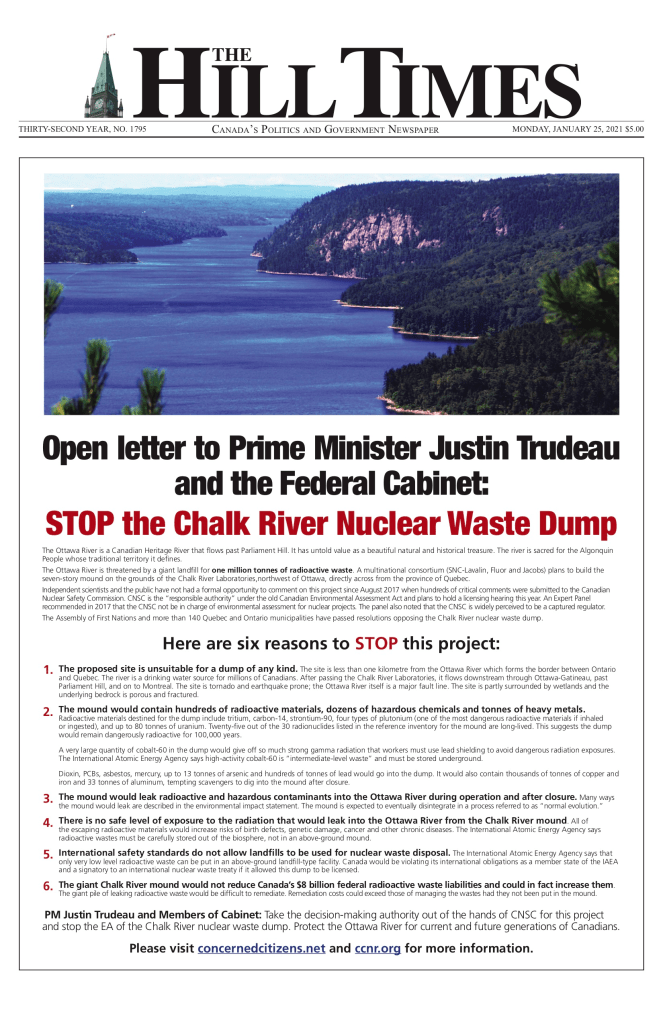
Hill Times Ad ~ Stop the Chalk River nuclear waste dump

LETTRE OUVERTE au premier ministre Justin Trudeau et au Conseil des ministres fédéral ~ ARRÊTEZ le dépotoir radioactif de Chalk River
Le 25 janvier 2021
Monsieur le Premier Ministre et mesdames et messieurs les Membres du Conseil des Ministres,
La rivière des Outaouais est une rivière du patrimoine canadien qui coule au pied de la Colline du Parlement. Sa valeur comme site naturel et comme trésor historique est inestimable. La rivière est sacrée pour le peuple algonquin, dont elle définit le territoire traditionnel.
La rivière des Outaouais est menacée par un dépotoir géant, d’une hauteur de sept étages, conçu pour abriter un million de tonnes de déchets radioactifs. Un consortium multinational (SNC-Lavalin, Fluor et Jacobs) prévoit construire ce monticule sur les terrains des Laboratoires nucléaires canadiens (LNC) près de Chalk River, en Ontario, à 150 km au nord-ouest d’Ottawa.
Les scientifiques indépendants et le public n’ont pas eu d’occasion de s’exprimer officiellement sur le projet depuis août 2017, alors que des centaines de commentaires critiques ont été soumis à la Commission canadienne de sûreté nucléaire (CCSN). La CCSN est l’« autorité responsable» en vertu de l’ancienne Loi canadienne sur l’évaluation environnementale et prévoit tenir une audience sur l’émission d’un permis cette année. Un Comité d’experts recommandait en 2017 que la CCSN ne soit pas chargée de l’évaluation environnementale des projets nucléaires. Le Comité avait aussi noté que la CCSN était largement perçue comme un « régulateur captif » des entreprises plutôt qu’un organisme indépendant.
L’Assemblée des Premières nations et plus de 140 municipalités du Québec et de l’Ontario ont adopté des résolutions s’opposant au dépotoir nucléaire de Chalk River.
Voici six raisons d’ARRÊTER ce projet:
1. Le site proposé est tout simplement inapte à recevoir un dépotoir, de quelque type qu’il soit. Le site est à moins d’un kilomètre de la rivière des Outaouais, qui forme la frontière entre l’Ontario et le Québec. La rivière fournit l’eau potable à des millions de Canadiens. Après avoir passé les LNC, elle coule entre Ottawa et Gatineau, au pied de la colline du Parlement, puis jusqu’à Montréal. Le site est exposé aux risques de tornades et de tremblements de terre; la rivière des Outaouais constitue d’ailleurs une ligne de faille géologique majeure. Le site est partiellement entouré de milieux humides et le substrat rocheux est poreux et fracturé.
2. Le monticule prévu contiendrait des centaines de matériaux radioactifs, des douzaines de produits chimiques dangereux et des tonnes de métaux lourds. Parmi les matériaux radioactifs destinés au monticule, on trouve du tritium, du carbone 14, du strontium 90, quatre types de plutonium (un des matériaux radioactifs les plus dangereux lorsqu’inhalé ou ingéré), et jusqu’à 80 tonnes d’uranium. Vingt-cinq des 30 radionucléides cités dans l’inventaire de radionucléides pour le monticule ont une longue durée de vie. Ces renseignements donnent à penser que le dépotoir demeurerait dangereusement radioactif pour quelque 100 000 ans.
La très grande quantité de cobalt 60 dans le dépotoir émettrait tellement de radiation gamma que les travailleurs devraient utiliser un blindage en plomb pour éviter une exposition dangereuse. L’Agence internationale de l’énergie atomique (AIEA) considère le cobalt 60 à haute activité comme un « déchet de moyenne activité », qui doit être stocké en profondeur.
Le dépotoir recevrait aussi des dioxines, des BPC, de l’amiante, du mercure, jusqu’à 13 tonnes d’arsenic et des centaines de tonnes de plomb. Il contiendrait aussi des milliers de tonnes de cuivre, de fer et 33 tonnes d’aluminium, des métaux qui pourront amener des voleurs à creuser dans le monticule après la fermeture du site.
3. Le monticule laisserait s’écouler des matériaux radioactifs et dangereux dans la rivière des Outaouais durant son opération et après sa fermeture. L’énoncé des incidences environnementales décrit plusieurs des façons dont le monticule pourrait laisser fuir son contenu. On prévoit que le monticule se désintégrera avec le temps, un processus qualifié d’« évolution normale ».
4. Il n’existe pas de niveau sécuritaire d’exposition aux radiations qui s’écouleraient du monticule de Chalk River dans la rivière des Outaouais. Chacun des matériaux radioactifs qui s’échapperait du site augmenterait les risques de malformations congénitales, d’altérations génétiques, de cancer et d’autres maladies chroniques. L’AIEA considère que les déchets radioactifs doivent être soigneusement stockés à l’écart de la biosphère et non dans un monticule en surface.
5. Les normes internationales de sécurité n’autorisent pas l’utilisation de dépotoirs pour disposer des déchets radioactifs. L’AIEA considère que seuls des déchets de très faible activité peuvent être placés dans une installation en surface, comme un dépotoir. Le Canada se déroberait à ses obligations internationales comme État membre de l’AIEA et signataire d’un traité international sur les déchets nucléaires s’il autorisait ce dépotoir à obtenir sa licence.
6. Le monticule géant de Chalk River ne réduirait pas la responsabilité légale du Canada face aux déchets nucléaires, qui s’élève déjà à 8 milliards de dollars. Il pourrait au contraire l’alourdir. La remise en état de cette colline de déchets radioactifs serait très difficile. Les coûts d’assainissement pourraient dépasser ceux de la gestion des déchets s’ils n’avaient pas été mis dans le monticule.
Monsieur le Premier Ministre et mesdames et messieurs les Membres du Conseil des Ministres: Retirez à la CCSN le pouvoir de décision en cette matière et arrêtez le dépotoir nucléaire de Chalk River. Protégez la rivière des Outaouais pour les générations actuelles et futures de Canadiens.
Veuillez recevoir l’expression de nos sentiments les plus sincères,
Gordon Edwards, Regroupement pour la surveillance du nucléaire, Montréal, QC
Éric Notebaert, Association canadienne des médecins pour l’environnement, Montréal, QC
Réal Lalande, Action Climat Outaouais, Gatineau, QC
Paul Johannis, L’Alliance pour les espaces verts de la capitale du Canada, Ottawa, ON
Lynn Jones, Concerned Citizens of Renfrew County and Area, Ottawa, ON
Johanna Echlin, Old Fort William (Quebec) Cottagers’ Association, Sheenboro, QC
Robb Barnes, Écologie Ottawa, Ottawa, ON
Beatrice Olivastri, Les ami(e)s de la terre Canada, Ottawa, ON
Ole Hendrickson, Ottawa River Institute, Ottawa, ON
Eva Schacherl, Coalition Against Nuclear Dumps on the Ottawa River, Ottawa, ON
CC:
Hon. Erin O’Toole, Chef de l’opposition
Yves-François Blanchet, chef du Bloc québécois
Jagmeet Singh, Chef du Nouveau Parti démocratique
Annamie Paul, Chef du Parti vert du Canada
To Prime Minister Trudeau and members of the federal cabinet ~ Stop the Ottawa River radioactive waste dump
January 25, 2021
Dear Mr. Trudeau and members of the federal cabinet:
The Ottawa River is a Canadian Heritage River that flows past Parliament Hill. It has untold value as a beautiful natural and historical treasure. The river is sacred for the Algonquin People whose traditional territory it defines.
The Ottawa River is threatened by a giant landfill for one million tonnes of radioactive and other hazardous waste. A multinational consortium (SNC-Lavalin, Fluor and Jacobs) plans to build the seven-story mound on the grounds of the Chalk River Laboratories, northwest of Ottawa, directly across the Ottawa River from the province of Quebec.
Independent scientists and the public have not had a formal opportunity to comment on this project since August 2017 when hundreds of critical comments were submitted to the Canadian Nuclear Safety Commission. CNSC is the “responsible authority” under the old Canadian Environmental Assessment Act and plans to hold a licensing hearing this year. An Expert Panel recommended in 2017 that the CNSC not be in charge of environmental assessment for nuclear projects. The panel also noted that the CNSC is widely perceived to be a captured regulator.
The Assembly of First Nations and more than 140 Quebec and Ontario municipalities have passed resolutions opposing the Ottawa River nuclear waste dump.
Here are six reasons to STOP this project:
1. The proposed site is unsuitable for a dump of any kind. The site is less than one kilometre from the Ottawa River which forms the border between Ontario and Quebec. The river is a drinking water source for millions of Canadians. After passing the Chalk River Laboratories, it flows downstream through Ottawa-Gatineau, past Parliament Hill, and on to Montreal. The site is tornado and earthquake prone; the Ottawa River itself is a major fault line. The site is partly surrounded by wetlands and the underlying bedrock is porous and fractured.
2. The mound would contain hundreds of radioactive materials, dozens of hazardous chemicals and tonnes of heavy metals. Radioactive materials destined for the dump include tritium, carbon-14, strontium-90, four types of plutonium (one of the most dangerous radioactive materials if inhaled or ingested), and up to 80 tonnes of uranium. Twenty-five out of the 30 radionuclides listed in the reference inventory for the mound are long-lived. This suggests the dump would remain dangerously radioactive for 100,000 years.
A very large quantity of cobalt-60 in the dump would give off so much intense gamma radiation that workers must use lead shielding to avoid dangerous radiation exposures. The International Atomic Energy Agency says high-activity cobalt-60 is “intermediate-level waste” and must be stored underground.
Dioxin, PCBs, asbestos, mercury, up to 13 tonnes of arsenic and hundreds of tonnes of lead would go into the dump. It would also contain thousands of tonnes of copper and iron and 33 tonnes of aluminum, tempting scavengers to dig into the mound after closure.
3. The mound would leak radioactive and hazardous contaminants into the Ottawa River during operation and after closure. Many ways the mound would leak are described in the environmental impact statement. The mound is expected to eventually disintegrate in a process referred to as “normal evolution.”
4. There is no safe level of exposure to the radiation that would leak into the Ottawa River from the Chalk River mound. All of the escaping radioactive materials would increase risks of birth defects, genetic damage, cancer and other chronic diseases. The International Atomic Energy Agency says radioactive wastes must be carefully stored out of the biosphere, not in an above-ground mound.
5.
5. International safety standards do not allow landfills to be used for disposal of “low level” radioactive waste. The International Atomic Energy Agency says that only Very Low Level Radioactive Waste (VLLW) can be put in an above-ground landfill-type facility. Canada would be shirking its international obligations as a member state of the IAEA and a signatory to an international nuclear waste treaty if it allowed this dump to be licensed.
The International Atomic Energy Agency says that only Very Low Level Radioactive Waste (VLLW) can be put in an above-ground landfill-type facility. Canada would be shirking its international obligations as a member state of the IAEA and a signatory to an international nuclear waste treaty if it allowed this dump to be licensed.
6. The giant Chalk River mound would not reduce Canada’s $8 billion federal radioactive waste liabilities and could in fact increase them. The giant pile of leaking radioactive waste would be difficult to remediate. Remediation costs could exceed those of managing the wastes had they not been put in the mound.
Prime Minister Trudeau and Members of Cabinet, we urge you to take the decision-making authority out of the hands of CNSC for this project and stop the Chalk River nuclear waste dump. Protect the Ottawa River for current and future generations of Canadians.
Yours sincerely,
Gordon Edwards, Canadian Coalition for Nuclear Responsibility, Montreal, QC
Éric Notebaert, Canadian Association of Physicians for the Environment, Montreal, QC
Réal Lalande, Action Climat Outaouais, Gatineau, QC
Paul Johannis, Greenspace Alliance of Canada’s Capital, Ottawa, ON
Lynn Jones, Concerned Citizens of Renfrew County and Area, Ottawa, ON
Johanna Echlin, Old Fort William (Quebec) Cottagers’ Association, Sheenboro, QC
Robb Barnes, Ecology Ottawa, Ottawa, ON
Beatrice Olivastri, Friends of the Earth Canada, Ottawa, ON
Ole Hendrickson, Ottawa River Institute, Ottawa, ON
Eva Schacherl, Coalition Against Nuclear Dumps on the Ottawa River, Ottawa, ON
CC
Hon. Erin O’Toole, Leader of the Official Opposition
Yves-François Blanchet, Leader of the Bloc Québécois
Jagmeet Singh, Leader of the New Democratic Party of Canada
Annamie Paul, Leader of the Green Party of Canada

Groups oppose plans to abandon defunct nuclear reactors and radioactive waste ~ Rabble.ca
Please chip in to support more articles like this. Support rabble.ca for as little as $5 per month!
Ole HendricksonFebruary 3, 2021ENVIRONMENT

The Canadian Nuclear Safety Commission (CNSC) has just given a green light to the preferred industry solution for disposal of nuclear reactors — entomb and abandon them in place, also known as “in-situ decommissioning.” This paves the way for the introduction of a new generation of “small modular” nuclear reactors or SMRs.
SMRs bring many challenges, including safety of untested designs, nuclear weapons proliferation risks, high costs, disposal of radioactive waste, and public acceptance. Groups concerned about nuclear safety are objecting to plans in the works to abandon these nuclear reactors and the radioactive waste they produce once they are shut down.
Over 100 Indigenous and civil society groups have signed a public statement opposing SMR funding, noting that the federal government currently has no detailed policy or strategy for what to do with radioactive waste. Many of these groups are also participating in a federal radioactive waste policy review launched in November 2020.
The Assembly of First Nations passed resolution 62/2018 demanding that the nuclear industry abandon plans for SMRs and that the federal government cease funding them. It calls for free, prior and informed consent “to ensure that no storage or disposal of hazardous materials shall take place in First Nations lands and territories.”
SMR waste includes not only reactor fuel but also the reactors themselves.
An SMR emits no radiation before start-up (other than from uranium fuel) and could easily be transported at that stage. But during reactor operation, metal and concrete components absorb neutrons from the splitting of uranium atoms — and in the process, transform into radioactive waste. Removing an SMR after shut-down would be difficult and costly, and comes with the need to shield workers and the public from its radioactivity.
Abandoning nuclear reactors on site has been in the works for some time. CNSC helped draft a 2014 nuclear industry standard with in-situ decommissioning as an option and then included it in a July 2019 draft regulatory document.
However, when the International Atomic Energy Agency (IAEA) released a peer-reviewed report on Canada’s nuclear safety framework last February, it said in-situ decommissioning is “not consistent” with IAEA safety standards.
The IAEA suggested that CNSC “consider revising its current and planned requirements in the area of decommissioning to align with the IAEA guidance that entombment is not considered an acceptable strategy for planned decommissioning of existing [nuclear power plants] and future nuclear facilities.” It also noted that CNSC is reviewing license applications for in-situ decommissioning of shut-down federal reactors in Ontario and Manitoba, and encouraged Canada “to request an international peer review of the proposed strategy” for legacy reactors.
But CNSC continued to pursue this strategy. Clever language in a June 2020 document appeared to rule out on-site reactor disposal, but left the door open where removal is not “practicable”:
“In-situ decommissioning shall not be considered a reasonable decommissioning option for planned decommissioning of existing nuclear power plants or for future nuclear facilities in situations where removal is possible and practicable.”
At public meeting last June, CNSC Commissioner Sandor Demeter asked: “why are future facilities in this sentence when in fact we should be designing them so that in-situ decommissioning is not the option?” Former CNSC staff member Karine Glenn replied that “leaving some small parts of a structure behind…especially if you are in a very, very remote area, may be something that could be considered.”
Glenn is now with the industry-run Nuclear Waste Management Organization, tasked with leading the development of a radioactive waste management strategy for Canada.
Commissioners decided to approve the regulatory document, but with added text to clarify where in-situ decommissioning would be acceptable. They asked for additional text on “legacy sites” and “research reactors,” stating that “[t]he Commission need not see this added text if it aligns with the oral submissions staff made in the public meeting.”
But no new clarifying text was added to the final version of the document published on January 29, 2021. It enables abandonment of SMRs — by retaining the reference to future nuclear facilities — and of “research and demonstration facilities, locations or sites dating back to the birth of nuclear technologies in Canada for which decommissioning was not planned as part of the design.”
The CNSC seems willing to ignore international safety standards — and a decision of its own commission — to accommodate nuclear industry proponents of SMRs and allow radioactive waste to be abandoned in place.
Meanwhile, the federal government has assigned the nuclear industry itself — via the Nuclear Waste Management Organization — the task of developing a radioactive waste strategy for Canada. Barring public outcry, that strategy will be abandonment.
Ole Hendrickson is a retired forest ecologist and a founding member of the Ottawa River Institute, a non-profit charitable organization based in the Ottawa Valley.
Presentation – Update on Chalk River radioactive waste disposal -BCI Jan. 2021
This presentation was given at the AGM of Biodiversity Conservancy International, January 14, 2021

This slide from the presentation shows Chalk River Labs in 1948. The original 10 megawatt version of the NRX reactor had been completed a year earlier, in July 1947. Plutonium was extracted from uranium irradiated in the NRX and shipped to the U.S. to make nuclear weapons. Later, irradiated targets containing plutonium were shipped to the U.S, for processing there. This continued until the mid-1960s.
Natural Resources Canada estimates that over half the nuclear wastes at Chalk River – including contaminated buildings, buried wastes, and contaminated lands – came from Cold War weapons-related activities.